This is an open access journal, and articles are distributed under the terms of the Creative Commons Attribution-Non Commercial-ShareAlike 4.0 License, which allows others to remix, tweak, and build upon the work non-commercially, as long as appropriate credit is given and the new creations are licensed under the identical terms.
© 2019 Journal of Advanced Pharmacy Education & Research | Published by SPER Publication
53
An economic evaluation of diabetes mellitus management in
South East Asia
Akhmad Priyadi
1,2, Ahmad Muhtadi
1, Auliya A. Suwantika
1,3*, Sri Adi Sumiwi
11Department of Pharmacology and Clinical Pharmacy, Faculty of Pharmacy, Universitas Padjadjaran, Jl. Bandung Sumedang KM. 21, Sumedang, Indonesia, 45363. 2Bandung School of Pharmacy, Indonesia. 3 Center of Excellence in Higher Education for Pharmaceutical Care Innovation, Universitas Padjadjaran, Indonesia.
Correspondence:
Auliya A. Suwantika. Faculty of Pharmacy, Universitas Padjadjaran, Jl. Bandung Sumedang KM. 21, Sumedang, Indonesia, 45363. E-mail:ABSTRACT
Background: In 2014, it was estimated that there were 422 million adults living with diabetes while there were 108 million ones in
1980. Since, 1980, the prevalence (age-standardized) of diabetes has almost doubled globally, increasing from 4.7% to 8.5% in the
adult population. Diabetes caused 1.5 million death in 2012. According to WHO, in 2013, one of the world's most significant health
expenditure was diabetes mellitus, about 612 billion dollars, or about 11% of the total direct health expenditure in the world. In
2014, there were 96 million adults with diabetes in 11 countries in the South East Asia region, with the prevalence of diabetes among
adult patients increasing from 4.1% in 1980's to 8.6% in 2014.
Objective:The aim of the study was to identify and review the
original articles which evaluated the economic impact of diabetes mellitus management in South East Asia. Method:
PubMed and
ProQuest database were reviewed to identify the economic evaluation of DMT2 management in South East Asia. The inclusion
criteria used in this study were all the original research articles published between 2005 and 2014 on the economic evaluation of
DMT2 management in South East Asia, using cost-minimization analysis, cost-benefit analysis, cost-effectiveness analysis, as well as
cost-utility analysis. The articles were assessed using the checklist of the Consolidated Health Economic Evaluation Reporting
Standards (CHEERS). Result: 15 articles were potentially related to this study. The evaluation of the economic impact of DMT2
management in South East Asia included the cost, medical and non-medical cost-effectiveness, assessment and acceptance from the
community. The uses of DMT2 single-drug or combination drugs could be used as a strategy to treat or reduce DMT2 disease and
avoid complications caused by this disease, by providing better cost-effectiveness. The diabetic patients were expected to become
more frequently disciplined in medical use and also in purchase of drugs. Quality-adjusted life year (QALY) was the main outcome to
appraise the effectiveness of these studies. Incremental cost-effectiveness ratio (ICER) was computed in the range from $93,896.52 to
$110,713.08 per QALY.
Conclusion: Early DMT2 drugs treatment was a cost-effective alternative in the Southeast Asian
countries. Complications have had a significant impact on the costs of managing type 2 diabetes mellitus. The prevention of diabetic
complications would not only benefit the patients but potentially reduce the overall healthcare expenditure.
Keywords
:
Economic Evaluation, DMT2, South East Asia.
Introduction
Diabetes Mellitus is a group of metabolic disorders
characterized by increased blood glucose concentration. Type
1 diabetes known as insulin-dependent or childhood-onset
diabetes is characterized by deficient insulin production in the
body. Meanwhile, Type 2 diabetes is known as non-insulin
dependent
[1]. Type 2 diabetes is often less marked, and as a
result, it may be diagnosed several years after onset when the
complications have already arose
[2]. It Is generally associated
with numbers of long-term severe complications which are a
major cause of morbidity, hospitalization, and mortality for
diabetic patients
[3]. Both the economic expenditure for
healthcare systems and the patients’ risk for disability, death,
and decreased quality of life are essentially enhanced by these
complications
[4]. Due to the direct medical costs and loss of
work and wages which are the consequences of diabetes and
its complications, people with diabetes and their families and
Access this article onlineWebsite: www.japer.in E-ISSN: 2249-3379
also health systems and national economies have to deal with
the remarkable economic loss
[1].
Globally, the prevalence of diabetes among adults has risen
from 108 million people in 1980 to 422 million people in
2014. The most remarkable rises have been observed in East
Asia and South Asia; and in 2014, the highest number of
people with diabetes were found to be in these areas; 106
million and 86 million; respectively
[5]. The global prevalence
of this disease was estimated to be 151 million in 2000, 194
million in 2003, 246 million in 2006, 285 million in 2009,
366 million in 2011 and 382 million in 2013 by the
International Diabetes Federation (IDF). The global diabetes
prevalence in adult aged 20-79 years was estimated to be
8.8% of the total world population in 2015 including 415
million
[6]. Western Pacific Region included the highest
number of people with diabetes (153.2 million). And, more
than half (56%) of all people with diabetes were found to be
living the South East Asia Region or Western Pacific Region
[6]
.
The high incidence of diabetes has been observed particularly
in Southeast Asia’s four most populous countries - Indonesia,
Philippines, Thailand, and Vietnam- which collectively have
over 500 million people. Indonesia alone has over 10 million
diabetic patients, according to the data from the International
Diabetes Federation (IDF). In Thailand, 4 million people
reportedly had diabetes in 2015. In the same year, in
Philippines and Vietnam, 3.5 million people were reported to
have diabetes mellitus
[5].
The region with the highest proportion of death from diabetes
was the Western Pacific Region, about 16% of all cause of
mortality in the region, and 75.5% of all diabetes death
occurred in people aged up to 69 years. In low-income
countries, diabetes deaths were in people under the age of 60,
whereas this portion in high-income country was 29.6%
[6].
South East Asia was the second highest number of deaths in
2015 after the western Pacific region, with 1.2 million of
deaths (IDF).
Diabetes imposes a significant economic burden on the global
health-care system. This burden can be measured through
direct medical cost, indirect medical cost associated with
productivity loss, premature mortality and negative impact
on the national gross domestic product (GDP)
[1]. Direct
medical cost associated with diabetes include expenditure for
preventing and treating diabetes and its complications. These
costs include inpatient hospital cares, outpatient and
emergency cares, medication and medical supplies, and
long-term care
[1, 7]. According to NCD-RisC report in 2016, the
direct cost of diabetes was over $825 billion per year on the
global economy
[5]. There are also some indirect costs related
to diabetes which include health-related days absence from
work and normal activities, free time loss, lost earning
capacity from permanent disability and lost productivity from
premature mortality. It also comprises of care in nursing
home and informal care
[7].
Health expenditure at a total of USD 7.3 billion to USD12.4
in 2015, which amounted to 12% of the health budget of the
region. In comparison with the other IDF regions, the lowest
health expenditure was spent per person with diabetes
(USD93 to USD158) in the Southeast Asia Region. In 2017,
it was shown that the average cost per person with diabetes
who lived in southeast Asia was accrued to be USD115.92. In
the meantime, in North America and the Carribean, diabetes
cost per person stood over USD8000 (www.statista.com).
Researches on the cost-effectiveness has been done in several
South East Asian countries. To obtain comprehensive
information about the economic evaluation, community
acceptance, and willingness to pay any intervention on
diabetes mellitus management, a systematic review has been
done. The result of this systematic review has been expected
to be used as a consideration of diabetes mellitus program
policy in South East Asia.
Objective
This study aimed to identify and review the original articles
which evaluated the economic impact of diabetes mellitus
management in South East Asia
Methods
Search Study
For finding the relevant studies for this review, a three-stage
process was used to search through the titles and abstracts. At
the first stage, the studies were chosen based on the abstracts
and titles. Irrelevant titles, abstracts only papers and
duplicates were rejected clearly. In the second stage, the
results were cross-checked, and their results and retained
candidate studies were collected for full paper screening.
Finally, the full papers of the studies were read thoroughly.
Studies about the economic evaluation of diabetes mellitus in
South East Asia were searched in PubMed and ProQuest. The
terms used for this review search were: “economic evaluation
(cost minimization, cost-benefit, cost effectiveness and cost
utility),” and “diabetes mellitus management in South East
Asia”. The data was obtained online and filtered based on the
inclusion and exclusion criteria. The inclusion criteria were
all sources published between 2005 – 2014 in full text which
were primarily written in English.
Inclusion criteria
(Disability Adjusted Life Years), cost per diabetes cases, and
other related outcomes. And finally, (vi) Studies should have
been published between January 2005 and December 2014.
Data Extraction
Data extraction using a standardized data extraction form was
done according to the Consolidated Health Economic
Evaluation Statement (CHEERS)
[8]. The kind of economic
evaluation, the subjects’ features, the intervention details, the
comparator, the analytical model which was used, the
effectiveness data, the sensitivity analysis, and the reported
results related to the review were all included in the obtained
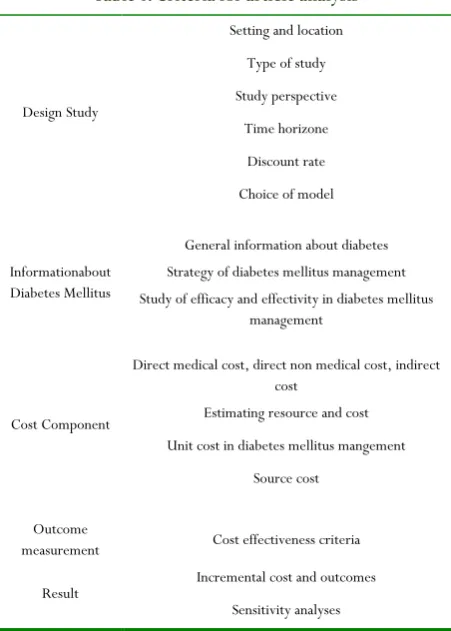
data. The extracted fields have been represented in Table 1.
Table 1. Criteria for article analysis
Design Study
Setting and location Type of study
Study perspective Time horizone
Discount rate
Choice of model
Informationabout Diabetes Mellitus
General information about diabetes Strategy of diabetes mellitus management Study of efficacy and effectivity in diabetes mellitus
management
Cost Component
Direct medical cost, direct non medical cost, indirect cost
Estimating resource and cost Unit cost in diabetes mellitus mangement
Source cost
Outcome
measurement Cost effectiveness criteria
Result Incremental cost and outcomes Sensitivity analyses
Result
A comprehensive review of the related literature found
original articles about the economic impact or economic
evaluation and community acceptance, and the willingness to
pay for any intervention in diabetes mellitus in the South East
Asia region. Articles with predefined keywords were added
with country names, namely Brunei, Myanmar, Cambodia,
Timor Leste, Indonesia, Laos, Malaysia, Philippines,
Singapore, Thailand, and Vietnam. Articles obtained
complied with the inclusion criteria of the PubMed and
ProQuest. All of them met the study criteria and were
included in the systematic review. Data from the selected
articles have been presented in figure 1.
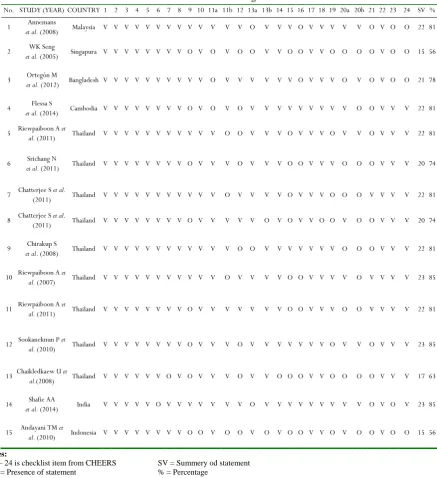
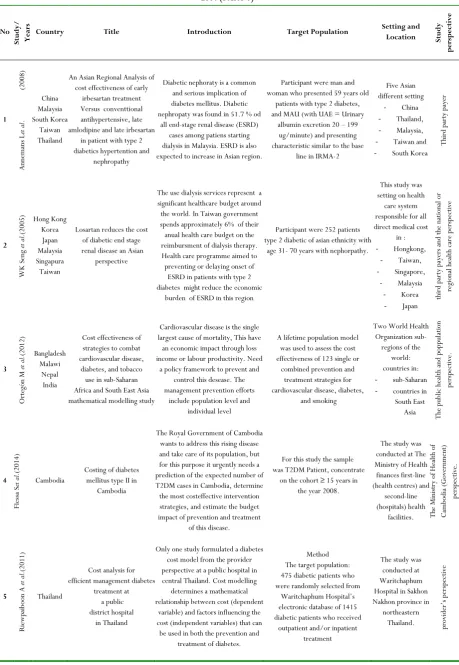
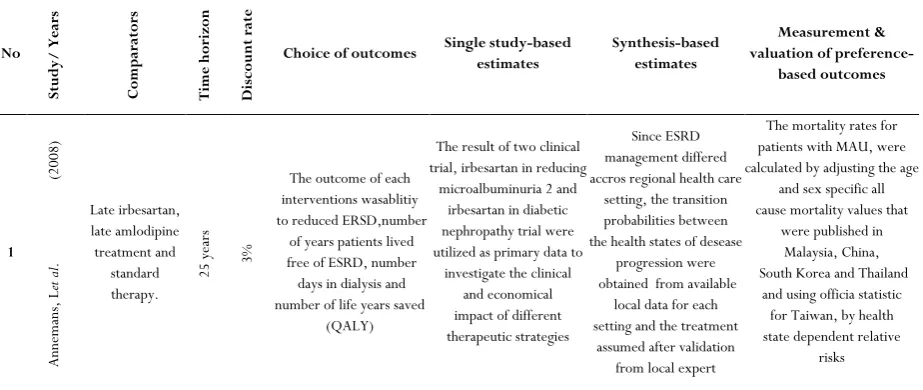
The results of the article screening were fifteen articles that
satisfied the criteria which were relevant to the economic
evaluation of diabetes mellitus. The articles were reviewed
using CHEERS checklist covering the method (the study
design) and the research results. The results of the review of
the fifteen articles can be seen in Table 2 and Table 3.
The review yielded four studies that assessed the
cost-effectiveness of oral antidiabetic drugs by different
interventions.
The intervention included in this reviewed varied from
preventing to treatment issues. The study in Waritchaphum
Hospital with 30 beds found that the average public treatment
cost per patient per year was 94.71 USD in 2008. Drug cost
(25% of total cost), inpatient cost (24%), and outpatient visit
cost (17%) were respectively the highest expenditures.
Another investigation conducted in Warichaphum estimated
the total cost of illness of 475 participants to be USD 418,696
USD in the financial year of 2008. 23% of the total cost
included the direct medical cost, 43% was the direct
nonmedical cost and 37 % was the other indirect costs. It was
found that the average cost of illness for each diabetic patient
was 881.47 USD in 2008, which equaled 21% of per capita
gross domestic product of Thailand. Therefore the disease not
only affected the individuals but also the family members,
friends, and neighbors. The study discovered that the average
time spent on informal caregiving was 112.38 hours per
month. The estimated cost of informal caregiving was
110,713.08 USD using the opportunity cost approach and
93,896.52 USD using the proxy good method in 2008
[9-13].
Studies to compare the performance, cost and
cost-effectiveness of the four screening method in identifying
individuals with abnormal fasting on plasma glucose among
Thai adults have been conducted at Chulalongkorn Memorial
Hospital. The total cost screening per one newly detected
patient was 59,12 to 69,62 US dollars. In comparison with
the universal FPG test, all screening methods using
questionnaires have been relatively more cost-effective.
Moreover, their relative cost effectiveness was not notably
different. The aim of using the screening program was
identifying T2DM cases as early as possible, to avoid negative
consequences. In Cambodia, the simulations of an ideal
screening program that detected every patient within one
year after the onset of T2DM have been conducted from the
government’s perspective. The cumulative number of T2DM
related death cases from 2008 to 2028 was 462.000 instead of
476.000. Screening for T2DM was only cost-effective if the
sensitivity of the test was high while the unit price was low
[14]
.
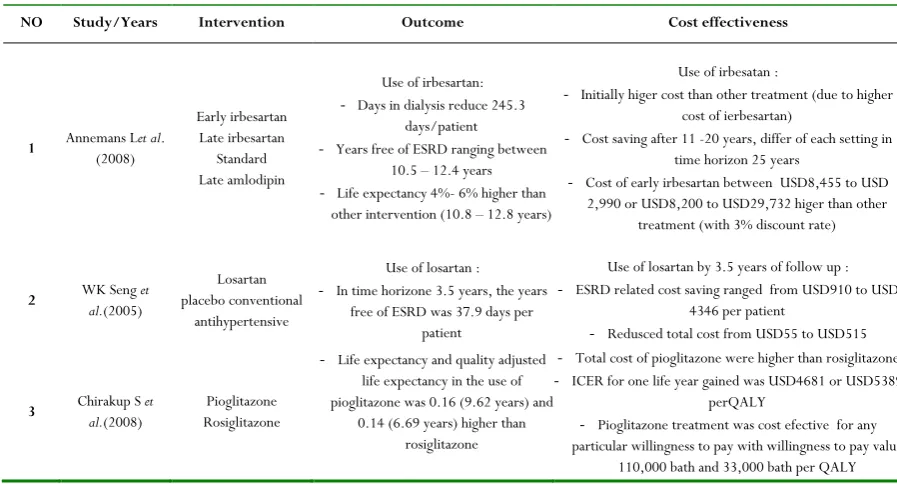
Malaysia and Singapore. Losartan plus CT (conventional
antihypertensive therapy) reduced the number of days
patients with ESRD (end stage renal disease) admitted in
hospitals by 37.9 per patient over 3.5 years compared with
CT alone. The reduction of ESRD days resulted in declining
costs which ranged from 910 USD to 4346 USD per patient
over 3.5 years. Pioglita zone has been administered in place
of rosiglitazone in type 2 diabetic patients who could not
control their blood glucose using the mixture of sulfonylurea
and metformin. Pioglitazone had better clinical outcomes and
higher lifetime cost. The incremental cost per QALY was
186,246 baht (5389 USD). The effect of pioglita zone on
%HbA1c decrease was the most sensitive to the outcomes
[9,10, 12, 15]
.
The complications of diabetes mellitus are often both
macrovascular and microvascular. A study of these
complication cases in Indonesia found that in total, 84.35 %
patients T2DM had at least one of these complications, with
8.7 % having only microvascular complications, and 48.7%
having only macrovascular complications, and 28.7 % of the
total having both macrovascular and microvascular
complications. The average cardiovascular was calculated to
be 774.37 USD per patient in 6 months. It included the cost
of medications, physician visits and monitoring cardiology
tests
[3].
Screening programs to determine T2DM cases as early as
possible have been conducted in some of the Southeast Asian
countries to avoid all negative consequences
[4].
The successful management of diabetes includes the control
of high glucose level (WHO, 2012). Some intervention has
been done to manage diabetes Mellitus Type2 in South East
Asian countries. The mostly used intervention provided in the
T2DM treatment was the use of drugs, such as irbesartan and
BIAsp 30. The use of irbesartan in the early stages has had
broad clinical and economic benefits in increasing life
expectancy from 0.31 to 0.48 years. Early irbesartan
treatment had a 66% (Thailand) to 95% (Taiwan) success
rate, which was dominant over late irbesartan
[9].
There is evidence that using BIAsp 30 as a cost-effective
treatment option in some western and developed countries
increased the life expectancy for more than 1 year, and was
highly cost-effective, and as well, it reduced the risk of
complications
[12]. Starting with BIAsp 30 in people with type
2 diabetes was found to be cost effective in all countries
increasing the life expectancy at 1 – 30 years
[12].
There has been an immediate need for an intervention to
develop an international policy framework for the prevention
and control of non-communicable diseases. A most
supportable strategy should include the interventions for
preventing and controlling interventions such diseases and
injuries that can be applied at the lowest cost in developing
areas where there is a high prevalence of the disease. Most of
the studied interventions were considered to be highly
cost-effective, meaning that they generated one healthy year of life
at the cost of <$Int2000
[11]. Table 4 shows the results of oral
People with diabetes are prone to consequences in both short
term and long term complications. The review yielded three
studies about the cost for diabetic patients with
complications, and one study about the cost of disability in
diabetic patients. The presence of the late complications of
diabetes has become a prime determinant of disability. Thus,
disability and complications have become an economic
burden for the countries, e.g., in this case Thailand and
Indonesia
[3, 16, 17]. The chronic nature of the disease and its
devastating complications have made it a very costly disease
[18]
.
The 2007 report revealed that most of the disabled patients
had impaired vision in one or both eyes, hearing impairments,
paresis, disability of limbs and amputations
[17]. The definition
of disability and its severity of disability among the study
participants used the Bartel index score. A person received a
score based on whether they received help while carrying out
these activities. The index of 100 indicated independence,
75-95 showed mildly disabled, 50-70 indicated moderately
disabled, 25-45 represented severely disabled and 0-20
showed very severely disabled
[17].
The cost of informal caregiving which has been a cost
component was never estimated in Thailand. Considering the
economical perspectives, the costs related to the informal
caregiving intensified the morbidity and mortality risk,
because providing informal cares implies that informal care is
not free. Informal care is the name given to the care provided
by people from care recipients’ social relations including
family, friends, acquaintances and neighbors. Therefore, to
formulate health policy, estimating the cost of informal care is
necessary
[13]. Revealed preference method has been
administered to determine the cost of informal care. For
valuing informal care by opportunity approach, time cost
approach was used as the based case. While valuing informal
care using proxy good method, the earnings from household
work and health and social workers were considered
[13].
Table 5 shows the cost of illness caused by diabetic
complications, disability, and informal caregivers of diabetic
patients. QALY and DALY were the popular outcomes used
in 15 articles reviewed. In this review, eight studies were
found using QALY and DALY as the outcomes, one study did
not report, while the rest found different outcomes.
This review yielded three articles about the cost of diabetes
mellitus, with two studies found in Thailand and one study
found in Cambodia
[4, 18, 19]. In Thailand, diabetes was ranked
fifth and third of top ten diseases among men and women;
respectively based on the years of disability in their life
[18]. In
cambodia, diabetes caused 3,122 cases (2008) and 39.00 cases
of disability adjusted year (DALY) per year in 2004
[4]. No
economic modeling of T2DM was found in Cambodia
[4]. In
Figure 1.
Study selection flowchart through literature search.
Table 2. Checklist item 15 articles using CHEERS instrument
No. STUDY (YEAR) COUNTRY 1 2 3 4 5 6 7 8 9 10 11a 11b 12 13a 13b 14 15 16 17 18 19 20a 20b 21 22 23 24 SV %
1 et al.Annemans (2008) Malaysia V V V V V V V V V V V V V O V V V O V V V V V O V O O 22 81
2 et al.WK Seng (2005) Singapura V V V V V V V V O V O V O O V V O O V V O O O O V O O 15 56
3 Ortegón Met al.
(2012) Bangladesh V V V V V V V V V V O V V V V V V O V V V O V O V O O 21 78
4 et al.Flessa S (2014) Cambodia V V V V V V V V O V O V O V V V V V V V V V O O V V V 22 81
5 Riewpaiboon A al. (2011) et Thailand V V V V V V V V V V V O O V V V O V V V O V V O V V V 22 81
6 et al.Srichang N (2011) Thailand V V V V V V V V O V V V O V V V O O V V V O O O V V V 20 74
7 Chatterjee S et al.
(2011) Thailand V V V V V V V V V V V O V V V V O V V V O O O V V V V 22 81
8 Chatterjee S (2011) et al. Thailand V V V V V V V V O V V V V V O V O V V O O V O O V V V 20 74
9 et alChirakup S
. (2008) Thailand V V V V V V V V V V V V O O V V V V V V V O O O V V V 22 81
10 Riewpaiboon A al. et
(2007) Thailand V V V V V V V V V V V O V V V V O O V V V V O V V V V 23 85
11 Riewpaiboon A al. (2011) et Thailand V V V V V V V V O V V V V V V V O O V V V O O V V V V 22 81
12 Sookaneknun P al. (2010) et Thailand V V V V V V V V O V V V O V V V V V V V O V V O V V V 23 85
13 Chaikledkaew U al.(2008) et Thailand V V V V V V O V O V V V O V V O O O V V O O O O V V V 17 63
14 et al.Shafie AA (2014) India V V V V V O V V V V V V V O V V V V V V V V V O V O V 23 85
15 Andayani TM al. et
(2010) Indonesia V V V V V V V V O O V O O V O V O O V V O V O O V O O 15 56
Notes:
1 – 24 is checklist item from CHEERS SV = Summery od statement V = Presence of statement % = Percentage
Article obtained from
PubMed & ProQuest are 2.232 articles
Articles obtained according to inclusion criteria
are 15 articles
0 = Absence of statement
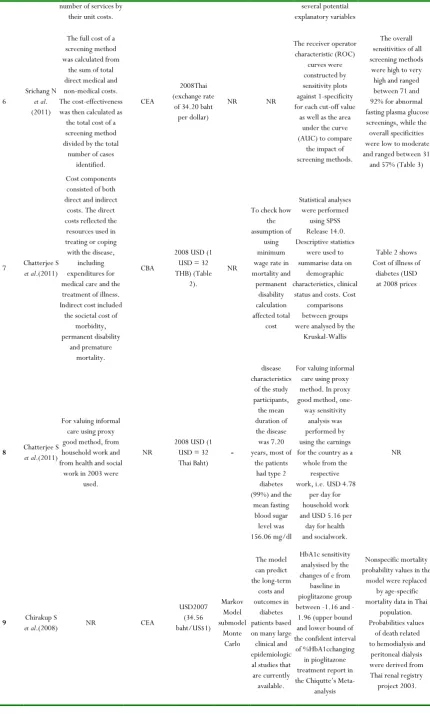
Table 3. Summary of 15 articles selected for the systematic review of metode economic evaluation of diabetes mellitus
management in South East Asia, as published in the international literature (in PubMed & ProQuest) between 2005 and
2014 (PART 1)
No St ud y/ Ye ar s
Country Title Introduction Target Population Setting and Location
St ud y per sp ect iv e 1 Anne m ans L et a l . (2008) China Malaysia South Korea Taiwan Thailand
An Asian Regional Analysis of cost effectiveness of early
irbesartan treatment Versus conventtional antihypertensive, late amlodipine and late irbesartan
in patient with type 2 diabetics hypertention and
nephropathy
Diabetic nephoraty is a common and serious implication of diabetes mellitus. Diabetic nephropaty was found in 51.7 % od
all end-stage renal disease (ESRD) cases among patiens starting dialysis in Malaysia. ESRD is also expected to increase in Asian region.
Participant were man and woman who presented 59 years old
patients with type 2 diabetes, and MAU (with UAE = Urinary
albumin excretion 20 – 199 ug/minute) and presenting characteristic similar to the base
line in IRMA-2
Five Asian different setting
- China - Thailand, - Malaysia,
- Taiwan and - South Korea
Th ird pa rty p ay er 2 WK S en g et al . (2005
) Hong Kong
Korea Japan Malaysia Singapura
Taiwan
Losartan reduces the cost of diabetic end stage renal disease an Asian
perspective
The use dialysis services represent a significant healthcare budget around the world. In Taiwan government spends approximately 6% of their anual health care budget on the reimbursment of dialysis therapy. Health care programme aimed to preventing or delaying onset of
ESRD in patients with type 2 diabetes might reduce the economic
burden of ESRD in this region
Participant were 252 patients type 2 diabetic of asian ethnicity with
age 31- 70 years with nephorpathy.
This study was setting on health
care system responsible for all direct medical cost
in : - Hongkong, - Taiwan, - Singapore, - Malaysia - Korea - Japan th
ird pa rty pa ye rs an d th e na tiona l or reg io na l h ea lth ca re per sp ec tiv e 3 O rte gón M et a l. (20 12) Bangladesh Malawi Nepal India
Cost effectiveness of strategies to combat cardiovascular disease,
diabetes, and tobacco use in sub-Saharan Africa and South East Asia mathematical modelling study
Cardiovascular disease is the single largest cause of mortality, This have
an economic impact through loss income or labour productivity. Need
a policy framework to prevent and control this desease. The management prevention efforts
include population level and individual level
A lifetime population model was used to assess the cost effectiveness of 123 single or
combined prevention and treatment strategies for cardiovascular disease, diabetes,
and smoking
Two World Health Organization
sub-regions of the world: countries in:
- sub-Saharan - countries in
South East Asia The pub
lic h ea lth an d poppul ati on per sp ec tiv e. 4 Fl essa S et a l. (2014)
Cambodia Costing of diabetes mellitus type II in Cambodia
The Royal Government of Cambodia wants to address this rising disease and take care of its population, but for this purpose it urgently needs a prediction of the expected number of T2DM cases in Cambodia, determine the most costeffective intervention strategies, and estimate the budget impact of prevention and treatment
of this disease.
For this study the sample was T2DM Patient, concentrate
on the cohort ≥ 15 years in
the year 2008.
The study was conducted at The Ministry of Health finances first-line (health centres) and
second-line (hospitals) health
facilities. The
M ini str y of H ea lth of Ca m bodi a ( G ov er nm ent) per sp ec tiv e. 5 Ri ew pa ib oon A et a l. (2011) Thailand
Cost analysis for efficient management diabetes
treatment at a public district hospital
in Thailand
Only one study formulated a diabetes cost model from the provider perspective at a public hospital in central Thailand. Cost modelling
determines a mathematical relationship between cost (dependent
variable) and factors influencing the cost (independent variables) that can be used in both the prevention and
treatment of diabetes.
Method The target population: 475 diabetic patients who were randomly selected from
Waritchaphum Hospital’s electronic database of 1415 diabetic patients who received
outpatient and/or inpatient treatment
The study was conducted at Waritchaphum Hospital in Sakhon Nakhon province in
northeastern Thailand. provide
6 Sr ic ha ng N et a l . (2011) Thailand
Cost and Effectiveness of Screening Methods for Abnormal Fasting Plasma
Glucose among Thai Adults Participating in the
Annual Health Check-Up at King Chulalongkorn Memorial
Hospital
Screening methods in thailand have been developed for detecting undiagnosed type 2 diabetes. These
include the method which was proposed RMAT, the method proposed by (MOPH), a diabetes
risk score for predicting incident diabetes and the method pro-posed
by Keesukphan et al. The effectiveness of these methods has
not been fully evaluated.
The target population: The study population included
individuals between 35 and 60 years of age with no known diabetes or pre-diabetes who had
participated in the annual health examination provided by the
Preventive Medicine Clinic of the King Chulalongkorn Memorial Hospital. Between July and December 2008.
The study was conducted at King
Chulalongkorn Memorial Hospital, Thailand Soc ie ta l pe rs pe cti ve and a s ing le pa ye r per sp ec tiv e. 7 C ha tter jee S et a l.(2011) Thailand
Cost of diabetes and its complications in Thailand: a complete picture of economic
burden
Diabetes is a common metabolic disorder with increasing burede In Thailand, studies on the cost of diabetes estimated the cost either from provider or from patient .
There is no study had yet been conducted in Thailand to explore the
cost of illness of diabetes from societal perspective, the broadest
viewpoint covering all costs irrespective of who incurs them. The present studywas an attempt towards
this end.
The target population: total of 1415 diabetic patients (inpatients and outpatients taken
together) received treatment from the study hospital and health centres in 2008.
The study was conducted at Waritchaphum hospital in Sakhon Nakhon province of
Thailand Soci
et al pe rs pe cti ve 8 C ha tter jee S et a l .(2011)
Thailand for diabetic patients in Cost of informal care Thailand
Most studies had found that the cost associated with unpaid informal caregiver time account for a majority of the total cost of the disease. Given this backdrop, the objective of the
present study was to estimate the cost of informal care for the diabetic patients at a public district hospital in
Thailand.
The target population: For this study the sample size was fixed at 475 from a total of 1415 diabetic patients (inpatients and
outpatients taken together) received treatment from the study hospital in 2008.
The study was conducted at Waritchaphum hospital, a public district hospital in Waritchaphum district of Sakhon Nakhon province in
Thailand So ci et al p er sp ec tiv e 9 C hi ra ku pS et a l .(2008) Thailand
Cost-Effectiveness Analysis of Thiazolidinediones in Uncontrolled Type 2 Diabetic
Patients Receiving Sulfonylureas and
Metformin in Thailand
In Thailand only two studies compared the cost effectiveness
between rosiglitazone and pioglitazone (thiazolidinediones groups) but both studies did not base
their effectiveness on meta analysis
This project is a multicenter registry of 9419 diabetic type 2 patients receiving medical care in diabetic
clinics of 11 tertiary centers in Bangkok and major provinces.
The registry data were collected from April to December
2003.
The study was conducted at Buddhachinaraj hospital’s, Thailand th e g ov er nm ent hos pi ta l po lic ym ak er p er sp ec tiv e. 10 Ri ew pa ib oon A et a l .(2007)
Thailand Diabetes Cost Model of a Hospital in Thailand
Study about cost of illness is rarely conducted in Thailand. The researcher was aware of only one
study conducted in seven government hospitals located in four
regions of the country and in Bangkok. Another study just focused
on patients’ expenses as they used complementary and alternative medicine and not on that of the
providers prespective.
The target population consisted of patients with diabetes (type 1 or type
2), defined as one who has plasma glucose at a level of at
least 126 mg/dL by the fasting plasma glucose test, who
receive treatment during fiscal year 2001 (October 1, 2000 to September 30, 2001)
This study was setting in Ampawa
Hospital, a 30-bed public
hospital in Samutsongkram, a central province of
Thailand. Th ird pa rty pa ye r pe rs pe cti ve and gov er nm ent pe rs pe ct iv e 11 Ri ew pa ib oon,A . et a l .(2011) Thailand
Disability and cost for diabetic patiens at a public distric hospital in
Thailand
Diabetic patiens with disability use healthcare services more frequently
than those not limited in activity. Estimated cost of disability among diabetic people aged 18-64 years to
be US$9.3 billion. In thailand, people with disablity has also been raising from 0.5 in 1974 to 2.85% in
2007.
The present study covered 475 diabetic patients from waritchaphum hospital, 354 were female (75%) and 121
were males (25%). Age of all participants was 59,34. Most of
them had primary education, dependent on farming and had
type2 DM.
This study were doing during fiscal
year 2008 (1 Oktober 2007 – 30
Sepetember 2008) at warichapuhum
hospital in waritchapum district of sakhon nakhon province in
12 Sook ane kn un P et a l .(2010) Thailand
Economic analysis of the diabetes and hypertension
screening collaboration between community pharmacies and a Thai government primary care unit
The sequential screening method is reasonable for cost and effectiveness in use. As com-munity pharmacies in
Thailand provide care in the private sector which is independent from the
government sector the quality of the cognitive services, such as screening
programs for diabetes and hypertension, are neither widespread
nor standardized.
Person who age 40 years old or older in the area of kasieng pharmacy, chusak pharmacy and samukee PCU
This study was setting in two pharmacies ((Kasieng Pharmacy
and Chusak Pharmacy)and and seven communities in the area of Samukee PCU (Primary Care Unit) supervision. pr ov ide r pe rs pe ct iv e 13 C ha ikl ed ka ew U et a l . ( 2008) Thailand
Factors affecting health care cost and hospitalizations
among diabetics patiens in Thai public hospitals
The anual average cost per diabetic patient was 6.017 baht in seven government hospital, which was significantly higher than those without diabetes. The annual total healthcare cost per diabetic patient was 1.751 baht. The average medical
cost per outpatient visit was about 1.206 baht per diabetic patient
This research is a retrospective study, conducted by using administrative
databases
obtained from four Thai government hospitals during october 1, 2002 and
september 30, 2003. Four Thai government hospitals. Pa tie nt pe rs pe tiv e a nd gov er nm ent pe rs pe ct iv e 14 Sh af ie , A A et a l . (2014) Arab Saudi India Indonesia
An analysis of the short and long term cost effectiveness of strating biphasic insulin aspart 30 in
insulin naive people with poorly controlled
type 2 diabetes
Analyse of randomised clinical trial and data from non interventional
studies that begining insulin analogues in people taking glucose lowering drugs alone is asscociated with improvements glucose control while improving quality of life. There
is evidence that using BIAsp 30 as a cost effectiveness treatment option in
a number of western and develope countries
Target Population : 1. Saudi Arabia, n=901
2. India, n=7546 3. Indonesia, n= 153 4. Nort Africa countries
(Algeria, Tunisa and Marocco), n=279
This study was setting in Saudi Arabia, Inonesia,
India and North Africa (Algeria, Tunisia and Marocco, analysed
using economic data from Algeria)
NR 15 Anda ya ni TM et al . (2010) Indonesia
Assessing The Impact of Complications on The Direct
Medical Costs of Type 2 Diabetes Mellitus outpatients
These complications in type 2 dibabetes melitus substantially increase not only the economic burden for healthcare systems,
but also the patient’s risk for disability, death, and diminished quality of life
The target population were patients admitted into the Dr. Sarjito
Hospital for treatment od Type 2 diabetes between may 2007 and august 2008.
This study was setting in Dr Sardjito Hospital in
Yogyakarta province, Indonesia Pr ov id er p er sp ec tive
Table 3. Summary of 15 articles selected for the systematic review of metode economic evaluation of diabetes mellitus
management in South East Asia, as published in the international literature (in PubMed & ProQuest) between 2005 and
2014 (PART 2)
No St ud y/ Ye ar s C om pa ra tor s Tim e ho rizo n D is co unt r at e
Choice of outcomes Single study-based estimates Synthesis-based estimates
Measurement & valuation of
preference-based outcomes 1 Anne m ans , L et a l . (2008) Late irbesartan, late amlodipine treatment and standard therapy. 25 ye ar s 3%
The outcome of each interventions wasablitiy to reduced ERSD,number
of years patients lived free of ESRD, number days in dialysis and number of life years saved
(QALY)
The result of two clinical trial, irbesartan in reducing
microalbuminuria 2 and irbesartan in diabetic nephropathy trial were utilized as primary data to
investigate the clinical and economical impact of different therapeutic strategies
Since ESRD management differed accros regional health care
setting, the transition probabilities between the health states of desease
progression were obtained from available
local data for each setting and the treatment
assumed after validation from local expert
The mortality rates for patients with MAU, were calculated by adjusting the age
and sex specific all cause mortality values that
were published in Malaysia, China, South Korea and Thailand
and using officia statistic for Taiwan, by health state dependent relative
2
WK
S
en
g,
et a
l.
(200
5)
The comparator of this study were placebo and conventional antihypertensive 3.5 y
ea
rs
The outcome of each interventions was evaluated in ablitiy the reduction of end point in
NIDDM, reduce of creatinin concentration and
reduce of blood pressure with RENAAL in patient with type 2 abetes and
nephropathy(free of ESRD)
NR
The RENAAL study design and result have been reported by brenner et al.
This study was to compared the renal protective effects of losartan plus CT with placebo plus CT in 1513
patients with typ2 diabetes. While the study
result from 252 patients aged 31-70 years of Asian ethnicity with nephropathy
and serum creatinin level of 115-265 µmol/L for men weiging > 60 kg have been reported by Chan JC
et al.
NR
3
O
rte
gón M
et a
l.
(20
12)
The majoity of the of intervention analysed are drug
base, ranges from 36% to 55% in low and
middle income countries in the public and private sector
respectively. Increase of taxation that would reduce smoking prevalence by
10%
ov
er
100 y
ea
rs
3%
The additional number of healthy years lived by population, equivalent to
the number of disability adjusted life years
(DALY’s)
NR
Source data on tobacco taxation from previous WHO and Word Bank Studies as reported by asaria P, et al in 2003. The interaction in risk between CPS II cohort as Steenland K et al reported. Ischemic heart desease and stroke
was modelled using estimates relatves risk of stroke and visa versa from published epidemiological studies as reported by mathers er al, ezzali et al,
WHO and Murray and lopez.
Comparisson between single or combined intervention with a baseline or null scenario. Null scenario was determined by back calculation incidence
and case. Fatality rates using intervention effect
sizes and current coverage rates
4
Fl
essa S
et a
l.
(2014)
The intervention inlude in this
study were treatent with Antidiabetic oral
and insulin and the role of peer educator network to search potential
diabetic cases
20
ye
ar
s (
2008
to 2028)
ND
The health outcome of each intervention are evaluated by disability adjusted life-years
(DALYs)
NR
The epidemiology of T2DM simulated with
markov model. Basic parameters of this model used international data and
adjusted it to cambodia.
NR
5
Ri
ew
pa
ib
oon
A
et a
l.
(2011)
cost (dependent variable) and
factors influencing the
cost (independent variables) that can be used in both the prevention and
treatment of diabetes.
th
e f
isc
al y
ea
r 2008 (
1 O
ctob
er
2007
to 3
0
Se
pte
m
be
r 2008)
.
3%
The health outcomes of each intervention are
evaluated in disabilityadjusted life-years (DALYs)
Medical histories from waritchapum hospital were
reviewed for the study period (fiscal year 2008) to
extract partici-pants.demographic characteristicsand types and quantities of medical
services received
6 Sr ic ha ng , N ., et a l ., (2011) The study compare the performance, cost, effectiveness and cost-effectiveness of four screening methods for abnormal fasting
plasma glucose. July
an d D ec em ber 2 00 8 NR
Reducing fasting plasma glucose (FPG) testing after the 12-hour overnight fast.
The participant with positive result from the screening questionnaires were followed up for fasting plasma glucose after
12 hour overnight fast. Universal venous FPG testing was also conducted
and use as refference for comparisson with other screening methods
Detail abaout variable and the cutt off criteria for positive results dor each
screening methods base on study that have been reported by suthijumron (methods 1), bureau of
non communicable desease, ministry of public
health (method 2), Aekplakorn (method 3) and Keesukphan (method
4) NR 7 C ha tter jee S et a l .(2011)
The costs were compared for different types of
complications as well as with and
without complications.. 1 ye
ar
(2007
–
2008)
3%
The health outcomes of each intervention are
evaluated in disabilityadjusted life-years (DALYs)
Unit cost medical services measued directly from hospital record. Medical
service utilization were collected by the study member by reviewing medical record participant
during october 2007 to september 2008). Information about direct
non medical cost and medical cost through direct personal interview
method
NR
The severe of disability confirmed using Bartel Index
score 8 C ha tter jee S et a l .(2011) The intervention use in this study was informal care giver such as
family, friends. Acquitances, or neighbours to be
cost saving in diabetic patiens D ur ing fi na nc ial ye ar 2008 till m ar ch 200 9.; NR
Time spent of informal care giver for activity
daily livint (includes instrumental daily livinf)
and house hold daily living, taken together under
helath are activities
Information of informal caregiving was collected through direct personal interview method either from the patients or from the caregivers. The
data on time spent for informal care were collected by using recall method. The participants aske to write down all their ativities during a specific time, in this study during financial year 2008
to march 2009
The concept of ADL, HDL and IADL were followed
from Van den berg et al.The ADL include personal care, moving around in the house, going
to the toilet, bathing, dressing, eating and drinking. The HDL include
preparation of food and drink, cleaning the house,
dishes, washing, ironing. While IADL include making trips and visiting family or friends, health care contacs, going to the
bangk, etc
Valuing informal care using proxy goods method. Earning defined as wage plus other
monetary and non monetary. Earning
for HCA and ADL USD 3.03 per day and
earning for HDL USD 4.47 for sakhon nakhon hospital. Work time per
week cannot be exceed 48 h. Total workin time per month
192 h. 9 Ch ira kup S et a l .(2008) The intervention in this study was use pioglitazone 45 mg orally
once daily compared with the rosiglitazone 8 mg oraly once daily in patients who cannot control their blood sugar with sulfonylureas and
metformin. Tim
e hor izon of th e sim ula tion w as 40 ye ar s.. 3%
The health outcomes of each intervention are
evaluated in Quality adjusted life-years (QALYs).
Cummulative od incidence in each diabetes
complications and total lifetime cost of the
diabetes
Most of diabetic complication cost were
calulated from Buddachinaraj hospital’s
database (Pitsanukook Thailand). The government policymaker
perspective were taken considering only direct medical cost for ech competing treatmant
Baseline characteristic in this study based on Thai Diabetes Registry Report
(TDRP). Other characteristic that not report in TDRP retrieved
from other publication related with thai polulation. T2DM patients
identified by ICD10. Complication cost that could not be calculated from the hospital were derived from thai published literature, expert opinioon and DRG’s (Diagnosis Related
Groups)
10 Ri ew pa ib oon,A et a l . (2007) The intervention in this study was medical services consist outpatient, visit, inpatient stay, pharmacy services, home health care visit,
laboratory investigation, emergency services and surgical services D ur in g fis ca l y ea r t he fi sc al y ea r 2001 (O ctob er 1, 2000 –S epte m be r 30,2001) 3%
Formulation of cost model provider
perspective
Data were collected by reviewing the medical record of each participant,
both inpatient and outpatient. The acquisition
cost of drugs collected from the pharmacy depatment and medical
material department
NR
The total direct medical cost were calculated through a summation of medical service
cost in the result of multiplying the number of services by their unit cost.
11 Ri ew pa ib oon,A et a l
.(2011) The intervention
of this study were the presence of complication and disability among diabetic patients D ur ing th e fis ca l y ea r 2008 NR
The outcome in each intervention are evaluated as disabilty
adjusted life year (DALY’s)
Data were collected from the hospital waritchapum hospital financial record, medical records of each participants to get the information of medical service utilization. Information on direct non
medial cost and time and productivity cost collect by
direct personal nterview
The severity level of impairment were checked by using the ThailandnMinistry of pulic helath check list
for evaluation. To get comprehensive
view, The Barthel index sore was used
The outcomes among group was difine by
bartel index score consist duration of disease, age and fasting
blood sugar level
12 Sook ane kn un P et a l . (2010) The intervention in this study were screening diabetes and hypertension between community pharmacies and
government D
ur ing Jul y– Sep tem ber 2007; ND
The outcome of this research was reduce of
blood sugar
The Data colected by action study among the participant in two pharmcy
and one PCU
The inclusion criteria of the participant followed the dibetes asscociation
of Thailand recommendationfor
PCU routine task.
ND 13 C ha ikl ed ka ew U et a l. (2008) - 30th S epte m be r 200 2 – 1s t O ctob er 2003 NR Decreased of comorbidity and complicatios
Data source obtained from four thai government hospital. Data include
demographic characteristics, medical history of illness, health care utilization and medical
cost.
All variables both comorbidities and complications used in this
study are presented in table 1 page 570, based on
ICD-10 codes. - 14 Sh af ie A A et a l .(2014
) The intervention
of this study was treatment with
BIAsp 30 in people with type
2 diabetes ov er 30 ye ar s ti m e hor izone 3%
The outcome of this stuy were QALY, the reduction of diabetes related complication
A1chieve was a 24-week, international, non-interventional, Participants
were asked to complete the EQ5D questionnaire, used for self-assessment of
HRQoL, at baseline and week 24
o evaluate the safety an clinical effectiveness of insulin analogue in people
with T2DM use A1 chive data collection. Data
were collected on clinical effectiveness and adverse events at routine clinical visits (baseline 12 an 24 weeks).
EQ-5D HRqol 15 Anda ya ni , TM et a l. (2010) The intervention in this study were individual with complication in T2DM (include macrovasvular, microvascular or
both) The
study w as done b etw ee n May 2007 and S epte m be r 2008. NR NR
The data collection was done by interviewing and
reviewing the medicalRecords. people were classified into four broad categories of complication status. A written informed consent was obtained from all the
patients.
Table 3. Summary of 15 articles selected for the systematic review of metode economic evaluation of diabetes mellitus
management in South East Asia, as published in the international literature (in PubMed & ProQuest) between 2005
and 2014 (PART 3)
No Study/Years
Single study-based economic evaluation
Model-based economic evaluation
Currency, price date,
& conversion
Choice of model
Model assumptions
Analytic methods
Study parameters
1
Annemans
Let al.
(2008) NR CEA 2004 US$
Markov
model NR
The probabilistic sensitivity analysis was use to assess the effect of uncertainly around each input
parameter using second order monte
carlo simulation).
The model investigated the impact of the four treatment option on the cumulative incidence of ESRD, the number of patients live free ESRD and the number of days dialysis and the number of
life years save
2 WK Seng al., (2005) et NR CEA 2004 US$ NR NR
In this study,the cost calculate in two
stages: -Estimation the mean realationship between cumulative cost &
survival time-Weightingf this mean
relationship by the kaplan meier probabilitis of survival
Tabel 2 (page 522) shows the mean number of days with ESRD by treatmen group
and follow up by time
3 Ortegón Met al.(2012)
Costs included all resour-ces required
for the im-plementation and
main-tenance of interventions, such as
administration and planning, media and
com-munications, law enforce-ment activities, training, evaluation, and
monitoring.
CUA 2005 USD. CHOICE WHO- NR
This analysis follows the standardised methodology on cost effectiveness analysis
set forth by the WHO-CHOICE project12-14 and builds on previous
analyses of public health interventions to
lower systolic blood pressure and cholesterol15 and of
tobacco use.
Main epidemiological parameters used in
analysis of cardiovascular disease,
diabetes, and tobacco related disease rates in WHO
sub-Saharan African sub-region AfrE and South East Asian sub-region SearD Shown
on table 2
4
Flessa Set al.(2014)
The ministry of health is obliged to
include only new intervention into basic package of services if they are
cost effective in comparison to other possible intervention
CEA
all values are expressed in 2013 US$.
Markov-Model
57% of insulin requiring
T2DM patients receive a monotherapy
the average cost of insulin therapy is 114 US$ p.c. p.a.
The treatment costs are crucial so that detailed analysiswas
done based on the data of MoPoTsyo, data from
WHO-CHOICE, the international drug price indicator guide
and additional research on market prices in Cambodia.
The parameter of this study
shows on table 1
5 A Riewpaiboo et al.(2011
The directmedical cost of the study participants was calculated by adding
the unit costs of medical services and
costs of drugs and medical supplies. The
cost of medical services was
CEA
The total annual cost for
the study hospital was
US$ 2008 prices (US$ 1 = THB 32, or Thai baht).
NR
The Study Formulated a
forecasting cost model with direct medical cost as a dependent
variable.
Descriptive statistics were used to summarize dependent
and independent variables. The stepwise multiple regression analysis was employed to calculate the relationship between
number of services by their unit costs.
several potential explanatory variables
6
Srichang N
et al. (2011)
The full cost of a screening method was calculated from
the sum of total direct medical and non-medical costs. The cost-effectiveness was then calculated as the total cost of a screening method divided by the total number of cases
identified.
CEA
2008Thai (exchange rate
of 34.20 baht per dollar)
NR NR
The receiver operator characteristic (ROC)
curves were constructed by sensitivity plots against 1-specificity for each cut-off value
as well as the area under the curve (AUC) to compare
the impact of screening methods.
The overall sensitivities of all screening methods were high to very high and ranged between 71 and 92% for abnormal fasting plasma glucose
screenings, while the overall specificities were low to moderate and ranged between 31 and 57% (Table 3)
7 Chatterjee Set al.(2011)
Cost components consisted of both direct and indirect
costs. The direct costs reflected the
resources used in treating or coping with the disease,
including expenditures for medical care and the treatment of illness. Indirect cost included
the societal cost of morbidity, permanent disability
and premature mortality.
CBA
2008 USD (1 USD = 32 THB) (Table
2).
NR
To check how the assumption of
using minimum wage rate in mortality and
permanent disability calculation affected total
cost
Statistical analyses were performed
using SPSS Release 14.0. Descriptive statistics
were used to summarise data on
demographic characteristics, clinical
status and costs. Cost comparisons between groups were analysed by the
Kruskal-Wallis
Table 2 shows Cost of illness of
diabetes (USD at 2008 prices
8 Chatterjee S et al.(2011)
For valuing informal care using proxy good method, from household work and from health and social
work in 2003 were used.
NR
2008 USD (1 USD = 32 Thai Baht)
-
disease characteristics
of the study participants, the mean duration of the disease was 7.20 years, most of
the patients had type 2 diabetes (99%) and the
mean fasting blood sugar level was 156.06 mg/dl
For valuing informal care using proxy method. In proxy good method, one-way sensitivity
analysis was performed by using the earnings for the country as a
whole from the respective work, i.e. USD 4.78
per day for household work and USD 5.16 per
day for health and socialwork.
NR
9 et alChirakup S.(2008) NR CEA
USD2007 (34.56 baht/US$1)
Markov Model submodel
Monte Carlo
The model can predict the long-term
costs and outcomes in
diabetes patients based on many large clinical and epidemiologic al studies that are currently
available.
HbA1c sensitivity analysised by the changes of e from
baseline in pioglitazone group between 1.16 and -1.96 (upper bound and lower bound of the confident interval
of %HbA1cchanging in pioglitazone treatment report in the Chiqutte’s
Meta-analysis
Nonspecific mortality probability values in the
model were replaced by age-specific mortality data in Thai
population. Probabilities values
of death related to hemodialysis and
peritoneal dialysis were derived from Thai renal registry
10
Riewpaibo A.et al.(200
Unit cost medical services calculated
from the data given by hospital, composed
in five steps
CMA
2001 Thai baht (THB) (approximatel
y 40 THB = US $1).
- -
The statistical analysis employed was the stepwise multiple regression The statistic’s assumptions
and model checking were examined, i.e., normal distribution,
multicollinearity, influential observations, and
outliers.
Table 2 shows the unit cost of medical services and drugs commonly
used by diabetic patients
11
Riewpaiboon
al.(2011
Cost of illness estimates followed the prevalence-based
approach and it measured of social prespective od cost of
illness of diabetes
CMA
2008 USD (1 USD = 32
thai bath)
- -
Data analysis were performed using spss
release 14 software, cost comparison between group were analysed by
Kruskal-Wllis Test
Total cost of illness for 475 study participant was
estimated at USD 418.696. Of this 22.66%
was direct medical cost, 39.887 was direct non medical cost and 37.47 was productivity cost. Unit cost of inpatient stay,
outpatient visit and dispensing (exclude drugs)
at waritchaphum hospital were USD 74.33.
12
Sookaneknu n P et al.
(2010)
The cost of the screening activities Direct medical costs
and direct non-medical cost in Model 1, 2 or combine from
model 1 and 2
CMA
In this study cost were expressed in
2007 US$ after convertion from Local currency THB
(Model 1) (Model 2), shown as
Fig. 2.
The framework
was constructed to
show the collaboration
model between the
National Health Service, private community pharmacies and pharmacy
educational organization as shown in
Fig. 3.
The sequential screening method is
reasonable for cost and effectiveness in
use
Table 2 Shows the screening results for each
model of hypertension and
diabetes.
13
Chaikledkae wUet al.(2008)
Medical cost data were all charges of
patients underpayments method such as capitation, free for
sevice and out of pocket. Out of pockets means patients pay all healthcare cost by
themselves
CMA ND NR -
Multiple linier regression analysis and
log transformation were used when a dependent variable was total helathcare
cost. Logistic regression analysis was applied when the
occurance of hospitalization was a dependent variable.
Table 2 shows the result of the descriptive statistic of the sample. There were24051 patients with diabetes with average age 59 years old. Sixty six percent od patients wth diabetes were female and 99%
had type II diabetes.
14 Shafie AA
et al. (2014)
NR CEA
In this study cost were expressed in
local currency, 2013 USD and
GDP for each CORE
Short term analysis was conducted using the incremental
cost of treatment and
Non parametric boostrapping was use in each
simulation to construct the confidence interval araound
effect on EQ5. This assumtion based on data collected from
A1chieve (shown ini
table1)
related complication, cost and cost effectiveness shows in table 2 page 4
15
Andayani TMet al.(2010)
Only direct medical costs, those directly related to delivery of
the health care service, are included
in the estimates reported here. Average per‐patient
total costs were estimated by applying unit costs to the likely course of treatment
for each complication.
NR
In this study cost were are
reported in 2008 US
dollars.
NR -
Descriptive statistics was done to analyze the demographic details. Median with
range was reported for cost details..
The macrovascular complications considered
in this analysis are hypertension, hyperlipidemia, hypertension heart disease, congestive heart failure, angina
pectoris, and ischemic heart disease.
Table 3. Summary of 15 articles selected for the systematic review of metode economic evaluation of diabetes
mellitus management in South East Asia, as published in the international literature (in PubMed & ProQuest)
between 2005 and 2014 (PART 4)
No Study/ Years Incremental costs and outcomes based economic Single study-evaluation
Model-based economic evaluation
Characterizing heterogeneity
Study findings, limitations, generalizability,
and fit with current knowledge
Source of funding
and support
Conflicts of interest
1 Annemans Lal.(2008) et
The incremental cost effectiveness
ratio (ICER) of given treatment projected 25 years
cost, expressed in 2004 US$
Summerized result of model operated in a 25
years an 3% discount rate for
both costs and outcomes in all
setting was discribed in figure 2, page 360
Both increasing of MAU mortality and decreasing
diabetic nephropathy mortality, reduced
the beneficial effect of early
irbesartan treatment in terms of decreased
life years gained compare to base
case.
-
The model exclude the cost of comedication for disease other than diabetic nephropathic
Not Found Not Found
2 WK Sengal.(2005) et - - -
The economic analysis did not include all countries
in Asia, the six countries not be
considereda representative sample of all Asian countries.
NA NA
3 Ortegón M et al.(2012)
ICER provided for each cluster of interventions, which give the additional cost needed to secure one extra healthy life
year as successively less cost effective strategies are entered
into the mix.
The probabilistic uncertainty analysis
depicted in figures 3⇓ and 4⇓ also show
that these interventions remain
highly cost effective (cost effectiveness ratio <$Int2000 per DALY averted) even after allowing for plausible variations
incosts and effects
-
These results were obtained by means of a dynamic population
model, using consistent demographic and epidemiological data
of the populations studied, allowing a more precise prediction of the behaviour of the disease and consequently of the health and economic
impact of the strategies studied.