Introduction
The International Association for the study of pain (IASP) defines pain as an unpleasant sen-sory and emotional experience associated with actual or potential tissue damage or described in terms of such damage. IASP in November 2010 further extended to define neuropathic pain as “Pain initiated or caused by primary lesion or dysfunction of the peripheral or central nervous system.[1]”. Neuropathic pain is a highly unpleasant sensation, which contributes to poor quality of life which is similar to patients with serious mental illness or severe heart dis-eases. [2,3] Correct diagnosis of neuropathic pain is always challenging. It is essential to recog-nize neuropathic pain, identify the underlying cause, assess the impact of pain on the quality of life of the patient and initiate appropriate treatment. This article limits itself to discuss about the Neuropathic pain pertaining to oro-facial
ABSTRACT
Various definitions have been provided with regard to pain. In articular, neuropathic pain is a highly unpleasant sensation, which contributes to poor quality of life which is similar to patients with serious mental illness or severe heart diseases. Correct diagnosis of neuropathic pain is always challenging. It is essential to recognize neuropathic pain, identify the underlying cause, assess the impact of pain on the quality of life of the patient, and initiate appropriate treatment. This article limits itself to discuss about the neuropathic pain pertaining to orofacial structures. It includes trigeminal neuralgia, post-herpetic neuralgia, cancer neuropathic pain, and HIV neuropathy.
Keywords: Neuropathic pain, carbamazepine, trigeminal neuralgia, gabapentin, pregabalin
Therapeutics in neuropathic pain - An overview
M. Subha, M. Arvind
Department of Oral Medicine and Radiology, Saveetha Dental College and Hospital, Saveetha University, Chennai, Tamil Nadu, India
Correspondence: M. Subha, Department of Oral Medicine and Radiology, Saveetha Dental College, Saveetha University, Chennai, Tamil Nadu, India. Phone: +91-9884141299. E-mail: [email protected]
structures. It includes Trigeminal Neural-gia, Post Herpetic Neuralgia (PHN), cancer neuropathic pain, HIV neuropathy.
Conditions Causing Neuropathic Pain
Neuropathic pain is caused due to damage to the neural functions. Neuropathic pain is most often consequences of a disease, rather the disease itself. It could be due to traumatic nerve damage or compression, diabetes, cancer, chemotherapy, viral infection, alcohol, and surgical amputation[4] [Table 1] - conditions causing neuropathic pain]. Pain can be central or peripheral based on which it is categorized as central neuropathic pain or peripheral neuropathic pain.
Pathophysiology
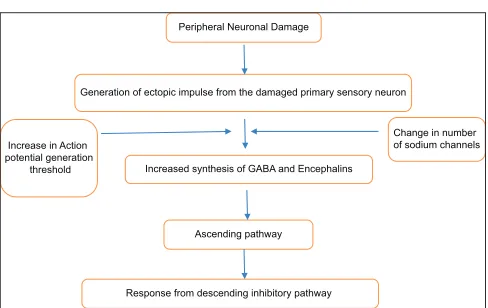
The peripheral and central mechanism together may contribute to the symptoms.[5-12] This can be given as follows [Figure 1]:
1. Nociceptors evoke the pathological activity.
2. Ectopic activity of damaged neuron and dorsal root ganglion cells.
3. Increased release of neurotransmitter due to increased sodium channel activity.
4. Increased afferent pathway activity causing central sensitization of dorsal horn neurons.
5. Increased central facilitation. How to cite this article: Subha M, Arvind M. Therapeutics in neuropathic pain - An
overview. J Adv Pharm Edu Res 2017;7(3):216-221. Source of Support: Nil, Conflict of Interest: None declared.
Access this article online
Website: www.japer.in E-ISSN: 2249-3379
Clinical Features
Neuropathic pain has a wide range of expression other than pain itself. It includes allodynia, anesthesia, hyperalgesia, hyperpathia, hypoesthesia, paraesthesia, and phantom pain. They are categorized as negative symptoms and positive symptoms. Negative symptoms include anesthesia and hypoesthesia which are due to impaired
Table 1: Common causes of neuropathic pain
Metabolic Multiple sclerosis
Diabetes mellitus Monoclonal gammopathies
Vitamin B deficiency Guillain-barre syndrome
Toxic Genetic
Drugs - isoniazid, phenytoin,
hydralazine, vincristin, vinblastine Hereditary motor and sensory neuropathy Metal poisoning - lead, mercury Vascular
Trauma Vasculitis
Phantom pain Cerebrovascular disorder
Complex regional pain syndrome Carcinomatous Carpel tunnel syndrome Paraneoplastic syndrome
Infection Compression or infiltration of tumour
Herpes zoster Neuralgia
HIV Trigeminal
Epstein barr virus Post herpetic
Immune Hypoglossal
Table 2: Steps in diagnosis of neuropathic pain
Step 1 History Suggestive of neural
distribution (central and peripheral) Possible Step 2 Clinical examination and
investigation Negative/positive sensory signs and confirmatory tests Probable Step 3 History+clinical finding+confirmatory tests. All positive Definitive Adapted from Treede RD, Jensen TS, Cambell et al. Neuropathic pain redefining a grading system for clinical and research purpose. Neurology 2008;70:1630‑5
Table 3: Conditions and the drug of choice
Disorder Clinical features Drug of choice
Trigeminal neuralgia Paroxysmal attacks of electric shock-like pain along the course of trigeminal nerve lasting for few second to minutes. Pain is aggravated from trigger areas by certain activities such as shaving, washing face, and brushing[3]
PHN HZ is unilateral, does not cross the midline, and is localized to a single dermatome of a single sensory ganglion. In orofacial region, it affects the trigeminal nerve. Chracterized by prodromal symptoms followed by distribution of rashes along the nerve course[18]
Central pain Constant, spontaneous, lancinating pain, may be associated with pruritis caused due to nerve injury[22]
HIV neuropathy Distal sensory neuropathy due to demylination of peripheral fibers results in severe neuropathic pain[23]
Oncologic neuropathic pain It occurs due to tumor invasion, infiltration, or abnormality in protein processing due to chemotheryapy or radiation therapy[24]
First line: Carbamazepaine, oxcarbazepine Second line: Lamotrigine, baclofen
Third line: Gabapentin, pregabalin, amitriptyline, duloxetine or venlafaxine[16,17]
First line: Amitriptyline or nortriptyline, pregabalin, and gabapentin along with topical lidocaine (5% paste) Second line: Topical capsaicin (0.025%) Third line: Baclofen or tramadol, memantine, lorazepam[19-21]
First line: Amitriptyline and nortriptyline, pregabalin, or gabapentin
Second and third line: Lamotrigine, tramadol, or opiods (morphine/fentanyl)[17,19]
First line: Amitriptyline or nortriptyline and pregabalin or gabapentin along with serotonin reuptake drugs duloxetine or venlafaxine
Second line: Tramadol or tramadol with paracetamolThird line: Lamotrigine or topical capsaicin[17,19,20]
First line: Tricyclic antidepressants and anticonvulsants Second line: Tramadol and opioids
Third line: Selective serotonin reuptake inhibitors[17,20,21] PHN: Post-herpetic neuralgia
afferent or efferent conduction. Positive symptoms include all other symptoms mentioned above which are due to increased or ectopic neuronal activity.
Neuropathic pain can also be classified based on their responds to stimuli as stimulus dependent and stimulus independent. Stimulus-evoked pain occurs due to slightest stimuli such as clothing or a non-painful touch. Stimulus-independent pain is spontaneous. It is continuous or intermittent, usually burning, shooting, or shock-like. It is mainly due to decreased inhibitory input from the brain and spinal cord. Although we classify them as stimulus dependent and independent, the symptoms occur as combinations which make it difficult to categorize under one particular type.[13,14]
Assessment of Neuropathic Pain
History
A detailed history helps us to understand the nature and characteristics of pain. History will indicate if the distribution and characteristics of pain categorize it as neuropathic pain criteria or it is due to some neurological lesion or condition.[15]
Clinical Examination
Table 4: Drugs and dosage for neuropathic pain
Drugs Dosage Duration Adverse effects Evidence
Tricyclic anti-depressant[25-29] Amitriptyline
Imipramine Nortriptyline
25–150 mg/day, titrated weekly by
10 mg/day from 25 mg/day 6-8 weeks Sedation, confusion, anxiety, anticholinergic effects such as dry mouth, increased intraocular pressure, constipation, urinary retention, orthostatic hypotension
Rowbatham et al. (2005) - A parallel group study
Chandra et al. (2006) - RCT with GPT
Serotonin-norepinephrine reuptake inhibitors[30-32]
Duloxetine 30–120 mg/day titrated weekly by
30 mg/day from 30 mg/day 4 weeks Asthenia, fatigue, nausea, vomiting, dry mouth, sedation, drowsiness, tremors. Its use is limited in patients with renal, hepatic and cardiovascular dysfunction
Ruskin et al. (2005) Wernick et al. (2006) Parallel-group RCTs
37.5–225 mg/day titrated weekly by
37.5 mg/day from 37.5 mg/day 4-6 weeks Kadiroglu et al. (2008) - RCT
Venlafaxine
Anticonvulsant[33,21,27,23,34]
Gabapentin 300–3600 mg/day titrated weekly by 300 mg
from 300 mg/day 3-8 weeks Fatigue, drowsiness, dizziness, hyponatremia. Special precautions with cardiac problems, hepatic and renal failure is necessary
Wiffen et al. (2006) - RCT with placebo
Pregabalin 150-600 mg/day titrate by 50 mg/day
from150 mg/day 4 weeks Vanseventel
et al. (2006), Sidal et al. (2006), Vranken et al. (2009) - RCT with placebo
Carbamazepine 100-1200 mg/day titrated by 100 mg/day
from 100 mg/day 4 weeks Cruccu Gronseth et alet al. (2008). (2006) - SR with 12 RCTs
300-1800 mg/day 4 weeks Grosskopf et al. (2006)
Parallel-group study with Placebo Oxcarbazepine
Topical Anesthetic[35-37]
Lidocaine 3 plasters /day 3 weeks Frank et al. (2009)- Cross over study
Silver et al. (2007)-parallel group study Ho et al. (2008) - Crossover study
Opioids[38-40]
Morphine 30-120mg / day titrated by increasing 5 mg
every 3 days from 15 mg/day 12 h 4-6 weeks Constipation, vomiting, nausea, dizziness, drowsiness, headache, dry mouth, Abuse, addiction, withdrawal syndrome and suicidal tendency are the risks.
Raja et al. (2002) - Crossover study Edward et al. (2006)- Crossover study
Fentanyl 25-100 micro g/h 4 weeks
Oxycodone 20–60 mg/day 4 weeks Gimbel et al. (2003), Jensen et al. (2005),
Hanna et al. (2008) - RCT with placebo
Others
Capsaicin[41-43] 0.025% 4 weeks Skin rash, erythema, burning
sensation Backonja et al. (2008)-RCT
Cannadidiols[44] 1-2 sprays every 4 h maximum 4 sprays on
day one and titrated gradually 4-6 weeks Nurmiko et al. (2010) - RCT
Screening and Assessment Tools
These tools are used to distinguish neuropathic pain and non-neuropathic pain.
The McGill pain questionnaire describes the quality and characteristic of pain. The descriptors fall into four major groups, sensory, affective, effective, and miscellaneous. It have 102 descriptive words under
these 4 categories along with these pain rating index is also recorded which is the sum of the rank value of the scoring given in the above 4 categories. It also includes present pain index based on a scale of 0–5. Although it gives a detailed description on the characteristics of pain, it is not widely used as it lacks specificity, it is time-consuming, and it has a language barrier.[45,46]
non-neuropathic Pain. It has five symptom item and two clinical examination item. The score lies between 0 and 24 if its below and if its above 12 it is considered as neuropathic pain. It was modified, and later, modified with five items related to the quality of pain as self-reported scale S-LANSS. This has high sensitivity and specificity and is commonly used in epidemiology studies in general population.[47,48]
The neuropathic pain questionnaire (NPQ) is another questionnaire with 12 items (10 sensory and 2 affective), and it helps describe pain but does not reveal the etiology. A modification of this NPQ short forms with 3 items with discriminative properties to differentiate between neuropathic pain and non-neuropathic pain.[48,49]
The douleur neuropathique 4 questions have 7 items related to symptoms and 3 related to clinical examination. The 7 symptoms can be used as self-reported questionnaire also. Each question is graded with 1 point if positive, and hence, the total score ranges between 0 and 10, if the score is more than 4, it is categorized as neuropathic pain. [50,51]
Pain detect questionnaire is again a self-reported questionnaire with 9 items. It pain has 5 sensory descriptors used in joint pain as it specifically has one item to whether pain is located in joints.[14,15]
Pain quality assessment scale is a self-reported tool. It has 20 descriptors each graded from 0 to 10, and the sum total tells the intensity of pain.[52]
In the neuropathic pain symptom inventory, it has 12 items, 10 symptom descriptors, and 2 items to evaluate spontaneous and paroxysmal spontaneous pain. Each parameter is graded from 0 to 10, and the sum total describes the intensity of pain.[53]
Neurophysiology
Eliciting the neurophysiology in neuropathic pain would be of great value in diagnosing and managing the disease. Although nerve conduction studies helps in eliciting the intensity of pain its nout widely accepted and practised. This includes microneurography, recording pain related reflex and functional neuroimaging.[15]
Microneurography
Is a minimally invasive technique in which single axon recordings from peripheral nerve is done on subjects when they are awake. It provides valuable information on physiology and pathophysiology of all nerve fiber group.[54-57]
Pain-related Reflexes
Pain related reflexes are diagnostically useful tool for facial pain. Early R1 blink reflex and early SP1 masseter inhibitory reflex effectively reveal symptomatic forms of Trigeminal Neuralgia. The early R1 blink reflex is positive in ophthalmic post-herpetic neuralgia (PHN) as well. Nociceptive blink reflex was delayed in patients with atypical odontalgia.[15]
Functional Neuroimaging
Positron emission tomography and functional magnetic resonance imaging measure cerebral blood flow (rCBF) or metabolic activity of the brain. In unilateral spontaneous neuropathic pain, there is decreased resting rCBF in contralateral thalamus. Thalamic hypoperfusion may be a marker of neuropathic and restoration of thalamic blood flow for treatment monitoring. However, there is no sufficient data to declare it.[58,59]
Skin Biopsy
A punch biopsy of skin in the painful areas allows immunostaining and visualization of the intradermal terminals of A delta and C to measure intraepidermal nerve fiber density (IENFD). In Post Herpetic Neuralgia IENFD of the affected site shows lower density than the contralateral mirror image skin. The allodynia is due to surviving irritable nociceptors. In complex regional pain syndrome, there are quantitative and qualitative changes in skin innervation.[60,61]
Management of Neuropathic Disorder
Neuropathic pain cannot be considered as a disease but is an effect of underlying clinical conditions. An injury or damage in the nervous system causes neuropathic pain, and hence, a proper understanding of the underlying cause helps us to diagnose and manage the disease better [Table 4]. Frequent reassessment is also required to provide an effective therapy to the patient. The therapeutic guidelines provided in Tables 3 and 4 are based on a review of guidelines on the management of neuropathic pain.
Conclusion
Neuropathic pain management is not only just management of the disease but also management of symptoms alone. The management of neuropathic pain starts from assessing the pain itself. To choose a suitable medicine for an individual patient, we should analyze the clinical condition, select management options wisely, determine the dosage required, check for any comorbities condition, monitor the Peripheral Neuronal Damage
Generation of ectopic impulse from the damaged primary sensory neuron
Change in number of sodium channels Increase in Action
potential generation
threshold Increased synthesis of GABA and Encephalins
Ascending pathway
Response from descending inhibitory pathway
outcome, reassess the condition ,and do necessary modification in the drugs prescribed and the dosage if required.
References
1. Merskey H, Bogduk N. Classification of Chronic Pain. Seattle: IASP Press; 1994.
2. Smith BH, Torrance N, Bennett MI, Lee AJ. Health and quality of life associated with chronic pain of predominantly neuropathic origin in the community. Clin J Pain 2007;23:143-9.
3. Doth AH, Hansson PT, Jensen MP, Taylor RS. The burden of neuropathic pain: A systematic review and meta-analysis of health utilities. Pain 2010;149:338-44.
4. Demarin V, Basic-Kes V, Zavoreo I, Bosnar-Puretic M, Rotim K, Lupret V, et al. Recommendations for neuropathic pain treatment. Acta Clin Croat 2008;47:181-91.
5. Dubinsky RM, Kabbani H, El-Chami Z, Boutwell C, Ali H, Quality Standars Suncommitee of the Americal Academy of Neurology. Practice parameter: Treatment of pastherpetic neuralgia: An evidence based report of the quality standards subcommittee of the American academy of neurology. Neurology 2004;63:959-65.
6. Attal N, Cruccu G, Haanpää M, Hansson P, Jensen TS, Nurmikko T, et al. EFNS guidelines on pharmacological treatment of neuropathic pain. Eur J Neurol 2006;13:1153-69.
7. Brainin M, Barnes M, Baron JC. Guidelines standard subcommittee of EFNS scientific committee. Guidance for the preparation of neurological management guidelines by EFNS scientific task forces-revised recommendations. Eur J Neurol 2004;11:577-81.
8. Rasmussen PV, Sindrup SH, Jensen TS, Bach FW. Symptoms and signs in patients with suspected neuropathic pain. Pain 2004;110:461-9.
9. Finnerup NB, Otto M, McQuay HJ, Jensen TS, Sindrup SH. Algorithm for neuropathic pain treatment: An evidence based proposal. Pain 2005;118:289-305.
10. Adriaensen H, Plaghki L, Mathieu C, Joffroy A, Vissers K. Critical review of oral drug treatments for diabetic neuropathic pain-clinical outcomes based on efficacy and safety data from placebo-controlled and direct comparative studies. Diabetes Metab Res Rev 2005;21:231-40.
11. Hemipenstall K, Nurmikko TJ, Johnson RW, A’Hern RP, Rice AS. Analgesic therapy in PHN: A quantitative systematic review. PLoS Med 2005;2:628-44. 12. Saarto T, Wiffen PJ. Antidepressants for neuropathic pain. Cochrane Database
Syst Rev 2005;3:CD005454.
13. Kumar A, Pottabathini R, Bhatnagar A, Garg S, Gupta V. Pharmacological management of neuropathic pain: Current trends and possible approaches. Arch Neurosci 2017;4:e28998.
14. Baron R. Mechanisms of disease: Neuropathic pain-A clinical perspective. Nat Clin Pract Neurol 2006;2:95-106.
15. Cruccu G, Sommer C, Anand P, Attal N, Baron R, Garcia-Larrea L, et al. EFNS guidelines on neuropathic pain assessment: Revised 2009. Eur J Neurol 2010;17:1010-8.
16.
17.
18.
19.
21.
22.
23.
24.
25.
26.
27.
28.
29.
30.
31.
32.
33.
34.
35.
36.
37.
38.
39.
Attal N, Cruccu G, Haanpää M, Hansson P, Jensen TS, Nurmikko T, et al. EFNS guidelines on pharmacological treatment of neuropathic pain. Eur J Neurol 2006;13:1153-69.
Attal N, Cruccu G, Baron R, Haanpää M, Hansson P, Jensen TS, et al. EFNS guidelines on the pharmacological treatment of neuropathic pain: 2010 revision. Eur J Neurol 2010;17:1113-e88.
Sampathkumar P, Drage LA, Martin DP. Herpes zoster (shingles) and post herpetic neuralgia. Mayo Clin Proc 2009;84:274-80.
Amorim D. Pharmacological treatment of neuropathic pain: Review of oral and topical therapy recommendations. Int J Clin Neurosci Ment Health 2015;2:4
20. Dworkin RH, O’Connor AB, Backonja M, Farrar JT, Finnerup NB,Jensen
TS, et al. Pharmacologic management of neuropathic pain: Evidencebased recommendations. Pain 2007;132:237-51.
Frizzo H, Hasse P, Veronese R. Trigeminal neuralgia: An analytic review of the literature. Brazilian Journal of Oral and Maxillofacial Surgery 2004;4:212-17.
Canavero S, Bonicalzi V. Central pain syndrome: Elucidation of genesis and
treatment. Expert Rev Neurother 2007;7:1485-97.
Pardo CA, McArthur JC, Griffin JW. HIV neuropathy: Insights in the pathology of HIV peripheral nerve disease. J Peripher Nerv Syst 2001;6:21-7.
Lema MJ, Foley KM, Hausheer FH. Types and epidemiology of cancer-related neuropathic pain: The intersection of cancer pain and neuropathic pain. Oncologist 2010;15 Suppl 2:3-8.
Ryder S, Stannard C. Treatment of chronic pain: Antidepressant, antiepileptic and antiarrhythmic drugs. Br J Anaesth 2005;5:18-21.
Dworkin RH, O’Connor AB, Audette J, Baron R, Gourlay GK, Haanpää ML, et al. Recommendations for the pharmacological management of neuropathic pain: An overview and literature update. Mayo Clin Proc 2010;85 3 Suppl:S3-14.
Dworkin RH, O’Connor AB, Backonja M, Farrar JT, Finnerup NB,Jensen TS, et al. Pharmacologic management of neuropathic pain: Evidencebased
recommendations. Pain 2007;132:237-51.
Finnerup NB, Otto M, McQuay HJ, Jensen TS, Sindrup SH. Algorithm for neuropathic pain treatment: An evidence based proposal. Pain
2005;118:289-305.
McDonald AA, Portenoy RK. How to use antidepressants and anticonvulsants as adjuvant analgesics in the treatment of neuropathic cancer pain. J Support
Oncol 2006;4:43-52.
Attal N, Cruccu G, Baron R, Haanpää M, Hansson P, Jensen TS, et al. EFNS guidelines on the pharmacological treatment of neuropathic pain: 2010 revision. Eur J Neurol 2010;17:1113-e88.
Mateos RG. Manual Práctico del Dolor Neuropático. Washington, DC.; Elservier España, S.L. Granada; 2010.
Attal N, Bouhassira D. Central neuropathic pain. In: Pappagallo M, editor. The Neurological Basis of Pain. New York: McGraw-Hill; 2005. p. 301-19..
Santos MM, Freire AR, Rossi AC, Prado FB, Caria PH, Botacin PR. Trigeminal neuralgia: Literature review. J Morphol Sci 2013;30:1-5.
Saarto T, Wiffen PJ. Antidepressants for neuropathic pain. Cochrane Database
Syst Rev 2005;3:CD005454.
Ballantyne J, Cousins M, Giamberardino M, Jamison R, McGrath P, Rajagopal M, et al. Pharmacological Management of Neuropathic Pain. Vol. 18. Seatle: IASP; 2010
Directorate-General for Health and the Portuguese Association for the Study of Pain. National Plan to Fight Pain; 2001. Available from: http:// www.apeddor.org/images/documentos/controlo_da_dor/ Programa_Controlo_da_Dor. pdf. [Last updated on 2017 Mar 10]. Moulin DE, Clark AJ, Gilron I, Ware MA, Watson CP, Sessle BJ, et al. Pharmacological management of chronic neuropathic pain - Consensus statement and guidelines from the Canadian pain society. Pain Res Manag 2007;12:13-21
Hojsted J, Sjogren P. Addiction to opioids in chronic pain patients: A literature review. Eur J Pain 2007;11:490-518
40.
41.
42.
43.
44.
45.
46.
47.
48.
49.
50.
55.
56.
57.
58.
59.
60.
61.
Wells J. Neuropathic pain, clasification and management for general practicioners 2007;3:3-5.
Dworkin R, O`Connor A, Backonja M, Farrar J, Finnerup N, JensenT, et al. Pharmacologic management of neuropathic pain: Evidence-based recommendations. Int Assoc Soc Psychiatry 2007;132:237-51.
Neuropathic Pain. The Pharmacological Management of Neuropathic Pain in Adults in Non-Specialist Settings. NICE; 2010. Available from: https:// www.nice.org.uk/guidance/cg173/resources/guidance-neuropathicpain- pharmacological-management-pdf. [Last updated on 2017 Feb ].9
Ranoux D, Attal N, Morain F, Bouhassira D. Botulinum toxin Type A induces directs analgesic effects in chronic neuropathic pain. Ann Neurol 2008;64:274-84
Moulin DE, Clark AJ, Gilron I, Ware MA, Watson CP, Sessle BJ, et al. Pharmacological management of chronic neuropathic pain – Consensus statement and guidelines from the Canadian pain society. Pain Res Manag 2007;12:13-21.
Melzack R. The McGill Pain Questionnaire. New York: Pain Management and Assessment, Raven Press; 1983.
Melzack R. The McGill pain questionnaire: Major properties and scoring methods. Pain 1975;1:277-99.
Bennett M. The LANSS pain scale: The leeds assessment of neuropathic symptoms and signs. Pain 2001;92:147-57.
Eckeli FD, Teixeira RA, Gouvea AL. Neuropathic pain evaluation tool. Rev Dor Sao Paulo 2016;17 Suppl 1:S20-2.
Krause SJ, Backonja MM. Development of a neuropathic pain questionnaire. Clin J Pain 2003;19:306-14.
Ochoa JL, Campero M, Serra J, Bostock H. Hyperexcitable polymodal and insensitive nociceptors in painful human neuropathy. Muscle Nerve 2005;32:459-72.
Orstavik K, Jørum E. Microneurographic findings of relevance to pain in patients with erythromelalgia and patients with diabetic neuropathy. Neurosci Lett 2010;470:180-4.
Serra J, Campero M, Bostock H, Ochoa J. Two types of C nociceptors in human skin and their behavior in areas of capsaicin-induced secondary hyperalgesia. J Neurophysiol 2004;91:2770-81.
Garcia-Larrea L, Maarrawi J, Peyron R, Costes N, Mertens P, Magnin M, et al. On the relation between sensory differentiation, pain and thalamic activity in Wallenberg’s syndrome: A PET-scan study before and after motor cortex stimulation. Eur J Pain 2006;10:677-88.
García-Larrea L, Peyron R, Mertens P, Gregoire MC, Lavenne F, Le Bars D, et al. Electrical stimulation of motor cortex for pain control: A combined PETscan and electrophysiological study. Pain 1999;83:259-73.
Hsieh JC, Belfrage M, Stone-Elander S, Hansson P, Ingvar M. Central representation of chronic ongoing neuropathic pain studied by positron emission tomography. Pain 1995;63:225-36.
Iadarola MJ, Max MB, Berman KF, Byas-Smith MG, Coghill RC, Gracely RH, et al. Unilateral decrease in thalamic activity observed with positron emission tomography in patients with chronic neuropathic pain. Pain 1995; 63:55-64
Haanpää M, Attal N, Backonja M, Baron R, Bennett M, Bouhassira D, et al. NeuPSIG guidelines on neuropathic pain assessment. Pain
2011;152:14-27. 51.
53.
54.
Santos JG, Brito JO, de Andrade DC, Kaziyama VM, Ferreira KA, Souza I, et al. Translation to Portuguese and validation of the douleur neuropathique 4 questionnaire. J Pain 2010;11:484-90.
Bostock H, Campero M, Serra J, Ochoa JL. Temperature-dependent double spikes in C-nociceptors of neuropathic pain patients. Brain 2005;128:2154-63.
Bouhassira D, Attal N, Fermanian J, Alchaar H, Gautron M, Masquelier E, et al. Development and validation of the neuropathic pain symptom inventory. Pain 2004;108:248-57.
Jensen MP, Gammaitoni AR, Olaleye DO, Oleka N, Nalamachu SR, Galer BS. The pain quality assessment scale: Assessment of pain quality in carpal tunnel syndrome. J Pain 2006;7:823-32.