This is an open access journal, and articles are distributed under the terms of the Creative Commons Attribution-Non Commercial-ShareAlike 4.0 License, which allows others to remix, tweak, and build upon the work non-commercially, as long as appropriate credit is given and the new creations are licensed under the identical terms.
© 2019 Journal of Advanced Pharmacy Education & Research | Published by SPER Publication
28
Efficacy of Kinesio tape on pressure pain threshold and
normalized resting Myoelectric activity on upper Trapezius
Myofascial Trigger points (a randomized clinical trial)
Alshaymaa S Abd El-Azeim
1*, Haytham M Elhafez
2, Salah Eldin B Ahmed
3, Amira H Draz
3, Omaima
M Kattabei
4, 51 Assistant lecturer at the Basic Science Department, Faculty of Physical Therapy, Cairo University, 7th Elzayat street, Giza, (12511). 2Professor at Basic Science Department,
Faculty of Physical Therapy, Cairo University, Egypt. 3Assistant Professor at Basic Science Department, Faculty of Physical Therapy, Cairo University, Egypt. 4Professor at
Basic Science Department, Faculty of Physical Therapy, Cairo University, Egypt. 5Vice Dean for Graduate Studies and Scientific Research at Deraya University, Egypt.
Correspondence:Alshaymaa S Abd El-Azeim, Assistant lecturer at the Basic Science Department, Faculty of Physical Therapy, Cairo University, 7th Elzayat street, Giza.
Email: shimaashaaban30 @ yahoo.com
ABSTRACT
Background: This study was designed to inspect the effects of Kinesio tape on the pressure pain threshold and normalized resting myoelectric activity at upper trapezius myofascial trigger points. Method: A pre- and post-randomized clinical trial was performed on thirty subjects with active trigger points. Subjects were randomly divided into two equal groups. Group "A" received KT 2 times/week for one week. Group B (control group) did not receive any treatment but followed the instructions. PPT and resting myoelectric activity were measured before and after completion of study. Results: Statistical analysis (t-test and z-test) showed a significant difference in PPT and normalized resting myoelectric activity in group "A" (p<0.05), but there was no significant difference in PPT and resting myoelectric activity in group "B" (p˃ 0.05). Conclusion: KT is an effective method in the treatment of subjects with active upper trapezius myofascial trigger points.
Keywords:Kinesio tape, pressure pain threshold, normalized resting myoelectric activity, myofascial trigger points.
Introduction
Myofascial pain syndrome (MPS) is a current term that describes chronic pain disorders that affect a segment of the population. This syndrome is characterized by the presence of trigger points. Trigger points are hyperirritable points within the taut band of skeletal muscles [1]. Trigger points are usually
seen in the upper fibres of the trapezius as a result of overload and micro trauma. Trigger points can be classified into active
and latent according to pain intensity. Active trigger points refer to pain without any pressure at rest and during activity, while latent trigger points refer to pain only during direct pressure. Emotional disorders and abnormal posture are the factors that increase the presence of trigger points [1]. Individuals
with active trigger points have pain and increased resting myoelectric activity according to a neurophysiological study [2].
The most popular treatment techniques that are used for the management of trigger points are strain counter strain [3],
LASER [4],ischaemic compression [5], kinesio tape (KT) [6], spray
and stretch technique [7], and integrated neuromuscular
inhibition technique [8].
Currently, KT plays a major role in the deactivation of trigger points due to its ability to resolve the theoretical energy crisis by increasing blood supply and providing a source of energy (adenosine triphosphate) for the muscle. Additionally, KT improves lymphatic fluid flow and restores muscle function [9].
Several studies have demonstrated a significant beneficial effect of KT on decreasing pain intensity by neurological suppression Access this article online
Website: www.japer.in E-ISSN: 2249-3379
How to cite this article:
Alshaymaa S Abd El-Azeim, Haytham M Elhafez,
Salah Eldin B Ahmed, Amira H Draz, Omaima M Kattabei. Efficacy of Kinesio tape on pressure pain threshold and normalized resting Myoelectric activity on upper Trapezius Myofascial Trigger points (a randomized clinical trial). J Adv Pharm Edu Res 2019;9(3):28-33.Journal of Advanced Pharmacy Education & Research | Jul-Sep 2019 | Vol 9 | Issue 3 29
[6], correct muscle tone by stabilizing the weakened muscle [10-12],
and improving the range of motion (ROM) and neck function[6, 13].
There is a lack of scientific evidence that supports a particular treatment approach for subjects with trigger points. Therefore, physical therapists encounter difficulties in choosing the most appropriate method of treatment for each individual [14].
Additionally, there is a lack of clinical trials that determine the true influence of KT on active trigger points due to the combination of KT with other therapeutic modalities or comparisons of KT with the active control group in the management of trigger points [15]. Therefore, this research was
conducted to focus on the efficacy of KT in reducing pain and improving resting myoelectric activity in subjects with upper trapezius active trigger points.
Materials and Methods
This pre- and post-randomized clinical trial was performed at the laboratory of electromyography, Faculty of Physical Therapy, Cairo University, during a two-month period from September 2017 to October 2017. This research was approved by the research ethics committee of the Faculty of Physical Therapy (NO: P. T. REC/012/001517).
Sample size calculation
The sample was calculated by using G*Power (version 3.1.9.2) (Franz Faul, Uni Kiel, Germany). The calculation was based on t-test; the type I error was set at 5% (alpha-level 0.05), and the effect size was 1.24 of the main outcome variable "pressure pain threshold" (PPT) obtained from a pilot study performed on ten subjects, type II error rate was set at 80% power. The estimated number was 24 subjects in two groups.
Subjects
Thirty-two subjects were recruited among undergraduate and postgraduate students of the Faculty of Physical Therapy (Cairo University-Egypt). Their ages ranged from 19 to 25 years.
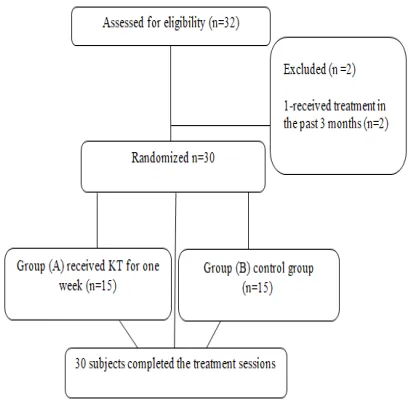
During the assessment of eligibility (fig. 1), two subjects were excluded because they had received treatment in the past three months. Thirty subjects received a verbal and written explanation of the purpose of this study; if they agreed to participate, they signed the consent form that was approved by the Faculty of Physical Therapy. Then, the allocation of subjects to the two groups was randomly performed by the distribution of sealed envelopes:
Group (A): subjects received KT twice per week for one week on the upper trapezius unilaterally in addition to instructions. Group (B): subjects did not receive any treatment, but they followed instructions for one week. All of subjects were ethically treated after the completion of the study.
Figure 1:Assessment of eligibility.
Inclusion and exclusion criteria
Subjects were involved in this research if they had active trigger points in the upper trapezius muscle unilaterally. The subjects had pain at rest, jump sign at pressure, limited ROM and referred pain[16]. Subjects were excluded if they had an allergy
to KT or a history of a whiplash injury, cervical spine surgery and any degenerative disease [17].
Outcome measurements
PPT was the primary outcome in this research and was assessed by a digital algometer (kg/cm2). The secondary outcome was
resting bioelectric activity in the form of the normalized root mean square (RMS). Assessments were performed before and after the completion of the study.
1. Pressure pain threshold assessment
A commander algometer (JTECH Medical, Midvale, Ut 84047, USA) was used to assess PPT. PPT is the lowest stimulus intensity at which a subject recognizes mechanical pain. To assess PPT, we asked the subject to determine the area of pain because they had active trigger points. All subjects had active trigger points at the middle of the transverse portion of the upper trapezius. The transducer probe tip (1 cm2) was applied
30 Journal of Advanced Pharmacy Education & Research | Jul-Sep 2019 | Vol 9 | Issue 3
Figure 2:PPT assessment.
2. Resting bioelectric activity
Assessment of muscle activity during the resting state was performed by a two-channel digital electromyogram device (Neuro-EMG-Micro, Neurosoft, Ivanovo, Russia) applied to the upper trapezius muscle unilaterally. Recording electrodes (one active and one reference) were positioned parallel to the muscle fibres with a distance of 2-3 cm between them, and the ground electrode was wrapped around the wrist joints[19]. The
skin overlying the upper trapezius and wrist joint was cleaned carefully with alcohol. Then, the active electrodes were placed 2 cm lateral to the center of a line drawn between the spinous process of C7 and the posterolateral acromion [20],and fixed by
self-adhesive plastic. The impedance was checked after the positioning of the electrode to confirm that it was at an acceptable level (<2 kΩ) [21].
Testing protocol:
1. Assessment of muscle activity in a resting
position
The subject was asked to relax as much as possible, and the resting amplitude was recorded [20].
2. Normalization of resting bioelectric activity
Normalization of the upper trapezius was performed according to the description ofMcLean, 2005. The subject was in a seated positioned and was asked to perform static contraction of shoulder abduction with the arm at 90° abduction and neutral shoulder rotation. Resistance was applied manually proximal to the elbow joint. Each contraction was maintained for 7 seconds and repeated three times with 30 seconds of rest in between [20].
3. Root mean square calculation
Normalized values were calculated as follows: Normalized RMS %=EMG amplitude during resting/ (average of EMGMAX for
the 3 trials) ×100[22].
Intervention
Treatment instructions
Group (A) and group (B) were given the following instructions
[23].
1) Be aware of your posture and change your neck position regularly.
2) Avoid prolonged static work.
3) Avoid lifting heavy weight on your head or shoulder.
Kinesio tape
Group "A" received an adhesive tape that is waterproof and porous (Kinesio Tex; Kinesio USA, Albuquerque, New Mexico). KT had a width of 5 cm and a thickness of 0.5 mm.
Application of KT
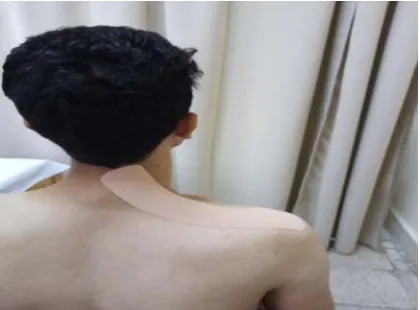
The subject was seated in a comfortable position. Then, the taped area was exposed, shaved and cleaned with alcohol. The measurement of the tape began from the origin of the muscle at the middle of the acromion to the insertion at the hairline on the nape of the neck. In the resting state, the base of KT was taped at the insertion site at the acromion. Then, the upper trapezius was stretched by applying side bending to the opposite side and rotation to the same side with slight flexion. KT was taped with 10% tension over the belly of the muscle to the point of origin. The tape was rubbed in the elongated muscle position[24] (figure3).
Figure 3:KT application
Statistical analysis:
The Shapiro Wilk test was used to assess the normality of the data. The variables (age, weight, height, BMI, and PPT) were normally distributed, but normalized resting bioelectric activity was not normally distributed. Therefore, all variables were tested with a parametric test (t-test: paired and unpaired), but normalized resting bioelectric activity was tested with a non-parametric test (z-test: Wilcoxon signed rank test and Mann-Whitney). We used SPSS version 23 (IBM Corp, New York, United States) to test the data. The level of significance was set at 0.05.
Results:
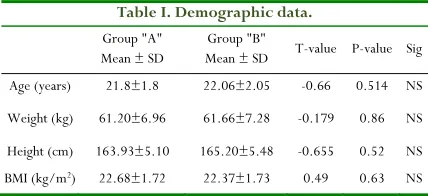
Journal of Advanced Pharmacy Education & Research | Jul-Sep 2019 | Vol 9 | Issue 3 31 Table I. Demographic data.
Group "A" Mean ± SD
Group "B"
Mean ± SD T-value P-value Sig Age (years) 21.8±1.8 22.06±2.05 -0.66 0.514 NS
Weight (kg) 61.20±6.96 61.66±7.28 -0.179 0.86 NS
Height (cm) 163.93±5.10 165.20±5.48 -0.655 0.52 NS BMI (kg/m2) 22.68±1.72 22.37±1.73 0.49 0.63 NS
Sig.: Significance, NS: Not significant, SD: Standard deviation, P: Probability value.
Outcome measurement results:
PPT results:
Paired t-test was used to determine the difference within each group. The pre-treatment mean ±SD for group (A) was 0.86 ±0.32, while the post-treatment value was 1.17±0.35. The difference between the pre- and post-treatment values was 0.31, and the percentage change was 36%. Paired t-test revealed a significant increase in PPT (p =0.0001 and t= -4.97).
The pre-treatment mean ±SD for group (B) was 0.83 ±0.34, while the post-treatment value was 0.95 ±0.42. The difference between the pre- and post-treatment values was 0.12, and the percentage change was 14%. Paired t-test revealed a significant increase in PPT (p=0.065 and t= -2). Unpaired t-test showed no significant difference between the pre-treatment or post-treatment PPT values of both groups (p=0.79 and t=0.27; and p=0.12 and t=1.6, respectively).
Normalized resting bioelectrical activity
results
The Wilcoxon signed ranks test was used to determine the difference within each group. The pre-treatment mean ±SD for group (A) was 3.82± 1.8, while the post-treatment value was 1.79 ± 0.96. The difference between the pre- and post-treatment values was 2.03, and the percentage change was 53%. The Wilcoxon signed ranks test revealed a significant decrease in bioelectrical activity (p <0.001 and Z= -3.35). The pre-treatment mean ±SD for group (B) was 3.46 ± 2.53, while the post-treatment value was 2.76±2.48. The difference between the pre- and post-treatment values was 0.7, and the percentage change was 20%. The Wilcoxon signed ranks test revealed no significant decrease in bioelectrical activity (p=0.31 and Z= -1.12).
The Mann-Whitney test showed no significant difference between the pre-treatment or post-treatment values of both groups (p = 0.367 and Z= -0.93; and p= 0.389 and Z= -0.87, respectively).
Discussion:
The aim of this study was to clarify the effects of KT on PPT and resting myoelectric activity in upper trapezius myofascial trigger points. The results of this study showed significant improvement in the KT group, but there was no significant
difference in the control group. Nonetheless, there was a percentage change in the control group. KT plays a major role in inhibiting myofascial pain by lifting the skin, which in turn leads to improvement in circulation, lymphatic drainage and decreased pressure on nociceptors [25]. In addition, Mense
(1993) stated that continuous stimulation of sensory receptors from muscles leads to neuropathic modification in posterior horn cells in the spinal cord excited by MTrP pain and closes the nerve ends, leading to a decreased pain level [26]. The change
in resting myoelectric activity in the KT group may be attributed to the type of application. Basset et al (2010) reported that the application of KT from insertion to origin produces eccentric pull on the underlying fascia that inhibits muscle activity [27].
The results of this study are in agreement with Ptaszkowski et al (2015) who investigated the effect of KT versus MET on resting bioelectric activity and VAS in upper trapezius pain. The results showed a decrease in muscle activity and VAS in the KT group
[12]. Additionally, Abdelfattah et al (2016) investigated the
effects of KT on upper trapezius myofascial trigger points. The consequences of this study informed changes in pain intensity (VAS and PPT) [28].
Similarly, Chao et al (2016) investigated the effects of manual pressure release alone or in combination with KT in subjects with trigger points. The measurements were muscle stiffness, PPT and mechanomyography. The consequences of this study showed improvement in all variables in both groups, but the group that received manual pressure release and KT achieved superior results [29]. Öztürk et al (2016) and Ay et al (2017)
investigated the efficacy of KT and sham KT on pain and PPT in upper trapezius MPS. At the end of this study, there was a significant improvement in pain and PPT with KT [6, 24].
In addition, Alotaibi et al (2018) reviewed the effectiveness of therapeutic programs that include KT on reducing the symptoms of MPS. This systematic review and meta-analysis were performed on six studies regarding the efficacy of KT on myofascial pain in the upper trapezius muscle. The meta-analysis suggests that the roles of KT with other therapeutic protocols are effective in the treatment of MPS [15].
The results of the present study are inconsistent with those of Halski et al (2015) who investigated the efficacy of KT and cross taping application in the management of latent trigger points. The authors measured the bioelectric activity of the upper trapezius and revealed no significant difference between pre-treatment, post-treatment and follow-up resting bioelectric activity. The lack of improvement in resting bioelectric activity in this study may be due to the treatment of latent trigger points
[30].
32 Journal of Advanced Pharmacy Education & Research | Jul-Sep 2019 | Vol 9 | Issue 3
common cause of trigger point formation because it leads to motor endplate damage and increases the production of acetylcholine. Therefore, when subjects follow the instructions, the possibility for trigger point formation may be decreased [31].
Limitation
Short treatment duration
Conclusion
KT is an effective method for increasing the level of PPT and decreasing muscle activity during the resting state in subjects with upper trapezius myofascial trigger points.
Conflict of interest
The authors declare that no conflicts of interest.
References
1. Shah JP, Thaker N, Heimur J, Aredo JV, Sikdar S, Gerber LH. Myofascial Trigger Points Then and Now: A Historical and Scientific Perspective. PM R. 2015; 7(7): 746-761.
2. Wytrazek M, Huber J, Lisin´ski P.Changes in muscle activity determines progression of clinical symptoms in patients with chronic spine-related muscle pain. Complex clinical and neurophysiological approach.Funct Neurol.2011; 26:141-149.
3. Meseguer AA, Fernández-de-las-Peñas C, Navarro-Poza JL, Rodríguez -Blanco C, Boscá Gandia JJ. Immediate effects of the strain/counter strain technique in local pain evoked by tender points in the upper trapezius muscle. Clin Chiropract; 2006; 9(3): 112-118.
4. Sibby M, Narasimman G, Vishal K. Effectiveness of Integrated Neuromuscular Inhibitory Technique and LASER with Stretching in the Treatment of Upper Trapezius Trigger Point. J Exer Sci Physiother. 2009; 5(2): 115-121.
5. Amir I, Sohrap K, Mohd M. Efficacy of ischemic compression technique in combination with strain counter strain technique in managing upper trapezius myofascial trigger point pain. Indian J Physiother Occup Ther. 2010; 4(2): 10-15.
6. Ay S, Konak HE, Evcik D, Kiba S. The effectiveness of Kinesio taping on pain and disability in cervical myofascial pain syndrome. Rev Bras Rheumatol Engl Ed. 2017; 57(2): 93-99.
7. Amin DI. Spray stretch technique versus progressive pressure release on treatment of myofascial pain trigger point: randomized controlled trial. Int J Physiother Res. 2017; 5(3):2101-07.
8. Saadat Z, Hemmati L, Pirouzi S, Ataollahi M , Ali-Mohammadi F. Effect of integrated neuromuscular inhibition technique on pain threshold and pain
intensity in patients with upper trapezius trigger points. J Bodyw Mov Ther. 2018; 22(4): 937-940.
9. Aguilar- Ferrándiz ME, Moreno-Lorenzo C, Matarán-Peñarrocha GA, Garcıa-Muro F, García-Ríos MC, Castro-Sánchez AM. Effect of a mixed kinesiotaping-compression technique on quality of life and clinical and gait parameters in postmenopausal women with chronic venous insufficiency: double-blinded, randomized controlled trial. Arch Physi Med and Rehab. 2014; 95(7): 1229–1239.
10. Aguilar-Ferrándiz ME, Castro-Sánchez AM, Matarán-Peñarrocha GA, Garcıa-Muro F, Serge T, Moreno-Lorenzo C. Effects of kinesio taping on venous symptoms, bioelectrical activity of the gastrocnemius muscle, range of ankle motion, and quality of life in postmenopausal women with chronic venous insufficiency: a randomized controlled trial. Arch Physi Med and Rehab. 2013; 94(12): 2315– 2328.
11. Gomez-Soriano J, Abián-Vicén J, Aparicio-García C, Ruiz-Lázaro P, Simón-Martínez C, Bravo-Esteban E, Fernández-Rodríguez JM. The effects of Kinesio taping on muscle tone in healthy subjects: a double-blind, placebo-controlled crossover trial. Man Ther.; 2014; 19(2): 131–136.
12. Ptaszkowski K, Slupska L, Paprocka-Borowicz M, et al. Comparison of the Short-Term Outcomes after Postisometric Muscle Relaxation or Kinesio Taping Application for Normalization of the Upper Trapezius Muscle Tone and the Pain Relief: A Preliminary Study. Evid Based Complement Alternat Med. 2015; 1-7. 13. Marianaa C, Carmen-Oana T. Massage versus Kinesio
Taping. Possibilities to Enhance the Kinetic Program in Mechanically Triggered Neck Pain. Procedia Soc Behav Sci .2014; 117: 639 – 645.
14. Skargren EI, Oberg BE. Predictive factors for 1-year outcome of low-back and neck pain in patients treated in primary care: comparison between the treatment strategies chiropractic and physiotherapy". Pain. 1998; 77(2): 201–207.
15. Alotaibi M, Ayoub A, King T, Uddin S. The Effect Of Kinesiotaping In Reducing Myofascial Pain Syndrome On The Upper Trapezius Muscle: A Systematic Review And Meta-Analysis. Eur Sci J. 2018; 14(6): 336-350. 16. Gary FB, Hodgson L. The effect of manual pressure
release on myofascial trigger points in the upper trapezius muscle. J Bodyw Mov Ther. 2005; 9(4): 248-255.
17. Hsieh YL, Kao MJ, Kuan TS, Chen SM, Chen JT, Hong CZ. Dry needling to a key myofascial trigger point may reduce the irritability of satellite MTrPs". Am J Phys Med Rehabil. 2007; 86(5): 397-403.
Journal of Advanced Pharmacy Education & Research | Jul-Sep 2019 | Vol 9 | Issue 3 33 19. Davoudi A, Haghighat A, Rybalov O, Shadmehr E,
Hatami H. Investigating activity of masticatory muscles in patients with hypermobile temporomandibular joints by using EMG. J Clin Exp Dent. 2015; 7(2):e310-e315.
20. McLean L. (): "The effect of postural correction on muscle activation amplitudes recorded from the cervicobrachial region". J. Electromyogr. Kinesiol. 2005; 215(6):527-35.
21. Falla D, Jull G, Edwards S, Koh K, Rainoldi A. Neuromuscular efficiency of the sternocleidomastoid and anterior scalene muscles in patients with chronic neck pain. Disabil Rehabil. 2004; 26 (12):712-7. 22. Larsson B, Karlsson S, Eriksson M, Gerdle B. Test–
retest reliability of EMG and peak torque during repetitive maximum concentric knee extensions. J. Electromyogr. Kinesiol. 2003; 13(3):281-7.
23. Huguenin LK. Myofascial trigger points: the current evidence". Phys Ther Sport. 2004; 5(1):2–12. 24. Öztürk G, Külcü DG, Mesci N, Şilte AD. Efficacy of
kinesiotape application on pain and muscle strength in patients with myofascial pain syndrome: a placebo-controlled trial. J Phys Ther Sci. 2016; 28(4): 1074– 1079.
25. Wu W, Hong C, Chou L. The Kinesio Taping Method for Myofascial Pain Control. Evidence-based complementary and alternative medicine": eCAM. 2015; Volume (2015), Article ID: 950519, 9 pages.
26. Mense S. Nociception from skeletal muscle in relation to clinical muscle pain. Pain. 1993; 54 (3):241- 289. 27. Basset KT, Lingman SA. Ellis RF. The use and
treatment efficacy of kinaesthetic taping for musculoskeletal conditions. N Z J Physiother.; 2010; 38 (2), 56-62.
28. Abdelfattah A, Kattabei O, Nasef S, Semaya A. Effect of kinesiotape in myofascial pain syndrome; Randomized Control Trial. The 4th European Congress of the ER-WCPT / Physiother.; 2016; Volume 102, Supplement 1, Page e140.
29. Chao WY, Lin JJ, Yang JL. Wang WT. Kinesio Taping and Manual Pressure Release: Short-Term Effects In Subjects With Myofascial Trigger Point. J Hand Ther. 2016; 29 (1): 23-29.
30. Halski T, Ptaszkowski K, Shupska L, et al. Short-Term Effects of Kinesio Taping and Cross Taping Application in the Treatment of Latent Upper Trapezius Trigger Points: A Prospective, Single-Blind, Randomized, Sham-Controlled Trial. Evid Based Complement Alternat Med. 2015; Volume (2015); Article ID: 191925, 9 pages.