http: // www.ijrtsm.com© International Journal of Recent Technology Science & Management
17
IJRTSM
INTERNATIONAL JOURNAL OF RECENT TECHNOLOGY SCIENCE & MANAGEMENT
“
DESIGN & PARAMETRIC STUDY OF SIZE REDUCTION MACHINE SWING JAW
PLATES USING FEM METHOD BY ANSYS, SOFTWARE
”
Akash Kumar Raikwar
1, Kamal Kant Tiwari
21M. Tech Scholar, Mechanical Engineering Dept., Oriental Institute of Science & Technology Bhopal,(M.P.), India 2
Assistant Professor, Mechanical Engineering Dept., Oriental Institute of Science & Technology, Bhopal,(M.P.), India
ABSTRACT
Crushers are the major size reduction machine used in the mineral mining and mechanical industries. It crushes hard and soft material to reduce its size. Nowadays, reduction ratio 1:7 machine are available. Swing jaw plates are the main wearing part of the crushers which directly takes part in crushing the stones. So, it lead for the design and analysis to be very important. Present work, is based on the work done by the researchers on the analysis of swing jaw plates, on which the static analysis have been done. in future there is still so many area of scope to develop and analyze swing jaw plate. With the help of CATIA software, a model of jaw plate is made, and importing this model to ANSYS , analysis is done. The change found during the analysis in the behavior of swing jaw plate is calculated. The modified Stiffened plate model is, estimated to reduce the consumption. of energy by 8%..
KEYWORDS: Jaw Crusher, Catia, Ansys, Stiffened-Jaw Plate, FEA, Swing jaw. Plate.
I. INTRODUCTION
Jaw crushers are the size reduction machines by the compression between the jaws. It were first manufactured in 1960.Double toggle type of crushers were first made. But today single toggle crushers is most popular today and is found in many crushing operations.jaw crushers are used for crushing the different variety of materials in mining, minerals, and steel industries. They are further used in recycling processes also. Jaw crushers are used for the size reduction of the materials, which is been, crushed in between the jaws plates in the crushers. Therefore, swing jaw plates are the weary part of the jaw crushers. Jaw crushers are probably the most easily recognized crushers in any quarry operation. They are also probably the oldest style of mechanical crusher, neglecting spalling hammers and stamp batteries.
http: // www.ijrtsm.com© International Journal of Recent Technology Science & Management
18 Fig.1 Jaw Profiles
In Today’s quarrying operations there are two styles of jaw crushers that are generally employed; single toggle and double toggle (or Blake) crushers. Over the years there have been other designs of jaw crushers, notably the horizontal pitman style and the Dodge machine. It is rare to find either of these machines today, as the crushers were limited in their ability to crusher hard materials at economical rates due to fairly inefficient transfer of crushing forces to the jaw plates.
Fig.2 Horizontal Pitman Jaw Crusher Fig.3 Dodge Jaw Crusher
The double toggle Blake machine is considered the original design of jaw crusher. It was designed in 1857 by Eli Whitney Blake after he was appointed to supervise the “macadamizing” of city streets in Westville, Massachusetts. He decided that the then-current method of breaking stone for this application was inefficient, and, being an inventor of some note, developed his Blake Stone-breaker. His design, with some comparatively minor improvements, can still be seen in mines and quarries all over the world today.
http: // www.ijrtsm.com© International Journal of Recent Technology Science & Management
19
In the double toggle machine the moving jaw (swing jaw) is pivoted at the top on the concentric swing-jaw shaft fitted with plain bushes, either in the frame of the crusher or in the swing jaw.
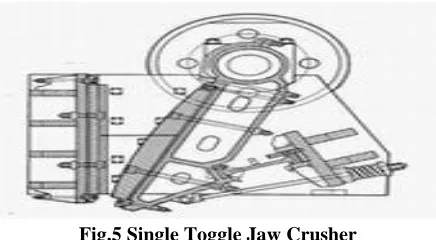
A reciprocating action is imparted to the swing jaw through the toggles, one either side of, and actuated by, the pitman, which is mounted to an eccentric shaft, generally with roller bearings. The eccentric shaft generally has two flywheels fitted, depending on the design of the machine. The swing jaw is held against the toggles by tension rods and springs. Adjustment of crusher setting is achieved by moving the toggle block (against the back of the mainframe) and adding or removing shims as required. The toggles are the overload protection devices for the machine, being designed to fail in the event of a crusher overload, thus protecting the main crusher components. A later development of the Blake design is the single toggle jaw crusher. These machines were originally called Roll Jaw Breakers due to the rolling crushing action imparted to the rock. They differ from the Blake design in that the pitman and the swing jaw are incorporated in the same component, removing the necessity for the second toggle plate and the swing jaw shaft, and providing a generally lighter machine for an equivalent size. Improvements in technology and subsequent design changes are allowing these machines to become more efficient than the double toggle type.
Fig.5 Single Toggle Jaw Crusher
Due to the different design of the single toggle crusher the moving jaw has an elliptical pattern to the stroke, as opposed to the direct reciprocating action of the double toggle machine. It was generally accepted that this elliptical motion means a shorter jaw plate life when compared to an equivalent double toggle machine, but improvements in jaw plate technology, including the design of reversible jaw plates, have largely negated this advantage. It has also been found that the combined grinding and compression action of the single toggle machine enhances the crushing capability.
Fig. 6 Crushing Actions
http: // www.ijrtsm.com© International Journal of Recent Technology Science & Management
20
II. OBJECTIVE OF WORK
The addition of stiffeners to swing jaw plate increase the strength / ratio which enables to save energy of the crusher machine, ultimately leading for a new energy efficient design of the jaw crusher. Plates with more no. of stiffener were stronger than without stiffener, when compare to strength / ratio point of view. The problem with the swing jaw plates today is their weight and they are the most wear-off part of the crushers. Due to the weight of the jaw plates, inertia of the jaw crusher increase too much. Mass of the plates are more likely to add more inertia to the crusher machine ,which require a more powerful motor to drive the eccentric shaft, also there will be more induced vibrations in the crusher. This cause maintenance cost, as well lower in the production capacity. To improve these consequences, swing jaw plates have been modified by the techniques of CAD-CAE. New modifications have been done, without affecting the material cost. Our problem is a simply supported beam with a hinged support at the other end. The static Structural analysis is done for the various plates sizes.
III. METHODOLOGY
3.1 Design of Jaw PlatesTotal energy consumption in the crushers is of major importance in the industries. There are many attempts are made to increase the strength / ratio, are common with the researchers. When the weight of the swing plate will decrease, it will consequently decrease the stiffness also. So to analyze for the energy saving in the jaw crushers while crushing the materials, relationship with the stress and deflection are studied with point load deformation. For such a investigation to be carried out, a model has been created using CATIA and FEA is done, by using ANSYS software. Firstly, various Swing jaw plates ranging from plate size thickness 140 mm to 224 mm were analyze and then by attaching stiffener numbers one by one up to four stiffeners. Effects of the stiffeners were analyzed.
Height of jaw plate ( H)= 4.0 x Gape Width of jaw plate (W) >1.3 x Gape < 3.0 x Gape
Throw (T) = 0.0502(Gape)0.85 where the crusher gape is in meters Crusher gape- meters.
Stiffener Size- 50 x 50 x 50 mm
For our work, we have chosen the crusher dimensions with, Top opening 304 mm and bottom opening 51mm.
3.2 Solid Modeling of Swing Jaw Plates
Various 3d model of Swing jaw plate has been made with different plate thickness. CATIA is a CAD software used to make different object, drawings and draft them in 2D or 3D. Here we have use the Catia for creating a model of swing jaw plate, which will further be imported to ANSYS software. Modeling can also be done on ANSYS, it is difficult to make and modify complex geometries in it, and requires knowledge in CAD.
But, in CATIA, with basic knowledge, our model has been created. 1) Go to file > New > Part > Ok
2) Selection of Axis plane, xy- plane is selected 3) Then > Sketcher, Draw the Sketch
http: // www.ijrtsm.com© International Journal of Recent Technology Science & Management
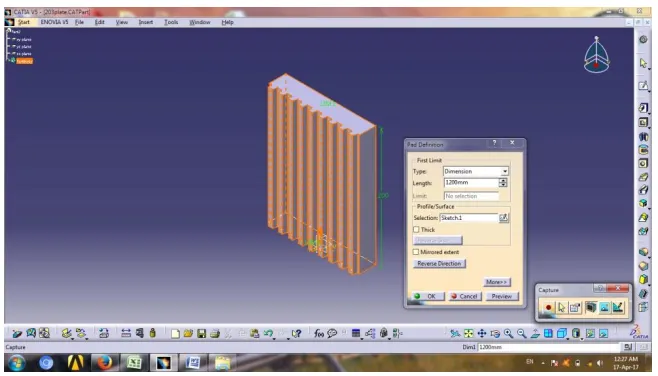
21 Fig. 7
Extruding the sketch
1) Invoke the Pad tool by clicking on it 2) Pad Button > Pad Definition
3) Ste length in the pad Definition dialog box to 1200mm % then OK
4) After OK, the Geometry is created Now, view the model in Isometric, by using the isometric view button. After extrude, our model is created, which is shown in the fig no.7
5) Save file & Close Also, save file in IGES format, to further import in ANSYS software
Fig. 8 Swing Jaw Plates Static Stress Analysis Using ANSYS 3.3 Assumptions
http: // www.ijrtsm.com© International Journal of Recent Technology Science & Management
22 3.4 Defining of Material Properties
Elastic Modulus (E) = 210 GPa, Mass Density (ρ) = 7440 kg/m, Poisons ratio (ν) = 0.3, Shear Modulus (Ф) =80.76 GPa, Yield Strength (Ys) =350MPa, Tensile ultimate strength = 940 MPa
Work Hardening Steel with Manganese=11-14% and Carbon = 1% )
Austenitic Manganese steel is produced to the had field specification .So, it gives optimum wear and work hardening properties and also it is non-magnetic. This steel has major application in crusher’s plates.
3.4.1 Chemical Composition
3.4.1 Chemical Composition
Materials Mn (%) C (%) Si (%) S (%) P (%)
ASTM 128 Gr B2
1.05 – 1.2 11.5 – 14 Less than 1.0 ---- Less than 0.070 Titus
Manganese
1.13 – 1.2 11.5 – 14 Less than 0.40 Less than 0.003
Less than 0.020
3.4.2 Mechanical Properties
YIELD Ultimate
tensile strength at 20° C (68°
F) Percentage Elongation CHARPY Kcvl 20°C (4°F) Brinells hardness
350 MPa 940 MPa (5d) >140J/sq.cm 220 to 540 51 KSI 136 KSI 40% 100 ft. lbs
Titus 11-14% Hadfield Manganese Vs Low Carbon Manganese 30-50% MORE SERVICE LIFE WITH INCREASED HARDNESS
Fig.9 Graph of hardness of Hadfield Manganese Vs Low Carbon Manganese
Brinell points of hardness have increase to more 100 value.
More hardness in the material due to 35% carbon.
http: // www.ijrtsm.com© International Journal of Recent Technology Science & Management
23
IV. MODELING
4.1 Swing Jaw Plates Static Stress Analysis with Stiffeners:
Fig.10 Meshing
4.2 Linear Static Stress and Deformation Analysis Results:
http: // www.ijrtsm.com© International Journal of Recent Technology Science & Management
24
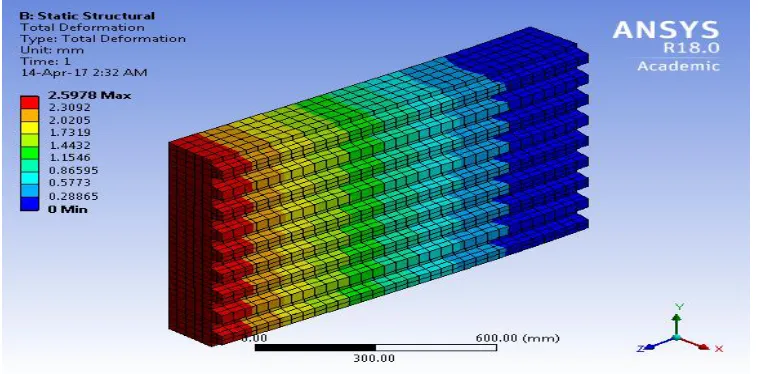
Fig. 12 Total Deformation
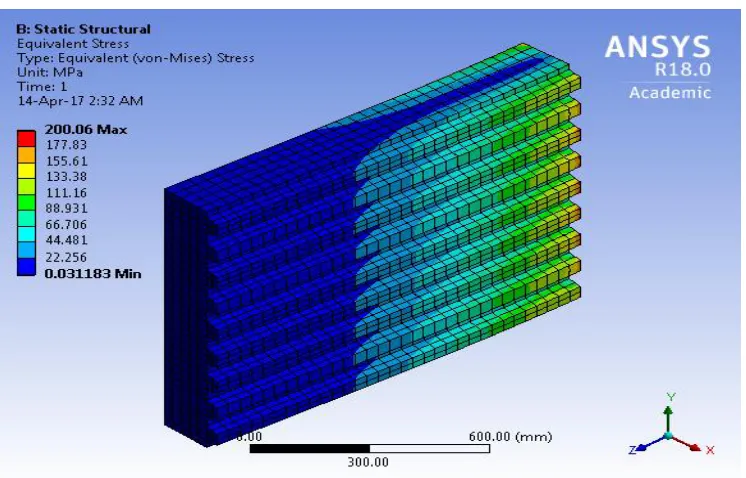
The results of the static stress analysis of the swing jaw plates with stiffener and without stiffener are shown in the below table. Which indicates that , there is much new improvements in the design of the swig jaw plates with stiffeners. With the more hardened and less sulfur content material, the stress bearing capacity of the swing jaw plates has increased with the addition of stiffeners, and this material ,manganese steel will surely give longer service life of the jaw plates.
4.3 Max. Tensile stress and maximum. Deflection on various thickness plates
Table.1
Jaw Plate
Max. Tensile
Stress
Max Deflection
Max
Thickness
(MPa)
(mm)
Driving
(in)
(mm)
ANSYS
ANSYS
Force (T)
Analysis
Analysis
(MN)
8.8
224
165.92
1.90
1.17
8.0
203
200.06
2.59
1.17
7.5
191
224.94
3.14
1.17
7.0
178
257.74
3.93
1.17
6.5
165
299.05
5.00
1.17
6.0
152
351.45
6.49
1.17
http: // www.ijrtsm.com© International Journal of Recent Technology Science & Management
25
Fig. 13 Max. Tensile Stress for Various Jaw Plate Thicknesses
4.4 Effect of stiffeners on various jaw plate thicknesses
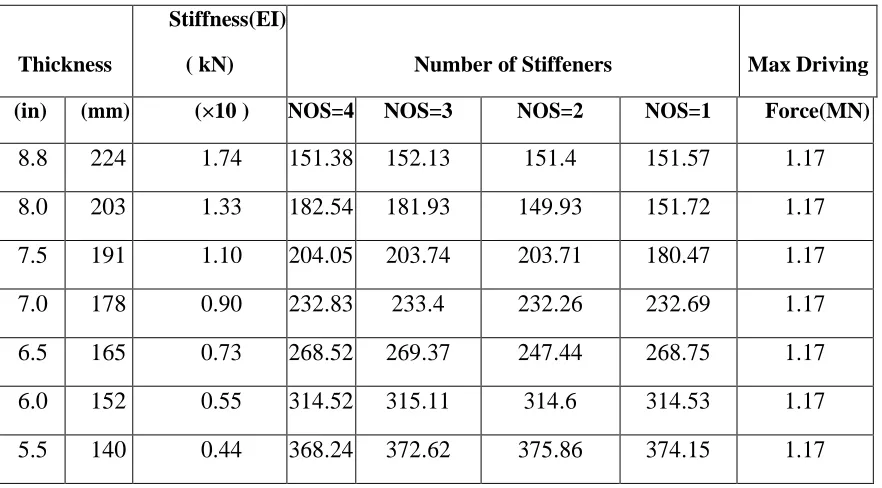
Table.2
Thickness
Stiffness(EI)
( kN)
Number of Stiffeners
Max Driving
(in)
(mm)
(×10 )
NOS=4
NOS=3
NOS=2
NOS=1
Force(MN)
8.8
224
1.74
151.38
152.13
151.4
151.57
1.17
8.0
203
1.33
182.54
181.93
149.93
151.72
1.17
7.5
191
1.10
204.05
203.74
203.71
180.47
1.17
7.0
178
0.90
232.83
233.4
232.26
232.69
1.17
6.5
165
0.73
268.52
269.37
247.44
268.75
1.17
6.0
152
0.55
314.52
315.11
314.6
314.53
1.17
http: // www.ijrtsm.com© International Journal of Recent Technology Science & Management
26
Fig. 14 Graph of stiffeners jaw plates stresses with corresponding plate thickness
4.5 Savings of Energy Using Stiffeners:
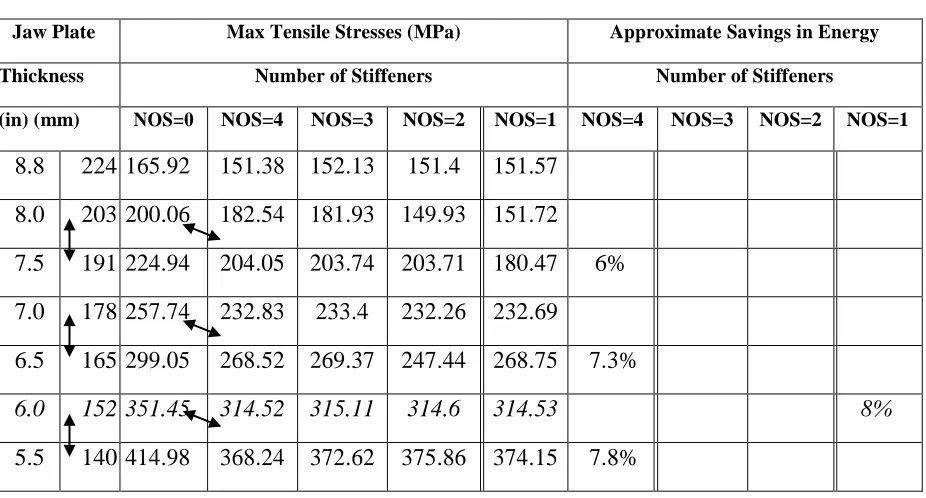
From the table date the Savings in energy were calculated, we came to find that, there is saving of energy, that means lower power motor can be used to drive the eccentric shaft ,which in turn gives the crushing movement to the movable jaw. Moreover, the strength / weight ratio has increased with stiffeners, which most importantly reduces the inertia of the jaw crusher. Thus the cost of the machine is also reduced, with decrease in maintenance
.
V. RESULT
5.1 Comparative data of Various Jaw Plates with and without stiffeners
Table. 3
Jaw Plate Max Tensile Stresses (MPa) Approximate Savings in Energy
Thickness Number of Stiffeners Number of Stiffeners
(in) (mm) NOS=0 NOS=4 NOS=3 NOS=2 NOS=1 NOS=4 NOS=3 NOS=2 NOS=1
8.8
224 165.92
151.38 152.13
151.4 151.57
8.0
203 200.06
182.54 181.93 149.93 151.72
7.5
191 224.94
204.05 203.74 203.71 180.47
6%
7.0
178 257.74
232.83
233.4
232.26 232.69
6.5
165 299.05
268.52 269.37 247.44 268.75
7.3%
6.0
152 351.45
314.52 315.11
314.6 314.53
8%
http: // www.ijrtsm.com© International Journal of Recent Technology Science & Management
27 NOS: 0 4 Weight plate Thickness 152mm size = 1127.6 kg
NOS: 0 1 Weight plate Thickness 152mm size = 1077.4 kg
So Weight reduction of jaw plate 152 mm size
= 1127.6 -1077.4 = 50 kg
VI. CONCLUSION
There is a reduction in the weight of the plates, which indicate for the design of a light weight machinery as a whole, with less inertia. In our result, it is found that the, stress bearing capacity of the various plates obtained from the analysis are enough to crush the material up to 414 MPa. Increase in the no. of stiffener also increases the strength / weight ratio of the plates. So, due to these reductions in the weight, there is indication of new design with more save in the energy. as the jaw plates material is saved ,the material costs also get reduced. with stiffener, strength of jaw plate is more ,than that of ja w plates without stiffener. The stiffened plate models leads to saving in energy by 8% approximately.
REFERENCES
1. Cao Jinxi, Qin Zhiyu, Wang Guopeng, “Investigation on Kinetic Features of Multi- Liners in Coupler Plane of Single Toggle Jaw Crusher”, Journal of Taiyuan Heavy Machinery Institute, July200.Pages 210-219
2. Dowding Charles H, Molling R, Ruhl C," Application of point load-deformation relationships and design of jaw crusher plates”, International Journal of Rock Mechanics and Mining Sciences & Geo mechanics, Volume 20,Issue 2, April 1983,Pages 277-286.
3. Gupta Ashok, Yan D.S. “Mineral Processing Design and Operation-An introduction”, Published by Elsevier, 2006, Pages 99-127.
4. DeDiemar R.B. “New concepts in Jaw Crusher technology”, Minerals Engineering, Volume 3, Issues 1-2, 1990, Pages
67-74
5. Briggs, C.A. and Bearman, R.A. “An Investigation of Rock Breakage and Damage in Comminuting Equipment”, Minerals Engineering, Volume 9, Issue 5, November 1996,Pages 489-497
6. Ramkrushna S. More, “A Design & Analysis of Swing Jaw Plates of Jaw Crusher”, International Journal of
Enhanced Research in Science Technology & Engineering, ISSN: 2319 -7463.Vol. 3 Issue 4, April-2014, pp:(400-408),Impact Factor: 1.252,
7. Investigation of Effect of Without Stiffener on Swing Jaw Crusher Plate by Finite Element AnalysisVirendrasinh N Dodiya1 Prof. Vijay Pipalia2 Prof. Dhaval P Patel
8. DR. k subramanyam, Kalapala Prasad Design and analysis of swing jaw plate with and without ribs volume 1, issue 12 (2016, Dec.) (ISSN-2455-6300) Online ANVESHANA’S INTERNATIONAL JOURNAL OF RESEARCH IN ENGINEERING AND APPLIED SCIENCES.
9. Computer Aided Design and Analysis of Swing Jaw Plate of Jaw CrusherM.AVULAIAH1, T.SESHAIAH ISSN 2319-8885 Vol.04,Issue.09, April-2015, Pages:1611-1616