Andrzej Lewandowski, Krystyna Markocka-Mączka, Krzysztof Grabowski
Esophagoplasty in Non-Standard Situations
Nietypowe przyczyny operacji wytwórczych przełyku
Department of Gastrointestinal and General Surgery, Wroclaw Medical University, Poland
Abstract
Background. Independent of the causes that make nourishment by the mouth impossible, the damage of the esophagus requires its reconstruction in which the stomach or a segment of the intestine is used. The kind of the productive intervention is determined by both anatomical and technical options and has to be chosen individually for each patient. Surgical procedures have to be performed in one or in a few stages.
Objectives. The paper presents esophagoplasty in non-standard situations.
Material and Methods. 5 patients of both sexes (F-1, M-4) were operated on in non-standard situations. The youngest woman was 21 years old and the oldest man was 65 years old. 1 woman was operated on because of esophageal atresia. 1 man because an injury of the neck with tearing of the throat, larynx and esophagus. 2 men because of Boerhaave’s syndrome. 1 man, because of invasive planoepitheliale carcinoma of the esophagus, had esophagectomy at the same time as gastric tube pull-up. 5 days after the operation, because of the ischemia and necrosis of the stomach, removal of the stomach, salivary fistula and jejunostomy was made. All the patients had supplementary esophagus made from right half of the colon.
Results. No complications were reported in the postoperative period. No one died. Radiographic (gastrographine) examina-tion was performed 7 days after surgery. The passage of contrast by the supplementary esophagus was efficient and patients began to consume liquids. 9 days after surgery, patients were able to consume all kinds of food. In the follow-up examina-tion, all patients described their quality of life as satisfying. They could eat different kinds of food with no dysphagia.
Conclusions. The kind of intestinal segment used for the esophagoplasty depends on the function of blood supply and technical options. Our experience shows that supplementary esophagus produced from a segment of the ileum and right half of the colon in an isoperistaltic arrangement are functionally better than other segments of the large intestine, particularly in an antiperistaltic arrangement (Adv Clin Exp Med 2011, 20, 4, 489–494).
Key words: supplementary esophagus, non-standard esophagoplasty.
Streszczenie
Wprowadzenie. Uszkodzenie przełyku, niezależnie od przyczyny, uniemożliwiające odżywianie się przez usta wymaga jego rekonstrukcji, do której wykorzystuje się żołądek lub uszypułowany segment jelita. Rodzaj zabiegu wytwórczego zależy od uwarunkowań anatomicznych oraz możliwości technicznych i musi być wybierany dla każ-dego pacjenta indywidualnie. Czasami operacje wytwórcze są wykonywane w jednym lub kilku etapach.
Cel pracy. Przedstawiono 5 chorych, u których wykonano zabieg wytwórczy przełyku z jelita grubego z powodu różnych i nietypowych przyczyn.
Materiał i metody. U 5 chorych (1 kobieta i 4 mężczyzn) wykonano plastykę przełyku. Najmłodsza pacjentka miała 21 lat, a najstarszy mężczyzna 65 lat. 1 kobieta była operowana z powodu wrodzonego zarośnięcia przełyku, 1 męż-czyzna z powodu urazu szyi z uszkodzeniem tchawicy, krtani i przełyku. 2 mężczyzn operowano z powodu zespołu Boerhaave. U 1 mężczyzny z powodu raka płaskonabłonkowego przełyku wykonano jego wycięcie i zespolenie prze-łykowo-żołądkowe. W 5. dobie po operacji z powodu martwicy żołądka usunięto go i wykonano przetokę ślinową na szyi i jejunostomię odżywczą. U wszystkich chorych przełyk zastępczy wykonano z prawej połowy okrężnicy.
Wyniki. W okresie pooperacyjnym nie stwierdzono powikłań. Nikt nie zmarł. Szczelność zespoleń sprawdzono radiologicznie kontrastem wchłanianym (gastrografina) w 7. dobie po zabiegu chirurgicznym. Pasaż kontrastu przez przełyk zastępczy był sprawny. Pacjenci odżywiali się samymi płynami, a od 9. doby stosowali dietę zwykłą. W badaniach kontrolnych wszyscy pacjenci określali jakość swojego życia jako satysfakcjonującą. Ich dieta jest różnorodna, nie mają trudności w połykaniu.
Wnioski. Rodzaj użytego segmentu jelita do wytworzenia zastępczego przełyku zależy przede wszystkim od jego ukrwienia i możliwości technicznych. W ocenie autorów przełyki zastępcze wytworzone z prawej połowy okrężnicy w ułożeniu izoperystaltycznym są funkcjonalnie lepsze niż z innych segmentów jelita grubego, zwłaszcza w ułoże-niu antyperystaltycznym (Adv Clin Exp Med 2011, 20, 4, 489–494).
Słowa kluczowe: przełyk zastępczy, niestandardowe przyczyny ezofagoplastyki.
Adv Clin Exp Med 2011, 20, 4, 489–494 ISSN 1230-025X
ORIGINAL PAPERS
A. Lewandowski, K. Markocka-Mączka, K. Grabowski
490
Congenital defects, cicatrical strictures, me-chanical damage and tumors of the esophagus are the conditions that cause difficulties in or even prevent the intake of nourishment in the natural way. At present, indications to the resection of the esophagus are first of all squamous cell carcinoma and benign cicatrical stricture, among which the most dominant are burns and post-reflux. Consid-erably more rare indications are megaesophagus, some causes of benign tumors, malignant medias-tinum tumors infiltrating the esophagus, and me-chanical damage of the esophagus, when the range of irreparable changes exclude the possibility of non-invasive treatment [1–3]. The blood supply of the esophagus has a segmental character. It comes from inferior thyroid arteries, a few small arteries coming from the aorta (mostly in the number of 6), branches of the diaphragm, bronchial and gas-tric left arteries. These vessels join with each other and create collateral circulation situated mainly in the submucous layer of the esophagus.
In spite of this connection, all trials of local resection of the esophagus and direct end-to-end joining inevitably ended in the development of ischaemia and incoherence of connections or, in the best case, an increase of the stricture.
A big difficulty while making an esophageal junction is the lack of the covering of this organ with serum membrane. Experimental research conducted on animals showed that, among all sec-tions of the alimentary track, the esophagus is the one that heals the most slowly. Practically, local resection of the esophagus is never carried out, only complete ones are made. Gastric pull-up is the method of choice in the reconstruction of the esophagus due to malignant tumors of this organ. The large intestine is subsequent after gastric pull-up as the substitute for the esophagus in recon-structions due to cancer, however it is the organ of choice in non-malignant causes.
The paper presents esophagoplasty in non-standard situations.
Material and Methods
In our department in last sixty years, about 500 esophagoplasties were made. Of those, 5 patients of both sexes (F-1, M-4) were operated on in a non-standard situation. The youngest woman was 21 years old and the oldest man was 65 (Tab.1).
Case 1
In the female, 21 years old, atresia of the esophagus was affirmed in the first day after birth when, as a matter of urgency, she was operated on. A right-side thoracotomy was performed and a 7 cm long esophageal atresia was found (classi-fication system Gross type A). In such conditions, no reconstruction, only nutritional gastrostomy as well as cervical salivary esophagostomy were made.
Despite many years of receiving nourishment only through gastrostomy, both physical and psy-chological development were good. The patient graduated from secondary school and passed her driving test. During consecutive check-ups, the patient was never qualified by the pediatric sur-geon for esophagoplasty.
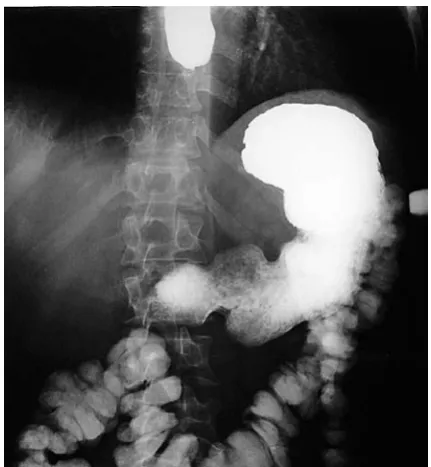
An X-ray examination after oral contrast ap-plication showed the section of the esophagus 3 cm wide reaching up to Th2 (Fig. 1). Contrast passed
by gastrostomy affirmed the correct passage by distant sections of the alimentary tract.
Supplementary esophagus was made when the patient was 21, from the ileum and right half of the colon on the colic right and median vessels in an isoperistaltic arrangement.
Table 1. Clinical material
Tabela 1. Materiał kliniczny No
(Nr) Sex(Płeć) Age(Wiek) The cause of esophageal reconstruction(Przyczyna rekonstrukcji przełyku) The way of esophageal reconstruction(Sposób rekonstrukcji przełyku) 1 F 21 congenital esophageal long-gap atresia right half colon
2 M 53 post-traumatic damage of cervical part of esophagus right half colon 3 M 65 spontaneous esophageal perforation/Boerhaave’s
syndrome right half colon
4 M 55 spontaneous esophageal perforation/Boerhaave’s
syndrome right half colon
5 M 64 gastric tube necrosis used for reconstruction after
Case 2
A 50 year old man, a woodcutter, sustained an injury of the neck with tearing of throat, lar-ynx and esophagus. As a matter of urgency, a tra-cheotomy, salivary fistula and gastrostomy were made. Esophagoplasty was made 3 years after the injury from the right half of the colon on the left colic vessels in an isoperistaltic arrangement. The junction of the pharynx with the large intestine was executed because of the severe damage to the esophagus (Fig. 2).
Case 3
During a Mediterranean cruise, a 55 year old seaman experienced spontaneous rupture of the esophagus – Boerhaave’s syndrome, as a result of which he developed purulent mediastinitis and septic shock. He was originally treated abroad, where a salivary fistula was made in the cervical section of the esophagus with the far section of the esophagus pulled out on the skin below the salivary fistula (Fig. 3). The esophagus was closed 6 cm above the diaphragm (Fig. 4). Drainage of the right pleural cavity and gastrostomy was made.
During a subsequent surgery, after 6 months, a transhiatal esophagectomy was made. Addi-tionally, because of the impaired emptying of the stomach, pyloroplasty was performed.
Fig. 1. Female with esophageal atresia. X-ray of cervi-cal part of the esophagus and a sketch of the type of the atresia – type A (case 1)
Ryc. 1. Pacjentka z wrodzonym zarośnięciem przełyku – zakontrastowany szyjny odcinek przełyku oraz sche-mat typu atrezji przełyku – typ A (przyp. 1)
Fig. 2. X-ray of patient after the neck injury. Cervical colo-pharyngeal junction and tracheostomy (case 2)
Ryc. 2. Pacjent po urazie szyi po zabiegu odtwórczym przełyku – widoczne zespolenie zastępczego przełyku z gardłem oraz tracheostomia (przyp. 2)
Fig. 3. Endoscopy showed salivary fistula in cervical of the esophagus. The arrow below shows the section of the esophagus with stitches in skin of the man with Boerhaave’s syndrome (case 3)
A. Lewandowski, K. Markocka-Mączka, K. Grabowski
492
The final solution, assuring the natural way of receiving nourishment, was esophagoplasty made from the ileum and right half of the colon on the ileocolic vessels in an isoperistaltic arrangement.
Case 4
A 65 year old man was admitted in our depart-ment in a generally severe state with developed septic mediastinum and septic shock after spon-taneous rupture of the esophagus. For many days prior to admittance, the patient had been drinking alcohol heavily. The chest pain occurred after the abundant vomiting. An X-ray examination and endoscopy investigation confirmed an inveterate rupture of 5 cm, in the supradiaphragmatic part of the esophagus on the left side (Fig. 5). Due to the serious condition, in the first stage, a salivary fistula in the cervical part of the esophagus, a gas-trostomy, and drainage of the left pleural cavity and mediastinum were made.
Because of the reflux into the esophagus while receiving nourishment through the gastrostomy, the next intervention was the closing of the esoph-agus above the cardia and pyloroplasty. After healing of the inflammation of the mediastinum and left pleural cavity, supplementary esophagus was made from the ileum and right half of the
colon on the ileocolic vessels in an isoperistaltic arrangement.
Case 5
A 64 year old man underwent an esophagectomy with gastric pull-up because of invasive planoepithe-liale carcinoma of the esophagus. The operation was made in another center. Due to the ischaemia and necrosis of the stomach, the patient was operated on again after 5 days and the removal the stomach, sali-vary fistula and jejunostomy were made. 3 months later, in our department, in order to recreate the con-tinuity of alimentary tract, supplementary esophagus was made from the right half of the colon on the ileo-colic vessels in an antiperistaltic arrangement.
Results
No complications were reported in the postop-erative period. No one died. A radiographic (gastro-graphine) examination was performed 7 days after surgery and the patients began to consume liquids. 9 days after surgery, the patients were able to con-sume all kinds of food. The passage of contrast by the supplementary esophagus was efficient. All the pa-tients described their quality of life as satisfying. They could eat different kinds of food with no dysphagia.
Discussion
Peristalsis is indispensable for the correct func-tion of the supplementary esophagus, assuring the ef-ficient transportation of the food from the oral cavity
Fig. 4. The same patient, X-ray examination. Contrast taken by gastrostomy and distance section of the esophagus. Distance shown between the esophagus and stomach (case 3)
Ryc. 4. Radiogram po wypełnieniu kontrastem żołądka (przez gastrostomię) oraz dalszego odcinka przełyku zamkniętego na głucho (przez przetokę skórną wyłonioną w odcinku bliższym) (przyp. 3)
Fig. 5. Left side esophago-pleural fistula (case 4)
to the stomach or intestine. Therefore, the choice of the most suitable segment of the intestine and its ar-rangement plays an important role in later function. The best substitute for the esophagus is the jejunum, but it is rarely used in esophagoplasty because of an unfavorable blood supply. Practically, the most often used substitute in esophagoplasty, the gastric pull-up or large intestine is used. In all the cases presented, the right half of the colon was used.
Among congenital defects, long-gap obstruc-tion of the esophagus is a large clinical problem. It arises from the impossibility of creating the pri-meval junction of the esophagus which is the most favorable solution with respect to both anatomical and functional matters.
When there is no possibility of performing ei-ther a primeval or delayed junction, reconstructive procedures are the methods of choice [4–8].
Regardless of the method of treatment, it should be finished in childhood, even if it needs to be prolonged till pre-school age.
Leaving the patient till adulthood with salivary fistula and being nourished through gastrostomy is a considerable risk for physical development and creates psychological problems for child itself as well as its minders.
Extensive injury to the neck with the cutting of the larynx and esophagus, such as presented in case 2, in the first stage requires life-saving inter-ventions, but first of all the assurance of the pa-tency of the respiratory tract.
Supplementary esophagus was executed as the last stage of the treatment.
Such extensive injury to the neck which doesn’t result in the patient`s death on the scene is quite rare. Spontaneous rupture of the esophagus,
Boer-haave syndrome, belongs to the rare diseases of the esophagus and, although its course is usually dramatic, the disease creates diagnostic difficulties and correct diagnosis is usually not made until the septic state is increasing.
Early diagnosis of a spontaneous rupture of the esophagus makes it possible to apply meth-ods that save the organ, such as a primeval suture, video-assisted thoracoscopic surgery, endoscopic stenting or clipping [9–12].
In the case of septic shock, the only life-saving procedure is, unfortunately, complete resection of the esophagus.
Both cases presented (3 and 4) required dis-connection of the esophagus in the initial stage of the treatment, and performing a substitute esopha-gus in the final stage as the only possible solution. Cancer of the chest and abdominal part of the esophagus determines an indication to esophagec-tomy.
Gastric pull-up is most commonly used in reconstruction for providing continuity of the ali-mentary tract [13]. In the case presented, this latter solution was applied, but complications developed after the operation, such as necrosis of the stom-ach, and caused the necessity of performing a sub-stitute esophagus from the large intestine.
In conclusion, the kind of intestinal segment used in esophagoplasty depends on the function of blood supply and technical options.
Our experience shows that supplementary esophagus produced from a segment of the ileum and right half of the colon in an isoperistaltic ar-rangement is functionally better than other seg-ments of the large intestine, particularly in an an-tiperistaltic arrangement.
References
[1] Bothereau H, Munoz-Bongrand N, Lambert B, Montemagno S, Cattan P, Sarfati E: Esophageal reconstruction after caustic injury: is there still a place for right coloplasty. Am J Surg 2007, 193, 660–664.
[2] de Schipper JP, Pull ter Gunne AF, Oostvogel HJ, van Laarhoven CJ: Spontaneous rupture of the esophagus: Boerhaave’s syndrome in 2008. Literature review and treatment algorithm. Dis Surg 2009, 26, 1–6.
[3] Matsuda T, Kaneda K, Takamatsu M, Takahashi M, Aishin K, Awazu M: Reliable preparation of the gastric tube for cervical esophagogastrostomy after esophagectomy for esophageal cancer. Am J Surg 2010, 199, e61–e64.
[4] Randjelovic T, Dikic S, Filipovic B, Gacic D, Bilanovic D, Stanisavljevic N: Short-segment jejunoplasty: the option treatment in the management of benign esophageal stricture. Dis Esophagus 2007, 20, 239–246.
[5] Holland AJ, Ron O, Pierro A, Drake D, Curry JI, Kiely EM, Spitz L: Surgical outcomes of esophageal atresia without fistula for 24 years at a single institution. J Pediatr Surg 2009, 44, 1928–1932.
[6] Burgos L, Barrena S, Andrés AM, Martinez L: Colonic interposition for esophageal replacement in children remains a good choice: 33-year median follow-up of 65 patients. J Pediatr Surg 2010, 45, 341–345.
[7] Kovesi T, Rubin S: Long-term complications of congenital esophageal atresia and/or tracheoesophageal fistula. Chest 2004, 126, 915–925.
[8] Zhang Z, Huang Y, Su P, Wang D, Wang L: Experience in treating congenital esophageal atresia in China. J Pediatr Surg 2010, 45, 2009–2014.
[9] Takada K, Matsumoto S, Hiramatsu T, Kojima E, Shizu M, Okachi S, Ninomiya K, Morioka H: Spontaneous pneumomediastinum: an algorithm for diagnosis and management. Ther Adv Respir Dis 2009, 3, 301–307.
A. Lewandowski, K. Markocka-Mączka, K. Grabowski
494
[11] Johnsson E, Lundell L, Liedman B: Sealing of esophageal perforation or ruptures with expandable metallic stents: a prospective controlled study and treatment efficacy and limitations. Dis Esophagus 2005, 18, 262–266.
[12] Cho S, Jheon S, Ryu KM, Lee EB: Primary esophageal repair in Boerhaave’s syndrome. Dis Esophagus 2008, 21, 660–663.
[13] Shimakawa T, Naritaka Y, Wagastuma Y, Konno S, Katube T, Ogawa K: Modification of the procedure for esophageal reconstruction after resection of esophageal cancer. Hepatogastroenterology 2006, 53, 372–375.
Address for correspondence:
Andrzej Lewandowski
Department of Gastrointestinal and General Surgery Wroclaw Medical University
Skłodowskiej-Curie 66 50-369 Wrocław Poland
Tel.: +48 71 600 177 907 E-mail: [email protected]
Conflict of interest: None declared