DEVELOPMENT OF A WEB-BASED CONTROL AND ROBOTIC
APPLICATIONS LABORATORY FOR CONTROL ENGINEERING
EDUCATION
Ahmet Emin Kuzucuoglu
1,*, Gokhan Erdemir
2 1Marmara University, Faculty of Technical Education Department of Electronics and Computer Education, Istanbul, Turkey
email: [email protected]
2
Michigan State University, Department of Electrical and Computer Engineering East Lansing MI, USA
email: dcapko [email protected]
Abstract. In this paper, a particular case of a pedagogically successful, dynamic, real-time and efficient web-based experiment platform (WBEP) design for control engineering education is presented. The design and construction of a multi purpose and WBEP for the application of liquid flow control, liquid filling level control, liquid flow-filling control (MIMO) and robot arm control for control engineering education is the main purpose of this study. The expe-riment platform designed and constructed consists of three main stations: liquid flow station, liquid filling station and a 5 DOF robot arm. The platform provides monitoring, real-time control and programming of each station for experi-mental studies and, it allows to users conduct these studies through a standard web browser without any additional supporting or supplementary software.
Keywords: process control; real-time control; robot control, web based control; web based education.
* Corresponding author.
1. Introduction
The World Wide Web has provided an opportunity for design and analysis of control systems over the Internet. An increasing number of Web-based software packages have been developed to enhance the teaching and design of control systems [1]. For the last decade, Web-based real-time laboratories have played an important role in technical education.
Laboratory experiments are the most important part of a robotics education, since students can apply and verify in practice the theoretical knowledge acqui-red during lectures [2-6]. One of the aims in robotic education, therefore, is to teach the techniques and possible challenges of theoretically-based design me-thods when applied in practice. Experimental study is the most important part of robotic education, but expe-rimental studies can be conducted using different methods. One of them is the traditional method. Tradi-tional experimental studies cover any method that involves conducting experiments in a real, physical laboratory at specific time. In this type study, students must be present in the laboratory during the ex-perimental study period and all experiments must be
performed by students. The traditional method has been a solution so far, but time and location depen-dency can and should be eliminated using today's technologies. Making this possible is the main goal of this study. While it could be argued that simulations could also be a suitable tool to achieve this aim; how-ever, in most cases they cannot replace a real experi-ment. Simulations, by definition, give only approxi-mations of actual behavior [4, 5]. For robotic courses, a student should be able to design and develop a new algorithms in a real system that matches a given per-formance requirement within a real plant environment [2-7]. Laboratory courses are, for this reason, of the utmost importance to gain practical experience.
A solid education that is relevant to real-world conditions depends on a well-equipped laboratory that provides a range of different experiments [6]. This in-volves a considerable investment. On the other hand, there is a restricted access to an experiment due to organizational factors (e.g. laboratory course is not being offered, instructors are not available, etc.) which impose rigid time schedules [3-6]. Furthermore, the students have access only to experiments offered by one institution or facility. As a result of the availability
of digital computers and technical progress of com-munication and information sciences, this innovative potential can be used to develop remote laboratory courses. The nearly omnipresent World Wide Web (WWW) successfully demonstrates how current tech-nology can support sharing information among large dispersed groups [6]. Significant functionality in transmitting information and an effective mechanism for integrating tools into a single interface are the main reasons for using the WWW for educational purposes. The advantages in having a Web-based re-mote laboratory can be summarized as follows [1-7]:
x Different experiments: access to experiments at different institutions or locations,
x More experiments: experiments can be done in short time, and also students can make more ex-periment without time and place dependencies,
x Flexible time-schedules: experiments can be acces-sed 24 hours a day,
x Saving instructors: virtual education shifts simulta-neously from the lecturer-oriented to the student-oriented type of teaching,
x Saving equipment costs: expensive experiment can be shared among laboratories.
Although the lack of a direct physical contact to the experiment may lead to a loss of ‘practical
feeling’, it can be compensated for with enhanced multimedia components and is outweighed by the ad-vantages of giving students access to an enhanced number of more diverse experimentation opportunities [6]. And just one student works in this system, and during experiment time other students only see experiment results. In the following section, a new web – based robotic laboratory approach will be de-scribed, which tries to obtain the necessary "close-ness" to the experiment [1-7].
2. Design Structure of Web Based Experimental Set
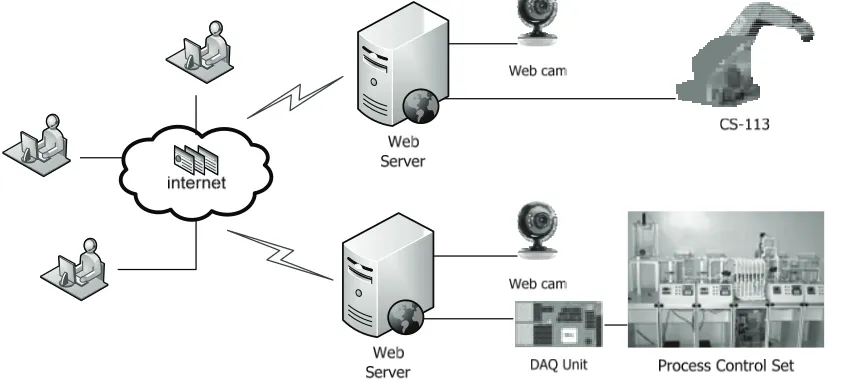
One important aspect when designing a remote lab is to keep all hardware components as simple as possible to guarantee fast and effective maintenance [1-8]. The modular structure of the remote lab pro-posed is shown in Figure 1. The main components are servers, webcams, data acquisition card (DAQ), client, Process Control unit and robot arm. The process cont-rol set is shown in Figure 2 and was established at the Marmara University, Mechatronics Education Depart-ment. The 5 DOF robot arm is shown in Figure 3. It was built at the Marmara University, Electronic and Computer Education Department.
Figure 1. Structure of system designed
2.1. Process Control Set
The Process Control Set may be used in basic vocational training, advanced training and retraining. With the stations of the Process Control System, the processes of filling level and flow control can be tested [4, 9]. The process control set is shown in Fig.2. The system consists of individual modules that can be combined in various ways. The following stations are available:
x Flow control station,
x Filling level control station,
2.2. DOF Robot Arm
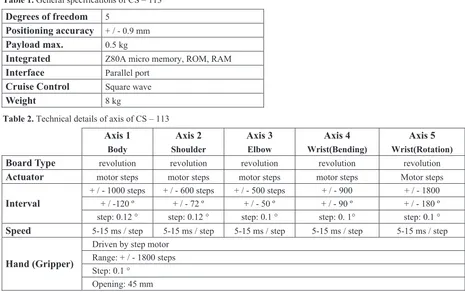
A CS – 113 industrial-type robot arm was used for the robotic application. It is shown in Fig.3 and controlled by RoboNet, which is explained in detail in the next section of this article. The general specifications of the CS – 113 are provided in Table 1 and the technical details of the axis of the CS – 113 are given Table 2 [5].
Figure 3. View of 5 DOF robot arm (CS 113)
Table 1. General specifications of CS – 113
Degrees of freedom 5
Positioning accuracy + / - 0.9 mm Payload max. 0.5 kg
Integrated Z80A micro memory, ROM, RAM Interface Parallel port
Cruise Control Square wave
Weight 8 kg
Table 2. Technical details of axis of CS – 113
Axis 1 Axis 2 Axis 3 Axis 4 Axis 5
Body Shoulder Elbow Wrist(Bending) Wrist(Rotation)
Board Type revolution revolution revolution revolution revolution
Actuator motor steps motor steps motor steps motor steps Motor steps
+ / - 1000 steps + / - 600 steps + / - 500 steps + / - 900 + / - 1800 + / -120 º + / - 72 º + / - 50 º + / - 90 º + / - 180 º Interval
step: 0.12 ° step: 0.12 ° step: 0.1 ° step: 0. 1° step: 0.1 ° Speed 5-15 ms / step 5-15 ms / step 5-15 ms / step 5-15 ms / step 5-15 ms / step
Driven by step motor Range: + / - 1800 steps Step: 0.1 °
Hand (Gripper)
Opening: 45 mm
2.3. Server Software
Two different types of server software were designed and developed, because these two systems were established in different places. The first server’s software is the Remote Lab Control (RLC), which is shown in Fig. 4. The RLC was designed and programmed with Visual C#.NET and National Instruments Measurement Studio [4, 7, 10] and is responsible for not only controlling liquid level and flow systems but also security and safety applications. (Safety applications are explained in Section 2.6.) The communication between the Web pages and server is performed through the RLC’s engine interface. Thus, RLC commands are sent to the Process Control Set through a Dynamic Link Library (DLL) attached to the Web server, to get or set parameters of the RLC model and to operate the experiment. The RLC is also responsible for video capture. The advantage of this configuration is that new experiments with different
physical structures can be easily set up, since one can directly write a new server-side program [4, 7].
The second server’s software is RoboNET, which is shown in Figure5. It was designed in 2005 by the authors to manipulate robot arms using web–based controls. The communication between the Webpages and server is performed through the RoboNET’s
en-gine interface. As with the RLC, RoboNET commands are sent to CS-113 robot arm through a Dynamic Link Library (DLL) attached to the Web server, to get or set parameters of the RLC model and also to operate the experiment.
Figure 5. Server Interface of the 5 DOF robot arm (RoboNET)
2.4. Video Transmission
Video transmission is provided via a web camera, which is connected to a video capture interface, respectively [2-6, 8]. This interface is included in the communication server performing video transmission to provide a sense of "closeness" to the experiment.
2.5. Web Interfaces (GUI)
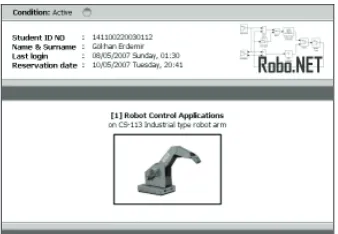
Web interfaces consist of a web browser, which runs on the student's computer, to access and operate the remote experiment [4, 7]. The Web page necessary to control the experiment is organized in the form of a control panel. ASP.NET, JavaScript and National Instruments Measurement Studio have been used to organize all actions of Process Control set [10, 11]. A web interface for robot control applications is shown in Figure 6. It is called RoboNET and was designed using ASP.NET and JavaScript.
Figure 6. GUI of Robot Control Applications (RoboNET)
For both systems, the main operating actions are located in the general control panel frame, since these actions do not vary based on the type of experiment. The specific commands to operate the plant, as well as parameters to modify the characteristics of the refe-rence signal and of the implemented controller, are found in the user console panel [5, 11-14]. Sliders are used to enter continuous data and to facilitate opera-ting the plant. Although the user can inspect the plant by the web camera, a graphical representation of mea-sured signals are required to show small variations [4-7, 12]. The diagrams are generated remotely on the communication server using NI Measurement Studio graphical components. In order to achieve both opti-mal speed and results, these diagrams are directly transferred to the Webpage [4, 7, 13]. Web pages have three different interfaces for On-Off, PID and Fuzzy controllers. The web user experiment interfaces are shown in Figure 7 for On-Off controller, PID Control-ler and Fuzzy controlControl-ler, respectively..
a. On-Off Controller GUI of RLC b. PID Controller GUI of RLC c. Fuzzy Controller GUI of RLC
Figure 7. Process Control Applications GUI
2.6. Safety Measures
The following safety and security measures have been taken to ensure the proper functioning of the vir-tual laboratory system:
x Emergency stop: Able to terminate not only all internet and peer-to-peer connections but also voltage sources, at which time a pre-designated person responsible for the system is automatically notified by phone,
x Command delay filter: A safety module that reverts to the previous position of the system if commands cannot be reached in sampling time,
x Collision detection: Prevents multiple connections to the system at the same time,
x Access termination: It blocks all requests to system when it is in use by another user.
3. Case Studies
3.1. Experiments on the Process Control Set
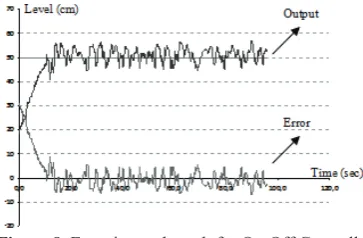
In this section experimental results will be shown graphically and discussed for On-Off, PID and Fuzzy Controller [4]. In these experiments, measured results are shown in Figure 8, 9 and 10 graphically from 20 cm. to 50 cm, respectively, the liquid tank level was monitored by different controllers.
Figure 8. Experimental result for On-Off Controller
3.2. Experiments on Robot Control Set
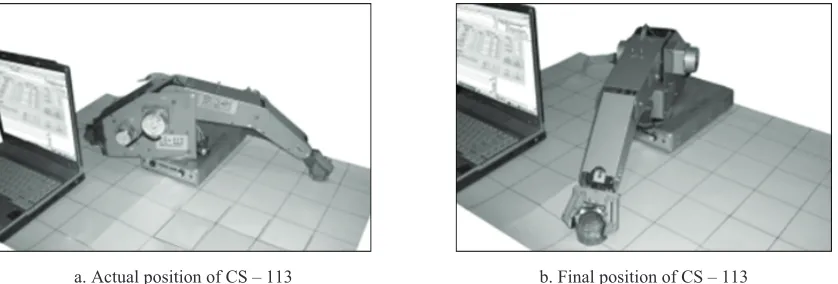
In the sample experiment conducted with Robo-NET, the behavior expected from the system was that, from a starting position, it takes an object and moves it to a different specified position. Target position values of robot arm were sent to the CS-113 by using
RoboNET software which was illustrated in Figure 5. Actual and target position values of the CS-113 are shown in Table3. Figure 11a shows the state and posi-tion of the robot prior to sending of these values to the robot. Figure 11b, on the other hand, shows the loca-tion of the robot after the localoca-tion data were relayed to the CS-113 [5]. In this exercise, the open loop control was applied. All commands were sent to the CS-113 directly. And also, movement and final position of arm were showed in web interface, which was illustrated in Figure 6, of RoboNET at the same time.
Figure 9. Experimental result for PID Controller
Figure 10. Experimental result for Fuzzy Controller
Table 3. Experiment results of Robot Arm
Actual Position
Target Position
Joint Angle Angle
Body 220 o 104 o
Shoulder -60 o -55 o
Elbow -20 o -24 o
Wrist (Bending) 30 o 30 o
Wrist (Rotation) 22 o 22 o
a. Actual position of CS – 113 b. Final position of CS – 113
Figure 11. Experiment results of CS-113
4. Conclusion & Future Work
In this paper, the design and development of web-based laboratory experiments on liquid level- flow system and a robot manipulator have been examined and their impact from both teaching and research points of view has been discussed. New and attractive features, such as a web-camera capturing real-time vi-deo, have been incorporated [4-7, 12-16]. Our ap-proach comes to propose the supervision and the control of a Web-based real laboratory, in order to minimize the process access time obstacle when per-forming online laboratory operations.
Another important objective of this project is to ensure that laboratories, which are expensive to estab-lish, do not remain idle after certain times but rather to open that unutilized time to utilization by students either in their own time or, optimally, in other time zones [15-17]. The RoboNET and RLC software de-scribed in this paper and for which the accompanying experimental results have been provided, move the experimental apparatus online into a virtual environ-ment in a fashion that is both efficient and secure and do so without requiring additional expenditure. Use of systems of this type will help to ensure optimal utili-zation of laboratory facilities by effectively removing the constraints of time and location.
In subsequent work, main objective is to develop a new software module that will allow for web-based control of mobile robots. By doing this, main objec-tive of us is to move all apparatus required for control and robotics education courses into an online, virtual environment. The step following that will be to com-bine all software modules into an integrated software architecture which will then be converted into a soft-ware package that will be opened up to use by any interested institution providing vocational or technical training anywhere in the world.
Acknowledgments
The authors would like to express their gratitude to the Marmara University, Department of Mechatronics Education and Dr.Erkan Kaplanolu for their support.
References
[1] Q. Yu, B. Chen, H.H. Cheng. Web based control sys-tem design and analysis. IEEE Control Syssys-tems Maga-zine, Vol. 24, Issue 3, 2004, 45 – 57.
[2] K.A. Arzen, A. Blomdell and B. Wittenmark. Labo-ratories and Real-Time Computing. IEEE Control System Magazine, Vol. 25, Issue 1, 2005, 30-34.
[3] M. Casini, D. Prattichizzo, A. Vicino. The Automa-tic Control Telelab. IEEE Control System Magazine, Vol. 24, Issue 3, 2004, 36-44.
[4] G. Erdemir. Web Based Real Time Process Control of Cascade Connect Liquid Level and Flow System. Master Thesis, Marmara University, Istanbul, Turkey, 2006.
[5] G. Erdemir, A.E. Kuzucuoglu. Web Based Robotic Education. 1st International Vocational and Techni-cal Education Technologies Congress (MTET), Sep-tember 5-7, stanbul, Turkey, 2005, 749-757.
[6] T.F. Junge, C. Schmid. Web-Based Remote Experi-mentation Using a Laboratory-Scale Optical Tracker. American Control Conference, Vol. 4, June 28 – 30, Chicago, Illinois, USA, 2000, 2951-2954.
[7] C. Schmid, A. Ali. A Web-Based System for Control Engineering Education. American Control Confe rence, Vol. 5, June 28 – 30, Chicago, Illinois, USA, 2000, 3463-3467.
[8] S.H. Yang, X. Chen, J.L. Alty. Design Issues and Implementation of Internet Based Process Control Systems. Control Engineering Practice, Vol. 11, Issue 6, 2003, 709-720.
[9] Process Control System User Manual. Festo Didactic, 2000.
[10] Measurement Studio 8.0 User Manual. National Ins-truments, 2006.
[11] A. Ušaniov, K. Motiejnas. A Method for Automated Testing of Software Interface. Information Technology and Control, Vol. 40, Issue 2, 2011, 99-109.
[12] D.R. Milivojevic, V.Despotovic, V. Tasic, M. Pav-lov. Process Control Program as an Element of Dis-tributed Control System. Information Technology and Control, Vol. 39, Issue 2, 2010, 152-58.
[14] S.H. Chen, R. Chen, V. Ramakrishnan, S.Y. Hu, Y. Zhuang, C. C. Ko, B.M. Chen. Development of a Web-Based Laboratory for Control Experiments on a Coupled Tank Apparatus. IEEE Transactions on Education, Vol. 44, Issue 1, 2001, 76-86.
[15] A. Valera, J.L. Diez, M. Valles, P. Albertos. Virtual and Remote Control Laboratory Development. IEEE Control System Magazine, Vol. 25, Issue 1, 2005, 35-39.
[16] M. Moallem. Design and Implementation of Com-puter Control Software: A Low Cost Laboratory Setup.IEEE Control System, Vol. 25, Issue 1, p.26-29, 2005.
[17] A. Noreika and S. Drsutis. Website Activity Ana-lysis Model. Information Technology and Control, Vol. 36, Issue 3, 2007, 268-272.