Pseudobankesia keersmaekersi
sp. n., a new species from Greece
(Lepidoptera, Psychidae, Taleporiinae)
Wilfried R. Arnscheid
1, Hans Henderickx
21 Im Ostholz 58, D-44879 Bochum, Germany; [email protected] 2 Hemelrijkstraat 4, B-2400 Mol, Belgium; deceased November 8, 2016
http://zoobank.org/A84686AB-B4A3-4842-AAB2-B7E461A33BCE
Received 25 November 2016; accepted 3 February 2017; published: 6 March 2017 Subject Editor: Jadranka Rota.
Abstract. Pseudobankesia keersmaekersi sp. n. (Lepidoptera, Psychidae, Taleporiinae) is described from Greece and compared with its likely close relatives Pseudobankesia arahova Stengel, 1990 and Pseudobank-esia darwinii Stengel, 1990. The new species is well characterized by its remarkably coloured forewings and wing-pattern and the unusually large larval cases.
Samenvatting. Pseudobankesia keersmaekersi sp. n. (Lepidoptera, Psychidae, Taleporiinae) wordt van Griekenland beschreven. Ze wordt vergeleken met de wellicht erg nauw aanverwante soorten Pseudobank-esia arahova Stengel, 1990, en PseudobankPseudobank-esia darwinii Stengel, 1990. De nieuwe soort wordt gekenmerkt door de opvallende kleur en tekening van de voorvleugel, bovendien hebben de larven buitengewoon grote larvenkokers.
Zusammenfassung. Pseudobankesia keersmaekersi sp. n. (Lepidoptera, Psychidae, Taleporiinae) wird aus Griechenland beschrieben und mit den vermutlich nächstverwandten Pseudobankesia arahova Stengel, 1990, und Pseudobankesia darwinii Stengel, 1990, verglichen. Die neue Art ist gekennzeichnet durch die auffällige Farbe der Vorderflügel und ihre Flügelzeichnung sowie durch die ungewöhnlich großen Säcke der Larven.
Introduction
Arnscheid & Henderickx: Pseudobankesia keersmaekersi sp. n., a new species from Greece ...
32
During his expeditions to Greece, HH discovered along with other psychids a lot of cases with larvae of a remarkable Taleporiinae species from which he reared one male and several females. The flight period of this species is in the second half of November through December. The larval cases were all found under lava rocks, never on walls or on the exposed surface of stones.
Comparing this material with the likely closely related taxa, as well as a subsequent analysis of the adult morphology including the male genitalia structures, supported the recognition of a new species, which is herewith introduced to science as Pseudobankesia keersmaekersi sp. n.
Pseudobankesia was separated from the related Bankesia Tutt, 1899 by Meier (1963) based on differences in the antennae of both sexes and in the male genitalia. The male genitalia of Pseudo-bankesia resemble those of Taleporia Hübner, 1825, which were illustrated by de Freina and Witt (1984), but the cases of Taleporia and Pseudobankesia are very different, and therefore these taxa are not congeneric as considered by de Freina and Witt (1984).
Material and methods
Figures 1a, b, c, and d were made with a Canon 5D mark III and MP-E 65 macro lens, with soft flash illumination. Figures 1a and 1b were stacked by using Zerene Stacker software. Figures 2a and 2b were taken from preparations in Euparal with an Olympus stereo microscope using a Pentax digital camera and stacked by CombineZP Stacker software. Figures 3a and b were made with an Olympus E1 digital camera and 35 mm macro objective.
We used DNA barcodes (a region of 658 base pairs of the mitochondrial cytochrome c oxi dase I, also known as COI) from seven Pseudobankesia species (one represented by two specimens) and two Bankesia species (one also represented by two specimens) as a tool to help us better un-derstand the taxonomy of Pseudobankesia. DNA sequencing of the DNA barcode was carried out at the Biodiversity Institute of Ontario, University of Guelph in 2015 and 2016 and it followed standard methods (Wilson 2012). The sequences are freely available in the online BOLD database (http://www.boldsystems.org/; Ratnasingham and Hebert 2007), as well as the images of the spec-imens. The specimens information can be found in Table 1. As an outgroup we used a specimen of Dahlica mannii, another species of Psychidae. The neighbour-joining tree, based on the Kimura 2 parameter (K2P) model of nucleotide substitution (Kimura 1980) as recommended in the barcod-ing protocol (Ratnasbarcod-ingham and Hebert 2007, 2013) was obtained usbarcod-ing MEGA 5 (Tamura et al. 2011). The intra- and interspecific distances are based on this analysis (Table 1).
Systematics
Pseudobankesia keersmaekersi Arnscheid & Henderickx, sp. n.
http://zoobank.org/7B7BF8DE-1FE6-40CC-BA35-0BD6676FFEB5
Material. Holotype ♂: Methana, Greece, 550 m, e.l. 6.xii.2012, leg. Henderickx.
Paratypes: 18 ♀ Methana, Greece, N 37.611348, E 23.365761, 550 m, e.l. Nov.- Dec. 2012 and 2014, leg. Henderickx.
Figure 1. Pseudobankesia keersmaekersi sp.n. a. ♂ holotype; b. ♀ paratype; c. ♀ larval case; d. detail of case decoration with insect debris and land molluscs; e. ♀ on larval case; f. larval case decoration with land mollusks.
Etymology. We gratefully dedicate this nice new species to Jan Keersmaekers, Mol (Belgium), who joined HH on the Greek expeditions and helped collect the cases with his son Tom.
Arnscheid & Henderickx: Pseudobankesia keersmaekersi sp. n., a new species from Greece ...
34
Figure 2. a. Pseudobankesia keersmaekersi sp.n. paratype female, head and legs after maceration in 20% KOH; b. male genitalia of Pseudobankesia keersmaekersi sp. n., holotype.
Figure 3. a. Pseudobankesia arahova Stengel, 1990, ♂, Greece, Sterea Ellas, Parnassos Mts., e.l. 22.v.2002, leg. Weidlich (coll. M. Weidlich); b. Pseudobankesia darwinii Stengel, 1990, ♂, holotype, Greece, Pelopon-nese, Mt. Helmos, e.l. 8.vi.1989, leg. Stengel (coll. Museum Witt Munich).
dark greyish, slightly glossy, scales narrow (class 2 after Sauter 1956). Venation hardly visible under magnification, with 10 veins from discal cell; accessory cell present, intercalary cell absent. Forelegs with tibial epiphysis, midlegs with one pair of apical tibial spurs, and hindlegs with me-dial and apical tibial spurs.
lobe-shaped sharp pointed appendages; clasper of sacculus short, broad, and with a distinctly point-ed process distally; saccus often very short, but also mpoint-edium-sizpoint-ed and pointpoint-ed in other species; val-va folded distally, extending beyond distal end of tegumen, more slender than in Taleporia, covered with hair and short spines. Phallus short and thin, curved, with setae in the distal half. Genital index (phallus length / valva length) 1.02 (n = 1).
Female (Fig. 1b). Wingless. Length 5.5–6.0 mm (excluding ovipositor), body segments creamy yel-lowish. Dorsally head and thorax brownish and sclerotized; each segment covered with fields of black-ish hair; ventrally less sclerotized. Eyes black, very small; antenna with 13–15 segments. Anal hair-tuft undulated, yellowish grey. Legs with 2–3 tarsal segments, spur of third tibia absent or very short.
Female genitalia with antrum and antevaginal plate distinctly sclerotized, two pairs of long apophyses, lateral plates triangular, pointed, postvaginal plate indistinct.
Case. Male length 9 mm, width 3 mm, female length 9–12 mm, width 4–5 mm, distinctly triangular in cross section. Light greyish brown, sparsely covered with plant debris and sand (Fig. 1c–f). The edges of the often broad cases are mostly ornamented/accentuated with organic material, the larval opening with larger invertebrate parts (i.e. ant debris and small land molluscs). It is especially remarkable that several specimens used minute juvenile snails of the family Zonitidae to decorate the cases at the larval opening.
Based on the differentiation in the DNA barcode, P. keersmaekersi is well separated from the other species in the genus (Fig. 4). The nearest species is P. kresnensis Weidlich (2016a), with a distance of 7%. Table 1. Distance matrix showing the intra- and interspecific distance between Pseudobankesia and Bankesia species based on the neighbour-joining analysis of the DNA barcode.
PHLAG435-12_Pseudobankesia_vernella PHLAG436-12_Pseudobankesia_vernella POESE188-16_Pseudobankesia_keersmaekersi PHLAB577-10_Pseudobankesia_alpestrella TISY494-12_Pseudobankesia_casaella PHLAH322-12_Pseudobansesia_lichenaria TIPSY496-12_Bankesia_montanella LEEUA045_1
1_Bankesia_conspurcatella
TYPSY007-08_Bankesia_conspurcatella PHLAH323-12_Pseudobankesia_aphroditae LEA
T014-13_Pseudobankesia_kresnensis
POESE1
10_Dahlica_mannii
Arnscheid & Henderickx: Pseudobankesia keersmaekersi sp. n., a new species from Greece ...
36
The distances to the next closest species of the genus are 8% to P. aphroditae Weidlich & Hendericks (2002), 11% to P. lichenaria Weidlich (2016), 12% to P. vernella (Constant, 1899) and 14% to P. alpestrella (Heinemann, 1870) (Table 1). No genetic data are available for P. arahova Stengel (1990) and P. darwinii Stengel (1990). In the future, sampling of Pseudobankesia species should be increased to include more specimens per species, as well as other species in the genus.
Placement of the new species in Pseudobankesia is based on the regular ciliation of the antennae of the male. Those of the probably most-closely related genus Bankesia have brushes of long hairs basally on both sides of each segment. On the other hand, females of P. keersmaekersi sp. n.have long antennae with 13–15 segments, while those of Bankesia species have short antennae with only 3–6 segments. The male genitalia of Bankesia are very different from those of Pseudobankesia. They are flat in general appearance and the tegumen is narrow, conical, and slightly indented, while the genitalia of Pseudobankesia are much higher in lateral view and the tegumen is more or less tri-angular. The valvae are long and slender, much more slender than in Pseudobankesia and like them protrude considerably beyond the distal end of the tegumen. The clasper of sacculus is sharply ex-tended, thorn-shaped, curved inwardly, while that of Pseudobankesia is short and broad with a dis-tinctly pointed process distally. The phallus is very thin, two-thirds length of valva, almost straight and not curved as in Pseudobankesia, in which it is tubular and slightly enlarged caudally with setae in the distal half. Further, as far as we know, the genus Bankesia is distributed only in western and south-western Europe and the presence of a Bankesia species in Greece seems unlikely. However, recently Bankesia cephalonica Weidlich, 2016b, was described from an Ionian island, Kefalonia.
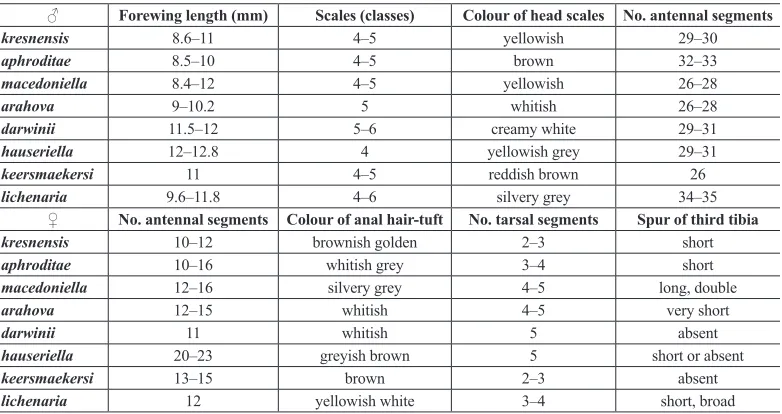
P. keersmaekersi is one of the larger Pseudobankesia species (wingspan 11 mm). The male (holotype) is distinctly characterized by its remarkable colouration and the very special wing pat-tern which is unique within the whole genus. Therefore, it cannot be confused with males of other Pseudobankesia species (Table 2). The geographically close Pseudobankesia species P. darwinii and P. arahova (Fig. 2a,b) differ from P. keersmaekersi sp.n. in the distinctly darker colouration and the remarkable female cases, which are broader.
Acknowledgements
The authors express their sincere gratitude to Dr. Thomas J. Witt, Munich (Germany) and Dr. Michael Weidlich, Neißemünde (Germany) for useful comments and the loan of material. We thank Dr. Nico Büsscher (Belgium) for determination of the mollusc shells. We also wish to thank Deborah Matthews (Gainesville, Florida, USA) for her critical comments and linguistic correction. Thanks to Donald R. Davis (Washington, USA) and another anonymous reviewer for critical review of the manuscript.
References
Arnscheid WR, Weidlich M (in press) Psychidae. In: Karsholt O, Mutanen M, Nuss M (Eds) Microlepidoptera of Europe 8. Brill, Leiden & Boston.
De Freina JJ, Witt TJ (1984) Taxonomische Veränderungen bei den Bombyces und Sphinges Europas und Nordwestafrikas*) Über Taleporia improvisella (Staudinger, 1859) und Taleporia pseudoimprovisella sp.n. (Lepidoptera, Psychidae II). Entomofauna 5: 153–163.
Kimura M (1980) A simple method for estimating evolutionary rates of base substitutions through compara-tive studies of nucleotide sequences. Journal of Molecular Evolution 16: 111–120. https://doi.org/10.1007/ BF01731581
Meier HG (1963) Zur Kenntnis der Gattungen Pseudobankesia gen. nov. und Bankesia Tutt (Lep., Psychidae). (5. Beitrag zur Kenntnis der Psychiden). Mitteilungen der Münchner Entomologischen Gesellschaft 53: 1–23. Meier HG (1969) Über ein Vorkommen von Pseudobankesia gramatella Lhomme (Lep., Psychidae) in den
südlichen Zentralalpen. (8. Beitrag zur Kenntnis der Psychiden). Zeitschrift der Wiener Entomologischen Gesellschaft 54: 139–145
Ratnasingham S, Hebert PDN (2007) BOLD: The Barcode of Life Data System (http://www.barcodinglife.org). Molecular Ecological Notes 7: 355–364. https://doi.org/10.1111/j.1471-8286.2007.01678.x
Ratnasingham S, Hebert PDN (2013) A DNA-Based Registry for All Animal Species: The Barcode Index Number (BIN) System. PLoS ONE 8(7): e66213. https://doi.org/10.1371/journal.pone.0066213
Table 2. A comparison of morphological characteristics of Pseudobankesia species from south-eastern Europe. ♂ Forewing length (mm) Scales (classes) Colour of head scales No. antennal segments
kresnensis 8.6–11 4–5 yellowish 29–30
aphroditae 8.5–10 4–5 brown 32–33
macedoniella 8.4–12 4–5 yellowish 26–28
arahova 9–10.2 5 whitish 26–28
darwinii 11.5–12 5–6 creamy white 29–31 hauseriella 12–12.8 4 yellowish grey 29–31
keersmaekersi 11 4–5 reddish brown 26
lichenaria 9.6–11.8 4–6 silvery grey 34–35 ♀ No. antennal segments Colour of anal hair-tuft No. tarsal segments Spur of third tibia kresnensis 10–12 brownish golden 2–3 short aphroditae 10–16 whitish grey 3–4 short macedoniella 12–16 silvery grey 4–5 long, double
arahova 12–15 whitish 4–5 very short
darwinii 11 whitish 5 absent
hauseriella 20–23 greyish brown 5 short or absent
keersmaekersi 13–15 brown 2–3 absent
Arnscheid & Henderickx: Pseudobankesia keersmaekersi sp. n., a new species from Greece ...
38
Stengel D (1990) Drei neue Psychidae-Arten aus Griechenland und ein neuer Status für Peloponnesia gla-phyrella culminella Sieder (Lepidoptera, Psychidae). Atalanta 20(1/2)[1989]: 211–217.
Tamura K, Peterson D, Peterson N, Stecher G, Nei M, Kumar S (2011) MEGA5: molecular evolutionary genetics analysis using maximum likelihood, evolutionary distance, and maximum parsimony methods. Molecular Biology and Evolution 28: 2731–2739. https://doi.org/10.1093/molbev/msr121
Weidlich M (2016a) Pseudobankesia lichenaria spec. nov., eine neue Psychiden-Art aus der Zagoria im griechi-schen Voria Pindos-Gebirge (Lepidoptera: Psychidae). Contributions to Entomology 66(1): 131–138. Weidlich M (2016b) Zur Schmetterlingsfauna der Ionischen Inseln Griechenlands mit der Beschreibung neuer
Psychiden-Taxa sowie ein Beitrag zu ihrer Köcherfliegenfauna (Lepidoptera, Trichoptera). Contributions to Entomology, in press.