Clematis guniuensis
(Ranunculaceae),
a new species from Eastern China
Rong-Bin Wang1,2,*, Wei-Yong Ni3,*, Wen-Jing Xu4,
Zheng-Wen Gui3, Shou-Biao Zhou1,5
1 College of Life Sciences, Anhui Normal University, Wuhu 241000, Anhui, China 2 Institute of Chinese Medicine Resources, Anhui College of Traditional Chinese Medicine, Wuhu 241000, Anhui, China 3 Admi-nistration of Guniujiang National Nature Reserve, Huangshan 245617, Anhui, China 4 School of Resources and Environmental Engineering, Anhui University, Hefei 230601, Anhui, China 5 Anhui Provincial Engi-neering Laboratory of Water and Soil Pollution Control and Remediation, Anhui Normal University, Wuhu 241000, Anhui, China
Corresponding author:Shou-Biao Zhou ([email protected])
Academic editor:M. Pellegrini | Received 15 February 2019 | Accepted 2 May 2019 | Published 23 July 2019
Citation: Wang R-B, Ni W-Y, Xu W-J, Gui Z-W, Zhou S-B (2019) Clematis guniuensis (Ranunculaceae), a new species from Eastern China. PhytoKeys 128: 47–55. https://doi.org/10.3897/phytokeys.128.33891
Abstract
Clematis guniuensissp. nov., a new narrowly endemic species of Clematis, is described and illustrated from the Huangshan Mountains of Eastern China. A description of C. guniuensis is presented along with illustrations, photographs and diagnostic differences between the new species and its putative close allies.
Keywords
Anhui, Early diverging eudicots, Ranunculales, Taxonomy
Introduction
Clematis L. (Ranunculaceae) is a large genus of early diverging eudicots, comprising ap-proximately 280–350 species (Tamura 1987, 1995; Johnson 1997; Grey-Wilson 2000; Wang and Li 2005), out of which 147 species are reported in China, 93 of them being
* These authors contributed equally to this work.
http://phytokeys.pensoft.net
Copyright Rong-Bin Wang et al. This is an open access article distributed under the terms of the Creative Commons Attribution License (CC BY 4.0), which permits unrestricted use, distribution, and reproduction in any medium, provided the original author and source are credited.
Rong-Bin Wang et al. / PhytoKeys 128: 47–55 (2019)
48
endemic to the country (Wang and Bartholomew 2001). The species of Clematis are eco-nomically important for their chemical properties relating to traditional medicine and also as ornamentals due to their attractive flowers (Grey-Wilson 2000; Wang and Bar-tholomew 2001). The genus is distributed worldwide, showing a high degree of specia-tion, with adaptations to a variety of habitats, especially in eastern Asia (Tamura 1993). Clematis species also show considerable morphological diversity and plasticity, making the taxonomy and classifications of the genus notoriously difficult (Brandenburg 2000), with different classifications emphasising different morphological characters (e.g. Prantl 1888; Tamura 1995; Johnson 1997; Grey-Wilson 2000; Wang and Li 2005).
During floristic surveys in experimental forestry plots of this Guniujiang Nation-al Nature Reserve between 2016 and 2018, a conspicuous species bearing 1-flowered cymes was collected. After thorough comparisons of diagnostic morphological and ana-tomical features of similar taxa (Lin and Wei 2009; Wang 2004a, 2004b, 2006a, 2006b, 2015a, 2015b; Wang and Bartholomew 2001; Wang and Huang 2014; Wang and Li 2016; Wang and Xie 2007), we have concluded that this specimen belongs to a hitherto undescribed species. We describe this specimen as a new species, presenting a morpho-logical description, illustrations and comments on morphomorpho-logically related species.
Material and methods
Measurements and morphological character assessments of the putative new species were undertaken using herborised and living specimens observed in the field or cultivated at the Botanical Garden of Anhui College of Traditional Chinese Medicine. All available specimens of Clematis, stored in the following herbaria (acronyms according to Thiers 2017+): IBK, IBSC, N, MO, P, PE, SYS, US and some local herbaria were examined. Images of type specimens were obtained from Tropicos.org (http://www.tropicos.org) and JSTOR Global Plants (http://plants.jstor.org). All morphological characters were studied using a dissecting microscope (SZX16, Olympus, Tokyo, Japan). Characters were described, using the terminology presented by Wang and Bartholomew (2001).
Taxonomy treatments
Clematis guniuensis W.Y.Ni, R.B.Wang & S.B.Zhou, sp. nov. urn:lsid:ipni.org:names:77200428-1
Figs 1, 2, 3
Figure 1. Clematis guniuensis W.Y.Ni, R.BWang & S.B.Zhou. A Habitat in flowering period B Inflores-cences with budding flower, showing the bracts C Stamen D Pistil E Achene F Stem cross-section.
Rong-Bin Wang et al. / PhytoKeys 128: 47–55 (2019)
50
Figure 2. Holotype of Clematis guniuensis W.Y.Ni, R.B.Wang & S.B.Zhou.
peti-ole 7–10 cm long; leaflets 3-lobed, ovate to narrowly-ovate; central lobe 6–7.5 × 3.5–4 cm, lateral lobes 4–5 × 2.8–3.5 cm, margin coarsely dentate to entire, apex acuminate or sometimes caudate, base broadly cuneate to rounded, papery, adaxially dark green, densely appressed white pilose, abaxially light green, sparsely puberulous to
Rong-Bin Wang et al. / PhytoKeys 128: 47–55 (2019)
52
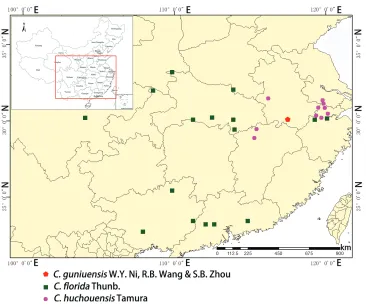
Figure 4. Distribution map of Clematis guniuensis (pentagon, red) and its congeners C. huchouensis
(round, violet) and C. florida (square, green).
brous, basal veins abaxially slightly prominent; and with petiolule 1–2 cm long. Cymes axillary, 1-flowered; peduncles 3–6 cm long, densely puberulous; bracts opposite, sub-sessile, ovate, 1.2–1.7 × 5–7 mm, margin entire, both surfaces puberulous. Flowers 6–8 cm diam.; pedicels ca. 2 cm long, conical, sulcate, green, densely puberulous; sepals 4, spreading, light green, ovate, ovate-lanceolate or broad-lanceolate, 3.5–4.5 × 1.8–2.3 cm, apex acute, adaxially glabrous, abaxially sparsely white pubescent, trin-erved; stamens numerous, 1–3 cm long, filaments linear, glabrous, about 3–5 times the length of the anthers, anthers narrowly oblong, ca. 6 mm long, white, glabrous, apex shortly apiculate; ovaries ellipsoidal, pubescent, style densely yellow-villose. Achenes dark-brown, strongly compressed, ovate to broadly ellipsoidal, ca. 3 × 1 mm wide, pubescent; persistent style 1.5–2 cm long, yellow-plumose.
Phenology. Flowering from April to May; fruiting from October to November.
Etymology. The specific epithet is derived from the type locality, Guniujiang Na-tional Nature Reserve.
Distribution and habitat. To date, C. guniuensis is only known from the type lo-cality, Guniujiang National Nature Reserve, Huangshan City, Anhui Province (Fig. 4). Currently the species is known from a few collections and there is only one known population with ca. 20 individuals at the type locality. The species is mostly found in tea plantations or forest edges along valleys of evergreen broad-leaved forests, at an elevation of 1,500 m a.s.l.
Conservation assessment. Based on the present field investigations, C. guniuensis is currently only known from the type locality and with a very small population size (ca. 20 individuals). The species should be given the IUCN status of Critically Endan-gered (CR) based on criteria D: “Population size estimated to number fewer than 50 mature individuals” (IUCN 2016).
Notes. A morphological comparison between C. guniuensis and morphologically related species, C. florida and C. huchouensis, is provided in Table 1. A total of 17 spe-cies of this genus was found in the Anhui province, with this new spespe-cies being easily distinguished from the other species in this region by its 3-lobed leaflets, 1-flowered cymes, flowers 6–8 cm diam., sepals 4 and light green and glabrous filaments.
Acknowledgements
The authors are grateful to Yu-Han Xiao from Nanjing Normal University of Spe-cial Education for the beautiful hand-drawings. This study was finanSpe-cially supported by Long-term Plot of Forest Ecosystem Project in Guniujiang National Nature Re-serve, the Anhui University Doctor Start-up Fund, Key University Science Research Project of Anhui Province (No. KJ2017A022), Anhui Natural Science Fund Project
Table 1. Diagnostic character differences amongst Clematis guniuensis, C. huchouensis and C. florida.
Characters Clematis guniuensis Clematis huchouensis Clematis florida
Petioles 7–10 cm long 1.7–3 cm long 2–4 cm long
Shape of leaflet blades 3-lobed 2- or 3-lobed or undivided undivided Indumentum of leaflet blades puberulous puberulous glabrous
Flower per cyme 1-flowered 1–3-flowered 1-flowered
Size of bracts 1.2–1.7 cm long 2–3 cm long 1.4–3 cm long Size of pedicels ca. 2 cm long 1.2–3 cm long 3.7–8.5 cm long
Size of flowers 6–8 cm wide 2–3 cm wide 3.6–5 cm wide
Number of sepals 4 4 6
Colour of sepals light green white white
Size of sepals 3.5–4.5 ×1.8–2.3 cm 1.4–2.2 × 0.3–0.6 cm 2–3 × 1–1.5 cm Size of anthers ca. 6 mm long 2.5–3.2 mm long 2.5–3.5 mm long Filaments about 3-5 times the length
of the anther, white equal to the length of the anther, white shorter than anthers, purple Persistent styles 1.5–2 cm long,
Rong-Bin Wang et al. / PhytoKeys 128: 47–55 (2019)
54
(1908085QC126), Key Projects for Academic Support of Top-level Talents in Col-leges and Universities in Anhui Province (No. gxbjZD2016106), National traditional Chinese medicine resources survey project (caishe [2017] no. 66).
References
Brandenburg WA (2000) Meclatis in Clematis: Yellow flowering Clematis species. Systematic studies in Clematis L. (Ranunculaceae), inclusive of cultonomic aspects. Wageningen: Wa-geningen Universiteit.
Grey-Wilson C (2000) Clematis the genus. Portland, Oregon: Timber Press.
IUCN (2016) Guidelines for using the IUCN Red List categories and criteria. Version 12. Pre-pared by the Standards and Petitions Subcommittee. http://jr.iucnredlist.org/documents/ Johnson M (1997) Släktet Klematis. Södertälje: M. Johnsons Plantskola AB.
Lin CR, Wei YG (2009) Clematis liuzhouensis (Ranunculaceae), a new species from China. Novon 19(2): 194–196. https://doi.org/10.3417/2007089
Prantl K (1888) Clematis. Beträge zur Morphologie und Systematik der Ranunculaceen. Bota-nische Jahrbuecher 9: 325–373.
Tamura M (1987) A classification of genus Clematis. Acta Phytotaxonomica et Geobotanica 38: 33–44. [In Japanese]
Tamura M (1993) Ranunculaceae. In: En Kubitzki K, Rohwer JG, Bittrich V (Eds) The fami-lies and genera of vascular plants, 2. Flowering plants-Dicotyledons. Springer-Verlag, Ber-lin, 563–583. https://doi.org/10.1007/978-3-662-02899-5_67
Tamura M (1995) Clematis. In: Hiepko P (Ed.) Die Natürlichen Pflanzenfamilien. Zwei Aufl 17a (4). Berlin: Ducker und Humboldt, 368–387.
Thiers B (2017) Index herbariorum: a global directory of public herbaria and associated staff. New York Botanical Garden’s Virtual Herbarium. Available at http://sweetgum.nybg.org/ science/ih/ [Accessed on 10 October 2017]
Wang WT (2004a) A revision of Clematis sect. Aspidanthera (Ranunculaceae). Zhiwu Fenlei Xuebao 42(2): 97–135.
Wang WT (2004b) A revision of Clematis sect. Brachiatae (Ranunculaceae). Zhiwu Fenlei Xue-bao 42(4): 289–332.
Wang WT (2006a) A revision of Clematis sect. Pterocarpa (Ranunculaceae). Guihaia 26(4): 341–344. https://doi.org/10.1360/aps050049
Wang WT (2006b) A revision of Clematis sect. Naraveliopsis (Ranunculaceae). Zhiwu Fenlei Xuebao 44(6): 670–699. https://doi.org/10.1360/aps050090
Wang WT, Xie L (2007) A revision of Clematis sect. Tubulosae (Ranunculaceae). Zhiwu Fenlei Xuebao 45(4): 425–457. https://doi.org/10.1360/aps06114
Wang WT (2015a) Clematis diebuensis, a new specis of Ranunculaceae from Gansu. Bulletin of Botanical Research 35(1): 1–3.
Wang WT, Bartholomew B (2001) Clematis. In Flora of China, vol. 6, Wu ZY, Raven P (Eds) Beijing: Science Press, St. Louis: Missouri Botanical Garden Press. 97–165.
Wang WT, Huang LQ (2014) Clematis chaohuensis, a new species of Ranunculaceae from An-hui Province. Bulletin of Botanical Research 34(3): 289–291.
Wang WT, Li LQ (2005) A new system of classification of the genus Clematis (Ranunculaceae). Zhiwu Fenlei Xuebao 43(5): 431–488. https://doi.org/10.1360/aps040091 [In Chinese] Wang WT, Li LQ (2016) Two new species of Clematis (Ranunculaceae) from Sichuan. Guihaia
36(Z1): 73–75. [In Chinese]
Appendix 1
List of all specimens analyzed for all three species for this study, with voucher number and deposition and origin information. Species are listed in alphabetical order.
Clematis florida Thunb.
CHINA. Anhui Province: Zhu P.Z., 64-0067 (JSPC); Ho Y.Y., Y.Y.Ho-02243 (SYS);
Chongqing City: Liu Z.Y., Liu Z.Y.-972413 (IMC); Guangdong Province: Huang C., Huang-162703 (IBSC); Chen W.Y., Chun Woon Young 8416 (PE); Chun Y.F., Y.F.Chun-30488 (SYS); Shi G.L., Shi G.L.13249 (WUK); Guangxi Zhuang Autonomous Region: Mashan Expedition Team, 450124140722047LY (GXMG); Liu Y. et al., Liu & Yu H0094 (IBK); Guangxi Investigation Team, Guangxi-3984 (PE); Guizhou Province:
Huang W.L. & Tu Y.L., Huang & Tu-0459 (GNUG); Wang Z.R., 522628140720152LY (GZTM); Gao J., Gao2013233024 (QNUN); Li K., DPS2013233024 (QNUN);
Henan Province: Ye Y.X., 20071024B8 (BJFC); Li G.Q., Li4257 (HEAC); Yang W.G., Yang W.G.58 (HEAC); Xu C.X., Xu 78055 (HENU); Yang X.F., Yang 28 (HENU); Wang X.F., Wang 181 (HENU); Fu J.Q., Fu 2201 (IBK); Hubei Province: Wu J.Q. & Ma X.Y., Wu & Ma 8061 (HIB); Sichuan Province: Li J.Y.,ss201208040024 (BJFC); Chien Y., Y.Chien 5993 (N); Yan J.X., Yan 87029 (PEM); Chien S.S., Chien Sung Shu 5342 (SZ); Zhejiang Province: Cheng R.C., R.C. Cheng 1976 (IBSC); Rwan Chia Tsuin, Rwan Chia Tsuin 37 (N); Zhejiang Investigation Team, Shen Jia-Yu 8065 (NAS).
Clematis huchouensis Tamura
CHINA. Guizhou Province: Huo P.Z., Zhi M.G. & Yuan D.X., 520222150126001LY (GZTM); Jiangsu Province: Wu W.X., Wu W.X.4205 (NAS); Ding Z.Z. & Wang Y.C., Ding & Wang 0939 (NAS); Wu W.X., W.X.Wu 6087 (NAS); Wu W.X., Wu W.X.4351 (WUK); Jiangxi Province: Shen S.J., Shen S.J.381 (PE); Shen S.J., Shen S.J.00565 (PE);
Sichuan Province: Ju W.B. & Deng H.N., HGX13374 (CDBI); Zhejiang Province: