The Thirty-Third AAAI Conference on Artificial Intelligence (AAAI-19)
Antonym-Synonym Classification Based on New Sub-Space Embeddings
Muhammad Asif Ali,
1Yifang Sun,
1Xiaoling Zhou,
1Wei Wang,
1,2Xiang Zhao
3 1School of Computer Science and Engineering, UNSW, Australia2College of Computer Science and Technology, DGUT, China
3Key Laboratory of Science and Technology on Information System Engineering, NUDT, China
[email protected],{yifangs, xiaolingz, weiw}@cse.unsw.edu.au, [email protected]
Abstract
Distinguishing antonyms from synonyms is a key challenge for many NLP applications focused on the lexical-semantic relation extraction. Existing solutions relying on large-scale corpora yield low performance because of huge contextual overlap of antonym and synonym pairs. We propose a novel approach entirely based on pre-trained embeddings. We hy-pothesize that the pre-trained embeddings comprehend a blend of lexical-semantic information and we may distill the task-specific information using Distiller, a model proposed in this paper. Later, a classifier is trained based on features con-structed from the distilled sub-spaces along with some word level features to distinguish antonyms from synonyms. Exper-imental results show that the proposed model outperforms ex-isting research on antonym synonym distinction in both speed and performance.
1
Introduction
Distinguishing between antonymy and synonymy is one of the crucial problems for NLP applications, especially those focused on lexical-semantic relation extraction, such as sentiment analysis, semantic relatedness, opinion mining and machine translation. We define synonyms as semanti-cally similar words (e.g., disperseandscatter) and antonyms as highly contrasting words (e.g.,disperseand garner) (Ono, Miwa, and Sasaki 2015). Existing manually curated lexical resources (e.g., WordNet (Fellbaum 1998)) are unable to address this problem, due to the limited cover-age. This calls the need for a machine learning model to clas-sify a given pair of words as either synonyms or antonyms.
Traditional research on antonym/synonym distinction makes use of word embeddings to capture the seman-tic relatedness among antonym/synonym pairs based on co-occurrence statistics (Scheible, Schulte im Walde, and Springorum 2013; Ono, Miwa, and Sasaki 2015; Nguyen, Schulte im Walde, and Vu 2016; Vulic 2018). However, the embedding models have a tendency to mix different lexico-semantic relations, so the performance cannot be guaranteed when they are applied on specific lexical-semantic analy-sis tasks (Glavas and Vulic 2018). This situation worsens in the case of antonym and synonym distinction, because these
Copyright c2019, Association for the Advancement of Artificial Intelligence (www.aaai.org). All rights reserved.
words can be used interchangeably and are considered indis-tinguishable (Mohammad et al. 2013). This is verified in this paper by the poor performance of a baseline classifier, i.e., Direct, that is purely designed based on pre-trained word embeddings.
Recently, pattern based approaches have gained consider-able research attention for lexical-semantic relation extrac-tion (Roth and Schulte im Walde 2014; Schwartz, Reichart, and Rappoport 2015). Nguyen, Schulte im Walde, and Vu (2017) formulated special lexico-syntactic pattern features that concatenate the lemma, POS-tag and dependency la-bel along the dependency path. Their model achieved the state-of-the-art result on antonym/synonym distinction task. Pattern based methods yield a low recall owing to the lexi-cal variations and the sparsity of lexico-syntactic patterns, which limits the information sharing among semantically similar patterns. Existing attempts to resolve the sparsity via generalization cause the resultant patterns to be highly over-lapping across different classes, which has a detrimental ef-fect on the classification accuracy. Moreover, they have to use a large-scale text corpus to combat sparsity, which dras-tically increases the computational overhead.
In this paper, we propose a novel two-phase ap-proach to address the above-mentioned challenges for antonym/synonym distinction by eliminating the need for a large text corpus. Firstly, we use a new model named: Dis-tiller, which is a set of non-linear encoders, to distill task-specific information from pre-trained word embeddingsto dense sub-spaces. For this, we design two new loss functions to capture unique relation-specific properties for antonyms and synonyms, i.e., symmetry, transitivity and the special
trans-transitivity (explained in section 3.3), in two differ-ent sub-spaces namely: SYN for synonyms and ANT for antonyms. Finally, a classifier is trained using features con-structed from the distilled information, in addition to other word-level features, to distinguish antonym and synonym pairs.
train-ing corpus. In addition, they are available for many lan-guages (Joulin et al. 2016), and are easily adaptable as one can customize the pre-trained embeddings by further train-ing with domain-specific corpus (Rothe and Sch¨utze 2016; Lampinen and McClelland 2017; Vulic and Mrksic 2018). We summarize the major contributions of this paper as fol-lows:
• We propose a novel model for the antonym/synonym distinction. Compared with existing research, our model makes less stringent data requirements (only requiring pre-trained embeddings), hence it is more practical and efficient.
• We introduce Distiller: a set of non-linear encoders to distill task-specific information from pre-trained embed-dings in a performance-enhanced fashion. In addition, we propose new loss functions to enforce the distilled repre-sentations to capture relation-specific properties.
• We demonstrate the effectiveness of the proposed model by comprehensive experimentation. Our model outper-forms the existing research on antonym/synonym distinc-tion by a large margin.
• We construct a new dataset for antonym/synonym distinc-tion task in Urdu language to demonstrate the language-agnostic properties of the proposed model.
2
Related Work
Existing research on antonym/synonym distinction can be classified as (i) embeddings based and (ii) pattern based ap-proaches.
Embeddings Based Approaches The embeddings based approaches rely on the distributional hypothesis, i.e., the words with similar (or opposite) meanings appear in a similar context (Turney and Pantel 2010). These models are trained using neural networks (Mikolov et al. 2013a; 2013b) or matrix factorization (Pennington, Socher, and Manning 2014). Dominant embeddings based approaches rely on training embedding vectors using different fea-tures extracted from large scale text corpora. For example, Scheible, Schulte im Walde, and Springorum (2013) ex-plained the distributional differences between antonyms and synonyms. Adel and Sch¨utze (2014) employed co-reference chains to train skip-gram model to distinguish antonyms. Nguyen, Schulte im Walde, and Vu (2016) integrated distri-butional lexical contrast information in the skip-gram model for antonym and synonym distinction.
The supervised variants of the embeddings based mod-els employ existing resources, i.e., thesaurus in combina-tion with the distribucombina-tional informacombina-tion for the distinccombina-tion task. Pham, Lazaridou, and Baroni (2015) introduced multi-task lexical contrast by augmenting the skip-gram model with supervised information from WordNet. Ono, Miwa, and Sasaki (2015) proposed a model that uses distributional in-formation alongside thesaurus to detect probable antonyms. The major limitation of the embeddings based methods is their inability to discriminate between different lexico-semantic relations; e.g., in Glove the top similar words for the word small yield a combination of synonyms (e.g.,
tiny,little), antonyms (e.g.,large,big), and irrele-vant terms (e.g.,very,some).
Pattern Based Approaches The pattern based approaches rely on capturing lexico-syntactic patterns from large scale text corpora. For example, Lin et al. (2003) proposed two patterns, i.e., either X or Y and from X to Y particu-larly indicative of antonym pairs. Roth and Schulte im Walde (2014) used discourse markers in combination with the lexico-syntactic patterns to distinguish antonyms from synonyms. Schwartz, Reichart, and Rappoport (2015) used symmetric patterns to assign different vector representations to the synonym and antonym pairs. Nguyen, Schulte im Walde, and Vu (2017) integrated the lexico-syntactic pattern features with the distributional information.
A major limitation of the pattern based methods is the huge overlap in feature space (i.e., lexico-syntactic pat-terns) across different classes, which hinders improve-ment in performance. For example, a commonly con-fused pattern is the noun-compound, which can be used to represent both the synonym pairs (government administration; card board) and the antonym pairs (graduate student;client server).
3
The Proposed Model
3.1
Problem Definition
In this paper, we aim to build a model that can classify a given pair of words as either synonyms or antonyms. We consider synonyms as semantically similar words (hav-ing similar mean(hav-ings), and antonyms as highly contrast(hav-ing words (having opposite meanings). Similar to the previous works (Roth and Schulte im Walde 2014; Schwartz, Re-ichart, and Rappoport 2015; Nguyen, Schulte im Walde, and Vu 2017), we assume the availability of training dataset, i.e., pairs of words with class labels indicating the pair satisfies either synonym or antonym relation. In contrast to the exist-ing research, the proposed model no longer relies on a text corpus. We replace it with the available pre-trained word em-beddings.
3.2
Overview
Our proposed model consists of two phases: inPhase I, we train theDistillerto distill task-specific representations of all words in the pre-trained embeddings via non-linear projec-tions; inPhase II, we train a classifier that exploits features constructed from the distilled representations together with other word-level features to classify a given pair of words into either synonyms or antonyms. Both phases are trained in a supervised fashion using the same set of training in-stances.
We argue that the proposed two-phase design has the fol-lowing advantages: (i) it allows us to answer the question,
3.3
Phase I (
Distiller
)
Distiller uses two different neural-network encoders to project pre-trained embeddings to two new sub-spaces in a non-linear fashion. Each encoder is a feed-forward neural network with two hidden layers using sigmoid as the acti-vation function. Mathematically, we model them as encoder functions; we useencS(v)andencA(v)for projections of
wordv’s pre-trained embedding vector to thesynonym and antonym sub-spaces, respectively.
We observe that antonyms and synonyms are special kind of relations (denoted asrAandrS, respectively), that exhibit
some unique properties. Synonyms possess symmetry and
transitivity, whereas, antonyms possesssymmetryand trans-transitivity.
Symmetryimplies thatr(a, b)if and only ifr(b, a), where
r(a, b)meansaandbparticipate in the relationr. For syn-onyms, thetransitivityimplies that ifrS(a, b)andrS(b, c)
thenrS(a, c)also holds. For antonyms, thetrans-transitivity
implies that if rA(a, b) and rS(b, c) then rA(a, c) — as
shown by the inferred antonym relation betweengoodand
evil in Figure 1(a). Trans-transitivity is a unique property that helps to infer probable antonym pairs.
Figure 1: (a) Illustrating the trans-transitivity of antonym and synonym relations, (b) Limitation of the translational embeddings to capture symmetric relations
We note that the existing translational entity embedding models (Bordes et al. 2013; Yoon et al. 2016) are not an appropriate choice for this problem. In translational embed-ding models, a relationris modeled as a translation vector r, andr(a, b)implies theL1orL2-norm of(a+r−b)is small. As shown in Figure 1(b), it is not possible for the translational embeddings to preserve symmetry by accom-modating both vector operationsa+r=bandb+r=a at the same time.
Formally, if we try to model a symmetric relation (i.e., synonyms or antonyms) via the translational model, we have
a+r−b=1 b+r−a=2
⇒ 2r=1+2
It means rmust be small to be able to model bothr(a, b)
andr(b, a). This leads to huge challenge in distinguishing differentrs, or has the risk of modeling one of the two pairs badly. A similar explanation suffices to expose the limitation of translational embeddings to preserve transitivity.
While the translational embeddings fail to capture the antonym and synonym relation pairs, we propose a model that:
• for each word vector, creates two distilled embeddings in two sub-spaces (i.e.,SYNandANT).
• models the symmetry and transitivity preserving synonym relation inSYN.
• models the symmetry and trans-transitivity preserving antonym relation using bothANTandSYN.
Loss Function for Synonyms In order to capture syn-onym relations inSYN, we use a margin based loss to em-bed the vectors corresponding to synonym pairs (positive examples) close to each other, while at the same time push-ing apart the vectors for irrelevant pairs (negative examples). This formulation preserves the symmetry and the transitivity of synonym pairs in theSYNsub-space. While the symme-try is enforced by the commutative nature of the inner prod-uct of real vectors1, the transitivity is preserved by following justification: ifais embedded close tobandbis embedded close toc, thenahas a high chance of being embedded close toc. It, moreover, ensures that we can distinguish between the synonym pairs and the irrelevant pairs within theSYN sub-space.
The loss function for modeling the synonyms is shown in Equation (1). Note that only the embeddings corresponding to theSYNsub-space are involved.
LS =
X
(a,b)∈TS
ReLU(1−f(a, b))
+ X
(a0,b0)∈T0
S
ReLU(1 +f(a0, b0))
(1)
wheref(a, b) = tanh(hencS(a), encS(b)i),TS is the set of
synonym training instances,TS0 is the set of negative pairs, andencS(v)is the non-linear mapping for the words in the
vocabularyV to distilled embedding in theSYNsub-space.
TS0 is generated fromTS by repeating the following
cor-ruption processk= 5times: randomly pickaorbfromTS,
and replace it with another randomly sampled word from training vocabulary.
Loss Function for Antonyms In order to capture the sym-metry and trans-transitivity for antonym pairs, our idea is to
correlatetheANTandSYNsub-spaces.
For illustration, consider an antonym pair rA(a, b), and
letbi be any synonym ofb. When the fact thatbi andbare
synonyms is sufficiently learned inSYN, we expectbito be
close tob, later, we encourage the embedding vectora ∈ ANTto be close tob∈SYN. As a result, it is highly likely thata∈ANTwill also be close tobi∈SYN.
In order to capture the trans-transitivity using theDistiller, for a given antonym relation pairrA(a, b), we bring the
vec-tora ∈ ANTclose to the vectorb∈SYN. For symmetry, we augment the training data by swapping the relation pairs
rA(a, b)to getrA(b, a), and correspondingly update the
em-beddings for the vectorsb∈ANTanda ∈SYN. This de-sign preserves the symmetry and the trans-transitivity prop-erty for the antonym pairs using both SYNandANT sub-spaces. The loss function for modeling antonyms is illus-trated in Equation (2). Note that unlike Equation (1), for this
1
loss function, the embeddings for both the sub-spaces are involved.
LA=
X
(a,b)∈TA
ReLU(1−g(a, b))
+ X
(a0,b0)∈T0
A
ReLU(1 +g(a0, b0))
(2)
whereg(a, b) = tanh(hencA(a), encS(b)i),TA is the set
of the antonym training instances,TA0 is the set of negative pairs,encS(v)is defined as in Equation (1) andencA(v)is
the non-linear mapping for the words in the vocabularyV to distilled embedding in theANTsub-space.
TA0 is generated fromTAby repeating the following
cor-ruption processk= 5times: randomly pickaorbfromTA,
and replace it with another randomly sampled word from the training vocabulary.
Synonymy and Antonymy Scores For a given word pair (a, b), we use our distilled embeddings to com-pute its synonymy score as cos(encS(a), encS(b)) and
the antonymy score as max(cos(encA(a), encS(b)),
cos(encA(b), encS(a))).
Loss Function forDistiller The loss function of the Dis-tillerisLS +LA+LM, whereLS andLAhave been
de-fined in Equations (1) and (2) respectively.LM is the
cross-entropy loss defined in Equation (3).
LM =−
1
N N
X
i=1
log(ˆp(yi|ai, bi)) (3)
ForLM, we concatenate the synonymy scorex1 and the antonymy score x2 from the distilled embeddings to form the feature vector x = [x1,x2], and use softmax function (Equation (4)) to predict the class label.
ˆ
p(y|(a,b)) =sof tmax(Wx+ ˆb) ˆ
y= argmax
y
ˆ
p(y|a,b) (4)
whereWis the weight matrix andbˆ is the bias. We opti-mize the loss of theDistiller, in an end-to-end fashion.
3.4
Phase II (Classifier)
In Phase II, we train a classifier to distinguish the synonym and antonym pairs. We use the XGBoost classifier (Chen and Guestrin 2016), and employ following features.
New Features fromDistiller For a given test pair(a, b), we compute two new features exploiting our distilled em-beddings (1)synonymy scoreand (2)antonymy score.
Features from Pre-trained Embeddings Similar to the best performing solutions for antonym and synonym dis-tinction that consider a combination of lexico-syntactic pat-terns and the distributional embeddings, we use distribu-tional similarity score, i.e.,cos(a,b)as a classification fea-ture, where a and b correspond to the pre-trained word embedding vectors. It helps in capturing highly confident antonym and/or synonym pairs trained using distributional
information. In Table 3, this feature is labeled as: distribu-tional.
Features from Negation Prefix Words that differ only by one of the known negation prefixes are highly un-likely to be synonym pairs, e.g., (able,unable), (relevant,irrelevant)etc. Similar to Rajana et al. (2017), we use the following set of negation prefixes:{de, a, un, non, in, ir, anti, il, dis, counter, im, an, sub, ab}. We use a binary feature for the candidate pairs, where the fea-ture value is 1 only if the two words in the candidate pair differ by one of the negation prefix. In Table 3, this feature is labeled as:prefix.
4
Experiments
4.1
Dataset
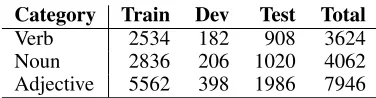
For model training, we use an existing dataset previously used by (Schwartz, Reichart, and Rappoport 2015; Roth and Schulte im Walde 2014; Nguyen, Schulte im Walde, and Vu 2016; 2017). It has been accumulated from different sources encompassing WordNet (Fellbaum 1998) and WordNik2. The details of the dataset are given in Table 1, it contains antonym and synonym pairs for three categories (i.e., verbs, adjectives and nouns) in the ratio (1:1). In order to come up with a unanimous platform for comparative evaluation, we use the priorly defined data splits by the existing models to training, test and dev sets. The training data is used to train theDistillerin Phase-I and the classifier in Phase-II. The de-velopment data is used forDistiller’s parameter tuning. The model performance is reported on the test set.
Category Train Dev Test Total
Verb 2534 182 908 3624
Noun 2836 206 1020 4062
Adjective 5562 398 1986 7946
Table 1: Antonym/Synonym distinction dataset
4.2
Experimental Settings
One advantage of our model is its ability to work with any set of word embeddings. For experimentation, we use fol-lowing set of pre-trained embeddings:
1. Random VectorsWe use 300d random vectors.
2. Glove (Pennington, Socher, and Manning 2014), purely unsupervised word embeddings. We use 300d pre-trained Glove embeddings.
3. dLCE (Nguyen, Schulte im Walde, and Vu 2016), cus-tomized embeddings for antonym synonym distinction task. Its dimensionality is 100d.
4. ELMO(Peters et al. 2018), deep contextualized embed-dings based on character sequences. Its dimensionality is 1024d.
2
Note that our model does not rely on a text corpus, so for the ELMO, we only consider the character sequence of the words in our dataset to acquire the embedding vectors. For Glove and dLCE, the vectors corresponding to the out-of-vocabulary tokens were randomly initialized. We use a smaller and compact representation for the sub-spaces, as they are supposed to preserve only the task-specific infor-mation. The dimensionality of each sub-space, (i.e., ANT andSYN) is set to 60d. The neural network encoders used in theDistilleremploy 80 units in the first layer and 60 units in the second layer. We use the Adam-Optimizer (Kingma and Ba 2014) to train theDistiller. All the experiments are performed on Intel Xenon Xeon(R) CPU E5-2640 (v4) with 256 GB main memory and Nvidia 1080Ti GPU.
4.3
Baseline Models / Model Comparison
We compare our work against the following models.
Direct Baseline. The Direct baseline is used to show the performance of using only the pre-trained embeddings to distinguish the antonym and synonym pairs. ForDirect baseline, we cluster the vector difference for antonym and synonym pairs using k-means clustering to get k-pivot vec-tors as representatives of synonym and/or antonym candi-date pairs. For classification, we use an XGBoost classifier with (i) cosine similarity, (ii) distance to the pivot vectors and (iii) vector difference as features.
Discourse Markers. Roth and Schulte im Walde (2014) used discourse markers (indicators of relations) alongside lexico-syntactic patterns to design vector space models. For the given data set, Michel Roth has already computed the performance of his methods (Nguyen, Schulte im Walde, and Vu 2017), we use the same scores for comparison.
Symmetric Patterns. Schwartz, Reichart, and Rappoport (2015) used automated techniques to extract symmetric pat-terns (sequence of 3-5 tokens encompassing two wild-cards and 1-3 tokens) from plain text. We use 500d embeddings (from author’s web-page3). Similar to (Nguyen, Schulte im Walde, and Vu 2017), we calculate cosine similarity between the test pair and use an SVM classifier to categorize them.
AntSynNET. Nguyen, Schulte im Walde, and Vu (2017) proposed two different architectures: (i) AntSynNET: a pattern-based model and (ii) Combined AntSynNET, i.e., combining the pattern-based model with the distributional embeddings. The Combined AntSynNET comprises two models namely: (1)AntSynNET + Glove and (2) AntSyn-NET + dLCE, acquired by using Glove/dLCE embeddings. We use the scores reported in the published paper.
4.4
Main Results
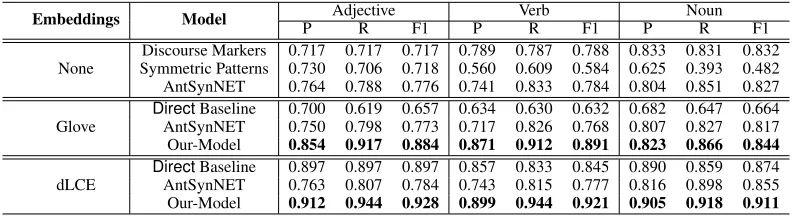
The results for the proposed model are shown in Table 2. Here, we use two different sets of pre-trained embeddings forDistiller, i.e., Glove and dLCE. The results are accord-ingly compared with the corresponding baseline models us-ing the same settus-ings.
3
https://homes.cs.washington.edu/∼roysch/papers/
sp embeddings/sp embeddings.html
Comparing the results for the Glove embeddings, our model outperforms theDirectbaseline and previously best performing models for all three classes by a significant mar-gin. We observe that for nouns the improvement in perfor-mance is relatively lower as compared with the verbs and adjectives. It is due to the effect of polysemy, which is more dominant among nouns. The unsupervised embeddings are unable to handle polysemous words and mostly the embed-ding vectors are oriented in the direction of most common sense (as explained in detail in the section 4.8). This finding is also aligned with that of (Scheible, Schulte im Walde, and Springorum 2013), which states that synonym and antonym pairs conforming to verbs and adjectives have relatively high contextual clues compared with that of nouns. Overall re-sults for our model with Glove embeddings show that even getting started with entirely unsupervised embeddings hav-ing a mixture of different lexical-semantic relations, the Dis-tilleris able to distill the task-specific information and out-perform the previous state-of-the-art models by a large mar-gin.
Especially noteworthy is the performance of our model withDistiller trained on dLCE. It simply outperforms the best performing model trained using dLCE, yielding a much higher value of F1 across all three word classes. Compared with the previous state-of-the-art, it improves the F1 score by 18%, 17% and 6% for adjectives, verbs and nouns re-spectively. This drastic improvement in performance ex-plains that in contrary to the Glove embeddings that con-tains a blend of lexical-semantic information, the dLCE em-beddings are enriched with more distinguishing information and theDistillerhelps to effectively distill the most relevant task-specific information for antonym/synonym distinction.
Such promising results strengthen our claim that the pre-trained embeddings contain a blend of lexico-semantic in-formation and we can acquire task-specific inin-formation by projecting them to low-dimensional subspaces.
4.5
Detailed Performance of Our Model
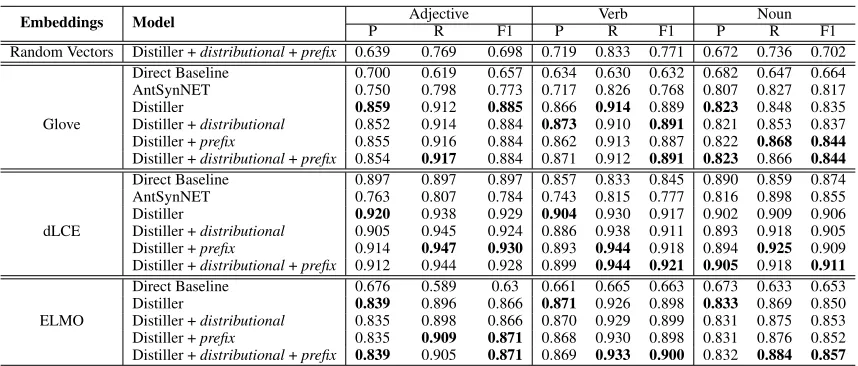
Table 3 shows the result of our model with different set of features and pre-trained embeddings. We also report the per-formance of our model with random vectors in order to ana-lyze the performance gained by the unsupervised contextual embeddings.
Embeddings Model Adjective Verb Noun
P R F1 P R F1 P R F1
Discourse Markers 0.717 0.717 0.717 0.789 0.787 0.788 0.833 0.831 0.832 None Symmetric Patterns 0.730 0.706 0.718 0.560 0.609 0.584 0.625 0.393 0.482 AntSynNET 0.764 0.788 0.776 0.741 0.833 0.784 0.804 0.851 0.827
DirectBaseline 0.700 0.619 0.657 0.634 0.630 0.632 0.682 0.647 0.664
Glove AntSynNET 0.750 0.798 0.773 0.717 0.826 0.768 0.807 0.827 0.817 Our-Model 0.854 0.917 0.884 0.871 0.912 0.891 0.823 0.866 0.844
DirectBaseline 0.897 0.897 0.897 0.857 0.833 0.845 0.890 0.859 0.874
dLCE AntSynNET 0.763 0.807 0.784 0.743 0.815 0.777 0.816 0.898 0.855 Our-Model 0.912 0.944 0.928 0.899 0.944 0.921 0.905 0.918 0.911
Table 2: Antonym/Synonym distinction performance comparison against baseline models
pairs.
Note that the Distillertrained using random vectors re-sults in a significant reduction in performance (first row in Table 3). It shows that the Distiller is not governed by input bias, rather it distills information contained in unsu-pervised contextual embeddings. Overall results in Table 3 show that our model outperforms the Directbaseline and the previous state-of-the-art model (AntSynNET) for all sets of pre-trained embeddings. These results, moreover, con-firm that the dLCE embeddings are indeed customized for antonym/synonym distinction task and on contrary to the AntSynNET, the proposed framework along with the Dis-tilleris able to use this information more effectively.
Recognizing Irrelevant Pairs Although, our current problem setting is not explicitly designed for multi-class classification, our model has an implicit ability to recognize irrelevant pairs. For irrelevant pairs, the resultant projections of words in SYN and ANT sub-spaces end up in a narrow region far from their synonyms and antonyms. For analysis, we augmented the dataset by adding an equal proportion of randomly selected words as “irrelevant” pairs and retrained the classifier in phase II for multi-class classification. With Glove embeddings, our model can distinguish three classes (antonyms, synonyms and irrelevant pairs) with F1 = 0.813, 0.775, and 0.818 for adjectives, verbs, and nouns respec-tively. These scores are better than the binary classification in previous state-of-the-art (i.e. F1= 0.773, 0.768 and 0.817 for AntSynNET), shown in Table 2.
4.6
Training Time
We analyzed the pre-processing and running time of our model in comparison with the previous best performing pattern-based approach, i.e., AntSynNET.
Our model doesn’t require any pre-processing, whereas, on our machine (explained in section 4.2) the AntSynNET takes more than 1 week to parse each sentence in the wiki dump. Moreover, our model is more than 100 times faster to train (e.g., AntSynNET takes more than 50 hours for model training, whereas, our model takes less than half an hour).
4.7
Language-Agnostic Model
We verify the language agnostic property of our model by testing its performance for antonym/synonym distinction task on another language. We manually curated a dataset for the Urdu language using linguistic resource and expert
verification. It consists of 750 instances with an equal pro-portion of antonyms and synonyms. We split the dataset into 70% train, 25% test and 5% validation set. We use fasttext for Urdu language (Joulin et al. 2016) as the pre-trained em-beddings. The performance of our model for the Urdu lan-guage is shown in Table 4. Huge improvement in the per-formance compared with theDirectbaseline shows that the proposed model is language-agnostic and has potential to work for other languages provided with the availability of pre-trained embeddings and a minimal set of training seeds.
4.8
Analyses of Errors and Distilled Embeddings
In this section, we perform a detailed error analysis, fol-lowed by analyzing the probable antonyms/synonyms cap-tured via distilled embeddings. We also list the key advan-tages of theDistiller.
Error Cases We randomly selected 50 error cases from our model with Glove embeddings for analysis. We catego-rized these errors into three distinct categories: (i) 76% er-rors are caused by the polysemous words (ii) 8% erer-rors are caused by the rarely used words (iii) 16% other errors.
A major portion of these errors are caused by the inherent limitation of the unsupervised embeddings, i.e., its inability to deal with multiple senses and rare tokens. For case (i), we analysed synonym pairs, e.g.,(author, generator), and antonym pairs, e.g., (frog, english). Here, at least one word is polysemous with embeddings oriented in direction of common sense, which is different from the sense required in antonym/synonym relation. This phenomenon is more dominant for the nouns. For example,generator’s vector is close to electrical device;frogis commonly used for reptile, however, in the given pair it represents a French person. For case (ii), the embeddings corresponding to the rarely used tokens are not adequately trained, e.g.,natal is a rarely used word for native. This results the rela-tion pair to have very low embeddings’ similarity (orthogo-nal vectors), which limits theDistillerto capture meaningful projections to low-dimensional sub-spaces.
Embeddings Model P AdjectiveR F1 P VerbR F1 P NounR F1
Random Vectors Distiller +distributional+prefix 0.639 0.769 0.698 0.719 0.833 0.771 0.672 0.736 0.702 Direct Baseline 0.700 0.619 0.657 0.634 0.630 0.632 0.682 0.647 0.664 AntSynNET 0.750 0.798 0.773 0.717 0.826 0.768 0.807 0.827 0.817 Distiller 0.859 0.912 0.885 0.866 0.914 0.889 0.823 0.848 0.835 Glove Distiller +distributional 0.852 0.914 0.884 0.873 0.910 0.891 0.821 0.853 0.837 Distiller +prefix 0.855 0.916 0.884 0.862 0.913 0.887 0.822 0.868 0.844
Distiller +distributional+prefix 0.854 0.917 0.884 0.871 0.912 0.891 0.823 0.866 0.844
Direct Baseline 0.897 0.897 0.897 0.857 0.833 0.845 0.890 0.859 0.874 AntSynNET 0.763 0.807 0.784 0.743 0.815 0.777 0.816 0.898 0.855 Distiller 0.920 0.938 0.929 0.904 0.930 0.917 0.902 0.909 0.906 dLCE Distiller +distributional 0.905 0.945 0.924 0.886 0.938 0.911 0.893 0.918 0.905 Distiller +prefix 0.914 0.947 0.930 0.893 0.944 0.918 0.894 0.925 0.909 Distiller +distributional+prefix 0.912 0.944 0.928 0.899 0.944 0.921 0.905 0.918 0.911
Direct Baseline 0.676 0.589 0.63 0.661 0.665 0.663 0.673 0.633 0.653 Distiller 0.839 0.896 0.866 0.871 0.926 0.898 0.833 0.869 0.850 ELMO Distiller +distributional 0.835 0.898 0.866 0.870 0.929 0.899 0.831 0.875 0.853 Distiller +prefix 0.835 0.909 0.871 0.868 0.930 0.898 0.831 0.876 0.852 Distiller +distributional+prefix 0.839 0.905 0.871 0.869 0.933 0.900 0.832 0.884 0.857
Table 3: Performance of proposed model under different settings
Model P R F1
Directbaseline 0.623 0.533 0.575 Our Model 0.897 0.867 0.881
Table 4: Antonym/Synonym distinction for Urdu language
pairs, the F1 drops down to 0.820. A similar trend is ob-served for nouns and verbs.
Effectiveness of Distiller Pre-trained word embeddings yield a blend of lexical-semantic relations as nearest neigh-bor of an input word. On contrary, theDistillerprovides us the provision to separately analyze just the antonyms and/or synonyms of a given word. We analyzed the nearest neigh-bors of largeusing Glove and the distilled embeddings. Results corresponding to Glove embeddings (first column in Table 5) show that it makes no distinction among lexico-semantic relations, e.g., the antonymsmallis ranked high-est in the list. The results corresponding to the distilled em-beddings (column-2) show that the top ranked terms (e.g., immense, gigantic) are indeed the synonyms. Like-wise, the results in column-3 show that the top ranked terms by the Distiller (e.g., slender, thin) are indeed the antonyms.
Glove Distiller(Synonyms) Distiller(Antonyms)
small (antonym) immense slender larger (synonym) gigantic thin smaller (antonym) influential lightweight
huge (synonym) full small
sized (other) enormous inconspicuous
Table 5: Top-5 nearest neighbors of the word:largeusing Glove embeddings vs synonyms and antonyms captured by the distilled embeddings
Key Advantages ofDistiller The key advantages of Dis-tiller compared with the previous state-of-the-art pattern based methods are listed below:
• Distilleris not constrained by naive assumptions. For ex-ample, the pattern based methods work only if a depen-dency path exists between candidate antonym/synonym pair, and it is impossible for every feasible synonym and/or antonym pair to co-occur within a sentence. Like-wise, theDistilleris not limited by the challenges posed by the overlapping nature of lexico-syntactic patterns, which hinder the performance of pattern based methods. • Distiller allows explicitly constraining the sub-spaces.
This formulation is best suited for lexico-semantic analy-sis, as it allows appropriate re-ordering of the sub-spaces to capture relation-specific characteristics.
• Thanks to the wide availability of pre-trained embeddings with various improvements and for most languages, Dis-tilleris a flexible and efficient choice for lexical-semantic analysis requiring no pre-processing and little linguistic knowledge.
5
Conclusions and Future Work
In this paper, we proposed a novel framework, Distiller, for antonym and synonym distinction. It employs carefully crafted loss functions to project the pre-trained embeddings to low-dimensional task-specific sub-spaces in a perfor-mance enhanced fashion. Results show that theDistiller out-performs previous methods on the antonym and synonym distinction task. In the future, we will extend the proposed framework to other lexical-semantic relations (e.g., hyper-nymy detection) and to other embedding models such as the hyperbolic embeddings (Nickel and Kiela 2017).
Acknowledgments. This research was partially funded by ARC DPs 170103710 and 180103411, and D2DCRC DC25002 and DC25003, and NSFC Grant 61872446.
References
Bordes, A.; Usunier, N.; Garc´ıa-Dur´an, A.; Weston, J.; and Yakhnenko, O. 2013. Translating embeddings for modeling multi-relational data. InNIPS, 2787–2795.
Chen, T., and Guestrin, C. 2016. Xgboost: A scalable tree boosting system. InKDD, 785–794. ACM.
Fellbaum, C. 1998.WordNet. Wiley Online Library. Glavas, G., and Vulic, I. 2018. Discriminating be-tween lexico-semantic relations with the specialization ten-sor model. InNAACL-HLT (2), 181–187. Association for Computational Linguistics.
Joulin, A.; Grave, E.; Bojanowski, P.; Douze, M.; J´egou, H.; and Mikolov, T. 2016. Fasttext.zip: Compressing text clas-sification models. CoRRabs/1612.03651.
Kingma, D. P., and Ba, J. 2014. Adam: A method for stochastic optimization.CoRRabs/1412.6980.
Lampinen, A. K., and McClelland, J. L. 2017. One-shot and few-One-shot learning of word embeddings. CoRR
abs/1710.10280.
Lin, D.; Zhao, S.; Qin, L.; and Zhou, M. 2003. Identifying synonyms among distributionally similar words. InIJCAI, 1492–1493. Morgan Kaufmann.
Mikolov, T.; Chen, K.; Corrado, G.; and Dean, J. 2013a. Efficient estimation of word representations in vector space.
CoRRabs/1301.3781.
Mikolov, T.; Sutskever, I.; Chen, K.; Corrado, G. S.; and Dean, J. 2013b. Distributed representations of words and phrases and their compositionality. InNIPS, 3111–3119. Mohammad, S.; Dorr, B. J.; Hirst, G.; and Turney, P. D. 2013. Computing lexical contrast. Computational Linguis-tics39(3):555–590.
Nguyen, K. A.; Schulte im Walde, S.; and Vu, N. T. 2016. Integrating distributional lexical contrast into word embed-dings for antonym-synonym distinction. InACL (2). The Association for Computer Linguistics.
Nguyen, K. A.; Schulte im Walde, S.; and Vu, N. T. 2017. Distinguishing antonyms and synonyms in a pattern-based neural network. InEACL (1), 76–85. Association for Com-putational Linguistics.
Nickel, M., and Kiela, D. 2017. Poincar´e embeddings for learning hierarchical representations. InNIPS, 6341–6350. Ono, M.; Miwa, M.; and Sasaki, Y. 2015. Word embedding-based antonym detection using thesauri and distributional information. InHLT-NAACL, 984–989. The Association for Computational Linguistics.
Pennington, J.; Socher, R.; and Manning, C. D. 2014. Glove: Global vectors for word representation. InEMNLP, 1532– 1543. ACL.
Peters, M. E.; Neumann, M.; Iyyer, M.; Gardner, M.; Clark, C.; Lee, K.; and Zettlemoyer, L. 2018. Deep contextualized word representations. InNAACL-HLT, 2227–2237. Associ-ation for ComputAssoci-ational Linguistics.
Pham, N. T.; Lazaridou, A.; and Baroni, M. 2015. A mul-titask objective to inject lexical contrast into distributional semantics. InACL (2), 21–26. The Association for Com-puter Linguistics.
Rajana, S.; Callison-Burch, C.; Apidianaki, M.; and Shwartz, V. 2017. Learning antonyms with paraphrases and a morphology-aware neural network. In*SEM, 12–21. As-sociation for Computational Linguistics.
Roth, M., and Schulte im Walde, S. 2014. Combining word patterns and discourse markers for paradigmatic rela-tion classificarela-tion. InACL (2), 524–530. The Association for Computer Linguistics.
Rothe, S., and Sch¨utze, H. 2016. Word embedding calcu-lus in meaningful ultradense subspaces. InACL (2). The Association for Computer Linguistics.
Scheible, S.; Schulte im Walde, S.; and Springorum, S. 2013. Uncovering distributional differences between syn-onyms and antsyn-onyms in a word space model. InIJCNLP, 489–497. Asian Federation of Natural Language Processing / ACL.
Schwartz, R.; Reichart, R.; and Rappoport, A. 2015. Sym-metric pattern based word embeddings for improved word similarity prediction. InCoNLL, 258–267. ACL.
Turney, P. D., and Pantel, P. 2010. From frequency to mean-ing: Vector space models of semantics. J. Artif. Intell. Res.
37:141–188.
Vulic, I., and Mrksic, N. 2018. Specialising word vectors for lexical entailment. InNAACL-HLT, 1134–1145. Association for Computational Linguistics.