MASTER THESIS
Towards a Reference Architecture for BIM (Building
Information Model) Integration in the Construction
Industry
Developing and prototyping a reference architecture and data platform to help overcome the barriers of Building Information Modeling (BIM) adoption by the Architecture, Engineering, and Construction (AEC)
industry and to support digital transformation and transition to smart industry.
Yvar Bosdriesz
Business Information Technology
Faculty of Electrical Engineering, Mathematics and Computer Science (EEMCS)
Author
Yvar Bosdriesz
Programme Business Information Technology
Track Enterprise Architecture
Faculty Electrical Engineering, Mathematics and Computer Science
Student Number 1235559
E-mail [email protected]
Graduation Committee
Dr Maria-Eugenia Iacob
Department Industrial Engineering and Business Information Systems
E-mail [email protected]
Dr Marten J van Sinderen
Department Electrical Engineering, Mathematics and Computer Science
E-mail [email protected]
Pieter Verkroost
Company CAPE Groep
www.capegroep.nl
Preface and Acknowledgements
The completion of this research marks the end of my time in Enschede and at the University of Twente. All these years ago, when I graduated high school and started studying Artificial Intelligence in Amsterdam, I had no idea I would end up this far from home studying Business & IT. I am however glad that I did. I ended up studying something I love, that’s highly relevant in todays’ world and that
will hopefully serve as a strong foundation for the challenges to come in my future.
When I started this thesis, I thought I had a lot of knowledge and that it would mostly be a matter of applying this knowledge in an innovating way. As it turns out, I did have a lot of knowledge, but there is so much more out there to learn. I knew very little about the construction industry, had never heard of BIM before and while I knew a lot about integrations, I never had to build one before. This work thus proved to be a huge learning experience.
Therefore, I am grateful to everyone who made this happen. First of all, I would like to thank CAPE Groep and especially Pieter for giving me a chance to perform this thesis research. You introduced me to a lot of interesting people, allowed me to sit in on a very interesting meeting and were always helpful in keeping me on track during these months. You were also never shy in giving your opinion on the architecture and giving helpful feedback. I also want to thank Mark and everyone else at CAPE who were patient enough to listen to all my questions, shared their expert knowledge and made this research happen. I also want to thank everyone at the construction company for being very helpful by providing the case, extensive feedback and a clear practical application for my research.
From the University, I would like to thank Maria and Marten, who were always willing to help despite
their own busy schedules. I’m glad you were there to offer feedback and be critical. Spending this much time in practice makes it easy to slip a bit too much into practical applications away from scientific work, so I’m thankful you were there to guard the scientific quality of this work. Lastly, I want to thank you for providing me with the opportunity to write a paper and present in at a conference in Berlin. This was a great opportunity for me to see more of the scientific world and meet some interesting people. It almost made me apply for a PhD position. Almost!
A special mention is required for my family, without whom I’m not sure I’d have ever reached the
Executive Summary
Traditionally, the Architecture, Engineering, and Construction (AEC) industry relies heavily on the use of paper-based communication. This is a major source of errors resulting in extra costs, delay, friction and even lawsuits in the construction process, since AEC projects typically involve complex
communication-intensive processes across multiple organizations.
In the past years, Building information modelling (BIM) has been hailed as the solution to help with many of these problems. BIM is one of the most promising recent developments in the architecture, engineering, and construction (AEC) industry. Using this technology it is possible to digitally construct a virtual model of a building. BIM has proven to provide various benefits, but also faces some barriers during its adoption. The biggest barriers we’ve found were the high knowledge requirements, and
thus training costs, and difficulties integrating different BIM platforms.
This leads to a proposed reference architecture and data platform to help overcome these barriers of Building Information Modeling (BIM) adoption by the Architecture, Engineering, and Construction (AEC) industry and to support digital transformation and transition to smart industry. The reference architecture focusses on keeping the traditional application landscape intact (therefore reducing training costs) and simplifying BIM integrations by adhering to the industry wide standard for BIM models: the Industry Foundation Classes (IFC). The architecture is prototyped using eMagiz Integration Platform as a Service (IPaaS), BIMServer and Mendix.
We provide science and practice alike with an example of a functioning, process-wide BIM
Table of Contents
List of Tables ... 1
List of Figures ... 1
1. Introduction ... 2
1.1 Context ... 2
1.1.1 Dutch AEC industry ... 2
1.1.2 Digital Transformation and BIM ... 3
1.2 Problem Statement ... 4
1.3 Case and parties involved in this Research Project ... 4
1.3.1 Cape Groep ... 4
1.3.2 Case: Construction Company ... 4
1.4 Research Goals ... 5
1.5 Approach and Methodology ... 6
1.6 Research Motivation ... 7
1.6.1 Relevance for Science ... 7
1.6.2 Relevance for Practice ... 7
1.7 Scope ... 7
1.8 Structure of the Report ... 7
2. Literature... 9
2.1 Barriers for BIM adoption ... 9
2.2 BIM Standards and Initiatives... 9
2.3 Existing BIM architectures ... 11
2.4 BIM Performance and Maturity ... 13
3. Problem Investigation ... 16
3.1 Stakeholder Assessment ... 16
3.1.1 Stakeholders in the construction industry ... 16
3.1.2 Stakeholders for intra-organizational BIM Integration ... 17
3.2 Case Study ... 18
3.2.1 Barriers identified in practice ... 18
3.2.2 BIM usage in practice ... 18
3.2.3 BIM Vision ... 19
4. Solution Design ... 19
4.1 BIM Tooling ... 20
4.2 Requirements ... 22
4.3 Architecture ... 24
5.1 Use Case ... 26
5.2 DMS / Model Repository ... 26
5.3 Integration ... 28
5.3.1 Integration Platform ... 28
5.3.2 CDM ... 29
5.3.3 Messaging ... 30
5.4 BIMSupport ... 34
5.4.1 Mendix ... 34
5.4.2 Functionality ... 34
5.5 Purchasing Portal ... 36
5.5.1 Functionality ... 36
5.6 Example of Message Flow ... 38
6. Validation and Evaluation ... 40
6.1 Validation ... 40
6.1.1 Validation and evaluation meetings ... 40
6.1.2 Requirements ... 41
6.1.3 Use Case ... 42
6.1.4 Validity of Use Case ... 43
6.2 Evaluation ... 43
7. Conclusions and Recommendations ... 44
7.1 Research Results ... 44
7.2 Limitations ... 45
7.3 Contributions hoeft niet los > eind 7.1 ... Fout! Bladwijzer niet gedefinieerd. 7.4 Future Work ... 46
7.5 Recommendations... 46
References... 47
Appendices ... 50
Appendix A. eMagiz Flows ... 50
Request IFC objects by IFCtype ... 50
1
List of Tables
Table 1: CBS GDP statistics for the Dutch AEC industry, in million euro . ... 2
Table 2. BIM capability stages according to Succar (Succar 2010). ... 14
Table 3. A selection of existing BIM tooling ... 21
Table 4. Experts consulted throughout validation process. ... 40
List of Figures
Figure 1: Number of construction firms by employee count in the third quarter of 2017 ... 3Figure 2. The Engineering/Design Cycle of the DSM Methodology ... 6
Figure 3. Structure of report within the context of the Design Science Methodology. ... 8
Figure 4. IFC standard. source: The IFC standard: A review of history, development, and standardization, information technology (Laakso and Kiviniemi 2012). ... 10
Figure 5. A reference architecture for a distributed, model-based, integrated system by Froese et al. (Froese et al. 2000). ... 11
Figure 6. Reference Architecture for Integration Platforms by Singh et al. (P. M. Singh, Van Sinderen, and Wieringa 2017) ... 12
Figure 7: construction project stakeholders ... 17
Figure 8. Current BIM usage in Case Study ... 19
Figure 9. Relation between types of BIM tooling ... 20
Figure 10. Requirement 2, based on the Shared Data Model ... 22
Figure 11. A Reference Architecture for BIM integration ... 24
Figure 12. Prototype use case ... 26
Figure 13. bimvie.ws, a plugin which adds a web portal to BIMServer ... 27
Figure 14. The eMagiz architecture of the prototype ... 28
Figure 15. The Common Data Model used in the Prototype ... 29
Figure 16. The message flow of the bus component ... 30
Figure 17. eMagiz entry connector flow for message 'bims-upd' from system bimserv. ... 31
Figure 18. eMagiz-MX Connector of the BIMSupport application ... 34
Figure 19. BIMSupport Object in relation to Purchasing Object ... 35
Figure 20. The mapping screen of BIMSupport ... 35
Figure 21. The purchasing portal domain model ... 36
Figure 22. ReceiveArticles Microflow ... 37
2
1. Introduction
In this chapter, an introduction to this research project is provided. First, an overview of the (Dutch) construction industry is provided. Then, the concept of Building Information Modelling (BIM) is introduced, followed by some information about the case, the problem statement, research goals and methodology. We conclude this chapter by providing some clarity on the scope and limitations of this work, as well as an overview of the structure of this report.
The Architecture, Engineering and Construction (AEC) industry is an industry that leaves a visible mark on the world. Buildings and other constructions are a large part of the daily view of billions of people. Buildings are part of our cultural heritage; think of master pieces such as the pyramids of Egypt, the colosseum and the Forum Romanum in Rome, the Eiffel Tower in Paris. All these buildings are known around the world, and form a huge part of the culture of these cities and even countries. It is also a functional industry; people need housing, schools, offices and transportation.
The AEC industry is a diverse one; the building projects range from large hotels and stadiums to roads and aqueducts. Larger projects often require collaboration between many different parties
throughout the lifecycle of a construction project.
In order to facilitate this collaboration, we have made some strides since we build the pyramids of Egypt. Building Information Modelling (BIM) has been hailed as a tool perfect for collaboration, and has been the focus of digital transformation within the AEC industry for the past ten years. Using this technology, it is possible to digitally construct a virtual model of a building (Azhar Salman, 2011). In the years since its introduction, BIM has grown to be the centrepiece of the AEC industry (Eastman, 2011).
1.1 Context
1.1.1 Dutch AEC industry
According to the central bureau of statistics, The Dutch AEC industry is responsible for roughly four to five percent of the GDP (Gross Domestic Product) of The Netherlands (Centraal Bureau voor de Statistiek 2017a). In reality, the economic value of this industry is even bigger, since the construction industry collaborates extensively with different parties, such as advisors and suppliers.
Year 2010 2011 2012 2013 2014 2015 2016
Contribution AEC industry 30 531 30 295 27 826 26 456 27 223 28 201 29 965 Million
GDP of The Netherlands 631 512 642 929 645 164 652 748 663 008 683 457 702 641 Million
[image:8.595.82.515.536.599.2]Percentage of GDP 4,83% 4,71% 4,31% 4,05% 4,11% 4,13% 4,26%
3
[image:9.595.73.528.180.440.2]The Dutch AEC industry is also very fragmented. In 2008, construction companies larger than 50 employees made up less than one percent of the total amount of construction companies (see figure 1)(Centraal Bureau voor de Statistiek 2017b). Furthermore, the construction industry has historically been known for their slow innovation.
Figure 1: Number of construction firms by employee count in the third quarter of 2017. (Sum of General Construction, Specialized Construction and Water-, Ground- and Road- Construction)
Source: CBS Statline 2017, ‘Bedrijven; bedrijfstak’
The Dutch construction industry consists of two massive organizations with a yearly revenue over 5 billion euro, namely BAM and VolkerWessels. Then there are six more with a revenue ranging between 1 and 3 billion euro, seven with a revenue ranging between 300 and 800 million euro and then a rather sizeable middle of the pack ranging between 100 and 300 million euro in revenue.
1.1.2 Digital Transformation and BIM
When it comes to digitally transforming the AEC industry, we found that existing literature spans many of the common DT subjects, such as Internet of Things / Sensoring, Big Data / Data
Management and AI / machine learning. Automation and Standardisation are two other key areas. However, digital transformation in the AEC industry has been slow; factors such as the heavily fragmented construction industry and unsophisticated supply chain make it harder to digitize the whole construction process.
4
1.2 Problem Statement
Many construction and civil engineering companies already use BIM in their building projects, making the adoption of BIM generally successful. However, BIM has various barriers barring it from being utilized to its fullest potential. An earlier exploratory literature review identified various benefits and barriers of BIM usage (Bosdriesz 2018).
The benefits of BIM have been described abundantly in existing literature. Solnosky described the current state of BIM benefits and challenges (Solnosky 2013). They found that the biggest perceived benefits of BIM are improved scheduling durations due to better error detection and elimination, a decrease in material procurement time, faster incorporation of changes suggested by various parties and rapid generation of design alternatives. These benefits closely resemble the benefits identified in the literature review performed earlier, in which we conclude that the benefits noted most often in existing literature are increased productivity, better clash detection and a reduction in conflicts / needed changes. Furthermore, it was concluded that there is a clear financial benefit to using BIM (Bosdriesz 2018).
When it comes to barriers, the barriers encountered most often were complex standards, high knowledge/training requirements and differing BIM usage between parties and integration thereof. In practice, we identify many of the same barriers. Difficulties in integrating BIM solutions between parties, or even BIM solutions with other, traditional systems that are in use, is proving difficult and is a large barrier towards further BIM adoption. At the same time, the construction industry is growing, and the traditional 2d based methods of communication are often no longer sufficient, as BIM usage is enforced for many government projects.
While inter-organisational collaboration is the big goal of BIM, intra-organisational usage of BIM can improve drastically as well. it appears that BIM is still largely limited to usage in the planning and design stage, and less so during construction and building management stages, despite literature supporting benefits for both.
In short, there is a large gap between current scientific literature and practical implementations. BIM adoption, while increasing, is still not as high as it could be, and is often limited to certain stages of the construction process.
1.3 Case and parties involved in this Research Project
1.3.1 Cape Groep
Cape Groep is an IT company situated in Enschede. They have extensive experience in integration solutions. Cape provides expert knowledge as well as prototyping tooling and evaluation possibilities for this research. Furthermore, they initiated the project in collaboration with one of their partners, described below.
1.3.2 Case: Construction Company
5
1.4 Research Goals
The goal of this research is to improve BIM integration possibilities, by providing the AEC industry with a clear reference architecture for BIM Integration. By prototyping this architecture, we hope to give a clear example of how BIM can be integrated with further processes within a construction organisation. This translates into the following research question:
Research Question: What are the characteristics of a reference architecture for BIM integration designed to facilitate BIM adoption?
This research question reflects the overall goal of this study; we want to implement a practical solution of BIM integration that reduces the gap between literature and practice, and helps the industry to gain the full benefits of BIM. In order to answer this question, the following sub questions have been determined:
• Sub question 1: What are the current barriers to BIM integration and adoption within the AEC industry as found in existing literature as well as practice?
This question will be answered partly in an exploratory literature review and partly with the construction company case study.
• Sub Question 2: Which standards, initiatives and tooling exist within the BIM domain and should be part of the architecture/prototype
This question will be answered by performing an exploratory literature review
• Sub Question 3: Which frameworks for BIM integration and interoperability already exist? This question will be answered by performing an exploratory literature review
Sub Question 4: Which levels of BIM maturity are currently identified in literature? This question will be answered by performing an exploratory literature review
• Sub Question 5: Which aspects should be part of a reference architecture for BIM integration?
6
1.5 Approach and Methodology
The approach of this study is twofold. Firstly, an exploratory literature review will be performed in order to determine the current landscape of BIM tooling, architectures as well as existing standards and initiatives. Secondly, the results of this review will be compared with the practical situation at a medium sized Dutch AEC company and an architecture will be designed based on the findings of both these studies, as well as findings from an earlier exploratory literature review (Bosdriesz 2018). This design is then validated, applied to a prototype and evaluated at a medium sized Dutch construction company.
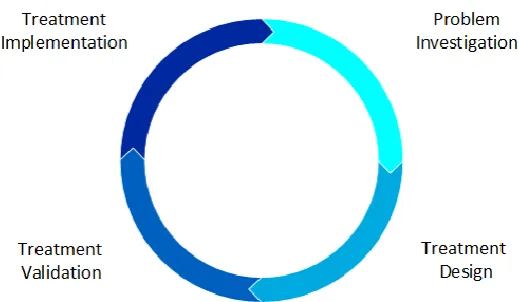
This research follows the Design Science Methodology for Information Systems and Software Engineering as described by Wieringa (Wieringa, 2014) as an overarching methodology. This methodology uses the engineering and design cycle as a central concept for IS design research. This cycle is shown in figure 2. It describes how an artefact is designed within the context of information systems. The design cycle consists of three stages: The Problem Investigation is the preparation stage, in which the design is prepared by studying the problem that the artefact is meant to solve as
well as the context in which it’s going to operate. The Treatment Design is the stage in which the artefact is designed; requirements are specified and optionally already existing treatments are examined. In the Treatment Validation the treatment is validated within the context, and checked whether it fulfils the goals and requirements. The engineering cycle includes a fourth, the treatment implementation, as design projects often serve a real world need, this stage exists to actually
[image:12.595.168.428.416.567.2]implement the treatment in a real world application. This stage is however outside the scope of this project.
7
1.6 Research Motivation
1.6.1 Relevance for Science
While BIM as a concept and many of its facets have already been studied extensively, a gap still appears to exist between scientific literature and practice. By providing a solid foundation with an architecture for BIM integration, the goal is to lower the barrier of BIM integration difficulties, thereby increasing BIM adoption. For science this would lead to being able to focus more on new BIM technologies and applications, with practice not being as far behind and therefore able to implement these new findings quickly.
1.6.2 Relevance for Practice
The goal is to provide practice with a clear example of the benefits that BIM can bring to your organization. By providing a reference architecture, we hope to take away some of the complexity of integrating with BIM solutions. In the future, this might even bring BIM to its original goal of
becoming a collaboration tool between the parties in a construction process.
1.7 Scope
While the research described here is not specifically aimed at the Dutch construction industry, all practice related work is done with Dutch companies and initiatives. While the goal is to deliver a broadly applicable architecture, the case study and evaluation are both performed for the Dutch construction industry, and may vary for other markets where BIM adoption might be less, or more mature.
1.8 Structure of the Report
The first chapter introduces this study. It covers information about the context, problem statement, the approach and methodology as well as the scope and limitations of this study. Furthermore, it describes the motivation for this study.
The second chapter is an overview of the current issues with BIM integration and adoption. This is partly a summary of an earlier literature review (“An Exploratory Literature Review Into the Digital Transformation of the (Dutch) Construction Industry” (Bosdriesz 2018)), and partly a case study of the practice of a medium sized Dutch construction firm.
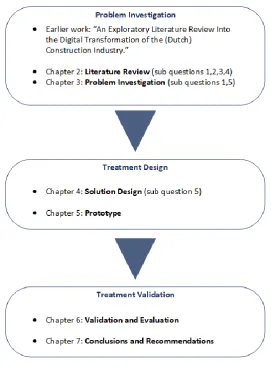
Chapter two consists of an exploratory literature review, looking at the current landscape of BIM tooling, existing architectures as well as existing standards and initiatives. Chapter three further explores the problem by identifying stakeholders and describing a case study. In the fourth chapter, the architecture and platform are designed.
8
9
2. Literature
In this Chapter a literature review is performed. It discusses the current BIM literature in order to identify BIM barriers, existing standards and initiatives as well as existing BIM architectures. Furthermore, an attempt is made to define BIM maturity levels.
2.1 Barriers for BIM adoption
Yan and Demian questioned 67 AEC academics and practitioners in the UK and found that according to their beliefs, the biggest barrier to BIM adoption was the time and human resource cost of BIM training (Yan and Demian 2008). This seems in line with a more recent study of BIM adoption in the Dutch construction industry by a Dutch publisher of market research in the construction industry. In their research they found that the required training and knowledge for BIM was the number one concern regarding BIM adoption (‘BIM & Ketensamenwerking in Kaart’ 2015). A close second was
‘difference in BIM usage between parties’. Bryde et al found that most of the negative benefits or challenges of implementing BIM focussed on software or hardware issues (Bryde, Broquetas, and Volm 2013).
In their assessment of the current state of BIM benefits and challenges, Solnosky identified the following challenge classes (Solnosky 2013):
• Legal and contractual
• Educational training
• Information modelling
• Software
• Cost
These classes largely coincide with the findings from the explorative literature performed in
preparation of this thesis (Bosdriesz 2018). Solnosky also identified major possible future benefits for BIM, mainly in the domain of integration. Further integration with existing processes is the next step of BIM, but still proves to be a challenge.
In order to compare these barriers with our case study, we identify four main barriers:
• Barrier 1. Required training and knowledge
• Barrier 2. Difference in BIM adoption between collaborating parties
• Barrier 3. Software and integration issues
• Barrier 4. Legal and contractual
2.2 BIM Standards and Initiatives
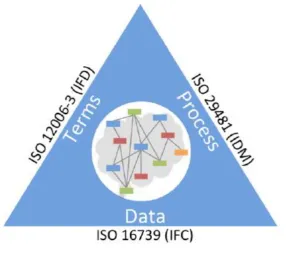
The Industry Foundation Classes (IFC) standard is an open data model used in the BIM domain. It is designed for the exchange of construction models. It is maintained by buildingSMART and has since been adapted as the ISO 16739 international standard (ISO 2013). The Geometric aspects of IFC are mostly defined or derived from a different ISO standard, ISO 10303 (ISO 2014) which also specifies the STEP Physical File (SPF) encoding that is most commonly used in IFC files (.ifc)(Arroyo Ohori et al. 2017).
10
Figure 4. IFC standard.
source: The IFC standard: A review of history, development, and standardization, information technology (Laakso and Kiviniemi 2012).
IFC is both the term for the filetype and the common data model. It contains both geometric and non-geometric data about a building project. It is essentially an entity-relationship model based on the EXPRESS data modelling language (also described in ISO 10303-11 (ISO 2014)). For example a door can have both attributes and properties attached on both the type and instance level. There are currently two relevant versions of IFC; IFC4 is the newest version currently available and contains modified and enriched existing entities and lacks some obsolete and deprecated IFC2x3 entities. IFC2x3 is the previous version. They are not automatically compatible with each other. IFC2x3 is currently used more widely in practice, and many industry agreements still use this standard. Therefore IFC2x3 appears to be the more relevant standard for the near future.
IFC provides a common schema to exchange all data that could possibly be exchanged between BIM tools. However, not every case of data exchange needs the full data set. An IFC MVD (Model View Definition) describes a subset of the IFC schema with specific information requirements, dependent on the process that the exchange is a part of.
Within the larger standard of IFC, local initiatives usually exist to streamline the exchange of design
phase model information. For the Dutch AEC industry, one of these initiatives is the ‘BIM basis ILS’
11
2.3 Existing BIM architectures
In order to develop a reference architecture for BIM integration, we must first look at existing
architectures within the BIM domain. We will discuss some of the often cited architectures within the BIM domain.
There have been several attempts at establishing a framework for BIM interoperability and cooperation. Most focus on either on the organizational aspects or the technological aspects of interoperability and cooperation.
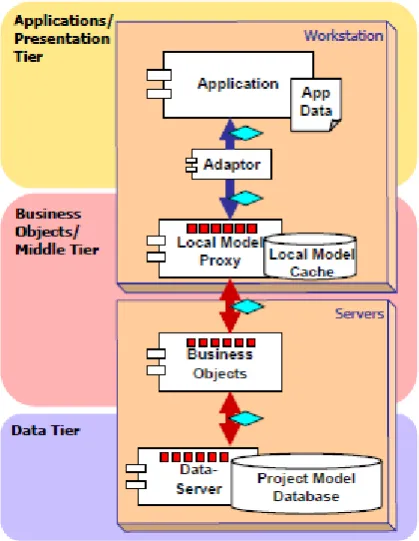
[image:17.595.192.402.260.531.2]One of the earliest of such attempts was made by Froese et al. They describe a general reference architecture for distributed, model-based integrated system (Froese et al. 2000). They describe their architecture in terms of three tiers, namely the Applications/Presentation Tier, the Business Objects/Middle Tier and the Data Tier.
Figure 5. A reference architecture for a distributed, model-based, integrated system by Froese et al. (Froese et al. 2000).
This reference architecture seems suitable for BIM integration, however at the time of writing many
of the standards, initiatives and technologies that we have now weren’t available or established yet. Therefore an updated reference architecture is desirable.
Other architectures and or platforms found in literature often focus on one aspect of BIM integration or collaboration, or focus more on an organizational level.
Based on an analysis and case study, Singh et al. came up with operational technical and support technical requirements for, and developed a, theoretical framework of a BIM-based multidisciplinary collaboration platform (V. Singh, Gu, and Wang 2011). They present a “framework that categorizes and
specifies features and technical requirements for a BIM-server to serve as a collaboration platform”.
12
Das et al. presented a similar framework, for integrating the construction supply chain in an attempt to solve the data heterogeneity and data sharing problems in the construction industry (Das, Cheng, and Law 2015). It describes an ontology based web service framework using various ontology based tools and techniques (OWL, Sparql etc).
Sanguinetti et al. (Sanguinetti et al. 2012) proposed a system architecture in which the data requirements for various analyses are automatically generated from a comprehensive BIM model, rather than having a separate BIM model for each purpose, using MVDs.
During the review it became apparent that due to the multidisciplinary nature of BIM, various frameworks exist but each of them focus on a certain discipline, domain or aspect of BIM. Therefore, for the development of a reference architecture for BIM integration, it is useful to look at existing architectures outside of the BIM domain.
[image:18.595.153.452.360.743.2]Singh et al performed an analysis of 31 existing papers on integration platforms spread over various disciplines and developed a reference architecture for integration platforms (P. M. Singh, Van Sinderen, and Wieringa 2017). They describe various components over three layers: the Data Layer, The Application Layer and the Service Layer. This is, in the most general terms, similar to the reference architecture for a distributed, model-based, integrated system by Froese et al (Froese et al. 2000). Figure 6 depicts the components of the reference architecture as developed by singh et al.
13
2.4 BIM Performance and Maturity
As discussed before, in the past years BIM has made huge strides to becoming industry standard, especially for complex construction projects. During this process however, it became clear that implementing BIM in practice was not always easy. The sheer amount of possibilities attributed to BIM lead to an increased need for the assessment of BIM performance within an organisation. There have been several attempts at establishing a way of assessing this BIM performance. One of these is the TNO QuickScan. The BIM QuickScan tool aims to ‘serve as a standard BIM benchmarking instrument in the Netherlands’. The scan is intended to be performed ‘in a limited time of maximum
one day’, and focusses on 4 overarching topics: organization and management, mentality and culture, information structure and information flow, and tools and applications (Sebastian and van Berlo 2010).
‘Each chapter contains a number of KPIs in the form of a multiple-choice questionnaire. . . With each KPI, there are a number of possible answers. For each answer, a score is assigned. Each KPI also carries a certain weighting factor. The sum of all the partial scores after considering the weighting factors represents the total score of BIM performance of an organization’ (Sebastian and van Berlo 2010).
Another stride towards making BIM performance and maturity measurable was done by Succar et al. in a number of different publications.
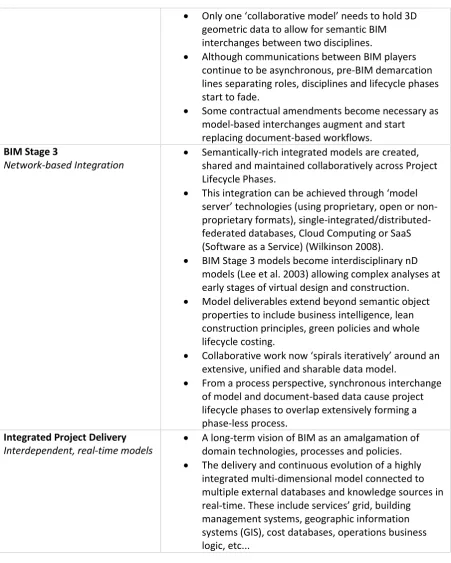
Succar identifies several BIM capability stages (Succar 2010). These stages are summarized in table 2.
Pre-BIM status
Disjointed Project Delivery
• Traditional way of working: heavy focus on 2D documentation.
• No data derived from 3D modelling.
• Collaborative practices between stakeholders are not prioritised and workflow is linear and asynchronous.
BIM Stage 1
Object-based Modelling
• BIM implementation is initiated through the
deployment of an ‘object-based 3D parametric software tool.
• Single-disciplinary models.
• Architectural design models and duct fabrication models.
• Used primarily to automate generation and coordination of 2D documentation and 3D visualisation.
• Other deliverables include basic data exports (e.g. door schedules, concrete volumes, FFE costs,...) and light-weight 3D models (e.g. 3D DWF, 3D PDF, NWD, etc...) Which have no modifiable parametric
attributes.
• No significant model-based interchanges between different disciplines.
BIM Stage 2
Model-based Collaboration
• Active collaboration with other disciplinary players.
• The interchange (interoperable exchange) of models or part-models (either through proprietary or non-proprietary (IFC) file formats).
14
• Only one ‘collaborative model’ needs to hold 3D
geometric data to allow for semantic BIM interchanges between two disciplines.
• Although communications between BIM players continue to be asynchronous, pre-BIM demarcation lines separating roles, disciplines and lifecycle phases start to fade.
• Some contractual amendments become necessary as model-based interchanges augment and start
replacing document-based workflows.
BIM Stage 3
Network-based Integration
• Semantically-rich integrated models are created, shared and maintained collaboratively across Project Lifecycle Phases.
• This integration can be achieved through ‘model server’ technologies (using proprietary, open or non -proprietary formats), single-integrated/distributed-federated databases, Cloud Computing or SaaS (Software as a Service) (Wilkinson 2008).
• BIM Stage 3 models become interdisciplinary nD models (Lee et al. 2003) allowing complex analyses at early stages of virtual design and construction.
• Model deliverables extend beyond semantic object properties to include business intelligence, lean construction principles, green policies and whole lifecycle costing.
• Collaborative work now ‘spirals iteratively’ around an
extensive, unified and sharable data model.
• From a process perspective, synchronous interchange of model and document-based data cause project lifecycle phases to overlap extensively forming a phase-less process.
Integrated Project Delivery
Interdependent, real-time models
• A long-term vision of BIM as an amalgamation of domain technologies, processes and policies.
[image:20.595.73.525.63.627.2]• The delivery and continuous evolution of a highly integrated multi-dimensional model connected to multiple external databases and knowledge sources in real-time. These include services’ grid, building management systems, geographic information systems (GIS), cost databases, operations business logic, etc...
Table 2. BIM capability stages according to Succar (Succar 2010).
Source: Handbook of Research on Building Information Modeling and Construction Informatics: Concepts and Technologies (Underwood and Isikdag 2010)
Based on all the earlier work, they established a framework consisting of five complementary components positioned to understand BIM performance and to enable its assessment and
improvement (Succar, Sher, and Williams 2012). The components of the framework are as follows:
15
• BIM maturity levels representing the quality, predictability and variability within BIM stages;
• BIM competencies representing incremental progressions towards and improvements within BIM stages;
• Organizational Scales representing the diversity of markets, disciplines and company sizes
• Granularity Levels enabling highly targeted yet flexible performance analyses ranging from informal self-assessment to high-detail, formal organizational audits.
Summarized, they look at BIM capability, maturity and competencies in relation to organizational scales.
The term ‘BIM maturity’ refers to the quality, repeatability and degree of excellence within a BIM
capability. Although a BIM ‘capability’ denotes a minimum ability, BIM ‘maturity’ denotes the extent
of that ability in performing a task or delivering a BIM service/product (Succar, Sher, and Williams 2012).
For BIM maturity, they established a BIM maturity model based on various existing models for BIM maturity, as well as several maturity models established in other disciplines. They identify five levels
of BIM maturity, but don’t specify the exact requirements for each level. Combined with the capability stages described above and the competency sets, these can serve as an assessment tool for BIM performance.
Initial/ad hoc Defined Managed Integrated Optimized
16
3. Problem Investigation
In this chapter, the research problem is investigated further by looking at the practice of a medium sized construction company. The stakeholders are identified and a case study is performed in order to compare literature findings with practice.
3.1 Stakeholder Assessment
Stakeholders have been an important aspect of both business and IS research ever since the term emerged in the mid-1980s. A focal point in this movement was the publication of Freeman’s Strategic
Management- A Stakeholder Approach (Freeman 2010). Within IS research, the definition of
stakeholder that’s used is often the one found in ISO/IEC/IEEE 42010. This standard is an
international standard for architecture descriptions of systems and software (ISO/IEC/IEEE 2011). The
definition of a stakeholder found in this standard is: “A individual, team, organization, or classes
thereof, having an interest in a system”.
It is important to consider various stakeholders in a design science project, as they are the source of goals an restraints of a project; which in turn lead to the requirements of the treatment (Wieringa 2014).
3.1.1 Stakeholders in the construction industry
The construction industry is a very fragmented industry, and thus there are often many stakeholders in a construction project. This further depends on size and context of a project; building an aqueduct will have different stakeholders than a residential building.
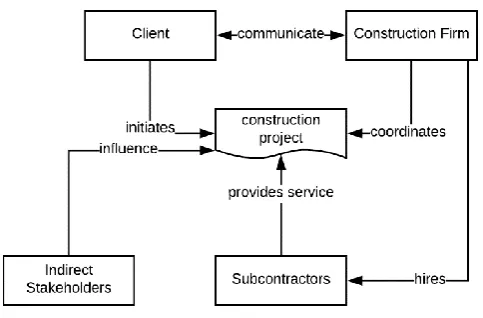
At the most general level, any construction project will have three major groups of stakeholders, namely a Client, the Construction Firm and Subcontractors. The client is often the initiator of a project. They want something build and provide the requirements for a construction project. The construction firm is the coordinator of the project; they are the ones hired by the client in order to get the project built. They in turn often hire a number of different subcontractors to perform (parts of) the construction project, for example they might use the services of an architecture firm, an electrician is hired, a plumber is used to provide their services. All these stakeholders have to work together to deliver the final product.
17
Figure 7: construction project stakeholders
3.1.2 Stakeholders for intra-organizational BIM Integration
For the artefact to be developed we are looking to identify the stakeholders for BIM integration. BIM integration can be inter-organizational or intra-organizational between departments. The
stakeholders of such an integration therefore differ on a case by case basis, it could be an integration between the construction firm and the client, or the firm and its subcontractors, or the firm
internally. Inter-organizational integration/collaboration comes with its own share of barriers regarding data ownership, governance and financial responsibilities (Lam 2005), which our artefact
won’t address; it focusses on improving BIM integration on a technological as well as intra -organizational level.
For the artefact, we identify the following intra-organizational stakeholders:
On a group level
The construction firm
The construction firm has their own role in this. They want to push further BIM usage and integration because they identified the benefits. They are responsible for overseeing the whole project.
The various departments
Each department has their own goals and requirements for the artefact. The software they use, their workflows or their demands may all influence the requirements of the artefact.
On a user level
Non-technical user
This stakeholder group describes all the users of the various departments that have no extensive BIM training. These are the users that should be able to use the data contained in the models in their own workflows, but without encountering the complexities of BIM.
Modeller
18
3.2 Case Study
The Case study was performed at a medium sized Dutch construction company. They have roughly between 300-600 employees. In a yearly top 50 ranking of 2017 by industry magazine Cobouw, they were ranked in the 20s with a revenue of over 150 million euro over 2016 (‘Cobouw50 2017’ 2017). The data was gathered through semi-structured interviews as well as during the regular sprint reviews. For more information about this process, please consult chapter 6.1.1 for an overview of experts.
3.2.1 Barriers identified in practice
At the construction firm investigated for this research, some kind of BIM usage the norm for most projects, at least as far as designing 3D models capable of containing extra object information. For each of the barriers identified from literature, we discuss whether we encountered these in practice. Barrier 1. Required training and knowledge
This barrier is present in our case study. The company has BIM experts as well as designers, but any pilot project that requires non BIM trained employees to participate, is expected to run into
resistance.
Barrier 2. Difference in BIM adoption between collaborating parties
This barrier is present, but not as strongly as in the past. They often work with the same set of parties, and therefore know what to expect when it comes to their BIM usage. They have guidelines in place for how models should be delivered and what they should contain, and the design stage is very collaborative. However, if BIM usage would be pushed beyond the design stage, this barrier might re-emerge, since different parties play a part during the construction process; they might have differing BIM capabilities from the firm itself.
Barrier 3. Software and integration issues
This barrier is present. Wanting to increase BIM usage as well as enriching the data available in the models is highly desired, but the desire is to connect BIM to existing software solutions/workflows, so integration is required. The solutions for this have been scarce, as many products seem to focus on bringing as much functionality as possible into the model, rather than extracting and adding data from and to the model through existing solutions.
Barrier 4. Legal and contractual
We didn’t encounter this barrier, but it was not focussed on either. It is out of the scope of this
project, and shouldn’t impair intra-organizational integration.
3.2.2 BIM usage in practice
While investigating a medium sized Dutch Construction Company, it became clear that a gap exists between the possibilities of BIM described in the extant literature, and the actual usage of so-called BIM models in practice.
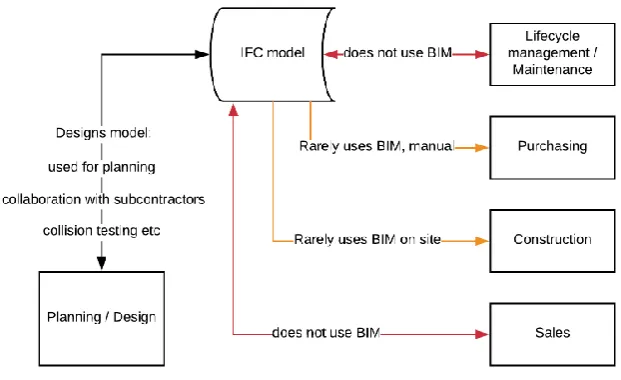
During the BIM model is an important document during the design and planning phase. Upon the acquisition of a new project, a first BIM design is developed in Autodesk Revit. This model is then converted to the open standard IFC and shared with subcontractors, who each check the model and refine it with their own additions. Then, in a joint session between all the stakeholders /
19
[image:25.595.144.455.171.361.2]used extensively. The purchasing department sometimes uses some data from the model, but sporadically, not automated and not standardized. In rare cases, mostly large projects, the construction site has a TV in the worker room where they can check the model, but in general the model is not used for the construction process either. This situation is depicted in figure 2.
Figure 8. Current BIM usage in Case Study
The construction company is rapidly growing, and are noticing that their current way of working is leading to an exceedingly large amount of paperwork. In addition to the BIM model, they still use several separate documents which contain much of the same data as the BIM model. Their wish is to further integrate their BIM usage with their existing processes, but in their opinion existing tooling falls short.
3.2.3 BIM Vision
In the case study, experts mentioned that their vision for BIM is a less consolidated approach, but with BIM as a central data source. Currently you see that a lot of extra features get added to BIM software to add new dimensions of data, however, these experts believe that a less consolidated approach is superior. In this approach, BIM is centralized as data source, but extra processes or dimensions are handled in their own tooling, specialized for that specific task. All object information should still be related to objects in the model, but enriched with task specific data stored in separate databases.
4. Solution Design
As mentioned earlier the most notable technical reason AEC companies are not yet reaping the full benefits of adopting BIM is the lack of interoperability between BIM implementations,
organizational barriers for collaboration, and different maturity levels of using BIM across but also within organizations.
20
In this chapter, the design process of the said artefacts is described. The architecture design is based on two factors: Firstly, the current situation at a medium sized Dutch construction firm, and secondly the current state of BIM literature. Requirements for the solution will therefore be based on needs both from practice (the case study) and literature. The chapter starts with a study into existing BIM tooling as well as architectures; in order to design a reference architecture, it is essential to know which resources are already out there.
4.1 BIM Tooling
Since BIM is a topic that covers various disciplines and has a rather long history of development, the BIM landscape consists of many different tools and types thereof. Furthermore, it is difficult to define when a tool is a BIM tool or not.
[image:26.595.89.486.298.519.2]Generally, we can divide BIM tooling in several categories, the first and foremost of which are the design tools; these tools are used to create the actual model of a building. In general, the relation of tools is described in figure 5.
Figure 9. Relation between types of BIM tooling
Not all these tools are required, nor does every organization use them all. Sometimes, a model will be made in a traditional design tool and then imported into a BIM supported one, sometimes a design will be made in the BIM supported tool itself. There is also tooling that perform several of these tasks. It is also not comprehensive, there are other specialized tools for example lifecycle management, which is outside the scope of this study. But in general, these are the tools that can play a role in BIM workflows.
21
The table below lists some of the tools available within the BIM domain.
Name Publisher Category Proprietary/Open Source
AutoCAD Autodesk Design Proprietary
Sketchup Trimble Design Proprietary
BricsCAD Bricsys Design Proprietary
Vectorworks Fundamentals
Vectorworks Design Proprietary
Tekla Structures Tekla Design + BIM Proprietary
Revit Autodesk Design + BIM Proprietary
ARCHICAD Graphisoft Design + BIM Proprietary
DDS-CAD Data Design System
AS
Design + BIM Proprietary AECOsim Building
Designer
Bentley Design + BIM Proprietary
BricsCAD BIM Bricsys Design + BIM Proprietary
Vectorworks Architect Vectorworks Design + BIM Proprietary
Tekla BIMSight Tekla Analysis/collaboration Proprietary
BIMServer Supported by
TNO/TUE
Collaboration/data management
Open Source
Trimble Connect Trimble Collaboration/data
management
Proprietary
AutoDesk 360 Autodesk Collaboration/data
management
Proprietary
BIMSync Catenda Collaboration/data
management
Proprietary
BIM+ AllPlan Collaboration/data
management
Proprietary EDMmodelServer Jotne EPM
Technology AS
Collaboration/data management
Proprietary
IFCHub IFChub Collaboration/data
management
[image:27.595.71.532.91.527.2]Proprietary
22
4.2 Requirements
In order to conceptualize our Reference Architecture for BIM integration, several requirements were established. These will be listed and discussed here.
R0. The system must allow for other applications to extract object information from a BIM model.
This is the basic premise of the architecture. For a move towards BIM models as centralized data source throughout the construction process, other applications must be able to access the object information stored within the model in order to use them for their regular workflows.
R1. The system must allow for other applications to modify object information in the corresponding BIM model.
Much like R0, This is the basic premise of the architecture. Other applications must be able to enrich model object data with their own, process specific data. This keeps the central BIM model up to date, and allows for more dynamic BIM usage.
R2. The system must use a centralized repository for the BIM models, making the model the leading document throughout the construction process.
[image:28.595.182.413.430.623.2]This requirement is based on expert interviews. Their BIM vision was to have BIM models as a central data source, with business processes having existing data sources in use. These existing data sources can then be used to enrich BIM model data, or simply be used in parallel, with objects information linked to BIM objects. This way, not everything has to be stored in the model itself, but every information used is retraceable to a BIM model object.
23
R3. The system must allow for seamless integration with the traditional applications used by non-technical users
In the previous chapter we identified a group of stakeholders called Non-technical Users. These users have no BIM training, or experience with BIM software.
One of the biggest barriers for BIM adoption identified in both literature and practice, is the high amount of knowledge required and the resulting human resource cost for training people. It
therefore seems unfeasible to have every user trained to be fully capable of using and understanding BIM software. Therefore, in order to design a system that improves BIM integration and adoption, it becomes paramount to keep the BIM complexities somewhat hidden from these users. Therefore, a requirement for the system is to allow users to use their traditional applications that are built specifically for their business process. These applications should be fed BIM model data, but this can be handled mostly on a technological level, causing the least amount of extra complexities for end users.
R4. The system must implement the current industry wide standard set of Industry Foundation Classes (IFC)
24
4.3 Architecture
Based on the aforementioned requirements, the following architecture was developed. The
[image:30.595.71.568.191.336.2]architecture is partly based on the architecture for a distributed, model-based, integrated system by Froese et al (Froese et al. 2000), but altered for modernized BIM needs. Furthermore, it can largely be mapped on the Reference Architecture for Integration Platforms by Singh et al. (P. M. Singh, Van Sinderen, and Wieringa 2017).
Figure 11. A Reference Architecture for BIM integration
The Design Software is used to develop the first edition of the model. During the design, the objects of the model are enriched with available data, and the model is exported to a IFCmodel. This IFC is stored on the DMS. By using IFC, it is likely that anyone wanting to implement this architecture can keep using their familiar design software, as IFC is already (rapidly becoming) the non-proprietary industry standard for BIM models, as previously discussed in 2.2. This satisfies requirement R4. The DMS / Model Repository component of the architecture serves as the back bone of the
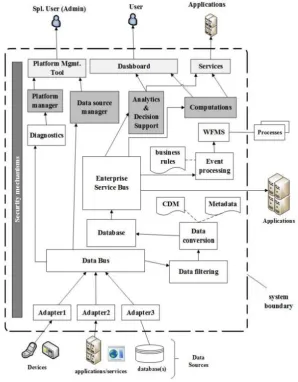
architecture. It is a central repository / database for BIM models, which manages existing models for the various construction projects. Different teams and departments can connect to this data source and access the models assigned to a project, and both extract and enrich object information. For the developed prototype, the open source application BIM server was used for this component, this choice is motivated in the next chapter. It enables querying of the model data (stored as a relational database). Furthermore, it offers an API which allows for access to this data. This component serves as a large part of the data layer, provides functionality compliant to requirements R0 and R1 and is the core of requirement R2. It further satisfies R4 by being fully IFC powered. It is furthermore powered by platform agnostic technologies, making it a solid choice for a research project trying to implement a reference architecture that is to be applied to a wide variety of construction companies. In order to integrate, some kind of integration platform or Enterprise Bus should be used. There are many options on the market for this specific task, but it is important that it can provide the
25
new ones. It is an integral component to satisfy requirement R3, and provides functionality for requirements R0 and R1.
An extra application called BIM Support is tasked with handling any BIM related messaging. A supporting application is required if data were to be sent back, as the bus itself has no memory, and in order to work with the IFC model, some data about IFC objects (such as type, objectID, projectID, revisionID) has to be retained. It is however not feasible to have this data available in every
application that wants to use BIM data, which concluded in the addition of a support application. Therefore, BIMSupport functions as an extra layer of translation and memory between the model repository and the traditional application landscape.
If a purchasing application is in need of object information about a ‘Door’ object, BIMSupport knows
that it should ask the model repository for IFCDoor objects. Furthermore, it can link purchasing object ids with IFC object IDs, and essentially masks the existence of IFC objects from the traditional applications. The functionality of this application could possibly be implemented in the data
26
5. Prototype
In order to validate the architecture, a prototype was developed and implemented, based on the reference architecture described in chapter 3. This chapter describes the development process as well as each of the prototype components. The prototype was developed within the context of a medium sized Dutch construction firm. The first subchapter describes the business process simulated with the prototype; afterwards, the actual prototype is described.
5.1 Use Case
[image:32.595.73.525.342.558.2]In order to develop the prototype, we took a very specific use case for one business process to simulate. A non-technical user from the purchasing department wants to know which articles he or she has to order. The BIM model contains information about objects, and therefore is an ideal source of data for this purpose. The user opens the project in his or her usual application environment, and gets a list of all the objects that are relevant for his or her purchasing operation. The user also wants to add an article number to one of the objects (enrich the model data). This use case is illustrated in figure 11.
Figure 12. Prototype use case
5.2 DMS / Model Repository
For the DMS / Model Repository, a database is needed that can contain BIM model data. Since development time is limited for this research project, a ready to use product is preferred. Looking at the available tooling from chapter 3.1, there are several products that provide some kind of IFC model repository. Many of them provide a whole portal/cloud environment, which is more than needed, and a lot of them are closed source with a proprietary data format.
27
querying, merging and filtering of the BIM data. Furthermore, it comes with core server features like revisions, authorization, compare, query, model checking, merging, etc.
Out of the box, it comes with several plugins to show its possibilities. In order to set up a test
[image:33.595.87.528.171.411.2]environment for the prototype, a plugin called bimvie.ws was used. This plugin provides a portal over the core BIMServer functionality, so that it can be used and managed from a web browser. This plugin is shown in figure 12.
Figure 13. bimvie.ws, a plugin which adds a web portal to BIMServer
28
5.3 Integration
5.3.1 Integration Platform
In order to integrate with the model repository, a tool was needed to fulfil the integration platform / bus role. While many tools exist on the market to provide integration, many of which are supplied by some of the giants in the technology world. SAP, Microsoft, Oracle and others all offer a wide variety of integration products. For the prototype, the eMagiz Model Driven Integration Platform as a Service (iPaaS) was used for integration purposes. It was chosen for three main reasons:
•
It was already used in the application landscape used to test and validate the prototype, therefore more expert knowledge was available and the focus could be on the benefits of the integration architecture, rather than the technological complexities.•
It is a user friendly, model driven way of designing integrations; this means there’s nearly no codingrequired, making it quicker to pick up for a limited duration research project.
•
The eMagiz platform has often been used with Mendix, the tool used to develop the prototype Purchasing Portal and BIMSupport applications. This combination of tools is therefore thoroughly tested and well supported. [image:34.595.79.518.423.607.2]eMagiz consists of several components. Central to the communication is the Java Message Service (JMS). In addition to this central component, a connector runs for each of the external servers that are part of the integration; these components handle the communication to that specific endpoint. Lastly, a component, in the figure below denoted as container, contains the functionalities for transforming messages to and from the CDM, and contains essentially all the eMagiz logic.
29
5.3.2 CDM
In order to facilitate messaging between the various components of the architecture, a common data model has been developed. It has initially been based on the BIM Service interface exchange
[image:35.595.72.581.174.370.2](BIMSie), a standard API for BIM cloud integration. Since the DMS / Model Repository makes use of this API, the messages were based of that. Later, some extra terms were added to the CDM in order to facilitate messages in the traditional application landscape. The CDM can be seen in figure 14.
Figure 15. The Common Data Model used in the Prototype
30
5.3.3 Messaging
In order to perform each of the tasks described in the use case, there are various messages that can be sent in the prototype. Figure 16 shows the general message overview of the prototype. All
messages are sent and received in XML format, using the SOAP protocol for both the BIMServer API as well as the connection with both Mendix applications.
Between the DMS / Model Repository BIMServer and the bus there are four defined message types. For a project update, a full description of the flow is given as an example. Other flows are
summarized and depicted in appendix A.
[image:36.595.49.569.126.354.2]31
BIMServ project update
This is a message which contains the following:
• General project information for all projects on the repository
• All IFCTypes contained in each of the models, so that BIMsupport knows what to ask for in follow up requests.
[image:37.595.81.524.262.609.2]In the prototype, this message is sent on a basic CRON timer, so that every x minutes BIMserver updates the other applications with up to date project data. A better implementation would be to send updates on change, e.g. when a new project is added or an existing project is changed, but due to time constraints the simpler solution was used. In order to create this message, several steps are taken in the eMagiz entry connector flow (shown in figure 17). It is an asynchronous connection, no response is expected.
Figure 17. eMagiz entry connector flow for message 'bims-upd' from system bimserv.
When a receive.crontrigger is called (upon receiving the cron trigger), eMagiz sends a
auth.loginUserToken SOAP API call to BIMServer, in order to log in with the user token stored in the eMagiz properties. This call returns an authorization key needed for further API calls to bimserver. In transform.addTokenToHeader, an xpath query retrieves this token and stores it in the eMagiz
message header. Transform.createGetAllProjectsMessage transforms the message using xslt to a new
‘getAllProjects’ message. This message is then send to the SOAP endpoint of BIMServer, returning a
32
each project. Using another xslt transformation in transform.createGetObjectTypesMessage, a message is constructed per project in order to retrieve all available IFCTypes used in that model. Per IFCType, a last message is constructed in transform.createBusMessage and sent to the bus.
Add Property to PropertySet
This message type is used to add a property to a specific propertyset. It should contain a property, a propertyset to add it to, and the object the propertyset should be a part of. The flow for this message uses the following BIMServer API calls:
• AuthInterface.loginUserToken
• LowLevelInterface.startTransaction
• LowLevelInterface.createObject
• LowLevelInterface.addStringAttribute
• LowLevelInterface.commitTransaction
Request IFC objects by IFCtype
This message sends a request to return all simple object data for all objects of a specific IFCType (e.g. all IFCDoors). This is a synchronous call, where BIMServer immediately responds with object
information. The message requires a revisionID and an IFCType. The flow for this message uses the following BIMServer API calls:
• AuthInterface.loginUserToken
• LowLevelInterface.getObjectsByType
Get PropertySets by IFCObject
This request retrieves the PropertySet(s) associated with a specific IFC object. ). This is a synchronous call, where BIMServer immediately responds with the property set object information. The flow for this message uses the following BIMServer API calls:
• AuthInterface.loginUserToken
33
Between the Bus and the BIMSupport Application, there are several types of messages. BIMSupport handles all of the communication with BIMServer, so like BIMServer, it handles the message types Add Property to PropertySet, Request IFC objects by IFCtype and Get PropertySets by IFCObject described above it also receives the BIMServ project update. Furthermore, it handles the communication with the purchasing portal. For this purpose, the following messages exist:
Update MX purchasing
This message is used to provide the purchasing portal with updated project information. It is called when BIMSupport receives new project data from BIMServer. It is a asynchronous call and consists of a Project (name, id) and a Revision (id).
Send Purchasing Articles
This message is used to send article information to the purchasing portal. It is an asynchronous call, and consists of an associated Revision(id), IFCType(name) and any number of IFCObjects(objName, objID, globalID).
Request Articles by Project
This message is used to request article information for a specific Project. It is sent by the purchasing portal and contains a Project(id) and Revision(id). It is used to trigger a Send Purchasing Articles
response.
Add Article Number
This message is used to add an article number to a article. This article number is sent to BIMSupport, which is supposed to add the number to an objects propertySet called:
‘Pset_ManufacturerTypeInformation’
34
5.4 BIMSupport
The BIMSupport application is a Mendix application, used to store the IFC data required to enrich IFC data in the external applications. It enables the purchasing application to use its own terminology rather than having to store IFC terminology in all connected applications. Furthermore it serves as a sort of memory for when the applications in the traditional application landscape want to send object data back to BIMServer.
5.4.1 Mendix
In order to develop the BIMSupport, the tool Mendix was used. Mendix is a Low Code Application Development Platform. The choice of Mendix was made due to several reasons:
• It offers the ability to rapidly deploy fully functioning applications, allowing for the development of the whole architecture within the time constraints of a Master thesis.
• It was already used extensively in the application landscape of the construction company where the architecture is tested, as well as being the tool of choice of Cape Groep. This meant that a significant amount of expert knowledge was available, leading to quicker development.
• Its low code functionality made it easier to convey the ideas and theory behind the prototype to non-technical users.
5.4.2 Functionality
Project Overview
The main page of the BIMSupport application consists of an overview of all the projects as they exist on BIMServer, including their available revisions. In the prototype, there is also a button available to send project data to the purchasing portal, triggering an Update MX purchasing message.
eMagiz-MX Connector
[image:40.595.70.524.525.742.2]The BIMSupport application contains a eMagiz-MX connector. This is a module developed and maintained by the eMagiz team, containing all the functionality to connect with the eMagiz bus, as well as the eMagiz portal. It has an overview of all the components running, and provides basic functionality for each of them.
35
Purchasing Mapping
One of the main features of the BIMSupport application is the mapping functionality. This
functionality allows the user to change the internal IFC object names to more appropriate naming schemes for traditional applications. For example, a user might want to order doors for a
construction project. Door objects in IFC are classified as IFCDoors, but the purchasing portal may know them as just Doors. Therefore, a mapping is made between IFCDoor and Door, from which point BIMSupport always sends IFCDoor objects as Door to the purchasing portal, and as IFCDoor to BIMServer (which only knows IFCDoor objects, and not Door objects).
[image:41.595.136.430.212.343.2]The page used to create this mappings first allows the user to select a project. After making a selection, a list of IFC objects that exist in the BIM model of said object. Per IFCobject a choice can then be made to include objects of said class in the purchasing process, and what name they should be mapped to.
[image:41.595.145.451.450.701.2]36
Article and article number requests
The article requests screen shows an overview of received requests for articles by the purchasing portal, showing a button which allows the user to request the correct objects from BIMServer, and send them back to the purchasing portal. The article number request screen shows all article numbers sent by the purchasing portal, which have to be delivered to the BIMServer application.
Web Services
In addition to the aforementioned functionality, BIMSupport contains various web services for handling the messaging to and from the eMagiz bus.
5.5 Purchasing Portal
The Purchasing Portal is prototyped in order to provide a basic implementation of a purchasing application. Like BIMSupport, Mendix is used for the prototyping; the reasons for this choice are the same as during the BIMSupport development. The Portal enables the end user to obtain a list of relevant objects per project from the origin IFC model on BIMServer as well enrich the data with additional article numbers. The purchasing portal does not contain IFC data, but rather article information.
5.5.1 Functionality
Project Overview
[image:42.595.119.476.424.598.2]The Purchasing Portal provides the end user with an overview of the available projects from which articles can be retrieved. It shows the projects as they exist on BIMServer, as well as the existing revisions. The data is stored locally, but updated whenever BIMServer pushes a project update.
Figure 21. The purchasing portal domain model
From the project overview, a request for articles can be sent using the ‘request articles by project’
button. This triggers a message to BIMSupport, which then handles the article request further. Once the articles for a specific project are in the system, an article number can be added to an object. This once again triggers a message to BIMSupport, which handles the rest of the add article number functionality.
Web Services