The Thirty-Third AAAI Conference on Artificial Intelligence (AAAI-19)
Story Ending Generation with
Incremental Encoding and Commonsense Knowledge
Jian Guan,
∗Yansen Wang,
∗Minlie Huang
†Dept. of Computer Science & Technology, Tsinghua University, Beijing 100084, China Institute for Artificial Intelligence, Tsinghua University (THUAI), China Beijing National Research Center for Information Science and Technology, China
[email protected];[email protected]; [email protected]
Abstract
Generating a reasonable ending for a given story context, i.e., story ending generation, is a strong indication of story com-prehension. This task requires not only to understand the con-text clues which play an important role in planning the plot, but also to handle implicit knowledge to make a reasonable, coherent story. In this paper, we devise a novel model for story ending generation. The model adopts an incremental en-coding scheme to represent context clues which are spanning in the story context. In addition, commonsense knowledge is applied through multi-source attention to facilitate story comprehension, and thus to help generate coherent and rea-sonable endings. Through building context clues and using implicit knowledge, the model is able to produce reasonable story endings. Automatic and manual evaluation shows that our model can generate more reasonable story endings than state-of-the-art baselines1.
Introduction
Story generation is an important but challenging task be-cause it requires to deal with logic and implicit knowledge (Li et al. 2013; Soo, Lee, and Chen 2016; Ji et al. 2017; Jain et al. 2017; Martin et al. 2018; Clark, Ji, and Smith 2018). Story ending generation aims at concluding a story and completing the plot given a story context. We argue that solving this task involves addressing the following issues: 1) Representing thecontext clueswhich contain key informa-tion for planning a reasonable ending; and 2) Usingimplicit knowledge(e.g., commonsense knowledge) to facilitate un-derstanding of the story and better predict what will happen next.
Comparing to textual entailment or reading comprehen-sion (Dagan, Glickman, and Magnini 2006; Hermann et al. 2015) story ending generation requires more to deal with the logic and causality information that may span multiple sen-tences in a story context. The logic information in story can
∗
Authors contributed equally to this work. †
Corresponding author: Minlie Huang.
Copyright c2019, Association for the Advancement of Artificial Intelligence (www.aaai.org). All rights reserved.
1
Our codes and data are available at https://github.com/ JianGuanTHU/StoryEndGen.
He hopes to get a lot of candy. Today is Halloween.
Jack is so excited to go trick or treatingtonight . He is going to dress uplike a monster.
The costumeis real scary.
Halloween
trick or treat
dress up monster
costume is scary
get candy
trick or treat
costume Halloween
dress up
monster scary
candy
scare hallow day
beast dressMa
nne
rO
f Rela
tedT
o
Re
la
tedT
o
RelatedTo RelatedTo
RelatedTo RelatedTo
RelatedTo . . .
. . .
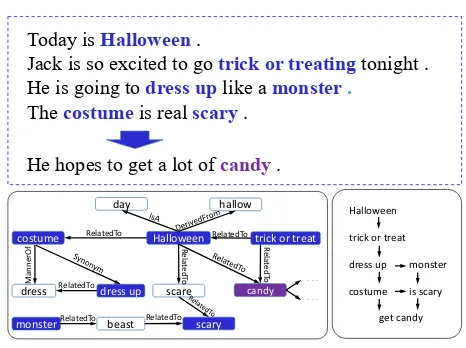
Figure 1: A story example. Words in blue/purple are events and entities. The bottom-left graph is retrieved from Con-ceptNet and the bottom-right graph represents how events and entities form the context clue.
be captured by the appropriate sequence of events2 or
enti-ties occurring in a sequence of sentences, and the chronolog-ical order or causal relationship between events or entities. The ending should be generated from the whole context clue rather than merely inferred from a single entity or the last sentence. It is thus important for story ending generation to represent the context clues for predicting what will happen in an ending.
However, deciding a reasonable ending not only depends on representing the context clues properly, but also on the ability of language understanding with implicit knowledge that is beyond the text surface. Humans use their own experi-ences and implicit knowledge to help understand a story. As shown in Figure 1, the ending talks aboutcandywhich can be viewed as commonsense knowledge about Halloween. Such knowledge can be crucial for story ending generation.
Figure 1 shows an example of a typical story in the ROC-Stories corpus (Mostafazadeh et al. 2016b). In this exam-ple, the events or entities in the story context constitute the
2
context clues which reveal the logical or causal relation-ships between events or entities. These concepts,
includ-ing Halloween,trick or treat, and monster, are connected
as a graph structure. A reasonable ending should consider all the connected concepts rather than just some individual one. Furthermore, with the help of commonsense knowledge retrieved from ConceptNet (Speer and Havasi 2012), it is easier to infer a reasonable ending with the knowledge that
candyis highly related toHalloween.
To address the two issues in story ending generation, we devise a model that is equipped with an incremental en-coding schemeto encode context clues effectively, and a
multi-source attention mechanism to use commonsense
knowledge. The representation of the context clues is built
through incremental reading (or encoding) of the sentences in the story context one by one. When encoding a current sentence in a story context, the model can attend not only to the words in the preceding sentence, but also the knowl-edge graphs which are retrieved from ConceptNet for each word. In this manner, commonsense knowledge can be en-coded in the model through graph representation techniques, and therefore, be used to facilitate understanding story con-text and inferring coherent endings. Integrating the concon-text clues and commonsense knowledge, the model can generate more reasonable endings than state-of-the-art baselines.
Our contributions are as follows:
• To assess the machinery ability of story comprehension, we investigate story ending generation from two new an-gles. One is to modeling logic information via incremental context clues and the other is the utility of implicit knowl-edge in this task.
• We propose a neural model which represents context clues by incremental encoding, and leverages commonsense knowledge by multi-source attention, to generate logical and reasonable story endings. Results show that the two techniques are effective in capturing the coherence and logic of story.
Related Work
The corpus we used in this paper was first designed for Story Cloze Test (SCT) (Mostafazadeh et al. 2016a), which re-quires to select a correct ending from two candidates given a story context. Feature-based (Chaturvedi, Peng, and Dan 2017; Lin, Sun, and Han 2017) or neural (Mostafazadeh et al. 2016b; Wang, Liu, and Zhao 2017) classification mod-els are proposed to measure the coherence between a can-didate ending and a story context from various aspects such as event, sentiment, and topic. However, story end-ing generation (Li, Dend-ing, and Liu 2018; Zhao et al. 2018; Peng et al. 2018) is more challenging in that the task re-quires to modeling context clues and implicit knowledge to produce reasonable endings.
Story generation, moving forward to complete story com-prehension, is approached as selecting a sequence of events to form a story by satisfying a set of criteria (Li et al. 2013). Previous studies can be roughly categorized into two lines: rule-based methods and neural models. Most of the traditional rule-based methods for story generation (Li et
al. 2013; Soo, Lee, and Chen 2016) retrieve events from a knowledge base with some pre-specified semantic relations. Neural models for story generation has been widely stud-ied with sequence-to-sequence (seq2seq) learning (Roem-mele 2016). And various contents such as photos and independent descriptions are largely used to inspire the story (Jain et al. 2017).To capture the deep meaning of key entities and events, Ji et al. (2017) and Clark, Ji, and Smith (2018) explicitly modeled the entities mentioned in story with dynamic representation, and Martin et al. (2018) decomposed the problem into planning successive events and generating sentences from some given events. Fan, Lewis, and Dauphin (2018) adopted a hierarchical architec-ture to generate the whole story from some given keywords. Commonsense knowledge is beneficial for many natural language tasks such as semantic reasoning and text entail-ment, which is particularly important for story generation. LoBue and Yates (2011) characterized the types of com-monsense knowledge mostly involved in recognizing tex-tual entailment. Afterwards, commonsense knowledge was used in natural language inference (R. Bowman et al. 2015) and language generation (Zhou et al. 2018). Mihaylov and Frank (2018) incorporated external commonsense knowl-edge into a neural cloze-style reading comprehension model. Rashkin et al. (2018) performed commonsense inference on people’s intents and reactions of the event’s participants given a short text. Similarly, Knight et al. (2018) introduced a new annotation framework to explain psychology of story characters with commonsense knowledge. And common-sense knowledge has also been shown useful to choose a correct story ending from two candidate endings (Lin, Sun, and Han 2017; Li et al. 2018).
Methodology
Overview
The task of story ending generation can be stated as fol-lows: given a story context consisting of a sentence sequence X = {X1, X2,· · ·, XK}3, where Xi = x
(i) 1 x
(i) 2 · · ·x
(i)
li represents thei-th sentence containingli words, the model
should generate a one-sentence endingY =y1y2...ylwhich
is reasonable in logic, formally as
Y∗=argmax Y
P(Y|X). (1)
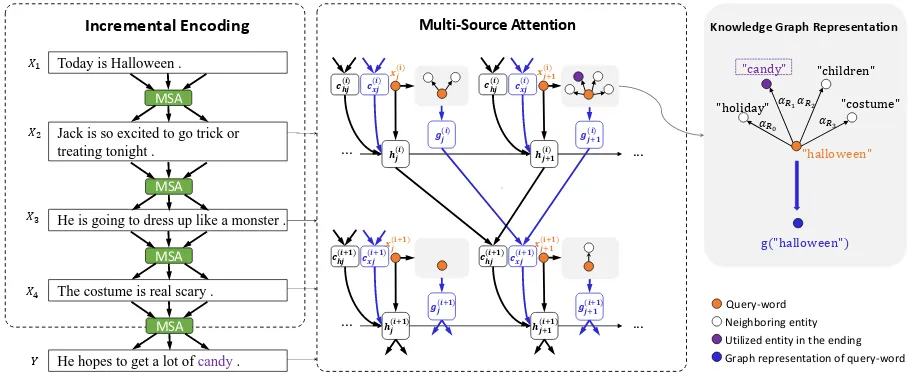
As aforementioned, context clue and commonsense knowledge is important for modeling the logic and casual information in story ending generation. To this end, we de-vise an incremental encoding scheme based on the gen-eral encoder-decoder framework (Sutskever, Vinyals, and Le 2014). As shown in Figure 2, the scheme encodes the sen-tences in a story context incrementally with amulti-source attention mechanism: when encoding sentenceXi, the
en-coder obtains a context vector which is an attentive read of the hidden states, and the graph vectors of the preceding sen-tenceXi−1. In this manner, the relationship between words
(some are entities or events) in sentenceXi−1and those in
3
Today is Halloween .
Jack is so excited to go trick or treating tonight .
He is going to dress up like a monster .
The costume is real scary .
He hopes to get a lot of candy.
s 𝒉𝒋
(𝒊) ...
𝒙𝒋(𝐢)
Multi-Source Attention
𝑋1
𝑋4
𝑌 𝑋3 𝑋2
"halloween"
"candy" "children"
"holiday" "costume"
Knowledge Graph Representation
𝛼𝑅0 𝛼𝑅1𝛼𝑅2
𝛼𝑅3
g("halloween")
Query-word Neighboring entity Utilized entity in the ending Graph representation of query-word 𝒉𝒋+𝟏
(𝒊) 𝒄𝒙𝒋(𝒊)
𝒄𝒉𝒋 (𝒊)
...
𝒈𝒋(𝒊) 𝒈𝒋+𝟏(𝒊)
Incremental Encoding
MSA
MSA
MSA
MSA
𝒙𝒋+𝟏(𝐢) 𝒄𝒙𝒋(𝒊)
𝒄𝒉𝒋 (𝒊)
𝒉𝒋
(𝒊+𝟏) ...
𝒙𝒋(𝐢+𝟏)
𝒉𝒋+𝟏 (𝒊+𝟏) 𝒄𝒙𝒋(𝒊+𝟏)
𝒄𝒉𝒋 (𝒊+𝟏)
...
𝒈𝒋(𝒊+𝟏) 𝒈𝒋+𝟏(𝒊+𝟏)
𝒙𝒋+𝟏 (𝐢+𝟏) 𝒄𝒙𝒋
(𝒊+𝟏)
𝒄𝒉𝒋 (𝒊+𝟏)
Figure 2: Model overview. The model is equipped with incremental encoding (IE) and multi-source attention (MSA).x(ji):
thej-th word in sentencei;chj(i): state context vector;c(xji): knowledge context vector; g(ji): graph vector of wordxj(i);h(ji): j-th hidden state of sentencei. The state (knowledge) context vectors are attentive read of hidden states (graph vectors) in the preceding sentence.
Xi is builtincrementally, and therefore, the chronological
order or causal relationship between entities (or events) in adjacent sentences can be captured implicitly. To leverage commonsense knowledge which is important for generating a reasonable ending, a one-hop knowledge graph for each word in a sentence is retrieved from ConceptNet, and each graph can be represented by a vector in two ways. The in-cremental encoder not only attends to the hidden states of Xi−1, but also to the graph vectors at each position ofXi−1.
By this means, our model can generate more reasonable end-ings by representing context clues and encoding common-sense knowledge.
Background: Encoder-Decoder Framework
The encoder-decoder framework is a general framework widely used in text generation. Formally, the model encodes the input sequenceX=x1x2· · ·xminto a sequence of
hid-den states, as follows,
ht=LSTM(ht−1,e(xt)), (2)
wherehtdenotes the hidden state at steptande(x)is the
word vector ofx.
At each decoding position, the framework will generate a word by sampling from the word distributionP(yt|y<t, X)
(y<t = y1y2· · ·yt−1 denotes the sequences that has been generated before stept), which is computed as follows:
P(yt|y<t, X) =softmax(W0st+b0), (3)
st=LSTM(st−1,e(yt−1),ct−1), (4)
wherest denotes the decoder state at stept. When an
at-tention mechanism is applied, ct−1 is an attentive read of the context, which is a weighted sum of the encoder’s hid-den states asct−1=P
m
i=1α(t−1)ihi, andα(t−1)imeasures
the association between the decoder state st−1 and the en-coder statehi. Refer to (Bahdanau, Cho, and Bengio 2014)
for more details.
Incremental Encoding Scheme
Straightforward solutions for encoding the story context can be: 1) Concatenating theKsentences to a long sentence and encoding it with an LSTM ; or 2) Using a hierarchical LSTM with hierarchical attention (Yang et al. 2016), which firstly attends to the hidden states of a sentence-level LSTM, and then to the states of a word-level LSTM. However, these so-lutions are not effective to represent the context clues which may capture the key logic information. Such information re-vealed by the chronological order or causal relationship be-tween events or entities in adjacent sentences.
To better represent the context clues, we propose an incre-mental encoding scheme: when encoding the current sen-tenceXi, it obtains a context vector which is an attentive
read of the preceding sentenceXi−1. In this manner, the or-der/relationship between the words in adjacent sentences can be captured implicitly.
This process can be stated formally as follows:
hj(i)=LSTM(hj−(i)1,e(xj(i)),c(lji)), i≥2. (5)
whereh(ji) denotes the hidden state at thej-th position of
thei-th sentence,e(x(ji))denotes the word vector of thej
-th wordx(ji).c(l,ji)is the context vector which is an attentive
read of theprecedingsentenceXi−1, conditioned onh(j−i)1. We will describe the context vector in the next section.
During the decoding process, the decoder obtains a con-text vector from the last sentenceXKin the context to utilize
st=LSTM(st−1,e(yt−1),clt), (6)
wherecltis the context vector which is the attentive read of
the last sentenceXK, conditioned onst−1. More details of
the context vector will be presented in the next section.
Multi-Source Attention (MSA)
The context vector (cl) plays a key role in representing the
context clues because it captures the relationship between words (or states) in the current sentence and those in the preceding sentence. As aforementioned, story comprehen-sion sometime requires the access of implicit knowledge that is beyond the text. Therefore, the context vector consists of two parts, computed with multi-source attention. The first onec(hij) is derived by attending to the hidden states of the
preceding sentence, and the second onec(xij)by attending to the knowledge graph vectors which represent the one-hop graphs in the preceding sentence. The MSA context vector is computed as follows:
c(lji)=Wl([c
(i)
hj;c
(i)
xj]) +bl, (7)
where ⊕indicates vector concatenation. Hereafter, c(hij) is
calledstate context vector, andc(xij)is calledknowledge
con-text vector.
Thestate context vectoris a weighted sum of the hidden states of the preceding sentenceXi−1and can be computed as follows:
c(hij)=
li−1
X
k=1 αh(i)
k,jh (i−1)
k , (8)
α(hi) k,j =
eβ (i)
hk,j
li−1
P
m=1 eβ(hm,ji)
, (9)
βh(i) k,j =h
(i)T
j−1Wsh
(i−1)
k , (10)
whereβh(i)
k,jcan be viewed as a weight between hidden state
h(j−i)1in sentenceXiand hidden stateh
(i−1)
k in the preceding
sentenceXi−1.
Similarly, the knowledge context vector is a weighted sum of thegraph vectorsfor the preceding sentence. Each word in a sentence will be used as a query to retrieve a one-hop commonsense knowledge graph from ConceptNet, and then, each graph will be represented by agraph vector. Af-ter obtaining the graph vectors, the knowledge context vec-tor can be computed by:
c(xij)=
li−1
X
k=1 α(xi)
k,jg(x (i−1)
k ), (11)
α(xi) k,j =
eβ (i)
xk,j
li−1
P
m=1 eβ(xm,ji)
, (12)
βx(i) k,j =h
(i)T
j−1Wkg(x
(i−1)
k ), (13)
whereg(x(ki−1))is thegraph vectorfor the graph which is
retrieved for word x(ki−1). Different frome(x(ki−1))which
is the word vector,g(x(ki−1))encodes commonsense knowl-edge and extends the semantic representation of a word through neighboring entities and relations.
During the decoding process, the knowledge context vec-tors are similarly computed by attending to the last input sentence XK. There is no need to attend to all the context
sentences because the context clues have been propagated within the incremental encoding scheme.
Knowledge Graph Representation
Commonsense knowledge can facilitate language under-standing and generation. To retrieve commonsense knowl-edge for story comprehension, we resort to Concept-Net4 (Speer and Havasi 2012). ConceptNet is a semantic
network which consists of triples R = (h, r, t) meaning that head concept hhas the relationrwith tail concept t. Each word in a sentence is used as a query to retrieve a one-hop graph from ConceptNet. The knowledge graph for a word extends (encodes) its meaning by representing the graph from neighboring concepts and relations.
There have been a few approaches to represent common-sense knowledge. Since our focus in this paper is on using knowledge to benefit story ending generation, instead of de-vising new methods for representing knowledge, we adopt two existing methods: 1)graph attention(Veliˇckovi´c et al. 2018; Zhou et al. 2018), and 2)contextual attention (Mi-haylov and Frank 2018). We compared the two means of knowledge representation in the experiment.
Graph Attention Formally, the knowledge graph of word (or concept)x is represented by a set of triples,G(x) =
{R1, R2,· · · , RNx} (where each triple Ri has the same head conceptx), and the graph vectorg(x)for wordxcan be computed viagraph attention, as below:
g(x) =
Nx
X
i=1
αRi[hi;ti], (14)
αRi = eβRi
Nx
P
j=1 eβRj
, (15)
βRi = (Wrri)
Ttanh(W
hhi+Wtti), (16)
where (hi, ri, ti) = Ri ∈ G(x) is the i-th triple in the
graph. We use word vectors to represent concepts, i.e.hi=
e(hi),ti =e(ti), and learn trainable vectorri for relation ri, which is randomly initialized.
Intuitively, the above formulation assumes that the knowl-edge meaning of a word can be represented by its neighbor-ing concepts (and correspondneighbor-ing relations) in the knowledge base. Note that entities in ConceptNet are common words (such astree, leaf, animal), we thus use word vectors to rep-resent h/r/t directly, instead of using geometric embedding
4
methods (e.g., TransE) to learn entity and relation embed-dings. In this way, there is no need to bridge the representa-tion gap between geometric embeddings and text-contextual embeddings (i.e., word vectors).
Contextual Attention When using contextual attention, the graph vectorg(x)can be computed as follows:
g(x) =
Nx
X
i=1
αRiMRi, (17)
MRi=BiGRU(hi,ri,ti), (18)
αRi= eβRi Nx
P
j=1 eβRj
, (19)
βRi=h T
(x)WcMRi, (20)
whereMRi is the final state of aBiGRUconnecting the el-ements of triple Ri, which can be seen as the knowledge
memory of thei-th triple, whileh(x)denotes the hidden state at the encoding position of wordx.
Loss Function
As aforementioned, the incremental encoding scheme is central for story ending generation. To better model the chronological order and causal relationship between adja-cent sentences, we impose supervision on the encoding net-work. At each encoding step, we also generate a distribution over the vocabulary, very similar to the decoding process:
P(yt|y<t, X) =softmax(W0h (i)
j +b0), (21)
Then, we calculate the negative data likelihood as loss func-tion:
Φ = Φen+ Φde (22)
Φen=
K
X
i=2
li
X
j=1
−logP(x(ji)=exj(i)|x(<ji), X<i), (23)
Φde=
X
t
−logP(yt= ˜yt|y<t, X), (24)
whereex(ji)means the reference word used for encoding at the j-th position in sentence i, and y˜t represents the j-th
word in the reference ending. Such an approach does not mean that at each step there is only one correct next sen-tence, exactly as many other generation tasks. Experiments show that it is better in logic than merely imposing supervi-sion on the decoding network.
Experiments
Dataset
We evaluated our model on the ROCStories corpus (Mostafazadeh et al. 2016a). The corpus contains 98,162 five-sentence stories for evaluating story understanding and script learning. The original task is designed to select a cor-rect story ending from two candidates, while our task is to generate a reasonable ending given a four-sentence story
context. We randomly selected 90,000 stories for training and the left 8,162 for evaluation. The average number of words in X1/X2/X3/X4/Y is 8.9/9.9/10.1/10.0/10.5 re-spectively. The training data contains 43,095 unique words, and 11,192 words appear more than 10 times. For each word, we retrieved a set of triples from ConceptNet and stored those whose head entity and tail entity are noun or verb, meanwhile both occurring in SCT. Moreover, we retained at most 10 triples if there are too many. The average number of triples for each query word is 3.4.
Baselines
We compared our models with the following state-of-the-art baselines:
Sequence to Sequence (Seq2Seq): A simple encoder-decoder model which concatenates four sentences to a long sentence with an attention mechanism (Luong, Pham, and Manning 2015).
Hierarchical LSTM (HLSTM):The story context is rep-resented by a hierarchical LSTM: a word-level LSTM for each sentence and a sentence-level LSTM connecting the four sentences (Yang et al. 2016). A hierarchical attention mechanism is applied, which attends to the states of the two LSTMs respectively.
HLSTM+Copy:The copy mechanism (Gu et al. 2016) is applied to hierarchical states to copy the words in the story context for generation.
HLSTM+Graph Attention(GA):We applied multi-source attention HLSTM where commonsense knowledge is en-coded by graph attention.
HLSTM+Contextual Attention(CA):Contextual attention is applied to represent commonsense knowledge.
Experiment Settings
The parameters are set as follows: GloVe.6B (Pennington, Socher, and Manning 2014) is used as word vectors, and the vocabulary size is set to 10,000 and the word vector di-mension to 200. We applied 2-layer LSTM units with 512-dimension hidden states. These settings were applied to all the baselines.
The parameters of the LSTMs (Eq. 5 and 6) are shared by the encoder and the decoder.
Automatic Evaluation
We conducted the automatic evaluation on the 8,162 stories (the entire test set). We generated endings from all the mod-els for each story context.
Evaluation Metrics We adopted perplexity(PPL) and
Model PPL BLEU-1 BLEU-2 Gram. Logic. Seq2Seq 18.97 0.1864 0.0090 1.74 0.70 HLSTM 17.26 0.2459 0.0242 1.57 0.84 HLSTM+Copy 19.93 0.2469 0.0248 1.66 0.90 HLSTM+MSA(GA) 15.75 0.2588 0.0253 1.70 1.06 HLSTM+MSA(CA) 12.53 0.2514 0.0271 1.72 1.02 IE (ours) 11.04 0.2514 0.0263 1.84 1.10 IE+MSA(GA) (ours) 9.72 0.2566 0.0284 1.68 1.26
IE+MSA(CA) (ours) 8.79 0.2682 0.0327 1.66 1.24
Table 1: Automatic and manual evaluation results.
Results The results of the automatic evaluation are shown in Table 1, where IE means a simple incremental encoding framework that ablated the knowledge context vector from
clin Eq. (7). Our models have lower perplexity and higher
BLEU scores than the baselines. IE and IE+MSA have re-markably lower perplexity than other models. As for BLEU, IE+MSA(CA) obtained the highest BLEU-1 and BLEU-2 scores. This indicates that multi-source attention leads to generate story endings that have more overlaps with the ref-erence endings.
Manual Evaluation
Manual evaluations are indispensable to evaluate the coher-ence and logic of generated endings. For manual evaluation, we randomly sampled 200 stories from the test set and ob-tained 1,600 endings from the eight models. Then, we re-sorted to Amazon Mechanical Turk (MTurk) for annotation. Each ending will be scored by three annotators and majority voting is used to select the final label.
Evaluation Metrics We defined two metrics - grammar
andlogicalityfor manual evaluation. Score 0/1/2 is applied
to each metric during annotation.
Grammar (Gram.): Whether an ending is natural and flu-ent. Score 2 is for endings without any grammar errors, 1 for endings with a few errors but still understandable and 0 for endings with severe errors and incomprehensible.
Logicality (Logic.): Whether an ending is reasonable and coherent with the story context in logic. Score 2 is for rea-sonable endings that are coherent in logic, 1 for relevant end-ings but with some discrepancy between an ending and a given context, and 0 for totally incompatible endings.
Note that the two metrics are scored independently. To produce high-quality annotation, we prepared guidelines and typical examples for each metric score.
Results The results of the manual evaluation are also shown in Table 1. Note that the difference between IE and IE+MSA exists in that IE does not attend to knowledge graph vectors in a preceding sentence, and thus it does use any commonsense knowledge. The incremental encoding scheme without MSA obtained the best grammar score and our full mode IE+MSA(GA) has the best logicality score. All the models have fairly good grammar scores (maximum is 2.0), while the logicality scores differ remarkably, much
lower than the maximum score, indicating the challenges of this task.
More specifically, incremental encoding is effective
due to the facts: 1) IE is significantly better than Seq2Seq and HLSTM in grammar (Sign Test, 1.84 vs.
1.74/1.57, p-value=0.046/0.037, respectively), and in log-icality (1.10 vs. 0.70/0.84, p-value< 0.001/0.001). 2) IE+MSA is significantly better than HLSTM+MSA in log-icality (1.26 vs. 1.06, p-value=0.014 for GA; 1.24 vs. 1.02, p-value=0.022for CA). This indicates that incremen-tal encoding is more powerful than traditional (Seq2Seq) and hierarchical (HLSTM) encoding/attention in utilizing context clues. Furthermore, using commonsense knowl-edge leads to significant improvements in logicality. The comparison in logicality between IE+MSA and IE (1.26/1.24 vs. 1.10, p-value=0.028/0.042 for GA/CA, re-spectively), HLSTM+MSA and HLSTM (1.06/1.02 vs. 0.84, p-value<0.001/0.001for GA/CA, respectively), and HLSTM+MSA and HLSTM+Copy (1.06/1.02 vs. 0.90, p-value=0.044/0.048, respectively) all approve this claim. In addition, similar results between GA and CA show that com-monsense knowledge is useful but multi-source attention is not sensitive to the knowledge representation scheme.
More detailed results are listed in Table 2. Comparing to other models, IE+MSA has a much larger proportion of end-ings that are good both in grammar and logicality (2-2). The proportion of good logicality (score=2.0) from IE+MSA is much larger than that from IE (45.0%+5.0%/41.0%+4.0% vs. 36.0%+2.0% for GA/CA, respectively), and also remark-able larger than those from other baselines. Further, HLSTM equipped with MSA is better than those without MSA, in-dicating that commonsense knowledge is helpful. And the kappa measuring inter-rater agreement is 0.29 for three an-notators, which implies a fair agreement.
Gram.-Logic. Score 2-2 2-1 1-2 1-1
Seq2seq 20.0% 22.0% 6.5% 1.5%
HLSTM 21.0% 17.0% 10.0% 3.5%
HLSTM+Copy 28.0% 19.0% 7.0% 5.5%
HLSTM+MSA(GA) 33.5% 25.0% 5.0% 4.0%
HLSTM+MSA(CA) 30.0% 26.0% 2.0% 8.0%
IE (ours) 36.0% 34.0% 2.0% 4.0%
IE+MSA(GA) (ours) 45.0% 24.0% 5.0% 2.0%
IE+MSA(CA) (ours) 41.0% 27.0% 4.0% 2.0%
Table 2: Data distribution over Gram.-Logic. scores.a-b de-notes that the grammar score isaand the logicality score is b. Each cell denotes the proportion of the endings with score a-b.
Examples and Attention Visualization
We presented an example of generated story endings in Ta-ble 3. Our model generates more natural and reasonaTa-ble end-ings than the baselines.
Context: Martha is cooking a special meal for her family.
Shewants everything to be just right
for when they eat.
Martha perfects everything and puts herdinnerinto theoven.
Martha goes to lay down for a quick
nap.
Golden Ending:
She oversleeps and runs into the
kitchento take out herburnt dinner.
Seq2Seq: She was so happy to have anew cake.
HLSTM: Her family and her family are very happy with herfood.
HLSTM+ Copy:
Marthais happy to be able toeat her family.
HLSTM+ GA:
She is happy to be able to
cook her dinner.
HLSTM+ CA:
She is very happy that she has made a newcook.
IE: She is very happy with herfamily.
IE+GA: When she gets back to thekitchen, she sees aburning lighton thestove.
IE+CA: She realizes thefoodand is happy she was ready tocook.
Table 3: Generated endings from different models. Bold
words denote thekeyentity and event in the story.Improper
words in ending is initalicand proper words are underlined.
(cake), generated repetitive contents (her family), or copied wrong words (eat). The models equipped with incremental encoding or knowledge through MSA(GA/CA) perform better in this example. The ending by IE+MSA is more coherent in logic, and fluent in grammar. We can see that there may exist multiple reasonable endings for the same story context.
In order to verify the ability of our model to utilize the context clues and implicit knowledge when planning the story plot, we visualized the attention weights of this exam-ple, as shown in Figure 3. Note that this example is produced from graph attention.
In Figure 3, phrases in the box are key events of the sen-tences that are manually highlighted. Words in blue or pur-ple are entities that can be retrieved from ConceptNet, re-spectively in story context or in ending. An arrow indicates that the words in the current box (e.g., they eatinX2) all have largest attention weights to some words in the box of the preceding sentence (e.g.,cooking a special meal in X1). Black arrows are for state context vector (see Eq.8) and blue for knowledge context vector (see Eq.11). For instance,
eathas the largest knowledge attention tomealthrough the knowledge graph (<meal, AtLocation, dinner>,<meal,
Re-latedTo, eat>). Similarly,eatalso has the second largest
at-tention weight tocookingthrough the knowledge graph. For attention weights of state context vector, both words in
per-fects everythinghas the largest weight to some ofeverything
Martha is cookinga special mealfor her family .
She wants everything to be just right for when they eat.
Martha perfects everything and puts her dinnerinto the oven.
Martha goes to laydown for a quick nap .
When she gets back to the kitchen, she sees a burninglight on the stove. 𝑋1:
𝑋2:
𝑋3:
𝑋4:
𝑌:
Entity commonsense knowledge
cook (cook, AtLocation, kitchen)
(cook, HasLastSubevent, eat)
meal (meal, AtLocation, dinner)
(meal, RelatedTo, eat)
eat (eat, AtLocation, dinner)
oven
(oven, AtLocation, stove)
(oven, RelatedTo, kitchen)
(oven, UsedFor, burn)
Figure 3: An example illustrating how incremental encoding builds connections between context clues.
to be just right(everything→everything,perfect→right).
The example illustrates how the connection between con-text clues are built through incremental encoding and use of commonsense knowledge. The chain of context clues, such as be cooking → want everything be right → perf ect everything → lay down → get back, and the commonsense knowledge, such as <cook, AtLocation,
kitchen>and<oven, UsedFor, burn>, are useful for
gener-ating reasonable story endings.
Conclusion and Future Work
We present a story ending generation model that builds con-text clues via incremental encoding and leverages common-sense knowledge with multi-source attention. It encodes a story context incrementally with a multi-source attention mechanism to utilize not only context clues but also com-monsense knowledge: when encoding a sentence, the model obtains a multi-source context vector which is an attentive read of the words and the corresponding knowledge graphs of the preceding sentence in the story context. Experiments show that our models can generate more coherent and rea-sonable story endings.
As future work, our incremental encoding and multi-source attention for using commonsense knowledge may be applicable to other language generation tasks.
Acknowledgements
References
Bahdanau, D.; Cho, K.; and Bengio, Y. 2014. Neural ma-chine translation by jointly learning to align and translate.
arXiv preprint arXiv:1409.0473.
Chaturvedi, S.; Peng, H.; and Dan, R. 2017. Story com-prehension for predicting what happens next. InEMNLP, 1603–1614.
Clark, E.; Ji, Y.; and Smith, N. A. 2018. Neural text gen-eration in stories using entity representations as context. In
NAACL, 1631–1640.
Dagan, I.; Glickman, O.; and Magnini, B. 2006. The pascal recognising textual entailment challenge. InMachine Learn-ing Challenges. EvaluatLearn-ing Predictive Uncertainty, Visual
Object Classification, and Recognising Tectual Entailment,
177–190.
Fan, A.; Lewis, M.; and Dauphin, Y. 2018. Hierarchical neural story generation. InACL, 889–898.
Gu, J.; Lu, Z.; Li, H.; and Li, V. O. K. 2016. Incorporating copying mechanism in sequence-to-sequence learning. In
ACL, 1631–1640.
Hermann, K. M.; Koˇcisk´y, T.; Grefenstette, E.; Espeholt, L.; Kay, W.; Suleyman, M.; and Blunsom, P. 2015. Teaching machines to read and comprehend. InNIPS’15, 1693–1701. Jain, P.; Agrawal, P.; Mishra, A.; Sukhwani, M.; Laha, A.; and Sankaranarayanan, K. 2017. Story generation from sequence of independent short descriptions. arXiv preprint
arXiv:1707.05501.
Ji, Y.; Tan, C.; Martschat, S.; Choi, Y.; and Smith, N. A. 2017. Dynamic entity representations in neural language models. InEMNLP, 1830–1839.
Knight, K.; Choi, Y.; Sap, M.; Rashkin, H.; and Bosselut, A. 2018. Modeling naive psychology of characters in simple commonsense stories. InACL, 2289–2299.
Li, B.; Lee-Urban, S.; Johnston, G.; and Riedl, M. O. 2013. Story generation with crowdsourced plot graphs. InAAAI, 598–604.
Li, Q.; Li, Z.; Wei, J.-M.; Gu, Y.; Jatowt, A.; and Yang, Z. 2018. A multi-attention based neural network with external knowledge for story ending predicting task. InCOLING, 1754–1762.
Li, Z.; Ding, X.; and Liu, T. 2018. Generating reason-able and diversified story ending using sequence to sequence model with adversarial training. InCOLING, 1033–1043. Lin, H.; Sun, L.; and Han, X. 2017. Reasoning with hetero-geneous knowledge for commonsense machine comprehen-sion. InEMNLP, 2032–2043.
LoBue, P., and Yates, A. 2011. Types of common-sense knowledge needed for recognizing textual entailment. In
ACL, HLT ’11, 329–334.
Luong, M.-T.; Pham, H.; and Manning, C. D. 2015. Effec-tive approaches to attention-based neural machine transla-tion. InEMNLP, 1412–1421.
Martin, L.; Ammanabrolu, P.; Wang, X.; Hancock, W.; Singh, S.; Harrison, B.; and Riedl, M. 2018. Event
repre-sentations for automated story generation with deep neural nets. InAAAI, 868–875.
Mihaylov, T., and Frank, A. 2018. Knowledgeable reader: Enhancing cloze-style reading comprehension with external commonsense knowledge. InACL, 821–832.
Mostafazadeh, N.; Chambers, N.; He, X.; Parikh, D.; Ba-tra, D.; Vanderwende, L.; Kohli, P.; and Allen, J. 2016a. A corpus and cloze evaluation for deeper understanding of commonsense stories. InNAACL, 839–849.
Mostafazadeh, N.; Vanderwende, L.; Yih, W. T.; Kohli, P.; and Allen, J. 2016b. Story cloze evaluator: Vector space representation evaluation by predicting what happens next.
In The Workshop on Evaluating Vector-Space
Representa-tions for Nlp, 24–29.
Papineni, K.; Roukos, S.; Ward, T.; and Zhu, W. J. 2002. Ibm research report bleu: a method for automatic evaluation of machine translation. InACL, 311–318.
Peng, N.; Ghazvininejad, M.; May, J.; and Knight, K. 2018. Towards controllable story generation. InThe Workshop on
Storytelling, 43–49.
Pennington, J.; Socher, R.; and Manning, C. 2014. Glove: Global vectors for word representation. InEMNLP, 1532– 1543.
R. Bowman, S.; Angeli, G.; Potts, C.; and Manning, C. 2015. A large annotated corpus for learning natural language infer-ence. InEMNLP, 632–642.
Rashkin, H.; Sap, M.; Allaway, E.; Smith, N. A.; and Choi, Y. 2018. Event2mind: Commonsense inference on events, intents, and reactions. InACL, 463–473.
Roemmele, M. 2016. Writing Stories with Help from Re-current Neural Networks. InAAAI, 4311 – 4312. Phoenix, AZ: AAAI Press.
Soo, V.; Lee, C.; and Chen, T. 2016. Generate believable causal plots with user preferences using constrained monte carlo tree search. InAAAI, 218–224.
Speer, R., and Havasi, C. 2012. Representing general rela-tional knowledge in conceptnet 5. InLREC, 3679–3686. Sutskever, I.; Vinyals, O.; and Le, Q. V. 2014. Sequence to sequence learning with neural networks. InNIPS, 3104– 3112.
Veliˇckovi´c, P.; Cucurull, G.; Casanova, A.; Romero, A.; Li`o, P.; and Bengio, Y. 2018. Graph attention networks. InICLR. Wang, B.; Liu, K.; and Zhao, J. 2017. Conditional gener-ative adversarial networks for commonsense machine com-prehension. InIJCAI, 4123–4129.
Yang, Z.; Yang, D.; Dyer, C.; He, X.; Smola, A.; and Hovy, E. 2016. Hierarchical attention networks for document clas-sification. InNAACL, 1480–1489.
Zhao, Y.; Liu, L.; Liu, C.; Yang, R.; and Yu, D. 2018. From plots to endings: A reinforced pointer generator for story ending generation. In Zhang, M.; Ng, V.; Zhao, D.; Li, S.; and Zan, H., eds.,NLPCC, 51–63.