World Maritime University World Maritime University
The Maritime Commons: Digital Repository of the World Maritime
The Maritime Commons: Digital Repository of the World Maritime
University
University
World Maritime University Dissertations Dissertations
2000
Toward a viable coastal resource management strategy for
Toward a viable coastal resource management strategy for
Liberia : the formation of an autonomous integrated coastal
Liberia : the formation of an autonomous integrated coastal
resource management commission
resource management commission
Cyrus L. Gray Jr.
World Maritime University
Follow this and additional works at: https://commons.wmu.se/all_dissertations Part of the Strategic Management Policy Commons
Recommended Citation Recommended Citation
Gray, Cyrus L. Jr., "Toward a viable coastal resource management strategy for Liberia : the formation of an autonomous integrated coastal resource management commission" (2000). World Maritime University Dissertations. 32.
https://commons.wmu.se/all_dissertations/32
WORLD MARITIME UNIVERSITY
Malmö, Sweden
TOWARD A VIABLE COASTAL RESOURCE
MANAGEMENT STRATEGY FOR LIBERIA:
THE FORMATION OF AN AUTONOMOUS
INTEGRATED COASTAL RESOURCE
MANAGEMENT COMMISSION
By
CYRUS L. GRAY, JR
Liberia
A dissertation submitted to the World Maritime University in partial fulfillment of the requirements for the award of the degree of
MASTER OF SCIENCE
in
SHIPPING MANAGEMENT
2000
ii
DECLARATION
I certify that all the material in this dissertation that is not my own work has been identified, and that no material is included for which a degree has previously been conferred on me.
The contents of this dissertation reflect my own personal views, and are not necessarily endorsed by the University.
……… (Signature) ……… (Date)
Supervised by:
Captain Fernando Pardo Associate Professor
World Maritime University
Assessor:
Mr. J. R. F. Hodgson Associate Professor
World Maritime University
Co-Assessor:
iii
ACKNOWLEDGEMENTS
I have the distinguished honor to extend my profound gratitude to the Government of Norway for providing the funding, through the IMO-Norway Technical Co-Operation Programme Fellowship, to enable me pursue studies at the World Maritime University. Equal gratitude is extended to the World Maritime University through the faculty of the Port and Shipping Management Department for the excellent program they have afforded me the opportunity to be a part of. I am especially grateful for the understanding exercised by the entire faculty and staff during the period of my tragedy.
Particular thanks go to Captain Fernando Pardo, my Dissertation Supervisor, for his insight and guidance while this work was been produced. I am also grateful to Ms. Lyndell Lunduhl and Dr. Moira McConnell for their assistance.
I return to Liberia fully cognizant of the importance of the IMO in ensuring the safety of the world’s fleet and the cleanliness of the ocean.
This work is dedicated to my wife, Alice, and kids, Emil, Cyrus III, Ottie, Gerald, and Papus for their patience and to my dear mother, Mrs. Sarah V. Karbbar, for her moral and financial support to my family while I was away. I will remain ever indebted to her charity. I also like to acknowledge my brothers and sisters for their support without which my success at WMU may have been compromised.
iv
ABSTRACT
Title of Dissertation: Toward a Viable Coastal Resource Management Strategy for Liberia: The Formation of an Autonomous Integrated Coastal Resource Management Commission
Degree: MSc.
Most of Liberia’s population of three million live in the vicinity of its 350 miles long coast and depend to a large extent on the resources and economy associated with the coastal area. There is also a huge potential for earnings from the exploitation of offshore petroleum, something, which has been discovered in Liberian waters but remains unexploited. The level of development in these areas, environmental considerations, regional cooperation and compliance with internationally agreed standards and conventions leaves much to be desired for Liberia.
This dissertation is an appraisal of Liberia’s treatment of these important issues, both in legislation and practice and an insight into the historical and economic framework upon which event have and continue to unfold. The main objective of this dissertation is to highlight the importance of a sober reflection of the management of Liberia’s coastal areas and resources and to initiate discussions among policy makers and the general public about the necessity of setting into place measures for the proper management of the coastal area, their resources and the environment.
v
TABLE OF CONTENTS
Declaration ii
Acknowledgement iii
Abstract iv
Table of Contents v
List of Tables vi
List of Figures vii
List of Abbreviations viii
1. Introduction 1
2. Coastal Area in Liberia 8
2.1 Fishery 8
2.2 Offshore Oil 9
2.3 Marine Transportation 11
2.4 Tourism 13
2.5 Environment 13
2.6 Other Areas 15
3. Sectorial Approach to Coastal Resource Management 17
3.1 Fishery 18
3.2 Hydrocarbon 19
3.3 Maritime Transport 19
3.4 Tourism 21
3.5 Environment 22
4. Analysis of the Liberian Situation 24
4.1 Historical Summary 24
4.2 Economic Summary 29
4.3 Regional and International Cooperation 31
4.4 Impact of Neglect of Coastal Resource Management 33
5. Formulation of Integrated Coastal Resource Management Strategy 37
5.1 Justification 37
5.2 Participants and Responsibilities 38
5.3 Special Coastal resource management Commission 39
vi
Management Commission 40
5.3.3 Functions of Sections 42
5.3.4 Staffing of Sections 44
5.3.5 Training 45
5.3.6 Financial Considerations 45
5.4 Four Step for Implementing Integrated coastal resource Management 46 5.4.1 Initiating the Effort 46
5.4.2 Formulation of ICRM Plan 47
5.4.3 Formal Adoption of ICRM by Government 48
5.4.4 ICRM Program Becomes Operational 48
Conclusion 49
vii
LIST OF TABLES
viii
LIST OF FIGURES
Figure 1 Block C: Liberia Offshore Oil Exploration Zone 09
Figure 2 Monrovia West Point Beach 14
Figure 3 Unpaved Road Linking the Interior in Liberia’s 20
Lofa County
Figure 4 Map of Liberia 1 1
8
ix
LIST OF ABBREVIATIONS
ACS American Colonization Society AFDB African Development Bank CCD Coastal Conservation Department ECA Economic Commission for Africa
ECOMOG Economic Community of West Africa Military Observer Group
ECOWAS Economic Community of West African States EEZ Exclusive Economic Zone
EIA Environmental Impact Assessment FAO Food and Agriculture Organization FDA Forestry Development Authority G-77 Group of 77
GESAMP Joint Group of Experts on the Scientific Aspects of Marine Pollution
ICAO International Civil Aviation Organization ICRM Integrated Coastal Resource Management IOC International Ocean Commission
IOI International Ocean Institute
IMO International Maritime Organization IT Information Technology
x
LPMC Liberia Produce Marketing Corporation LPRC Liberia Petroleum Refining Corporation NPFL National Patriotic Front of Liberia OTC Oriental Timber Corporation
SIDA Swedish International Development Agency UNCED United Nations Conference on Environment and
Development
UNCLOS United Nations Convention on the Law of the Sea UNDP United Nations Development Program
UNEP United Nations Environment Program UNOPS United Nations Office for Project Service
1. INTRODUCTION
The coastal areas in many countries have been seen only in terms of their use for ports and fishing. In these areas fishing of near shore waters is the major economic activity supplying fish for subsistence for the inhabitants of urban centers. In Liberia port and fishing activities constitute the main use of the coastal area but both sectors are not optimized. These uses have been performed arbitrarily. Port efficiency is still wanting in all its aspects in the four seaports along the Liberian coast. The fishing industry on the other hand is virtually undeveloped; as a result foreign poachers seem more to be the proud owners of Liberia’s fish resources than the people of the country do.
The coastal area, however, is far more extensive and important to the livelihood of man than just its use for port activities and fishing. In nature the coastal system maintains an ecological balance that accounts for shoreline stability, beach replenishment, and nutrient generation and recycling, all of which are of great ecological and socioeconomic importance. Activities that add further value to coastal resources include recreation and tourism, which have become major sources of domestic and foreign exchange earnings in many coastal nations. The coastal area may also contain valuable mineral deposits including petroleum.
Most of the world’s population live in 60km of the coastline and rely on coastal resources and economic activities associated with the coast on a large scale. For the last quarter century, governments have sort to assume control or, in the least, knowledge of the resources and activities of the coastal areas so as to explore ways in which they can be directed to the benefit of man. Coastal Zone Management as a formal governmental activity was first undertaken in the United States in 1972 with the enactment of the Coastal Zone Management Act. Ever since then application of a coastal zone management system has become widespread.
Coastal Zone Management, Coastal Area Management and Coastal Resources Management have been used interchangeably to refer to a process of governance which consists of the legal and institutional framework necessary to ensure that development and management plans for coastal areas and resources are integrated with environmental goals and are made with the participation of those affected. The purpose of Integrated Coastal Resource Management is to maximize the benefits provided by the coastal zone and minimize the conflicts and harmful effects of activities upon each other, on resources and on the environment. Prominence was given to Integrated Coastal Resource Management at the United Nations Conference on Environment and Development (UNCED) that culminated in the Earth Summit convened in Rio de Janeiro in 1992. The Agenda 21 Action Plan of the Rio Summit gave a prominent role to Integrated Coastal Resource Management in support of Chapter 17 of the Law of the Sea Convention (UNCLOS III).
20th century, the ocean was considered by nations to be divided into two general areas, the marginal sea and the high sea. The marginal sea was accepted to be the length of three miles from the coastline. This area was viewed as the sovereign territory of the coastal state. The high sea, which constituted the rest of the sea beyond the three miles, was considered free for all.
The erosion of this principle began in 1945 when president Truman asserted, in a proclamation, that the United States had exclusive right to exploit the mineral and hydrocarbon resources lying on or under its continental shelf. In a few years, more coastal nations followed Truman's lead by enclosing the resources of their adjacent continental shelf areas. Eventually, some nations extended their claims to include submerged landmasses beyond the recognized continental shelf. The steady assertion of claims over the ocean led to concern among many nations, including landlocked countries. Many maritime nations favored internationally imposed limits on enclosure. These nations were instrumental in convening in 1958 the first United Nations Convention on the Law of the Sea. This convention did not make much difference. A second convention was convened in 1960 and a third in 1973. The deliberations of the third convention which continued until 1980 cumulated, into what is now known as the United Nations Convention on the Law of the Sea in 1982 (UNCLOS III).
Initially started to halt the enclosure of the sea, UNCLOS III effectively sanction enclosure by delineating the ocean into zones. Articles 2 and 3 state that coastal states have sovereignty over their territorial sea where they have the right to establish its breadth up to a limit not exceeding 12nm, this area being an inseparable part of the territory of the state.
non-living, of the waters superjacent to the sea-bed and of the sea-bed and its subsoil. It also has sovereign rights with regard to other activities for the economic exploitation and exploration of the zone. These rights include scientific research and the protection and preservation of the marine environment. All other states have freedom of navigation and over flight in the EEZ as well as freedom to lay submarine cables and pipelines. It is this part of the convention, which contains the greatest aspiration of most development states.
In 1992 the issue of environment was firmly incorporated into development and has since become a very important consideration. The Rio Declaration on environment and development contained in the United Nations Conference on Environment and Development held at Rio de Janeiro from June 3rd to 4th, 1992 gave support to the EEZ. In addition is gave responsibility to the state to ensure that activities within its jurisdiction or control do not cause damage to its environment or areas beyond the limits of national jurisdiction.
Together, UNCLOS III, UNCED and other international instruments attempt to enhance the integrated management of coastal resources contain in coastal areas and the EEZ for sustainable development while allowing freedom of navigation and non-harmful uses of the ocean. Chapter 17 of Agenda 21, which set forth rights, and obligations of states provides the basis upon which to pursue the protection and sustainable development of coastal resources. It includes Integrated Management and Sustainable Development of Coastal Areas, Marine Environmental Protection, Sustainable Use and Conservation of Marine Living Resources of the High Seas, Sustainable Use and Conservation of Marine Living resources under National Jurisdiction, Addressing critical uncertainties of the Management of Marine Environment and Climate Change, Strengthening Regional and International Cooperation and Coordination, and Sustainable developments of small islands.
coordination aimed at achieving an integrated management of coastal resources and designation of a centralized lead agency empowered to control coastal resource management with authority over other sector-oriented agencies involved with separate areas of coastal resource management. Sri Lanka, for instance, has a centralized organ of government called the Coast Conservation Department (CCD) which is charged with the responsibility for coastal protection and coastal zone management. In the USA, on the other hand, a lead agency is designated among existing government agencies to coordinate the matter of coastal resources between relevant agencies.
This work looks at civil administration in Liberia and attempts to identify the ills affiliated with Liberia’s management and use of its coastal resources. Its main objective is to advance a proposal for the design of a mechanism for the efficient management of coastal area and resources through the establishment of an Integrated Coastal Resource Management Commission empowered to coordinate activities of sectoral ministries and agencies of government that are responsible for functions that affect coastal resources.
To do this Chapters 2 gives a picture of existing situation with respect to coastal and marine resources management in Liberia while Chapter 3 reviews the legal framework under which sectoral ministries and agencies operate. Chapter 4 attempts to unfold the factors influencing national policies and the current state of affairs by revisiting the political and economic history of Liberia, the level of the country’s engagement with the international community and the impact of current policies and practices in coastal resource management on the economy. Chapter 5 is a draft of a proposed Coastal Resource Management Commission.
functionaries and the general breakdown in the national infrastructure due mainly to the effects of the protracted civil war may, very well, present the right occasion for the design and implementation of a completely new approach to the management of coastal resources unburdened by antique ineffective methods.
Research for this dissertation was done mainly from published materials both in Liberia and abroad. A survey of the physical operations at the Freeport of Monrovia and the Port of Buchanan was conducted in December 1999. Random interviews were also conducted at the Ministries of Transport, Agriculture and Lands Mines and Energy, respectively and the Bureau of Maritime Affairs, the National Legislature and the University of Liberia. Valuable materials on the state of Coastal Zone Management were obtained through communication with IOI and FAO and through resource links on the World Wide Web.
2. COASTAL AREA IN LIBERIA
There are five main areas of coastal resource management in Liberia. They are fisheries, offshore oil and gas, marine transportation, tourism and environment.
2.1 FISHERY
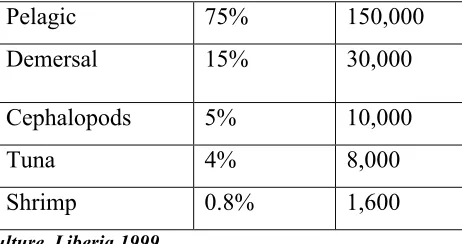
The Ministry of Agriculture Annual Report of 1999 states the level of fish catch in Liberia to be very low as compared to the pre-war levels. While the average fish catch as of 1979 was 1.2 million tons, the 1998 figure is shown as 200,000 tons. This figure does not include illicit catch by poachers off the Liberian shores. It is believed that unreported catch by poachers and local fishermen who discharge their valuable catch to high sea markets is double the amount of catch landed on Liberian shores.
Table 1
Estimated Catch By major Stock (1998) - 200,000 tons
Pelagic 75% 150,000
Demersal 15% 30,000
Cephalopods 5% 10,000
Tuna 4% 8,000
Shrimp 0.8% 1,600
Source: Ministry of Agriculture, Liberia 1999
Liberian war, fishermen were especially singled out for harsh treatment to the extent that most of the fishing communities out side of the capital were displaced. The Montserrado Group of Companies, by far the largest fishing company in Liberia was ransacked and closed down after the military takeover of 1980. The second contributing factor to the low catch is the freedom of fishing in Liberian waters, allowing for the harvesting of inestimable value of fish and shrimp by unscrupulous poachers from Europe, the Far East and other African States. They operate in Liberian waters with impunity because of the lack of patrol boats to police Liberia’s 70,000 square miles economic zone. Liberian is serving a UN Arms Embargo (UN Security Council Resolution Nos. 788 & 985, 1992 & 1995).
There are presently five fishing companies operating fifteen conventional fishing trawlers in the entire country and an estimate of 1800 artisanal fishermen sharing five hundred traditional fishing crafts at some 30 fishing stations along the Liberian coast. (1999 Annual Report, Ministry of Agriculture). The most valuable stocks in the area are the pelagic species. They are highly migratory, moving extensively within the region. As a result, there is little correlation between national fish capacity and resource base. Industrial fishing is non-existent at the moment. There is no fish exportation; nearly all catch is for domestic consumption. There is no quota of allowable catch, species or size restriction in Liberia fishery regime. In principle, Liberia's fishery resources is widely unregulated and unmonitored. The main fishing stations are located at the Freeport of Monrovia, Marshall Beach and the Port of Buchanan.
2.2 OFFSHORE OIL
Figure 1
Block C: Liberia Offshore oil Exploration Zone
Source: Golden Gate Resources Ltd. - www.ggrl.com
According to the report, Project Liberia, by Golden Gates Resources Ltd. (www.ggrl.com), the Government of Liberia, on October 14, 1998 signed an agreement granting Golden Gate Resources Ltd. and Societe Atlantique D’Energie Limited (Operator), both foreign companies, the right to conduct a geological and geophysical study of the petroleum exploration potential of an area off the Liberian coast designated as Block C, approximately 4,625 square kilometers.
37Md in the upper part of the lower cretaceous. In the S/3-1 well, the upper cretaceous includes good reservoirs with porosity reaching 30%.
The nearest production to the Liberian site is more than 300km east at Espoir Field offshore Cote d'Ivoire. Golden Gate believes that the Espoir Field and other accumulation in Cote d'Ivoire offer encouragement that similar fields will be discovered in Liberia. Initial production from Espoir Field ranged from 18,000 to 20,000 barrels/day. There is no new information on whether actual oil exploration was started after the completion of Golden Gates’ Evaluation of the site.
2.3MARINE TRANSPORTATION
Marine transportation in Liberia involves two general areas. The first area is the transport of imports and exports to and from Liberian ports. Most consumable items in Liberia are imported. According to the 1999 Annual Report of Liberia’s Ministry of Finance, Import value for 1999, main in food and machinery for transport and reconstruction was $167 million while export, mainly of rubber and timber, was valued at $56 million.
The second area of marine transportation is the transit use of Liberia coastal waters. Liberian coastal water as part of the West African Coast serves as a major transit route for foreign vessels, mainly tankers moving crude oil from the Middle East and West African Oil Fields to Europe and America. More than 600 million tons of crude oil transits this area yearly-amounting to an estimate of 1765 supertankers and 5883 mid-sized tankers yearly (P. Underwood & P. Saunder, 1985).
The potential for a major disaster along the Liberian coast is very real yet there is hardly any adequate regulatory regime is place and functioning to prevent pollution or any level of preparedness for eventually. An acceptable program of search and rescue is non existent. Domestic shipping and transit shipping is unsupervised and unregulated. Compliance to international environmental laws is unchecked and taken for granted.
Coastal shipping, cabotage is undeveloped in Liberia
notwithstanding the enormous potential benefits. Most
of Liberia roads are unpaved and near impossible to
use during the rain season. A good coastal shipping
program could get essential cargo, which are
predominantly discharged in Monrovia to cities along
the coast by sea and reduce the difficulty in moving
them onwards to the interior from the closest point
along the coast.
2.4 TOURISM
the sea at many points where they provide breathtaking beauty. The ecosystems in the numerous swamps common along the coast are still rich and uninterrupted. The capital city of Monrovia sits on a Peninsula that displays a natural waterway in and around the entire city. These resources could be used to develop marinas for recreation and inland transportation to curb the congestion in the city. Except for use as a latrine by dwellers along it banks these waters remain, as they were 153 years ago, when Liberia declared her independence.
2.5 ENVIRONMENT
The environment has hardly been a consideration in the formulation of national policy in Liberia. While there is limited study on the impact of degradation of the environment from marine source, land based pollution is well documented in Liberia in two basic areas, sewage, and garbage disposal. The level of development in drainage is fairly small. The main population centers are cities along the coast. Almost all of these cities are more than one hundred years old. In addition, maintenance is not a common practice in Liberia; as a result the drainage and sewage systems in most cities are, at the least, impossible. Most private home and builders are constructed with their own sewage systems. A large number of the existing buildings, especially public facilities, however, depend on the city sewage system. Because of the poor network, Central Monrovia is a scene of domestic waste accumulation at street corners and frequent runoff of contaminated substances that should otherwise be in the sewage system.
The are other potential sources of environmental degradation, which goes, unnoticed in Liberia. Two such sources are agriculture runoff and domestic effluents leading to algae blooms and low oxygen conditions and the displacement on land of sediments collected through port dredging from the seabed which are know to contain toxic substances accumulated from anti-fouling paints and chemical spillage. The jetty at the oil terminal is also a source of concern. The large accumulation of petroleum product on the water surface is sufficient room for suspicion and study on the environmental impact of oil that have been persistently spilled in the air for years of discharge operations.
The question of environmental impact assessment which has become a yardstick for determining whether or not to grant permission to carry on development projects on environmental grounds is absent in policy making in Liberia. No particular attention is paid to the impact of human or other activities on the environment. The need for concern about the state of the environment can not be overemphasized. The estuaries and coastal areas of Liberia provide habitat for large populations of wide variety of seabirds, shorebirds, marine mammals and commercially important fish species. The coastal zone is also a favorable habitat for humans; many of Liberia’s settlements are around the coast. Unfortunately, the coastal waters are also the recipients of much of the waste from the coastal settlements.
2.6 OTHER AREAS
Figure 2
Monrovia West Point Beach: Erosion from Sea Rise
Source: Liberian Post (www.liberian.tripod.com)
Mining of these minerals has supported construction work throughout the history of Liberia. It employs the services of huge fleet of trucks and provides employment for a number of coastal dweller. In the last few years, however, city corporations in coastal cities have named beach mining as one of the chief causes of beach erosion and sea rise.
3. SECTORIAL APPROACH TO COASTAL RESOURCES
MANAGEMENT
Liberia administers coastal resources through the sector-oriented method whereby particular agencies regulate different coastal resource with little or no reference to each other. Fisheries, Hydrocarbon, Maritime Transport, Tourism and Environment are each assigned to particular organs of government and treated separately from the others. As a result of the isolated manner in which the administration of these closely related areas is perceived and structured the optimization of coastal resources have been elusive.
A view of the legislation supporting each of the five mentioned areas seem to suggest that detailed information about coastal resources, their benefits to society and their sustenance for future generation were not considered by the legislators promulgating various enactment. Some of the laws are seemly vague and rest for their success on the wisdom and vision of the executive branch of government to design the right policies. Whereas this may be good in certain instances where the requisite technical knowledge and adequate funding is available, it can be disastrous in a country with limited trained manpower, inadequate placement and meager funds.
government policies and their implementation related to the five areas of concern in coastal resources management, and the laws supporting them.
3.1 FISHERY
One of the oldest legislation in Liberia is the Act creating the Ministry of Agriculture. The Agriculture Act of 1952 created a Department of Agriculture headed by an Agriculture Secretary accountable to the President of the Republic. This act empowered the department to regulate farming, forestry and wild life and the methods used to look after crops and animals for food security and commerce. In 1973 another Act to amend the Agriculture Act of 1952 changed the name to the Ministry of Agriculture.
In 1977, two separate Acts were promulgated creating the Forestry Development Authority (FDA) and the Liberian Produce Marketing Corporation (LPMC), respectively. FDA was to assume authority over the management of forest resources including timber and wildlife while LPMC was to support the cultivation of cash crops by private farmers, and serve as a bridge between farmers and foreign buyers of agriculture products. With this new Act, the Ministry of Agriculture was left with the function of regulating fisheries, aquaculture, animal husbandry and small farming. It also retained the authority to represent the government of Liberia at all international conferences related to agriculture.
Articles 14 and 15 of the Agriculture Act gave the Ministry the authority to regulate the fishery of Liberia’s 200 nautical miles territorial sea under four counts:
i. To ensure the adequate exploitation of Liberia’s fishery for food and industrial purpose
ii. To formulate guidelines for the establishment and operation of fishing companies
iv. To regulate fishing methods and implements to ensure that Liberian fishery is not abused or over exploited, and formulate measures relevant for the long-term viability of Liberian fishery as a source of food and income.
3.2 HYDROCARBON
The responsibility for administration of hydrocarbon under Liberian Law is viewed from two angles, exploration on one hand and purchase and distribution on the other. Two organs of government perform the respective functions, the Ministry of Lands, Mines and Energy and the Liberian Petroleum Refining Company (LPRC).
The Ministry of Lands, Mines and Energy is empowered to explore the utilization of potential hydrocarbon resources in Liberia. In April 2000, a Presidential Proclamation announced the creation of Liberia National Oil Company. The ownership and function of this new company, and the extend to which the company is backed by law in the face of the existence of both the Ministry of Lands Mines and Energy and the LPRC remains unclear.
3.3 MARITIME TRANSPORT
Figure 3:
Unpaved Road Linking the Interior in Liberia’s Lofa County
Source. Liberian Post (www.liberian.tripod.com)
The Act of 1987 creating the Ministry, earlier a Department under the Ministry of Commerce Industry and Transport gave general responsibilities. Relative to shipping, one such provision states that “ the Ministry of Transport shall regulate the operations of ports and harbors and formulate policies to encourage the utilization of coastal waters for shipping as a business in Liberia.” No mention is made in the Act about concern for the environment or the question of ensuring compliance to international conventions on pollution by ships.
the President’s directive the completion of the transfer has not been realized for administrative reasons. For the main time, domestic shipping remains largely unregulated.
The Bureau of Maritime Affairs on the other hand has made marked improvement in relations to Port State Control at Liberian ports. An organized regime has been established and staffed with well train port states officers. Reports indicate that programs are being steadily developed to ensure compliance to IMO conventions in Liberia. Thanks to the foresight and willingness of the Maritime Executives to make these changes.
3.4 TOURISM
There is minimum use of Liberia’s coastal resources for tourism. The Ministry of Information Culture and Tourism is charged with the formulation of tourism policies. The Ministry manages one Cultural Heritage Center called Kandiji at a beach resort near Monrovia, where cultural troupes are stationed. Arts and craft exhibits and traditional dance are staged to attract visitors during particular seasons.
These facilities are mainly visited by local and foreign residence of Monrovia. There is no concerted national policy for the development of tourism as a business in Liberia, notwithstanding the all year tropical climate and beautiful nature beach resources along Liberia’s 350 miles coast.
3.5 ENVIRONMENT
The systematic disposal of waste by the city corporations and garbage collectors at riverbanks and on isolated beaches is common place.
In November 1999 the Convention on Bio-diversity was ratified by the Liberian Legislature and an Act to create the National Environmental Commission was promulgated. The Minister of Agriculture was named as its chairman. This Commission which has the mandate to formulate policies for prevention and control of environmental degradation is still being constituted.
Liberia’s status as it relates to international conventions on the environment speaks for the level of priority given to the environment. Four key conventions are considered; they include the London Dumping Convention (1972), the United nations Law of the Sea Convention (1982), the Montreal Protocol on Land based Sources of Pollution and Annex VI and IV of MARPOL (73/78).
Liberia has ratified non of the agreements stated. In the case of the UN Convention on the Law of the Sea which grants 200 nautical miles Exclusive Economic Zone to coastal states like Liberia, Liberia still hold claim to 200 nautical miles territory sea in contrast to UNCLOS III on account of an Act promulgated in 1977.
4. ANALYSIS OF THE LIBERIAN SITUATION
Upon studying existing practices in Liberia it is obvious that there is no clear policy for the management of national resources. Many of the nation’s policies, unguided by the reality of the day, are obsolete and require elaborate review and correction. This current state of affairs have had a negative impact on a nation just out of a very destructive civil war and still battling insurgents who frequently attack border towns.
This chapter looks at Liberia’s troubled history, economy and international relations with the view to highlight the main causes of arbitrary management of the national enterprises with particular emphasis on coastal resources. It also views the practices that have lead to share neglect of the essential factors of coastal resource management and the level of ignorance and bigotry on the part of succeeding governments that have facilitated the maintenance of stagnation in Liberia.
4.1 HISTORICAL SUMMARY
with the United States, beginning with these events, is the most extensive and long-standing of any African Nation. The other group, which constitutes over 90% of the population, is made mainly of African natives totally 26 tribes, who had migrated from other African civilizations at periods covering hundreds of years.
Americo-Liberians, upon reaching Liberia, then known as the Grain Coast, eagerly emulated their former homeland. They adopted a constitution written by a team of Harvard Professors to launch their fledgling nation in 1847. They named their capital after the fifth president of the United States, James Monroe, and used the American dollar as legal tender. But in the face of all the virtues brought over to Africa from the United States these returning Negroes also brought a curse, the slave legacy. This time around they perceived themselves as masters and the natives their slaves.
This practice saw for over a 125 years a system of segregation whereby natives were excluded from the mainstream of national life. Neglect of the interior resulted in the annexation of large portions of Liberian lands by the French on the eastern border and the British on the southwestern border. It was not until 1904 that voting rights were granted the natives and even so, this was token surrender as there was only one political party, True Wing Party; and the party elite ultimately chose candidates to occupy government posts.
The Tolbert’s Administration ushered in a period where citizens were urged to speak out against ills of their government without fear of retribution. He built more schools and roads than any of his predecessors and encouraged the rise of the Liberian middle class and an era of industrialization. He solicited opposition and encouraged the establishment of political parties. This was a clear departure from early administrations that operated oligarchies that gave no consideration to the views of the masses. President Tolbert is on record to have upheld the rule of law. He demonstrated this commitment when he signed the death warrant of his own brother who had been tried, condemned and sentenced to death by the court for murder. He also approved the death by hanging of a group of mainly Americo-Liberians in the city of Harper who had been condemned for ritualistic killings. He was loved by his people and internationally respected. At his death he was the Chairman of the Organization of African Unity and President of the World Baptists Alliance.
Many took the new freedom that Tolbert championed as a chance to avenge the oppression that previous settler regimes characterized. As a result agitation from young vocal leaders of the new political groupings led in 1980 to a coup d’etat headed by low ranking soldiers of the Army Forces of Liberia. Tolbert, undoubtedly considered as Liberia best leader, became the first victim of his drive for change. He was killed on the day of the coup led by twenty-eight year old Master Sergeant called Samuel K. Doe. The coup was overwhelmingly embraced by the masses. The day of the natives had finally come. Many of the settlers, among them some of Liberia’s most educated and connected, were summarily killed and their properties destroyed or confiscated. Thousands fled the country launching the beginning of Liberia’s brain drain.
economic and political situation had seriously deteriorated. Promised elections were held and racked by the incumbent President Doe.
On the morning of November 12, 1985, Doe’s closest friend and former head of the army, Gen. Thomas Qwiwonkpa, entered Liberia and announce the overthrow of President Doe. The streets of the country were lighted with jubilant citizens in celebration of the takeover; but by noon Doe had regain power and begun the largest extermination of opponents imagined in Liberia at the time. Thousands, mainly from Nimba, Quiwonkpa’s home, were rounded up and executed in all parts of the country. Hatred amongst the natives intensified during the next few years and opposition to the government both at home and abroad became widespread. This period was to see again the large migration of frighten opponents of the government into neighboring countries.
On the eve of Christmas 1989, President Doe informed the world that insurgents under the command of Charles Taylor, a former cabinet member, had invaded the country through Nimba County. Within six months, the group calling itself the National Patriotic Front of Liberia (NPFL), had occupied all of Liberia except the capital. The war, prosecuted mostly by uneducated natives, left in its wake the total destruction of the country’s infrastructure and social institution. In September the same year, President Doe was captured and mutilated.
were to disarm warring factions, conduct national elections and restructure the national army reflecting ethnic and geographical balance.
Disarmament was reasonably achieved and in 1997 national elections were held in which Charles Taylor was elected with an overwhelming majority and declared President of Liberia. By this time, an estimated 150,000 lives had been lost, 250,000 exiled in neighboring countries, 50,000 internally displaced and an additional 90,000 Sierra Leonean Refugee on Liberian soil (US Committee for Refugee, Liberia 1999, www.refugee.org/world/country index/liberia).
4.2 ECONOMIC SUMMARY
Twenty years of political instability and the present disfavor of the Charles Taylor led government by major players in the international community have greatly hampered Liberia’s economic recovery. Between 1950 and 1979, Liberia’s economic performance placed her among the countries with the highest GNP, second to Japan; but today she has been declared unfit for credit by the African Development Bank, an institution which Liberia created. The nation has lost respect at the UN, the World Bank and the International Monetary Fund ( Dr. Romeo Horton, Independence Day Oration, July 26, 2000). Investment has evaporated as confidence in the economic and political situation has eroded. Corruption has exploded into unbelievable proportions. Liberia’s export sector, which has been largely based on raw material, is now mostly dormant. Ninety percent of all major concessions operated before 1990 have ceased to operate.
Table2.
Liberia Economic Profile
POPULATION
(POP. Growth Rate: 4.92%) (Birth Rate:41.88/1000 pop.) (Death Rate:1.28/1000 pop.) Infant Mort. Rate: 103.13 Death/1000 Live Birth)
(Life Expectancy: 59.45 yrs)
LITERACY RATE 38.35%
GDP: Purchasing Power Parity US$2.6B
NATIONAL BUDGET(1999) US$100M
EXPORT VALUE* US$56M
IMPORT VALUE* US$167M
EXTERNAL DEBT (1997) US$2B
RAILWAYS 490KM
HIGH WAYS
( Only 657km Paved)
10,600KM
SEAPORTS 4
MERCHANT MARINE 1620 SHIPS
AIRPORTS
(Only 2 with paved runways)
46
ELECTRICITY CAP. (Utilization: < 5% pop.)
332,000KW (1995)
PIPE BORNE WATER <5% POP.
*The huge disparity in import and export figure quoted above is due on one hand to the large imports by NGO and UN Agencies to support their operations in Liberia and the lack of figures for smuggled exports in minerals, fishery and agricultural produce.
Source. Liberia Economy, www.liberia.net
The lack of defined fiscal policy has allowed the few remaining concessions to operate arbitrarily with contracts created to benefit individuals rather than government. Many such concessions do not pay taxes or adhere to national policy regulations, where regulations exist.
Long before 1980, Liberia’s monetary economy has been burdened by imbalances induced by disparities and active economic mismanagement. Even though economic growth was phenomenally high due to high price for Liberian raw material on the international market, no serious effort was made to diversify the economy through the development of a manufacturing sector that would have accounted for a significant
to reduce the country’s dependence on exports dominated by depletable natural resource. Nothing can explain the economic situation better; but all is not lost.
The formulation of economic goals consistent with national endowment and regional and global dynamics must now be vigilantly pursued. To accelerate rapid and long-term economic growth, the country must establish a set of norms. The first step in this process is to constitute some of the best minds into a committee fully supported to begin a realistic and impartial study of the Liberian situation and practices that will ensure succinct understanding of the factors necessary for national development. The development of sound fiscal and monetary policy reflecting the country strength and weaknesses must now be a priority.
4.3 REGIONAL AND INTERNATIONAL COOPERATION
Liberia is affiliated with almost all the major international groupings, including ACP, AFDB, CCC, ECA; ECOWAS; FAO, G-77, IAEA, IBRD, ICAO, ICFTU, ICRM, IDA, IFAD, IFC, IFRCS, ILO, IMF, IMO, Inmarsat, Intelsat (Non-Signatory User), Interpol, IOC, IOM, ITU, NAM, OAU, UN, UNCTAD, UNESCO, UNIDO, UPU, WCL, WFTU, WHO, WIPO, WMO, and many other bilateral arrangements.
For the past ten years, however, Liberia’s participation in programs of these organizations has been mostly passive. In fact, many of Liberia’s foreign missions have been abandon during this period, and as such the promotion of the image of the country and programs of government is virtually unheard of abroad. This is happening in the face of concerted negative international campaign against the government of Liberia, emanating mainly from Liberian exiles in the United States.
to invade neighboring countries. Presently there is a war of words between Liberia and Guinea, both accusing each other of aiding insurgents.12
The International Community, mainly the United States and Great Britain, have persistently singled out Liberia as the main supporter of the infamous RUF rebels in Sierra Leone. These developments have further isolated Liberia and made it difficult to achieve anything through regional and international cooperation.
Liberia must now move towards encouraging cordial relations with its neighbors. The African continent is perhaps the most balkanized. It consist of 178 borders among 53 countries; the purchasing power parity of the majority of which is below the level that would support economic investment of scale.13 Liberia must encourage cordial relations with her neighbor and through that enhance trade and regional cooperation, consistent with measures taken by other regions of the world.
4.4 IMPACT OF NEGLECT OF COASTAL RESOURCE MANAGEMENT
The manner in which coastal resources is perceived and managed by government has left much wanting for the Liberian economy. The increased lack of knowledge of coastal resources endowment has deprived Liberia of significant assets at this time of economic crisis. The accumulated impact of these conditions on the economy can be view from four main perspectives: loss of earnings, unemployment, under-utilization of transportation potentials and environmental degradation.
There is loss of income for failure to design adequate policies by which rent, royalty and capital flow from fishing licenses can be accrued. There is also lost of port income owing to unproductive practices and inefficient use of port facilities. In many areas, the ports of Liberia are under-utilized and services are not always the best because of berth limitations and failure to invest in the requisite port
12 “Guinea Aids Insurgents”, The Inquirer, 12 Jul 2000, 1
equipment. In other instances resourceful port areas are given to private persons and companies without proper contract to ensure that the port is justly compensation. The ports of Harper, Greenville and the Bong Mines Pair at the Freeport of Monrovia were all given to private operators without sound managerial consideration. The sinking of the MV Victory Reefer in the Port of Harper in July 2000 has been attributed to the lack of navigational buoys along the port channels.14
Ports that are inadequately managed do not attract business. Accumulation of terrible practices in the ports may lead to high freight rates and directly impact the price of basic commodities on the local market.
Illicit shipping is also a common problem. Vessels under the protection of government officials utilize port and coastal fishery without compensating the ports or paying taxes to the government. Custom officers are highly restricted in performing their function in many such ports when it comes to certain consignees. The existence of petroleum resources in Liberian coastal water is a potential source of income. Government treatment of these resources and to what extent is enhances public good is still to be reviewed. Even though Golden Gate’s exploration assessment was completed in early 1999, information on the status offshore oil has not been made public by government.
Most Liberians of working age are currently unemployed. The current estimate is as high as 85%. Sound management of integrated coastal resources will consider the employment potential for ports fisheries, tourism and domestic shipping and provide the guidance for the optimization of these potentials.
It will enhance the economy through employment, income generation and speedy delivery of cargo along the coast.
Trucking of containers from Monrovia by road to distant areas has proven to be very difficult, at times impossible during the rain season. The topography of
Monrovia is suitable for the use of the coastal waters rather than roads for cargo movement. If a system of coastal shipping is developed and utilized transit time for cargo was drastically reduce. This area may prove to be more viable than the Liberian Maritime Registry. With traditional maritime countries rapidly adopting the tonnage tax scheme and a second international registry allowing owners to freely man their vessel irrespective of crew nationality, Liberia and Panama flags may loss their competitive edge.
The potential for environmental disaster from oil pollution along the Liberian Coast is very real due to the huge traffic of oil tankers transiting the region. In addition, pollution from ship ballast and land based sources must be reviewed seriously and regulated in keeping with international standards. A system of environmental impact assessment must be designed and installed to ensure that current practices do not endanger the well being of the people and posterity. The official use of coastal zone for waste disposal by municipality threatens marine life. It must be discouraged.
5.
FORMULATION OF INTEGRATED COASTAL RESOURCE
MANAGEMENT STRATEGY
5.1 JUSTIFICATION
Different kinds of coastal problems and opportunities constitute mitigating circumstances for the setup of a coastal management regime. They include the following:
Desire to increase economic benefits from the use of coastal resources Problems of resource depletion
Increased pollution of coastal and ocean environment Damage to productive coastal ecosystem
Threat to life and property from natural coastal hazards and disasters
Perceived economic opportunities associated with new forms of development in the coastal zone
Conflicts of interest among user groups
Coastal areas are a mosaic of rich and diverse ecosystems and resources that are strategically important to the economic and social well being and development of all human settlements. When applied in a timely and comprehensive manner, integrated coastal resource management can be the vehicle for sound investment and sustainable use of the coastal areas and their natural resources.
5.2 PARTICIPANTS AND RESPONSIBILITIES
governments for the benefit of their people. Particular government ministries and agencies are responsible for particular resources and their use. The key to success is the coordinated involvement of all parties and the demonstration that integrated coastal resources management is in the long-term interest of all.
Several Institutional approaches may be use to perform coastal resource management. They include:
A central planing unit (i.e. Ministry of Planning and Economic Affairs)
Formal establishment of an Interagency or Inter-ministerial council or committee Creation of a Special Coordinating Commission or Committee and
Formal Designation of one Agency or Ministry to act as “Lead Agency” and to oversee interagency coordination process.
Study shows that establishment of a formal Coastal Resource Management Commission or Agency to coordinate the management of coastal resources and matters emanating from same has proven to be the most efficient approach in addressing this sensitive issue.
Government will have to give formal approval to the establishment of the Integrated Coastal Resource Management Commission since it may require significant realignments of institutional responsibilities and the expenditure of important sums of money.
5.3 Special Coastal Resource Management Commission 5.3.1 Special Commission
The Special commission may have five main functions:
• Planning Integrated Coastal management programs
• Promoting and Strengthening Interagency and inter-sectoral collaboration
• Reducing interagency rivalry and conflicts
• Minimizing duplication of functions of line agencies and providing a forum for conflict resolution among sectors
• Monitoring and evaluating the progress of Integrated Coastal Management projects and programs
The special commission oversees the implementation and operation of all coastal resource management programs and assume general management and support responsibilities, particularly with respect to coordination of plans, environmental impact assessment, human resource development, transnational issues, budget coordination and political accountability. These concerns are normally beyond the management responsibility of individual ministries or agencies, yet the Special Commission does not in any way assume the role of the individual ministries or agency to perform direct responsibilities designated to them. The Special Commission provides the framework by which all ministries and agencies can perform their designated duties in a coordinated faction and with clear understanding and regards for each separate function, their coordinated optimization and impact on the community and/or nation.
Public awareness and transparency must play pivotal roles in integrated coastal resource management. All efforts must be employed to ensure that there is general understanding of the goals and achievements of all programs.
5.3.2 Structure of Special Integrated Coastal Management Commission
An efficient coastal management commission does not require elaborate staff. As overseers they will rely to a great extend on the professional staff already present in various ministries and agencies and research from universities and other academic institutions and in a significant way on specialized international organizations and bilateral arrangements with friendly governments. The commission will however be required to maintain a competent team of managers to perform the task of research gathering, integrated planning, information management and program evaluation.
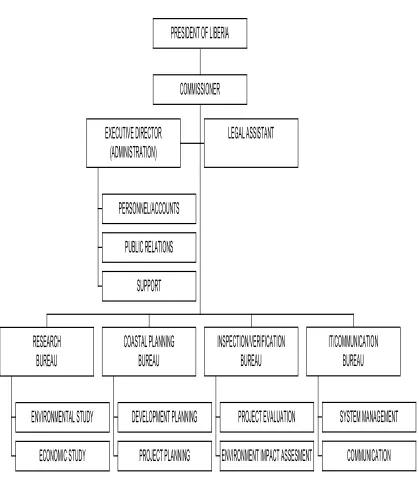
A Commissioner who must be an experienced civil servant and manager, very influential and well respected both locally and abroad will head the ICM Commission. He or she must be a tested performer who will stop at nothing to see that programs are supported and performed as planned. The Commissioner shall be the chief spokesman of the commission. A professional team of four Managers and an Executive Secretary will assist him or her. The four Managers will head the main four sections of the commission: Research Bureau, Planning Bureau, IT Bureau and Inspection & Verification Bureau.
5.3.3 Functions of Sections
Each of the four sections will perform the following functions:
ICRM COMMISSION
ORGANIZATIONAL STRUCTURE
PERSONNEL/ACCOUNTS
PUBLIC RELATIONS
SUPPORT
EXECUTIVE DIRECTOR
(ADMINISTRATION)
LEGAL ASSISTANT
ENVIRONMENTAL STUDY
ECONOMIC STUDY
RESEARCH
BUREAU
DEVELOPMENT PLANNING
PROJECT PLANNING
COASTAL PLANNING
BUREAU
PROJECT EVALUATION
ENVIRONMENT IMPACT ASSESMENT
INSPECTION/VERIFICATION
BUREAU
SYSTEM MANAGEMENT
COMMUNICATION
IT/COMMUNICATION
BUREAU
COMMISSIONER
PRESIDENT OF LIBERIA
Figure 4
adjust plans in keeping with current research findings and evaluation results to ensure suitability.
The Inspection & verification Bureau will constantly study the implementation and performance of programs under the eyes of the Commission and report achievements and short falls. It will conduct elaborate field operations covering the length of the Liberian coast, coaster waters and Environmental Impact Assessment (EIA) on all development projects. International expertise will be solicited to assists this bureau in the work of EIA for the first few years.
Integrated coastal management programs should be subject to regular monitoring and evaluation as a way of continually improving the process. It is especially important that the goals of the overall management effort and the goals and objectives of individual projects be specified as clearly and as quantitatively as possible; otherwise assessment as to how well they are being achieved is difficult. Enforcement of existing rules and regulations is one of the most difficult aspects of government. Chances of enforcement are dependent on public awareness and the credibility of government programs.
The IT/Communication Bureau will management the Commission’s information system and ensures that vital links to the Internet, and an Intranet system are in place and functioning. This Bureau will be vital to the work of the Commission. Most of the work of such overseer institution is based on the ready availability of vital current information sources. The internet and links to other international coastal resource management and research institutions and teams around the world will be essential in ensuring that the Commission remains up to date and accurate in all aspects of its work.
facilitate all communication in and out of the Commission and organize all publications and public relations matters. The Executive Director shall also perform general administrative tasks including personnel and logistics matters and control all support staff.
5.3.4 Staffing of Sections
The following is the lists of professional staff under the four sections:
Bureau of Research
Three Research Officers, each in the areas of Environment, Economic and Maritime Affairs, respectively.
Bureau of Planning
Three Planning Officers each in the areas of Development Planning, Microeconomics, and Environment, respectively.
Two Jr. Planning Officers, all university graduates under the age of 30 years
Inspection & Verification Bureau
Two Sr. Inspectors with vast experience each in Project Evaluation, and Environmental Impact Assessment, respectively.
Four Jr. Level Inspectors
Bureau of IT/Communication
Two Computer Assistants, each with advance knowledge in Computer Engineering and Software Design, respectively
5.3.5 Training
For the commission to ably perform its task as a
professional institution, training programs must be
constantly identified and provided for staff on a regular
basis. There are periodic training programs in
Integrated Coastal Management and Sustainable
Development issues that are being sponsored by
international organizations and conducted all over the
world. One such program is that conducted under the
auspices of the International Ocean Institute (IOI)
based in Halifax, Canada. The Commission should
also keep abreast of and attend all relevant
international meetings related to its work. On the
national level workshops and seminars must be
designed a conducted regularly to create a forum for
the discussion of relevant issues.
5.3.6 Financial Considerations
Funding is normally allocated by the national government. International organizations and friendly governments may however provide substantial funding where they find the national government to be serious about sustainable development. Some of the international groups that will be willing to support integrated coastal resource management are UNEP, IOI, FAO, UNDP, IMO, UNESCO, UNOPS, SIDA, to name a few. Most such groups and friendly governments will be willing to assist if they are brought into the picture in the very beginning.
5.4 FOUR STEP FOR IMPLEMENTING INTEGRATED COASTAL RESOURCE MANAGEMENT
There are many ways through which an integrated coastal resource management program can be set into place. Four steps presented in the World Bank Report on “Guidelines for Integrated Coastal Zone Management” offer a list of comprehensive procedures for the overall effort in developing, implementing and controlling an Integrated coastal resource management program for Liberia.15 They are, Initiating the Effort, Formulating the ICRM Plan, Formal Adoption by Government of the Program and the Operational Stage.
5.4.1 Initiating the Effort
As much as possible, the formulation team should be composed of local staff selected from key government agencies having important management roles regarding coastal resources. All the relevant local and international agencies should be represented. It is best that the team be directed by someone representing a higher policy level in the government, either the Ministry of Planning or the President’s office.
5.4.2 Formulation of ICRM Plan
At this stage the planning team assemble necessary information and data on the physical, economic, environmental and social characteristics of the coastal area and resources and prepare a plan that takes into consideration public participation, technical, financial and manpower feasibility, new economic development opportunities and assessment of institutional capacities. They should also develop options for interagency coordination, possible new regulation and management measures, and submits recommendation to government.
An effective ICRM Program must be based upon adequate information. Some of this data may be available in existing country profiles, national development plans, specialized resource inventories and the like. Sources may include government agencies, universities and other research institutions; resource related private sector firms and relevant international organizations. A new initiative to study and formulate plans on important issues, the environment for instance, where they have never been considered should be undertaken.
The plan should be concluded with a realistic timetable and a budget.
5.4.3 Formal Adoption of ICRM Program by Government
5.4.4 The ICRM Program Becomes Operational
The ICRM program becomes operational when:
The ICRM Commission begins oversight of the ICRM process and program. New and revised management programs come into effect
Individual sectoral line agencies and ministries continue to perform their regulatory and management responsibilities but now in conformity with ICRM programs
Specific projects are designed and undertaken in connection with new economic opportunities in the coastal area
A monitoring and evaluation program is initiated.
CONCLUSION
In Liberia, most major developments and economic activities are centered in coastal cities. As a result, there is continued growth of coastal population as a consequence of migration of people in search of employment, education, health care and better life, in general. Evidence presented in this dissertation shows that despite the enormous resource capacity of Liberia in fishery, offshore oil and a rich and long coastline comprising valuable beaches and mangrove of diverse marine ecosystems, the great majority of the population is very poor and do not have asses to basic services including water and electricity. Further, the quality of the country’s environment is for the most part being degraded during either to neglect or exposure to harmful waste by human actions.
succeeding administrations of basic principles of good governance. In addition, the method of civil administration by sector, whereby coordination of the efforts of various closely related agencies and ministries is not an operational requirement has created duplication of functions and poor utilization of existing resources for development.
Evidence also suggest that the unfortunate state of mismanagement and corruption is not the result of deliberate efforts on the part of individuals or groups to continually ensure the perpetual stagnation of Liberia, but rather the result of the lack of a functioning integrated national development plan fully understood by all parties including government functionaries, the private sector and the general public. These conditions are being further aggravated by the poor relationship currently existing between Liberia and her neighbors on one hand and Liberia and major powers in the international community on the other. Persistent insurgency and threats of war emanating from neighboring countries against Liberia is putting a drain on national resources and diverting much needed cash to the support of the war efforts.
The main goal of this dissertation is to create the awakening among decision makers and the general public of the inadequacies prevalent in the present management of national resources so as to ignite decisions both at government level and among the population of ways to arrest these inadequacies. This dissertation is intended to serve as a general guideline to direct these deliberations by addressing the management of coastal resources and environmental conservation.
role of government in all its sectors by all parties to achieve efficiency and enhance accountability.
The end result of Integrated Coastal Resource management is the utilization of coastal resources for the satisfaction of economic needs of the citizenry while ensuring that those uses do not lead to depletion of the resources or degradation of the environment.