566
Copyright © 2011-15. Vandana Publications. All Rights Reserved.
Volume-5, Issue-3, June-2015
International Journal of Engineering and Management Research
Page Number: 566-572
Cold Mix Asphalt and Its Mix Parameters
Amit khokher1, S.S.Kazal2
1
Student, M. Tech, ITS, Bhiwani, Haryana, INDIA
2
Assistant Professor & HOD, Department of Civil Engineering, ITS, Bhiwani, Haryana, INDIA
ABSTRACT
In a developing country like India we can observe cold mix technology is lagging behind in both research and application fields. It is our primary motivation underlying selection of cold mix technology as the present research area. Though, it has economical and environmental advantages over the hot mixes. But upto now there is no universally adopted cold mix design method.Due to this deformity in the laboratory cold mix design procedures followed by different organization/researchers/agencies. So it is difficult to form reliable correlation and to have a comparative study between experimental results reported by them. So the objective of this project work is aimed to select important mix parameters and determine their effect on cold mix asphalt. The mix parameters selected for the present work are (i) method of compaction, (ii) level of compaction, (iii) additives and (iv) aggregate gradation. The first three parameters are selected for their importance as presented in a number of previous research works. And the last one has been selected nowhere in literature much attention has been paid to the aggregate gradation which is very important of the compacted mix. All the mix parameters have been selected to assess the effect on Marshall properties of CMA mixture.First a suitable experimental methodological work has been prepared and then the effects of selected mix parameters on performance of compacted mix are studied. And a comparative study for the above results has been done on the basis of Marshall stability and air void content of the cold mix. By studying all the selected mix parameters, it is observed that in case of gyratory compaction the air void range 3-5% could be achieved. All mix parameters has contributed to increase the Marshall Stability of cold mixes butcement and developed gradations has also shown more significant increase in stability of cold mixes.
Keywords---- CMA, Marshall Stability, Cold Mix, Gyratory Compaction, Hot Mixes.
I.
INTRODUCTION TO COLD MIX
ASPHALT
Hot mix asphalt is use mostly as a paving mixture in road construction. In India 90 % of road network is occupied by bituminous pavement only but there are certain limitation of hot mix so now a day’s Cold Mix technology is getting preferable over hot mix method. In hot mix method there are certain drawbacks like burning of fuel, wood, tyres and heating of bitumen, emission of air pollutants, environmental degradation, hot bitumen fumes, toxicity and occupational hazards etc. But Cold Mix have certain advantages.
Advantages of Cold Mix:
Cold Mix has ready to use materials without heating and without preparation near road side.
It is environmentally friendly method with absolutely zero pollution.
It is simple to use with better workability. It is labour friendly that is no occupational hazard to the workers.
It could involve unskilled labours which create income earning jobs to the villagers.
This method works even in wet and humid climatic conditions.
It is 4-5 times faster method than Hot Mix method. In this method we could complete 1Km pavement in 3-4 days with proper man power and support.
In this method the fuel consumption is zero percent due to this there is reduction of 4000 kg of CO2
The research is done in cold mix method to improve its mixing qualities with additives. It is done by two ways the first one is adding the additives to aggregate during the production of cold mix and second one is
emission per km.
567
Copyright © 2011-15. Vandana Publications. All Rights Reserved.
adding the additives to bitumen emulsion before to production of cold mix the various additives use in the research field are discussed as :
Cement:
The effect of adding cement for improve the slow development of strength of emulsion treated mixes studied by Schmidt et al. in 1973. Their study shows that mixes treated in this way cured faster, and developed a high resilient modulus and were more resistant to water damage. He indicated that addition of cement had a varry significant effect on mix stability, addition of 1 % cement produce and increase in stability of 250 to 300 % over that of untreated samples.
Oruc et al. in 2007 conducted experiments to evaluate the mechanical properties of asphalt mixture having cement substituted for mineral filler in an increase percentage from 0 to 6 %. This test suggested that cement modified asphalt emulsion mixes might be used as a structural pavement layer. They also shows that the addition of 1 to 2 % of rapid setting cement accelerated the early strength.
Lime:
Wang and Sha in 2010 in a study indicated that lime stone and lime stone filler have impact over hardness was significant. If it compared with granite and granite fillers.
Fly Ash:
Fly ash is generally use as filler material. Fly Ash has been use in a wide range of applications like for grouting, as fill material and soil stabilization. Fly ash is also used in road pavement as road bases, sub bases and for sub grade formation. In 2009 Thanaya et al. described the test and result obtained from ashes into cold bituminous emulsions mixtures. The mixture properties evaluated are : Stiffness modulus , Volumetric properties and Repeated load axial creep.
Due to the various properties of fly ash it is found to be very stable for use as filler in cold bituminous mixtures. Five percent of specific waste material from 0.5 to 5.5 % of aggregate mass in the mixture was incorporated in the CPEM. It indicated that Oil shale fly ash modification improved the resilient modulus and the dynamic creep.
Fiber:
Benedito et al. in 2003 studied the effect of addition of some polypropylene fiber on the mechanical properties of dense grated cold mix asphalt mixture. This result shows that addition of fiber was responsible for a small variation in mixture strength parameter.
III. METHOD OF MARSHALL
COMPACTION & GYRATION METHOD
Marshall Compaction Method:
In the Marshall method, the resistance to plastic deformation of a compacted cylindrical specimen of bituminous mixture is measured. At that time the specimen
was loaded diametrically at a deformation rate of 50 mm per minute. The Marshall method of mix design have two major properties. (1) Density –void analysis and (2) Stability – flow test. The Marshall Stability of any mix is defined as the maximum load carried by the specimen at the specified standard test temperature. Then the flow value is also measured. Flow value is defined as the deformation that the test specimen undergoes during loading up to maximum load. This apparatus consist of sample extractor, a mould assembly, compaction pedestal and hammer, loading machine, breaking head, flow meter and water bath. In this Marshall test method of mix design we prepared three compacted samples for each binder content. For getting the optimum binder content we should test at least four binder content. All these compacted specimens were subjected to the following test: Stability and Flow test and Density and Void analysis and Bulk Density determination. First of all the bulk density of the sample is determined by weighting the sample in air and in water. It could also calculated by using the weight in saturated surface dry condition.
Gyratory Compaction Method:
568
Copyright © 2011-15. Vandana Publications. All Rights Reserved.
IV. GRAPHICAL REPRESENTATION OF
RESULTS
1. Justification of Design and Determination of ORAC value
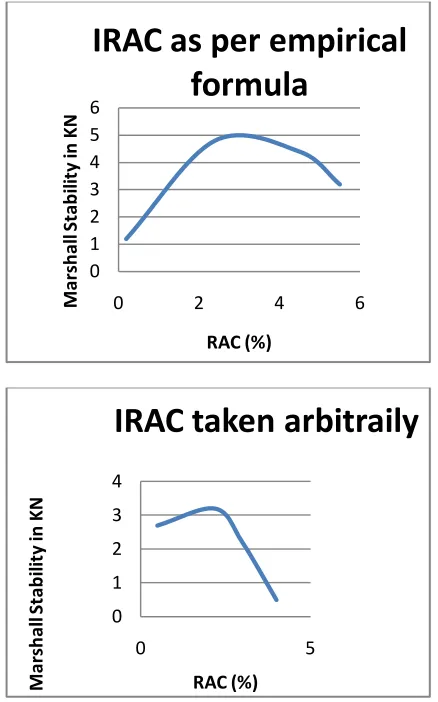
After Mixing the fine aggregate, coarse aggregate and crusher dust as the filler material to produce gap graded and dense graded cold mix , various samples were compacted by using Marshall method. For this two types of IRAC values were considered, one was taken arbitrarily and other as per empirical formula and by doing so two type of sets of mixes were produced for gradation containing IRAC values.
a) Dense Graded Cold Mixes
The test results of samples which were produced by Marshall compaction as per the adopted design procedure a table is formed below showing its results:
Table 1 Optimum Compositions of Dense Graded Cold Mixes
IRAC by Empirical formula
IRAC by Arbitrary value
IRAC = 5 % OTLC = 5.75 % OPWC = 2.5 % IEC = 8.25 % ORAC = 3.5 % Dry Stability = 5.25 KN
Soaked Stability = 4.75 KN
IRAC = 3 % OTLC = 6.25 % OPWC = 2.75 % IEC = 5.15 % ORAC = 3.5 % Dry Stability = 2.85 KN
Soaked Stability = 2.55 KN
These results of Soaked stability and Dry stability are produced at ORAC value. Determination of ORAC value
Fig.1.Determination of ORAC for dense grade cold Mix
0 1 2 3 4 5 6
0 2 4 6
M
ar
sh
al
l S
ta
bi
lit
y
in
K
N
RAC (%)
IRAC as per empirical
formula
0 1 2 3 4
0 5
M
ar
sh
al
l S
ta
bi
lit
y
in
K
N
RAC (%)
569
Copyright © 2011-15. Vandana Publications. All Rights Reserved.
Determination of OTLC value:Fig 3. Air void, VMA, Flow value and Unit weight results of dense graded cold mix
b) Gap Graded Cold Mixes:
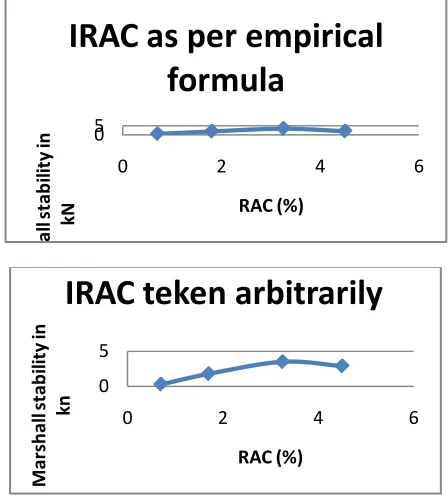
Now the test results related to gap graded cold mixes are illustrated below. And both the results of soaked stability and dry stability values are derived at ORAC value.
Fig. ORAC determination for gap graded cold mixes
It is observed that initial stability of the mix depends upon OTLC values. The curing time to obtain full strength of mix is greater as if the total liquid content is higher at same binder content. Therefore to avoid delay in work process we should determine OTLC value for laboratory procedures and also this supports the design method of the present study.
It has been observed that Dry stability value is greater than the soaked value for all types of cold mixes as we analyzed the result for stability values at ORAC value. Therefore, Dry stability would satisfy the same requirement as Soaked stability satisfied the minimum stability requirement. So, it is more economic to obtain ORAC value on basis of Soaked stability test and this is also supported by Thanaya stated in 2007.
0 1 2 3 4 5 6
0 2 4 6 8
Ai
r v
oi
d (
%
)
RAC (%)
0 1 2 3 4 5
0 1 2 3 4
VM
A (
%
)
RAC (%)
0 5 10 15
0 5 10
Fl
ow v
al
ue
in
m
m
RAC (%)
0 2 4
0 2 4 6
U
ni
t W
ei
ght
in
gm/
cm3
RAC (%)
05
0 2 4 6
al
l s
ta
bi
lit
y
in
kN RAC (%)
IRAC as per empirical
formula
0 5
0 2 4 6
M
ar
sh
al
l s
ta
bi
lit
y
in
kn
RAC (%)
570
Copyright © 2011-15. Vandana Publications. All Rights Reserved.
C) Comparative study between Dense graded and Gapgraded cold mix:
It was seen that performance of Dense graded mix (Cold Mix D) was superior than gap graded (Cold Mix G) in every perspective except in one case that is of the stability loss value which was less for Cold Mix D.
Various Effects of Compaction Level:
a) Dense graded Cold Mix:
Dense graded cold mix (Cold Mix D) with IRAC as per empirical formula was compacted at 75 blows of compaction with the previously observed values of OTLC and ORAC values as stated above. And the determined values are shown in table below :
Table Properties of Dense graded Cold Mix at 50 and 75 blows of compaction
Design parameters
50 blows compaction level
75 blows compaction level
Design requirem ent Marshall
stability
4.75 kN 5.25 kN Min. 2.2kN Flow value 3.1 mm 2.25 mm Min. 2
mm Stability
loss
5.25 % 2.50 % Max. 50% Emulsion
content
6% 6.75 % 7 – 10 %
Air void 6.75 % 6.95 % 3 – 5 %
VMA 14.25 % 13.75 % Min. 14 %
It was seen that as the mix performance improved at higher compaction level but it failed to meet the required air void target of 3 to 5 % range as like the 50 blows of compaction.
b) Gap graded Cold Mix :
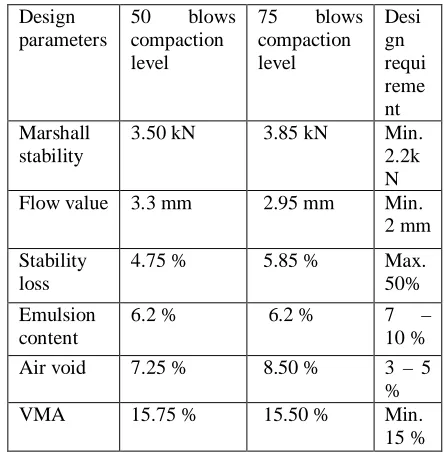
Gap graded cold mix (Cold Mix G) with IRAC as per empirical formula was compacted at 75 blows of compaction with the previously observed values of OTLC and ORAC values as stated above. And the determined values are shown in table below :
Table Properties of Gap graded Cold Mix at 50 and 75 blows of compaction:
It was seen that as the mix performance improved at higher compaction level but it failed to meet the required air void target of 3 to 5 % range as like the 50 blows of compaction. Besides, In case of gap
graded mix the stability loss found more for 75 blows of compaction and it has been happened because of lack of stone to stone contact for degradation of aggregate at higher compaction level.
So, 50 blows of compaction was studied in further studied to produce Marshall Compacted mixes.
Effects of Additives:
In the mix composition cement, lime and fly ash were substituted for stone crusher dust for Marshall compacted dense graded and gap graded cold mix at ORAC only.
0 1 2 3 4 5 6 7 8
1 2 3 4 5
M
ar
sh
al
l S
ta
bi
lit
y
in
k
N
Substituted Additive quantity (%) Lime Cement Fly ash
Design parameters
50 blows compaction level
75 blows compaction level
Desi gn requi reme nt Marshall
stability
3.50 kN 3.85 kN Min. 2.2k N Flow value 3.3 mm 2.95 mm Min.
2 mm Stability
loss
4.75 % 5.85 % Max. 50% Emulsion
content
6.2 % 6.2 % 7 – 10 % Air void 7.25 % 8.50 % 3 – 5
% VMA 15.75 % 15.50 % Min.
571
Copyright © 2011-15. Vandana Publications. All Rights Reserved.
Figures above related to Marshall Stability, Unit weight, Flow value and Air void results of Dense graded Cold Mix with additives.
Gap graded cold mixes:
In Gap graded cold mixes substitutions of additives were done at 2%, 4%, 6%, 8%, 10% separately and the test result obtained are shown below in the various figures.
As result obtained from Marshall test it was seen that Cold Mixes with cement as additive performed well enough among all mixes in every perspective as compared in case of dense grade mix and Mixes with lime and fly ash as an additive has showed greater stability to the limited extent of substitution and resulted in greater air void content with increase in the percentage of substitution. In gap graded mix, mixes compacted with lime has showed greater stability but greater air void content in comparison to the mixes compacted with fly ash.
V. CONCLUSIONS
From the above study following conclusions are drawn on the basis of performance of the cold mix.
From this study we have observed that initial stability of the mix is dependent on optimum total liquid content (OTLC) of the compacted mix. Although achieving of OTLC is difficult for various field applications, this may be applied for laboratory procedures so that there is no delay in the work process. At some binder content higher the total liquid content there is greater the curing time for obtaining full strength of the mix. This concept has support the adopted design procedure for the present study. Increasing in the compaction level does not show much effect in decreasing
0 2 4 6 8 10 12
1 2 3 4 5
U
ni
t w
ei
ght
in
gm
/cm
3
Substituted Additive quantity (%) Lime Cement Fly ash
0 2 4 6 8
1 2 3 4 5
Fl
ow V
al
ue
in
m
m
Substitued Additive quantity (%) Lime Cement Fly ash
0 1 2 3 4 5 6
1 2 3 4 5
Ai
r v
oi
d (
%
)
Substituted Additive quantity (%) Lime Cement Fly ash
0 1 2 3 4 5 6 7
2 4 6 8 10
Fl
ow V
al
ue
in
m
m
Substituted additive quantity (%) Lime Cement Fly ash
0 1 2 3 4 5 6
2 4 6 8 10
Ai
r V
oi
d (
%
)
572
Copyright © 2011-15. Vandana Publications. All Rights Reserved.
the air voids in cold mixes. But it increase the stability loss value in the gap graded mix (SMA) which may be resulted due to the destruction of stone to stone content skeleton at higher compaction level. If higher is the compaction level then greater may be the difficulty in field applications.
There is increase stability and reduced air void content of compacted cold mix if we increase in the number of gyration. 40 number of gyration has been found to be suitable as at higher level of compaction bleeding phenomenon of binder occurred which may affect durability of the mix.
Among all the additives the stability value has been improved by fly ash, lime and cement, and performance of cement modified mix is observed to be superior in all aspect. By using lime and fly ash as a substituent for filler the stability increase but higher air void content is noticed in case of cold mixes modified with lime.
For improving the stability of both dense and gap graded cold mix has been improved by Bailey method of gradation even without mixing of cement.
In between dense and gap graded cold mixes, though the dense graded mixes has resulted in higher stability value, it shows lesser indirect tensile strength but higher deformation in comparison to gap graded mix.
After considering all the selected mix parameters we have noticed that in case of gyratory compaction the adequate air void range in cold mixes has been achieved. After studying various parameters we conclude that cement and developed gradations has shown more significant effect to increase the stability of cold mixes.
Limitations and Recommendations for Future Research:
The limitations of the study are sighted below : This study has been limited to the design procedure followed by MS 14 and few other researchers so there should be a suitable procedure developed.
The performance of the cold mix is mainly based on analysis of Marshall stability and air void content. The mix performance properties in terms of many other injuring properties need to be considered.
REFERENCES
[1] AASHTO R 35 (2009), “Superpave Volumetric Design for Hot‐Mix Asphalt (HMA)”, American Association of State and Highway Transportation Officials, USA
[2] Al-Busaltan S., Al Nageim H., Atherton W. and Sharples G. (2012), “Mechanical Properties of an Upgrading Cold-Mix Asphalt Using Waste Materials.” Journal of Material in Civil Engineering, Vol. 24(12), pp. 1484 - 1491.
[3] Asi I., and Assaad A. (2005), “Effect of Jordanian oil shale fly ash on asphalt mixes”, J journal of Materials in Civil Engineering (ASCE), Vol. 17, pp. 553 - 559
[4] Asphalt Institute Manual Series No.14 (MS-14) (1997), “Asphalt cold mix mannual (Third Edition)”, Lexington, KY 40512-4052 USA
[5] ASTM D 6931 (2007), “Indirect Tensile (IDT) Strength of Bituminous Mixtures”, American Society for Testing Materials, Philadelphia, USA
[6] Benedito de S. Bueno, Wander R. da Silva, Dario C. de Lima and EnivaldoMinnete (2003), “Engineering properties of fiber reinforced cold asphalt mixes”, Journal of Environmental Engineering, Vol. 129(10), pp. 952 - 955 [7] BorhanMuhamadNazri, SujaFatihah, Ismail Amiruddin and RahmatRizaAtiq O.K. (2009), “The Effects of Used Cylinder Oil on Asphalt Mixes”, European Journal of Scientific Research, Vol. 28(3), pp. 398-411
[8] Brown S. F. and Needham D. (2000), “A Study of Cement Modified Bitumen Emulsion Mixtures”, Proceeding of AAPT, pp. 69