Volume 5, Issue 11 (Dec 2016) PP: 01-09
The Study Of Effective Factors On Customer Behavior In
Environmental Design
(Case Study: Airtoya VS. Central Car)
SogolMahmoudkhan Shirazi
1, Negin Moghaddasi Jahromi
2 1Department of Industrial Design, University of Tehran, Tehran, Iran
2Department of Engineering (Viterbi School), University of Southern California, USA
Abstract:-This report's aim is to introduce a new knowledge with a short review on environmental psychology and it's relationship with skeletal designing to architect, municipal and industrial designer whose life time isn't more than three decade. This report involves some matters about the relationship between human behavior and the environment including the nature of environmental psychology, the competence and the environment's competence and also has paid attention to the models of designing in a place including: form, light, color, decorative and operational elements, furniture, the line of vision in the space, the scale at space and spatial performance. So, after identifying and collecting initial information, research were performed with observation, interview and photographing from two places of Airtoya car and central car exhibition. The statistical group was 35 people who were visiting these two places. To study these model, relationship customer, behavior. The result according to the graphs show that the monotonous and stable light and having a roof with 3/5m height make the place professional the use of warm and light colors results in a kind of sincerity sense and also a wide vision in the place results in a kind of visional clearness sense. The tableau of cars, characteristics imply a kind of confidence sense to the customer and the cars,Arrangement in the space so that the custom can visit the car easily causes a mental calmness for the customer. Finally we conclude that the effect of these models on the customer is very high and is very effective on the customer decision for buying a car. According to this research's result, it is proposed that some other spaces be analyzed to consider designing model's effect on the user's behavior in every space while designing and creating
Keyword:-recognition, human needs, behavioral sciences, internal architecture, and environmental psychology.
I.
INTRODUCTION
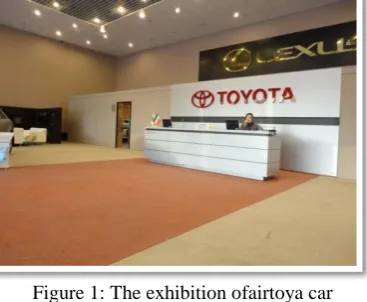
being high and also can create a splendid climate on the other hand, short roofs highlight the quality of being shelter and tend to create a sincere and suitable space. "Spatial performance ": The forming of the space depends on our manner of using. The nature of our activities and manner of their performance, influence on the design, order and organizing of internal space. One environment has special obligations as, a result of skeletal features and the competencies full of opportunities. When these capabilities find meaning in cooperation with the user's behaviors, they become potential (Bachtle, 1977). According to the researches which were done according to environmental psychology and the effect of designing models on the customer's behaviors, the environment was analyzed as an emotional sample and the customer's behavior on designing models at the exhibition of Airtoya car and central car.#" Results ": The analyzed results were composed of 35 peoples between 18 to 70 years old whose level of education is at least diploma. They interview with specialists and the results were analyzed by statistical data according to the tables and also we analyzed the data by photographing of Airtoya and central car's exhibition.The analyzed models if designing in the space are: light, the roof's height, the color of internal space, the field of the vision, the table of the car's features, internal feature and the manner of cars, arrangement. At first we look at the current condition of Airtoya and central car's exhibition. Airtoya has a size as 412 m2 with rectangular section and the height of the roof is 5 m any column is used in this space. The color of internal space of exhibition is neural gray with wide light that provide the light of the whole place, and also light and warm colors are used for the floor of internal place that create a suitable and colorful composition ( figure 1 ).
Figure 1: The exhibition ofairtoya car
In two sides of the hall, modern furniture is used for relaxation and customers communication. In this hall, cars are placed with much distance from each other and near every car, there is the table of it's features.
Figure 2: the exhibition of airtoya car
Figure 3: the exhibition of central car
The furniture in the place is limited in front of the seller's table and the entrance. In this place, the cars are placed in different directions and with little distance from each other.
Figure 4: the exhibition of central car
The results from studies are obtained from interviewing with the people who are visiting the exhibition.
The graphNo 1: the effect of light on customer's behavior
This conclusion shows that how much Lighting is effective in exhibition. As you can see from graph 1, 12 peoples from 35 peoples consider this place nonprofessional and airtoya 13 peoples from 35 people consider this place professional.
0 2 4 6 8 10 12 14
Airtoya
0 2 4 6 8 10 12 14
Graph 2: the effect of the roof's height on the customer behavior
According graph 2 it is clear that the roof's height in central car result in the customer’sstuffiness, which is 48/5%, and in airtoya this factor results in beauty of the place, which is 45/7%.
Graph 3: the effect of the color of internal space of the customer's behavior
As it is clear from graph 3 the effect of internal space's color in central car results in non-sincerity which is 45/5% and his factor in airtoya results in sincerity which is 34/2%. According to the options, we understand that the customer's behaviors are totally one positive and one negative.
Graph No 4: the effect of vision's field at the beginning of entrance to the place on the customer's behavior In interview about the effect of vision's field according to graph 4, it is clear that this factor in central car causes not being conversant with the space in the customer's behavior which is 42/8%, and in airtoya is 57% and makes the optical clearance in the customer
0 5 10 15 20
0 5 10 15 20
0 5 10 15 20
0 5 10 15
0 5 10 15 20 25
Graph No 5: the effect of the tableau of features on the customer's behavior
According to the figure 5, it is clear that the tableau of the car's feature is placed near every car and results in a kind of reliability sense for the customer in airtoya exhibition whose the most amount is 48/5% and in central car, lack of these tableau results in the lack of reliability in the customer which is 51/5%.
#Figure 5: the tableau of the car's features
0 5 10 15 20
0 5 10 15 20
Graph 6:the effect of internal furniture on the customer's behavior
According to the studies it is clear from graph 6 that internal furniture in airtoya results in considering the customer important which includes 42/8% of the people and this factor in central car results in not considering the customer important which 42/8%.
Figure 6: internal furniture in airtoya and central car
Graph 7: the effect of the kind of cars Sort on the customer's behavior
According to graph 7, the arrangement of cars in airtoya has an effect on the mental calmness of the customer, which is 45/7%, and this factor has an effect for the entertainment of the people in central car, which is 45/7%. It is clear that the customer's feelings in feeling in these two places are quietly contrastive.
0 5 10 15 20
Trivialize the customer
Precious space
Lack of calmness
feeling
Insincerity
0 5 10 15 20
Figure No 7: the kind of arrangement of the cars in airtoya and central car
Graph 8: the effect designing models on customer's buy in airtoya
According to the interviews, this question were finally asked, " If you’re suitable car is toyota, which exhibition do you prefer and too percent select airtoya. As it is evident from graph 8, the effect of designing models in airtoya on the customer's buying is high and is equivalent to 55/7%.
II . DISCUSSION AND CONCLUSION
What is analysed in this research is a short review about environmental psychology in relation to the skeletal designing and the models of designing which is studied for the factors that influence in the laboratory environment the behavior of customer and also the extent of the important of designing models for the customer's purchase was studied. As it was observed in the results, the kind of light in airtoya causes a kind of professional feeling for the customer because the light in the roof is stable and similar in the whole roof that has the light for 850 lux, so there weren't any source of light for making the place clearer the kind of light in central car causes a kind of nonprofessional feeling for the customer because two light sources were used and this factor caused a kind of unbalance in the environmentthe height of the roof in airtoya made place splendid for the customer because the height of the roof in airtoya is 5m which is seen in special places, but in central car, caused a kind of extinction feeling for the customer because the height of the central car's roof is 3m which is common is houses and because cars have big dimension, a kind of extinct feeling was caused for the customer. The color of the internal place of the central car was obtained for the results that caused a kind if non sincerity feeling the customer because in central car, cold colors are used which aren't balanced optically and causes a kind of insincerity feeling for the customer. The color of internal car in aurtoya has caused a kind of sincerity feeling for the customer because in airtoya, warm colors are used and are placed in the manner so a good composition is appeared and a positive feeling is associated. According to the results for the field of the vision in airtoya that has caused a visional clearance for the customer, there is this reason that in airtoya there is no column and the internal space is coherent and in the central car this has caused not including because there are two columns in the middle part and because the number of the cars is great has caused a kind of not occupied for the customer.According to the statistics about the tableau of the car's features in airtoya that caused a reliability feeling for the customer is because of this fact that when the customer see the car's features near every car, resting question will be answered and the dominance feeling for the employees causes a reliability feeling and the tableau of car's features is as a guarantee for the customer but in central car because of not having this tableau, this reliability is vanished and the customer has no sufficient reliability about the sayings, exhibition's ownerThe internal furniture of airtoya has caused an importance feeling for the customer because the selected furniture is harmonious with the environment and devoted a place for thinking or advising with other members of the family privately and think factor has made a kind of importance feeling for the customer but in central car, the lack of these facilities has caused the lack of importance for the customer. According to the results the customer in airtoya have mental calmness because the cars are placed with equal distance from each other so the customer can study the considered car completely and also the distance of the cars from each other is great so a kind of mental calmness in decision is made. In central car, the distance of cars from each other is small and the customer can't study the cars completely so a kind of fuzziness is caused. The effect of considered designing models in exhibition change the customer's behavior and influence on his or her decision for buying that car. The designer's familiarity with the sciences which help directly or indirectly the designing made the designers
9
16
7
3 0
0 2 4 6 8 10 12 14 16 18
REFERENCES
[1] Arabi, J., Creation of Forms, Second Edition 1999, Tehran: Herfeyehhonarmand Publication.
[2] Aizman, L., Fundamental of Colors Psychology, Translator: RouhollahZemzemeh, First Edition 1957, Tehran, Beihaghketab Publication.
[3] Bachtel, R., Enclosing Behavior Stroudsburg. Second Edition, 1977, PA: Dowden.
[4] Ching, F., Interior Design, Translator: HosseinaliRasouli, First Edition 1943, Tehran: Azarakhsh Publication.
[5] Craik, K. H., Environmental Psychology. Second Edition 1970, New York: Holt [6] Le Corbusier, Towards a new Architecture New York: Praeger, 1923.
[7] MotalebiEsfidvajani, G., Pictures as Real Environments in Research, 1998. Pp. 141-156, in M. A. [8] Mous, P., The Psychology of place. Ninth Edition, 1976. London: The Architectural Press.
[9] Neufert, E. “neufert”: Architecture Information, Translator: HosseinMozaffaritarshizi, Ninth Edition 1913, Tehran: Azadeh Publication
[10] Pakzad, J., Similarity within space, Spring-Fall 1996, SofehShahidBeheshti Publication, pp. 22-23 [11] Plater, N., Zyberk, D. Forward In Brenda. Third Edition 1994. New York: Champman and Hall.
[12] Shaterial, R., Introduction of Architectural form and Environment, first Edition 1999, Tehran: NashreTourang Publication.