The Thirty-Third AAAI Conference on Artificial Intelligence (AAAI-19)
Recognizing Unseen Attribute-Object Pair with Generative Model
Zhixiong Nan,
1,2∗Yang Liu,
2∗Nanning Zheng,
1Song-Chun Zhu
21Xi’an Jiaotong University, China 2University of California, Los Angeles, USA
Abstract
In this paper, we are studying the problem of recognizing attribute-object pairs that do not appear in the training dataset, which is called unseen attribute-object pair recognition. Ex-isting methods mainly learn a discriminative classifier or compose multiple classifiers to tackle this problem, which ex-hibit poor performance for unseen pairs. The key reasons for this failure are 1) they have not learned an intrinsic attribute-object representation, and 2) the attribute and attribute-object are pro-cessed either separately or equally so that the inner relation between the attribute and object has not been explored. To ex-plore the inner relation of attribute and object as well as the intrinsic attribute-object representation, we propose a genera-tive model with the encoder-decoder mechanism that bridges visual and linguistic information in a unified end-to-end net-work. The encoder-decoder mechanism presents the impres-sive potential to find an intrinsic attribute-object feature rep-resentation. In addition, combining visual and linguistic fea-tures in a unified model allows to mine the relation of attribute and object. We conducted extensive experiments to compare our method with several state-of-the-art methods on two chal-lenging datasets. The results show that our method outper-forms all other methods.
Introduction
Attributes are the description of ‘objects’. To reach a higher level of vision understanding, a computer should under-stand not only object categories but also their attributes. As a result, recognizing objects with their attributes have been widely studied in various problems such as person re-identification (Su et al. 2016), scene understanding (Laffont et al. 2014), image caption (Wu et al. 2017), image search (Kumar, Belhumeur, and Nayar 2008), and image genera-tion (Yan et al. 2016).
Encouraged by the success of discriminative models im-plemented with deep neural networks for object classifi-cation (Simonyan and Zisserman 2014; He et al. 2016; Huang et al. 2017), some studies like (Misra, Gupta, and Hebert 2017) have tried to recognize attribute-object pairs by composing the discriminative models that are separately trained for the object and attribute. Factually, the discrimina-tive models are trying to learn the attribute visual ‘prototype’
∗
Yang Liu and Zhixiong Nan are co-first authors.
Copyright c2019, Association for the Advancement of Artificial Intelligence (www.aaai.org). All rights reserved.
old bear old book old bike old bridge small dog wrinkled dog big dog wet dog
Figure 1: The upper row shows the same object ‘dog’ with the different attributes. Though dogs can be small, big, wet, or wrinkled, they present similar visual properties. The lower row shows the same attribute ‘old’ with the different objects, we can observe that the visual properties signifi-cantly differ from each other.
Realizing this issue, some works like (Chen and Grau-man 2014) have tried to process the attribute and object as a whole to explore their inner relations. However, many of them still employ discriminative models to tackle the prob-lem, resulting in poor performance for recognizing unseen attribute-object pairs. The major reason is that the individ-ual property of the attribute and object are not learned. For example, there are pairs like ‘old book’ and ‘small dog’ in the training set, so the model are well fitted to these pairs. However, the model fails to learn the concept of individual attribute and object like ‘old’, ‘book’, ‘small’, and ‘dog’, thus can hardly generalize to unseen pairs like ‘old dog’ or ‘small book’.
Summing up the above, to recognize unseen attribute-object pairs, we should design a model that should consider not only the individual property of the attribute and object but also the inner relation between them. To this end, in this paper, we propose an encoder-decoder generative model bridging visual and linguistic features in a unified end-to-end network. We first obtain the visual feature of images us-ing state-of-the-art deep neural network, and the lus-inguistic feature by extracting the semantic word embedding vectors of object and attribute label. To explore the inner relation of the attribute and object, inspired by the idea of ZSL (Zero-Shot Learning), we project the visual feature and the linguis-tic feature into a latent space where the attribute and object are processed as a whole. During the projection, to preserve the individual property of the attribute and object, the orig-inal visual and linguistic features of the attribute and object are projected by different functions. In the latent space, in order to minimize the ‘distance’ between the visual feature and linguistic feature, we have exploited several loss func-tions to penalize the dissimilarity between them. In addition, we propose the decoding loss which has been proved crucial to generalize better to unseen pairs because it can find the natural and intrinsic feature representations.
In the experiments, we have compared with four state-of-the-art methods on two challenging datasets, MIT-States (Isola, Lim, and Adelson 2015) and UT-Zappos50K (Yu and Grauman 2014). The experiments show that our method out-performs other methods significantly. We also performed some ablation experiments to study the effect of individual loss function, the influence of visual feature extractor, and the interdependence of the attribute and object, from which we draw some important conclusions.
our contributions in this paper are as follows:
• We propose a generative model to recognize unseen attribute-object pairs instead of composing multiple clas-sifiers.
• Our model combines the visual and linguistic information in the same latent space, which is significant for exploring the inner relation of the attribute and object.
• We apply the encoder-decoder mechanism to the problem of attribute-object pair recognition.
Related Work
Object and attribute In recent years, object, attribute, and attribute-object composition recognition have been
in-tensively studied in both image and video domains (Laf-font et al. 2014; Isola, Lim, and Adelson 2015; Su et al. 2016; Wu et al. 2017; Misra, Gupta, and Hebert 2017; Liu, Wei, and Zhu 2017). Attribute recognition is a basic problem, the typical method for attribute recognition is sim-ilar to that for object classification, training discriminative models using attribute-labeled samples (Parikh and Grau-man 2011; Patterson and Hays 2012; Scheirer et al. 2012; Singh and Lee 2016; Lu et al. 2017). Attribute-object pair recognition is a more challenging problem. Some conven-tional methods often use a classifier or compose multiple classifiers to tackle the problem (Chen and Grauman 2014; Misra, Gupta, and Hebert 2017). Some other studies assume object-attribute relationship is known and datasets are sim-ple that only contain one or few dominant object categories (Wang and Mori 2010; Mahajan, Sellamanickam, and Nair 2011; Wang and Ji 2013). To make the model applicable to complex datasets that cover various object and attribute classes, some good models are proposed (Wang et al. 2013; Kulkarni et al. 2013). However, they are suffering from ‘do-main shift’ problem - the test data distribution differs from that estimated by the training data, leading to the low per-formance on testing data. To overcome this problem, the work (Nagarajan and Grauman 2018) proposes to take the attributer as the operator and attribute-object pair as a vec-tor that is transformed by this operavec-tor, then this transformed vector is compared with CNN visual feature to recognize un-seen pairs. In this paper, we propose a generative model with encoder-decoder mechanism which is significant for explor-ing the intrinsic feature representation, thus can better trans-fer the concept of object and attribute from training set to the testing set.
wrinkled
dog Wrinkled Dog
tiger
small
building island forest wet young
wrinkled dog
small dog
wet dog young tiger
wet forest
small building
small island d
Visual space
Latent space
Semantic linguistic space
Visual feature in visual space Visual attribute feature in latent space Visual object feature in latent space
Visual attribute-object pair feature in latent space Reconstruction of visual feature in visual space
Linguistic attribute feature in semantic linguistic space Linguistic object feature in semantic linguistic space Linguistic attribute feature in latent space Linguistic object feature in latent space
Linguistic attribute-object pair feature in latent space ConvNet
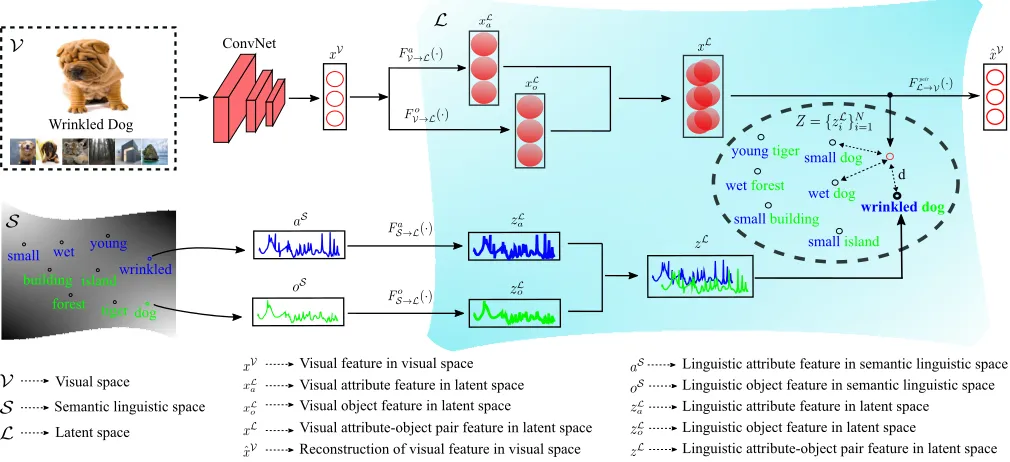
Figure 2: Given an image with the attribute-object pair label ‘wrinkled dog’, our goal is to correctly recognize this label. The challenge is that there are many possible pairs. As shown in the black ellipse in latent spaceL, the pair may be ‘young tiger’, ‘small dog’, or others. To find the correct one, we first extract the visual featurexV of the given image in visual spaceVand projectxVinto latent spaceL. After some processing, we finally obtainxLthat represents the visual feature of the given image inL. At the same time, for all possible pairs, we extract their linguistic representationsZ ={zLi}N
i=1in latent spaceL. Each elementzLi inZ corresponds to one possible pair, which is obtained by mapping the corresponding word embedding vectors
aS andoS from semantic linguistic spaceSto latent spaceL. Finally, we take the label ofzLi with closest distance toxL as recognition result.
latent space where the most likely attribute-object pair is se-lected with the least loss calculated by our self-defined loss function.
Vision and language combination With the rapid devel-opment of vision and language, vision and language com-bination has been studied to tackle many problems. For ex-ample, as mentioned above, many ZSL models take linguis-tic text description (Lei Ba et al. 2015; Elhoseiny, Saleh, and Elgammal 2013) as auxiliary information for unseen object recognition. However, text description annotation is ‘expensive’, especially for large scale datasets. Therefore, it is intuitive to utilize linguistic word embedding as aux-iliary information because all words can be encoded as vectors with the pre-trained model (Socher et al. 2013; Frome et al. 2013). In this paper, we represent object and at-tribute as linguistic word embedding vectors. Different from one-hot vectors, word embedding vectors imply the seman-tic similarity of their corresponding words. In another word, semantically similar attribute and object will create similar word embedding vectors, which is significant for learning the inner relation of the attribute and object.
Approach
In this paper, we are studying the problem of identifying the attribute-object pair of the given image. For example, given an image as shown in Fig. 2, our task is to output
the attribute-object pair ‘wrinkled dog’. It is challenging for two reasons: 1) we are recognizing unseen attribute-object pairs that are not included in training data, and 2) this is fine-grained recognition problem and the number of possi-ble attribute-object pairs is large.
Overview
Given an imageIwith the attribute labelya and object la-bel yo, our goal is to correctly choose its attribute-object
label from the set Z = {ziL}N
He et al. 2016) to extract the visual feature of I in visual space V and denote it as xV, which is then projected into latent spaceLasxL. For all possible pairs, we extract their
attribute vector aS and object vector oS, and then project them into latent spaceLwhere they are merged as linguistic attribute-object pair featurezL. In the training stage, we are trying to learn the projection fromV andS toLby mini-mizing the ‘distance’ between the visual featurexL and its corresponding linguistic featurezLin the latent space. In the testing stage, we predict the attribute-object label ofzLthat is the closest to the xL. To this end, we need to consider two crucial problems: 1) how is original visual and linguis-tic data transitioned between different spaces to obtainxL
andzL, and 2) how to design the loss functions to minimize their ‘distance’. We will tackle these two problems in the following sub-sections.
Data transitions
Fig. 2 signals the data transition process of our method. In the figure, the red circles represent the visual data flow, while green and blue waves represent the linguistic data flow. For visual data flow, the visual featurexV in visual space V is projected into latent spaceL as two flows representing vi-sual attribute featurexLa and visual object featurexLo respec-tively.xLa andxLo are then merged as visual attribute-object pair featurexL. To obtain reconstruction of the original vi-sual feature,xL is re-mapped back to visual spaceV, the re-mapped feature is denoted asxˆV. For linguistic data flow,
the linguistic attribute featureaS and linguistic object fea-tureoS in word embedding spaceS are projected into the latent space aszaLandzoL, respectively. ThenzaLandzoLare merged as linguistic attribute-object pair featurezL.
For the projections of linguistic attribute and object fea-tures from S to L, we define two projection functions
FS→La (·)andFS→Lo (·)as linguistic encoders:
zaL=FS→La (aS) (1)
zLo =FS→Lo (oS) (2)
Here, we define different projection functions for the at-tribute and object because object (a noun in most cases) and attribute (an adjective to describe the noun in most cases) are two different kinds of instances and should be processed dif-ferently to explore their potential properties. The experiment results validate the effectiveness of this separate processing, the details can be found in the experiment section.
Based on the above two transitions, we can get the at-tribute feature and object feature individually. To explore their inner relation, we add them together:
zL =zaL+zoL (3)
For visual feature inV, we define two project functions
Fa
V→L(·)andFV→Lo (·)which projectxVto its attribute
fea-turexLa and object featurexLo.
xLa =FV→La (xV) (4)
xLo =FV→Lo (xV) (5)
With the same manner as we combine latent attribute fea-ture and object feafea-ture from language. We getxLby:
xL=xLa +xLo (6)
Our decoder to re-map the visual feature from latent space
Lto original visual spaceVis defined as:
ˆ
xV=FL→Vpair(xL) (7)
Loss functions
Encoding loss The goal of encoding loss is to minimize the ‘distance’ between visual attribute-object pair featurexL
and linguistic attribute-object pair featurezL. There are mul-tiple ways to define the distance in the latent space. The most intuitive and common one is L2 distance. However, when us-ing L2 distance, the value of visual and lus-inguistic features in latent space tend to be extremely small during optimization which leads to poor performance. Therefore, we define the encoding loss as cosine similarity betweenxLandzL:
Len=dist(xL, zL) = 1− < x
L, zL>
kxLk
2kzLk2
, (8)
From geometrical aspect, we measure the angle between two vectors, and encourage them to have the same direction. The reason we do not consider the cosine similarity betweenxLo
andzoL as well as the similarity betweenxLa andzLa is that individual attribute or object feature includes limited infor-mation for attribute-object pair estiinfor-mation. In another word, we treat the attribute and object in the latent space as a whole to explore their inner relation.
Triplet loss The encoding loss defined in the Eq. 8 encour-ages the visual feature to be close to the linguistic feature of the indexed attribute-object pair, but doesn’t consider that the visual feature should be far from the linguistic feature of other attribute-object pairs. Therefore, we add an extra loss called triplet loss, which impels the distance between
xLandzL to be smaller than the distance betweenxLand other linguistic attribute-object featuresz˜Lby a marginK:
Ltri=max
0, dis(x L, zL)
dist(xL,z˜L)−K
(9)
Decoding loss Inspired by recent zero-shot learning works using autoencoder (Kodirov, Xiang, and Gong 2017; Wang et al. 2018), to explore the intrinsic representation of the in-put image, we introduce the decoding loss which is defined as the L2 distance between original visual featurexV and reconstructed visual featurexˆV:
Lde=kxV−xˆVk2 (10)
The decoding loss encourages ˆxV to be same with xV
Discriminative loss In the above, we have introduced the encoding loss to encourage the visual attribute-object pair feature to be close to the indexed linguistic attribute-object pair feature. However, this may lead to that the dominance effect of attribute or object. In another word, either attribute or object tends to represent the whole pair. To avoid this im-balance case, we define the discriminative loss to encourage to preserve the information for attributes and objects. The discriminative loss consists of attribute discriminative loss and object discriminative loss:
Ldis=Ldis,a+Ldis,o (11)
Ldis,aandLdis,oare defined as
Ldis,a=h(xLa, ya), Ldis,o=h(xLo, yo)
whereh(·)is a one fully connected layer network with cross-entropy loss.
The purpose of the discriminative loss is to stress the indi-vidual property of the attribute and object in visual domain. The experiments validate the effectiveness of the discrimina-tive loss, the details can be found the in experiment section.
Learning and Inference
The purpose of learning is to estimate the parameters of data transition functions defined in Eq. 1-7. LetW be all param-eters of functions involved in Eq. 1-7. Given a set of images with the attribute and object labels, the estimation ofW is equal to minimize the losses defined in Eq. 8-11 whereκ,α,
β,γare the weights for different losses:
W∗= arg min W
(κLen+αLtri+βLde+γLdis) (12)
During inference, when a new image arrives, the visual feature is extracted and then projected to latent space, pro-ducing the visual representationxL in latent space. At the same time, the linguistic features of allNpossible attribute-object pairs are also computed to obtain a set of linguistic representationsZ ={zL
i }Ni=1. We compute the cosine sim-ilarity betweenxL andzL
i , and select the indexed
attribute-object pair label of the most similarzLi as recognition result. In another word, we predict the attribute-object pair label by choosing thezLi with the minimum encoding loss.
Experiments
Setup
Datasets Two datasets, MIT-States (Isola, Lim, and Adel-son 2015) and UT-Zappos50K (Yu and Grauman 2014), are used for evaluation. The MIT-States is a big dataset with 63,440 images. Each image is annotated with an attribute-object pair such as ‘small bus’. It covers 245 ob-ject classes and 115 attribute classes. However, it does not have 245×115 attribute-object pairs as labels because not all pairs are meaningful in real world. Following the same setting as in (Misra, Gupta, and Hebert 2017) and (Nagara-jan and Grauman 2018), 1,262 attribute-object pairs are used for training and 700 pairs for testing. The training pairs and testing pairs are non-overlapping. UT-Zappos50k is a fine-grained shoe dataset with 50,025 images. Following the
same setting as in (Nagarajan and Grauman 2018) We use 83 attribute-object pairs for training and 33 pairs for testing. The training pairs and testing pairs are also non-overlapping.
Baselines and metric We widely compare with four base-line methods, three of them are recently proposed state-of-the-art methods. ANALOG (Chen and Grauman 2014) predicts unseen attribute-object pairs using a sparse set of seen object-specific attribute classifiers. SAE (Kodirov, Xi-ang, and Gong 2017) predicts unseen pairs by projecting the input feature in a semantic space where the auxiliary information of unseen pairs is known. REDWINE (Misra, Gupta, and Hebert 2017) predicts unseen attribute-object pairs by composing existing attribute and object classifiers. ATTOPERATOR (Nagarajan and Grauman 2018) represents the attribute-object pair as the object vector transformed by attribute operator, the transformed vector is compared with CNN visual feature for unseen pair recognition. We use the top-1 accuracy on testing images as evaluation metric.
Implementation details We extract 512 dimension visual feature of the image using ResNet-18 (He et al. 2016) pre-trained on ImageNet (Russakovsky et al. 2015). The net-work is not fine-tuned on MIT-States or UT-Zappos50K dataset. We extract 300 dimension linguistic feature for ob-ject and attribute using pre-trained word vectors (Penning-ton, Socher, and Manning 2014), some not-included words are substituted by synonyms. All these features are mapped into a 1024 dimension latent space.Kin Eq. 9 is a parameter that controls the margin, and is set to0.9in our experiment.
κ,α,β,γin Eq. 12 are with the ratio of1 : 0.2 : 2 : 2for Mit-States dataset and1 : 0.2 : 0.5 : 2for UT-Zappos50K dataset. We implement our end to end neural network with MXNet (Chen et al. 2015). All projection functions are im-plemented using one fully connected layer. For the projec-tions from visual space to latent space, to resolve overfitting problem, we add dropout layers after each fully connected layer with dropout ratio as 0.3. We use ADAM as our opti-mizer with the initial learning rate as 0.0001, which decays by 0.9 every two epochs. At every iteration we feed the mini-batch to the network with the mini-batch size as 128.
Quantitative results
As shown in Tab 1, our method outperform all recently pro-posed methods, achieving 25.4% and 4.5% improvement over the second best methods respectively on MIT-States and UT-Zappos50k datasets. Our method outperforms others for two reasons: 1) we introduce the encoder-decoder mech-anism that enables to learn the general and intrinsic repre-sentation of attributes-object pair, and 2) our model consid-ers not only the individual property of the attribute and ob-ject but also the inner relation between them.
Methods MIT-States(%) UT-Zappos(%)
CHANCE 0.14 3.0
ANALOG(Chen and Grauman 2014) 1.4 18.3 SAE (Kodirov, Xiang, and Gong 2017) 14.0 31.0 REDWINE (Misra, Gupta, and Hebert 2017) 12.5 40.3 ATTOPERATOR (Nagarajan and Grauman 2018) 14.2 46.2
Ours 17.8 48.3
Table 1: Top-1 accuracy of methods tested on the MIT-States dataset and UT-Zappos50k dataset. For fair comparison, all methods use the same visual feature extracted with ResNet-18.
Images in MIT-States Images in UT-Zappos50K Dry
Forest Wet Forest
Painted Building
New
Building Broken Phone Satin Sandals Suede
Slippers Hair Heel-shoesCanvas Boat-shoesRubber Ankle-boots
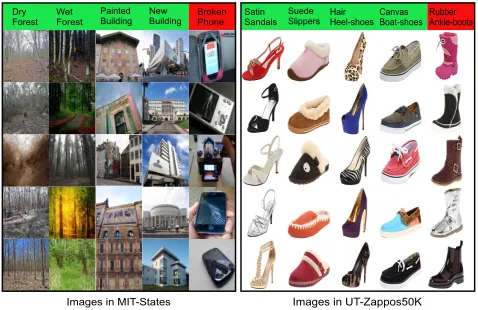
Figure 3: Qualitative results on two datasets. For each dataset, the fifth column shows some false recognitions and other columns show the true recognitions.
Qualitative results
Fig. 3 shows some qualitative results on MIT-States dataset and UT-Zappos50K dataset. Columns with the green mark show some true recognitions. We can observe that some samples with extremely abstract attribute-object pairs are correctly recognized. For example, some images like ‘wet forest’ and ‘dry forest’ are correctly recognized. However, the accuracy is low. On one hand, forest is an abstract ob-ject sharing similar properties with obob-jects like tree, bush, plant, and jungle. On the other hand, wet and dry are ab-stract attributes sharing the similar properties with attributes like damp, verdant, mossy, and barren. Factually for some ‘wet forest’ testing images, our model has recognized them as ‘damp bush’, ‘mossy jungle’, ‘verdant plant’ and other similar compositions. This demonstrates that our model has learned some macro concepts for attribute-object pairs, but some micro concepts have not been precisely distinguished. Columns with the red mark shows some false recogni-tions. We can observe that some images with the label of ‘scratched phone’ and ‘broken camera’ are wrongly recog-nized as ‘broken phone’, and pairs like ‘synthetic ankle-boot’ are wrongly recognized as ‘rubber ankle-ankle-boot’. One main reason is that some attributes are similar and some ob-jects present similar appearance. For example, the attribute of ‘scratched’ is similar with ‘broken’, the appearance of some cameras is similar to that of phone, and some ‘syn-thetic’ boots also present the attribute of ‘rubber’.
Item MIT-States UT-Zappos Top1 (%) Top5(%) Top1 (%) Top5(%)
Att 15.1 38.9 18.4 76.8
Att (pair) 25.1 55.3 52.0 92.7
Obj 27.7 56.4 68.1 96.7
Obj (pair) 29.9 51.6 77.3 93.9
Table 2: ‘Att’ and ‘Obj’ correspond to the accuracies that are trained using the original visual feature, while ‘Att (pair)’ and ‘Obj (pair)’ correspond to the accuracies that are ex-tracted from our attribute-object pair recognition results.
Attribute and object relation
To validate the relation of the attribute and object we have learned, we designed an experiment that measures the at-tribute and object recognition accuracy under two condi-tions: 1) not considering the relation of the attribute and ob-ject, as ‘Att’ and ‘Obj’ shown in Tab. 2, and 2) considering the relation of the attribute and object in both visual and lin-guistic domains, as ‘Att (pair)’ and ‘Obj (pair)’ shown in Tab. 2. Actually, ‘Att (pair)’ and ‘Obj (pair)’ correspond to the accuracy that are extracted from our attribute-object pair recognition results. While for ‘Att’ and ‘Obj’, we have sep-arately trained a 2-layer MLP model to recognize attribute and object category. We can observe from Tab. 2 that at-tribute recognition accuracy of our model is always higher than that does not consider relation of the attribute and ob-ject, which validates our claim that attribute is highly depen-dent on object.
Ablation study
We design two experiments. One is to study the importance of different loss functions, the other is to study the effect of different visual features.
Loss MIT-States(%) UT-Zappos(%)
en 3.6 37.8
+tri 11.2 45.5
+dis 15.3 37.9
+de 17.2 41.3
+tri+dis 15.7 41.4
+tri+de 17.4 46.7
+dis+de 17.5 43.5
+de+dis+tri* 16.5 47.5 +de+dis+tri 17.8 48.3
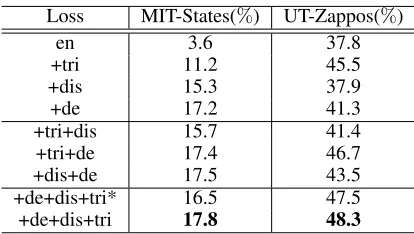
Table 3: Accuracy for loss function ablation study. ‘en’, ‘tri’, ‘dis’, and ‘de’ represent the encoding loss, triplet loss, dis-criminative loss, and decoding loss, respectively. *means sharing parameters forFa
S→L(·)andFS→Lo (·)
(+dis) to encoding loss, we obtain significant performance improvement on MIT-States but slight improvement on UT-Zappos50K. On one hand, we can conclude that the discrim-inative loss allows to learn better visual attribute-object rep-resentation by stressing individual attribute and object prop-erty. On the other hand, it is based on certain condition. The MIT-States dataset is complex and has many object and at-tribute classes, while the UT-Zappos50K is relatively simple that the visual features already have good representations, so adding discriminative loss only contributes slightly. If we add decoding loss (+de), we obtain impressive performance improvement on the MIT-States, even better than adding both triplet loss and discriminative loss (+tri+dis), which demonstrates that encoder-decoder mechanism can mine the essential representation for attribute-object pair. On the UT-Zappos50K, the decoding loss is also helpful.
From the Tab. 3 we can observe that the performance is basically increasing when adding more loss functions. Though in some cases adding more losses lead to worse re-sults, the best performance is achieved when using all loss functions (+de+dis+tri), from which we can conclude that the four loss functions are complementary to each other. In the Tab. 3, (+de+dis+tri*) corresponds to the accuracy when we impose the constraint that the attribute and object are processed by the same projection function (sharing the pa-rameters in Eq. 1 and Eq. 2). We can observe that the accu-racy of (+de+dis+tri*) is lower than that of (+de+dis+tri) on both datasets, from which we can draw another important conclusion that object and attribute are two different kinds of instances and should be processed differently to better explore their individual properties.
In Tab. 4, we report the accuracy corresponding to differ-ent kinds of visual feature extractors. We tested two kinds of network architectures, VGG (Simonyan and Zisserman 2014) and ResNet (He et al. 2016). We can observe from table that the visual feature significantly affects the final performance. VGG-19 presents similar performance with VGG-16. ResNet behaves better than VGG, and basically achieves higher accuracy with deeper architectures.
Network MIT-States(%) UT-Zappos(%)
VGG-16 15.4 40.7
VGG-19 15.3 40.8
ResNet-18 17.8 48.3
ResNet-50 19.7 52.0
ResNet-101 20.0 51.9
Table 4: Accuracy of our method with different visual fea-ture extractors.
Conclusion
In this paper, to recognize the unseen attribute-object pair of a given image, we propose an encoder-decoder generative model to bridge visual and linguistic features in a unified end-to-end network. By comparing our method with sev-eral state-of-the-art methods on two datasets, we reach the conclusion that 1) the generative model is more competitive than discriminative models to recognize unseen classes, 2) the encoder-decoder mechanism is crucial for learning in-trinsic feature representations, and 3) an appropriate model should consider not only the individual property of the at-tribute and object but also the inner relation between them.
Acknowledgment
This research is supported by DARPA XAI grant N66001-17-2-4029, ONR MURI grant N00014-16-1-2007, and ARO grant W911NF-18-1-0296 from USA. This research is also supported in part by the National Natural Foundation of China under Grand 61773312.
References
Akata, Z.; Reed, S.; Walter, D.; Lee, H.; and Schiele, B. 2015. Evaluation of output embeddings for fine-grained im-age classification. IEEE Conference on Computer Vision and Pattern Recognition.
Changpinyo, S.; Chao, W.-L.; Gong, B.; and Sha, F. 2016. Synthesized classifiers for zero-shot learning.IEEE Confer-ence on Computer Vision and Pattern Recognition.
Chen, C.-Y., and Grauman, K. 2014. Inferring analogous at-tributes. IEEE Conference on Computer Vision and Pattern Recognition.
Chen, T.; Li, M.; Li, Y.; Lin, M.; Wang, N.; Wang, M.; Xiao, T.; Xu, B.; Zhang, C.; and Zhang, Z. 2015. Mxnet: A flexi-ble and efficient machine learning library for heterogeneous distributed systems. arXiv preprint arXiv:1512.01274. Elhoseiny, M.; Saleh, B.; and Elgammal, A. 2013. Write a classifier: Zero-shot learning using purely textual descrip-tions.IEEE International Conference on Computer Vision. Frome, A.; Corrado, G. S.; Shlens, J.; Bengio, S.; Dean, J.; Mikolov, T.; et al. 2013. Devise: A deep visual-semantic embedding model.Advances in neural information process-ing systems.
Huang, G.; Liu, Z.; Van Der Maaten, L.; and Weinberger, K. Q. 2017. Densely connected convolutional networks. IEEE Conference on Computer Vision and Pattern Recogni-tion.
Isola, P.; Lim, J. J.; and Adelson, E. H. 2015. Discover-ing states and transformations in image collections. IEEE Conference on Computer Vision and pattern recognition.
Kodirov, E.; Xiang, T.; and Gong, S. 2017. Seman-tic autoencoder for zero-shot learning. arXiv preprint arXiv:1704.08345.
Kulkarni, G.; Premraj, V.; Ordonez, V.; Dhar, S.; Li, S.; Choi, Y.; Berg, A. C.; and Berg, T. L. 2013. Babytalk: Un-derstanding and generating simple image descriptions.IEEE Transactions on Pattern Analysis and Machine Intelligence. Kumar, N.; Belhumeur, P.; and Nayar, S. 2008. Facetracer: A search engine for large collections of images with faces. European Conference on Computer Vision.
Laffont, P.-Y.; Ren, Z.; Tao, X.; Qian, C.; and Hays, J. 2014. Transient attributes for high-level understanding and editing of outdoor scenes. ACM Transactions on Graphics.
Lampert, C. H.; Nickisch, H.; and Harmeling, S. 2014. Attribute-based classification for zero-shot visual object cat-egorization.IEEE Transactions on Pattern Analysis and Ma-chine Intelligence.
Lei Ba, J.; Swersky, K.; Fidler, S.; et al. 2015. Predicting deep zero-shot convolutional neural networks using textual descriptions. IEEE International Conference on Computer Vision.
Liu, Y.; Wei, P.; and Zhu, S.-C. 2017. Jointly recognizing object fluents and tasks in egocentric videos. IEEE Interna-tional Conference on Computer Vision.
Lu, Y.; Kumar, A.; Zhai, S.; Cheng, Y.; Javidi, T.; and Feris, R. S. 2017. Fully-adaptive feature sharing in multi-task networks with applications in person attribute classification. IEEE Conference on Computer Vision and Pattern Recogni-tion.
Mahajan, D.; Sellamanickam, S.; and Nair, V. 2011. A joint learning framework for attribute models and object descrip-tions.IEEE International Conference on Computer Vision.
Misra, I.; Gupta, A.; and Hebert, M. 2017. From red wine to red tomato: Composition with context. IEEE Conference on Computer Vision and Pattern Recognition.
Nagarajan, T., and Grauman, K. 2018. Attributes as opera-tors. European Conference on Computer Vision.
Norouzi, M.; Mikolov, T.; Bengio, S.; Singer, Y.; Shlens, J.; Frome, A.; Corrado, G. S.; and Dean, J. 2013. Zero-shot learning by convex combination of semantic embeddings. arXiv preprint arXiv:1312.5650.
Parikh, D., and Grauman, K. 2011. Relative attributes.IEEE International Conference on Computer Vision.
Patterson, G., and Hays, J. 2012. Sun attribute database: Dis-covering, annotating, and recognizing scene attributes.IEEE Conference on Computer Vision and Pattern Recognition.
Pennington, J.; Socher, R.; and Manning, C. D. 2014. Glove:
Global vectors for word representation. Empirical Methods in Natural Language Processing.
Russakovsky, O.; Deng, J.; Su, H.; Krause, J.; Satheesh, S.; Ma, S.; Huang, Z.; Karpathy, A.; Khosla, A.; Bernstein, M.; et al. 2015. Imagenet large scale visual recognition chal-lenge. International Journal of Computer Vision.
Scheirer, W. J.; Kumar, N.; Belhumeur, P. N.; and Boult, T. E. 2012. Multi-attribute spaces: Calibration for attribute fusion and similarity search.IEEE Conference on Computer Vision and Pattern Recognition.
Simonyan, K., and Zisserman, A. 2014. Very deep convo-lutional networks for large-scale image recognition. arXiv preprint arXiv:1409.1556.
Singh, K. K., and Lee, Y. J. 2016. End-to-end localization and ranking for relative attributes. European Conference on Computer Vision.
Socher, R.; Ganjoo, M.; Manning, C. D.; and Ng, A. 2013. Zero-shot learning through cross-modal transfer. Advances in neural information processing systems.
Su, C.; Zhang, S.; Xing, J.; Gao, W.; and Tian, Q. 2016. Deep attributes driven multi-camera person re-identification. European Conference on Computer Vision.
Verma, V. K.; Arora, G.; Mishra, A.; and Rai, P. 2018. Gen-eralized zero-shot learning via synthesized examples. IEEE Conference on Computer Vision and Pattern Recognition. Wang, X., and Ji, Q. 2013. A unified probabilistic approach modeling relationships between attributes and objects.IEEE International Conference on Computer Vision.
Wang, Y., and Mori, G. 2010. A discriminative latent model of object classes and attributes. European Conference on Computer Vision.
Wang, S.; Joo, J.; Wang, Y.; and Zhu, S.-C. 2013. Weakly su-pervised learning for attribute localization in outdoor scenes. IEEE Conference on Computer Vision and Pattern Recogni-tion.
Wang, W.; Chen, C.; Chen, W.; Rai, P.; and Carin, L. 2016. Deep metric learning with data summarization. Joint Euro-pean Conference on Machine Learning and Knowledge Dis-covery in Databases.
Wang, W.; Pu, Y.; Verma, V. K.; Fan, K.; Zhang, Y.; Chen, C.; Rai, P.; and Carin, L. 2018. Zero-shot learning via class-conditioned deep generative models. AAAI Conference on Artificial Intelligence.
Wu, Q.; Shen, C.; Wang, P.; Dick, A.; and van den Hengel, A. 2017. Image captioning and visual question answering based on attributes and external knowledge. IEEE transac-tions on pattern analysis and machine intelligence.