The Journal of Social Sciences Research
ISSN(e): 2411-9458, ISSN(p): 2413-6670
Vol. 5, Issue. 2, pp: 472-483, 2019
URL: https://arpgweb.com/journal/journal/7 DOI: https://doi.org/10.32861/jssr.52.472.483
Academic Research Publishing Group
*Corresponding Author
Original Research Open Access
Does Accounting Conservatism Mitigate the Operating Cash Flows Downside
Risk?
Amneh Hamad
*Department of Accounting, School of Business, University of Jordan, Jordan
Mohammad AL-Momani
Department of Accounting, Faculty of Economic and business, Jadara University, Jordan
Hamzah Al-Mawali
Department of Accounting, School of Business, University of Jordan, Jordan
Abstract
The aim of this study is to investigate whether the two types of accounting conservatism (conditional and unconditional) mitigate the risk of falling operating cash flows in the presence of cash holdings of Jordanian companies for the period from (2005–2014) for a sample of (160) companies listed in Amman Stock Exchange (ASE). By using the principle components analysis method in the SPSS system to generate a composite measure for the measurement of the conditional conservatism (CC_CM) consisting of three measures: negative accruals (CC_NACC), current accruals to total accruals (CC_CACC), and accounting conservatism to the good news (CC_ACGN). As well as to generate another composite measure for the measurement of the unconditional conservatism (UC_CM) consisting of three measures: total accrual (UC_TACC), book to market (UC_BTM) ratio, and skewness (UC_Skew). In order to measure the downside risk of operating cash flows, we used the root lower partial moment of operating cash flow (RLPM_OCF). We find that two types of accounting conservatism are significantly positively effect on cash holdings. In addition, we conclude that there is a significantly negatively indirect effect for accounting conservatism on downside risk of operating cash flows in Jordanian companies that have cash holdings. It means that the increasing of the accounting conservatism leads to the increasing of cash holdings, which leads to mitigate the operating cash flows downside risk.
Keywords: Conditional accounting conservatism; Unconditional accounting conservatism; Root lower partial moment; Operating cash flows downside risk; Cash holdings.
CC BY: Creative Commons Attribution License 4.0
1. Introduction
The aim of this study is to investigate whether the conditional and unconditional accounting conservatism mitigate the downside risk of operating cash flows (OCFs) under the retention of cash. The financial risk is one of the most important risks that facing the various economic sectors, which requires of their departments to use tools and policies to enable them to protect their ability to survive, achieve their objectives, enhance their reputation, stability in achieving profits and protecting their cash flows (Woods and Dowd, 2008). While the fall of (OCFs) below its expected level is one of the most important financial risks that have negatively effect on the company and related parties, where the risk of management theories suggest that companies have incentives to manage these risks to hedge against negative cash flows decline (Smith and Stulz, 1985); (Froot et al., 1993) through the use of tools such as cash holdings, derivatives hedging, and credit lines, etc., these instruments except cash holdings include explicit and clear costs and require practical and financial expert to implement them (Disatnik et al., 2012). However, risk management is based on accounting such as accounting conservatism which has a lower cost and experience than other tools, under the accounting conservatism; accountants exercise a reasonable degree of caution in recognizing transactions that are subject to uncertainties. Also, accounting conservatism does not encourage excessive profits and it enhances the veracity of accounting information, which increases the credibility of the financial reports of companies and reduces the risks of bankruptcy (Biddle et al., 2012), (Hui et al., 2012).
Basu (1997), interpreted the conservatism as "capturing accountants' tendency to require a higher degree of verification for recognizing good news than bad news in financial statements". Conservatism often results in the recognition of bad economic news faster than good economic news. Several studies pointed out that accounting conservatism is clearly divided into two types: conditional and unconditional conservatism.
practices of this type also include the timing of recognition of advertising costs, R&D costs, and the use of accelerated depreciation methods (Ruch and Taylor, 2015).
The importance of this study is to examine the impact of the accounting conservatism on mitigating the risks of falling operational cash flows by enhancing the value of cash holdings by applying it for Jordanian companies that lack such studies. This study demonstrates the effect and uses it as a tool to mitigate the risks of falling (OCFs) at a low cost compared to other hedging instruments. Also, this study adds to the risk management literature an accounting tool such as accounting conservatism that has a low cost that can be used to mitigate risks by the companies listed in (ASE) as well as other risk management tools.
The research problem is the studying of the risks of the decline in (OCFs) for companies because of the importance of cash for them. It represents the company's nerve and indicates the company's ability to meet its obligations at maturity which are necessary to protect the company from liquidation. The risk management theories show that companies have incentives to hedge against decreasing cash flows and falling into financial crises by using several tools. As cash holdings which means that companies hold cash as a buffer against future cash deficits (Lins et al., 2010). Other tools are also used derivative instruments such as options, futures and forward contracts are expensive and require financial expertise for implementation (Disatnik et al., 2012), but risks management in accounting basis, such as accounting conservatism has a lower cost and experience. We can express the problem of the study by asking the following question:
Is there a statistically significant indirect effect of the conditional and unconditional accounting conservatism on operating cash flows downside risk by enhancing cash holdings?
1.1. Accounting Conservatism, Operating Cash Flows Downside Risk and Cash Holdings
Risks management which use the concept of accounting conservatism may help to mitigate the risks of falling of (OCFs), the results of the study (Biddle et al., 2012) indicates that both types of conservatism help to enhance cash holdings that reduce the risks of falling of operational cash flows. Several studies, such as Louis et al. (2012), Al-Amri and Al-Busaidi (2015) and Lin et al. (2018), have linked the conservatism with cash holdings, which have resulted in accounting conservatism by enhancing the value of cash holdings. Ahmed et al. (2002), found that the conservatism reduces the cost of debt and thus it reduces the risks of paying excessive dividends to the shareholders on an account of the interest of debt holders, thus reducing the cost of borrowing which is reflected on a little cash outflow from the company. Biddle et al. (2016), found that companies with higher levels of conservatism gains more cash, which gives them the ability to meet there debt service obligations and mitigate subsequent bankruptcy risks.Watts (2003a), supported this argument, that the conservatism reduces or limits cash expenditures for compensation based on managers' performance, dividends, and taxes. Accounting conservatism limits the opportunistic behavior of management, in case it is practicing of earnings management to maximize their benefits to get incentives and bonuses on an account to stakeholders. Accounting conservatism is the best way against earnings management which leads to the emergence of net assets understatement, so it reduces the amounts that can be paid for the managers of the company as bonuses and shareholders as distributions. The use of the accounting conservatism policy shows low profits and leads to deferred tax payments to future periods. Gao and Liang (2011) indicated that the role of applying the accounting conservatism is in the balance of earnings management and not overstatement the profits, which helps to reduce the lack of investment and reduces shocks and decreases in (OCFs) in the company.
Companies may avoid political costs where some enterprises may avoid various laws and regulations. They use the accounting conservatism to reduce their income for the fear of interference by the government or nationalization of companies that make high profits or to impose on them the amounts paid to political parties and organizations, so the management of these companies aims to reduce their profits in order to avoid additional political costs (Hamad and Abu Nassar, 2013).
Therefore, maintaining cash holdings rather than falling leads to enhance the company's cash position and helps to avoid the risk of falling operational cash flows. If accounting conservatism leads to a reduction in the risks of falling cash flows that means it protects them from the financial deficient that ultimately leads to the risk of bankruptcy. So, companies maintain cash as a buffer against future cash deficits (Lins et al., 2010). Thus, accounting conservatism helps to have cash holdings which reduce or avoid the reduction of operational cash flows in the company.
2. Literature Review
The study of Todd (2014) tested the hypothesis that accounting conservatism is associated with low risk investment companies on a sample of US companies that reached (2,208) companies for the period (1984-2006). The result of this study is that there is a negative relationship between accounting conservatism and acquisition riskiness, which is consistent with more conservative accounting to reduce managerial incentives that make acquisitions more risky. Al-Amri and Al-Busaidi (2015), examined the relationship between the level of the accounting conservatism and the cash holdings of the company, and whether this relationship depends on the types of companies public or private. Using data from the Gulf Cooperation Council (GCC) countries for the period from (2003-2012). The researchers found that there was a positive relationship between the level of the accounting conservatism and the level of cash holdings of GCC companies, and found that the correlation is higher for public companies compared to private companies. The results indicate that the highest level of conservatism is positively correlated with the level of cash holdings.
The study of Jahanbakhsh and Esmaeilzadeh (2015) was conducted to examine whether there is a relationship between the risk of managing the conditional and unconditional conservatism and the (OCFs) of the listed companies on Tehran Stock Exchange except for the investment, brokerage and insurance companies. The sample size was 122 companies for the period from (2008 - 2013). In addition, the results showed that there is a positive and statistically significant relationship between conditional and unconditional conservatism and operational cash flows, in other words the greater the accounting conservatism, the greater the level of (OCFs). Biddle et al. (2016) aimed to test the relationship between both types of accounting conservatism (conditional and unconditional) and the subsequent bankruptcy risk by enhancing cash holdings of a sample of (4,621) American companies for the period (1989-2007). The result of this study is that both types of accounting conservatism are negatively associated with subsequent bankruptcy risks, and that both types of accounting conservatism reduce the risk of subsequent bankruptcy by enhancing cash holdings. The researchers believe that the results of this study reinforcing the relationship between the conservatism and reduce the risk of corporate bankruptcy which caused by the lack of cash flow. That indicates that there is a role for accounting conservatism in reducing the decline in cash flows as demonstrated in the hypothesis of this study.
The study of Hamad and AL-Momani (2018) aimed to identify whether (Industrial, Services and Finance) sector companies listed in Amman Stock Exchange exercise the conditional and unconditional accounting conservatism and investigated the direct effect of the both types of accounting conservatism on managing the risk of falling in the (OCFs) for the period (2005-2014) on a sample of (160) companies. The study found that all sectors of companies listed in (ASE) exercise both types of accounting conservatism. However, the financial sector exercises the accounting conservatism more than the industrial and services sectors. There is a significantly negatively direct effect of the two types of accounting conservatism on the risk of falling operational cash flows of companies listed in (ASE).
This study is complementary to the study of Hamad and AL-Momani (2018) which was distinguished by the study of the indirect effect of the both types of conservatism on the risks of falling (OCFs) by enhancing the value of cash holdings. Also, this study was distinguished from the study of Biddle et al. (2012) according to some measures of the accounting conservatism used and the difference of the society study. This study was applied for a developing country such as Jordan. It was also distinguished by other studies in the method of statistical analysis, where the use of three-stage least squares (3SLS) regression analysis, and generated a new variable to measure the accounting conservatism by using the principal components analysis of three components conservatism. We find seldom Arab and foreign studies that used the Root Lower Partial Moment (RLPM) to measure the risks of falling operational cash flows. It was chosen because it takes all levels of loss, knowing that computationally is more complex compared to other measures.
According to the results of Hamad and AL-Momani (2018) which examined the direct effect of the conditional and unconditional accounting conservatism on the downside risk of (OCFs) that was applied for Jordanian Companies listed in (ASE). But it did not test the indirect effect of two types of conservatism. Therefore, this study will be tested the indirect effect of two types of accounting conservatism for the risks of falling (OCFs) below its expected level as these companies hold cash.
After that, in order to achieve the research objectives by testing the following research hypothesis stated:
H0: There is no statistically significant indirect effect of the conditional and unconditional accounting
conservatism on operating cash flows downside risk by enhancing cash holdings.
3. Material and Method
3.1. Population of the Study and Sample Size
The study of the population consists of all companies listed in Amman Stock Exchange (ASE) from (2005-2014). The study test was conducted on them which are subject to the following conditions:1) That the company has not had extraordinary events during the study period such as merger or shares split; 2) Regularity of publishing the financial reports of the surveyed companies and providing the necessary accounting data to calculate the variables. After studying the data and excluding the companies that did not meet the above conditions, public shareholding companies were selected as the sample and the numbers (160)1 of the observations were (1600).
1
3. 2. Study variables
3.2.1. - Independent Variable: Accounting Conservatism Measures
The following methods were used to measure the conditional and unconditional accounting conservatism, similar to the methods used by Biddle et al. (2012) and Hamad and AL-Momani (2018) as the following:
3.2.2. The Composite Measure of Conditional Conservatism (CC_CM):-
This variable was extracted by using the Principle Components Analysis method in the SPSS system which consists of three measures:
3.2.3. Negative Accruals (CC_NACC)
Givoly and Hayn (2000), developed a negative accruals measure (accumulated non-operational accruals). The basic rationale of using this measure of conditional conservatism (CC) is to use the conservatism accruals mechanism to delay the recognition of economic revenues and gains. Also, it speeds up the recognition of economic expenses and losses. By postponing gains and accelerating losses, the level of the accumulated non-operational accruals becomes gradually more negative.
CC_NACCit = TACCit – OACCit ……….(Eq. 1) Where:
CC_NACCit: Negative accruals.
TACCit :Total accruals. [(Net income + depreciation expense) – operating cash flows]/ Total Assets at the beginning of the period.
OACCit : Operating accruals.[(Δ accounts receivable + Δ inventories + Δ prepaid expenses) – (Δ accounts payable + Δ taxes payable)]/ Total Assets at the beginning of the period.
3.2.4. Current Accruals to Total Accruals (CC_CACC)
Biddle et al. (2012), developed proportion of total current accruals to total accruals in order to measure the conditional accounting conservatism, and multiplied by (-1) to yield an increasing measure of conservatism. The variables of this measure were calculated according to Francis et al. (2008).
CC_CACCit =
(CAit) ……...…… (Eq.2)
(TAit) Where:
CC_CACCit: Current accruals/ total accruals.
CAit: Current Accruals equal ΔCAit – ΔCLit – ΔCashit +ΔSTDDEBTit.
TAit: Total Accruals equal ΔCAit – ΔCLit – ΔCashit + ΔSTDDEBTit – DEPit.
ΔCAit: The ratio of changes in current assets.
ΔCLit: The ratio of changes in current liabilities.
ΔCashit: The ratio of changes in cash holdings (Cash and cash equivalent) to total assets.
ΔSTDDEBTit: The ratio of changes in standard deviation of the short-term loans.
DEPit: Depreciation expense.
3.2.5. Accounting Conservatism to the Good News (CC_ACGN)
Khan and Watts (2009) developed the measure which is provided by Basu (1997) known as the asymmetric timeliness of earnings of the measurement of the conditional accounting conservatism. Khan and Watts (2009), used C-Score and they estimated it for each firm per year and incorporated firm-specific characteristics such as (size, market value/ equity book value, and leverage). They identified both the good news timeliness (G_Score) and the incremental timeliness for bad news over good news (C_Score) to estimate the appropriate timing of the accounting through the following steps: -
Step 1:The simple Basu model (1997) is presented below:
𝐸𝑃𝑆𝑖𝑡 /𝑃𝑖𝑡−1 = 𝛽1+ 𝛽2𝐷𝑅𝑖𝑡 + 𝛽3𝑅𝑖𝑡 + 𝛽4𝐷𝑅𝑖𝑡𝑅𝑖𝑡 + 𝜖𝑖𝑡 ....…….. (Eq.3) Where:
𝐸𝑃𝑆𝑖𝑡: Earnings per share. 𝑃𝑖𝑡−1: Opening stock market.
𝐷𝑅𝑖𝑡: A dummy variable with a value of 1 if 𝑅𝑖𝑡 is negative, otherwise 0. 𝑅𝑖𝑡: The rate of stock return.
𝛽3: The good news timeliness measure.
𝛽4: The incremental timeliness for bad news over good news which is the main indicator of the level of the accounting conservatism, under conservative financial reports, the coefficient (β4) is expected to be positive and significant.
𝜖𝑖t: Random error.
Step 2: In order to take into account both firm-year-variation in conservatism, Khan and Watts (2009) incorporated firm-specific characteristics such as (size, market to book value, and leverage) into model (3). Both G_Score and C_Score will be calculated as follows:
.………….(Eq.5) Where:
G_Score: Captures the timeliness of good news.
C_Score: Capture the incremental timeliness of bad news at a firm-year level. A higher C_Score indicates increased conditional conservatism.
μi&λi: 1 to 4, are estimated from annual cross-sectional regressions.
M/B: Ratio of the market value/ equity book value.
Size: The natural logarithm of the total assets.
𝐿𝐸𝑉: Ratio of the sum of long-term and short-term debts/ total assets.
Step 3: Replacing β3and β4in model (3) by equations (4) and (5), respectively, which produces the following model:
(
)
(
)
Where: The variables in model (6) were defined in step1 and step 2
In order to measure the conservatism, we run annual cross-sectional regressions on (Eq. 6) and obtain μi and λi estimators, for using them to extract the value of C_Score and G_Score. To know the proportion of the accounting conservatism to good news/ year, Biddle et al., 2012) used this method to measure the conditional conservatism (CC) as it is shown below
CC_ACGNit =
C_Score + G_Score
……….. (Eq.7) G_Score
Where:
CC_ACGNit: Accounting conservatism to good news.
C_Score&G_Score were defined above.
3.2.6. The Composite Measure of Unconditional Conservatism (UC_CM):-
The composite measure of unconditional conservatism (UC_CM) is a variable that was extracted by using the Principle Components Analysis method in the SPSS system which consists of three measures:
3.2.6.1. Total Accruals (UC_TACC)
Givoly and Hayn (2000) used the total accruals which were also used by several studies to measure the unconditional conservatism (UC), including Ahmed et al. (2002) and Biddle et al. (2012).
Givoly and Hayn (2000), focused on the effect of accounting conservatism on the income statement over a long period of time. Since the accounting conservatism leads to negative accruals continuously. The negative accruals are the difference between the (OCFs) and the net profit.
UC_TACCit = [(NIit+ DEPit) - OCFit] /Average Total Assetsit…..…(Eq.8) Where:
UC_TACCit: Total accrualsequal [(net income + depreciation expense) – operating cash flows]/
Averagetototalassetsofthe current and prior two years.
NIit : Net income.
DEPit: Depreciation expense.
OCFit: Operating cash flows.
Average Total Assetsit : Average the current and prior two years.
3.3.2.6.2. Skewness (UN_Skew)
Givoly and Hayn (2000), also developed this measure to calculate unconditional accounting (UC) by finding the difference between (OCFs) skewness and profits skewness. If the result of the skewness is to the left (negative), this indicates that companies use the conservatism in their financial reports.
UC_Skewit = (x - μ)3 /σ3 ………(Eq.9) Where:
UC_Skewit:Skewness of profits or (OCFs).
X: Profits or (OCFs).
μ&σ: The mean and standard deviation of the profits or (OCFs) over the last five years. All variables are divided by total assets.
3.3.2.6.3. Book-to-Market (UN_BTM) Ratio
deviation of this ratio (BTM), which are biased and lagged accounting recognition. A fixed effect regression was made of this ratio for each of the return on equity (ROE) for six years in addition to the effect of time and type of firms. We consider that this measure is more accurate to measure the accounting conservatism than using this ratio in its simple form.
∑ (Eq.10)
Where:
𝑈 𝑇 : Ratio of book value/ market value at the fiscal year-end.
Fixed time variation in BTM ratio common to the sample firms. Firm effect (bias component of BTM ratio).
The deviation of the book value/ market value which is due to the factor of time or time for each sample companies.
𝑅 𝐸 Current and 5 lagged ROE (Lag component of BTM ratio).
Regression coefficient of
3.2.6.4. The dependent variable: Operating Cash Flows downside Risk (RLPM_OCF)
We used the same method that Luo et al. (2012), Biddle et al. (2012) and Hamad and AL-Momani (2018) to measure (OCFs) downside risk. The rationale for this measure is the Root Lower Partial Moment (RLPM) of the lower (OCFs) below the expected level relative to the Root Upper Partial Moment (RUPM). The Root Lower Partial Moment (RLPM_OCF) is measured as follows:[ ] … (Eq.11)
Where:
RLPM_OCFit: Operating cash flows downside risk measure.
RLPM2 𝐹 ) = [( ⁄ )∑ ]⁄ , ………(Eq.11.a)
RUPM2 𝐹 ) = [( ⁄ )∑ ]⁄ , ……..(Eq.11.b)
έit: The residual estimated from OLS regressions of the cash flows expectation model from Eq. (12).
Iέit<0: An indicator that equals one if (έit<0) and zero otherwise.
By using the residuals estimated (έit) from OLS regressions of the (OCFs) expectation model Eq. (12) estimated by Fama and French (1997). If the residuals are lower than zero, there is an indication that there is a fall in (OCFs) less than the expected. It is a dummy variable that obtains number one if the remainder of the model is less than zero έit> 0, and zero otherwise. In order to apply the expectation model Eq. (12) the autoregressive regression was used, and Dechow et al. (1998) states that autoregressive regression improves predictability.
(Eq. 12)
Where:
OCFit-1: Ratio of (OCFs)/ total assets.
SALE it-1: Ratio of total sales/ total assets.
SIZE it-1: The natural logarithm of the total assets.
𝐿𝐸𝑉it-1: Ratio of the sum of long-term and short-term debts/ total assets.
STD_OCFit-1: Standard deviation of (OCFs) using (3 - 5) years.
εit: The random error and its outcome is a measure of the expectation of (OCFs). If the result is less than zero, there is an indication that there is a fall in (OCFs) less than expected. It is a dummy variable that takes number one if the remainder of the form is less than zero (έit> 0), and zero otherwise.
3.2.6.4.1. Moderator Variable
The moderator variable in this research is the cash holdings and following Biddle et al. (2012) and Hamad and AL-Momani (2018).
3.2.6.4.2 Control Variables
A set of control variables were used cash and cash equivalents (CASH), change in cash (ΔCASH), capital expenditures (Invest_Capx), return on assets (ROA), return on equity (ROE), leverage ratio (LEV), firm size (Size), standard deviation of annual return (Sigma), loss (Loss) and net working capital (NWC). These variables were measured according to the study of Biddle et al. (2012) and Hamad and AL-Momani (2018).
3.3. Statistical Models Used
Statistical model used to test the effect of the accounting conservatism on the risk of falling operational cash flows by cash holdings. A set of control variables were used to adjust the relationship between them and three-Stage Least Square (3SLS) as in the following stages:
First Stage:
CONit = 𝛽0 + 𝛽1CONit-1 +𝛽2Cash it-1 +𝛽3RLPM_OCF it-1+ 𝛽4ROAit-1 + 𝛽5ROEit-1+ 𝛽6Size it-1+ 𝛽7LEVit-1 + υit-1 ... … … (Eq.13)
Where:
CONit :CC_CM and UC_CM. Estimated residuals from this stage regression.
Cashit-1: Cash holdings and short-term investments/ total assets.
ROAit-1: Net income/ total assets.
ROEit-1 : Net income/ total equity.
Sizeit-1: The natural logarithm of the total assets.
𝐿𝐸𝑉it-1: The ratio of the sum of long-term and short-term debts/ total assets.
υit-1 : Residuals from this-stage regression, CC_CM_R and UC_CM_R are used in the second and the third-stage regressions.
Second Stage:
CHit =𝛽0 + 𝛽1CC_CM_Rit-1+ 𝛽2UC_ CM _Rit-1 + 𝛽3ΔCashit-1 + 𝛽4Invest_Capxit-1 + 𝛽5ROAit-1 +𝛽6ROEit-1 + 𝛽7NWC
it-1+ 𝛽8𝐿𝐸𝑉it-1+ 𝛽9Sizeit-1 + 𝛽10Sigmait-1 +𝛽11Lossit-1+ εit ... (Eq. 14). Where:
CHit : Cash holdings and short-term investments/ total assets.
CC_ CM _Rit-1: Residuals from the first-stage regression are used with conditional conservatism.
UC_ CM _Rit-1: Residuals from the first-stage regression are used with unconditional conservatism.
ΔCashit-1: The ratio of changes in cash holdings and short-term investments/ total assets .
Invest_Capxit-1: The ratio of capital expenditures/ total assets.
ROAit-1: The ratio of net income/ total assets.
ROEit-1: The ratio of net income/ total equity.
NWC it-: The ratio of current assets minus current liabilities/ total assets.
𝐿𝐸𝑉it-1: The ratio of the sum of long-term and short-term debts/ total assets.
SIZEit-1: The natural logarithm of the total assets.
Sigmait-1: The annualized standard deviation of monthly stock returns calculated over the prior twelve months.
Lossit-1: A dummy variable equals to one if a firm has a negative income for the current fiscal year and zero otherwise.
εit: Residuals from this-stage regression, Ch_Rit-1are used in the third-stage regression.
Third Stage:
Rlpm_OCFit =γ0 + γ1Ch_Rit-1*CC_CM_Rit-1 + γ2Ch_Rit-1*UC_ CM_Rit-1 + γ3CC_CM_Rit-1 + γ4UC_CM_Rit-1 + γ5CH_Rit-1 + γ6Invest_Capxit-1+ γ7ROAit-1 +γ8ROE it-1 + γ9𝐿𝐸𝑉it-1+ γ10Sizeit-1 + γ11Sigmait-1 +γ12Lossit-1 + μit……..
(Eq. 15). Where:
Rlpm_OCFit : Operating cash flows downside risk measure.
Ch_Rit-1*CC_CM_Rit-1: Residuals from the second- stage regression, Ch_R multiply residuals from third-stage regression CC_CM_R are used with conditional conservatism.
Ch_Rit-1*UC_CM_Rit-1: Residuals from the second- stage regression, Ch_R multiply residuals from third-stage regression UC_CM_R are used with the unconditional conservatism.
CC_CM_Rit-1 : Residuals from the first-stage regression, are used with the conditional conservatism.
UC_CM_Rit-1 : Residuals from the first-stage regression, are used with the unconditional conservatism.
CH_Rit-1: Residuals from the second-stage regression.The other variables were defined in model (Eq.14).
4. Results
4.1. Testing the Validity of Data
We used Kolomogorov-Smirnov (K-S) test to verify how close the data are to their normal distribution. The following results which are shown in table (1) indicated that all the variables of the model are less than (5%) which mean that their data are not close to the normal distribution. Thus, to overcome this problem Skewness was examined for all study variables. West et al. (1995), showed that if the number of the study observations exceeds (300) observations and their distribution is limited between (-2) and (2+), these values are close to their normal distribution. We noted from table (1) that the values of the skewness coefficients for all study variables were limited between (-1.100 and 1.951), and therefore they tend to be normal distribution and valid for statistical analysis.
Table-1. Kolomogorov-Smirnov and Skewness Test
Variables (K-S) Skewness Observation
Statistic Sig.
Rlpm_OCF .069 0.000 .577 1600
CC_CM .177 0.000 -.287 1600
UC_CM .092 0.000 1.456 1600
CASH .211 0.000 1.951 1600
ΔCASH .180 0.000 -1.100 1600
Invest_Capx .186 0.000 .963 1600
ROA .140 0.000 -.785 1600
ROE .141 0.000 -1.045 1600
LEV .076 0.000 .596 1600
Size .114 0.000 .829 1600
Sigma .118 0.000 1.446 1600
Testing the correlation coefficient between the variables of the study,table (2) showed that the correlations between the downside risks of (OCFs) in firms listed in (ASE) and between the conditional accounting conservatism (CC_CM), the unconditional accounting conservatism (UC_CM) and the cash holdings. Spearman correlation coefficients are in the upper-right of the table (2) have been used because of the lack of normal distribution in the data study. However, Pearson correlation coefficients are in the lower-left of the table (2) which was used because of the skewness for the study variables were less than the absolute value of the number (2). This indicates that the values are close to their normal distribution.
Table-2. Spearman and Pearson Correlation
CASH UC_CM
CC_CM Rlpm_OCF
Variables
-0.032* -.153**
-.092** 1
Rlpm_OCF
0.127** .304**
1 -.071**
CC_CM
.101** 1
154** -.132**
UC_CM
1 .074**
0.112** -0.025*
CASH
**,* Denotes significance at <.01 and <.05 levels, respectively.
.
The results showed that the composite measure of the conditional (unconditional) accounting conservatism CC_CM (UC_CM) were statistically negatively correlated with (Rlpm_OCF), the coefficient of Spearman (Pearson) for the composite measure of the conditional accounting conservatism (CC_CM) was - 092** (-0.71**), and the composite measure of the unconditional accounting conservatism (UC_CM) was -153**(-.132**). In addition, the results in table (2) show that the relationship between cash holdings and risk are significantly negatively whether using Spearman or Pearson. These results provide initial evidence that the conditional and unconditional accounting conservatism in the listed companies are negatively correlated with (OCFs) downside risk. This indicates that the greater the practice of accounting conservatism mitigates the falling in (OCFs) downside risk.
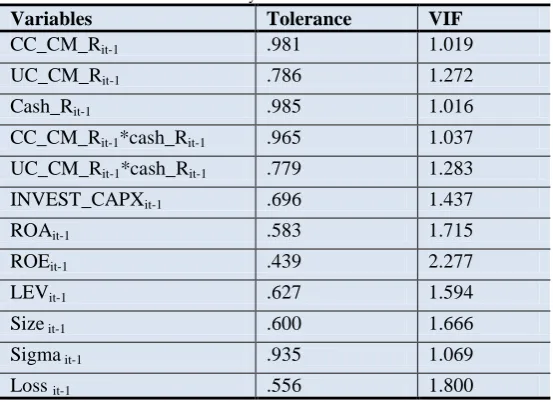
To test the collinearity of the variables of the risk model, variance inflation factor (VIF) was used as it is shown in table (3). The values of (VIF) were limited between (1.016 −2.277) and they were less than ten. This points out that there is no problem in collinearity with the variables. Tolerance values are also shown as an indicator of the linear relationship between the variables which are usually accepted if they are greater than (0.2).The results showed that all values were greater than (0.2) and less than ten indicated that there was no problem in the linear collinearity between the variables. This is what Gujarait and Porter (2010) pointed out.
Table-3. Collinearity Test of Variables in Risk Model
VIF Tolerance
Variables
1.019 .981
CC_CM_Rit-1
1.272 .786
UC_CM_Rit-1
1.016 .985
Cash_Rit-1
1.037 .965
CC_CM_Rit-1*cash_Rit-1
1.283 .779
UC_CM_Rit-1*cash_Rit-1
1.437 .696
INVEST_CAPXit-1
1.715 .583
ROAit-1
2.277 .439
ROEit-1
1.594 .627
LEVit-1
1.666 .600
Size it-1
1.069 .935
Sigma it-1
1.800 .556
Loss it-1
Autocorrelation test (Durbin Watson) was used to ensure that there was no problem of autocorrelation between the residuals of the model expectations. The values of this test range from (0-4). Values from 0 to less than 2 indicate positive autocorrelation. However, the values from more than (2) to (4) indicate negative autocorrelation. Saad (2003), indicated that the optimum result was between (1.5 − 2.5). The result of this test was (2.020) which indicated that there was no autocorrelation between the residuals.
After the validity of the data was confirmed, the hypothesis of the study could be tested.
4.2. Descriptive Statistics
Table (4) includes a statistical description of the variables of the study where it shows the minimum, maximum, mean and the standard deviation. The mean of (Rlpm_OCF) in the listed companies in ASE was (-0.003) and the standard deviation was (0.034), with the minimum and the maximum values were (-0.154) and (0.220), respectively. The results showed that the lowest value of the (CC- CM) was (-11.962) and the highest value was (10.165).
indicates that some companies have cash and cash equivalents for the current period less than the previous period. In general, the mean of this variable (0.003) was positive. This means that most companies have cash holdings and expanded them with short term investments due to the rapid conversion into cash and the desire of these companies to take quick profits.
Table-4. Descriptive Statistics
Variables Min Max Mean Std. Dev.
Rlpm_OCF -0.154 0.220 -0.003 0.034
CC_CM -11.962 10.165 0.000 1.000
UC_CM -8.326 14.553 0.000 1.000
CASH 0.000 0.998 0.143 0.182
ΔCASH -1.164 0.762 0.003 0.128
Invest_Capx 0.000 1.646 0.262 0.294
ROA -0.600 0.514 0.018 0.098
ROE -0.906 1.063 0.040 0.163
LEV -0.541 1.048 0.369 0.256
Size 5.672 9.859 7.444 0.704
Sigma -0.600 1.765 0.313 0.269
NWC 0.000 1.561 0.231 0.262
Dummy Variable
Variables Classification Frequency Percentage
Loss 1 544 %2..5
Otherwise 0 1154 %61.7
Observation 1700 %100
The results point out that the average (ROE) reached (0.040) during the study period and this ratio is close to (ROA) was (0.018).The appearance of the lower value is negative for (ROE) and (ROA) due to loss of some companies during the study period where the descriptive statistics table (4) showed that the percentage of observations that have suffered losses during the study period was (28%) and most of the observations showed a profit of (72%).
The mean (Invest_Capx) was (26%) of total assets. The average ratio of total debt to total assets (LEV) stands at (37%). This means that the financing of the sample companies for their internal assets was (63%) higher than the financing of their assets from the third parties, in addition to, the results point out that the average size of all companies equals (7.444).
The standard deviation of Sigma and Net working capital (NWC) were 0.269 and 0.262, respectively. So as to test the hypothesis of the study, Three-phase least squares (3SLS) model was performed as it is shown in table (5).
4.3. Hypothesis Testing
The stages and presentation of the results of each stage:
4.3.1. First Stage
A multivariate regression of conditional and unconditional accounting conservatism model was used to calculate the residuals for using them in the second stage. The results of this stage showed that cash holdings had a statistically significant adverse effect on the conditional accounting conservatism table (5) where the regression coefficient of the (Cashit-1) is negative (-0.034), with negative t-statistic (-2.31) and a p-value of 0.017 significant 5%. The results also showed that the risks of falling operational cash flows (Rlpm_OCFit-1) have an adverse consequence on the conditional and unconditional accounting conservatism, where the regression coefficient of the (Rlpm_OCFit-1) is negative (-5.874) and (-2.032) respectively, with negative t-statistic (-8.652) and (-2.808) are respectively, and a p-value of 0.000 and 0.005 are respectively, significant 5%.
4.3.2. Second Stage
A multivariate regression was performed using the residuals from the first stage regression (conditional and unconditional conservatism model) Eq. (13) to calculate the residuals associated with this stage (cash model) Eq. (14).The second stage showed that the conditional and unconditional accounting conservatism significantly increase cash holdings table (5), where the regression coefficient of the (CC_CM_Rit-1) and (UC_CM_Rit-1) are positive (0.012) and (0.474) respectively, with positive t-statistic (2.318) and (3.405) respectively, and a p-value of 0.021 and 0.001 are respectively, significant 5%.
4.3.3. Third Stage
indirect impact of conditional and unconditional conservatism on the risk of falling operational cash flows by cash holdings.
The results at this stage in table (5) showed that the value of (F) is (4.767) and the statistical significance of it (0.000). This indicates that the interaction of the accounting conservatism with the cash holdings and the existence of the control variables have a statistically significant effect by (0.05). The results showed that cash holdings have a statistically significant adverse effect on the risk of falling operational cash flows. As it is shown in table (5) that the value of t-statistic (-3.265) at a significant level by (0.05). These results support that cash holdings as a meditation variable between conditional and unconditional accounting conservatism mitigate the risks associated with falling of (OCFs). Since the meditation of the impact of cash holdings are equal to -0.007 = (0.012 * -0.019) for conditional conservatism and equal to -0.455 = (0.474 * -0.019) for unconditional conservatism.
The results showed in table (5) that the greater the conditional accounting conservatism by cash holdings in one-unit, the lower of the risk in falling of (OCFs) by (0.015), while the greater the unconditional accounting conservatism in the existence of cash in one-unit, the lower of the risk in falling of (OCFs) by (0.012). The results showed that the (R2) value is equal to 0.065, which means that the accounting conservatism of both types and the presence of cash holdings explain 6.5% of the variance in the risk of falling operational cash flows.
The regression coefficient of the capital expenditures (INVEST_CAPXit-1) is negative (-0.12) with negative t-statistic (-3.398) and a p-value of 0.001 significant 5%. Based on this result (INVEST_CAPXit-1) is negatively and significantly related to the (Rlpm_OCFit). This supports the capital expenditures increased by one unit, reducing the (Rlpm_OCFit) by 12%.
The profitability of the company, measured by return on equity (ROEit-1), showed the value of the regression coefficient is negative (-0.28) with negative t-statistic (-3.615) and a p-value of 0.000 significant 5%. Based on this result the (ROEit-1) increased by one unit, reducing the (Rlpm_OCFit) by 28%. The results also showed that the risks associated with the shares of Jordanian companies have a positive effect, as the value of the regression coefficient of the (Sigmait-1) is positive (0.007) with negative t-statistic (2.139) and a p-value of 0.033 significant 5%. In other words, the risks related to shares of listed Jordanian companies (Sigmait-1) increased by one unit, the (Rlpm_OCFit) increased by (0.007). In other words, the greater the accounting conservatism in Jordanian companies, the greater the cash holdings as they were shown in the second stage (cash model).Thus, mitigating the risk of falling operational cash flows as they were shown in the third stage (risk model) in table (5).
Table-5. Three-Stage Least Squares (3SLS) Regression to Test the Research Hypothesis
Three-Stage least squares (3SLS) Model Independent Variable Third Stage Second Stage First Stage Rlpm_OCF Model Model Cash UC Model CC Model Sig t ß Sig t ß Sig t ß Sig t ß .182 -1.336 -.014 .171 -1.370 -0.066 .998 -.002 -.001 .013 -2.491 -.754 Intercept .000 6.022 .149 CC_CMit-1 .0000 10.663 .249 UC_CMit-1 .203 -1.274 -.001 .021 2.318 .012 CC_CM_ Rit-1
.029 -2.188 -.002 .001 3.405 .474 UC_CM_Rit-1 .758 -.308 -.042 .017 -2.31 -.034 Cashit-1 .001 -3.265 -.019
Cash_ Rit-1
.017 -2.648 -.015
CC_CM_Rit-1*cash_ R it-1
.004 2.858 -.012
UC_CM_Rit-1*cash_ R it-1 .000 -8.652 -5.874 .005 -2.808 -2.032 Rlpm_OCFit-1 .000 4.622 .138 ∆Cashit-1 .001 -3.398 -.012 .000 -11.520 -.185 INVEST_CAPXit-1 .589 .540 .006 .000 5.218 .227 .000 -4.344 -1.300 .001 -3.264 -1.049 ROAit-1 .000 -3.615 -.028 .000 3.680 .040 .000 -4.201 -.779 .706 .377 .075 ROEit-1 .433 -.784 -.003 .000 -5.019 -.092 .144 1.461 .159 .088 1.708 .199 LEVit-1 .247 1.159 .002 .001 3.406 .022 .784 .274 .011 .039 2.061 .090 Sizeit-1 .033 2.139 .007 .000 4.368 .060 Sigmait-1 .102 1.637 .004 .386 .867 .008 Lossit-1 .000 9.433 .153 NWC it-1
1600 1600 1600 1600 Observation 0.065 0.346 0.202 0.081 R-square .0000 5.676 .0000 39.70 .0000 22.183 .0000 7.727 F_Value
5. Discussion
The results of the first stage showed that cash holdings had a statistically significant adverse effect on the conditional accounting conservatism. This explained that companies that hold cash have the opportunity to expose their profits to sudden falls and shocks because these companies warned in the management of their investments and operations. In addition, companies that hold (Cashit-1) have weak incentives to apply high levels of conditional accounting conservatism to acquire external financing at a lower cost than debt. Companies that have high cash flows are more likely to problem with the agency and tend to holdback bad news (conditional conservatism).The results at the first stage also showed that the risks of falling operational cash flows (Rlpm_OCFit-1) have an adverse consequence on the accounting conservatism of both types. This supports the fact that companies that use low levels of accounting conservatism have a high risk of falling of operating cash flows.
Based on the results of this study at the final stage, the accounting conservatism of both types had a greater impact on the risk of falling in (OCFs) in the financial reports of the companies listed in (ASE) that have cash holdings. The results showed that the greater the conditional accounting conservatism by holding cash in one-unit, the lower of the risk in falling of (OCFs) by (0.015), while the greater the unconditional accounting conservatism in the presence of cash in one-unit, the lower of the risk in falling of (OCFs) by (0.012). We noted that these values are higher than the values observed in (Hamad and AL-Momani, 2018) in the absence of cash holdings, as these values were (0.002 and 0.006) for both conditional and unconditional accounting conservatism, respectively.
Consequently, the increase in the accounting conservatism in the Jordanian companies leads to a reduction in profits, which means a lower borrowing cost by paying less interest to the bondholders, as well as paying less amounts as dividends to the shareholders, also reducing the amounts paid to managers who get a percentage of profits as bonuses and lower tax payments. All these keep the existence of cash and reduce cash outflows, which gives the company the ability to maintain its operating cash flows from the risk of falling to below the expected level. These results are consistent with a study (Biddle et al., 2012) in the presence of cash holdings.As the study of Razmeh et al. (2014) has shown, the accounting reservation limits the risk of corporate bankruptcy caused by the lack of cash flow. Based on the findings of this study, the null hypothesis is rejected and the alternative hypothesis which states that there is a statistically significant indirect effect of the conditional and unconditional accounting conservatism on operating cash flows downside risk by enhancing cash holdings is accepted.
6. Conclusion
The results of the research showed that the composite measure of the conditional (unconditional) accounting conservatism CC_CM (UC_CM) was a statistically negatively correlated with (OCFs) downside risk by using the root lower partial moment of operating cash flow (Rlpm_OCF). In addition, the results showed that the relationship between CC_CM (UC_CM) and cash holdings are statistically positively. As well as, the results showed that the relationship between cash holdings and downside risk are significantly negatively whether using Spearman or Pearson. The results also showed that there is a negative indirect effect that is statistically significant for the CC_CM (UC_CM) on the risk of falling of (OCFs) by enhancing the value of cash holdings. That means cash holdings as a moderate variable between the conditional and unconditional accounting conservatism and the risks reduce the falling of (OCFs).
We conclude that the increasing of the accounting conservatism in Jordanian public shareholding companies lead to increase cash holdings of these companies which in turn lead to mitigate the risks of falling of (OCFs).
Based on the results of the study, we recommend that companies which suffer from risk of falling in their (OCFs) should exercise an appropriate degree of accounting conservatism, taking into account the quality of the financial statements, and encouraging companies to adopt the accounting conservatism as a tool to manage the risk of falling (OCFs), and with focusing the future studies on other measures of (OCFs) downside risk.
References
Ahmed, A. S., B. K., Billings, R. M., Morton and Stanford-Harris, M. (2002). The role of accounting conservatism in mitigating bondholder-shareholder conflicts over dividend policy and in reducing debt costs. The
Accounting Review, 77(4): 867-90.
Al-Amri, K. M. and Al-Busaidi, A. S. (2015). Conservatism and corporate cash holdings, A risk prospective.
Investment Management and Financial Innovations, 12(1): 101-13.
Basu, S. (1997). The conservatism principle and the asymmetric timeliness of earnings. Journal of Accounting and
Economics, 24(1): 3-37.
Beaver, W. H. and Ryan, S. G. (2000). Biases and lags in book value and their effects on the ability of the book-to-market ratio to predict book return on equity. Journal of Accounting Research, 38: 127–48.
Beaver, W. H. and Ryan, S. G. (2005). Unconditional and conditional conservatism, Concepts and modeling. Review
of Accounting Studies, 10: 269-309.
Biddle, G. C., Ma, M. L. and Song, F. M. (2012). The risk management role of accounting conservatism for operating cash flows. Available: http://ssrn.com/abstract=1695629
Biddle, G. C., Ma, M. L. and Song, F. (2016). Accounting conservatism and bankruptcy risk. Working paper,
University of Hong Kong. Available: https://ssrn.com/abstract=1621272 or
http://dx.doi.org/10.2139/ssrn.1621272
Dechow, P., Kothari, S. P. and Watts, R. (1998). The relation between earnings and cash flows. Journal of
Accounting and Economics, 25(2): 133-68.
Disatnik, D., Duchin, R. and Schmidt, B. (2012). Cash Flow Hedging and Liquidity Choices. Working paper, University of Michigan.
Fama, E. F. and French, K. R. (1997). Industry costs of equity. Journal of Financial Economics, 43(2): 153-92. Francis, J., Nanda, D. J. and Olsson, P. (2008). Voluntary disclosure, Earnings quality, And cost of capital. Journal
of Accounting Research, 46(1): 53–99.
Froot, K. A., Scharfstein, D. S. and Stein, J. C. (1993). Risk management, Coordinating corporate investments and financing policies. Journal of Finance, 48(5): 1629-58.
Givoly, D. and Hayn, C. (2000). The changing time-series properties of earnings, Cash flows and accruals, Has financial reporting become more conservative? Journal of Accounting and Economics, 29(3): 287-320. Gujarait, D. N. and Porter (2010). Basic Econometrics. 5th edn: McGraw-Hill: USA.:
Hamad, A. and Abu Nassar, M. (2013). The effect of the income smoothing on the market return of listed companies In Amman Stock Exchange, University of Jordan. Dirasat, 40(2): 329 - 51.
Hamad, A. and AL-Momani, M. (2018). The Effect of Accounting Conservatism in Managing the Risk of Downside of Operating Cash Flows of Companies Listed in Amman Stock Exchange: An Analytical Study, University of Jordan. Jordan Journal of Business Administration, 14(1): 81–107.
Hui, K. W., Klasa, S. and Yeung, E. (2012). Corporate suppliers and customers and accounting conservatism.
Journal of Accounting and Economics, 53(1-2): 115-35.
Jahanbakhsh, S. and Esmaeilzadeh, A. (2015). The relationship between risk management conservatism and operating cash flow. International Journal of Allied Practice, Research and Review, 11(9): 13 – 25.
Khan, M. and Watts, R. L. (2009). Estimation and empirical properties of a firm-year measure of accounting conservatism. Journal of Accounting and Economics, 48(2-3): 132-50.
Lin, C. M., Chan, M. L., Chien, I. H. and Li, K. H. (2018). The relationship between cash value and accounting conservatism, The role of controlling shareholders. International Review of Economics and Finance, Elsevier, 55(C): 233-45.
Lins, K., Servaes, H. and Tufano, P. (2010). What drives corporate liquidity? An international survey of cash holdings and lines of credit. Journal of Financial Economics, 98(1): 160-76.
Louis, H., Sun, A. X. and Urcan, O. (2012). Value of cash holdings and accounting conservatism. Contemporary
Accounting Research, 29(4): 1249-71.
Luo, Y., Ma, M. and Wu, F. (2012). Earnings Downside Risk. Working paper, University of Hong Kong.
Razmeh, A., Dowraghi, H. and Dowraghi, M. (2014). Investigate the relationship between accounting conservatism, Firm size, And cash flow, The risk of bankruptcy, The companies listed in Tehran stock exchange. Indian J. Sci. Res., 7(1): 539-45.
Ruch, G. W. and Taylor, G. (2015). Accounting conservatism, A review of the literature. Journal of Accounting Literature, 34: 17–38.
Saad, B. (2003). Guide to Statistical Program SPSS. Central Statistical Organization: Baghdad.
Smith, C. W. and Stulz, R. M. (1985). The determinants of firms’ hedging policies. Journal of Financial and
Quantitative Analysis, 20(4): 391-405.
Todd, K. D. (2014). Accounting conservatism and managerial risk - taking, Corporate acquisitions. Journal of
Accounting and Economics, 57(2): 218 - 40.
Watts, R. L. (2003a). Conservatism in Accounting Part I, Explanations and Implications. Accounting Horizons,
17(3): 207-21.
West, S. G., Finch, J. F. and Curran, P. J. (1995). Structural equation models with nonnormal variables, Problems and remedies. Hoyle RH, editor. Structural equation modeling, Concepts, Issues and applications. Stage: Newbery Park, CA. 56-75.
Woods, M. and Dowd, K. (2008). Financial risk management for Management Accountants, The society of
Management Accountants of Canada. The American Institute of Certified Public Accountants and the