A Comparative Study for Finding the Cost of
Assignment Problem using Hungarian Method
and Genetic Algorithm of Artificial
Intelligence
Rajendra Prasad#1 Samiullah#2
Abstract
From the general description, the use of Genetic Algorithm in the Assignment Problem as compared to Hungarian Method is shorter and more efficient.
Keywords: Artificial Intelligence, Assignment Problem, Genetic Algorithm, Hungarian Method, Operation Research.
I.INTRODUCTION
The Assignment of Operation Research is generally solved by Hungarian Method ([1],[6]). In this paper we use the Genetic Algorithm, which makes the solution much faster and more efficient ([2],[3],[4],[5]).
II.DEFINITIONS
Genetic Algorithm: Genetic Algorithm is an odd mixture of Genetics and Computer Science. Genetic Algorithms are search algorithm for finding optimal or near optimal solution.
Chromosomes: A structure in the nucleus containing a linear thread of DNA which transmits genetic information and associated RNA and his tones. An individual’s genetic structure is described by bit strings as a list of 1’s and 0’s. These strings are called Chromosomes.
Alleles: One of two or more alternative forms of a gene at corresponding site (loci) of homogeneous Chromosomes which determine alternative characters in inheritance Chromosomes strings containing bits are called alleles.
Genotype: The whole genetic constitution of an individual also, the alleles present at one or more specific loci. The bit string associated with a given individual is called the individual’s genotype.
Generation:
(i) The process of reproduction.
(ii) A class composed of all individuals removed by the same number of successive ancestors from common predecessors.
Reproduction: The productions of offspring by organized bodies, individuals from one generation are selected for next generation.
Cross Over: The exchanging of material between homologous Chromosomes during first meiotic division resulting new combination of genes. Genetic Material from one individual is exchanged with genetic material of another individual.
Mutation: A permanent transmissible change in genetic material.
III.ASSIGNMENTPROBLEM
The assignment problem refers to the class of L.P.P. that involves determining the most efficient assignment of: A. People of the Project
B. Sales people to territories C. Contracts of bidders D. Jobs to machines etc.
The objective is most often to minimize total cost or total time of performing the tasks at hand. One important characteristic of assignment problems is that only one job or worker is assigned to one machine or project. Each assignment problem has associated with a table, or matrix. Generally, the rows contain the objects or people, we wish to assign, and columns comprise the tasks or things we want them assigned to. The numbers in the table are the cost associated with each particular assignment.
Special algorithms exist to solve assignment problems. The most common is probably the Hungarian Solution Method. The Hungarian method of assignment provides us with an efficient means of finding the optimal solution without having to make a direct comparison of every assignment option. It operates on a principal of matrix reduction, which means that by subtracting and adding appropriate numbers in the cost table or matrix, we can reduce the problem to a matrix of opportunity cost. Opportunity Costs show
the relative penalties associated with assigning any person to a project as opposed to making the best.
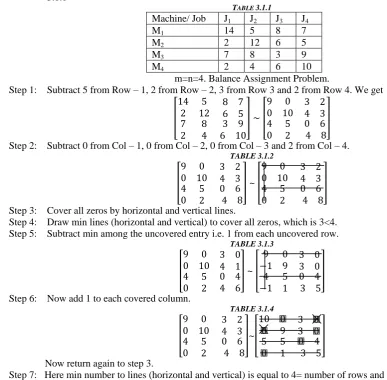
Ex 3.1 A Company has four machines and four jobs to be completed. Each machine must be assigned to complete of one job. The requirement to setup each machine for completing each job is shown in Table 3.1.1 –
TABLE 3.1.1
Machine/ Job J1 J2 J3 J4
M1 14 5 8 7
M2 2 12 6 5
M3 7 8 3 9
M4 2 4 6 10
m=n=4. Balance Assignment Problem.
Step 1: Subtract 5 from Row – 1, 2 from Row – 2, 3 from Row 3 and 2 from Row 4. We get
14 5 8 7
2 12 6 5
7 2 8 4 3 9 6 10 ~
9 0 3 2
0 10 4 3
4 0 5 2 0 6 4 8
Step 2: Subtract 0 from Col – 1, 0 from Col – 2, 0 from Col – 3 and 2 from Col – 4.
TABLE 3.1.2
9 0 3 2
0 10 4 3
4 0 5 2 0 6 4 8 ~
9 0 3 2
0 10 4 3
4 0 5 2 0 6 4 8
Step 3: Cover all zeros by horizontal and vertical lines.
Step 4: Draw min lines (horizontal and vertical) to cover all zeros, which is 3<4. Step 5: Subtract min among the uncovered entry i.e. 1 from each uncovered row.
TABLE 3.1.3
9 0 3 0
0 10 4 1 4 0 5 2 0 4 4 6 ~
9 0 3 0
−1 9 3 0
4 −1 5 1 0 4 3 5
Step 6: Now add 1 to each covered column.
TABLE 3.1.4
9 0 3 2
0 10 4 3
4 0 5 2 0 6 4 8 ~
10 0 3 0
0 9 3 0
5 0 5 1 0 4 3 5
Now return again to step 3.
Step 7: Here min number to lines (horizontal and vertical) is equal to 4= number of rows and columns =4
TABLE3.1.5
Process Job (i) M1 J2
(ii) M2 J4
(iii) M3 J3
(iv) M4 J1
Ex 3.2 Consider the following cost matrix of assignment problem.
TABLE 3.2.1
Machine/ Job J1 J2 J3 J4
M1 5 3 6 8
M2 7 4 9 10
M3 3 4 7 6
M4 9 2 11 7
Find its optimal solution?
Here a number of rows are equal to number of columns, Hence this is Balance assignment problem.
TABLE 3.2.2
5 3 6 8
7 4 9 10 3 9 4 2 7 6 11 7 ~
2 0 3 5
3 0 5 6
0 7 1 0 4 3 9 5
Step 2: Now subtract min 0 from Col – 1, Min 0 from Col – 2, min 3 from Col – 3, Min 3 from Col – 4.
TABLE 3.2.3
2 0 3 5
3 0 5 6
0 7 1 0 4 3 9 5 ~
2 0 0 2
3 0 2 3
0 7 1 0 1 0 6 2
Step 3: Cover all zeros by minimum horizontal or vertical lines. Step 4: Here all number of lines 3<4.
2 0 0 2
3 0 2 3
0 7 1 0 1 0 6 2
Step 5: Subtract min – 2 which is minimum among uncovered entries from uncovered row.
TABLE 3.2.5
2 0 0 2
3 0 2 3
0 7 1 0 1 0 6 2 ~
2 0 0 2
1 −2 1 1 0 5 1 7 1 0 4 0
Step 6: Now add 2 to each covered column
TABLE 3.2.6
2 0 0 2
1 −2 0 1 0 5 1 7 1 0 4 0 ~
2 2 0 2
1 0 0 1
0 5 3 9 1 0 4 0
Now return again to step 3. Min numbers of lines horizontal and vertical are 4 equal to number of rows and columns. Process ends.
TABLE 3.2.7
Process Job
(i) M1 J3
(ii) M2 J2
(iii) M3 J1
(iv) M4 J4
Optimal solution is: 6 + 4 + 3 + 7 = 20
IV. SOLUTION OF ASSIGNMENT PROBLEM USING GENETIC ALGORITHM
(1) The string is defined as ij|c where i and j row and column, and c is cost. (2) Write ij|c in bit string, a list of 1’s and 0’s.
(3) The selection of individual’s genotype is allowed two off springs and the smallest value of …. is not fit, put this right adjacent to highest value.
(4) Put the remaining genotypes to right and left according to value of cost in decreasing order.
(5) Three genetic operators are applied to produce the next generation solution (chromosome). These operators are selection/ reproduction, cross over and mutation.
After reproduction, crossover and mutate the new individual by a small number of bits, arrows with dotted line indicate mutation and arrows with smooth lines indicate copying. We have generation n+1. Choose highest value of bits to make the circle ij|c in the cost matrix and draw the vertical line of jth column of matrix. If there are two same highest values, consider the lower cost.
(6) Again take the genotype for next generation of second row except ij of above return to step 5.
(7) Put the remaining genotypes of third and fourth row for reproduction, after completion of all steps, choose the highest value of bits to make the circle ij|c cost and draw vertical line of jth column. Now take value of cost of remaining row.
V. TAKE EXAMPLE 3.1:
Consider the following cost matrix of Assignment problem.
14 6 8 7
Row – 1
15 is maximum. Make a circle 12|6 and draw a vertical line j=2
14 6 8 7
3 12 7 6
7 3
8 5
4 9 7 10
Row – 2 Take second row for generation except 22|12.
15 is maximum. Make a circle 24|6 and draw a vertical line j = 4
14 6 8 7
3 12 7 6
7 3
8 5
4 9 7 10
Take the third and 4th row for generation except 32|8, 34|9, 12|5, 44|10. Row 3 and 4.
15 is the max. Make a circle 33|4, draw a vertical line j=3
14 6 8 7
3 12 7 6
7 3
8 5
Now take remaining value of 4th row, 3, i.e., 41|3. Make a circle. Optimal solution is 6 + 6 + 4 + 3 = 19
Which is also can be solved by Hungarian method as Ex 3.1 and 3.2.
VI. SUMMARY AND CONCLUSION
From the general description of the use of Genetic Algorithm in the Assignment Problem and the problems solved, a little efforts show that these problems yield the same results with the use of Hungarian method. It is evident that Genetic algorithm is shorter and more efficient than Hungarian method. The Hungarian method requires in general, a succession of steps to take care of zeros, whereas Genetic Algorithm uses the Genetic operations only thrice in 4 order cost matrix. Compare to Genetic Algorithm method, the Hungarian method, when applied to the Assignment Problem is some thing a long haul.
REFERENCES
[1] Fredric S. Hillier, “Introduction to Mathematical Programming.”, Stanford Univ. Mac Graw-hill Inc. (1995). [2] Goldbery D. E., “Optimization and Machine Learning.”, Genetic Algorithm in Search (1989).
[3] Addison – Wesley, Mitchell, “An Introduction to Genetic Algorithm.” Press (1996). [4] Patricia D. Novac, “Dorland’s Pocket Medical Dictionary.” W. B. Saunders Company.
[5] Thomas Dean. James Allen, “Artificial Intelligence Theory and Practice.” The Benjamin/ Cumming Publishing Company Inc. Redwood City, California 94665 (1965)