ISSN: 2231-5373
http://www.ijmttjournal.org
Page 36Multi-Agent Coalition Formation for Course Selection
Strategies in E-Learning System
Swati Basak#1, Bireshwar Dass Mazumdar*2
#
Dept. of Computer Science, SITM, Lucknow, U.P., India *
Dept. of Computer Science, SMS, Varanasi, U.P., India
Abstract - Multi Agent Systems are being used in a wide variety of applications, ranging from comparatively small systems for personal
assistance, to open, complex, systems for industrial applications. In e-learning, Multi Agent Systems appear to be a promising approach to deal with the challenges in educational environments. They can provide new patterns of learning and applications, such as personal assistants, user guides and alternative help systems, which are helpful for both students and teachers. In this work, we presented a multi-agent system based for this e-learning scenario based on course selection theory. We have described here coalition formation among the student agents who are going to select the courses which will be running in the university. We first introduced a novel voting procedure where agents make coalition among them & allocate points to different courses and voting occurs for subject/course in several rounds. This way the agents are able to freely express their preferences and at the same time use the information provided from previous rounds to vote intelligently and strategically. We then introduced different voting strategies for subject/course selection in the university by coalition, and evaluated their performance in a range of scenarios. The results show that even a simple voting strategy provides outcomes which are close to optimal. Furthermore, our intelligent strategy was unable to exploit other, more native voters.
Keywords - Multi-Agent System (MAS), Coalition Formation, Course Selection, E-Learning.
I. INTRODUCTION
Multi Agent Systems are being used in a wide variety of applications, ranging from comparatively small systems for personal assistance, to open, complex, systems for industrial applications. In e-learning, Multi Agent Systems appear to be a promising approach to deal with the challenges in educational environments. They can provide new patterns of learning and applications, such as personal assistants, user guides and alternative help systems, which are helpful for both students and teachers [1]. It has been argued that using Multi Agent Systems to design educational systems can lead to more versatile, faster and lower cost systems [2]. Agent technologies could allow us to take this personalization to new levels. In particular, consider an online university that has an open enrolment for adult learners to work towards a qualification (or a given set of skills needed for a particular job). Adults seek courses to match their own requirements, but the university can only run courses that have sufficiently high interest. An agent framework enables the students and university to negotiate which courses students select, and therefore which courses will run.
ISSN: 2231-5373
http://www.ijmttjournal.org
Page 37introduce a number of different voting strategies that student agents could use, and examine the resulting student satisfaction (which measures how well the courses that are running match the preferences of an individual student). Through a simulation of coalition method, we evaluate our Multi Agent System and the proposed strategies. The objective is to investigate whether voting procedures in particular and multi-agent technology in general could potentially replace a centralized infrastructure (where the selection of courses is determined directly by the university), and to explore the impact of agents using different strategies.
This paper is organized as follows. Next section discusses the background of e-learning and coalition formation in agent based system, the architecture of e-learning process by using coalition method & voting procedure for course selection in the university; all are described in the section two. The problem description, of our work is explained in section three. The experimental setup & implementation, results and observation of the work for modeling coalition formation in MAS in e-learning have been presented in section four. The discussion of our work is shown in section five and finally conclusion of this work is described in section six.
II. THE MULTI AGENT SYSTEM IN E-LEARNING PROCESS BY COALITION FORMATION
Voting theory in e-learning is part of the general area known as social choice, which is concerned with
procedures for making collective decisions that maximize the social choices (the sum of choices of courses of
individual agents), while at the same recognizing that agents are self interested and act in a way that maximizes their own individual preferences. Likewise, in our e-learning scenario, the university would like to choose the best overall set of courses, while each student would like their most preferred courses to be selected by using the coalition method.
A. Coalition Formation for E-Learning
Social choice theory is an active area of research in Multi Agent Systems that enable decisions in a decentralized way. The designer of a voting system is concerned with analyzing and designing the mechanisms that are used for collective decision making. In the last two decades this field has increasingly been the area of investigation by computer scientists, and especially researchers in Multi Agent Systems [3]. This is because agents are inherently autonomous, and may have different and conflicting goals. At the same time, each agent would like to maximize its own utility. In such a setting voting systems provide an appropriate solution to reach a socially desirable decision, while taking into account individual preferences [2]. A voting system applies a set of rules that govern how votes are cast in an election, how they are aggregated, and how winners are determined. In the simplest system, each voter has one vote and the single candidate who receives the most votes, irrespective of the percentage of these votes among the total number of votes cast, is declared the winner. The winner determination process then proceeds in several rounds. In each round, all votes for the most preferred candidate are counted, and the candidate who has received the least number of votes is eliminated. Then, anyone who has voted for the eliminated candidate as their first
preference now has their second preference allocated as their first preference. The process then repeats until
ISSN: 2231-5373
http://www.ijmttjournal.org
Page 38Intelligence. Coalition is a key process in many Multi Agent Systems. Coalition formation, viewed as a general principle in social systems of e-learning [5], is an important cooperation method and has received a lot of attention. In many Multi Agent Systems self-interested agents can operate more effectively by forming coalitions and coordinating their activities within each coalition in e-learning.
B. Architecture of Course Selection Model
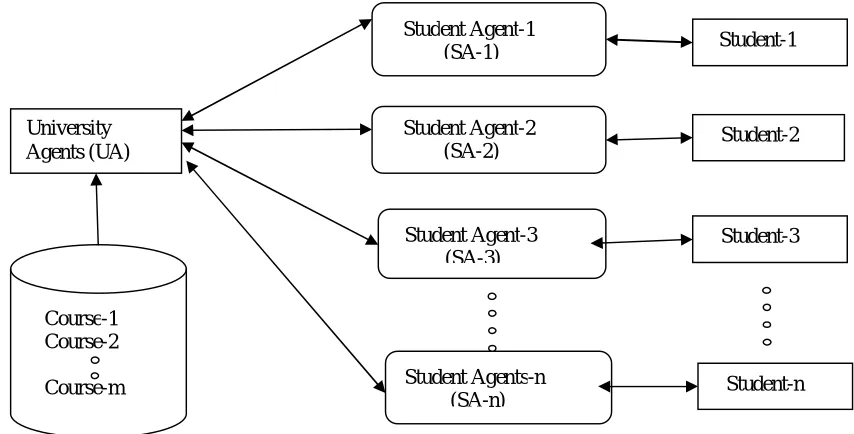
The entities and objects in e-leaning model forms coalition that exist in the system are shown in Fig. 1. Each agent is autonomous, that is, it is in control of its own actions and responses. The system consists of two types of agents: student agents (SAs) and the university agent (UA). First the student expresses his or her preferences to the student agent, and also chooses an appropriate voting strategy. Then the SAs and the UA use a voting procedure to interact with each other and to choose which courses or subjects to run. To this end, the UA manages the votes cast by the student agents and decides, based on the voting procedure and the votes received, which courses will be cancelled. Furthermore, after completing the entire process, UA will provide the final list of running courses or subjects to SAs and SAs will send the course/subject list to the individual student’s agents which make the coalition group for e-learning process.
C. Voting Procedure for Course / Subjects Selection
In general, a protocol is the set of rules that controls the interactions between agents and determines the beginning and end conditions of a given conversation in coalition formation [6]. In our system, the protocol works in several stages. In each stage, the student agents cast their votes for the courses by allocating weights to each course. The course that receives the lowest number of weights is cancelled. In the next round, the student agents can use these points to vote again. Furthermore, in each round, the students are informed about which course is cancelled and the total number of points that have been allocated to the remaining courses so far [7]. Note that, once allocated, a student cannot retrieve its points, unless the course is cancelled. The
Fig. 1 Architecture of Course Selection Model University
Agents (UA)
Student Agent-1 (SA-1)
Student Agent-2 (SA-2)
Student Agent-3 (SA-3)
Student Agents-n (SA-n)
Student-1
Student-2
Student-3
Student-n Course-1
Course-2
ISSN: 2231-5373
http://www.ijmttjournal.org
Page 39advantage of this iterative approach is that votes are not wasted since weights allocated to the cancelled course can be reused for the remaining courses. In more detail, the protocol proceeds as follows:
1. Each student have weight factor/some weights value as decide the threshold, from the UA that student
can use to cast their votes.
2. Each student allocates their available weights of threshold values to the available courses/subjects.
3. Same preference of subject/course choices of students make the link among them by using
coordination and coalition strategies and different choices of students put isolated.
4. The UA calculates the weightage values of threshold for each course.
5. The UA cancels the course with the lowest weights of threshold values.
6. The UA informs all the SAs about the cancelled & remaining courses.
7. The UA send the list of selected courses which have highest priority of weights in subjects/courses and
SAs send that final list of courses to the students.
8. The above procedure is repeated until the final subject/course will be selected for running in the university.
III. PROBLEM DESCRIPTION
ISSN: 2231-5373
http://www.ijmttjournal.org
Page 40IV. EXPERIMENTAL WORK AND IMPLEMENTATION
We use the Netlogo [10] programming language for simulating the models. Netlogo is particularly well suited for agent modeling complex systems developing over time.
A. Experimental Setup
On a 32 x 32 torus we have placed agents randomly. Up to 1000 ticks the student’s agents are provided with the opportunity to find other agents of similar course selection traits and establish links with them who have same choice of course selection. After this we sample the different coalitions formed among student’s agents. The model is run for 1500 ticks and results taken by varying the weighted threshold values distribution strategies of equal and proportionate distribution (Fig. 3 – Fig. 7) & changing the preference of student’s agents toward behavioral and social parameters for course selection in e-learning.
Snapshots of the NetLogo implementation of the agent’s coalition formation on a 32 X 32 grid, with 63 student’s agents for course selection in e-learning (Fig. 2):
Fig. 2 Snapshot of the initial random placement of agents in the environment at tick 0
3 (a) 3 (b)
ISSN: 2231-5373
http://www.ijmttjournal.org
Page 41
Fig. 4 Plot for total uncomfortable agents Fig. 5 Plot for average coalition size
Fig. 6 Plot showing number of single agent Fig. 7 Plot for number of groups of different sizes
B. Results
The model is run for 1500 ticks and total numbers of agents are 63. The results obtained after several runs of simulation for different weight distribution on agent’s selection for the models are shown below in table:
TABLE I DIFFERENT WEIGHTAGE DISTRIBUTION SCHEMES AND STRATEGIES FOR THRESHOLD VALUES AND THE NUMBER OF UNCOMFORTABLE AGENTS IN RESULTED
Number of uncomfortable agents in case of proportionate weight distribution scheme for threshold values
Number of uncomfortable agents in case of equal weight distribution scheme for threshold values
6 12
2 11
5 7
11 11
7 4
2 5
1 6
5 5
12 5
13 4
3 19
11 13
1 10
6 24
10 11
3 26
1 8
2 3
7 5
7 6
6 13
ISSN: 2231-5373
http://www.ijmttjournal.org
Page 420 5 10 15 20 25 30
1 3 5 7 9 11 13 15 17 19 21 23 25 27 29 31 33 35 37 39 41 43 45 47 49
proportionate payoff distribution scheme
equal payoff distribution scheme
Fig. 8 Graph showing the number of uncomfortable agents resulted in case of different weightage strategies. Y-axis represents the number of uncomfortable agents & x-axis represents the number of runs.
After taking several runs of the model and plotting the corresponding graph (Fig. 8), it appeared that weightage distribution strategies do play role in determining the comfort level of the agents. It can be observed that proportionate scheme of distributing of weights for course selection resulted in lesser uncomfortable agents than in case of equal weight distribution for courses scheme. Also, since the agent population is highly heterogeneous, results can only be observed after several runs. In our model, we have also incorporated the role of identical similarity apart from closeness in monetary assets. The results obtained after many runs show that agents searching partners of social similarity rather than partners with behavioural similarity values are more comfortable in their present coalition.
V. DISCUSSION
The self-organizing capability seen in the model is closely congruent to the emergent phenomena. We deduced that the emergent coalition structures depend on factors like student’s agent types, the perceived coalition group and the behavioral and social parameters voting distribution strategies. We observed that the comfort level of agents in their group is better if their weighted threshold is distributed in proportionate manner not in random manner. Our real world application of coalition formation suggests that agents grouped together on the basis of behavioral and social parameters similarity to choose the course in e-learning process by coalition method.
VI. CONCLUSION
In this work, we presented a multi-agent system based for this e-learning scenario based on course selection theory. We have described here coalition formation among the student agents who are going to select the courses which will be running in the university. We first introduced a novel voting procedure where agents make coalition among them & allocate points to different courses and voting occurs for subject/course in several rounds. This way the agents are able to freely express their preferences and at the same time use the information provided from previous rounds to vote intelligently and strategically. We then introduced different voting strategies for subject/course selection in the university by coalition, and evaluated their performance in a range of scenarios. The results show that even a simple voting strategy provides outcomes which are close to optimal. Furthermore, our intelligent strategy was unable to exploit other, more native voters.
ISSN: 2231-5373
http://www.ijmttjournal.org
Page 43REFERENCES
[1] P. Kommers and L. Aroyo, “Special issue preface - intelligent agents for educational computer-aided systems”, Journal of Interactive Learning Research, Vol. 10, pp. 235-242, 1999.
[2] M. Wooldridge and N.R. Jennings, “Intelligent agents: theory and practise”, Journal ofKnowledge Engineering Review, Vol. 10, Issue 2, pp. 115-152, 1995.
[3] A.D. Procaccia, Computational Voting Theory: Of the Agents, By the Agents, For the Agents, PhD thesis, TheHebrew University of Jerusalem, 2008.
[4] V. Conitzer, M. Rognlie, and L. Xia, “Preference functions that score rankings and maximum likelihood estimation”, Proceedings of the 21st International Joint Conference on Artificial Intelligence, pp. 109-115, 2009.
[5] M. Ali, H. Enrico, and E.M. David, “A voting-based agent system for course selection in e-learning”, International Conference on Web Intelligence and Intelligent Agent Technology, 2010.
[6] M. Beer, M. Inverno, M. Luck, N.R. Jennings, C. Preist, and M. Schroeder, “Negotiation in multi-agent systems, knowledge engineering review”, International Journal of Computer Science and Technology (IJCST), Vol.14, Issue 4, pp. 285-289, 1998.
[7] D.A. Hensher, J.M. Rose, and W.H. Greene, Applied Choice Analysis : A Primer, Cambridge, Cambridge University Press, 2005.
[8] K. Lerman and O. Shehory, “Coalition formation for large-scale electronic markets”, Proceedings of the Fourth International Conference on Multi Agent Systems (ICMAS), pp. 216–222, 2000.
[9] M. Van de Vijsel and J. Anderson, “Coalition formation in multi-agent systems under real world conditions”, Proceedings of the International Conference on AAAI, Workshop on Forming and Maintaining Coalitions and Teams in Adaptive Multi Agent Systems, San Jose, July 2004.
[10] U. Wilensky. (1999) homepage on NetLogo. [Online]. Available: http://ccl.northwestern.edu/netlogo, Centre for Connected Learning and Computer-Based Modeling, Nothwestern Univeristy.
[11] P. Liviu and L. Sean. The Cooperative Multi-Agent Learning: State of the Art, MIT Press.