6706 AN OVERVIEW ON CORRECTIVE AND PREVENTIVE ACTION, ROOT CAUSE
ANALYSIS AND ITS EFFECTIVE IMPLEMENTATION
Syed Shakeeb Ahmed, Gowrav M.P*, Gangadharappa H.V.
Pharmaceutical Quality Assurance Group, Department of Pharmaceutics, JSS College of Pharmacy, JSS Academy of Higher Education & Research, Sri Shivarathreeshwara Nagara,
Mysuru-570015, Karnataka, India.
*Corresponding author E-mail: [email protected]
ARTICLE INFO ABSTRACT
Key Words
Corrective action, Preventive action, Out of
specification, Quality Management system,
non-conformities, Root causes analysis.
The purpose of the corrective and preventive action (CAPA) in pharmaceutical industry is to identify the non-conformities, deviations or failures in the pharmaceutical industry. CAPA is the system which offers a mechanism for obtaining critical quality data to enable out of specifications (OOS). CAPA is also the method in which preventive measures are taken before deviations occur so that the occurrence of any non-conformity can be prevented. This study presents an overview on Root cause analysis and implementation the CAPA system in case of OOS results. CAPA helps primarily to determine and investigate the root cause of the problem or issue, which are identified, documented and the planned deviations will also be identified and will be recorded. By implementing an effective CAPA it ensures that the product quality can be improved and regulatory requirements are met. CAPA is a part of overall Quality management system (QMS) in the pharmaceutical industry. To reduce the losses incurred from non-compliance, the only way out is to investigate and prevent a recurrence of their cause. Analysis of root cause is used to address
non-compliance issues and causes of the particular issue.
INTRODUCTION
Corrective and preventive actions (CAPA) are basic quality management system which must be used in the management of the quality in the product and service. CAPA are the important tools which are manufacturing pharmaceutical products. This management tools provide the step by step process for avoiding or minimizing the non-conformities in the system. The results will be completely and properly documented according to the regulatory requirements and compliance (1). It is a process which ensures that products which are produced in the pharmaceutical industry are safe and
effective. CAPA which continuously improves the quality of the system or products and which is the essential part of quality management system and it should meet the regulatory requirements which are specified by the regulatory agencies, ISO and other quality system.
Correction: It is an immediate action taken by team to eliminate the detected non-conformities or undesirable situation.
Corrective action: Corrective action is a reaction or remedial action to the undesirable action or non-conformities which were exist. It assumes that the
Journal of Global Trends in Pharmaceutical Sciences
6707 undesirable situation or non-conformities
which were exist and which has been reported by the concerned department either by internal or external source to the particular department (2). Following steps which are included in the corrective action:
Documentation of the problem
Analysing the problem
Correction of the situation or non-conformities
Recognition of the situation Installing of proper control system correction of the situation
Prevention action: It is an action or proactive approach for avoiding something from happening, which may affect the process or the system. It is the action which will be taken before occurring or existing the non-conformities (2). The preventive action process includes as follows,
Identification of the
non-conformance
Analysing the cause of the non-conformance
Development of the method or plan
to prevent the non-conformities Implement the process or plan Review the action
Importance of CAPA:
To assess the CAPA processes that
address the criteria identified and recorded in the quality system
regulations which have been
defined and documented
To recognize current product and quality issues requiring corrective action
To identify potential product and quality problems which requires preventive action
To determine whether CAPA are
effective
To confirm the corrective and
preventive action do not cause
adverse effects to the finished product or medical device
Helps to detect recurring quality problems and analytical findings
are contrasted with other
information sources
Quality management system in CAPA:
Quality Management System (QMS) is the management process compilation that describes the process, management duties, organisational structure, processes and specifications required to fulfill the service
or product development, customer
satisfaction. It is a business process which is used to control and direct an organization for the product quality. Under the 21CFR-820 regulatory requirements the CAPA are established by the FDA to maintain the uniformity in the product development and the service, which are dispensing to the customer. The QMS is referred as quality system regulation under
21CR-820 part (3). This guideline
provides, how to evaluate the
non-conformance and issues which are
occurred or occurring during the process.
Quality system inspection technique
(QSIT) are the published guidelines or procedures by the FDA which are used by the inspectors to evaluate the safety and quality of the product. QSIT mainly focuses on the four key subsystems which are design control, organization control, CAPA and production control and process control. Most of the pharmaceutical industries are recognized how to nurture the quality system to its effectiveness.
CAPA Procedures: By implementing an effective or essential corrective action (CA) or preventive action (PA) which ensure that improvement of the product quality and satisfies the QA and RA documentation requirements (2). The basic steps involved in the CAPA procedures are as follows:
6708 issue, it must include the cause source and
accurate cause explanation, it must provide the cause or problem evidence. It is important to completely and accurately describe the situation or condition as it exists.
Examination of cause: Examination of the cause is the important step, in this step detailed study of the cause and the source of the cause will be identified and examined and the reason for the cause will be inspected. The written procedures must be followed to carry out an investigation to detect problems. Written procedure to ensure that the enquiry is complete and that the procedure should include the action's goal.
Evaluation of cause: The evaluation step which includes the situation that has been
described and documented in the
identification of the cause and should evaluated to determine the problem which exists. The impact of the cause and the risks to the organization and/or customer must be determined. The reason must be
documented which involves in the
concerned problem.
Analysis of cause: The primary objective of the study is to identify and investigate the root cause of the problem or issue that is recognized and recorded. The planned deviations will also be identified and will be recorded. It is important to differentiate between the observed symptoms of a cause and the root cause of the problem. The investigation procedure which are created and which will be used to investigate the cause of the problem (4).
Action plan or Implementation of CAPA
By using the results from the analysis of the root cause the suitable method for correcting the problem or situation is determined and action plan will be
developed. The action plan should
conclude in the products to be finished,
process changes, procedural or system
modifications, document needed
modifications and personnel training and any necessary measures or controls to avoid the cause or condition of the issue. The action plan should also recognize the process participant and the individual responsible for completing the assignment.
Follow up: It is one of the most fundamental step involved in the process of CAPA evaluation of the action that were taken. some of the key questions must be answered in this section which are,
Have all the objectives met the CAPA process, did the action corrects or prevents the problem or situation
Have all the changes been verified and completed and implemented Has appropriate training has been
given to the employees or
implemented to assure the
understanding the situation and the CAPA Procedure as follows in Fig1
Fig 1: CAPA Procedures
6709 pharmaceutical products. OOS results
includes all the test results which do not meet the specification or acceptance criteria (5). In case of USFDA regulated
pharmaceutical, medical device and
biotechnology product industries, must meet the certain regulatory requirements to implement the CAPA system. Under quality system regulation i.e. 21 CFR part 820, manufacturer of medical devices are required to establish the CAPA procedures which helps to investigate the non-conformities (10). The common way of handling of OOS is by deciding the material or product issues. However, manufacturers must not only decide on the OOS outcomes after the product has been placed on the market, but also avoid the recurrence of similar non-conformities in the future. In this regard, the non-conformance process closely linked with the CAPA.
Out of specification investigation:
According to the FDA regulations an investigation must be conducted when the test results are OOS. The purpose of the investigation of OOS is to determine the cause or source for existing non-conformities in the process or system. The investigation of the OOS includes the
Phase 1 (primary and laboratory
investigation) and Phase 2 (manufacturing
investigation and resampling and
reanalysis of the sample) (5). The investigation of OOS plan must include the following:
Description of non-conformance
Scope of investigation Qualified investigation team Responsibilities of the personnel
involved in the investigation
Resources of OOS
Tools and method of investigation
CAPA Management system: Upon rising the complaint, OOS and deviation reports about the process/system, review of the issue occurred will be verified by the
concerned department. concerned
department will gather the data or source of non-conformities which have happened in the process. once the source is identified correction will be made for the non-conformities which have occurred during the process and if, CAPA required to avoid the non-conformities, SOP of CAPA must be followed and then investigates the root cause analysis. Issues must be notified to the respective person and CAPA form will be issued by the QA head upon rising the issues by the concerned department head. The concerned department will implement the CAPA under the supervision of QA head. After the implementation of CAPA,
conduct review process of the
implemented CAPA. Once the
implemented CAPA, meets the
specification authorization will be done by the QA head and all the management of CAPA documents will be kept with the respective department head (6) and process as mentioned in Fig 2.
CAPA relationship with quality subsystem: The quality subsystem is the establishment for the other five assembling subsystems which helps to meet the consistent level, each of the quality subsystem work together to efficiently create quality product. CAPA system is an
important component of QMS and it must be maintained in good and effective relationship with all the quality subsystems as in the Fig 3. The goal of the organization or industry to have effective, compliant and efficient CAPA system. These quality subsystems and CAPA which helps to identify the existing potential problems of products in which the internal data source includes: Test data, Process control data, Calibration and
validation of equipment, Equipment
6710 Fig 2: CAPA Management System
6711 The procedures and methods must be
received and changed to incorporate the effective CAPA, personnel or employee responsible in QA must be provided with the information regarding the problems and change control systems as in the Fig 4 (8).
Fig 4: CAPA relationship with quality subsystem
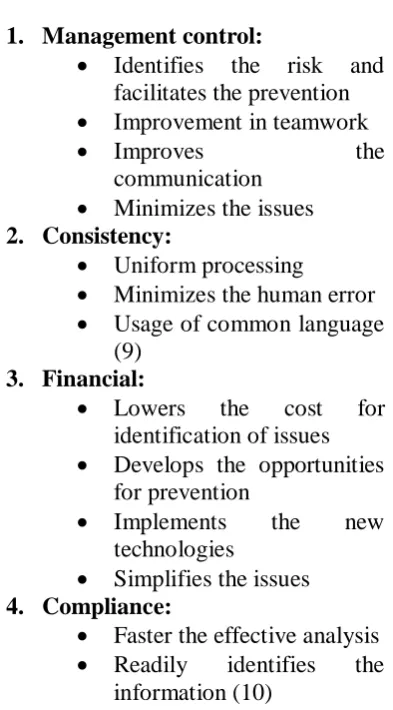
Benefits of CAPA:
1. Management control:
Identifies the risk and
facilitates the prevention
Improvement in teamwork
Improves the
communication Minimizes the issues 2. Consistency:
Uniform processing
Minimizes the human error
Usage of common language
(9) 3. Financial:
Lowers the cost for
identification of issues Develops the opportunities
for prevention
Implements the new
technologies
Simplifies the issues 4. Compliance:
Faster the effective analysis
Readily identifies the
information (10)
Documentation of CAPA: The initiation of CAPA needs that the department concern to submit the source of documents to the head of the department of QA (11).
QA head will review the document
submitted by the concerned
department.
QA head will decide the need for CAPA.
The department head will receive the CAPA form which is issued by the QA head and shall fill all the required information, which should include source of issue, date of issue happened and other related information.
Department head shall send the CAPA form to the QA head and QA head will review the CAPA form and assigns the CAPA number and then the CAPA form will be forwarded to the concerned department (12).
Authorization are must be done by the QA head for proposed CAPA implementation actions.
With the review of the supporting document, the QA head verifies the implementation and completion of CAPA.
The change control procedure, SOP
and records of each CAPA must be retained if any modifications are made.
QA shall receive copies of the CAPA introduced, and QA shall compile all the records (13).
6712 avoids repetition of non-conformities;
prevention of reoccurrences and it
provides permanent solution for
occurrence of the problem. In some organizations it is a part of the policy which minimizes the error and the goal for facilitating improvement of the system for a longer period. The root cause analysis depends on the set of minds and requires a long time at the beginning, but is a high return investment to prevent completely non-conformities. Analysis of root cause is a approach comprising a sequence of events of well-known new applications, tools and methods that can really generate and provide a productive, systematic, documented and quantified technique for finding and understanding underlying causes. The basic concept of assessing the root cause is to use symptoms as a way to find the origin of a cause. Treating the symptoms can minimize or even aggravate the problem identified. RCA's primary objective is to determine the real or actual root cause of an observed deficiency, failure, or problem, cause and use that information to rectify it. Since the root cause must be supported by proof, it is systematic and coherent to determine the root cause. Probable root cause(s) can be identified for a specified scenario. Root cause analysis is a technique created to identify the issues, not only how an incident happened or what that event is, but also why it led to the event occurring. Once the root cause is identified, the investigators will be able to specify appropriate corrective measures to prevent similar events from occurring in the future. The advantage of an efficient RCA is that the root causes recognized over time can be used to detect major possibilities for improvement and process steps as given in Fig 5 (14).
RCA Process and its Implementation:
1. Collection of Data
The initial step of RCA is to collection of the data related to
problem or event related
information occurred. Without
proper understanding and complete information about the problem or event, the root causes and casual factors related to the event or problem cannot be identified, since
the collection of data plays
important role in the collection of data.
2. Causal factor charting
The causal factor test is a logic test that explains the occurrence, events and the conditions that surround these events. Casual factor charting
facilitates the investigator
framework for examining,
arranging and analysing data
gathered during the investigation. It
helps understand knowledge
deficiencies and gaps as the research progresses Once the entire event has been mapped, the
researchers identify the main
contributors to the event, called causal factors. Causal variables,
such as human errors and
component failures, would have either decreased their seriousness or avoided the event, if the casual
variables would either have
reduced the occurrence or
prevented the event (15).
3. Identification of Root cause
Identification of the Root cause involves the identification of the sources for the non-conformities after all the casual factors were recognized. In this step, by using the decision diagram, the reasons for each causal factor or variables are recognized. With the help of decision diagram the reasoning
method of researchers are
6713 why the specific causal factors
occur or exist.
4. Decision to create and implement RCA
The last step is the generation of decision. Realizable suggestions or decisions that prevent recurrence and are produced for a specific casual factor after root causes have been identified. Organizations must
ensure that suggestions are
followed up to completion. Once the decisions are made by the organization the implement the RCA.
CONCLUSION:
From the above study, the
corrective action and preventive actions are important tools for improving the quality management system and its efficiency. In Quality Risk Management System, it plays a significant role for producing the quality product. By applying CAPA, the root cause assessment of any issue or deviation can be accomplished readily and easily. The root cause analysis and CAPA which increases the safety and quality of the product.The pharmaceutical, healthcare and medical devices sectors should adhere strictly to the application of CAPA in their organization upon the identification of non-conformance.
Acknowledgement: I thank JSS College of Pharmacy, JSS Academy of Higher Education & Research, Mysuru. For providing me opportunity to carry out my review work.
REFERENCES:
1. Kumar KB, Kumar TM. Corrective
and preventive action a route cause analysis in manufacturing quality system: review. Innovare Journal of Sciences. 2016; 4(2): 1-4
2. Tashi T, Mbuya VB,
Gangadharappa HV. Corrective action and preventive actions and
its importance in quality
management system: a review.
International Journal of
Pharmaceutical Quality Assurance. 2016 Jan 1; 7(1): 1-6
3. CFR - Code of Federal Regulations Title 21 [Internet].
Accessdata.fda.gov. 2019 [cited 11 March 2019]. Available from: https://www.accessdata.fda.gov/scr ipts/cdrh/cfdocs/cfCFR/CFRSearch .cfm
4. R.M Baldwin, Inc. Preventive /
Corrective Actions (CAPA)
Guidelines
5. Chopra V, Shukla AK, Aiyyer R, Trivedi P, Nagar M. Investigating Out-of-Specification Results and Development CAPA Program for
Pharmaceutical Industries: An
Overview. Scholars Research
Library. 2011, 3(2): 368-382 6. Raj A. A review on corrective
action and preventive action
(CAPA). African Journal of
Pharmacy and Pharmacology. 2016 Jan 8;10(1):1-6.
7. Motschman TL, Moore SB.
Corrective and preventive action. Transfusion science. 1999 Oct 1;21(2):163-78.
8. Alto P B. Corrective and
Preventive Actions: The
Cornerstone of Effective Quality and Compliance Management in Healthcare. 2010. 1-9
9. Sharonina TN. Corrective and
preventive actions in quality
management system. Issues of Modern science and practice 2010, 9(30): 7-30
10. Code of Federal Regulations CFR
(2015). Title 21, Part 820,
www.accessdata.fda.gov
11. Corrective Action Preventive
Action (2015). Defining
alternatives to training as a root cause, www.mnasq.org
6714 FDA Inspection Under the QSIT,
Corrective and Preventive Actions
Subsystem. Suite, Washington,
DC: 2001. PP 4-24.
13. Rodriguez PJ. CAPA for the FDA Regulated Industry. Milwaukee, Wisconsin: ASQ Quality Press. 2005. 1-25.
14. Peerally MF, Carr S, Waring J. The problem with root cause analysis. BMJ Quality and Safety first. 2016 June; 1-6.
15. Menon N, Kamath KK, Shabaraya
A.R. Conducting root cause