Available Online at www.ijpret.com 191
INTERNATIONAL JOURNAL OF PURE AND
APPLIED RESEARCH IN ENGINEERING AND
TECHNOLOGY
A PATH FOR HORIZING YOUR INNOVATIVE WORK
DESIGN OF A LOW-POWER EFFICIENT DOUBLE EDGE TRIGGER FLIP FLOP
R SIVA KUMAR1, T SRINIVASA PADMAJA2
1. M. Tech Student, Embedded systems, Department of ECE, Siddhartha Institute of Engineering & Technology, A.P., India, 2. Assistant Professor, Department of ECE, Siddhartha Institute of Engineering & Technology, A.P., India,
Accepted Date: 24/07/2015; Published Date: 01/08/2015
\
Abstract: - The data signal changes in Double-edge triggered Flip-Flops on both the rising and
falling clock edges. Thus, results in low clock swing and it leads to lower power consumption and the data throughout are preserved. The leakage current has become a most dominant problem in VLSI system design, because it leads to more power consumption. Some of the methods have been presented in this paper to control the leakage current. The proposed design successfully solves the long discharging path problem in conventional explicit type pulse-triggered FF (P-FF) designs and achieves better speed and power performance. Also, DDFF and P-FF are compared with other state-of-the-art designs and DD-FF design is implemented in a 4-b ring counter. The performance improvements indicate that the proposed designs are well suited for modern high-performance designs where power dissipation and latching overhead are of major concern. The proposed circuit is simulated using Tanner EDA tool. The simulations are carried out by applying T-SPICE software. The number of clock transistors decrease which in turn results in lower leakage current, hence the power consumption reduces.
Keywords:P-FF, DDFF, Ring Counter
Corresponding Author: MR. R. SIVA KUMAR
Access Online On:
www.ijpret.com
How to Cite This Article:
R. Siva Kumar, IJPRET, 2015; Volume 3 (12): 191-199
Available Online at www.ijpret.com 192
INTRODUCTION
Most of the Flip-flops (FFs) are the memory storage elements extensively used in many digital designs. In particular, digital designs consisting of a intensive pipelining techniques and employ many FF-rich modules such as register file, shift register, and counters. It is also calculated that the power consumption of the clock system, which consists of clock distribution networks and storage elements, which consumes 50% of the total system power. FFs thus contribute a major portion of the chip area and power consumption to the overall system design.
The power dissipation is an important factor for the low power applications. The power optimization techniques are used at different levels of a digital design. The optimization at the logic level is one of the most necessary tasks for minimizing the power consumption. The latches and flip flops are viewed as the critical logic components for the effectiveness of the digital circuits. They are widely used in the memory design, test applications and pipelines implementations. Since the power consumption depends on several parameters, different methods have been applied to reduce each of them. The processing speed of the system is doubled, if both clock edges have been used or the processing speed is preserved, if the circuit frequency becomes half. As the frequency becomes half it implies that the dynamic power of flip-flop and clock distribution network are half. The circuit uses flip-flop with both clock edges.
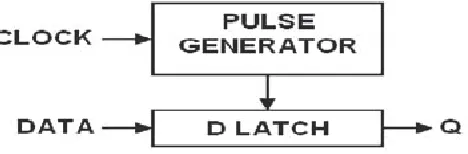
Figure 1: Pulse Triggered Flip flop
Available Online at www.ijpret.com 193
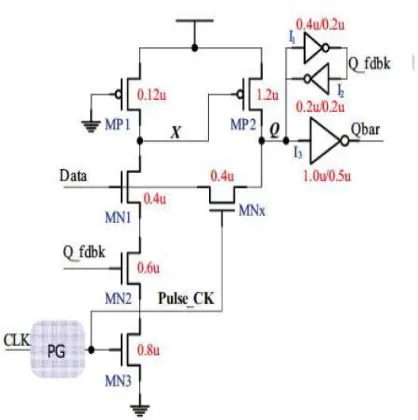
Figure 2: Explicit Pulse triggered FF design
Pulse-triggered FF (P-FF), because of its single-latch structure, is more popular than the transmission gate (TG) and master–slave based FFs in higher speed applications. Apart from the speed advantage, its circuit simplicity lowers the power consumption of the clock tree system. A P-FF consists of a pulse generator for strobe signals and a latch is for data storage. If the triggering pulses are narrow, the latch acts like an edge-triggered FF. Since only one latch, as opposed to two in the conventional master–slave configuration, is needed, a P-FF is simpler in circuit complexity.
Available Online at www.ijpret.com 194
2. PROPOSED SYSTEM
Figure3 shows the proposed DDFF architecture. Node X1 is pseudo-dynamic, with a weak inverter acting as a keeper, whereas, compared to the P-FF, in the new architecture node X2 is purely dynamic. An unconditional shutoff mechanism is provided at the frontend instead of the Conditional one in P-FF. The operation of the flip-flop can be divided into two phases: 1) the evaluation phase, when CLK is high, and 2) the pre-charge phase, when CLK is low
Figure 3: Proposed DDFF
The actual latching occurs during the one-to-one overlap of CLK and CLKB during the evaluation phase. If D is high prior to this overlap period, node X1 is discharged through NM0-NM2. This switches the state of the cross coupled inverter pair INV1-INV2 causing node X1B to go high and output QB to discharge through NM4 transistor. The low level at the node X1 is retained by the inverter pair INV1-INV2 for the rest of the evaluation phase where no latching occurs. Thus, node X2 is kept at high throughout the evaluation period by the PM1. When CLK goes to low, the circuit enters the pre-charge phase and node X1 is pulled high through pmos transistor
PM0, switching the state of INV1-2. During this period node X2 is not properly driven by any transistor, it stores the charge dynamically. The outputs at node QB and maintain their voltage levels through INV3-4. If D is zero prior to the overlap period, node X1 remains high and node
90-Available Online at www.ijpret.com 195
nm UMC process technology. Node X1 undergoes charge sharing when the CLK makes a low to
high transition while D is held at low logic level.
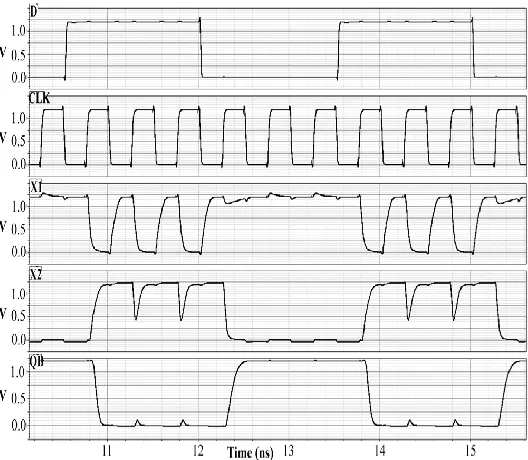
The timing diagram shows that node X2 retains the charge level during the pre-charge phase when it is not driven by any transistor. Note that the temporary pull down at node X2 when sampling a “one” is due to the delay between X1 and X1B. The setup time and hold time of a flip-flop refers to the minimum time period before and after the CLK edge, respectively where the data should be stable so that proper sampling is possible. Here setup time and the hold time depend on the CLK overlap period.
Figure 4: Timing diagram of DDFF at 2-GHz CLK frequency.
3. PERFOMANCE ANALASIS IN RING COUNTER
Available Online at www.ijpret.com 196 CLK edge and 0% represents no data transition. Since the performance of the proposed flip-flops depends on the CLK overlap period, a detailed analysis at various process and temperature corners is carried out.
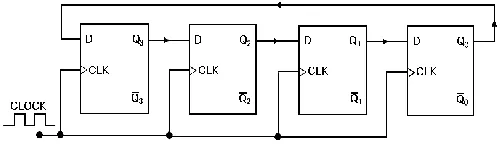
Figure 5: 4-bit Ring Counter
Since static leakage power is one of the major sources of power dissipation at scaled down technology nodes, comparison of the leakage performance of various designs has been carried out. The leakage currents for different input and output conditions are measured to find the reason for leakage power. In addition, all the designs were analyzed at different voltage points to understand the impact of supply voltage fluctuation in the functionality of the flip-flops. Finally, a 4-b ring counter is designed to highlight the performance of the proposed flip-flop architecture. The reason for considering a ring counter is that the data activity at each bit position is known. The most significant bit (MSB) has the least data activity (12.5%), whereas the least significant bit (LSB) has the maximum (100%).
4. OBSERVATIONS
The performance of the proposed DD-FF design is evaluated against existing designs through post-layout simulations. The compared designs include four explicit type P-FF designs shown in Fig. 2, an Pulse triggered flip flop design shown in fig. 1 A conventional CMOS NAND-logic-based pulse generator design with a three-stage inverter chain is used for DDFF designs, which employs its own pulse generation circuitry.
Type of FF Power Delay (ns) Power Delay Product
Existing D-FF 8.37 0.57 4.77
Explicit P-FF 6.34 0.23 1.45
DD FF 6.14 0.18 1.10
Ring Counter 3.92 0.55 2.15
Available Online at www.ijpret.com 197
Chart-1: Performance Analysis Chart for various type of FFs
4. CONCLUSION
In this paper, a new low power DDFF was proposed. An analysis of the overlap period required to select proper pulse width was provided in order to make the design process simpler. The proposed DDFF eliminates the redundant power dissipation present in the pulse triggered FF. A comparison of the proposed DD flip-flop with the conventional flip-flops showed that it exhibits lower power dissipation along with comparable speed performances. The post-layout simulation results showed an improvement in PDP by about 10% compared to the P-FF at 25% data activity. By eliminating the charge sharing problem, the revised structure of the proposed flip-flop, The efficiency of the flip-flop is highlighted using a 4-b ring counter. It was proven that the proposed architectures are well suited for modern high performance designs where area, delay-overhead, and power dissipation are of major concern
ACKNOWLEDGEMENT
I would like to express my gratitude to the following people for their support and guidance for the success of this paper.
Available Online at www.ijpret.com 198
REFERENCES
1. “Low-Power Pulse-Triggered Flip-Flop Design Based on a Signal Feed-Through Scheme”, Jin-Fa Lin, IEEE TRANSACTIONS ON VERY LARGE SCALE INTEGRATION (VLSI) SYSTEMS, VOL. 22, NO. 1, JANUARY 2014
2. H. Kawaguchi and T. Sakurai, “A reduced clock-swing flip-flop (RCSFF) for 63% power reduction”, IEEE J. Solid-State Circuits, vol. 33, no. 5, pp. 807–811, May 1998.
3. K. Chen, “A 77% energy saving 22-transistor single phase clocking D-flip-flop with adoptive-coupling configuration in 40 nm CMOS”, in Proc. IEEE Int. Solid-State Circuits Conf., Nov. 2011, pp. 338–339.
4. E. Consoli, M. Alioto, G. Palumbo, and J. Rabaey, “Conditional push pull pulsed latch with 726 fJops energy delay product in 65 nm MOS”, in Proc. IEEE Int. Solid-State Circuits Conf., Feb. 2012, pp. 482–483.
5. H. Partovi, R. Burd, U. Salim, F.Weber, L. DiGregorio, and D. Draper, “Flow-through latch and edge-triggered flip-flop hybrid elements”, in Proc. IEEE Int. Solid-State Circuits Conf., Feb. 1996, pp. 138–139.
6. F. Klass, C. Amir, A. Das, K. Aingaran, C. Truong, R. Wang, A. Mehta, R. Heald, and G. Yee, “A new family of semi-dynamic and dynamic flip-flops with embedded logic for high-performance processors”, IEEE J. Solid-State Circuits, vol. 34, no. 5, pp. 712–716, May 1999
7. Low-Power Dual Dynamic Node Pulsed Hybrid Flip-Flop Featuring Efficient Embedded Logic”, Kalarikkal Absel, Lijo Manuel, and R. K. Kavitha, Member, IEEE, IEEE TRANSACTIONS ON VERY LARGE SCALE INTEGRATION (VLSI) SYSTEMS, VOL. 21, NO. 9, SEPTEMBER 2013.
8. B.-S. Kong, S.-S. Kim, and Y.-H. Jun, “Conditional-capture flip-flop for statistical power reduction”, IEEE J. Solid-State Circuits, vol. 36, no. 8, pp. 1263–1271, Aug. 2001.
9. Stojanovic and V. Oklobdzija, “Comparative analysis of masterslave latches and flip-flops for high-performance and low-power systems”, IEEE J. Solid-State Circuits, vol. 34, no. 4, pp. 536– 548, Apr. 1999.
Available Online at www.ijpret.com 199 11.C. K. Teh, M. Hamada, T. Fujita, H. Hara, N. Ikumi, and Y. Oowaki, “Conditional data applying flip-flops for low-power and high performance systems”, IEEE Trans. Very Large Scale Integer. (VLSI) Syst., vol. 14, no. 12, pp. 1379–1383, Dec. 2006.