Available Online at www.ijpret.com 1083
INTERNATIONAL JOURNAL OF PURE AND
APPLIED RESEARCH IN ENGINEERING AND
TECHNOLOGY
A PATH FOR HORIZING YOUR INNOVATIVE WORK
MOUSE CURSOR BASED CAPTCHA SECURITY
MS. SONIKA A. CHOREY1, PROF. S. V. DHOPTE2
1.M.E. in Information Technology, P.R.M.I.T.R, Badnera.
2.Associate Professor Dept. of Information Technology. P.R.M.I.T.R, Badnera.
Accepted Date: 05/03/2015; Published Date: 01/05/2015
Abstract: CAPTCHA is an acronym for "Completely Automated Public Turing test to tell
Computers and humans Apart." The process usually involves one computer (a server) asking a user to complete a simple test which the computer is able to generate and grade .CAPTCHA is an image of distorted letters is dynamically generated. Since the letters are a part of an image and not text, it is difficult for a spam bot or other computer program to read. Captcha is a so called win-win solution, in that if a bot cannot break it, it provides security, but if it is automatically broken, that means that a difficult task in computer vision or related areas has been solved. . A common type of CAPTCHA requires that the user type letters or digits from a distorted image. The most common form of CAPTCHA requires visitors to type in a word or series of letters and numbers that the application has distorted in some way. CAPTCHAs are classified based on what is distorted and presented as a
challenge to the user.
Keywords:CAPTCHA, Cryptography, Authentication
Corresponding Author: MS. SONIKA A. CHOREY
Access Online On:
www.ijpret.com
How to Cite This Article:
Sonika A. Chorey, IJPRET, 2015; Volume 3 (9): 1083-1089
Available Online at www.ijpret.com 1084 INTRODUCTION
CAPTCHA is an acronym for "Completely Automated Public Turing test to tell Computers and
humans Apart." It is a type of challenge-response test used in computing to ensure that the
response is not generated by a computer. The process usually involves one computer (a server) asking a user to complete a simple test which the computer is able to generate and grade. Because other computers are unable to solve the CAPTCHA, any user entering a correct solution is presumed to be human. A common type of CAPTCHA requires that the user type letters or digits from a distorted image that appears on the screen [1].
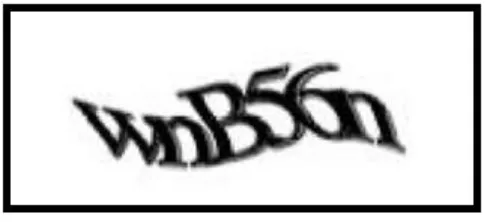
CAPTCHA is an image of distorted letters is dynamically generated. Since the letters are a part of an image and not text, it is difficult for a spam bot or other computer program to read. A human, in fact, has little trouble reading the letters in a captcha image. Using a captcha test on a website is a great way to ensure, for instance, that a person and not a spambot is filling out a web form. For example, humans can read distorted text as the one shown in Figure 1, but current computer programs cannot. Captcha is a so called win-win solution, in that if a bot cannot break it, it provides security, but if it is automatically broken, that means that a difficult task in computer vision or related areas has been solved. The problem with current visual text based captcha systems is that most of them have proven to be either not robust enough (they have been broken) or they are too complicated or annoying to read even for humans [2].
One common application of CAPTCHA is for verifying online polls. In fact, a former Slashdot poll serves as an example of what can go wrong if pollsters don't implement filters on their surveys. In 1999, Slashdot published a poll that asked visitors to choose the graduate school that had the best program in computer science. Students from two universities -- Carnegie Mellon and MIT --
created automated programs called bots to vote repeatedly for their respective schools. While
those two schools received thousands of votes, the other schools only had a few hundred each. If it's possible to create a program that can vote in a poll, how can we trust online poll results at all? A CAPTCHA form can help prevent programmers from taking advantage of the polling system [3].
Available Online at www.ijpret.com 1085 Figure. 1. CAPTCHA
The most common form of CAPTCHA requires visitors to type in a word or series of letters and numbers that the application has distor-ted in some way. Because computers aren't always able to identify words from a digital scan, humans have to verify what a printed page says. Then it's possible for search engines to search and index the contents of a scanned document [4].
II. CAPTCHA characteristics
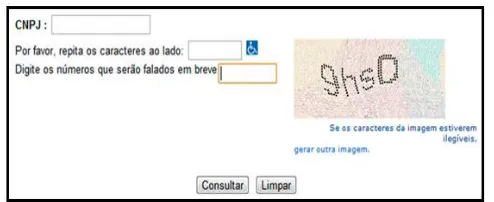
The Website implements two kinds of CAPTCHAs, audio and visual. In the audio CAPTCHA, two male voices speak simultaneously, and the user has to type only the numbers that are spoken. The visual CAPTCHA has a wide vocabulary and uses different backgrounds, fonts, and texture. For example, in the CAPTCHA in Figure 5, the letters are made of separated dots, which are not trivial to cluster together to a letter shape by an algorithm [5].
Figure 2.The CAPTCHA interface provided by Agency
III. Types of CAPTCHAs
CAPTCHAs are classified based on what is distorted and presented as a challenge to the user. They are:
3.1Text CAPTCHAs
These are simple to implement. The simplest yet novel approach is to present the user with some questions which only a human user can solve. Examples of such questions are:
1. What is twenty minus three?
Available Online at www.ijpret.com 1086
Such questions are very easy for a human user to solve, but it’s very difficult to program a computer to solve them. These are also friendly to people with visual disability – such as those with colour blindness. Other text CAPTCHAs involves text distortions and the user is asked to identify the text hidden.
3.2Gimpy
Gimpy is a very reliable text CAPTCHA built by CMU in collaboration with Yahoo for their Messenger service. Gimpy is based on the human ability to read extremely distorted text and the inability of computer programs to do the same. Gimpy works by choosing ten words randomly from a dictionary, and displaying them in a distorted and overlapped manner [6].
3.3Ez – Gimpy
This is a simplified version of the Gimpy CAPTCHA, adopted by Yahoo in their signup page. Ez – Gimpy randomly picks a single word from a dictionary and applies distortion to the text. The user is then asked to identify the text correctly.
Figure 3. Yahoo’s Ez – Gimpy CAPTCHA
3.4 Baffle Text
This was developed by Henry Baird at University of California at Berkeley. This is a variation of the Gimpy. This doesn’t contain dictionary words, but it picks up random alphabets to create a nonsense but pronounceable text. Distortions are then added to this text and the user is challenged to guess the right word. This technique overcomes the drawback of Gimpy CAPTCHA
because, Gimpy Division of Computer Science, SOE, CUSAT 8 uses dictionary words and hence,
Available Online at www.ijpret.com 1087 3.5 Bongo
Another example of a CAPTCHA is the program we call BONGO [2]. BONGO is named after M.M. Bongard, who published a book of pattern recognition problems in the 1970s [3]. BONGO asks the user to solve a visual pattern recognition problem. It displays two series of blocks, the left and the right. The blocks in the left series differ from those in the right, and the user must find the characteristic that sets them apart.
These two sets are different because everything on the left is drawn with thick lines and those on the right are in thin lines. After seeing the two blocks, the user is presented with a set of four single blocks and is asked to determine to which group the each block belongs to. The user passes the test if she/he determines correctly to which set the blocks belong to. We have to be careful to see that the user is not confused by a large number of choices [7].
3.6 Vidoop CAPTCHA
VidoopCAPTCHA2 is a verification solution that uses images of objects, animals, people or landscapes, instead of distorted text, to distinguish a human from a computer program. By verifying that users are human, the site and users are protected against malicious bot attacks. As shown in Figure 2, a Vidoop challenge image consists in a combination of pictures representing different categories. Each picture is associated with a letter which is embedded in it. In order to pass the challenge, the user is asked to report the letters corresponding to a list of required categories [8].
IV. PROPOSED SYSTEM
Available Online at www.ijpret.com 1088
So here we are going to present CAPTCHA which include a new technique that utilizes image from custom mouse cursors and outperforms some most popular CAPTCHA techniques such as Text – based CAPTCHAs and previous Image – based CAPTCHAs. So here we are providing combination of both image based and text base CAPTCHA first of all use will able to see one image that contains one small cross image which is diametrically situated in the main image use has challenge to click on that image and then user will going to clear the CAPTCHA test.
In this project we will going to going to give an environment of CAPTHCA creation under new concept of cursor in which first of all user has to click on the image in the area of nested image (image on image), then user can able to see CAPTCHA text image then user will going to type that CAPTHCA text after that user will clear that CAPTCHA.
V. CONCLUSION
Currently phishing attacks are so common because it can attack globally and capture and store the users’ confidential information. This information is used by the attackers which are indirectly involved in the phishing process. Phishing websites as well as human users can be easily identified using our proposed "Anti-phishing framework based on Visual Cryptography".
The proposed methodology preserves confidential information of users using 3 layers of security. 1st layer verifies whether the website is a genuine/secure website or a phishing website. If the website is a phishing website (website that is a fake one just similar to secure website but not the secure website), then in that situation, the phishing website can’t display the image captcha for that specific user (who wants to log in into the website) due to the fact that the image captcha is generated by the stacking of two shares, one with the user and the other with the actual database of the website. Second layer cross validates image Captcha corresponding to the user.
Available Online at www.ijpret.com 1089 8. REFERENCES
1. Varun Ambrose Thomas, Karanvir Kaur “Cursor CAPTCHA – Implementing CAPTCHA Using
Mouse Cursor” IEEE Conference 978-1-4673-5999-3/13-2013 IEEE
2. Thiyagarajan, P.; Venkatesan, V.P.; Aghila, G.; "Anti-Phishing Technique using Automated
Challenge Response Method'", in Proceedings of IEEE- International Conference on Communications and Computational Intelligence, 2010.
3. Sun Bin.; Wen Qiaoyan.; Liang Xiaoying.; "A DNS based Anti-Phishing Approach," in
Proceedings of IEEE- Second International Conference on Networks Security, Wireless Communications and Trusted Computing, 2010
4. Nourian, A.; Ishtiaq, S.; Maheswaran, M.;" CASTLE: A social framework for collaborative
antiphishing databases", in Proceedings of IEEE- 5th International Conference on Collaborative Computing: Networking, Applications and Worksharing, 2009.
5. Anthony Y. Fu, Liu Wenyin, "Detecting Phishing Web Pages with Visual Similarity Assessment
Based on Earth Mover’s Distance (EMD)",IEEE Transactions on Dependable and Secure Computing, v 3, n 4, p301-311, October/December 2006
6. Nirmal, K.; Ewards, S.E.V.; Geetha, K.; "Maximizing online security by providing a 3 factor
authentication system to counter-attack 'Phishing'", in Proceedings of IEEE- International Conference on Emerging Trends in Robotics and Communication Technologies, 2010.
7. Tianyang Li.; Fuye Han.; Shuai Ding and Zhen Chen.; "LARX: Large-scale Anti-phishing by
Retrospective Data-Exploring Based on a Cloud Computing Platform", in Proceedings of IEEE-
20th International Conference on Computer Communications and Networks, 2011.
8. Qingxiang Feng.; Kuo-Kun Tseng.; Jeng-Shyang Pan.; Peng Cheng and Charles Chen.; "New