Available Online at www.ijpret.com 911
INTERNATIONAL JOURNAL OF PURE AND
APPLIED RESEARCH IN ENGINEERING AND
TECHNOLOGY
A PATH FOR HORIZING YOUR INNOVATIVE WORK
A HYBRID APPROACH FOR DOCUMENT CLUSTERING IN COMPUTER FORENSIC
ANALYSIS
TANUSHRI POTPHODE, PROF. AMIT PIMPALKAR Department of computer Science & Engineering, GHRAET, Nagpur University, India. Accepted Date: 05/03/2015; Published Date: 01/05/2015
Abstract: In today’s world, criminals have greatest use of all new technologies and technical methods in commit crimes like ethical hacking, fraud in different domains, prohibited access etc. So, the investigation of such cases is difficult and more important task. That’s why need to do the forensic analysis. In recent times digital forensics analysis has become a major activity in crime investigation since computers are gradually more used as tools to commit crimes. Throughout forensic investigation the digital devices such as desktops, notebooks, smart phones, PDAs etc. found at the crime scene are collected for further investigation .In digital forensic analysis, huge amount of files are generally examined. Much of the data in those files consists of indistinct text, whose investigation by computer examiners is very tough to achieve. Digital forensics deals with study such huge set of documents to collect the evidence from computer devices. So, to do digital forensic analysis time limit is an also major factor. So it’s a not easy task for examiner to do such analysis in quick period of time. That’s why to do the digital forensic analysis of documents within short period of time requires particular techniques to make such complex task in a simpler approach. Such special technique includes document clustering. So, clustering algorithms are of great interest. This document clustering analysis is very helpful for crime investigation to analyze the information from seized digital devices. In this paper we proposed hybrid approach to attain efficient document clustering in forensic analysis. The accuracy of clustering of documents has been improved by means of this hybrid approach. And show the implementation of proposed system. We also propose enhance clustering algorithm which will improve accuracy of clustering to finding related documents from huge amount of data. Which will helps to improve the document clustering for forensic analysis.
Keywords:Document Clustering, Forensic Analysis, Investigation, Crime
Corresponding Author: MS. TANUSHRI POTPHODE
Access Online On:
www.ijpret.com
How to Cite This Article:
Available Online at www.ijpret.com 912 INTRODUCTION
A.What is Digital forensic analysis?
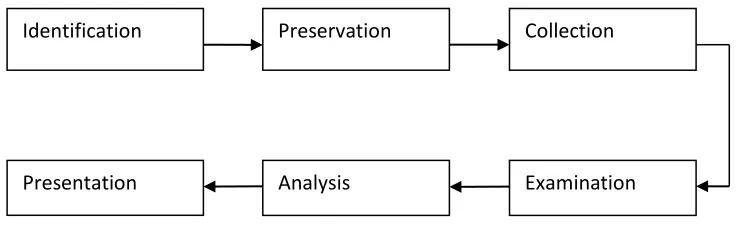
Digital Forensic analysis is the branch of systematic forensic analysis process for investigation of matter found in digital devices interrelated to computer crimes. Digital evidence equivalent to particular incident is any digital data that provides suggestion about incident. The important part of Digital forensic Process is to examine the documents that present on suspect’s computer. Due to increasing count of documents and larger size of storage devices makes very difficult to analyze the documents on computer. usually, digital forensics is the use of investigation and analysis technique to collect and protect evidence from a exacting computing device in a way that is proper for presentation in a court of proceed .It also deals with the preservation, identification, extraction as well as documentation of digital evidences .This is task of analyze enormous number of files from computer seized devices. But in computer forensic procedure all the essential information and files are stored in digital form. This digital information stored in computer seized devices has an key factor from an investigative point of view which treated as evidence in the court of law to prove what occurred based on such evidences. Therefore collection of evidence from seized devices is also task of forensic examiner. Digital evidence is defined as the information and data of investigative value that are stored on, received or transmitted by digital device. Such digital evidences needs to be collected from computer seized devices in order to confess the case in court of law. So such digital evidences have a great asset for the forensic examiner .So the key factor to improve such forensic analysis process requires document clustering technique The process of digital forensic analysis is shown in below figure 1
Figure 1: Process of Digital Forensic Investigation (DFI)
Above Figure1 Illustrates the Digital Forensic Investigation (DFI) process as defined by DFRWS. After determining items, components, and data related with the unpleasant incident
Identification Preservation Collection
Available Online at www.ijpret.com 913 (Identification phase), the next level step is to preserve the crime scene by stop or prevent several actions that can harm digital information being collected (Preservation phase). Follow that, the next level step is collect digital information that might be related to the incident, for example copying files or recording network traffic (Collection phase). Next step, the investigator conducts an in detail efficient search of evidences related to the incident being analysis such as filter, validation and pattern matching techniques (Examination phase) [16]. The investigator can put the evidence together and tries to develop theories concerning events that occurred on the suspect’s computer (Analysis phase). Finally the examiner review and the findings by explaining the reasons for each hypothesis that was formulated during the investigation (Presentation phase). In the examination phases investigators often utilize certain forensic tools to help examine the collection files and perform an in detail systematic search for pertinent evidence
B.Document clustering
Clustering is the task of grouping data objects into subsets based on their relationship, i.e., objects with similar properties are grouped together. Each subset is called a cluster. Each cluster contains a collection of objects that are “similar "between them Objects in different clusters are “dissimilar" to each
Requirements for clustering
Scalability
Different types of attributes/high dimensionality
Minimal domain knowledge for determining features
Document clustering is the process of grouping similar documents into cluster. The main benefit of document clustering is to retrieve the information effectively, reduce the search time and space, to identify the outliers, to handle the high dimensionality of data and to provide the review for related documents.
This paper is present in the following way. In section 2 some earlier work is explained, and in section 3, explain the work of proposed system, section 4 conclude the work.
I. LITERATURE REVIEW
Available Online at www.ijpret.com 914 studied various text clustering algorithms and shows comparative studies between them.[2],proposed practical approach of document clustering in computer forensic analysis in that they implemented K-representative algorithm which helps to improve efficiency of document clustering in forensic analysis.
L.F.C Nassif etal [3], proposed a computer devices. They illustrated an approach by carrying out wide experimentation with six well known clustering algorithms (K-mean, K-medoids, Single Link, Average Link, complete Link and CSPA) applied to five real world datasets obtained from computer seized. They were also studied uses of the comparative validity index criteria for the estimating the number of clusters in an automated manner which overcomes the limitations of previous techniques.
S. Mascarnes et al[4] focused on a novel document clustering model that allows an examiner to semantically clusters the documents stored on a suspect's digital devices with the help of subject suggestions initially provided to him. Provided subject suggestion improves the accuracy and speeds up the process of searching the evidences in forensic analysis.
B.Vidhya etal [5],studied various text clustering and document clustering technique for digital forensic analysis .To improve digital forensic analysis they proposed K-mean algorithm and ant colony optimization algorithm. This was very important among swarm intelligent algorithm. K-mean was one of the simplest algorithm for document clustering which was efficient to giving better clusters form huge amount of datasets.
T.Thopte etal [6],they proposed system is preprocess formless document to structured data. For that they have idea to extract four features of each document like title sentences, numeric words, proper nouns and term weights. That makes There method much simpler than any other methods. They Proposed System neglecting unwanted extension’s considering only extensions which was rich in text like .pdf, .doc, .txt.. The grouping of these scored values represents the most accurate clustered documents. which was very efficient for improving computer inspection in forensic analysis.
Available Online at www.ijpret.com 915 description of arbitrarily shaped clusters in high-dimensional data sets which was better to achieve fast and efficient analysis.
S. Karol etal [8], suggested fast as well as high-quality document clustering algorithms which plays very important role in document clustering for effective navigation, summarization, and organization of information. They suggests two techniques for efficient document clustering; these suggested techniques relating the application of soft computing concept as an intelligent hybrid PSO based algorithm. The two approaches are partitioning clustering algorithms Fuzzy C-Means (FCM) and K-C-Means each hybridized with Particle Swarm Optimization (PSO).
C. Jadon etal [9],they studied of various clustering technique. like K-means Agglomerative Hierarchical Clustering. I addition to that various clustering techniques they discusses about various document-representing techniques in graph and particular Vector Space Model and Matrix Representation .After studying all these things, they created a new approach of clustering algorithm and also a new representation technique of documents. They compared their results with K-means Algorithm which was given giving good results.
G. Thilagavathi etal [10], studied computer forensic process is to examine the documents present in suspect’s computer. Due to huge amount of amount of documents and larger size of storage space devices makes very difficult to evaluate the documents on computer. To overcome those problems, they had propose a subject based semantic clustering technique along with bisecting-k means that allows the examiner to examine and cluster the documents based on particular subject and also the terms that does not belong to any subject. For that they proposed Subject vector space model (SVSM),. The accuracy of clustering of files has been improved by means of this enhance approach.
S. Oliver etal, [11] proposed SOM-based algorithms were used for clustering files with aim of making the decision-making process performed by the examiners more resourcefully.
Available Online at www.ijpret.com 916 R. Hadjidj etal [13] developed an integrated approach for mining e-mails for forensic analysis, using classification and clustering algorithms K. Stoffel etal [14], provided techniques and an automatic process for infer accurate and simply clear expert-system-like rules from forensic data. That method was based on the fuzzy set theory. C.Charu etal [13], clustering is an extensively studied finds many applications in customer segmentation, mutual filtering, visualization, document organization and indexing to preprocess the data logically.
A. Preprocessing:
Preprocessing most important phase since it can affect the result of a document clustering algorithm. In the implementation of proposed system which will used to reduce the noise, dimensionality, computational complexity and loss of information. Preprocessing involves the tokenization, stop words removal, Stemming process and Indexing sub-phases.
Preprocessing phase involves the tokenization, stop words removal, Stemming process and Indexing sub-phases. In tokenization method we will breaking stream of text into words or phrases into tokens called as “Tokenization”. In a document, tokenization separate the sequence of characters into tokens by using punctuation and white space consider as separators. For example 1, regard as the string “Parth, David and Vidhi” produce the tokens such as: “Parth”, “David”, and “Vidhi”.
After that stop words are words measured not to convey any meaning. We use a standard list of stop words and remove them from the collection of documents .It is used to save space and to speed up searching procedure; the words which are considered as less significant must be removed. Any group of words can be chosen as stop word for instance ‘the’, ‘which’, ‘what’, ‘at’, ‘on’, etc. In stemming method we will reduce the word to its root or stem. The input terms used in document are expressed by stem rather than original words. For example, consider the words “produces”, “production”, and “producing” can be reduced to the root word, “Product”. After that performing indexing it this
We describe how often times the particular term will be appear within document.
B. Term significance:
Available Online at www.ijpret.com 917 In particular, each weighted term frequency must be determines as
℧(t,d)= tf(t,d)×idf(t,D) (2)
Where tf (t, d) represents frequency of term t in document d and idf (t, D) denotes the inverse document frequency of term t in the document set D
idf(t,D) = 1+log(|D|/1 + Freq(t,D)) (3)
Where ,|D| denotes the count of documents in the huge set of documents D, and Freq (t, D) is the count of documents in D that denotes the term t. There will be more number of terms generated for each subject even though it is limited by entry value. To reduce the noise, dimensionality reduction technique such as term variance is used to limit the terms that improves the efficiency and effectiveness of clustering algorithm.
C. Apply Document Clustering Algorithm:
After the preprocessing document clustering is applied to form the set of clusters according to specified clustering criteria.
D. Clusters Formation:
After applying algorithm we get result clusters which are forms according to the input query. It is used for application such as forensic analysis in which clustering results are used for further analysis.
E. Evaluating results:
Forensic analysis process uses the result of document clustering for further analysis. The result of document clustering enhances the forensic process within sake of time.
Implementation Details:
In implementation details we shows snapshots of our core modules of proposed system which are explained below.
Available Online at www.ijpret.com 918 according to the requirement of users. By clicking on “Search ”button system start to find the result it goes through preprocessing phase we shows the data on GUI after preprocessing and stop word list also which shows the word which are meaningless in files and reduce our searching time. After that in this same GUI we shows clusters which are form after applying K-medoid and K-representative algorithm. In that we show which file are relevant to our user query. We also maintain synonyms directory related to the crime for reducing searching time if user knows only crime but it has synonym but it have various synonym in that case system will also forming the clusters which are related to the crime like misuse, injustice because of that we will improve searching time of our proposed system
Fig 3.Result after Preprocessing and clustering
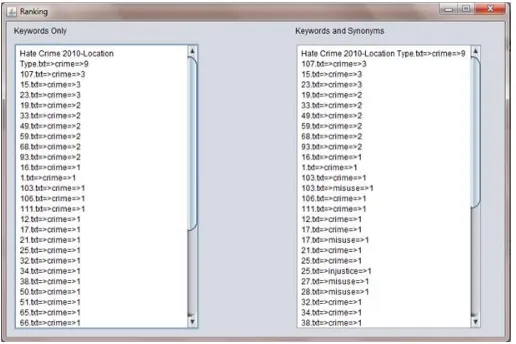
Available Online at www.ijpret.com 919 In above Figure 4 we shows ranking of clusters. Ranking can give examiner an overall view of a certain set of files, which is beneficial for examiner to grasp the most important information in a short time. In above fig we show the file which contains maximum occurrences of crime word. It is appears first. Which are most important to collect the information within short period.
II.CONCLUSION
In this paper our contribution is to shows an hybrid approach for implementation of proposed system which will uses enhance text clustering algorithm which forming clusters on the basis of relative match. It also gives better results and improves the accuracy of document clustering technique. By using this approach searching time for finding relevant document from huge amount of datasets will be reduce and recover the efficiency of forensic analysis.
III.REFERENCES
1. T .Potphode and A.Pimpalkar, “An Empirical Approach for Document Clustering in Forensic
Analysis: A Review” International Journal of Science, Engineering and Technology Research (IJSETR),Volume3-Issue-11-2892-2896November 2014.
2. T,Potphode and A.Pimpalkar ,“A practical Approach for document clustering in Computer Forensic analysis”, ABHIYANTRIKI International Journal of engineering&Technology,Vol.1,NO.2 December 2014.
3. L.F.D.C Nassif and E.R. Hruschka, “Document Clustering for Forensic Analysis: An Approach for Improving Computer Inspection”, IEEE Transactions on Information Forensics and Security, Vol. 8, No. 1, January 2013.
4. S. Mascarnes and J.Gomes “Subject based Clustering for Digital Forensic Investigation with Subject Suggestion”, International Journal of Computer Applications (0975 – 8887) Volume 102 – No.11, September 2014.
5. B.Vidhya and R.Priya Vaijayanthi, “Enhancing Digital Forensic Analysis through Document Clustering”, International Journal of Innovative Research in Computer and Communication Engineering, Vol.2, Special Issue 1, March 2014
Available Online at www.ijpret.com 920 7. R. Mundhe, A. Maind and R. Talmale, “Information Retrieval Using Document Clustering for Forensic Analysis”, International Journal of Recent Advances in Engineering & Technology (IJRAET), Vol. 2, 2014.
8. S. Karol and V. Mangat, “Evaluation of a Text Document Clustering Approach based on Particle Swarm Optimization”, International Journal of Computer Science and Network Security (IJCSNS), Vol. 13, July 2013.
9. C. Jadon and A. Khunteta, “ A New Approach of Document Clustering”, International Journal of Advanced Research in Computer Science and Software Engineering, Volume 3, Issue 4, April 2013.
10.G. Thilagavathi and J. Anitha, “Document Clustering in Forensic Investigation by Hybrid Approach”, International Journal of Computer Applications Vol. 91, April 2014.
11.B. K. L. Fei, J. H. P. Eloff, H. S. Venter, and M. S. Oliver, “Exploring forensic data with self-organizing maps”, Internatinal Conference Digital Forensics, 2005.
12.K. Nagarajan and Dr. M. Prabakaran, “A Relational Graph Based Approach using MultiAttribute Closure Measure for Categorical Data Clustering”, The International Journal Of Engineering And Science (IJES) ,Vol. 3, 2014.
13.R. Hadjidj, M. Debbabi, H. Lounis, F. Iqbal, A.Szporer, and D. Benredjem, “Towards an integrated e-mail forensic analysis framework,” Digital Investigation,Elsevier, vol. 5, 2009.
14.K. Stoffel, P. Cotofrei, and D. Han, “Fuzzy methods for forensic data analysis”, IEEE International Conference Soft Computing and Pattern Recognition, 2010.
15.C. C. Charu, and C. X. Zhai, Eds., “Chapter 4: A Survey of Text Clustering Algorithms”, Mining Text Data. NewYork: Springer, 2012.