Available Online at www.ijpret.com 625
INTERNATIONAL JOURNAL OF PURE AND
APPLIED RESEARCH IN ENGINEERING AND
TECHNOLOGY
A PATH FOR HORIZING YOUR INNOVATIVE WORK
IMPROVED CLUSTER BASED MOBILITY SCHEME FOR MANET
MISS. P. D. LANJEWAR, DR. V. M. THAKARE
SGBAU, Amravati, India.
Accepted Date: 15/03/2016; Published Date: 01/05/2016
\
Abstract: Mobility models of MANET have been still research area in mobile computing and
in wireless network with lots of mobility algorithms to design the efficient mobility model. This paper focused on five different techniques such as cTRUST Aggregation scheme, mobility modelling for cyber physical system, Mobility Aware Loose Clustering, Efficient Flooding Scheme, and Network Coding based relay scheme. This paper also present the new method for distributed clustering using “trusted index based” mobility scheme which overcome the problems of existing mobility schemes. Using this new scheme overhead can be reducing with the increase in packet delivery ratio.
Keywords: cTrust, clustering, flooding, delay, overhead, throughput, network coding, and
trusted index based, MANET etc.
.
Corresponding Author: MISS. P. D. LANJEWAR
Access Online On:
www.ijpret.com
How to Cite This Article:
Available Online at www.ijpret.com 626
INTRODUCTION
Mobility scheme plays the important role in designing the different mobility models for mobile ad hoc network (MANET). Many mobility models have been developed such as random walk mobility model, random direction mobility model, random waypoint mobility model, reference point group mobility model and realistic mobility model. There are many environments are designed to effectively run the mobility scheme that are cyclic mobile ad hoc network, cluster, cyber physical system and network coding.
This paper, discusses five different mobility schemes such as cTRUST Aggregation scheme, mobility modelling for cyber physical system, Mobility Aware Loose Clustering, Efficient Flooding Scheme, and Network Coding based relay scheme. These mobility schemes provide the better capacity-throughput-delay trade-offs, more reliability, reduce overhead, less power consumption, accuracy, robust and secure etc.
But these methods also have some problem that is shown in analysis and discussion so to overcome such problems the improve version of mobility scheme is propose here that is
“trusted index based scheme for distributed cluster”. The existing method has many problems
when node complexity increases which takes much time to search the exact destination to send the packets. So in distributed clustering if trusted index based method with the use of the multicast transmission is used then easily performance of the existing mobility scheme will improve. The problems of cluster method is overcome by this propose mobility scheme.
II) BACKGROUND
Available Online at www.ijpret.com 627 method shows how performance is improve in terms of throughput, delay, packet loss, trust ratio and packet sent [4]. The network coding based relay scheme for static network and for mobile network using two-hop and flooding scheme for different mobility models to improve the performance in terms of goodput-delay tradeoffs [5].
This paper introduces five mobility scheme ie cTRUST Aggregation scheme, mobility modelling for cyber physical system, Mobility Aware Loose Clustering, Efficient Flooding Scheme, and Network Coding based relay scheme. These are organizes as follows. Section I Introduction.
Section II discusses Background. Section III discusses previous work. Section IV discusses
existing methodologies. Section V discusses attributes and parameters and how these are affected on mobility models. Section VI proposed method and outcome result possible. Finally
section VII Conclude this review paper.
III) PREVIOUS WORK DONE
Available Online at www.ijpret.com 628
IV) EXISTING METHODOLOGIES
Many mobility schemes have been implemented over the last several decades. There are different methodologies that are implemented for different mobility models i.e cTRUST Aggregation scheme, mobility modelling for cyber physical system, Mobility Aware Loose Clustering, Efficient Flooding Scheme, and Network Coding based relay scheme.
cTrust Distributed Trust Aggregation Algorithm: In the initial stage of an evolving cMANET
which preset direct trust at direct trust information and indirect trusts are needed. Indirect trust information will be added to trust tables and updated as the aggregation process [1]. Algorithms involve following steps 1: Initialize local trust tables, for each time slot search node belong to cMANET. 2: Find node i direct trust neighbor set at i current state then normalize transition probability. 3: Determine target node j by transition probability and Send trust table request to node j. 4: Receive incoming trust tables. 5: Relax each trust table entry by trust value iteration function update next hop nodes. 6: If receive any trust table request from other nodes, send trust table back.
Mobility modelling for cyber physical system: Two types of mobility modelling can be done
under the VANET and Robot. Simulation under VANETs uses real mobility traces since they are clearly more accurate than random models. Real traces can be hard to collect in order to be used in simulation. Microscopic models emulate the behaviour of individual vehicles independently. Mobility modelling under robotic network offers advanced and detailed models of communications as well as network protocols and routing. However, there is a need for models of physical robotics and their dynamics within the surrounding environment. This need is realized by existing robotic simulators, which model various components of robotics, including mechanical parts such as wheels and legs, engines, sensors, and actuators [2].
Mobility Aware Loose Clustering: Taking high transmission power and mobility of nodes into
Available Online at www.ijpret.com 629
Efficient Flooding Scheme: Flooding is one of the most basic and important operations in
MANET. Traditional flooding scheme suffer from extra redundant messages, resource contention, and signal collision. This causes high protocol overhead and intrusion to the existing traffic. The proposed flooding scheme is based on only one-hop neighbour’s information. Efficient flooding algorithm has two steps. 1: The number of forwarding nodes in each step should be minimized. 2: The time complexity for forwarding nodes computation should be low, which is O (nlogn), where n denotes the number of neighbours of a node [4].
Network-Coding-Based Relay Scheme with two-hop and flooding scheme: This scheme is used
for the static network and algorithm consists of following steps. 1: The source node combines the k original packets and generates (1 + ε) k packets according to NC. Afterward, it transmits the packets to (1 + ε) k nearest nodes (relays) as multi-unicast. 2: All the relay nodes in one cell are separated into some groups, and each group includes G nodes. The nodes belonging to the same group transmit packets to the next cell simultaneously. Afterward, the nodes in the next cell employ PNC, and finished when all the packets are transmitted to the nearest cells around the destination cell. 3: All the packets in the nearest cells around the destination cell will be transmitted to the destination node as “many-to-one” transmission, which is called converge-cast. Two-hop relay scheme use only two phases such as source to relay (SR) and relay to destination (RD). But RR phase is not allowed. The flooding scheme has three phases as SR, RR and RD [5].
V) ANALYSIS AND DISCUSSION
Ctrust distributed aggregation scheme runs in cMANET that shows the average trust path length, aggregation accuracy, convergence time, average trust table size for random trust topology and scale free trust topology with the less overhead and the 90% accuracy. It performs well in more network size and complexity [1].
Mobility modelling for cyber physical system depends on the various objects that are being simulated and the objects are network nodes, vehicles and robots that generate more reliable physical models [2].
Available Online at www.ijpret.com 630 Efficient Flooding Scheme shows the performance analysis in terms of delay, number of packet sent, number of packet loss and trust ratio. By using this scheme delay and packet loss has been reduced, number of packet sent is more ant trust is more because of more secure and reliable [4].
Network Coding based relay scheme gives the analysis for static network and mobile networks with different mobility models. Static networks give better throughput-delay tradeoffs and network coding with mobile networks enhances the performance using the random iid and random walk mobility models [5].
Mobility scheme Advantages Disadvantages
cTRUST Aggregation
scheme
Message overhead in cTrust method is minimum and trust information spreads fast in cMANET.
Convergence time is increase as the network capacity increase.
More accuracy, efficiency,
scalability and robustness.
The ctrust algorithm proved to be worst for the scale free topology than random topology.
mobility modelling for cyber physical system
This provides the better
realistic modeling of mobility with cyber physical system.
Provide the faster movement of
packets with less energy
consumption.
During the modeling of CPS several challenges are arises such
as heterogeneity of cyber
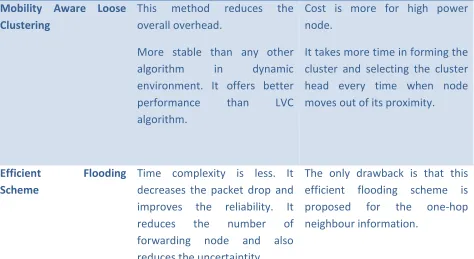
Available Online at www.ijpret.com 631 Mobility Aware Loose
Clustering
This method reduces the overall overhead.
More stable than any other
algorithm in dynamic
environment. It offers better
performance than LVC
algorithm.
Cost is more for high power node.
It takes more time in forming the cluster and selecting the cluster head every time when node moves out of its proximity.
Efficient Flooding
Scheme
Time complexity is less. It decreases the packet drop and improves the reliability. It
reduces the number of
forwarding node and also reduces the uncertaintity.
The only drawback is that this efficient flooding scheme is
proposed for the one-hop
neighbour information.
Network Coding based relay scheme for static network and two-hop
scheme for mobile
network
Proposed scheme provides the better network capacity as for goodput-delay tradeoffs.
Using the two-hop and flooding scheme with the proposed method for mobile network under random i.i.d mobility model additionally enhances the performance.
This proposed method gives better performance only for random i.id mobility model than any other mobility model. And for static network it is not be proved good as compare to mobile network.
Available Online at www.ijpret.com 632
VI) PROPOSED METHODOLOGY
As the network complexity increases then it is difficult to send the packets which result in more overhead and give less packet delivery ratio. If in network large number of clusters is present then source node takes more time to forward the data to the appropriate destination. As source node require to go through all the nodes present in all cluster which result in more overhead and time. In clustering environment every cluster take more time in selecting the cluster head every time when node moves out of the cluster which results in less packet delivery ratio and more overhead. So to overcome such problems the new mobility scheme
“trusted index based scheme for distributed cluster” is propose here. In this method when
cluster is form using various nodes then at that time one trusted index based list is generated for every cluster. When number of cluster is more then using this trusted index list source node easily forward the packets. Instead of going to every route table of each node of all cluster, the source node checks only trusted index based list of each cluster. Separate list is design for each cluster which contains the address of every nodes present in the cluster. If node moves out of the cluster or any node enter in the cluster, the list is immediately updated itself.
So source node can easily trust on the index based list of cluster to forward the packets to the destination node using multicast transmission. In this way this method can improve the performance of existing cluster based mobility scheme.
Fig1: overview of trusted index based method.
Cluster of Seven nodes Index list
1.addr(node1)
2.addr(node2)
3.addr(node3)
4.addr(node4) 5.addr(node5)
6.addr(node6)
7.addr(node7)
6
4
3
1 2
Available Online at www.ijpret.com 633 Above figure, shows the index list containing the address of each nodes present in the cluster so using this list source node easily send the packets to destination.
OUTCOME POSSIBLE RESULT
In this way this method can improve the performance of existing cluster based mobility scheme in terms of the overhead, packet delivery ratio, throughput and less time. When the large number of cluster is formed in the network then to reduce the complexity the, trusted index based cluster method improve the performance in terms of time and delivery ratio.
VII) CONCLUSION
This paper focused on the study of various mobility scheme i.e cTRUST Aggregation schemes, mobility modelling for cyber physical system, Mobility Aware Loose Clustering, Efficient Flooding Scheme, and Network Coding based relay scheme. But there are some problems in clustering network to forward the packets so to improve this “trusted index based scheme for distributed cluster” is propose here.
REFERENCES
1. Huanyu Zhao, Xin Yang, Xiaolin Li, “cTrust: Trust Management in Cyclic Mobile Ad Hoc Networks”, IEEE TRANSACTIONS ON VEHICULAR TECHNOLOGY, Vol. 62, No. 6, July 2013.
2. Mohannad A. Alharthi, Abd. Elhamid M. Taha, “Modeling Mobility for Networked Mobile Cyber-Physical Systems”, ACM, 10.1145/2593458.2593468, April 2014.
3. V. V. Neethu, Awadhesh Kumar Singh, “Mobility Aware Loose Clustering for Mobile Ad hoc Network”, ELSEVIER, 1877-0509, June, 2015.
4. Sindhuja M, Selvamani K, Kannan A, Kanimozhi S., “Mobility Assisted Uncertainty Reduction in MANETS Using Forward Node Optimization”, ELSEVIER, 1877-0509, April, 2015.