Available Online At www.ijpret.com
INTERNATIONAL JOURNAL OF PURE AND
APPLIED RESEARCH IN ENGINEERING AND
TECHNOLOGY
A PATH FOR HORIZING YOUR INNOVATIVE WORK
A RESEARCH FOR MOBILE TO MOBILE CALLING THROUGH WI-FI
RANJANA WASU, V.S.KASAT, C.S GADGE
Accepted Date:
27/02/2013
Publish Date:
01/04/2013
Keywords
VoIP;
WIFI P2P;
WLAN;
Mobile Telephone
Corresponding Author
Ms. Ranjana Wasu
Abstract
Available Online At www.ijpret.com INTRODUCTION
The support of telephony services over
mobile phone has been used everywhere
using technology. Global System for Mobile
phones and 3rd Generation mobile
telecommunication but the cost is high. On
the other way, using IP telephony try to
reduce the cost for supporting this service
over mobile phone. The aim is to provide
the service over mobile phone live
communication over IP at no cost. Two
approaches are suggested in this paper to
meet the objective of having free telephony
services over mobile phones. These are the
use of WIFI technology over AP and WIFI
over Peer-to-Peer. In addition, a novel
algorithm has been invented to tackle the
first fundamental problem of designing Ad
hoc and p2p telephony using WIFI, which
will not depends on central database, and
will not require users registration for any
service. This can be achieved through
executing an algorithm to map a mobile
number to a unique IP address that can be
used to establish p2p connection to any
other mobile phone running the same
algorithm. Ad hoc network is an IEEE 802.11
communication network which establishes
contact with multiple stations in a specified
area network without the use of access
points. Peer to peer networks help
extending the range of fixed wireless
networks and give rise to flexible
architectures to adapt to geography of
users, information, and signal transmission
in a locally optimal manner. This mobile
telephony lends itself to be a completely
distributed system in terms of architecture.
Currently, servicing IP addressing in
traditional networks are managed by two
technologies, the DNS (Domain Name
System), and DHCP (Domain Host
Configuration Protocol).DNS Servers resolve
human- friendly domain names to IP
addresses for computers and resources on
the Internet globally. DNS keeps website
addresses consistent regardless of the
physical location or routing protocol. DHCP
helps to make automatic network
configuration, IP address allocation, for
network devices. Whenever a new device is
connected to the network the device will
request for an IP address from the server,
which will allocate the address to the
networked device for a specific time period,
Available Online At www.ijpret.com The DNS mechanism cannot be applied to
p2p Ad hoc network, and therefore a better
solution should be used such as the one
suggested in this paper, which is based on
WIFI technology.
The first stage of developing the voice over
WIFI IEEE 802.11 (Wireless Fidelity)
application dealt with the problem of
developing a method that could assign
unique IP addresses to mobile devices on
the fly without user interaction and central
management. However, this was a major
challenge since devices in Ad hoc mode do
not register with any central service such as
DHCP and DNS. Since the mobile software
IP addressing facility lacks coordination with
central database, then IP address allocation
and IP conflicts present a major issue. The
solution to the IP problem was tackled in a
very innovative way that did not
compromise the software’s p2p and Ad hoc
values. GSM mobile phones come with
SIM(Subscriber Identification Modules)
cards that help identify users uniquely in
GSM networks, by mapping SIM numbers to
subscribers and unique telephone address
of the subscribe. There is no two phones
can have the same number in the same
network. However the GSM approach relies
on centralized system of communication
routing and management. However, the
solution proposed in this paper will only
rely on the fact that each user has a unique
phone number. An algorithm was devised
to map telephone numbers to IP addresses,
consequently creating a unique IP
addresses for p2p devices that wishes to
communicate. IPv6 was chosen because of
its vast address space availability which is
2138 IP addresses. IPv6 utilizes 128-bit
addresses versus IPv4 which uses 32-bit
addresses. The telephone number & area
code are in the format of 0-9 digits for the
area code and 0-9 digits, except for the first
number that cannot be given the value 0
comprise off 9,000,000,000 numbers
unique numbers. IPv6 which has
accommodates for more spaces was a
better candidate than IPv4 which has fewer
space and is already being exhausted and
already in use by many traditional and
wireless networks.
VOIP WI-FI PHONE
Wi-Fi phone works by accessing wireless
Internet connections such as a wireless
Available Online At www.ijpret.com hotspots around the globe. You can access
open WiFi hotspots quickly and easily, as
well as various secure hotspots. Voice over
Internet Protocol (Voice over IP, VoIP) is a
family of technologies, methodologies,
communication protocols, and transmission
techniques for the delivery of voice
communications and multimedia sessions
over Internet Protocol (IP) networks, such
as the Internet. Other terms frequently
encountered and often used synonymously
with VoIP are IP telephony, Internet
telephony, voice over broadband (VoBB),
broadband telephony, and broadband
phone. It works at many hotels, airports,
coffee shops, and more! This innovative
wireless Internet phone provides portable,
high-quality and low-cost plans. VoIP is
available on many smart phones and
Internet devices so that users of portable
devices that are not phones may place calls
or send SMS text messages over 3G or
Wi-Fi. On the receiving side, similar steps
(usually in the reverse order) such as
reception of the IP packets, decoding of the
packets and digital-to-analog conversion
reproduce the original voice stream.
MOBILE CALL USING WIFI
Wi-Fi telephony, also known as Voice over
wireless LAN (VoWLAN), delivers the all the
capabilities and functionality of the
enterprise telephone system in a mobile
handset. The Wi-Fi phone is a WLAN client
device, sharing the same wireless network
as laptops, PDAs and TABs. The handset is
functionally equivalent to a wired desk
phone, giving end-users all the features
they are used to having in a wired office
phone. The benefits of VoWLAN can result
in substantial cost savings over other
wireless technologies by leveraging the
Wi-Fi infrastructure and by eliminating
recurring charges associated with the use of
public cellular networks. For end users,
VoWLAN enables employee mobility,
resulting in increased responsiveness and
productivity. Wi-Fi telephony is the
upcoming technology that can be set up on
existing enterprise Wi-Fi network and
empowers enterprises with voice mobility
benefits in an easy, scalable and cost
effective way. Increased deployment of
superior Wi-Fi networks to achieve wireless
data access and increased adoption of VoIP
technologies to make cost-effective calls
Available Online At www.ijpret.com emerge in the recent years. With Wi-Fi
telephony in place, voice mobility can be
achieved in an easy to use and inexpensive
way. Voice mobility in general refers to
flexibility for users to make telephone calls
from any place within a premise. Enterprise
premises empowered with voice mobility
have more productive employees,
increased employee convenience and
improved business process resulting in
faster decision making, increased
responsiveness and greater overall
productivity and efficiency.
First, as described in the previous section,
using WIFI technology will allow mobile
phones to communicate to each other at no
cost compare to GSM technology where
high charge is applied. In order to support
voice call over mobile phones using WIFI
seamlessly without affecting the user
normal behavior in making a call to any
mobile phone, a new technique has been
invented in this paper as described in Figure
1.
In this figure, if mobile user (U1) is willing to
make a call to other mobile user (U2), the
invented algorithm will convert both mobile
numbers to 2 unique IP numbers using IP6.
Then U1 will try to establish a p2p call to U2
using the mapped IP to Mobile (IPU1, IPU2).
If U2 is Within the range of WIFI of U1, then
a virtual connection will be established
between U1 and U2, and then U2 will
convert IPU1 to M (U1) and make the ring
by showing the calling number coming from
U1. If user of U2 accepts the call, U1 and U2
will be able to communicate to each other
using voice over IP. However, if U2 is far
from U1, then U1 will try to see if U2 is
connected to close AP within the same
range of U1. If both U1 and U2 are
connected through AP, then U1 and U2 will
establish a virtual connection using (IPU1,
IPAP, IPU2). Then if user of U2 accepts the
call, U1 and U2 will be able to communicate
to each other using voice over IP. However,
Available Online At www.ijpret.com network, a message will be popped up to
user of U1 asking if he/she is willing to
continue the call through GSM or other
wireless network. Then the user would have
the choice to carry on or cancel the call. As
it was described in the previous section,
WIFI would require the mapping of mobile
number to a unique IP address, and vice
versa.
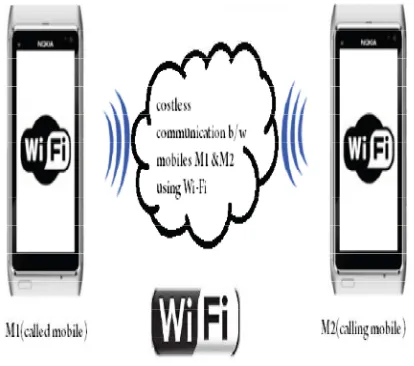
Fig 2. Mobile Telephony Using Wi-Fi
The algorithm described in this paper would
allow the mapping without the need for
storing this mapping since it will convert
mobile number to unique IP and unique IP
to mobile number. This algorithm needs to
be applied to all mobiles wishing to use this
technique. It is clear that the new technique
using WIFI would allow users to make a
voice call through mobile phone at no cost.
MOBILE TO IP CONVERSION
ALGORITHM
A software solution was developed in order
to convert mobile numbers to IP addresses
and vice versa. In this program
development, it is possible to map the
mobile numbers to a valid IPv6 address, and
therefore there is no need for DNS lookup.
In addition, there is no need for
complicated hashing and addressing
protocols because the IP-to-Mobile
algorithm would produce a unique number
used as input, leading to a unique output
hexadecimal IPv6 address. The outputted
address is then allocated to private IP
within a specified range in order not to
conflict with other devices in the same
wireless range.
A. Traditional Hashing Algorithm for IP
N is the size of IP range, which should be a
prime number larger than our range in
Available Online At www.ijpret.com algorithm. Consider every IP address as a
quadruple of integers modulo N which in IP
addresses are 32-bit which quadruple 8- bit.
We can define function H for hashing of
number mod N, and fix any four coefficients
such that-
Ha (x1,x2,x3,x4) = (a1 × x1, a2× x2, a3 × x3,
a4× x4) mod N[11].
B. Mobile to IP Conversion Algorithm
This algorithm will map any mobile number
to a unique IPv6 address,
where X10 is {x |1,000,000,000≤ x ≤
9,999,999,999) base 10 decimal integer and
the function f(x) converts X base10 to X
base 16 Hexadecimal integer with range
{ x|3B9ACA00 ≤ x≤2540BE3FF} as defined
in the pseudo code of MobToIP.
C. function MobToIp(String number)
//Input: String representation of phone
number
//Output: IPv6
String ip←"" String hex←""
//character array of 16 hexadecimal group
of 4 hexadecimal octets, and all initialized
to zero
and separated by":"
ipArray ← ['0','0','0','0',':',...,':','0','0','0','0']
/* read mobile number and store it in
charArray, where each digit of the mobile
number is represented by one equivalent
hex digit. Eg charArray [ ] =
readMobNum(“9897345112”), then char
Array[‘9’,’8’,’9’,’7’,’3’,’4’,’5’,’1’,’1’,2’] */
char Array [ ]
=readMobNum(“calledNumber”)
/*Initialize Integers counter variables for
loop
Integer i←0; Integer k←0;
Loop {
if ipArray[k]=0
{
ipArray[k]=charArray[i]
i←i+1
}
if ipArray[k]=":"
{
ipArray[k+1]=charArray[i]
}
k←k+1
Available Online At www.ijpret.com While( i<=len of charArray & k<= len of
ipArray)
/*create String buffer object hexBuffer
Integer c←0
Loop for c<= length of ipArray
{
hexBuffer←ipArray[c]
c←c+1
}
ip←hexBuffer return ip
End function
IP- to-Mobile Conversion Algorithm
This algorithm would do the reverse of
Mobile-to-IP algorithm to convert unique
IPv6 into mobile number, where X16 is
{x|3B9ACA00 ≤ x ≤2540BE3FF} base 16
hexadecimal integer and the function g(x)
converts X base16 from to X base10 decimal
integer with range X10 is {x|1,000,000,000≤
x ≤ 9,999,999,999} as defined in the pseudo
code of IpToMob.
E. Function IP To Mob
/*Input: IPv6
/*Output: String representation of phone
number
/*Initialize local String variables to empty
Strings
String string1, string2, string3←"" String
output←""
charArray will be set to input ip value
charArray ← ip
/*String buffer object firstBuffer new buffer
object
Integer loop counter i←0
Loop For i< length of charArray
{
firstBuffer←charArray[i] increment i←i+1
}
/*reverse order of string buffer elements of
firstBuffer string1← firstBuffer reverse
/*Character Array charArray2 will contain
values of string 1 charArray2 ← string1
/*loop replace trailing zeros with "*"
Integer loop counter c←0
Loop For c<charArray2.length
{
if charArray2[c]=':' or charArray2[c]=='0'
{
/*replace zeros & colon with “*” to mark
that they are no longer needed
Available Online At www.ijpret.com }
else
{
break out of for loop
}
}
End for loop
String buffer secondBuffer new buffer
object
Integer loop counter c←0
Loop For c<charArray2.length
{
secondBuffer<charArray2[c]
}
End for loop
/* reverse order of string buffer elements of
secondBuffer
string1 ←secondBuffer reverse
String x
character array charArray3 ← string2
Integer loop counter k←0
Loop For k←length of charArray3
{
if charArray3[k]!='*'
{
string3←string3+charArray3[k]
}
}
End for loop
character array charArray4 ← string3
Integer loop counter a←0
Loop For a<length of charArray
{
if charArray[a]!=':'
{
output ← output + charArray[a]
}
}
End for loop
Long integer num ← output to integer
return num
End function
5 ALGORITHM TEST RESULT
The voice over WIFI telephony application
will use Java technology as means to
develop the software for mobile devices.
Java for Micro-Devices or J2ME also
software developers to implement software
that is able to be distributed to all Java
enabled phones with minimal alteration in
compilation and versioning. J2ME is robust,
scalable, and secure platform for mobile
phones, personal digital assistants, and
embedded devices. J2ME contains TCP/IP
networking and GUI APIs along with other
Available Online At www.ijpret.com development mobile applications. The
utilization of native platform dependent
code maybe needed in order to
automatically change IP addresses within
the phones operating system without user
interaction. At this stage implementation
covers the conversion of mobile number to
IPv6 address and the reverse conversion of
IPv6 address into mobile number. A Java
program for the conversion from mobile to
IPv6 and from IPv6 to mobile has been done
and proven the correctness of the
algorithms. Where, a user would enter the
mobile number which will be converted to a
unique IPv6. The other IPv6 to mobile
algorithm allows user to enter IPv6 in hex
and then it will convert it to mobile
number. In the future a complete program
will be developed to establish a p2p
connection or a virtual connection over AP
in order to allow the 2 mobile phones to
communicate to each other over WIFI
technology at no cost.
Conclusion
It can be possible to design a application for
Smartphone OS such as Android mobile by
which we can communicate with other
using SIP-based VoIP. The purpose of this
paper is to implement a telephony program
that uses WIFI in Peer to-Peer or WLAN
(Wireless Local Area Network) as a means
of communication between mobile phones
at no cost. The system will allow users to
search for other individuals within WIFI
range and to establish free peer to peer
connection for voice communication.
References
1. B. Regis J, and D. W. Gregory, “Voice
and Data Communication”, 4rth ed.
California, Berkeley: McGraw Hill, 2001.
2. F. Borko, and M. Ilyas, “Wireless
Internet Handbook Technology, Standards,
and Applications”, 1st ed. NY, New York:
McGraw Hill, 2000.
3. O. Tammer, and P. Valduriez, “Principles
of Distributed Database Systems”, 2nd ed.
New Jersey: Prentice Hall, 1999.
4. C. Douglas, “Internetworking with
TCP/IP Volume 1: Principles, Protocols, and
Architecture”, 3rd. Upper Saddle River, NJ:
Prentice Hall International, 1995.
5. Hac, and Anna, “Mobile
Available Online At www.ijpret.com Networks”, 1st.London: John Wiley & Sons
LTD, 2000.
6. J. Distefane, and A. Ronan, “Guide To
Wireless Enterprise Application
Architecture”, 1st ed. NY, New York: John
Wiley &Sons Inc, 2002.
7. S. Gast, and Mathew, “802.11 Wireless
Networks the Definitive Guide”, 1st.
California: Orielly, 2000.
8. William Lee, “Wireless and Cellular
Telecommunications.3rd”, New York, NY:
McGraw Hill, 2006.
9. Taylor D. Edgar, “TCP/IP Complete”, 1st.
New Jersey: McGraw Hill, 1998.
10. A. Forouzan Behrouz, “TCP/IP Protocol