Address for correspondence
Dr. P. Bharath Rathna Kumar Department of Pharmaceutical Analysis, JNTUA - Oil Technological Research Institute,
Ananthapuramu - 515001, Andhra Pradesh, India. E-mail: [email protected]
Bharath Rathna Kumar et al. / JGTPS / 6(2)-(2015) 2555 – 2561
A NEW RP-HPLC METHOD DEVELOPMENT AND VALIDATION FOR
SIMULTANEOUS ESTIMATION OF TRIFLUOPERAZINE AND
CHLORDIAZEPOXIDE IN A TABLET DOSAGE FORM
INTRODUCTION
Trifluoperazine is chemically 10-[3-(4-methyl piperazine-1-yl)propyl]-2-(trifluoro10-[3-(4-methyl)- piperazine-1-yl)propyl]-2-(trifluoromethyl)-10H-phenothiazine[1], its molecular weight is 407.496g/mol with an empirical formula C21H24F3N3S.It acts as anti-psychotic agent, it blocks postsynaptic mesolimbic dopaminergic D1 and D2 receptors in the brain; depresses the release of hypothalamic and hypophyseal hormones and is believed to depress the reticular activating system thus affecting basal metabolism, body temperature, wakefulness, vasomotor tone, emesis[2] and also it acts as anti-emetic, dopamine antagonist, antipsychotic [3-7]. The structure of Trifluoperazine is shown in Fig.1.
Fig1:Chemical Structure of Trifluoperazine
Chlordiazepoxide is chemically 7-chloro-2-Methylamino-5-phenyl-3H-1,4- benzodiazepine-4-oxide[6], its molecular weight is 299.80g/mol with an empirical formulaC16H14ClN3O. It was the first benzodiazepine to be used clinically with general properties similar to those of diazepam and used in the short-term treatment of anxiety disorders and insomnia [7]. The structure of Chlordiazepoxide is shown in Fig.2.
A simple, rapid, accurate, specific and sensitive reverse phase-HPLC method has been developed and validated for the simultaneous estimation of Trifluoperazine and Chlordiazepoxide in pharmaceutical dosage form. The chromatographic separation was performed on InertsilODS-3V C18 Column (150mm×4.6mm, 5μm particle size) using a mobile phase of Mixed phosphate buffer: Acetonitrile (55:45 v/v), at a flow rate of 1.0ml/min at an ambient temperature with the detection wave length at 252nm. The retention times of Trifluoperazine and Chlordiazepoxide were 5.001 min and 3.058 min respectively. The linearity was performed in the concentration range of 2.5-15μg/ml (Trifluoperazine) and 2.5-15μg/ml (Chlordiazepoxide) with a correlation coefficient of 0.9997 and 0.9983 for Trifluoperazine and Chlordiazepoxide respectively. The percentage purity of Trifluoperazine and Chlordiazepoxide was found to be 99.46 and 99.13% w/v respectively. The proposed method has been validated for specificity, linearity, precision, accuracy and robustness were within the acceptance limit according to ICH guidelines and the developed method was successfully employed for routine quality control analysis in the combined pharmaceutical dosage forms.
Key words: Trifluoperazine, Chlordiazepoxide, RP-HPLC, Validation.
ABSTRACT
Sukanya. R,
Bharath Rathna Kumar.P*,
Venu Priya R
Chandra Sekhar.K.B
Department of Pharmaceutical
Analysis, JNTUA - Oil
Technological Research
Institute, Ananthapuramu
-515001, Andhra Pradesh,
India.
Journal of Global Trends in Pharmaceutical Sciences
Journal home page: www.jgtps.com
ISSN: 2230-7346
Fig2:Chemical Structure of Chlordiazepoxide
The combination of these both Trifluoperazine and Chlordiazepoxide drugs were used for the treatment of anxiety, acute alcohol withdrawal, agitation or tension, increase activity of the inhibitory transmitter GABA in different parts of CNS; they also produce antipsychotic, muscle relaxant and anticonvulsant activity. Literature survey reveals that few Spectrophotometric methods[8], Colorimetric method[9], HPLC methods[10-11], and has been reported for the estimation of Trifluoperazine and Chlordiazepoxide. The aim of the present study is to develop a simple, precise and accurate reversed-phase HPLC method for the estimation of Trifluoperazine and Chlordiazepoxide in pharmaceutical dosage form as per ICH guide lines.
MATERIALS AND METHODS
Instrumental and analytical conditions: Reagents and chemicals:
The pharmaceutical drug samples Trifluoperazine and Chlordiazepoxide were obtained as an all the chemicals used of HPLC grade such as Mixed Phosphate Buffer was obtained from Rankem (RFCL Limited)Manufacturers and Acetonitrile was purchased from Thermo fischer scientific India Pvt. Ltd, used as a mobile phase. Water used in the buffer preparation was freshly prepared from Milli-Q.
Equipment:
A Waters e2695 gradient system with Empower-2 software and 2489 UV/Vis detector is the most sensitive and versatile dual wave length absorbance detector was used. It was manufactured by the company Waters, Alliance, Japan. Intelligent LC pump with sampler programmed at 20μL capacity per injection was used.
Chromatographic conditions:
The column used was IntersilODS-3V C18 Column (150mm×4.6mm, 5μm particle size) was used for analytical separation. The mobile phase consisted of an aqueous solution of Mixed phosphate buffer and Acetonitrile in the ratio of (55:45%v/v). The flow was adjusted to 1.0ml/min. The instrument was operated at an ambient temperature. The UV detection was achieved at 252nm and purity analysis was performed over a wavelength range of 200-400nm. The injection volume was 20μL capacity.
Preparation of Analytical solutions:
Preparation of Mixed Phosphate buffer solution: A weighed quantity of 3.25g of potassium dihydrogen phosphate and 0.69g of di potassium hydrogen phosphate taken in a 1000ml beaker. Adjust pH to 3 with orthophosphoric acid. The mixture is sonicated and filtered through 0.45μ membrane filter.
Preparation of Mobile phase (diluent):
Mix a mixture of above buffer 550 ml (55%), 450 ml of Acetonitrile (HPLC grade-45%) and degas in ultrasonic water bath for 5 minutes. Filter through 0.45μ filter under vacuum filtration.
Preparation of standard stock solution:
Preparation of the individual Trifluoperazine standard preparation
The standard stock solution was prepared by dissolving 2mg of standard drug of Trifluoperazine in 50ml volumetric flask to which add 40ml of mobile phase [Mixed phosphate buffer: Acetonitrile (55:45,v/v)] and sonicated for about 10 min then the final volume was made upto 50 ml with the mobile phase and shaken then filtered through 0.45µ membrane filter. The filtered solution was further diluted in the diluent to make the final concentration.
Preparation of the individual Chlordiazepoxide standard preparation
The standard stock solution was prepared by dissolving 10mg of standard drug of Chlordiazepoxide in 50ml volumetric flask to which add 40ml of mobile phase [Mixed phosphate buffer: Acetonitrile (55:45,v/v)] and sonicated for about 10 min then the final volume was made upto 50 ml with the mobile phase and shaken then filtered through 0.45µ membrane filter. The filtered solution was further diluted in the diluent to make the final concentration.
Preparation of standard solution:
Pipette out 1ml from the above stock solution into a 10ml volumetric flask and was diluted up to the mark with diluent. Then the concentration of Trifluoperazine and Chlordiazepoxide was found to be 4ppm and 20ppm respectively.
Preparation of sample solution (Marketed formulation):
Method Development and Validation of HPLC: The suggested analytical method was validated according to ICH guidelines with respect to certain parameters such as specificity, linearity, precision, accuracy, robustness and system suitability.
Specificity:
The specificity was carried out to determine whether there are any interference of any impurities (presence of components may be unexpected to present) in retention time of analytical peak. Forced degradation studies are carried out by using 0.1M HCl, 0.1M NaOH, heat and U.V light.
Linearity:
Express ability to obtain test results where directly proportional to the concentration of analyte in the sample. The linearity of the method was established by a spiking a series of sample mixtures of Trifluoperazine and Chlordiazepoxide, the solutions of six different concentration levels 1-6μg/ml (Trifluoperazine) and 5-30µg/ml (Chlordiazepoxide) are injected in to the HPLC system. Construct the calibration curves for the standard solutions by plotting their response ratios (ratios of the peak area of the analytes) against their respective concentrations linear regression was applied and slope-a, intercept-b, correlation coefficient-R2 and standard error (Er) were determined.
Precision:
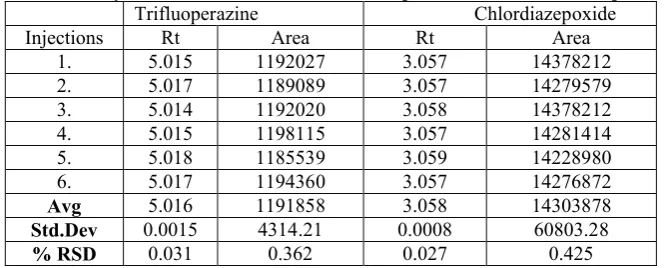
Express the closeness of agreement between the series of measurement obtained from multiple sampling of same homogeneous sample under the prescribed conditions. Method precision was determined both in terms of repeatability (injection and analysis) and intermediate precision/Ruggedness (It shows the degree of reproducibility of test results obtained by analysing the sample under variety of normal test conditions such as analyst, instruments). In order to determine precision, six independent sample solution preparations from a single lot of formulation 4μg/ml for Trifluoperazine and 20μg/ml for Chlordiazepoxide was injected in to HPLC system, the retention time and peak area was determined and expressed as mean and %RSD calculated from the data obtained which are found to be within the specified limits.
Accuracy:
Accuracy was determined in terms of percentage recovery the accuracy study was performed for 50%, 100% and 150 % for Trifluoperazine and Chlordiazepoxide. Standard and sample solutions are injected in to HPLC system in triplicate and percentage recoveries of Trifluoperazine and Chlordiazepoxide were calculated. The area of each level was used for calculation of % recovery.
Robustness:
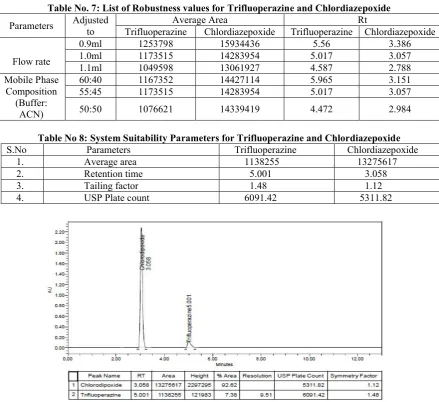
Robustness of the developed method was investigated by evaluating the influence of small deliberate variations in procedure variables like flow rate (±5%) and change in wave length (±5nm). The robustness was performed for the flow rate variations from 0.9ml/min to 1.1ml/min and the method is robust only in less flow condition and even by change in the mobile phase ±1%.
System Suitability:
System suitability tests were carried out on freshly prepared standard stock solutions of Trifluoperazine and Chlordiazepoxide and it was calculated by injecting standards in six replicates at 6 minutes interval and the values were recorded.
RESULTS AND DISCUSSIONS
Trifluoperazine and Chlordiazepoxide was found to be 99.1% and 99.8% presented in Tables 5 & 6.The robustness were carried out with minor but deliberate changes in parameters i.e., detection wavelength, column temperature, and flow rate as presented in Table 7. Theoretical plates and tailing factor were observed and were found to be 6091.42 and 5311.82 (theoretical plates) and 1.48 and 1.12
(tailing factor) for Trifluoperazine and Chlordiazepoxide respectively.
The system suitability parameters like theoretical plates (N), tailing factor (T) were calculated and were found to be more than 2000 and not more than 2 and ascertained that proposed RP-HPLC method was accurate and precise as presented in Table 8.
Table No. 1: Linearity results for Trifluoperazine and Chlordiazepoxide Trifluoperazine Chlordiazepoxide S.No Concentration(µg/ml) Area Concentration(µg/ml) Area 1. 1 289760 5 3957807 2. 2 587503 10 7361399 3. 3 873352 15 10247854 4. 4 1138255 20 13275617 5. 5 1463447 25 16525102 6. 6 1736351 30 19906547
y = 28954x + 1183. R² = 0.999
0 500000 1000000 1500000 2000000
0 2 4 6 8
Ar
ea
Concentration (µg/ml)
Linearity of Trifluoperazine
Fig3: Showing linearity for Trifluoperazine
y = 64834x + 45685 R² = 0.998
0 5000000 10000000 15000000 20000000 25000000
0 10 20 30 40
Ar
ea
Concentration (µg/ml)
Linearity of Chlorodipoxide
Table No. 2: System Precision values for Trifluoperazine and Chlordiazepoxide Trifluoperazine Chlordiazepoxide
Injections Rt Area Rt Area
1. 5.015 1192027 3.057 14378212
2. 5.017 1189089 3.057 14279579
3. 5.014 1192020 3.058 14378212
4. 5.015 1198115 3.057 14281414
5. 5.018 1185539 3.059 14228980
6. 5.017 1194360 3.057 14276872
Avg 5.016 1191858 3.058 14303878
Std.Dev 0.0015 4314.21 0.0008 60803.28
% RSD 0.031 0.362 0.027 0.425
Table No. 3: Method Precision values for Trifluoperazine and Chlordiazepoxide Trifluoperazine Chlordiazepoxide Injections Rt Area Rt Area 1. 5.017 1189025 3.057 14211779 2. 5.019 1183777 3.058 14279960 3. 5.017 1184535 3.057 14279960 4. 5.021 1172043 3.059 14374879 5. 5.02 1186300 3.057 14387095 6. 5.021 1182384 3.057 14374755 Avg 5.019 1183011 3.058 14318071 Std.Dev 0.0018 5840.98 0.0008 71284.53 % RSD 0.037 0.494 0.027 0.498
Table No. 4: Ruggedness values for Trifluoperazine and Chlordiazepoxide Ruggedness-Day-1
(Intra day Precision)
S No Trifluoperazine Chlordiazepoxide
RT Area RT Area
1 5.021 1186308 3.053 14387099
2 5.023 1186317 3.055 14387122
3 5.025 1186321 3.057 14387128
4 5.027 1186325 3.059 14387135
5 5.029 1186333 3.061 14387269
6 5.031 1186345 3.063 14387299
Avg 5.026 1186325 3.058 14387175
Std Dev 0.0037 12.9 0.0037 85.56
RSD 0.074 0.001 0.122 0.001
Table No. 5: Recovery Studies for Trifluoperazine % Concentration (at
Specification level) Area % Recovery Mean Recovery 50% 286607 99.8%
99.2% 100% 1138208 99.1%
150% 1716315 99.6%
Table No. 6: Recovery Studies for Chlordiazepoxide % Concentration (at
Specification level) Area % Recovery Mean Recovery 50% 3512793 98.8%
99.4% 100% 14188219 99.8%
Table No. 7: List of Robustness values for Trifluoperazine and Chlordiazepoxide
Parameters Adjusted to TrifluoperazineAverage AreaChlordiazepoxide Trifluoperazine RtChlordiazepoxide
Flow rate
0.9ml 1253798 15934436 5.56 3.386
1.0ml 1173515 14283954 5.017 3.057
1.1ml 1049598 13061927 4.587 2.788
Mobile Phase Composition
(Buffer: ACN)
60:40 1167352 14427114 5.965 3.151
55:45 1173515 14283954 5.017 3.057
50:50 1076621 14339419 4.472 2.984
Table No 8: System Suitability Parameters for Trifluoperazine and Chlordiazepoxide S.No Parameters Trifluoperazine Chlordiazepoxide 1. Average area 1138255 13275617 2. Retention time 5.001 3.058 3. Tailing factor 1.48 1.12 4. USP Plate count 6091.42 5311.82
Fig5: Standard Chromatogram of Trifluoperazine and Chlordiazepoxide
SUMMARY AND CONCLUSION
The proposed method was found to be simple, precise, accurate and rapid for determination of Trifluoperazine and Chlordiazepoxide from pharmaceutical dosage form. The method was validated for parameters like specificity, linearity, accuracy, precision, robustness and system suitability values were found to be within limits. The method has significant advantages, in terms of shorter analysis time, selectivity, and accuracy than previously reported. The validation study indicates that method can be considered suitable for carrying out quality control and routine determination of Trifluoperazine and Chlordiazepoxide in bulk and pharmaceutical dosage form
ACKNOWLEDGEMENTS
The authors are thankful to Bio-Leo labs, Kukatpally, Hyderabad and JNTUA - Oil Technological Research Institute, Ananthapuramu for providing necessary facilities to carry out the research work.
REFERENCES
1. P. Shetti and A. Venkatachalam, E-Journal of Chemistry, 2010; 7(1): 299-313.
2. Sree Vidya Parvataneni and Pathuri Jnana Nagarjuna,World Journal of Pharmacy And Pharmaceutical Sciences,(2014; 3,(10), 1021-1031.
3. C.M.Bhaskar Reddy, G.V.Subba Reddy and N. Ananda Kumar Reddy, International Journal of Scientific and Research Publications, 2012; 2(8),1-5.
4. Donthineni Kalyan and Punna Venkateshwarlu, Asian Journal of Pharmaceutical Research,2015; 5(1), 7-12.
5. Jameel M. Dhabab, Al- Mustansiriya J. Sci, 2011; 22(2),123-128.
6. RB Saudagar, Swarnlata Saraf and S Saraf, Indian Journal of Pharmaceutical Sciences, 2007; 69(1), 149-152.
8. Sejal Patel, N. J. Patel, and S. A. Patel, Indian Journal of Pharmaceutical Sciences, 2009; 71(4),468-472.
9. Safwan Ashour and Nuha Kattan, Journal of Pharmaceutics, 2013; 2013; 7.
10. Sejal Patel and N. J. Patel, Indian Journal of Pharmaceutical Sciences,2009; 71(4), 472-476. 11. Patel, Sejal K, Patel and Natvarlal J, An
International Journal of Analytical Science, (2010); 93,(3),904-910.