ISSN: 1942-9703 / © 2016 IIJ Abstract— BIDIKMISI scholarship given to students is concerns
of the government through the Directorate General of Higher Education (Directorate of Higher Education) to students who are academic potential adequate but economically disadvantaged in Indonesia. The program is channeled through universities or institutions designated as recipients of BIDIKMISI Scholarship through the Directorate General of Higher Education (Directorate General of Higher Education). One main goal of BIDIKMISI is to cut the chain of poverty lines. It means that children with limited economy can enter higher education. Many studies have been carried out by applying algorithms in order to get the best decision of the scholarsip recipients. Artificial neural network (ANN) has been known for prediction based data. In this paper, ANN with backpropagation method is studied to find the best solution in deciding the recipients as the application increases dratically from time to time.
Index Terms—ANN, Backpropagation, BIDIKMISI and Student, prediction, model
I. INTRODUCTION
ach citizen is entitled to teaching. The right of every citizen of the country has been included in Article 31 (1) of the Constitution of 1945 of Republic of Indonesia. According to the article, the government and the regional governments are obliged to provide services and facilities, and to ensure implementation of high quality education for every citizen without discrimination, and people are required to provide support resources in education. Various types of scholarships or tuition assistance both by the central government, the local governments as well as from the business or industry have been launched. However, the relative assistances could not meet the needs of the study, the number of targets and yet ensure the sustainability of the students to complete the study.
Manuscript received August 10, 2015.
Ayub Wimatra is with the ATKP Medan, South Sumatera, Indonesia; (email: [email protected]).
Darmeli Nasution is with University of Pembangunan Pancabudi Medan, South Sumatera, Indonesia; (phone +628134864446; email: [email protected]).
T. Henny Febriana Harumy is with University of Pembangunan Pancabudi Medan, South Sumatera, Indonesia; (phone +6281264945037; email: [email protected]) .
Sunardi is with is with the ATKP Medan, South Sumatera, Indonesia; (email: [email protected]).
The Government through the Directorate General of Higher Education, Ministry of Education and Culture began in 2010 has launched the Assistance Program Education Cost BIDIKMISI namely tuition assistance for prospective students who have finished their studies and have academic potential either to study in colleges or universities on excellent courses with on time graduation, Legislation that is premised on the provision of tuition assistance is the Law of the Republic of Indonesia Number 20 Year 2003, the Law of the Republic of Indonesia Number 12 Year 2012, the Indonesian Government Regulation No. 48 of 2008 and the Government Regulation of the Republic of Indonesia Number 66 Year 2010. Scholarships include tuition payments BIDIKMISI Scholarship for each semester study for free with the added cost of living and the cost of extracurricular activities during the three years of college. Cost of living alone ranges from 600,000 to 650,000 per month per student in all public universities in Indonesia.
Approximately 117 state universities in Indonesia have acquired these funds. In 2011, BIDIKMISI Scholarship of Higher Education was given to several colleges in Indonesia despite its quota is less than the quota of BIDIKMISI Scholarship for universities. One of the goals of BIDIKMISI scholarships is to cut the chains of poverty. It means that children with limited economy could attend higher educations. Private colleges such as Panca Budi Medan is one of the universities or institutions have been trusted to receive scholarships aimed to conduct the mission of the Directorate General of Higher Education (Directorate of Higher Education). The university will receive students who have academic potential adequate but economically disadvantaged. In providing the aim of the scholarships at the mission, the college or institution does not have any standards or rules that can be used as guidances or references. This has resulted in intense competition for BIDIKMISI scholarship students from private colleges.
Prospective scholarship recipients will face tough competition in order to get scholarships as intended by the mission, particularly for high school graduates who will go to colleges. Therefore, it needs a rule made by the university or institution for channeling funds scholarship program BIDIKMISI Scholarship properly to the students so that the goal of the government in carrying out this scholarship can be realized in order to cut the chain poverty line and to assist the problems related to the course of a lecture being undertaken. The scholarship covers living expenses and tuition fee for a period of 3 years.
Backpropagation Model for BIDIKMISI
Recipients
Ayub Wimatra, Darmeli Nasution, T. Henny Febriana Harumy and Sunardi
A number of studies have been carried out related to the BIDIKMISI Scholarship. The study, among other things are Wibowo [1], Pesos Umami, et al [2] with the title of decision support systems scholarships aimed at the mission, and Arifin and Syahrudin [3] entitled to survey the use of scholarships are managed by recipients BIDIKMISI scholarship. In this paper, the investigation is aimed to compare the extent to which the accuracy of the algorithms used in predicting the data problems based on previous research.
Artificial Neural Network (ANN) or Network Neural (ANN) is one method that has been known for prediction problems. The method can also be used to forecast based on the pattern of events in the past. This can be done by using the ability of neural networks to remember and make generalizations from what already existed. One method that can be used to improve the weight of the neural network is called Backpropagation method. This method is commonly used in the completion of problems relating to identification, prediction, pattern recognition and so on. In the repetitive training, this algorithm will result in better performance. This means that the "weight of interconnection" in the Artificial Neural Network (ANN) will be closer weights as it should be. Another advantage possessed by the ANN is its ability to learn (adaptive) for error immune (Fault Tolerance) with an excess of the ANN that can create a system that will withstand damage (robust) and consistently working well. Neural Network can provide the best solution in reaching a decision to the universities or institutions in providing scholarship grants aimed by the mission
II. LITERATURE
AI is a field of study based on the premise that intelligent thought can be regarded in the computation form that can be formalized and ultimately mechanized. To achieve this, however, two major issues need to be addressed. The first issue is knowledge representation, and the second is knowledge manipulation [4]. The main aim of Artificial Intelligence (AI) is to study how to build artificial systems that perform tasks normally carried out by human being. From that moment on, a lot of effort has been made and many goals have been achieved but unfortunately there are many failures as well. Today, the AI is a very important discipline and it includes a number of well-recognized and mature areas: Expert Systems, Fuzzy Logic, Genetic Algorithms, Language Processing, Logic Programming, Planning and Scheduling, Neural Networks and Robotics [5].
The general problem of simulating intelligence has been simplified to specific sub-problems which have certain characteristics or capabilities that an intelligent system should exhibit. The following characteristics have received considerable attention:
a. Deduction, reasoning, problem solving (embodied agents, neural networks, statistical approaches to AI);
b. Knowledge representation; Planning (multi-agent planning and cooperation);
c. Learning (machine learning);
d. Natural Language Processing (information retrieval – text mining, machine translation); e. Motion and Manipulation (navigation,
localization, mapping, motion planning);
f. Perception (speech recognition, facial, recognition, object recognition);
g. Social Intelligence (empathy simulation);
h. Creativity (artificial intuition, artificial imagination); and
i. General Intelligence (Strong AI).
Classic AI approaches focus on individual human behavior, knowledge representation and inference methods. Distributed Artificial Intelligence (DAI), on the other hand, focuses on social behavior, i.e. cooperation, interaction and knowledge-sharing among different units (agents). The process of finding a solution in distributed resolution problems relies on sharing knowledge about the problem and cooperation among agents. It was from these concepts that the idea of intelligent multi - agent technology emerged. An agent is an autonomous cognitive entity which understands its environment, i.e. it can work by itself and it has an internal decision-making system that acts globally around other agents. In multi-agent systems, a group of mobile autonomous agents cooperate in a coordinated and intelligent manner in order to solve a specific problem or classes of problems [3].
A. The use of artificial intelligence for forecasting
The most used AI technique is probably the artificial neural networks (ANN). The concept of the learning algorithm of the ANN is similar to the function of the human brain. They work by a series of interconnected neurons in a similar manner to the working of the brain. However even with the largest modern computers it is estimated that an ANN with 10 million interconnections would have a neuron structure somewhat smaller than a cockroach. The process of using the ANN for forecasting is largely the same as for other forecasting methods such as multiple regressions. These two techniques are often utilized and compared. In each case, there is input data which is used to model output data. Each uses a series of coefficients in the modeling process and attempts to minimize error in a similar manner. The standard methods of holdout samples are also commonly used in both as a measure of the forecasting ability. The internal process of the ANN is however more complex and less easy to reproduce and explain. It functions as a “black box” to a much larger extent than for traditional statistical methods. On the other hand, people with no background in the method seem to be able to make better predictions using ANNs. This sets a dangerous precedent and it is probable the use of ANNs will be over-sold, and they will be used in situations where more conventional methods are probably superior [9].
B. Artificial Neural Networks (NN)
ISSN: 1942-9703 / © 2016 IIJ output in order to achieve better performance. However, in
unsupervised learning, there is no trainer present to hand over the desired output and the network, therefore the network tries to learn by itself, organizing the input instances of the problem. NN architectures have been broadly classified as single layer feed forward networks, multilayer feed forward networks and recurrent networks. Over the years, several other NN architectures have evolved . Some of the well known NN systems include Backpropagation network, perceptron, ADALINE, Boltzmann machine, adaptive resonance theory, Self-organized feature map, and Hopfield network. Neural Network has been successfully applied to problem in the field of pattern recognition, image processing, data compression, forecasting and optimization to quote a few [4].
C. Architecture Backpropagation
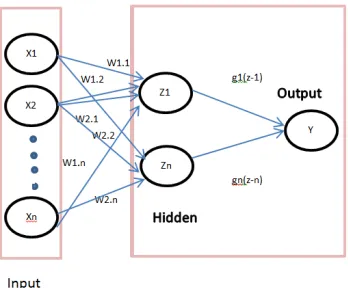
The back-propagation learning algorithm (BPLA) was proposed by Rumelhart et al. [13]. It has a learning algorithm among ANNs. In the learning process, in order to reduce the inaccuracy of ANNs, BPLAs use the gradient-decent search method to adjust the connection weights. The structure of a back-propagation ANN is shown in Fig. 1below:
Fig 1.Architecture of Backpropagation
The output of each neuron is the aggregation of the numbers of neurons of the previous level multiplied by its corresponding weights. The input values are converted into output signals with the calculations of activation functions. Backpropagation ANNs have been widely and successfully applied in diverse applications, such as pattern recognition, location selection and performance evaluations [5].
There are several algorithms that can be used to create an artificial neural network, but the Back propagation is chosen because it is the easiest algorithm for implementation, while preserving efficiency of the network. Backward Propagation Artificial Neural Network (ANN) uses more than one input layers (usually 3). Each of these layers must be either of the following:
a. Input Layer – holds the input for the network b. Output Layer – holds the output data, usually an
identifier for the input.
c. Hidden Layer – comes between the input layer and the output layer. They serve as a propagation point for sending data from the previous layer to the next layer [6].
D. Steps Backpropagation Neural Network
Phases in Backpropagation Technique algorithm can be divided into two phases: propagation and weight update.
Phase 1: Propagation
The propagation involves the following steps:
1. Forward propagation of a training pattern's input is given through the neural network in order to generate the propagation's output activations.
2. Back propagation of the output activations propagation through the neural network using the training pattern's target in order to generate the deltas of all output and hidden neurons.
Phase 2: Weight Update For each weight-synapse:
1. Multiply its input activation and output delta to get the gradient of the weight.
2. Bring the weight in the direction of the gradient by adding a ratio of it from the weight.
This ratio impacts on the speed and quality of learning; it is called the learning rate. The sign of the gradient of a weight designates where the error is increasing; this is why the weight must be updated in the opposite direction. The phase 1 and 2 are repeated until the performance of the network is satisfactory [7].
E. Evaluating The Performance Of The Models
The main measures used for evaluating the performance of machine learning techniques for predicting the software effort are as follows [8]:
a. Sum Squared Error (SSE)
The sum squared error is defined as.
∑ (𝑃𝑃𝑃𝑃 − 𝐴𝐴𝑃𝑃)𝑛𝑛 2
𝑖𝑖=1 (1)
Where
Pi = Estimated value for data point i; Ai =Actual value for the data point i; n = Total number of data points.
b. Mean Squared Error (MSE)
The mean squared error is defined as.
1
𝑛𝑛∑ (𝑃𝑃𝑃𝑃 − 𝐴𝐴𝑃𝑃)𝑛𝑛𝑖𝑖=1 2 (2)
Where
Pi = Estimated value for data point i; Ai =Actual value for the data point i; n = Total number of data points.
The root mean squared error is defined as.
�1
𝑛𝑛∑𝑛𝑛𝑖𝑖=1(𝑃𝑃𝑃𝑃 − 𝐴𝐴𝑃𝑃)2 (3) Where
Pi = Estimated value for data point i; Ai =Actual value for the data point i; n = Total number of data points.
d. Mean Absolute Error (MAE)
The mean absolute error measures of how far the estimates are from actual values. It could be applied to any two pairs of numbers, where one set is “actual” and the other is an estimate prediction.
𝑀𝑀𝐴𝐴𝑀𝑀 =1
𝑛𝑛∑𝑛𝑛𝑖𝑖=1|𝑃𝑃𝑃𝑃 − 𝐴𝐴𝑃𝑃| (4) Where
Pi = Estimated value for data point i; Ai =Actual value for the data point i; n = Total number of data points.
e. Mean Percent Errors (MPE)
The Mean Percent Error (MPE) is a well known measure that corrects the 'cancelling out' results and also keeps into basis the different scales at which this measure can be calculated and thus can be used to analyze different predictions Where
𝑀𝑀𝑃𝑃𝑀𝑀 =1 𝑛𝑛∑
𝑃𝑃𝑖𝑖−𝐴𝐴𝑖𝑖 𝑃𝑃𝑖𝑖 𝑛𝑛
𝑖𝑖=1 ∗ 100% (5)
Pi = Estimated value for data point i; Ai =Actual value for the data point i; N = Total number of data points
III. RESEARCH METHODOLOGY
A. Source of Data
The data obtained and used in this paper are data recipients of BIDIKMISI scholarship since 2013 and 2014 at the University of Panca Budi Medan. This data amounted to 28 people where14 the data is use for training data and testing to get the best architectural patterns and 14 the data used to predict the result of the determination of the best patterns obtained during the experiment.
B. Variables Research
The observed variables are the factors used in the University of Panca Budi Medan in selecting recipients of scholarship. The search variables consist of 10 variables:
1) The job of parents
a Government employees = 1 b Private employees = 0.9 c Entrepreneur = 0.7
d TNI /Police = 0.5
e Farmer/fisherman = 0.3
f Other = 0.1
2) Income of parents
a Salary<1million (Low) = 0.2 b Salary=1-2.5 million (Medium) = 0.4 c Salary>2.5-5 million (High) = 0.6 d Salary>5 Million (Very High) = 0.8
3) The number of dependent parents a 1 Person = 1 b 2 Persons = 0.8 c 3 Persons = 0.6 d 4 Persons = 0.4 e > 5 Persons = 0.2
4) The state of the house
a Own = 0.9
b Contracts/Lease = 0.5
c Ride = 0.3
5) Home distance
a 1-5 Kilometers (Near) = 0.5 b >5-10 Kilometer (Medium) = 0.7 c >10 Kilometers (Far) = 0.9
6) Achievement 4th semester a Rating1 – 5 = 0.8 b Rating6 - 10 = 0.6 c Rating11 - 15 = 0.4 d Rating>16 = 0.2
7) Achievement 5th semester a Rating1 – 5 = 0.8 b Rating6 - 10 = 0.6 c Rating11 - 15 = 0.4 d Rating>16 = 0.2
8) Value 4th semester
a 0-100 = 0.3 b >100 – 1300 = 0.7 c > 1300 = 0.9
9) Value 5th semester a 0-100 = 0.3 b >100 - 1300 = 0.7 c > 1300 = 0.9
10) Achievement extracurricular
a Yes = 1
b No = 0
IV. DATA ANALYSIS METHODS
A. Analysis of Artificial Neural Network
The architecture of artificial neural networks is used in the determination of student selection by using backpropagation method. Here are the steps of the neural network forecasting procedures.
ISSN: 1942-9703 / © 2016 IIJ b) Initiation weight [0,1].
c) Determine many inputs based on pre determined criteria.
d) Learning algorithm data with backpropagation. e) Evaluating the criteria for selecting the best model in
any combination of inputs and neurons.
f) Training result data are returned to the initial scale data.
g) The best models are processed back to determine the prediction.
B. Determining the Best Model
To determine the best models, it is necessary to observe the value of MSE (Mean Square Error) is the smallest. The smaller the value indicates that the prediction is better and the model is feasible to be used for selection of students.
V. RESULTS AND DISCUSSION
A. Training and Testing
Training and testing phases have two processes, namely: a. Input Data
The input data used in this application were in the form of the factors considered as a condition of the recipient student selection of BIDIKMISI scholarship. Factors used were as many as 10 pieces. After that, it was to determine the values of each weighting variables (factors). The value of the variable was determined between [0-1] and adapted to the case of each of these factors. In this paper, it was determined if the value of these variables is high, it means the higher the dependence on the variable and vice versa.
b. Output Data
The output results from the selection of BIDIKMISI scholarship recipients are divided into feasible and not feasible. The output will be made in 3 nodes, as given in Table 1 and Table 2 below which indicate the output target value. The results are as follow:
a) To determine the feasibility of student selection view finder recipient mission. The output of eligibility are two possibilities, namely:
1. Eligible weighs 1 2. Not worth the weight 0 b) Category feasible or not feasible.
Categorization of worth is determined by the level of minimum error. Suitable categorization is given in Table I:
TABLEI Data Categorization Worth
No Description Error Minimum
1 very Worthy 0.0000 - 0.0010
2 worthy 0,0011 - 0,0100
3 Decent enough 0.0101 - 0.1000
Categorization of not worth is determined by the level of minimum error. Categorization of not feasible can be seen in Table 2:
TABLEII Data Categorization Worth
No Description Error Minimum 1 Very Improper 0.0000 - 0.0010 2 Not feasible 0,0011 - 0,0100 3 Enough Improper 0.101 - 0.1000
B. Pattern Determination of the Best
Training and testing were conducted multiple times with the same parameters in order to obtain the best results with the software application Matlab 6.1. Architectural models used in this study in order to get the best pattern are 10-50-1, 10-75-1, 10-100-1, 10-50-75-1and 10-75-100-1. Attribute parameters are as follow:
Activation function to Hidden Layer1 = Logsig Activation function to Hidden Layer2 = Tansig Activation function to Output Layer = Logsig
Type Trainning = Traingd
Number of Hidden Neurons Layer1 = 75 Number of Hidden Neurons Layer1 = 100
Learning rate = 0.1
Maximum Error limit = 0.0001
Show Limits = 1000
Epoch limit Maximum = 50000
a. Architecture10-50-1
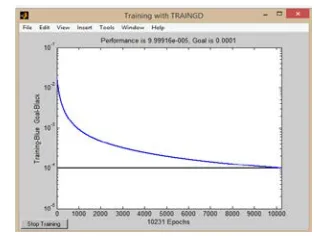
The parameters used to model the architecture of 10-50-1 with 10231 epochs leaded to MSE 0.9866999129 as shown in Fig. 2.
Fig 2.Results10-50-1architecture achieve Goal
b. Architecture 10-75-1
Fig 3.Results10-75-1architecture achieve Goal
c. Architecture10-100-1
The parameters used to model architectural 10-100-1with epochs 8237 gave MSE .9841857571 shown in Fig. 4.
Fig 4. Results 10-100-1 architecture achieve Goal
d. Architecture 10-50-75-1
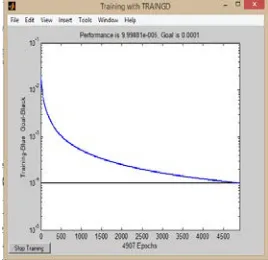
The parameters used to model the architecture of 10-50-75-1 with epochs 4907 produced MSE 0.9845571671 shown in Fig. 5.
Fig 5. Results architecture 10-50-75-1 achieve Goal
e. Architecture10-75-100-1
The parameters used to model the architecture of 10-75-100-1 with epochs 2913 leaded to MSE0.98338574 shown in Fig. 6.
Fig 6.Results 10 -75 -100 -1 architecture achieve Goal
From the results of the training and testing performed by the software application Matlab 6, the architecture 110 – 75 – 100 -1 resulted in the best results with pattern epochs 2913 and MSE0.98338574. The data comparison of each model is shown in Table III below:
Table III. Classification of ANN
10-50-1
10-75-1
10-100-1
10-50-75-1
10-75-100-1 Epochs 10231 10295 8237 4907 2913 MSE 0.9867 0.9855 0.9841 0.9845 0.9834
C. Prediction Scholarship Selection Aim BIDIKMISI
The last stage of the process is the selection of the prediction process for recipient of BIDIKMISI Scholarship by comparing the minimum error value of the obtained results. Using 10-75-100-1architectural models, data will be predicted to see how accurate the model is able to recognize data. The desired result of this final stage is to get the minimum error value for the prediction of architectural patterns. Data to be predicted are the data sample of BIDIKMISI 14 award from 28 the data recipients in 2014 and 2015 at the University of Development Panca Budi Medan. The resulted levels are given in Table IV below.
Table IV. Classification of ANN
ISSN: 1942-9703 / © 2016 IIJ VI. CONCLUSION
Backpropagation method was applied to predict the selection of award for recipients of BIDIKMISI scholarship. Using the backpropagation method, the desired output target achieved high accuracy in testing due to the adjustment of weights values and bias that got better in the training process. Selection prediction results obtained grantee BIDIKMISI Scholarship to the level of data accuracy above 90% of the14 tested samples.
REFERENCES
[1] H. Wibowo , et al., "Decision Support System for Determining Bank BRI Scholarship Recipients Using FMADM (Case Study: Student Faculty Teknology Industry University Of Islam Indonesia)," in National Conference (SNATI) , Yogyakarta, 2009, pp. B62 - B67. [2] P. Umami, L.A. Abdillah, I.Z. Yadi, "Decision Support System BIDIK
MISI Scholarship," in National Conference Information System (KNSI), STMIK Dipanegara Makassar, Sulawesi Selatan, 2014. [3] B. Arifin and H. Syahrudin, "Aplication BIDIKMISI Scholarship to
Student FKIP UNTAN," Pendidikan dan Pembelajaran Journal,” vol. 2, 2013.
[4] S. Singh and S. Singh, “Artificial Intelligence International,” Journal of Computer Applications (0975 – 8887), vol. 6, no. 6, September 2010. [5] B. Castaño and Á. Moreno, “Technoma thematics Research Foundation
Artificial Intelligence And Bluetooth Techniques In A Multi user M-Learning Domain,” International Journal of Computer & Applications, vol. 5, no.1, Pp.1-13, 2008.
[6] S. Dilek, et al,, “Applications of Artificial Intelligence Techniques To Combating Cyber Crimes: A Review,” International Journal of Artificial Intelligence & Applications (IJAIA), vol. 6, no.1, Jan. 2015 [7] S.P. Kosbatwarand and S.K. Pathan, “Pattern Association For Character
Recognition By Back-Propagation Algorithm Using Neural Network Approach,” International Journal of Computer Science & Engineering Survey (IJCSES), vol.3, no.1, February 2012
[8] Zhen - GuoChe, et al, ”Feed - Forward Neural Networks Training: A Comparison Between Genetic Algorithm And Back-Propagation Learning Algorithm,” International Journal of Innovative Computing, Information and Control ICIC International 2011, ISSN 1349-4198, vol. 7, no. 10, pp. 5839–5850, October 2011.
[9] N.Y. Choudhary, et al,, “Signature Recognition & Verification System Using Back Propagation Neural Network,“ International Journal of IT, Engineering And Applied Sciences Research (IJIEASR), ISSN: 2319-4413, vol. 2, no. 1, January 2013.
[10] S. Santhosh Baboo and I. Kadar Shereef, “An Efficient Weather Forecasting System Using Artificial Neural Network “, International Journal of Environmental Science and Development, ISSN: 2010-0264, vol. 1, no. 4, October 2010.
[11] N. Devbrat and Sahu Deepty Dubey, “Software Cost Estimation Using Artificial Neural,“ IJISET - International Journal of Innovative Science, Engineering & Technology, vol. 2 Issue 6, www.ijiset.com ISSN 2348 – 7968, June 2015.
[12] P. Rossini, “Using Expert Systems and Artificial Intelligence For Real Estate Forecasting,” Sixth Annual Pacific-Rim Real Estate Society Conference Sydney, Australia, 24-27 January 2000.
[13] D. E. Rumelhart, G. E. Hinton and R. J. Williams, “Learning representations by back-propagating errors,” Nature , vol. 323, no. 6088, pp.533-536, 1986.
Ayub Wimatra, S.SiT.,M.Pd is a lecturer in Academy of Avionic Flight Safety (Akademi Teknik Keselamatan Penerbangan), Medan.
Darmeli Nasution, S.Kom.,M.Kom is a lecturer at University of Pembangunan Panca Budi, Medan. She was graduated from Gunadharma University, Jakarta. Her research concerns to algorithm and computer graphic.
T. Henny F.H, S.Kom.,M.Kom, she is a lecturer at University of Pembangunan Panca Budi, Medan. Her focus research is algorithm and artificial intelligent.