Volume 7, Number 2, pp. 25–32. http://www.scpe.org c 2006 SWPS
BENCHMARKING OF A JOINT IRISGRID/EGEE TESTBED WITH A BIOINFORMATICS APPLICATION
J. HERRERA∗ , E. HUEDO∗ , R. S. MONTERO∗ ,AND I. M. LLORENTE∗
Abstract. Loosely-coupled Grid environments, based only on Globus services, allow a straightforward resource sharing, as
the resources are accessed by usingde facto standard protocols and interfaces, while providing non trivial levels of quality of service. This paper describes the execution of a Bioinformatics application over a highly distributed and heterogeneous testbed. This testbed is composed of resources devoted to EGEE and IRISGrid projects and has been integrated by taking advantage of the modular, decentralized and “end-to-end” architecture of the GridWay framework. Results obtained from the experiments have been analyzed using a performance model for high throughput computing applications.
1. Introduction. Different Grid infrastructures are being deployed within growing national and transna-tional research projects. The final goal of these projects is to provide the end user with much higher performance than that achievable on any single site. However, from our point of view, it is arguable that some of these projects embrace the Grid philosophy, and to what extent. This philosophy, proposed by Foster [7], definesa grid as a system (i) not subject to a centralized control and (ii) based on standard, open and general-purpose interfaces and protocols, (iii) while providing some level of quality of service (QoS), in terms of security, throughput, response time or the coordinated use of different resource types. In current projects, there is a tendency to ignore the first two requirements in order to get higher levels of QoS. However, these requirements are even more important because they are the key to the success ofthe Grid.
The Grid philosophy leads to computational environments, which we callloosely-coupled grids, mainly char-acterized by [3]: autonomy (of the multiple administration domains), heterogeneity, scalability and dynamism. In a loosely-coupled grid, the different layers of the infrastructure should be separated from each other, being only communicated with a limited and well defined set of interfaces and protocols. This layers are [3]: Grid fabric, core Grid middleware, user-level Grid middleware, and Grid applications.
The coexistence of several projects, each with its own middleware developments, adaptations or extensions, arise the idea of using them simultaneously (from an user’s viewpoint) or contribute the same resources to more than one project (from an administrator’s viewpoint). One approach could be the development of gateways between different middleware implementations [1]. Other approach, more in line with the Grid philosophy, is the development of client tools that can adapt to different middleware implementations. We hope this could lead to a shift of functionality from resources to brokers or clients, allowing the resources to be accessed in a standard way and easing the task of sharing resources between organizations and projects. We should consider that the Grid not only involves the technical challenge of constructing and deploying this vast infrastructure, it also brings up other issues related to security and resource sharing policies [13] as well as other socio-political difficulties [15]. Practically, the majority of the Grid infrastructures are being built on protocols and services provided by the Globus Toolkit1, becoming a
de factostandard in Grid computing. Globus architecture follows an hourglass approach, which is indeed an “end-to-end” principle [2]. Therefore, instead of succumbing to the temptation of tailoring the core Grid middleware to our needs (since in such case the resulting infrastructure would be application specific), or homogenizing the underlying resources (since in such case the resulting infrastructure would be a highly distributed cluster), we propose to strictly follow the “end-to-end” principle. Clients should have access to a wide range of resources provided through a limited and standardized set of protocols and interfaces. In the Grid, these are provided by the core Grid middleware, Globus, just as, in the Internet, they are provided through the TCP/IP protocols. Moreover, the “end-to-end” principle reduces the firewall configuration to a minimum, which is also welcome by the security administrators.
One of the most ambitious projects to date is EGEE2
(Enabling Grids for E-sciencE), which is creating a production-level Grid infrastructure providing a level of performance and reliability never achieved before. EGEE currently uses the LCG3
(LHC Computing Grid) middleware, which is based on Globus. Other much
∗Departamento de Arquitectura de Computadores y Autom´atica. Facultad de Inform´atica, Universidad Complutense de Madrid.
28040 Madrid, Spain.{jherrera, ehuedo}@fdi.ucm.es,{rubensm, llorente}@dacya.ucm.es
1
http://www.globus.org
2
http://www.eu-egee.org
3
http://lcg.web.cern.ch
26 J. Herrera, E. Huedo, R. S. Montero and I. M. Llorente
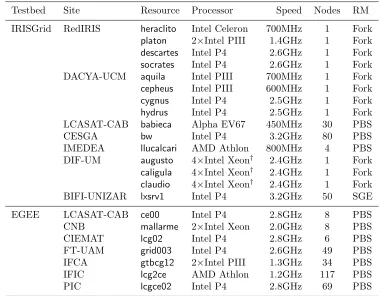
Table 2.1
IRISGrid and EGEE resources contributed to the experiment.
Testbed Site Resource Processor Speed Nodes RM
IRISGrid RedIRIS heraclito Intel Celeron 700MHz 1 Fork
platon 2×Intel PIII 1.4GHz 1 Fork
descartes Intel P4 2.6GHz 1 Fork
socrates Intel P4 2.6GHz 1 Fork
DACYA-UCM aquila Intel PIII 700MHz 1 Fork
cepheus Intel PIII 600MHz 1 Fork
cygnus Intel P4 2.5GHz 1 Fork
hydrus Intel P4 2.5GHz 1 Fork
LCASAT-CAB babieca Alpha EV67 450MHz 30 PBS
CESGA bw Intel P4 3.2GHz 80 PBS
IMEDEA llucalcari AMD Athlon 800MHz 4 PBS
DIF-UM augusto 4×Intel Xeon† 2.4GHz 1 Fork
caligula 4×Intel Xeon† 2.4GHz 1 Fork
claudio 4×Intel Xeon† 2.4GHz 1 Fork
BIFI-UNIZAR lxsrv1 Intel P4 3.2GHz 50 SGE
EGEE LCASAT-CAB ce00 Intel P4 2.8GHz 8 PBS
CNB mallarme 2×Intel Xeon 2.0GHz 8 PBS
CIEMAT lcg02 Intel P4 2.8GHz 6 PBS
FT-UAM grid003 Intel P4 2.6GHz 49 PBS
IFCA gtbcg12 2×Intel PIII 1.3GHz 34 PBS
IFIC lcg2ce AMD Athlon 1.2GHz 117 PBS
PIC lcgce02 Intel P4 2.8GHz 69 PBS
†These resources actually present two physical CPUs but they appear as four logical CPUs due to hyper-threading
more modest project is IRISGrid4(the Spanish Grid Initiative), whose main objective is the creation of a stable
national Grid infrastructure. The first version of the IRISGrid testbed is based only on Globus services, and it has been widely used through the GridWay framework5
.
For the purposes of this paper we have used a Globus-based testbed to run a Bioinformatics application through the GridWay framework. This testbed was built up from resources inside IRISGrid and EGEE projects. The aim of this paper is to demonstrate the application of an “end-to-end” principle in a Grid infrastructure, and the feasibility of building loosely-coupled Grid environments based only on Globus services, while obtaining non trivial levels of quality of service through an appropriate user-level Grid middleware.
The structure of the paper follows the layered structure of Grid systems, from bottom-up. The Grid fabric is described Section 2. Section 3 describes the core Grid middleware. Section 4 introduces the functionality and characteristics of the GridWay framework, used as user-level Grid middleware. Section 5 describes the target application. Section 6 presents the experimental results, which are analyzed through a benchmarking model in Section 7. Finally, Section 8 ends up with some conclusions.
2. Grid Fabric: IRISGrid and EGEE resources. This work has been possible thanks to the collab-oration of those research centers and universities that temporarily shared some of their resources in order to set up a geographically distributed testbed. The testbed results in a very heterogeneous infrastructure, since it presents several middlewares, architectures, processor speeds, resource managers (RM), network links, etc. A brief description of the participating resources is shown in Table 2.1.
Some centers are inside IRISGrid, which is composed of around 40 research groups from different spanish institutions. Seven sites participated in the experiment by donating a total number of 195 CPUs. Other centers
4
http://www.irisgrid.es
5
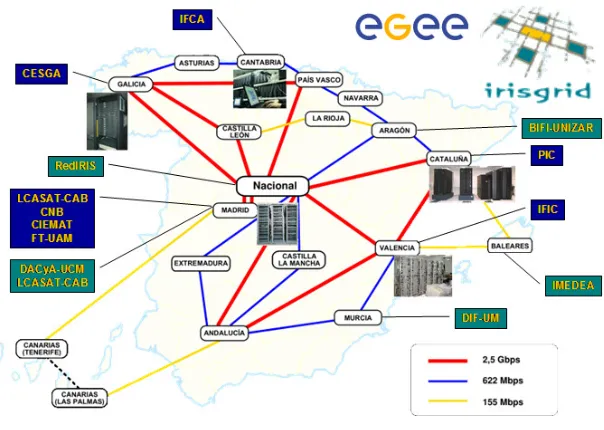
Fig. 2.1.Geographical distribution and interconnection network of sites.
participate in the EGEE project, which is composed of more than 100 contracting and non-contracting partners. Seven spanish centers participated by donating a total number of 333 CPUs.
Together, the testbed is composed of 13 sites (note that LCASAT-CAB is both in IRISGrid and EGEE) and 528 CPUs. In the experiments below, we limited to four the number of jobs simultaneously submitted to the same resource, with the aim of not saturating the whole testbed, so only 64 CPUs were used at the same time. All sites are connected by RedIRIS, the Spanish Research and Academic Network. The geographical location and interconnection links of the different sites are shown in Figure 2.1.
3. Core Grid Middleware: Globus. Globus services allow secure and transparent access to resources across multiple administrative domains, and serve as building blocks to implement the stages of Grid schedul-ing [14]. Table 3.1 summarizes the core Grid middleware components existschedul-ing in both IRISGrid and EGEE resources used in the experiments. In the case of EGEE, we only used Globus basic services, ignoring any higher-level services, like the resource broker or the replica location service.
Table 3.1
Core Grid middleware.
Component IRISGrid EGEE
Security Infrastructure
IRISGrid CA and
manually generated
grid-mapfile
DATAGRID-ES CA and automatically generated grid-mapfile
Resource Management
GRAM with shared home directory in clusters
GRAM without shared home directory in clusters Information
Services
IRISGrid GIIS and local GRIS, using the MDS schema
CERN BDII and local GRIS, using the GLUE schema
Data
Management
28 J. Herrera, E. Huedo, R. S. Montero and I. M. Llorente
We had to introduce some changes in the security infrastructure in order to perform the experiments. For authentication, we used a user certificate issued by DATAGRID-ES CA, so we had to give trust to this CA on IRISGrid resources. Regarding authorization, we had to add an entry for the user in thegrid-mapfilein both IRISGrid and EGEE resources.
4. User-Level Grid Middleware: GridWay. User-level middleware is required in the client side to
make it easier and more efficient the execution of applications. Such client middleware should provide the end user with portable programming paradigms and common interfaces.
In a Globus-based environment, the user is responsible for manually performing all the submission steps [14] in order to achieve any functionality. To overcome this limitation, GridWay [11] was designed with asubmit & forget philosophy in mind. The core of the GridWay framework is a personalsubmission agentthat performs all scheduling stages and watches over the correct and efficient execution of jobs on Globus-based Grids. The GridWay framework provides adaptive scheduling and execution, as well as fault tolerance capabilities to handle the dynamic Grid characteristics.
A key aspect in order to follow the “end-to-end” principle is how job execution is performed. In EGEE, file transfers are initiated by a job wrapper running in the compute nodes, therefore they act as client machines, so needing network connectivity and client tools to interact with the middleware. In GridWay, however, job execution is performed in three steps by the following modules:
1. prolog: It prepares the remote system by creating a experiment directory and transferring the input files from the client.
2. wrapper: It executes the actual job and obtains its exit status code.
3. epilog: It finalizes the remote system by transferring the output files back to the client and cleaning up the experiment directory.
This way, GridWay doesn’t rely on the underlying middleware to perform preparation and finalization tasks. Moreover, since bothprologandepilogare submitted to the front-end node of a cluster andwrapperis submitted to a compute node, GridWay doesn’t require any middleware installation nor network connectivity in the compute nodes.
Other projects [5, 6, 8, 16] have also addressed resource selection, data management, and execution adap-tation. We do not claim innovation in these areas, but remark the advantages of our modular, decentralized and “end-to-end” architecture for job adaptation to a dynamic environment.
In this case, we have taken full advantage of the modular architecture of GridWay, as we didn’t have to directly modify the source code of the submission agent. We extended the resource selector in order to understand the GLUE schema used in EGEE. Thewrappermodule also had to be modified in order to perform an explicit file staging between the front-end and the compute nodes in EGEE clusters.
5. Grid Application: Computational Proteomics. One of the main challenges in Computational Biology concerns the analysis of the huge amount of protein sequences provided by genomic projects at an ever increasing pace. In the following experiments, we will consider a Bioinformatics application aimed at predicting the structure and thermodynamic properties of a target protein from its amino acid sequence [10].
The algorithm, tested in the 5th round of Critical Assessment of techniques for protein Structure Prediction (CASP5)6
, aligns with gaps the target sequence with all the 6150 non-redundant structures in the Protein Data Bank (PDB)7, and evaluates the match between sequence and structure based on a simplified free energy
function plus a gap penalty item. The lowest scoring alignment found is regarded as the prediction if it satisfies some quality requirements. In such cases, the algorithm can be used to estimate thermodynamic parameters of the target sequence, such as the folding free energy and the normalized energy gap.
To speed up the analysis and reduce the data needed, the PDB files are pre-processed to extract the contact matrices, which provide a reduced representation of protein structures. The algorithm is then applied twice, the first time as a fast search, in order to select the 200 best candidate structures, and the second time with parameters allowing a more accurate search of the optimal alignment.
We have applied the algorithm to the prediction of thermodynamic properties of families of orthologous proteins, i. e. proteins performing the same function in different organisms. The biological results of the comparative study of several families of orthologous proteins are presented elsewhere [4].
6
http://PredictionCenter.llnl.gov/casp5/
7
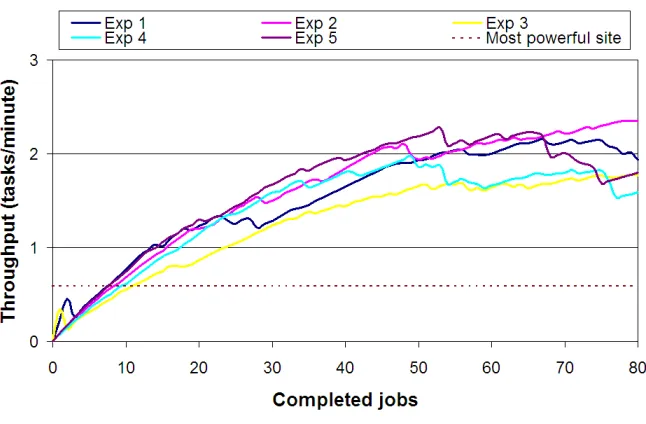
Fig. 6.1.Testbed dynamic throughput during the five experiments and theoretical throughput of the most powerful site.
The experiment files consists of: the executable (0.5MB) provided for all the resource architectures in the testbed, the PDB files shared and compressed (12.2MB) to reduce the transfer time, the parameter files (1KB), and the file with the sequence to be analyzed (1KB). The final name of the executable and the file with the sequence to be analyzed is obtained at runtime for each task and each host, respectively.
6. Experiences and Results. The experiments presented here consist in the analysis of a family of 80 orthologous proteins of the Triose Phosphate Isomerase enzyme (an enzyme is a special case of protein). Five experiments were conducted in different days during a week. The average turnaround time for the five experiments was 43.37 minutes.
Figure 6.1 shows the dynamic throughput achieved during the five experiments alongside the theoretical throughput of the most powerful site, where the problem could be solved in the lowest time, in this case DIF-UM (taking into account that the number of active jobs per resource was limited to four). The throughput achieved on each experiment varies considerably, due to the dynamic availability and load of the testbed. For example, resourcece00 at site LCASAT-CAB was not available during the execution of the first experiment. Moreover, fluctuations in the load of network links and computational resources induced by non-Grid users affected to a lesser extent in the second experiment, as it was performed at midnight.
7. Grid Benchmarking Model. In this section we apply a benchmarking methodology to analyze the performance of computational Grid infrastructures in the execution of a High Throughput Computing (HTC) applications [12]. In order to assess this model we will use the execution of the Bioinformatics application explained in previous sections. The benchmarking process used here provides a way to investigate performance properties of Grid environments, to predict the performance of this category of applications, and compare different platforms by inserting performance models in the benchmarking process.
7.1. Workload Characterization. In order to obtain the workload characterization of a grid, we have considered the formerly mentioned Bioinformatics application, that comprises the execution of a set of indepen-dent tasks, each of which performs the same calculation over a subset of parameter values. In the execution of this kind of applications, a grid can be considered, from the computational point of view, as an array of het-erogeneous processors. Therefore, the number of tasks completed as function of time is given by the following equation:
n(t) =X i∈G
Ni
t Ti
(7.1)
30 J. Herrera, E. Huedo, R. S. Montero and I. M. Llorente
The best characterization of the Grid can be obtained if we take the line that represents the average behavior of the system. The next formula represents this line using ther∞andn1/2parameters defined by Hockney and
Jesshope [9]:
n(t) =r∞t−n1/2 withm=r∞andb=−n1/2 (7.2)
These parameters are called:
• Asymptotic performance (r∞): the maximum rate of performance in task executed per second. In the
case of an homogeneous array ofN processors with an execution time per taskT, we haver∞=N/T.
• Half-performance length (n1/2): the number of task required to obtain the half of asymptotic
per-formance. This parameter is also a measure of the amount of parallelism in the system as seen by the application. In the homogeneous case, for an embarrassingly distributed application we obtain
n1/2=N/2.
The following equation defines the performance of the system (tasks completed per time) on actual appli-cations with a finite number of tasks based on the linear relation of Eq. 7.2:
r(n) =n(t)/t= r∞ 1 +n1/2/n
(7.3)
The half-performance length (n1/2) provides a quantitative measure of the homogeneity in a grid. We can
define the degree of homogeneity (v) as
v= 2n1/2
N . (7.4)
This parameter varies fromv= 1 in the homogeneous case, tov ≈0 when the actual number of processors in the Grid is much greater than the apparent number of processors (highly heterogeneous).
7.2. Benchmarking Methodologies. Previously, we have defined ther∞andn1/2parameters to obtain
a Grid model. These parameters can be determined in two ways:
• Intrusive benchmarking. The system parameters are calculated by linear fitting to the experimental results obtained in the execution of large-scale HTC applications. In order to empirically determine
r∞ andn1/2 the benchmarking process should be intrusive to exercise all the resources in the testbed
(n >> N).
• Non-intrusivebenchmarking. In general, it may not be feasible to run such an intrusive high throughput benchmark for large Grid environments. In this situation, ther∞andn1/2parameters can be computed
using 7.3 and raw performance data (average wall time per task,Ti) of each resource. Let us consider
Ti=Tixf r+Tiexe+Tisch, whereT xf r
i andTiexeare the average file transfer and execution times in host
i; and Tsch
i is the scheduling time which represents the resource selection overhead. We can rewrite Eq. 7.1 as:
n(t) =X i∈G
Ni
$
t
Tixf r+Tiexe+Tisch
%
. (7.5)
This equation can be used to obtain thenon-intrusiver∞ andn1/2parameters by fitting the best straight
line. We can also estimate the influence of the resource selection overhead by comparing the non-intrusiver∞
andn1/2, with those obtained by settingTsch to 0 in Eq. 7.5.
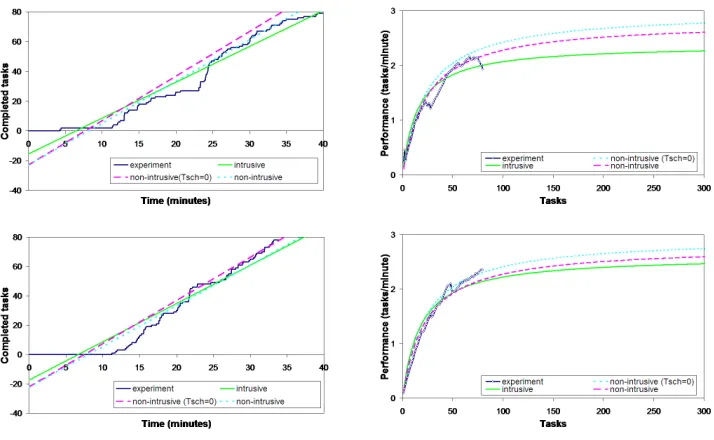
7.3. Experiments and Results. We begin the analysis presenting the intrusive and non-intrusive mea-surement made on testbed of the parameters r∞ and n1/2. Figure 7.1 shows the experimental performance
obtained in the first two executions of the mentioned Bioinfomatics application, along with that predicted by Eq. 7.3. The r∞ and n1/2 have been calculated by linear fitting to: (i) experimental results obtained in the
execution of the application; (ii) Eq. 7.5 using the average file transfer and execution times of each host and
Tsch= 60s; and also (iii) Eq. 7.5 withTsch= 0s.
Fig. 7.1.Measurements ofr∞ andn1/2 on the testbed based on experimental data, and raw resource performance (left-hand charts). Experimental performance of the Bioinformatic application, along with that predicted by Eq. 7.3 (right-hand charts).
to the same host. This delay is mainly due to the Globus MDS update frequency and the GridWay resource broker. However, it does not affect to then1/2 parameter, since the brokering overhead increases the execution
time (Ti) by the same amount in all the resources.
Table 7.1 shows the values of ther∞ and n1/2 coefficients for each execution of the experiments. For the
shake of the completeness, we also include the turnaround time (TGrid). Based on the intrusive results, the testbed is characterized by an average asymptotic performance of 2.31 tasks per minute. Furthermore, in order to achieve the half of this asymptotic performance it is necessary to execute, on average, 15.34 tasks. And so, the apparent number of resources to the application is approximately 30.68, with an execution time of 13.26 minutes per task.
In Table 7.1, we can also see the degree of homogeneity (v) for the intrusive and non-intrusive case. Thus, the average of the intrusivevis 0.61 (low homogeneity degree), and the average of non-intrusivevis 0.9, closer to the homogeneous case (v= 1). This difference is mainly due to the experiments not saturating the testbed, as can be seen in the right-hand charts of Figure 7.1. Moreover, this difference is also consequence of calculating non-intrusivev by applying the model under ideal conditions, therefore yielding in an homogenization of the results.
Table 7.1
Turnaround timeTGrid,r∞(tasks/minute),n1/2(tasks), and degree of heterogeneity coefficientvfor each experiment.
Intrusive Non-Intrusive
Experiment r∞ n1/2 v r∞ n1/2 v TGrid
1 2.38 15.02 0.58 2.85 23.20 0.89 42.00 2 2.61 17.48 0.70 2.79 22.54 0.90 33.82 3 2.04 17.04 0.71 2.74 21.52 0.90 46.05 4 2.14 13.88 0.51 2.67 23.64 0.88 50.37 5 2.40 13.27 0.53 2.95 22.73 0.91 44.87
32 J. Herrera, E. Huedo, R. S. Montero and I. M. Llorente
We have shown that the “end-to-end” principle works at the client side (i. e. the user-level Grid middleware) of a Grid infrastructure. Our proposed user-level Grid middleware, GridWay, can work with Globus, as a standard core Grid middleware, over any Grid fabric in aloosely-coupled way. The smooth process of integration of two so different testbeds, although both are based on Globus, demonstrates that the GridWay approach (i. e. the Grid way), based on a modular, decentralized and “end-to-end” architecture, is appropriate for the Grid. Moreover, the Grid performance model for High Throughput Computing Applications validates the experimental results obtained.
Acknowledgments. This research was supported by Consejer´ıa de Educaci´on of Comunidad de Madrid, Fondo Europeo de Desarrollo Regional (FEDER) and Fondo Social Europeo (FSE) through BIOGRIDNET Research Program S-0505/TIC/000101, by BSCH/UCM through research grant PR27/05-14035-BSCH and by Ministerio de Ciencia y Tecnolog´ıa, through the research grant TIC 2003-01321. The authors participate in the EGEE project.
We would like to thank all the institutions involved in the IRISGrid initiative and the EGEE project, in particular those who collaborated in the experiments. They are Red Acad´emica y de Investigaci´on Nacional (RedIRIS), Departamento de Arquitectura de Computadores y Autom´atica (DACyA) at Universidad Com-plutense de Madrid (UCM), Laboratorio de Computaci´on Avanzada, Simulaci´on y Aplicaciones Telem´aticas (LCASAT) at Centro de Astrobiolog´ıa (CAB), Centro de Supercomputaci´on de Galicia (CESGA), Instituto Mediterr´aneo de Estudios Avanzados (IMEDEA), Facultad de Inform´atica (DIF) at Universidad de Mur-cia (UM), Instituto de Biocomputaci´on y F´ısica de Sistemas Complejos (BIFI) at Universidad de Zaragoza (UNIZAR), Instituto de F´ısica de Cantabria (IFCA), Instituto de F´ısica Corpuscular (IFIC), Centro Nacional de Biotecnolog´ıa (CNB), Centro de Investigaciones Energ´eticas, Medioambientales y Tecnol´ogicas (CIEMAT), Departamento de F´ısica Te´orica (FT) at Universidad Aut´onoma de Madrid (UAM) and Port d’Informaci´o Cient´ıfica (PIC).
We would like to also thank Ugo Bastolla, staff scientist in the Bioinformatics Unit at Centro de Astrobi-olog´ıa (CAB) and developer of the Bioinformatics application used in the experiments.
REFERENCES
[1] R. J. Allan, J. Gordon, A. McNab, S. Newhouse, and M. Parker,Building Overlapping Grids, tech. rep., University of Cambridge, Oct. 2003.
[2] E. B. Carpenter,RFC 1958: Architectural Principles of the Internet, June 1996.
[3] M. Baker, R. Buyya, and D. Laforenza,Grids and Grid Technologies for Wide-Area Distributed Computing, Software – Practice and Experience, 32 (2002), pp. 1437–1466.
[4] U. Bastolla, A. Moya, E. Viguera, and R. van Ham,Genomic Determinants of Protein Folding Thermodynamics in Prokaryotic Organisms, Journal of Molecular Biology, 343 (2004), pp. 1451–1466.
[5] F. Berman, R. Wolski, H. Casanova, et al.,Adaptive Computing on the Grid Using AppLeS, IEEE Trans. Parallel and Distributed Systems, 14 (2003), pp. 369–382.
[6] R. Buyya, D.Abramson, and J. Giddy,A Computational Economy for Grid Computing and Its Implementation in the Nimrod-G Resource Broker, Future Generation Computer Systems, 18 (2002), pp. 1061–1074.
[7] I. Foster,What Is the Grid? A Three Point Checklist, GRIDtoday, 1 (2002). http://www.gridtoday.com/02/0722/100136.html
[8] J. Frey, T. Tannenbaum, M. Livny, I. Foster, and S. Tuecke, Condor/G: A Computation Management Agent for Multi-Institutional Grids, Cluster Computing, 5 (2002), pp. 237–246.
[9] R. Hockney and C. Jesshope,Parallel Computers 2:Architecture Programming and Algorithms, Adam Hilgee Ltd., 1998. [10] E. Huedo, U. Bastolla, R. S. Montero, and I. M. Llorente, A Framework for Protein Structure Prediction on the
Grid, New Generation Computing, 23 (2005), pp. 277–290.
[11] E. Huedo, R. S. Montero, and I. M. Llorente,A Framework for Adaptive Execution on Grids, Intl. J. Software—Practice and Experience (SPE), 34 (2004), pp. 631–651.
[12] R. S. Montero, E. Huedo, and I. M. Llorente,Benchmarking of High Ttroughput Computing Applications on Grids, Parallel Computing, (2006). in press.
[13] O. San Jos´e, L. M. Su´arez, E. Huedo, R. S. Montero, and I. M. Llorente,Resource Performance Management on Computational Grids, in Proc. 2nd Intl. Symp. Parallel and Distributed Computing (ISPDC 2003), IEEE CS, 2003, pp. 215–221.
[14] J. M. Schopf, Ten Actions when Superscheduling, Tech. Rep. GFD-I.4, Scheduling Working Group—The Global Grid Forum, 2001.
[15] J. M. Schopf and B. Nitzberg,Grids: The Top Ten Questions, Scientific Programming, special issue on Grid Computing, 10 (2002), pp. 103–111.