Available Online at www.ijpret.com 333
INTERNATIONAL JOURNAL OF PURE AND
APPLIED RESEARCH IN ENGINEERING AND
TECHNOLOGY
A PATH FOR HORIZING YOUR INNOVATIVE WORK
PUSH OVER ANALYSIS OF RCC BUILDING WITH FLAT SLAB
DR. AKIL AHMED
Department of Civil Engineering, Jamia Millia Islamia (A Central University), Jamia Nagar, New Delhi, India 110025.
Accepted Date: 15/03/2016; Published Date: 01/05/2016
\
Abstract:RCC building with flat slab has some advantages such as its easy construction over conventional RCC frame structures. There are many flat slab constructions all over the world. To evaluate potential seismic hazard and risk analysis, seismic analysis of flat slab structures has been important to get appropriate response under seismic loading. In present study, it aims to focus on the behavior of Flat slab structure using medium-rise flat-slab buildings with masonry infill walls. The software program is used to perform a static inelastic push over analysis. The building was designed according to the regulations of IS 456-2000: Plain and Reinforced Concrete - Code of Practice and IS 1893-1 – 2002: Criteria for Earthquake Resistant Design. Analysis is carried out using standard package SAP 2000.
Keywords: Flat slab, SAP 2000, inelastic analysis, push over analysis, base shear, storey drift
Corresponding Author: DR. AKIL AHMED
Access Online On:
www.ijpret.com
How to Cite This Article:
Akil Ahmed, IJPRET, 2016; Volume 4 (9): 333-340
Available Online at www.ijpret.com 334
INTRODUCTION
Earthquake Engineering is an emerging branch in the engineering fields. Recent earthquakes make more awareness in people’s mind. Scientists, researchers, engineers and academicians have got driven force for research from the recent devastating earthquakes. They are trying to develop methodologies and tools to predict earthquake, to analyse new and existing structures, to evaluate potential seismic hazards and risk, to develop seismic mitigation techniques more accurately. More research works are still required for modelling and analysis of all type of structures.
Flat slab structures have some major advantages over the conventional RCC frame structures. Flat slabs have the following advantages:
- Highly versatile elements widely used in construction, providing minimum depth, fast construction and allowing flexible column grids
- Considered to be faster and more economic than other forms of construction
- Partition walls can be placed anywhere providing flexible room layout
- Detailing, formwork and placement of reinforcement are easy
- As there are no beams, building height can be reduced, subsequently it will save materials
and reduce load on foundation
There are some disadvantages of flat slab. As there is no beam, there is less transverse stiffness. There is large lateral deformation, causing failure in non-structural elements of structures even under moderate level of earthquake. Due to unbalanced moment between slab and column, there may punching failure in the slab; and high shear stress in the slab under earthquake load. The stiffness of the flat slab may be reduced due to cracking produced from construction load, gravity load, shrinkage and temperature load. The flat slab structure should be provided with shear wall or bracing in the frame in the seismically active region to increase its lateral load capacity.
2. LITERATURE REVIEW
Available Online at www.ijpret.com 335
M. Altug Erberik, Amr S.Elnashai (2004) performed the study that focuses on the derivation of fragility curves for medium-rise flat-slab buildings having masonry as infill walls. The study employed a set of earthquake records compatible with the design spectrum that selected to represent the variability in ground motion. Inelastic response-history analysis (ZEUS-NL software) was used to analyze the random sample of structures subjected to the suite of records scaled in terms of displacement spectral ordinates, while monitoring four performance limit states. The fragility curves developed from this study were compared with that of moment-resisting RC frames. The study concluded that the vulnerability curves of conventional moment-resisting frames to assess the damage due to earthquake of flat-slab buildings is non-conservative.
Masanobu Shinozuka, M. Q. Feng, Jongheon Lee, and Toshihiko Naganuma (2000) presented a statistical analysis of structural fragility curves that considered both - both empirical and analytical fragility curves. The empirical fragility curves are developed by using bridge damage data taken from the 1995 Hyogo-ken Nanbu (Kobe) earthquake. The analytical fragility curves are obtained based on the nonlinear dynamic analysis.
Paolo Bazzurro I and C. AHin Cornell (1995) generalized conventional seismic hazard analysis methodology that estimates directly the annual seismic risk of exceeding a specified level of post elastic damage in real structures. In the procedure, they made use of empirical statistics of the nonlinear -response-based factor FDM that is a measure of the damage potential of ground motions to multi-degree-of-freedom structures.
Saraswati Setia, Shakti Kalyani (2015) presented analytical study that investigates the influence of parameters - concrete strength, column aspect ratio, slab thickness and gravity loading governing the behavior of connections under punching shear. Software Structural Analysis Program 2000 V14 is used to model the structure. Displacement control non-linear static pushover analysis was applied to investigate the influence of the parameters on punching shear capacity of the intermediate and corner column connections and it was proved to be the governing criteria to prescribe drift limits for flat plate systems in seismic zones.
3. MODELING
Available Online at www.ijpret.com 336
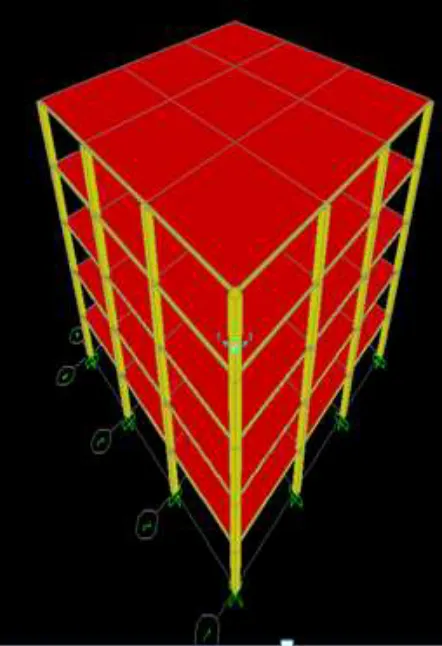
Figure 1: 3D view of RCC building with flat slab
Available Online at www.ijpret.com 337
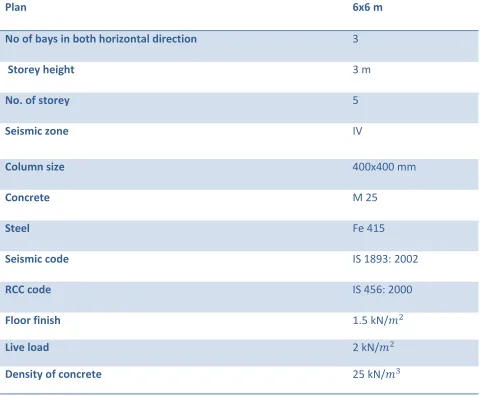
Table 1. Model Specifications
Plan 6x6 m
No of bays in both horizontal direction 3
Storey height 3 m
No. of storey 5
Seismic zone IV
Column size 400x400 mm
Concrete M 25
Steel Fe 415
Seismic code IS 1893: 2002
RCC code IS 456: 2000
Floor finish 1.5 kN/𝑚2
Live load 2 kN/𝑚2
Density of concrete 25 kN/𝑚3
4. RESULTS AND DISCUSSION
Available Online at www.ijpret.com 338
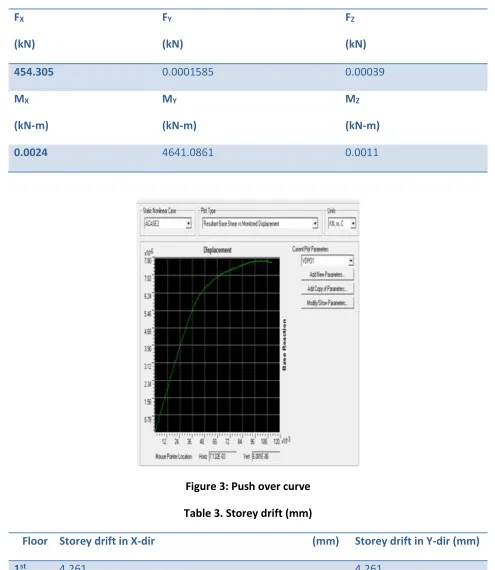
Table 2: Base shear in global X, Y and Z directions
FX
(kN)
FY
(kN)
FZ
(kN)
454.305 0.0001585 0.00039
MX
(kN-m)
MY
(kN-m)
MZ
(kN-m)
0.0024 4641.0861 0.0011
Figure 3: Push over curve
Table 3. Storey drift (mm)
Floor Storey drift in X-dir (mm) Storey drift in Y-dir (mm)
Available Online at www.ijpret.com 339
2nd 12.186 12.186
3rd 20.40 20.40
4th 27.324 27.324
5th 32.141 32.141
Maximum roof displacement = 32.141 mm
As per is 1893:2002, clause 7.11.1, the storey drift in any storey due to the design lateral force shall not exceed 0.004 times the storey height
Maximum permissible storey drift = 0.004 x 15 m = 0.060 m = 60 mm
5. CONCLUSION
It is observed that storey drift increases from base to top floor. Maximum storey drift is found to be within permissible storey drift range as per IS 1893:2002. The maximum drift obtained for a 5 storey flat slab structure was 32 mm whereas permissible drift is approximately 60 mm. The maximum base shear in X direction was found to be 454.305 KN. For the analysis purpose, basic parameters taken are - base shear, storey drift, and static push over curve and results are interpreted.
REFERENCES
1. Indian Standard criteria for earthquake resistant design of structures IS 1893:2002
2. IS 456-2000 (Plain and Reinforced Concrete - Code of Practice)
3. Apostolska R P, Necevska -Cvetanovska GS, Cvetanovska J P and Mircic N (2008), “Seismic performance of flat-slab building structural systems”, The 14th World Conference on Earthquake Engineering October 12-17, 2008, Beijing, China.
4. Erberik M A and Elnashai S A (2004),“Fragility analysis of flat-slab structures”, ELSEVIER, Engineering Structures, Vol.26, pp. 937–948.
5. Makode R K, Akhtar S and Batham G(2014), “Dynamic analysis of multi-storey RCC building
Available Online at www.ijpret.com 340
6. Mohamed A A El-shaer (2013), “Seismic Load Analysis of different RC Slab Systems for Tall
Building”, INPRESSCO, Vol. 3, No.5.7- Chow HL, Selna LG. Seismic response of non ductile flat plate buildings. Journal of Structural Engineering, ASCE 1995;121(1):115–23.
7. Push over analysis on shear critical frames, Serhan Guner and Frank J. Vecchio.
8. Limniatis A. Seismic behavior of flat-slab RC structures, M.Sc. Dissertation, Civil engineering Department, Imperial College of Science, Technology and Medicine, 2001.