Facile, Green Synthesis of Large Single Crystal Copper
Micro and Nanoparticles with Ascorbic Acid
and Gum Arabic
Preston B. Landon*#1,2, Alexander H. Mo#3, Carlos T. Ramos4, Jose J. Gutierrez4, Ratnesh Lal*1,2,3 1Department of Mechanical Engineering, University of California, San Diego, USA
2Department of Bioengineering, University of California, San Diego, USA 3Materials Science and Engineering Program, University of California, San Diego, USA
4Department of Chemistry, The University of Texas Pan American, Edinburg, USA
Email: *[email protected]; [email protected]
Received June 29, 2013; revised August 5, 2012; accepted August 12, 2013
Copyright © 2013 Preston B. Landon et al. This is an open access article distributed under the Creative Commons Attribution
Li-cense, which permits unrestricted use, distribution, and reproduction in any medium, provided the original work is properly cited.
ABSTRACT
Large single crystal colloidal copper particles with diameters between 0.5 - 2 μm were created using a green synthesis process. The process used ascorbic acid to reduce Schweizer’s reagent created in situ using copper salts in the presence
of various concentrations of gum arabic. The Schweizer’s reagents were created by varying the concentrations of am-monium hydroxide and copper nitrate solutions, copper hydroxide, or copper sulfate. The pH of the solution was con-trolled by the addition of ascorbic acid. Particle formation was favored at high temperature using copper sulfate at pH values ranging from 7.5 to 9, while the optimal formation occurred at a pH value of 8.5. At high concentrations, copper particle formation was found to occur from the aggregation of smaller particles which continued to nucleate once ag-gregated, and this resulted in the creation of globular particles and large aggregates of micron-sized particles. The addi-tion of gum arabic resulted in the creaaddi-tion of large single crystal particles that did not aggregate. SEM was used to ob-serve the effect of increasing gum arabic concentrations and EDX was used to confirm the elemental purity of the parti-cles.
Keywords: Copper; Green Synthesis; Microparticles; Nanoparticles; Gum Arabic; Ascorbic Acid
1. Introduction
Colloidal copper particles are of great research interest because of their low cost, high conductivity, unique chemical [1], thermal [2], and optical [3] properties. A variety of physical [4,5] and chemical [6-12] methods exist for the synthesis of colloidal copper. The parame-ters under study are typically the nature of the copper salts [10,11], reducing agents[11,12], binding agents [9, 12], temperature [7], pH [6], and catalyst [8]. In a cost- effective and environmentally friendly process, however, the conditions must allow a high efficiency for the for-mation of particles with minimal risks to people and en-vironment and the reagents must be readily available and inexpensive. Recently, a novel green aqueous method for the formation of colloidal copper has been reported [13,14]. Here, we report a process to synthesize colloidal
copper using copper sulfate and ascorbic acid. We also report the effect of pH and introduce a way to create large single colloidal copper particles using gum arabic.
Using the readily available copper sulfate and ammo-nium hydroxide dissolved in deionized (DI) water, solu-tions of Schweizer’s reagent [Cu(NH3)4(H2O)2](OH)2
were prepared and optimized for use with ascorbic acid (vitamin C). Schweizer’s reagent is formed by the chemi- cal reaction:
2
4 2 4
CuSO aq 2OH aq Cu OH aq SO aq
(1)
4 2
3 4 2 2 2 2
Cu OH 4NH OH
Cu NH H O OH 2H O
aq aq
aq
(2)
The inspiration for this particular method came from observing the reduction of Tollen’s reagent with different agents including ascorbic acid.
*Corresponding author.
plex that deposits a shiny, metallic silver film onto its container upon reduction and has been used for making mirrors for hundreds of years. Noting the similarities between the Tollen’s and Schweizer’s reagent, initial testing of different reducing agents found that only as- corbic acid was effective in producing a copper film [13,14].
To improve the quality of the formed crystals, a bind-ing and cappbind-ing agent, gum arabic, was used. Gum ara-bic is derived from hardened sap of the acacia tree and has previously been demonstrated to form well-deve- loped gold and silver particles [15,16] and nanoparticle functionalization [17]. To the best of the authors’ knowl-edge, this is the first reported usage of gum arabic in the formation of copper micro and nanoparticles.
Schweizer’s reagent/ascorbic acid reaction solutions have been optimized adjusting levels of copper sulfate, ammonium hydroxide, and ascorbic acid and observing the copper film quality on the reaction vials. Once opti-mized, solutions were prepared with increasing amounts of gum arabic, while heated and stirred. The supernatant of each sample was extracted, centrifuged, and dried on a SEM post. SEM images were then used to observe gum arabic’s effects on copper formation.
2. Materials and Methods
2.1. Preparation of SolutionsStock solutions of copper sulfate consisted of 12.5 g of CuSO4·5H2O (Sigma, St Louis, MO), a certain amount of
concentrated NH4OH (Fischer Scientific, Pittsburgh, PA),
dissolved in DI water (MilliQ, Millipore, Billerica, MA) with a resistance of 18.6 MΩ to a total volume of 500 mL. A 0.3 M reducing solution of L-ascorbic acid was prepared with 52.8 g of L-ascorbic acid (Sigma, St. Louis, MO) in 500 mL of DI water. Different reaction condi- tions were tested in 20 mL glass vials by adding a certain volume of copper sulfate solution to a certain volume of L-ascorbic acid solution for a total of 20 mL. Solution pH was monitored initially and after conclusion of the reaction with a pH monitor (Accumet Excel XL60, Fischer Scientific). Varying amounts of gum arabic were introduced into the optimized reaction mixture in order to observe its effects on copper crystal formation.
2.2. Preparation for Imaging
After 72 hours to ensure reaction completion, particle suspensions were transferred in entirety to a 50 mL coni- cal centrifuge tubes (Corning Inc., Corning, NY) and cen- trifuged at room temperature at 3220 g for 40 min- utes. Afterwards the supernatant was disposed. The par- ticles were washed twice by resuspension of the pellet in 50 mL of DI water, centrifuging, disposing the super- natant. After washing, the pellet was resuspended by
adding 5 mL of DI water. 10 µL of copper particle solu-tion was extracted and placed onto a flat SEM post. The posts were placed in a vacuum oven to prevent oxidation and to evaporate the residual water.
2.3. Imaging
Copper particles were imaged using scanning electron microscopy. Samples were placed in a Phillips FEI XL30 with an FEI Sirion column that allows for resolutions up to 1 nm at 10 kV. An Oxford energy dispersive X-ray spectroscopy (EDX) instrument was used to perform elemental analysis to confirm the presence of copper in the SEM images.
3. Results and Discussion
High quality copper particles resulting from the reduction of Schweizer’s reagent formed were desired. To that end, three parameters were optimized: the NH3/Cu2+ molar
ratio in the precursor solution, the pH by adjusting the amount of ascorbic acid added to the reaction mixture, and the amount of gum arabic introduced into reaction solution.
3.1. Optimization of the Precursor Solution 12.5 g of copper sulfate and different amounts of con- centrated ammonium hydroxide mixed together and dis- solved in DI water to achieve 500 mL stock solutions with NH3/Cu2+ ratios of 0, 1.15, 2.30, 4.60, 6.90, and
9.20. 10 mL aliquots of these stock solutions were trans- ferred to 20 mL glass vials and reduced with 10 mL of 0.3 M ascorbic acid. The reaction mixture was allowed to deposit on the sides of the glass vials for 24 hours at 15˚C - 20˚C. Visual inspection of the film color, smooth- ness and reflectivity was used to determine the best reac- tion conditions for the set. A copper sulfate solution with a NH3/Cu2+ ratio of 6.90 provided the most consistent
and highest quality plating on the vial walls.
Using the 6.90 ratio as a starting point, the precursor solution was finely tuned with stepwise additions of 50
μL of concentrated ammonium hydroxide to a 10 mL 6.90 ratio sample. These stepwise additions were made every 2 hours until another addition of ammonium hy-droxide caused the solution to turn clear. This fine ad-justment resulted in an optimal precursor solution with NH3/Cu2+ ratio of 7.13.
3.2. Optimization of pH
filled with DI water to a total reaction volume of 20 mL
(Figure1). Visual inspection for film color, smoothness,
and reflectivity was once again used to determine film quality. Determining the optimal pH of the solution was based on the color of the solution. If the solution was too green, the mixture was too acidic; if the solution were too basic the solution would turn yellow. The amount of ascorbic acid was adjusted carefully to turn the solution clear and then follow through to green (Figure 1(b)). This corresponded to a molar ratio of ascorbic acid to copper of 2.55 at a pH of 8.5.
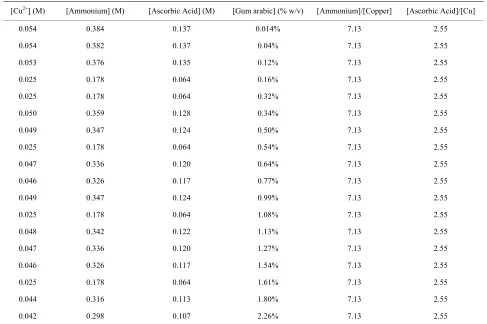
3.3. Optimization of Gum Arabic Concentration A series of reaction solutions were prepared with the 1/7.13/2.55 solution and final concentration of gum ara- bic between 0% - 2.26% w/v as listed in Table1. Upon SEM imaging, it was determined that a final concentra-tion in soluconcentra-tion above approximately 0.16% w/v induced the formation of highly crystalline copper microparticles
(Figure 2) Higher concentrations produced relatively
regular single crystals ranging between 0.5 to 2 μm. These solutions reacted under vigorous stirring and ele- vated temperatures (100˚C).
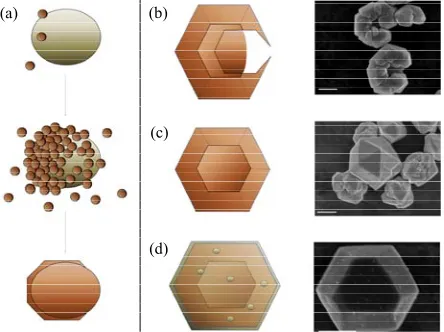
It was found upon examination of the SEM images that the gum arabic acted both as binding and capping agent depending on the concentration. At low concentra-tions, small droplets of gum arabic served as nucleation centers by binding many small copper seeds and allow- lowing an orderly crystallization around it (Figure3(a)). However, at higher concentrations, the gum arabic drop
(a)
[image:3.595.311.538.283.398.2](b)
Figure 1. Plating quality with varying ascorbic acid content/ pH (a) Finding the right plating in the copper after 168 hrs. Start on the left increasing amounts of 0.5 mL L-ascorbic acid was added to 10 mL of an Ammonium hydroxide/ Copper sulfate solution mixed to a mole ratio of NH4/Cu =
7.12. From left to right: 1, 2.5, 4, 5.5, 7 (pH 8.9), 8.5 (pH 8.5), 10 (pH 7.5), 11.5, 13, 15 mL of L-ascorbic acid were added to solution and deionized water was used to raise the vol-ume to 20 mL. On visual inspection, the best the condition was found to be 8.5 mL of L-ascorbic acid with a pH 8.5. The best sample is indicated by a black box around the sample. (b) Time elapsed observation of the optimal condi-tion (8.5 mL of ascorbic acid) (left to right) 5 min., 1 hr, 4.5 hr, 7.5 hr, 28 hr, 168 hr.
lets became incorporated into the copper crystal facets, spreading out, and limiting further incorporation of cop-per into the particle (Figure 3(b)). Energy-dispersive X-ray (EDX) spectroscopy was used confirm that parti- cles observed were composed of copper (Figure4).
On the other hand, while ascorbic acid reduction of Schwiezer’s reagent is specific to copper sulfate-ammo- nium solutions, we explored the use of other copper salts like copper hydroxide and copper nitrate. Preliminary work in this area allowed the formation of copper films on reaction vials using various NH3/Cu ratios.
4. Conclusion
[image:3.595.313.535.469.635.2]Schweizer’s reagent was optimized and reduced with ascorbic acid in the presence of gum arabic to produce
Figure 2. Transition from grainy to highly crystalline ob-jects. SEM shows the particle formation with increasing gum arabic concentration (w/v) (A) 0% (B) 0.014% (C) 0.12%, (D) 0.16%, (E) 0.32%, (F) 0.34%. All scale bars are 1 micron.
(a) (b)
(c)
(d)
Figure 3. Proposed model for the role of gum arabic. Scale bars are 500 nm. (a) Gum arabic acts as a binding agent pulling in copper seeds and growing larger. (b) Below the threshold, not enough gum arabic is around to form nice complete copper microparticles. (c) At the threshold value nice copper particles formed. d) Much above the threshold, the gum arabic starts to act as a capping agent, embedding itself in the copper crystal and limiting further inclusion of
[image:3.595.62.285.475.584.2]Figure 4. EDX confirmation that particles are copper. Scale bars are 1 μm. (A) SEM image of the particle under analysis. (B) Sample EDX analysis of shows presence of copper in the particles. Other elemental peaks are ascribed to the aluminum alloy SEM holder.
Table 1. Concentration of reaction mixtures tested at pH 8.5 at 100˚C.
[Cu2+](M) [Ammonium] (M) [Ascorbic Acid] (M) [Gum arabic] (% w/v) [Ammonium]/[Copper] [Ascorbic Acid]/[Cu]
0.054 0.384 0.137 0.014% 7.13 2.55
0.054 0.382 0.137 0.04% 7.13 2.55
0.053 0.376 0.135 0.12% 7.13 2.55
0.025 0.178 0.064 0.16% 7.13 2.55
0.025 0.178 0.064 0.32% 7.13 2.55
0.050 0.359 0.128 0.34% 7.13 2.55
0.049 0.347 0.124 0.50% 7.13 2.55
0.025 0.178 0.064 0.54% 7.13 2.55
0.047 0.336 0.120 0.64% 7.13 2.55
0.046 0.326 0.117 0.77% 7.13 2.55
0.049 0.347 0.124 0.99% 7.13 2.55
0.025 0.178 0.064 1.08% 7.13 2.55
0.048 0.342 0.122 1.13% 7.13 2.55
0.047 0.336 0.120 1.27% 7.13 2.55
0.046 0.326 0.117 1.54% 7.13 2.55
0.025 0.178 0.064 1.61% 7.13 2.55
0.044 0.316 0.113 1.80% 7.13 2.55
0.042 0.298 0.107 2.26% 7.13 2.55
REFERENCES
highly crystalline copper particles between 0.5 - 2 μm.The gum arabic was observed to serve as binding agent in low concentrations and a capping agent in higher con- centrations. Highly crystalline copper micro/nanoparti- cles were synthesized using environmentally friendly re- agents requiring few steps.
[1] N. A. Dhas, C. P. Raj and A. Gedanken, “Synthesis, Cha- racterization, and Properties of Metallic Copper Nanopar- ticles,” Chemistry of Materials,Vol. 10, No. 5, 1998, pp.
1446-1452. http://dx.doi.org/10.1021/cm9708269
[2] H. Ching-Yen, T. Yu-Hsiang and S. Feng-Ming, “Ther- mal Transport in the Copper Powders with Nanometer and Micrometer Particles,” Advanced Materials Research,
Vol. 126-128, 2010, pp. 952-956956.
http://dx.doi.org/10.4028/www.scientific.net/AMR.126-1 28.952
5. Acknowledgements
[image:4.595.54.541.274.598.2][3] K. P. Rice, E. J. Walker, M. P. Stoykovich and A. E. Saunders, “Solvent-Dependent Surface Plasmon Respon- se and Oxidation of Copper Nanocrystals,” Journal of Physical Chemistry C, Vol. 115, No. 5, 2011, pp. 1793-
1799. http://dx.doi.org/10.1021/jp110483z
[4] T. Tsing-Tshih, C. Ho, C. Liang-Chia, H. Lee-Long, L. Chih-Hung and L. Ming-Kun, “Development of Pressure Control Technique of an Arc-Submerged Nanoparticle Synthesis System (ASNSS) for Copper Nanoparticle Fab- rication” Materials Transactions, Vol. 44, No. 6, 2003,
pp. 1138-1142.
http://dx.doi.org/10.2320/matertrans.44.1138
[5] S. Noël, J. Hermann and T. Itina, “Investigation of Nanoparticle Generation during Femtosecond Laser Ab-lation of Metals,” Applied Surface Science,Vol. 253, No.
15, 2007, pp. 6310-6315.
http://dx.doi.org/10.1016/j.apsusc.2007.01.081
[6] M. Biçer and I. Şişman, “Controlled Synthesis of Copper Nano/Microstructures Using Ascorbic Acid in Aqueous CTAB Solution,” Powder Technology, Vol. 198, No. 2, 2010, pp. 279-284284.
http://dx.doi.org/10.1016/j.powtec.2009.11.022
[7] M. Blosi, S. Albonetti, M. Dondi, C. Martelli and G. Baldi, “Microwave-Assisted Polyol Synthesis of Cu Na- noparticles,” Journal of Nanoparticle Research,Vol. 13, No. 1, 2011, pp. 127-138.
http://dx.doi.org/10.1007/s11051-010-0010-7
[8] D. Ensign, M. Young and T. Douglas, “Photocatalytic Synthesis of Copper Colloids from Cu(II) by the Ferrihy-drite Core of Ferritin,” Inorganic Chemistry,Vol. 43, No.
11, 2004, pp. 3441-3446. http://dx.doi.org/10.1021/ic035415a
[9] D. Mott, J. Galkowski, L. Wang, J. Luo and C.-J. Zhong, “Synthesis of Size-Controlled and Shaped Copper Na- noparticles,” Langmuir,Vol. 23, No. 10, 2007, pp. 5740- 5745. http://dx.doi.org/10.1021/la0635092
[10] A. G. Nasibulin, P. P. Ahonen, O. Richard, E. I. Kauppi- nen and I. S. Altman, “Copper and Copper Oxide Nano- particle Formation by Chemical Vapor Nucleation from Copper (II) Acetylacetonate,” Journal of Nanoparti- cle Research,Vol. 3, No. 5-6, 2001, pp. 385-400.
[11] W. Songping, “Preparation of Fine Copper Powder Using Ascorbic Acid as Reducing Agent and Its Application in MLCC,” Materials Letters, Vol. 61, No. 4-5, 2007, pp.
1125-1129.
http://dx.doi.org/10.1016/j.matlet.2006.06.068
[12] S.-H. Wu and D.-H. Chen, “Synthesis of High-Concentra-tion Cu Nanoparticles in Aqueous CTAB SoluHigh-Concentra-tions,”
Journal of Colloid and Interface Science,Vol. 273, No. 1,
2004, pp. 165-169.
http://dx.doi.org/10.1016/j.jcis.2004.01.071
[13] J. G. Brandon C. Jarvis, G. Ussery, J. K. Schaefers, T. E. Renfro, R. Glosser and P. B. Landon, “Synthesis and Op- tical Properties of Micron Sized Metallic Colloidal Cop- per and Self Assembled Opals Composed of Micron Sized Metallic Silver Spheres,” SPIE Conference—Op- tical Materials and Structures Technologies, San Diego, July 2005.
[14] P. B. Landon, “Nano-Engineering of Colloidal Particles, Synthetic Biomimetic Blood Cells, Synthetic Opals, Photonic Crystals and the Physics of Self-Assembling Nanostructures,” PhD Thesis, University of Texas, Dallas, UMI Publishers, 2005.
[15] C. C. Wu and D. H. Chen, “Facile Green Synthesis of Gold Nanoparticles with Gum Arabic as a Stabilizing Agent and Reducing Agent,” Gold Bulletin,Vol. 43, No.
4, 2010, pp. 234-240.
http://dx.doi.org/10.1007/BF03214993
[16] K. P. Velikov, G. E. Zegers and A. van Blaaderen, “Syn-thesis and Characterization of Large Colloidal Silver Par-ticles,” Langmuir,Vol. 19, No. 4, 2003, pp. 1384-1389.
http://dx.doi.org/10.1021/la026610p
[17] I. L. Batalha, A. Hussain and A. C. A. Roque, “Gum Arabic Coated Magnetic Nanoparticles with Affinity Ligands Specific for Antibodies,” Journal of Molecular Recognition,Vol. 23, No. 5, 2010, pp. 462-471.