International Journal of Science Technology
Management and Research
Available online at: www.ijstmr.com
IJSTMR
©
2017 | All Rights Reserved 12A Review on Droop Control Strategy for Reactive
Power Sharing in Islanded Microgrid
Mr. Ankush R. More1
PG,Student
Department of Electrical Engineering
Matoshri College of Engineering and Research Center, Nashik MH, India
Mr. S. S. Hadpe2
Assistant Professor
Department of Electrical Engineering,
Matoshri College of Engineering and Research Center, Nashik, MH, India
Abstract: Due to increase in demand of electricity as use of devices that consume electricity increases. Small localized power sources, commonly known as ‘Distributed Generation” (DG) have become a popular alternative to bulk electric power generation. There are many reasons for the growing popularity of DG; however, on top of DG tending to be more renewable, DG can serve as a cost effective alternative to major system upgrades for peak shaving or enhancing load capacity margins. . Additionally, if the needed generation facilities could be constructed to meet the growing demand, the entire distribution and transmission system would also require upgrading to handle the additional loading. For Microgrid in islanded operation, due to the effects of mismatched line impedance, the reactive power could not be shared accurately with the conventional droop method. To improve the reactive power sharing accuracy. There are two operations, Error Reduction Operation, Voltage Recovery Operation. The sharing accuracy is improved by the sharing error reduction operation, which is activated by the low-bandwidth synchronization signals. But the error reduction operation will result in a decrease in output voltage amplitude. Therefore, the voltage recovery operation is proposed to compensate the decrease .In this paper we will review the some droop control strategy for reactive power sharing in islanded microgrid
Keywords: Droop control, low-bandwidth Synchronization Signals, Microgrid, Reactive Power sharing, Voltage recovery Operation.
I. INTRODUCTION
IJSTMR
©
2017 | All Rights Reserved 13 1.1 Distributed Generation (DG)Distributed generations are small electric power generators. DG can be installed close to the customers because of its size and clean energy technology. Installation and operation of electric power generation units connected to the local network or off-grid generation is characterized by: Distributed generation occurs when power is generated locally and sometimes might be shared with or sold to neighbors through the electrical grid (or over the fence) Large central generation is not directly used The Public Service Commission may define only one supplier as a utility.
II. LITERATURE SURVEY
The real and reactive power management strategies of electronically interfaced distributed generation (DG) units in the context of a multiple-DG microgrid system. The emphasis is primarily on electronically interfaced DG units. DG controls and power management strategies are based on locally measured signals without communications. Based on the reactive power controls adopted, three power management strategies are identified and investigated [1].
A method for the parallel operation of inverters in an ac-distributed system is proposed. The explores the control of active and reactive power flow through the analysis of the output impedance of the inverters and its impact on the power sharing. As a result, adaptive virtual output impedance is proposed in order to achieve a proper reactive power sharing, regardless of the line-impedance unbalances. A soft-start operation is also included, avoiding the initial current peak, which results in a seamless hot-swap operation. Active power sharing is achieved by adjusting the frequency in load transient situations only, owing to which the proposed method obtains a constant steady-state frequency and amplitude. As opposed to the conventional droop method, the transient response can be modified by acting on the main control parameters. Linear and nonlinear loads can be properly shared due to the addition of a current harmonic loop in the control strategy [2].
The preplanned switching events and fault events that lead to islanding of a distribution Sub system and formation of a micro-grid. The micro-grid includes two distributed generation (DG) units. One unit is a conventional rotating synchronous machine and the other is interfaced through power electronic converter. The interface converter of the latter unit is equipped with independent real and reactive power control to minimize islanding transients and maintain both angle stability and voltage quality within the micro-grid. The studies show that an appropriate control strategy for the power electronically interfaced DG unit can ensure stability of the micro-grid and maintain voltage quality at designated buses, even during islanding transients [3].
The feasibility of control strategies to be adopted for the operation of a microgrid when it becomes isolated. Normally, the microgrid operates in interconnected mode with the medium voltage network; however, scheduled or forced isolation can take place. In such conditions, the microgrid must have the ability to operate stably and autonomously. An evaluation of the need of storage devices and load shedding strategies is included [4].
The load sharing problem in is landing microgrids, this paper proposes an enhanced distributed Generation (DG) unit virtual impedance control approach. The proposed method can realize accurate regulation of DG unit equivalent impedance at both fundamental and selected harmonic frequencies. In contrast to conventional virtual impedance control methods, where only a line current feed-forward term is added to the DG voltage reference, the proposed virtual impedance at fundamental and harmonic frequencies is regulated using DG line current and point of common coupling (PCC) voltage feedforward terms, respectively. With this modification, the impacts of mismatched physical feeder impedances are compensated. Thus, better reactive and harmonic power sharing can be realized [5].
IJSTMR
©
2017 | All Rights Reserved 14 The control for voltage source inverters with the capability to flexibly operate in grid connected and islanded modes. The control scheme is based on the droop method, which uses some estimated grid parameters such as the voltage and frequency and the magnitude and angle of the grid impedance. Hence, the inverter is able to inject independently active and reactive power to the grid. The controller provides a proper dynamics decoupled from the grid-impedance magnitude and phase. The system is also able to control active and reactive power flows independently for a large range of impedance grid values [7].The low-frequency relative stability problem in paralleled inverter-based distributed generation (DG) units in microgrids. In the sense of the small-signal dynamics of a microgrid, it can be shown that as the demanded power of each inverter changes, the lowfrequency modes of the power sharing dynamics drift to new locations and the relative stability is remarkably affected, and eventually, instability can be yielded. To preserve the power sharing stability, an adaptive decentralized droop controller of paralleled inverterbased DG units [8]. A virtual impedance design and implementation approach for power electronics interfaced distributed generation (DG) units. To improve system stability and prevent power couplings, the virtual impedances can be placed between interfacing converter outputs and the main grid. However, optimal design of the impedance value, robust implementation of the virtual impedance, and proper utilization of the virtual impedance for DG performance enhancement are key for the virtual impedance concept. In this paper, flexible small-signal models microgrids in different operation modes are developed first. Based on the developed microgrid models, the desired DG impedance range is determined considering the stability, transient response, and power flow performance of DG units [9].
A suitable for simulating the dynamic behavior of LV Microgrids both under grid connected and autonomous operation. The stability approach, focusing on low-frequency dynamics, and adjusts the standard methodology so that the dynamic analysis of the system can be carried out, even in the absence of a synchronous machine when all the sources are interfaced to the network with inverters. Proper network representation allows for the modeling of all the characteristic unbalances of the LV network. The capability of the algorithm to simulate the operating modes of a Microgrid is demonstrated by representative study cases [10].
The two cost-prioritized droop schemes for distributed generators (DGs) in a rural or islanded microgrid. Dispatch prioritization of the schemes allows autonomous identification of the appropriate DGs for generation, in accordance to the overall load conditions of the microgrid. The result is a lower total generation cost for the microgrid when compared to other droop schemes. An experimental system has been implemented and tested with results showing a higher saving achieved by the proposed schemes [11].
To solve the reactive power sharing issue in droop control application, many solutions have been developed based on the basic wireless manner. However existing wireless meth ods cannot eliminate reactive power sharing errors effectively, especially in load change situation. A wireless reactive power sharing method that employs feeder current sensing and adaption virtual impedance control is proposed for microgrid [12].
III.PROBLEMDEFINITION
To overcome the reactive power sharing issue, a few improved methods have been proposed. There are mainly three approaches to address the effect of the interconnecting line impedance on droop-based control.
1. To introduce the virtual output impedance by modifying the output voltage reference based on output current feedback. This method can reduce the reactive power sharing error by reducing the relative error of the output impedances .However, the introduction of the virtual impedance may lead to degradation of the system voltage quality.
2. The second is based on a signal injection technique. A certain harmonic signal containing reactive power information is injected into the output voltage reference of each DG unit and the output reactive power is regulated to improve the accuracy of the reactive power sharing according to the harmonic power. However, this method results in output voltage distortion. In order to reduce the reactive power sharing errors, the method injects some small disturbance signals containing reactive power information in to the frequency reference of each DG unit. By using the active power error before and after the injecting signal, this method can eliminate the reactive power sharing error. However, this method is a classic event-triggered control and its stability is not easy to be guaranteed.
IJSTMR
©
2017 | All Rights Reserved 15 3.1 MethodologyA new reactive power sharing method is proposed the method improves the reactive power sharing by changing the voltage bias on the basis of the conventional droop control, which is activated by a sequence of synchronization events through the low-bandwidth communication network.Its a cost-effective and practical approach since only a low bandwidth communication network is required. Investigation of power sharing principles among multiple DGs under various system conditions such as load variation during grid connected operation and load variation during islanded operation.
III. PROPOSED SYSTEM
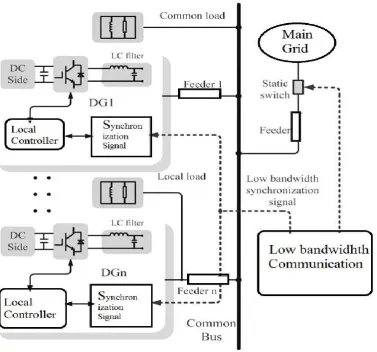
Operation of AC Microgrid An operation of a microgrid that consists of multiple units and dispersed loads is shown in Fig.1. The microgrid is connected to the utility through a static transfer switch at the point of common coupling (PCC).Each DG unit is connected to the microgrid through power electronic converter and its respective feeder. This aims to solve the fundamental active and reactive power sharing in islanded mode.
Figure 1: Ac Microgrid Configuration
Proposed Droop Controller-:
IJSTMR
©
2017 | All Rights Reserved 16 ωi = ω*− miPi (1)k-1 k
Ei(t)=E∗−ni Qi (t)− ∑ Ki Qin + ∑Gn ΔE (2) n=1 n=1
Where k denotes the time of synchronization event until time t.According to (1), the control is a hybrid system with continuous and discrete traits. In the digital implementation of the proposed method, the continuous variables Ei(t) and Qi(t) are discretized with sampling period Ts , and Ts is greatly less than the time interval between two consecutive synchronization events. Therefore, the droop (2) at the kth synchronization interval could be expressed as
k-1 k Ek
i=E∗−ni Qi (t)− ∑ Ki Qin + ∑Gn ΔE (3) n=1 n=1
where ω∗ and E∗ are the values of DG angular frequency and output voltage amplitude at no-load condition; mi and ni are the droop gains of frequency and voltage of DG-i unit; Gn is the voltage recovery operation signal at the nth synchronization interval,Gn hastwopossiblevalues:1or0.IfGn =1,itmeans the voltage recovery operation is performed. Qn i represents the output reactive power of DG-i unit at the nth synchronization interval. Ki is a compensation coefficient for the DG-i unit, ΔE is a constant value for voltage recovery. For simplicity of description, the third term of (3) is referred to the sharing error reduction operation, and the last term is called the voltage recovery operation. For simplicity, the output voltage for the DG-i unit in (4) is written as follows in iterative method:
Ek
i = Eik−1−ni(Qki −Qik−1 )−KiQik−1 + GkΔE (4)
Therefore, for its implementation, only Ek−1 i and Qk−1 i should be stored in DSP. To better understand the proposed method, a specific example is given. If there are two DG units with the same capacity working in parallel, and the conventional droop is only used. There will exist some reactive power sharing error due to some factors. If the sharing error reduction operation for each unit is performed at the time, the resulting reactive power sharing error will decrease.
CONCLUSION
In this paper we will review the some droop control strategy for reactive power sharing in islanded microgrid. A new reactive power control for improving their active sharing is proposed for power electronics interfaced DG units in ac microgrids. The proposed control strategy is real-ized through the following two operations: sharing error reduction operation and voltage recovery operation.The rst operation changes the voltage bias of the conventional droop characteristic curve periodically, which is activated by the low-bandwidth synchronization signals.
REFERENCES
1. W. P. W. Deng and Z. Qi, \Impact and improvement of distributed generation on voltage quality in micro-grid," Proc. 3rd Int. Conf. Electric Utility Deregulation Restruct. Power Technol, vol. PP, no. 99, pp. 1,8, 2008.
2. R.H.Lasseter, "Microgrids," Proceedings of IEEE Power Eng.Soc. Winter Meet.,vol. 1, pp. 305-308, 2002.
3. C. L. M. J. A. Peas Lopes and A. G. Madureira, “Defining control strategies for microgrids islanded operation," IEEE Transactions on Power Delivery, vol. 21, pp. 914-
924, May 2006.
4. D. M. V. Y.W. Li and P. C. Loh, “Design, analysis, and real time testing of a controller for multibus microgrid system," in IEEE Trans.Power Electron, pp. 1195-
1204, Sept 2004.
5.Y. A. R. I. Mohamed and E. F. El-Saadany, “Adaptive decentralized droop controller to preserve power sharing stability of paralleled inverters in distributed generation
IJSTMR
©
2017 | All Rights Reserved 176. J. M. M. C. J. M. Guerrero, J. C. Vasquez and L. G.Vicuna, Defining control strategies for microgrids islanded operation," IEEE Trans. Ind. Electron., vol. 56,
pp. 726-736, March 2009.
7. J. M. L. G. d. V. a. C. J. M. Guerrero, J. C. Vasquez, “ Hierarchical control of droop-controlled ac and dcmicrogrids-a general approach towards standardization," IEEE Trans.Ind. Electron., vol. 58, pp. 158-172, Jan 2010.
8. D. M. D. M. C. Chandorkar and R. Adapa, “ Control of parallel connected inverters in standalone ac supply systems," IEEE Trans. Ind.Appl, vol. 29, pp. 136-143, Jan/Feb 193.
9. J. M. Guerrero, J. Matas, L. G. D. V. D. Vicuna, M. Castilla, and J. Miret, “Wireless-control strategy for parallel operation of distributed-generation inverters," IEEE Transactions on Industrial Electronics, vol. 53, pp. 1461-1470, Oct 2006.
10. J. He, Y. W. Li, J. M. Guerrero, F. Blaabjerg, and J. C. Vasquez, “An islanding mi-crogrid power sharing approach using enhanced virtual impedance control scheme," IEEE Transactions on Power Electronics, vol. 28, pp. 5272-5282, Nov 2013.
11. J. M. M. C. 11. J. M. Guerrero, L. G. Vicuna and J. Miret, “Output impedance design of parallel-connected ups inverters with wireless load sharing control," IEEE Trans. Ind. Electron., vol. 52, pp. 1126-1135, Aug 2005.
12. Y. W. Li and C.-N. Kao, “ An accurate power control strategy for power-electronics interfaced distributed generation units operating in a low-voltage multi bus micro- grid," IEEE Trans. Power Electron, vol. 24, pp. 2977-2988, Dec 2009.
13. L. G. d. V. M. C. 13. J. M. Guerrero, J. Matas and J. Miret, “Decentralized control for parallel operation of distributed generation inverters using resistive output impedance," IEEE Trans. Ind. Electron, vol. 54, pp. 994-1004, Apr. 2007.
14.J. M. M. C. J. M. Guerrero, L. G. Vicuna and J. Miret, “A wireless controller to enhance dynamic performance of parallel inverters in distributed generation systems,"
IEEE Trans. Power Electron, vol. 19, pp. 131-137, Sep. 2004.
15. T. U. A. Tuladhar, H. Jin and K.Mauch, “Control of parallel inverters in distributed ac power systems with consideration of line impedance effect," IEEE Transactions on Industrial Electronics, vol. 36, pp. 131{137, Jan/Feb 2000.
16.J. He and Y. Li, \An enhanced microgrid load demand sharing strategy," IEEE Transactions on Power Electronics, vol. 27, pp. 3984-3995, Sep 2012.
17. C. K. Sao and P. W. Lehn, “Autonomous load sharing of voltage source converters," IEEE Transactions on Power Electronics, vol. 20, pp. 1009-1036, Aug 2005. 18. J. L. K. 18. A. Moawwad, V. Khadkikar, “A new p-q-v droop control method for an interline photovoltaic (i-pv) power system," IEEE Transactions on Power Electron- ics, vol. 28, pp. 658{668, Apr 2013.
19. P. C. C. E. A. A. Coelho and P. F. D. Garcia, “Small-signal stability for parallel-connected inverters in stand-alone ac supply systems," IEEE Trans. Ind. Appl, vol. 38, pp. 533{542, Mar/Apr 2008.
20.M. P. 20. N. Pogaku and T. C. Green, “Modeling, analysis and testing of autonomous operation of an inverter-based microgrid," IEEE Transactions on Power
Electronics, vol. 22, pp. 613-625, March 2007.
21. D. M. H. Mahmood and J. Jiang, “Accurate reactive power sharing in an islanded microgrid using adaptive virtual impedances," IEEE Transactions on Power Elec tronics, vol. 99, pp. 1-3, Apr 2014.
22.Q.-C. Zhong, “Robust droop controller for accurate proportional load sharing among inverters operated in parallel," IEEE Transactions on Industrial Electronics, vol. 60,
pp. 1281-1290, Apr 2013.
23. R. E. B. D. J. C. C. N. Rowe, T. J. Summers and T. G. Moore, “Arctan power-frequency droop for improved microgrid stability," IEEE Transactions on Power Electronics, vol. 28, pp. 3747-3759, Aug. 2013.