236
Topic
10
Multiplying and
Dividing Fractions
and Mixed Numbers
How far can a sloth move in an hour? You will find out in Lesson 10-3.
3
Each letter of this sign is 50 feet tall and runs 30 feet at its base. How long of a space would you need to make a sign you could hang on the wall? You will find out in Lesson 10-4.1
How much fuel does it take to move the space shuttle from its hangar to the Vehicle Assembly Building? You will find out in Lesson 10-7.
2
237 Topic 10
KdXVWjaVgn
4
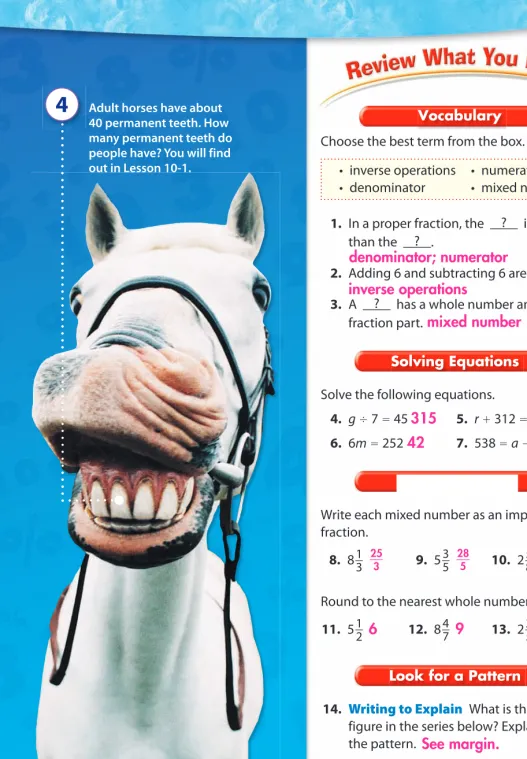
Adult horses have about40 permanent teeth. How many permanent teeth do people have? You will find out in Lesson 10-1.
Choose the best term from the box.
• inverse operations • numerator • denominator • mixed number
1. In a proper fraction, the ? is greater than the ? .
2. Adding 6 and subtracting 6 are ? .
3. A ? has a whole number and a fraction part.
Hdak^c\:fjVi^dch Solve the following equations.
4. g 7 45 5. r 312 487 6. 6m 252 7. 538 a 108
B^mZYCjbWZgh
Write each mixed number as an improper fraction.
8. 8 1 _ 3 9. 5 3 _ 5 10. 2 5 _ 8
Round to the nearest whole number.
11. 5 1 _ 2 12. 8 4 _ 7 13. 2 2 _ 5
Add`[dgVEViiZgc
14. Writing to Explain What is the next figure in the series below? Explain the pattern.
? YZcdb^cVidg0cjbZgVidg
^ckZghZdeZgVi^dch
b^mZYcjbWZg
(&* &,*
)' +)+
TT'*( '-TT* '&TT-
+ . '
HZZbVg\^c#
238
<j^YZYEgVXi^XZ
2 __ 3morning-glories
Another Example
How can you simplify before
you multiply?
Write a multiplication sentence for each picture.
1. 2.
1 _ 2 1 _ 2
N
1 _ 4N
N
3. 4.
5. In the morning-glory example, look at the model for multiplying fractions that are both less than 1. Compare the size of the product to the size of each factor.
6. In Another Example, how would the answer to 16 __ 12 5 be different if a
GCF had not been used to divide a numerator and denominator?
Do you know HOW? Do you UNDERSTAND?
*For another example, see Set A on page 258.
Find 16 __ 12 5 . Simplify before you multiply by finding
the GCFs of any numerator and any denominator.
4
16
__ 1 __ 12 5 3 The GCF of 16 and 12 is 4. Divide 16 and 12 by this GCF.
The GCF of 1 and 5 is 1. 1 and 5 are simplified.
4
16
__ 1 __ 12 5 3 __ 20 3 6 2 _ 3 Multiply.
How do you find products of fractions?
Paige is planting 3 _ 4 of her garden with flowers, and 2 _ 3 of the flowers she plants will be morning-glories. What fraction of the garden will be planted with morning-glories?
Choose an Operation Multiply to
find what fraction of the garden will be planted with morning-glories.
Lesson
10-1
Multiplying Fractions
3 __ 4 flowers
NS 2.2 Explain the meaning of multiplication and division of positive fractions and perform the calculations (e.g.,
5 _
8 16 ___ 15 5 _ 8 15 ___ 16 2 _ 3 ). Also NS 2.1.
&
T) TT'%&
HZZWZadl#
I]ZVchlZgldjaYcdiWZ^c h^beaZhi[dgb#
T(*T&)2TT'%( T(-'T(2T&)
*# I]ZegdYjXi^haZhhi]VcZ^i]Zgd[ i]Z[VXidgh#
& T*
239
Lesson 10-1
>cYZeZcYZciEgVXi^XZ
EgdWaZbHdak^c\
22. Number Sense Brianna lives 1 _ 3 mile from school. If she walks to and from school every day for 5 days, how far will she walk?
24. A display in a grocery store has 120 pieces of fruit. Apples make up 3 _ 5 of the display, and oranges make up 2 _ 5 of the display. If 1 _ 2 of the apples are green, how many green apples are there?
A 24 C 48
B 36 D 72
23. Draw It Mr. Reed is planting peppers in 2 _ 5 of his garden, and 4 _ 5 of the peppers are sweet peppers. Draw a picture to show 2 _ 5 4 _ 5 .
25. Writing to Explain Which is greater:
3 _
8 1 _ 3 or 3 _ 8 1 _ 5 ? Explain how you know.
26. Adult horses have about 40 permanent teeth. If people have 4 _ 5 this number of permanent teeth, how many permanent teeth do people have?
A 32 C 45
B 40 D 50
In 7 through 21, find each product. Simplify if possible.
7. 54 5 _ 6 8. 4 _ 7 56 9. 16 8 3 _ 10. 5 _ 9 5 3 _ 11. 1 _ 2 3 _ 7
12. 2 _ 9 72 13. 4 3 _ 1 _ 4 14. 5 __ 11 33 __ 35 15. 18 7 __ 12 16. 5 _ 8 26
17. 3 3 _ 5 15 18. 2 3 1 _ 21 19. 5 _ 8 3 __ 10 20. __ 10 12 3 _ 5 21. 18 3 _ 4
To find the product: Multiply the numerators. Multiply the denominators. Simplify if possible.
3 _ 4 2 _ 3 3 ____ 4 3 2
6 __ 12 1 _ 2
Use a calculator. Press:
3 n d n d
= ENTER = ENTER Simp S
4 d d
n n = ENTER = ENTER Simp S d d n n = ENTER = ENTER Simp S
2 n d n d
= ENTER = ENTER Simp S
3 d d
n n = ENTER = ENTER Simp S d d n n = ENTER = ENTER Simp S d d n n = ENTER = ENTER Simp S d d n n = ENTER = ENTER Simp S d d n n = ENTER = ENTER Simp S d d n n = ENTER = ENTER Simp S Display: d d n n = ENTER = ENTER Simp S
Paige will plant 1 _ 2 of her garden in morning-glories. This model shows the
meaning of multiplying 3 _ 4 2 _ 3 .
Six of the 12 squares have overlapping colors.
3 _ 4 2 _ 3 6 __ 12 2 __ 3
3 __ 4
)* (' + T&( (TT&)
&+ (TT&+ T(, &%T&' &+T&)
*) ). (TT&+ T&' &(T&'
&%
TT(dg(&T(b^aZh HZZbVg\^c#
HZZbVg\^c#
240
Di]Zg:mVbeaZh
<j^YZYEgVXi^XZ
>C8=:H
&. '% '& '' '( ')
&( &) &* &+ &, &- '* '+ ', '- '. (% (& (' (( () (* (+ , - . &% && &'
% & ' ( ) * +
1 ft 2 ft 3 ft
>C8=:H
&. '% '& '' '( ')
&( &) &* &+ &, &- '* '+ ', '- '. (% (& (' (( () (* (+ , - . &% && &'
% & ' ( ) * +
Write a division sentence to represent each.
1.
% & ' ( )
2.
3. Reasonableness When you divide a
whole number by a fraction, will the quotient be larger or smaller than the whole number?
4. How many pieces would you get from
cutting a board 10 feet long into pieces that are 2 _ 3 foot long?
Dividing a Fraction by a Whole Number
Find 1 _ 2 3.
Use a picture to show 1 _ 2 .
& '
Divide 1 _ 2 into 3 equal parts. 1 _ 2 3
Each part contains 1 _ 6 of the whole.
So, 1 _ 2 3 1 _ 6 .
Dividing a Fraction by a Fraction
Find 3 _ 4 1 _ 4 .
Use a number line to show 3 _ 4 .
% () &
Divide 3 _ 4 into 1 _ 4 parts. There are 3 parts.
% ( &
)
So, 3 _ 4 1 _ 4 3.
Do you know HOW? Do you UNDERSTAND?
*For another example, see Set B on page 258. Lesson
10-2
Understanding Division
of Fractions
How can you model division of fractions?
Mr. Roberts uses pieces of wood that are 3 _ 4 foot long for a set of shelves he is making. How many pieces of wood can he get from a board that is 3 feet long?
NS 2.2 Explain the meaning of multiplication and division of positive fractions and perform the calculations (e.g., 8 5 _ 16 ___ 15 8 5 _ 15 ___ 16 3 2 _ ). Also NS 2.1.
>il^aaWZaVg\Zg# HZZbVg\^c#
(
T)½'2T(- &*e^ZXZh
241 Lesson 10-2
>cYZeZcYZciEgVXi^XZ
% & ' (
EgdWaZbHdak^c\
Leveled Practice In 5 and 6, complete each
division sentence using the models provided.
5. 6 1 _ 2
N
% & ' ( ) * + 6. 2 _ 3 3
N
In 7 through 10, find each quotient. Draw a model to help you visualize.
Simplify if possible.
7. 6 _ 7 3 _ 7 8. 7 _ 8 3 9. 8 4 _ 5 10. 5 _ 9 10
11. Draw a Picture Keiko divided 3 _ 8 gallon of milk evenly into 5 glasses. What fraction of a gallon is in each glass?
13. Draw a Picture A car trip is 6 hours long. Every 2 _ 3 of an hour, Brian changes the radio station. How many times does Brian change the station during the trip?
15. For training, Raul runs several miles each day. He runs each 1 _ 2 mile in 3 minutes.
a How much time does Raul need to run 6 miles?
b How much time does Raul need to run 2 1 _ 3 miles?
12. Writing to Explain Without solving, explain how you can compare the quotient of 6 _ 7 1 _ 2 to 6 _ 7 .
14. Geometry A regular polygon has a perimeter of 8 units. If each side measures 4 _ 5 unit, how many sides does the polygon have?
16. Which division
sentence is shown by this model?
% & ' (
A 3 _ 8 3 C 8 3 _ 5 B 3 3 _ 8 D 3 _ 5 8
How many 3 _ 4 s are in 3?
Use a number line to show 3 feet. Divide it into 3 _ 4 -foot parts.
So, 3 3 _ 4 4.
When the divisor is less than 1, the quotient is larger than the dividend.
One Way Another Way
Think of division as repeated subtraction. Rewrite 3 as an improper fraction, __ 12 4 . Then, subtract 3 _ 4 repeatedly:
12 __ 4
__ 3
4 9 __ 4
9 __ 4
3 __
4 6 __ 4
6 __ 4
__ 3
4 3 __ 4
3 __ 4
3 __
4 0 Mr. Roberts can get 4 pieces.
&' T'.
' TT'), &% TT&-&
8]ZX`hijYZcih¼e^XijgZh0TT)%(\Vaadc
8]ZX`hijYZcih¼e^XijgZh0.i^bZh
(+b^cjiZh
&%h^YZh HZZbVg\^c#
&)b^cjiZh
242
Di]Zg:mVbeaZh
<j^YZYEgVXi^XZ
.(
*
+'+
,.
.(
*
+'+
,.
* ' +
' *+ *+
' ) ) *
' * ' + ) ' * )
In 1 through 4, find the reciprocal of each
fraction or whole number.
1. 3 _ 5 2. 1 _ 6
3. 9 4. 7 _ 4
In 5 through 8, find each quotient.
Simplify if possible.
5. 3 _ 5 2 _ 3 6. 4 _ 7 4 _ 7
7. 9 3 _ 4 8. 5 _ 6 3 _ 8
9. Explain how you find the reciprocal or multiplicative inverse of a whole number.
10. Look at the Other Examples above. Explain why 3 _ 5 3 _ 8 3 _ 5 8 _ 3 .
11. What is the reciprocal you would multiply by to divide __ 12 5 3?
Dividing a Fraction by a Fraction
Find 3 _ 5 3 _ 8 .
3 _
5 3 _ 8 3 _ 5 8 _ 3
1 3 _ 5 8 _ 3 1
1 _ 5 8 _ 1
8 _ 5 1 3 _ 5
Dividing a Fraction by a Whole Number
Find 5 _ 9 4.
5 _
9 4 5 _ 9 1 _ 4
__ 36 5
Do you know HOW? Do you UNDERSTAND?
*For another example, see Set C on page 258.
The reciprocal of 3 __ 8 is 8 __ 3 . The reciprocal of 4 is __ 1 4 .
Lesson
10-3
Dividing Fractions
Animated Glossary
www.pearsonsuccessnet.com
Animated Glossary
www.pearsonsuccessnet.com
How can you divide fractions?
Look at the division and multiplication sentences at the right.
What is the pattern?
Use the pattern to find the quotient for 4 2 _ 3 .
NS 2.2 Explain the meaning of multiplication and division of positive fractions and perform the calculations (e.g., 8 5 _ 16 ___ 15 8 5 _ 15 ___ 16 3 2 _ ). Also NS 2.1.
T*( +
T&. T),
TT&%. &
&' ''T.
HZZbVg\^c#
HZZbVg\^c#
& T(
243
Lesson 10-3
>cYZeZcYZciEgVXi^XZ
A tortoise can move 300 ft in 1 __ 3 h. EgdWaZbHdak^c\
A sloth can move 50 ft in 1 __ 8 h. A snail can move
40 ft in 1 __ 4 h.
A sloth can move
In 12 through 23, find each quotient. Simplify if possible.
12. 1 _ 4 5 _ 7 13. 2 _ 3 8 3 _ 14. 5 _ 6 2 _ 3 15. 4 _ 9 4 _ 5
16. 36 3 _ 4 17. __ 11 7 __ 15 14 18. __ 16 9 3 _ 4 19. 18 2 _ 3
20. 2 _ 3 8 _ 9 21. 5 _ 6 3 _ 7 22. __ 11 3 4 _ 9 23. __ 11 12 3
24. Writing to Explain A bowl of soup
holds 7 ounces. If a spoonful holds 1 _ 6 ounce, how many spoonfuls are in 3 bowls of soup? Explain.
25. Find the solution to the expression.
( 1 _ 4 1 _ 3 ) ( __ 15 4 1 _ 3 )
A __ 20 7 B __ 12 7 C 3 _ 5 D __ 10 17
Use this information for 26 and 27.
The pattern in the table shows a rule you can use: Dividing by a fraction is the same
as multiplying by its reciprocal.
A reciprocal is the multiplicative inverse of a number. The product of a number and its reciprocal is 1.
2 _ 3 3 _ 2 1, so the reciprocal of 2 _ 3 is 3 _ 2 .
To divide by a fraction, rewrite the problem as a multiplication problem using the reciprocal of the divisor. Simplify; then multiply.
4 2 _ 3 4 3 _ 2
2 4 _ 1 3 _ 2 1 6
26. About how far could each animal move
in one hour?
27. Number Sense Which animal could
move the farthest in 3 hours?
TT'%, &T,. &&T) T*.
)- TT&*'' T() ',
T() &&,TT&- TT',)) TT&&(+
Idgid^hZ
idgid^hZ.%%[ZZi!
hcV^a&+%[ZZi!hadi])%%[ZZi HZZbVg\^c#
244
Explain It Explain It
Each postcard is 3 __ 8 foot wide.
Di]Zg:mVbeaZh
In Lesson 3 –2, you learned how to use rounding and compatible numbers to estimate with decimals. Now you can use what you learned to estimate with fractions. Rounding to a Whole Number
Estimate 5 1 _ 6 30 2 _ 7 .
5 1 _ 6 30 2 _ 7 Round to the nearest whole numbers.
5 30
5 30 150 So, 5 1 _ 6 30 2 _ 7 y 150.
Using Compatible Numbers
Estimate 14 1 _ 3 4 5 _ 8 .
14 1 _ 3 4 5 _ 8 Use compatible numbers.
15 5
15 5 3 So, 14 1 _ 3 4 5 _ 8 y 3.
1. Is the estimate for the example on the left greater than
or less than the exact answer? How can you tell without computing?
2. Is rounding a good technique for estimating the example
on the right? Explain.
How can you use compatible numbers or rounding
to estimate with fractions and mixed numbers?
Sara has 14 postcards that are each 3 _ 8 foot wide. Estimate the width of these postcards placed side by side.
Choose an Operation Multiply to find the width of the postcards side by side.
Lesson
10-4
Estimating Products
and Quotients
NS 2.0Students calculate and solve problems involving addition, subtraction, multiplication, and division.
MR 2.0 Students use strategies, skills, and concepts in finding solutions.
AZhhi]Vc0Wdi]cjbWZghlZgZgdjcYZYYdlc#
HVbeaZVchlZg/Cd!gdjcY^c\gZhjaih^c&)½*! l]^X]^hY^[ÄXjaiidXdbejiZbZciVaan#
245
Lesson 10-4
>cYZeZcYZciEgVXi^XZ
<j^YZYEgVXi^XZ
For 7 through 22, estimate each product or quotient.
7. 1 _ 4 25 8. 70 5 _ 8 9. 4 _ 9 20 10. 5 5 _ 6 8 1 _ 9
11. 356 2 _ 3 12. 23 5 _ 8 5 4 _ 7 13. 11 3 _ 8 3 7 _ 9 14. 3 _ 7 1 1 _ 8
15. 268 3 _ 4 16. 15 7 _ 8 4 3 1 _ 17. 49 9 __ 10 20 1 _ 6 18. 355 8 _ 9
19. 36 5 _ 8 13 1 _ 3 20. 3 __ 11 12 4 7 _ 8 21. 2 3 _ 4 30 22. 1 4 _ 5 75 2 _ 9 In 1 through 4, estimate each product
or quotient.
1. 3 _ 4 19 2. 35 5 _ 9
3. 3 8 _ 9 1 _ 5 4. 27 2 _ 3 6 4 _ 5
5. For the example above, why can you have two different estimates?
6. Estimate the width of 11 photos side by side if each photo is 2 _ 3 foot wide. Do you know HOW? Do you UNDERSTAND?
*For another example, see Set D on page 259.
Use a compatible whole number to estimate 3 _ 8 14.
Change 14 to the nearest whole number that is compatible with the denominator of the fraction 3 __ 8 .
3 _ 8 14 y 3 _ 8 16
_ 1 8 16 2, so 3 _ 8 16 6. The width of 14 postcards would be about 6 feet.
Use a compatible benchmark fraction to estimate 3 _ 8 14.
3 __ 8 is close to the benchmark fraction 1 __ 2 , and the denominator of 1 __ 2 is compatible with 14.
% & &
'
(
3 _
8 14 y 1 _ 2 14, or 7 The width of 14 postcards would be about 7 feet.
One Way Another Way
HVbeaZVchlZghVgZh]dlc#
+ )* -
* ) ( T&'
( +) 'T&' +
( '% .% &*%
&* '%
'% )
:hi^bViZhXVcY^[[Zg#
-[ZZi
246
EgdWaZbHdak^c\
23. Number Sense What benchmark
fraction could you use to estimate the product of 4 _ 9 16?
25. Writing to Explain Suppose you want
to estimate the answer to 5 2 _ 3 2 1 _ 6 .
a Would you change the mixed
numbers to improper fractions before making your estimate? Explain why or why not.
b What method would you use to find
the estimate of the quotient? Explain why you chose that method.
27. Write an algebraic expression to show that Nila has 5 fewer rubber bands than three times the number of rubber bands Ken has.
24. Estimate the product of 2 _ 7 15.
A 4 C 30
B 5 D 23
26. Use estimation to determine which of the following comparisons is true.
A 5 1 _ 5 3 3 _ 4 < 14
B 24 4 _ 7 4 5 _ 9 > 8
C 6 1 _ 3 7 7 _ 8 > 42
D 44 2 _ 3 2 5 _ 7 < 14
28. Wen-ho hiked 3.8 km of a trail that was 6.4 km long. How much of the trail is left to hike?
Millie’s friend is moving to California. Millie wants to make her friend a personalized sign. The table shows how long a space is taken up by different types of letters and numerals. Use the table for 29 through 31.
29. Estimate the length needed to spell out “CALIFORNIA” in all capital letters.
30. If a sign is 20 inches long, how many lowercase letters could fit on one horizontal line?
31. Write a message for a sign using capital letters, lowercase letters, and numerals. Assume the space between words is the same length as a lowercase letter. Find the length of your sign.
32. Reasonableness Kwame says the answer to 25 2 _ 9 is 5 5 _ 9 .
a What benchmark fraction can you use to replace 2 _ 9 when making an estimate of the answer?
b What compatible number can you use to replace 25
when making an estimate?
c Use an estimate to determine whether Kwame’s
answer is reasonable.
IneZd[aZiiZg^c\ AZc\i]^cX]Zh
8Ve^iVaaZiiZg TT()
AdlZgXVhZaZiiZg TT*.
CjbZgVa TT&(
IneZd[aZiiZg^c\ AZc\i]^cX]Zh
8Ve^iVaaZiiZg (TT)
AdlZgXVhZaZiiZg *TT.
CjbZgVa &TT(
& T'
& T ) ')
6XXZeigZVhdcVWaZZhi^bViZhd[T()&%# (+adlZgXVhZaZiiZgh
HVbeaZVchlZg/(m·* '#+`b
HZZbVg\^c#
HZZbVg\^c#
')&T)2+0@lVbZ¼hVchlZg^hgZVhdcVWaZ#
HVbeaZVchlZg/)'(EVX^ÄXK^Zl6kZcjZ0&''*TT(+^cX]Zh
247
Lesson 10-4
Equations with Fractions
Remember that you can evaluate an algebraic expression by substituting a value of the variable and simplifying.
Use v 3 _ 4 to determine whether each equation is true.
1. 2 _ 3 v 8 _ 9 2. v 1 _ 2 1 1 _ 4
3. v 2 _ 5 1 _ 2 4. 1 _ 4 v __ 16 3
5. 4 _ 5 v 3 2 _ 6. 3 _ 4 v 1
7. __ 10 3 v 1 __ 20 1 8. v 1 _ 6 4 1 _ 2
9. 1 _ 3 v 1 1 _ 4 10. v 1 _ 4 1 _ 2
11. v 1 _ 3 2 1 _ 4 12. v 2 _ 5 1 7 _ 8
For 13 and 14, write an equation that describes each problem. Then solve the equation to find the answer.
Example: If m = 2 _ 5 , which of the three equations listed below are true?
2m 1; m 3 _ 5 1; m 5 5
How can I check to see if each equation is true?
Substitute 2 _ 5 for m in each equation.
2( 2 _ 5 ) 4 _ 5 p 1 ( 2 _ 5 ) 3 _ 5 1
( 2 _ 5 ) 5 2 _ 5 1 _ 5 __ 25 2 p 5
The only true equation is m 3 _ 5 1.
13. It rained 2 _ 3 inch on Saturday. Find the total amount of rain, t, for the weekend if it rained 1 _ 4 inch on Sunday.
14. Jill is 1 _ 3 as old as Romero. Find Jill’s age, x, if Romero is 15 years old.
15. Write a Problem Write a real-world problem using the equation n 4 1 _ 2 .
IgjZ IgjZ
CdiigjZ/,TT'%≠&T' IgjZ
CdiigjZ/&TT'%≠'T( CdiigjZ/TT&+.≠&
IgjZ IgjZ
CdiigjZ/&&TT&'≠&T&) IgjZ
CdiigjZ/T&)≠'&T) IgjZ
i2T'( &T)0TT&&&'^cX]
m2&*&T(0*nZVghdaY
HVbeaZVchlZg/6WdVgY^h)[ZZiadc\#
=dlbVcn&T'"[ddie^ZXZhXVcWZXji[gdbi]ZWdVgY4
248
<j^YZYEgVXi^XZ
7 __ 1 3 ounces eachhalf-full
Another Example
Do you know HOW? Do you UNDERSTAND?
In 1 through 8, find each product. Simplify if possible.
1. 3 __ 12 1 6 2. 5 1 _ 4 1 4 _ 7
3. 2 5 _ 6 9 4. 6 2 _ 3 4 7 _ 8
5. 5 1 _ 6 3 3 _ 4 6. 5 7 __ 16 3
7. 1 5 _ 8 3 4 _ 5 8. 4 2 _ 9 2 1 _ 3
9. How could you find 3 4 2 _ 7 without using the Distributive Property?
10. One case of 7 1 _ 3 -ounce cans of tomatoes contains 25 cans. How many ounces of tomatoes are in one case?
How can you use the Distributive Property to
multiply a whole number and a mixed number?
Find 3 4 __ 15 2 .
Step 1
Estimate:
3 4 12
*For another example, see Set E on page 259. Step 2
Break apart the mixed number; use the Distributive Property:
3 4 __ 15 2 3 (4 __ 15 2 )
(3 4) (3 __ 15 2 )
Step 3
Multiply each part and add:
12 + __ 15 6 12 __ 15 6
The answer, 12
__ 15 6 , is close to the estimate, 12, so the answer is reasonable.
How can you find the product of mixed numbers?
A small can of tomatoes weighs 7 1 _ 3 ounces. How much do 4 1 _ 2 cans of tomatoes weigh?
Find 4 1 _ 2 7 1 _ 3 .
Lesson
10-5
Multiplying Mixed Numbers
NS 2.2 Explain the meaning of multiplication and division of positive fractions and perform the calculations (e.g., 8 5 _ 16 ___ 15 8 5 _ 15 ___ 16 3 2 _ ). Also NS 2.1; AF 1.3.
HZZbVg\^c# &-T&' -T&)
'*T&' ('T&'
&.T(- (*TT&*&+
+,TT)% .'(TT',
&-(T&(do
249 Lesson 10-5
>cYZeZcYZciEgVXi^XZ
EgdWaZbHdak^c\
In 11 through 18, find each product. Simplify if possible.
11. 5 1 _ 3 6 3 _ 5 12. 2 5 _ 8 3 4 _ 9 13. 7 1 _ 3 4 9 __ 10 14. 8 3 3 _ 4
15. 1 3 _ 8 4 5 _ 6 16. 5 7 _ 9 3 1 _ 9 17. 6 2 _ 3 12 18. 7 4 _ 5 2 3 _ 7
In 19 through 22, evaluate each expression for R 2 1 _ 4 .
19. 7 1 _ 2 R 20. 2 1 _ 5 R 21. 3 1 _ 3 R 22. 1 2 _ 3 R
23. Geometry Melba’s kitchen has
parallelogram-shaped tiles on the floor. What is the measure of angle w?
&(* l
25. Mrs. Damico’s bookshelf has a set of 16 books on it. Each book is 1 3 _ 8 inches wide. If the books take the full length of the shelf with no space left over, how long is the shelf?
A 11 __ 11 7 inches C 20 inches
B 17 3 _ 8 inches D 22 inches
24. Juanita’s dog weighs 2 1 _ 2 times as much as Caleb’s dog. Caleb’s dog weighs 8 3 _ 4 pounds. Solve the equation w = 8 3 _ 4 2 1 _ 2 to find the weight, w,
of Juanita’s dog.
26. Writing to Explain Explain how to change a mixed number to a fraction.
27. Lakenda divided up her garden plot to have 1 _ 8 tomatoes, 1 _ 4 peppers, 1 _ 6 dill,
1 _
6 basil, and the rest flowers. Draw a diagram of her garden.
4 1 _ 2 7 1 _ 3 Then multiply. Write each mixed
number as an improper fraction.
31 9 _ 2 __ 22 3 11
1 Look for common factors and simplify.
3 _ 1 11 __ 1 33 __ 1 33
The answer is close to the estimate and reasonable. So, 4 1 _ 2 cans of tomatoes weigh 33 ounces.
Estimate. Use rounding.
4 1 _ 2 7 1 _ 3
5 7 35
So, 4 1 _ 2 7 1 _ 3 35.
(*T&* .&TT') (*TT&)&* (%
+(&TT)- &,TT,.
-& -% &-TT(((*
&+T,- )TT'%&. ,T&' (T()
)*
9^V\gVbh]djaY]VkZ')ZfjVaeVgih/( eVgihidbVidZh!+eVgiheZeeZgh!)eVgih Y^aa!)eVgihWVh^a!VcY,eVgihÅdlZgh#
'&T,-edjcYh
HZZbVg\^c#
250
<j^YZYEgVXi^XZ
>cYZeZcYZciEgVXi^XZ
Do you know HOW? Do you UNDERSTAND?
In 1 through 6, find each quotient. Simplify if possible.
Remember to estimate.
1. 18 3 2 _ 3 2. 4 1 _ 3 2 4 _ 5
3. 5 6 2 _ 5 4. 6 5 _ 9 1 7 _ 9
5. 7 2 _ 3 5 1 _ 9 6. 3 3 _ 7 5 6 _ 7
7. When dividing mixed numbers, why is it important to estimate the quotient first?
8. How many medium bumper stickers could fit on a 76-inch-long bumper?
Leveled Practice In 9 through 20, find each quotient.
Simplify if possible.
9. 1 3 _ 8 4 1 _ 8 10. 2 5 _ 6 6 3 1 _ 11. 3 1 _ 4 4 2 _ 7 12. 5 1 _ 2 7 2 _ 5
13. 1 8 5 _ 9 14. 3 5 _ 6 9 6 5 _ 15. 4 1 _ 3 3 1 _ 4 16. 8 2 2 _ 3
17. 6 3 _ 4 1 7 _ 8 18. 2 5 _ 8 13 19. 3 6 _ 7 6 3 _ 4 20. 9 7 _ 9 8 1 _ 4
In 21 through 28, evaluate each expression for n 2 1 _ 5 .
21. 8 1 _ 2 n 22. n ÷ 4 23. 20 4 _ 5 n 24. n ÷ 5 _ 8
25. 3 4 _ 5 n 26. 15 n 27. n 2 1 _ 5 28. n 2 4 _ 9
*For another example, see Set F on page 260. Lesson
10-6
Dividing Mixed Numbers
How can you find the quotient of mixed numbers?
Damon has 37 1 _ 2 inches of space on his car bumper that he wants to use for bumper stickers. How many short bumper stickers can he fit side by side on his car bumper?
Find 37 1 _ 2 ÷ 6 1 _ 4 .
9ldg\iJk`Zb\ij
Kpg\
C\e^k_
J_fik
-
TT+
(
D\[`ld
('
TT*
+
Cfe^
(,
NS 2.2 Explain the meaning of multiplication and division of positive fractions and perform the calculations (e.g., 8 5 _ 16 ___ 15 8 5 _ 15 ___ 16 3 2 _ ).
)TT&%&& &'(TT)' TT'*(' (&&TT&+ &&T' TT'))&
HZZWZadl#
VWdji,bZY^jbWjbeZghi^X`Zgh
T&( TT&,(- TTT&'%.& TT**,)
TT,,. TT'(*. &T&( (
((T* '&TTT&%) T), &TT',*
(&.TT'' TT&&'% .TT&&* (TT&('* &TT&&- +TT&&. & TT&%.
,# 9^k^Y^c\b^mZYcjbWZgh]VhhZkZgVa hiZeh#8dbeVg^c\i]ZVchlZgidi]Z Zhi^bViZ^hVlVnidX]ZX`i]ViVaa i]ZhiZehlZgZYdcZXdggZXian#
251
Lesson 10-6 '% _ )
* [ZZi EgdWaZbHdak^c\
4
29. Writing to Explain Explain why 3 7 _ 8 1 _ 8 is greater than 3 7 _ 8 1 _ 8 .
31. Number Sense Which number is its
own reciprocal? Explain.
33. Which expression would you use to find how many halves there are in 6 3 _ 8 ?
A 1 _ 2 6 3 _ 8 C 1 _ 2 6 3 _ 8
B 6 3 _ 8 1 _ 2 D 6 3 _ 8 2
35. Estimation Bus 26 takes 2 3 _ 4 hours to complete its route. Estimate how many times Bus 26 can complete its route in 16 hours.
37. The large room is twice as long as the smaller room.
a How long is the larger room?
b If the length of the smaller room were divided into two equal parts, how long would each part be?
30. Into how many 3 _ 4 -ft pieces can you cut a 6 1 _ 2 -ft ribbon?
32. Number Sense If 9 _ 6 x 9 _ 6 x , then what does x equal? Explain.
34. Algebra Evaluate each expression if T 2 _ 3 .
a 1 _ 2 T b 8 _ 9 + T c 2 ÷ T
36. Geometry Diane wants to divide her 10 1 _ 2 ft by 7 1 _ 4 -ft garden into 3 equal sections. What is the area of each section?
Write each mixed number as an improper fraction. 37 1 _ 2 6 1 _ 4 __ 75 2 25 __ 4
75
__ 2 __ 25 4 Use the reciprocal of a multiplication problem.__ 25 4 to write
3
1 75 __ 2 __ 25 4 21 6
Damon can put 6 short bumper stickers on his car bumper.
Estimate using compatible numbers.
37 1 _ 2 6 1 _ 4
36 6 6
So, 37 1 _ 2 6 1 _ 4 y 6.
6Wdji*i^bZh0&*½(2*
HZZbVg\^c#
&%T'*[ZZi )&T(*[ZZi
-HZZbVg\^c#
T&( &*T. ( &0T&&T&&2&#
'*T(-[i'
252
Di]Zg:mVbeaZh
<j^YZYEgVXi^XZ
You have learned to solve equations with whole numbers. Now use what you learned to solve equations with fractions. Subtraction EquationSolve: y 4 _ 9 5 1 _ 3 .
y 4 _ 9 4 _ 9 5 1 _ 3 4 _ 9
y 5 3 _ 9 4 _ 9
y 5 7 _ 9
Multiplication Equation
Solve: 3 _ 8 n 15.
Multiply by the reciprocal of 3 __ 8 .
3 _ 8 n 15
( 8 _ 3 ) 3 _ 8 n ( 8 __ 3 ) 15
n 1 8 _ 3 __ 151
5
n 40
Division Equation
Solve: m 2 _ 5 4 3 _ 4 .
m 2 _ 5 __ 19 4
m 2 _ 5 2 _ 5 __ 19 4 2 _ 5 m 219 __ 4 2 _ 5 1
m __ 19 10
m 1 __ 10 9
*For another example, see Set G on page 260.
How can you solve equations involving fractions
and mixed numbers?
Melissa split a 6-foot-long strip of fruit leather into two pieces, as shown below. What is the length of the shorter piece of fruit leather?
Use the equation 3 3 _ 4 x 6 to solve the problem.
Lesson
10-7
Solving Equations
3 3 __ 4 feet
In 1 through 6, solve each equation and check your answer.
1. t 2 _ 3 25 3 _ 4 2. v 5 _ 8 9 1 _ 3
3. 3 _ 4 x 27 4. y 4 _ 7 8 5 _ 9
5. 7 _ 9 g 49 6. r 3 _ 5 15 5 _ 8
7. How did subtracting the mixed
number help you solve the problem at the top of the page?
8. Check the answer to each equation
in Other Examples.
Do you know HOW? Do you UNDERSTAND?
AF 1.1 Write and solve one-step linear equations in one variable.
HZZWZadl#
'+TT&'* -TT&,')
(+ )T-.
+( &+TT)%.
HZZbVg\^c# ,# >ijcY^Yi]ZVYY^i^dcVcYaZ[ii]Z
kVg^VWaZVadcZdci]ZaZ[ih^YZd[ i]ZZfjVi^dc#
253
Lesson 10-7
>cYZeZcYZciEgVXi^XZ
%[i &%[i '%[i (%[i )%[i *%[i
1 gal EgdWaZbHdak^c\
Length of strip
Length of
longer piece Length of shorter piece 6
3 __ 3 4 x
In 9 through 16, solve each equation and check your answer.
9. s 1 _ 6 22 2 _ 3 10. 16 n 3 _ 4 11. 3 1 _ 6 f 7 5 _ 6 12. p 6 2 __ 12 7
13. 7 1 _ 9 2 4 _ 5 m 14. a 3 1 _ 4 5 9 2 _ 15. 5 _ 6 b 7 1 _ 3 16. k 6 3 _ 8 4 6 _ 7
17. Writing to Explain A fraction, f,
divided by 2 _ 5 equals 7 _ 8 . Write an algebraic sentence to show the equation. Then solve the equation and explain how you solved it.
19. Number Sense Is the solution of b 5 _ 6 25 greater than or less than 25?
How can you tell before computing?
18. Santa Barbara is 279 miles from San Francisco. San Jose is between the two cities and is 232 miles from Santa Barbara. How far is San Jose from San Francisco? Use the equation 232 x 279.
20. Choose the expression with the greatest product.
A 3 1 _ 8 2 _ 5 C 3 1 _ 8 5 1 _ 2
B 3 1 _ 8 2 _
3 D 3 1 _ 8 5 1 _ 8
21. How many gallons, g, of fuel does it take to move the space shuttle the 3 miles from its hangar to the Vehicle Assembly Building if it takes 1 gallon to move 42 feet?
3 3 _ 4 x 6
Use inverse relationships and properties of equality. Subtract 3 3 _ 4 from both sides of the equation to get x alone.
3 3 _ 4 x 6
3 3 _ 4 x 3 3 _ 4 6 3 3 _ 4
x 2 1 _ 4
The shorter piece is 2 1 _ 4 feet long. Check.
3 3 _ 4 x 6
3 3 _ 4 2 1 _ 4 6
6 6
What You Think What You Write
(,T. &' )('T -TT&',
)&)TT)* &TT(*(+ -T)* &&TT&(*+
HZZbVg\^c#
HZZbVg\^c#
),b^aZh
(,,&T,\Vaadch
254
<j^YZYEgVXi^XZ
>cYZeZcYZciEgVXi^XZ
* &&
) '&' (() &'&'
%%%%%%%%%%%%%%%%%%% &''''&&&'''''''''''''''&&&&&&& ''
' Problem Solving
Do you know HOW? Do you UNDERSTAND?
Find the pattern.
1. 0, 1 _ 4 , 2 _ 4 , 3 _ 4 ,
N
,N
,N
,N
, 8 _ 42. 0, 2 _ 3 , 4 _ 3 , 6 _ 3 ,
N
,N
,N
,N
, __ 16 33. –2, –6, –18,
N
,N
, –4864. Why should you check two other consecutive points after you find a possible pattern?
5. Write a Problem Write a problem that starts with 5 1 _ 2 , uses a pattern three times, and leaves blanks to fill in.
Find the missing numbers. Describe the pattern.
6. __ 24 4 , 21 __ 4 , 18 __ 4 , 15 __ 4 ,
N
,N
,N
,N
, 0 _ 47. 12, 10 1 _ 2 , 9, 7 1 _ 2 ,
N
,N
,N
,N
, 08. –16, –12, –8,
N
,N
,N
,N
, 129.
N
,N
,N
,N
, 10, 12 1 _ 2 , 15, 17 1 _ 210. 23,
N
,N
,N
,N
, 21 1 _ 8 , 20 3 _ 4 , 20 3 _ 811. 9 _ 2 , 9 _ 4 , 9 _ 8 ,
N
,N
,N
,N
, ___ 256 9 Lesson10-8
Look for a Pattern
*For another example, see Set H on page 261.
• What do I know? • What am I asked to find? • What diagram can I use to help
understand the pr oblem? • Can I use addition, subtr
action, multiplication, or division? • Is all of my work correct? • Did I answer the right question? • Is my answer reasonable?
A 12 1 _ 2 mile walk-or-run is being planned. Water stations are to be placed at distance markers using a pattern. What are the distances for the five unmarked signs where water stations will be placed?
MR 1.1 Analyze problems by identifying relationships, distinguishing relevant from irrelevant information, identifying missing information, sequencing and prioritizing information, and observing patterns. Also NS 2.1.
VYYT&) VYYT'(
bjai^eanWn(
HZZbVg\^c#
8]ZX`hijYZcih¼eViiZgch#
&'
TT)!.T)!T)+!T()0hjWigVXi(T)
+!)&T'!(!&T&'0hjWigVXi&T&' ·)!%!)!-0VYY)
%!'&T'!*!,T&'0VYY'T&'
''T*-!''&T)!'&T,-!'&T&'0hjWigVXi(T-
.
TT&+! TT('.! TT+).!TTTT.
&'-0bjai^eanWn&TT'
255 Lesson 10-8
EgdWaZbHdak^c\
* &&
) '&' (() &'&'
%
% '& * &%
' (() +&) ,&' -() &&&)
&&
) &'&'
% &)& '&' (() * +&) ,'& -() &% &&&) &'
& '
Use the chart at right for 12 through 14.
12. What is the next equation in the pattern?
13. Use the pattern to find 1,234,567 8 7.
14. Writing to Explain How did you find the answer to Exercise 13 without computing?
15. Which figure completes this pattern?
?
A B C D
&-&.
&'-'
.-&'(-(.-,
&!'()-).!-,+
16. Some pairs of numbers make an interesting pattern when they are squared. 122 144, and 212 441. Explain
whether this pattern is the same for 132, 312, and 1122,
2112.
17. Maya and Carlos are growing crystals for the science fair. They check their crystals’ growth at certain times based on a pattern. They began at 1:15. Add the missing times and describe the pattern they used.
1:15, 2:30, 3:45, 5:00,
N
,N
,N
,N
, 11:15Look for a pattern. Choose the first 2 markers. How can you mathematically get from the first value to the second?
Add 1 1 __ 4 .
Check the pattern using other consecutive markers.
2 1 _ 2 1 1 _ 4 3 3 _ 4
3 3 _ 4 1 1 _ 4 5
The pattern “add 1 1 _ 4 ” works.
Copy and complete the pattern by adding 1 1 _ 4 mile.
The missing distances are 6 1 _ 4 , 7 1 _ 2 , 8 3 _ 4 , 10, and 11 1 _ 4 miles.
Plan Plan Solve
&'!()*- *2.-!,+*
.!-,+!*)(
&)#;daadli]ZeViiZgc0i]ZVc" hlZg]Vhi]ZhVbZcjbWZg d[eaVXZhVhi]Zdg^\^cVa cjbWZg^cYZXZcY^c\dgYZg WZ\^cc^c\l^i].#
+/&*!,/(%!-/)*!&%/%%0ZkZgn&T&)]djgh HZZg^\]i#
NZh0^cWdi]XVhZh!i]ZcjbWZghVgZgZkZghZY/
&+.!.+&0&'!*))!))!*'&#
256
1. Raven is making pillows. Each pillow
requires 3 _ 5 of a yard of fabric. If Raven has 6 yards of fabric, use the model to find 6 ! 3 _ 5 , the number of pillows Raven can make. (10-2)
% & ' ( ) * +
A 10
B 6
C 5
D 3
2. What step can be taken to find the
solution to the equation shown? (10-7)
5 __ 14 x" 20
A Subtract 5 __ 14 .
B Divide by 14 __ 5 .
C Multiply by 5 __ 14 .
D Multiply by __ 14 5 .
3. Which number sentence is represented
by the number line? (10-2)
% & '
A 2 !__104 " 5
B 2 !__101 "__104
C __104 ! 2 " 5
D 5 !__104 " 2
4. What is 9 __ 14 # 7 __ 10 ? (10-1)
A 16 ___ 140
B 9 __ 20
C 9 __ 10
D __ 45 49
5. Which of the following is the same
as 2 _ 5 ! 5 _
9 ? (10-3)
A 5 _ 2 # 5 _ 9
B 5 _ 2 ! 5 _ 9
C 2 _ 5 ! 9 _ 5
D 2 _ 5 # 9 _ 5
6. The student desks in Mrs. Miller’s
room are 2 1 _ 4 feet wide. If she plans to arrange 4 desks as shown, estimate the approximate width of the 4 desks altogether. (10-4)
?
A 8 feet
B 14 feet
C 12 feet
D 15 feet
27292_T10_256-257 256
257
7. Find 3 _ 4 ! 1 _ 8 . (10-3)
A 10 2 _ 3
B 6
C 1 _ 6
D __ 32 3
8. Which of the following can be used to find 1 _ 2 " 6 2 _ 7 ? (10-5)
A ( 1 _ 2 # 6) " ( 1 _ 2 # 2 _ 7 )
B (6 # 1 _ 2 ) " (6 # 2 _ 7 )
C (6 " 1 _ 2 ) # (6 " 2 _ 7 )
D ( 1 _ 2 " 6) # ( 1 _ 2 " 2 _ 7 )
9. Hal is stacking some CD cases on a shelf that is 19 7 _ 8 inches wide. If each stack is 4 __ 11 16 inches wide, estimate how many stacks of cases will fit on the shelf. (10-4) A 3
B 4
C 6
D 12
10. Find 2 1 _ 6 ! 2 _ 3 . (10-6)
A 1 4 _ 9
B 2 1 _ 4
C 3 1 _ 4
D 6 1 _ 2
11. Solve t # 1 _ 4 $ 2 __ 12 7 . (10-7)
A t $10 1 _ 3
B t$2 1 _ 3
C t$2 5 _
6
D t$ __ 31 48
12. Shasta has 3 lbs of wax and uses 3 _ 8 lb to make one candle. Which number sentence can be used to find c, the number of candles she can make? (10-2)
A 3 # 3 _ 8 $ c
B 3 % 3 _ 8 $ c
C 3 ! 3 _ 8 $ c
D 3 " 3 _ 8 $ c
13. The table shows the weight of a small dog each week since it was born. If the pattern continues, what will be the weight in pounds of the puppy in week 6? (10-8)
Week 1 2 3 4 5 6
Weight
in pounds ___ 16 5 __ 1 2 16 ___ 11 __ 7 8
■ ■
A __ 16 3B 1 __ 16 1
C 1 1 _ 4
D 1 1 _ 2
27292_T10_256-257 257
258
Find 3 _ 8 4 _ 9 .
Multiply the numerators and denominators.
3 _
8 4 _ 9 ____ 3 8 9 4 __ 12 72
Simplify if possible. Divide the numerator and denominator by their GCF. The GCF of 12 and 72 is 12.
12
__ 72 ______ 12 72 12 12 1 _ 6
Remember you can also simplify before multiplying by using the GCF.
1. 5 _ 6 3 _ 5 2. 2 _ 7 1 _ 8
3. 2 _ 3 45 4. 1 _ 9 4 _ 7
5. 3 _ 4 8 _ 9 6. 5 _ 8 32
7. 3 __ 12 20 8. 1 _ 3 12 __ 15
Find 4 4 _ 5 .
Use a number line.
% & ' ( )
4 4 _ 5 5
Remember that when the divisor is less than 1, the quotient is larger than the dividend.
1. 7 1 _ 2 2. 6 2 _ 5
3. 2 _ 8 1 4. 8 _ 9 4 _ 9
5. 2 _ 3 2 6. 3 _ 4 3
Remember that dividing by a fraction is the same as multiplying by its reciprocal.
1. 7 _ 8 1 _ 4 2. 1 _ 3 3 _ 5
3. 25 4 _ 9 4. 3 _ 4 1 _ 3
5. 12 3 _ 5 6. 5 _ 6 3 _ 8
7. 1 _ 3 1 _ 2 8. 8 5 _ 7
9. 4 _ 7 2 _ 3 10. 3 __ 12 6
Set B, pages 240–241
Set C, pages 242–243 Find 3 _ 4 5 _ 8 .
Rewrite the problem as a multiplication problem using the reciprocal of the divisor.
3 _
4 5 _ 8 3 _ 4 8 _ 5
Look for common factors and simplify.
1 3 _ 4 8 _ 5 2
Multiply the numerators and denominators. Then write the improper fraction as a mixed number.
3 _ 1 2 _ 5 6 _ 5 1 1 _ 5
Set A, pages 238–239
&T' TT'-&
(% TT+()
'T( '%
* TT&*)
&) &*
&+ '
&T( &T)
(T&' *T.
*+&T) 'T&)
'% 'T'.
'T( &&&T*
+T, TT')&
259 Topic 10 Reteaching
Estimate 3 1 _ 5 8 3 _ 4 using rounding. Round each factor to the nearest whole number.
3 1 _ 5 8 3 _ 4
3 9 3 _ 9 1 _ 3 So, 3 1 _ 5 8 3 _ 4 y 1 _ 3 .
Estimate 5 1 _ 4 2 7 _ 8 using compatible numbers. 5 1 _ 4 2 7 _ 8
5 3 15 So, 5 1 _ 4 2 7 _ 8 y 15.
Remember that you can also estimate using rounding and compatible numbers.
Estimate each product or quotient.
1. 7 _ 9 16 2. 24 __ 10 4 6 1 _ 3 3. 3 5 _ 6 8 2 _ 7 4. 27 3 2 _ 5 5. 36 3 _ 8 12 2 _ 5 6. 3 __ 11 12 4 4 _ 5 7. 7 3 _ 8 11 1 _ 4 8. 79 3 _ 4 19 7 _ 9 9. 8 4 _ 7 1 4 _ 5 10. 4 _ 5 9 11. 29 __ 11 12 4 4 _ 5 12. 20 4 _ 9 13. 32 1 _ 5 1 _ 2 14. 3 _ 4 7 15. 6 1 _ 5 3 _ 7 16. 12 4 _ 9 3 7 _ 8
Find 5 1 _ 3 2 7 _ 8 .
Write the mixed numbers as improper fractions.
5 1 _ 3 2 7 _ 8 16 __ 3 __ 23 8
Look for common factors and simplify. 2
16 __ 3 __ 23 8 1
Multiply the numerators and denominators. Then write the improper fraction as a mixed number.
2 _ 3 __ 23 1 __ 46 3 15 1 _ 3
Remember that when changing a mixed number to an improper fraction, the denominator does not change. Find each product. Simplify if possible.
1. 3 1 _ 5 2 1 _ 4 2. 4 1 _ 6 3 3 _ 5 3. 1 3 _ 8 4 2 _ 3 4. 5 2 _ 3 7 1 _ 2 5. 3 1 _ 6 2 2 _ 9 6. 6 3 _ 4 3 3 _ 7 7. 8 1 _ 4 12 8. 1 2 _ 5 2 1 _ 4
9. 5 2 _ 5 1 2 _ 3 10. 4 5 _ 8 1 7 _ 9 Set E, pages 248–249
Set D, pages 244–246
TT&+& )
&T' .
( )T*
TT&&, )
&+
,T&* &*
+TT&'* )'&T'
,&TT', '(&T,
.. (TT'%(
. -T'.
&*% &%
&+ +
(
)-HVbeaZVchlZghh]dlc#
260
Find 6 1 _ 2 1 1 _ 6 .
Write the mixed numbers as improper fractions.
6 1 _ 2 1 1 _ 6 13 __ 2 7 _ 6
Write the problem as a multiplication problem using the reciprocal of the divisor.
__ 13 2 7 _ 6 __ 13 2 6 _ 7
Look for common factors and simplify.
1 __ 12 3 6 _ 7 3
Multiply the numerators and denominators.
__ 13 1 3 _ 7 __ 39 7
Write the improper fraction as a mixed number.
5 4 _ 7
Remember to make an estimate
before working the problem so you can check the reasonableness of your answer.
Find each quotient. Simplify if possible.
1. 6 3 _ 8 4 1 _ 4
2. 9 2 2 _ 7
3. 3 3 _ 5 1 1 _ 5
4. 5 1 _ 2 3 3 _ 8
5. 3 2 _ 5 1 1 _ 5
6. 12 1 _ 6 3
7. 1 1 _ 3 2 2 _ 5
Solve w 4 1 _ 3 7.
Use the inverse relationship, in this case
subtracting 4 1 _ 3 from both sides of the equation.
w + 4 1 _ 3 7
w + 4 1 _ 3 4 1 _ 3 7 4 1 _ 3
w 2 2 _ 3
Check:
w 4 1 _ 3 7
2 2 _ 3 4 1 _ 3 7 7 7
Remember that you can use inverse
relationships and properties of equality to get the variable alone.
Solve each equation and check your answer.
1. g + 3 5 _ 8 7 1 _ 4
2. b 15 8 1 _ 3
3. 7 _ 9 y 49
4. w 1 5 _ 6 __ 11 12
5. 36 3 _ 5 a
6. 7 1 _ 9 2 4 _ 5 m
Set F, pages 250–251
Set G, pages 252–253
&&T' (TT&*&+
(
&&,TT',
l2'(T)
'T*+
)TT&-&
T*.
n2+(
W2&'*
\2(T*-
V2+%
b2)TT&))*
261
Topic 10 Reteaching
The table below shows how tall some bean plants were at the end of Week 1 through Week 3. If the pattern continues, how tall will the plants be at the end of Week 4 and Week 5?
LZZ` & ' ( ) *
<gdli]^c# 'TT&' * ,TT&'
N
N
Look for a pattern. The plants grew 2 1 _ 2 inches during Week 1.
Check the pattern “Add 2 1 _ 2 ” for Weeks 2 and 3:
2 1 _ 2 2 1 _
2 5 5 2 1 _
2 7 1 _ 2 .
So, the pattern works.
Use the pattern to solve the problem.
7 1 _ 2 2 1 _ 2 10
10 2 1 _
2 12 1 _ 2
The bean plants will be 10 inches at the end of Week 4 and 12 1 _ 2 inches at the end of Week 5.
Remember to look for a pattern by finding relationships between numbers, figures, or expressions. Then check the pattern to be sure it works. Finally, solve the problem.
Find the missing numbers.
1. __ 17 1 , __ 17 3 , __ 17 6 , __ 10 17 ,
N
,N
2. 12, 13 1 _ 3 , 14 2 _ 3 , 16,
N
,N
3. 10, 8 3 _ 4 , 7 1 _ 2 ,
N
,N
Find the missing numbers and describe the pattern.
4. __ 18 5 , __ 18 4 , __ 18 3 ,
N
,N
5. 6, 2, –2, –6,
N
,N
6. 10 1 _ 4 , 8 3 _ 4 , 7 1 _ 4 , 5 3 _ 4 ,
N
,N
,N
,7. –12, –7, –2,
N
,N
,N
, 18Set H, pages 254–255
TT&*&,!TT'&&,
&,T&(!&-T'(
+T&)!*
)# TT&-'!TT&-&0hjWigVXi&TT&-[gdb ZVX]iZgb#
*# ·&%!·&)0hjWigVXi)[gdb ZVX]iZgb#
)T&)!'(T)!&T&)0HjWigVXi&T&' (!-!&(06YY*
HZZWZadl#
HZZWZadl#