Multi-Layer Wireless Perception and Recognition
Technology Based on Internet of Things
https://doi.org/10.3991/ijoe.v15i01.9776
Er-hua Sun (*), Yu Chen
Chongqing Real Estate Career Academy, Chongqing, China
Abstract—To study the multi-layered wireless sensation and recognition technology of the Internet of Things, the background and research status at home and abroad were summarized. An IoT system architecture based on a multi-layer multi-reader passive network and a technology for simultaneous simulation of multiple network standards based on OMNeT++ were proposed. The proportion of the time consumption of each communication phase in the entire communication process was analyzed in detail. A variety of strategies for shortening the system delay were proposed. At the same time, multiple network standard protocol stacks were divided and modeled. Dual-layer networks based on IEEE 802.11 and IEEE 802.15.4a were verified as examples. The results showed that the length of the hop sequence and the number of readers were optimized. Therefore, this method is effective.
Key Words—Internet of Things, wireless perception, recognition technology, multi-level
1
Introduction
The Internet of Things is an intelligent network that connects all objects together. Technologies and equipment such as radio frequency identification, wireless communication, real-time positioning, video processing, and sensing are used to enable any intelligent object to communicate information through a network. Physical objects are seamlessly integrated into the information network. The purpose is to connect every item to the network, which is convenient for management and identification. The Internet of Things is built using a variety of network technologies. One of the very important technologies is the RFID tag technology. Based on the RFID system, network technology, sensor technology, database technology, and middleware technology are integrated. The construction of a huge network consisting of a large number of networked readers and mobile tags that is larger than the Internet has become a trend in the development of the Internet of Things. In this network, the system can identify, locate, track, monitor and trigger corresponding events automatically and in real time.
supervision, global security, home security, and healthcare. The Internet of things will improve the efficiency of the business process. Other applications include material handling and logistics, warehousing, tracking of products, management of data, reduction of production costs, acceleration of asset flow, anti-counterfeiting, and reduction of production errors. The defective product was immediately recalled. Waste is effectively recycled and utilized. The safety of drug prescriptions is enhanced. Food safety and quality are improved. In addition, the smart technology of the Internet of Things is integrated. For example, robots and wearable computers can make everyday objects a device for thinking and communicating. For example, an alarm may be issued when the pressure of a car tire is too low or if it is frozen on the road.
A multi-layer wireless sensing and identification system for the Internet of Things is built. Four key issues in the design and application of the Internet of Things are discussed. It includes protocol design, simulation platform and simulation method for physical layer and media access control layer, design of sensing nodes and network services, and design of video sensor codec hardware accelerator. Theoretical analysis, simulation methods, node design, and system implementation are deeply studied.
2
State of the Art
RFID is an automatic identification technology, which was proposed in 1948. Researchers at Los Alamos National Laboratory demonstrated passive passive tags and semi-active tags. This is an early RFID tag that uses reflected energy modulation. Liu et al. [1] pointed out that the operating frequency of this portable system is 915 MHz and 12-bit tags are used. This reflective modulation technique is widely used in today's UHF RFID and microwave RFID tags.
Tham [2] pointed out that MIT's Auto-ID Lab brought RFID manufacturers, researchers, and users together to jointly develop RFID standards, conduct related research, and share information for supply chain applications. EPC Global has been working on RFID standards for this application area. Li et al. [3] pointed out that the international organization for standardization has also made positive actions for the establishment of RFID standards in a large number of applications.
Global. In reality, the labels produced by Alien Technology can be duplicated. Geng and Dong [7] pointed out that Matrics/Symbol has issued 0+ products. This product uses the same protocol as the Type 0 product. In fact, it is completely rewritable [7]. In order to improve the first-generation standard, EPC introduced the Type 1 Generation 2 standard. Type 0 protocols have been abandoned. The second-generation standard has significantly improved performance over the first-generation standard. It includes faster and more flexible read and write speeds. The identification of tags is more reliable. Security is enhanced. With multiple readers, the robustness and scalability of performance are improved. Wu et al. [8] proposed a DFSA algorithm. The algorithm estimates the unrecognized tag by multiplying the number of conflicting slots in the current frame by 2.39 times the posterior probability value of the number of tags in each conflicting slot and uses this value to adjust the length of the next frame. This algorithm is very effective when the number of tags is very close to the frame length. However, when the difference between the number of tags and the frame length is large, the estimation error of the algorithm will increase significantly. A method using the distance between the observation and the expected vector is proposed to estimate the number of tags. At least two tags responded in the collision time slot, and the lower limit of the total number of tags was estimated as FS+2Fc. Among them, Fs is the number of successful slots in the current frame, and Fc is the number of collision slots. Then, the algorithm uses Markov process to model the tag identification process, and gives a recommended dynamic frame length set. To obtain the minimum vector distance, the algorithm requires a lot of calculations.
3
Methodology
3.1 Internet of Things based on passive RFID system
The concept of the Internet of Things was first proposed in 1999 by the Auto-ID Center at the Massachusetts Institute of Technology (MIT). If everything from books to cars in daily life is equipped with sensor tags, they can be recognized and managed by computers. The Internet of Things will encode 50 to 100 trillion objects and track their movement. Different existing communication standards will be used to build the IoT infrastructure. The Internet of Things needs to use a multi-layered network structure to obtain information from target objects and deliver it to users.
also a gateway to an external network (Internet) and can provide network services. In an intermediate network, readers in a reader-writer cluster can implement self-organizing connections. The purpose of the intermediate network is to provide an effective cooperation mechanism between readers and handle the conflict between readers. In the underlay network, passive RFID standards, such as the EPC Class 1 Generation 2 standard, are used to reduce the conflict between tags and to effectively collect and preprocess the tag's sensory information.
Fig. 1. Multi-layer Internet of Things based on passive RFID system
3.2 Principle of reflection modulation
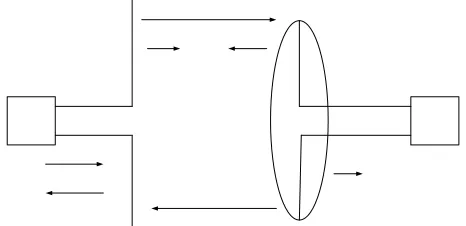
The RFID system using reflected energy is essentially a radar system. The reader provides energy for two-way communication. The tag does not have an active transmitter. It transmits its ID and other data by modulating the energy reflected from the tag antenna. The energy emitted by the reader is also used to increase the necessary operating voltage for the tag's circuitry. The tag can change the amplitude or phase of the reflected signal by changing the real or imaginary part of the chip impedance.
The reader antenna and the tag antenna have the same polarity. When the distance between the reader and the tag is r, the density S of the radiated power received by the tag can be obtained by calculating the quotient of the transmitted power and the sphere surface area, as shown in the following equation:
(1) Internet
Reader Cluster 1 Reader Cluster 2 Reader Cluster N
Server
Reader 1
Reader 2
Reader N
In the formula, PEIRP is the effective isotropic radiation power. P1 is the radiated power of the reader antenna. G1 is the gain of the reader and writer antenna. Figure 2 shows a simplified model of RFID system using reflection energy.
Fig. 2. Simplified model of RFID system using reflected energy
Through analysis, it can be known that the reflected power of the tag received by the reader is inversely proportional to the distance between the reader and the tag. It is related to the directionality of the reader antenna and the tag antenna, and the matching condition of the tag antenna and the chip. These characteristics of the reflection modulation make passive RFID systems based on reflection modulation very sensitive to the distance between the reader and the tag, and are susceptible to multipath effects and multi-user interference. In some cases, the identification of tags is very difficult.
3.3 A brief introduction to the simulation platform
The construction of the Internet of Things needs to make existing communication protocols compatible with each other. The new multi-layer wireless network communication protocol should be designed. Intelligent node hardware and firmware design, middleware development and field testing can truly reflect the performance of the protocol. However, the design of hardware, the construction of networks, and the testing of experiments will consume a lot of time and money, and the Internet of Things will grow rapidly in size and complexity. Accurate simulation of wireless network protocols has many advantages in terms of time and cost. At present, there are many kinds of network simulation tools, including NS-2, OPNET, OMNeT++, G1oMoSim, J-Sim, QualNet and so on. However, different network simulation tools have their own deficiencies. For example, the model is too simple, and user customization is not supported. The transplantation of existing protocol modules is difficult to obtain and the price is very high. The network simulation tool for the project is very important for developers. The three most commonly used network simulation tools, NS-2, OPNET and OMNeT++, are mainly introduced and compared.
graphical interfaces, and arbitrary depth layered models. OMNeT++ also supports user-customized and parameterized topologies, while OPNET only supports fixed topologies. OMNeT++ is much more flexible and extensible than NS-2, and it is better than OPNET. OMNeT++ supports graphical runtime environment and target detection, which makes tracing and debugging OMNeT++ programs simpler and faster than NS-2 and OPNET. However, network simulation tools often assume that the propagation of wireless signals is only a function of distance. Such an overly simple model makes the simulation of certain applications inaccurate. In contrast, MATLAB has an accurate channel model and a large number of powerful functions and models. However, MATLAB is not suitable for task scheduling. Table 1 compares the respective characteristics of these four tools in different aspects:
Table 1. Comparison of simulation tools
Tool NS-2 OPNET OMNeT++ MATLAB
Interface
language C++/OTCL(IL) C/C++(CL) C++/NED(CL) MATLAB(IL)
Support
module TM,MANET,Zigbee TM,MANET,WSN TM,MANET,WSN,IEEE 802.15.4
Accurate channel Harbin Physical layer model, DSP, matrix operation Dynamic
module Support Support Support Nonsupport
Parallelism Nonsupport Support MPI/PVM Support
Extensibility Small Secondary Large Large
Tracking / debugging
Very limited visual support, consuming memory
Command line debugging
Module output window, target detection, graphic running environment Intuitionistic parameter detection, time consuming Authorization
license Open Source Expensive Open Source Low
3.4 Network standards and the composition of the Internet of Things
The Internet of Things will be a Heterogeneous Network. It consists of mobile communication networks, the Internet, Wi-Fi, Bluetooth, Global Position System (GPS), and satellite communication networks. A large number of heterogeneous wireless terminal devices will be densely distributed in every corner of life. The Internet of Things needs to integrate these heterogeneous networks. The function is more complicated. The scale is even bigger. Real-time web services need to be provided.
and the downlink is 935-960 MHz. The band that is applicable to the world in the IEEE 802.15.4 protocol is 2400-2483.5 MHz, which has 16 channels. The working frequency of WLAN IEEE 802.11b/g/n includes the scope of 2.4GHz. When such multiple network standards coexist, there may be serious interference between them.
Therefore, for the simulation of the Internet of Things, it is necessary to support simultaneous simulation of multiple wireless network standards in one simulation instance. The characteristics of various network standards are reflected and the interference between them is considered. Although existing network simulation tools provide a variety of network standard modules, they do not give a method for how to simulate these modules in a simulation instance at the same time, and such simulation examples are lacking.
A method for simultaneous simulation of multiple network standards based on OMNeT++ is proposed. For a given IoT application, network standards need to be considered first. The protocol stack is divided into these network standards respectively. The simulation module of each layer of each protocol stack is built. Then, the types of heterogeneous nodes in the Internet of Things and the network standards for each node are considered. Therefore, according to each protocol stack module, a node's simulation model is built, and an interface module between each standard is designed.
4
Result Analysis and Discussion
4.1 Multilevel asymmetric network structure
millimeter-level positioning accuracy is achieved. This is of great significance to the construction of the Internet of Things. Orthogonal TH-PPM IR-UWB is applied to the reverse connection, which can effectively reduce the conflict between tags. Different readers may successfully receive information from different tags in the same time slot, which can further speed up the tag identification process.
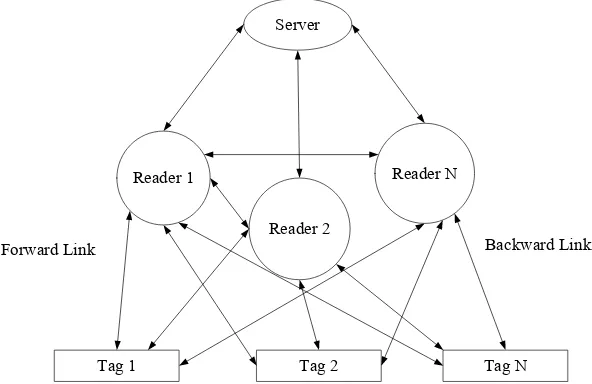
Based on this asymmetric connection, a multi-level and asymmetrical network structure is proposed. The network contains servers, readers and passive tags. The server contains a Wi-Fi network card. The reader includes a Wi-Fi network card, an UHF transceiver, and an orthogonal TH-PPM IR-UWB receiver. The passive tag contains an UHF receiver and a quadrature TH-PPM IR-UWB transmitter. They form a three-tier wireless network, namely the upper network, the middle network, and the underlying network.
Fig. 3. Multilevel asymmetrical passive network structure
4.2 Performance analysis and comparison
To verify its good performance, CDMA-based multi-reader passive RFID systems, EPC Class-1 Generation-2 systems and multi-user detection-based systems were compared in dense environments. The readers in the three systems work on only one frequency band and do not use frequency hopping. The reason is that in this application environment, frequency hopping will cause the reader to conflict with the tag. Many RFID applications need to know the location of the tag, which usually requires multiple readers to monitor the same channel at the same time. Therefore, all three systems use multiple readers. They all use the same tag clock frequency. Both the proposed system and the multi-user detection-based system only use the Gold code for the RN 16 information. EPC Class-Z Generation-2 systems and systems based on multi-user detection both use network synchronization to avoid reader-to-tag conflicts and reader-writer-to-reader conflicts.
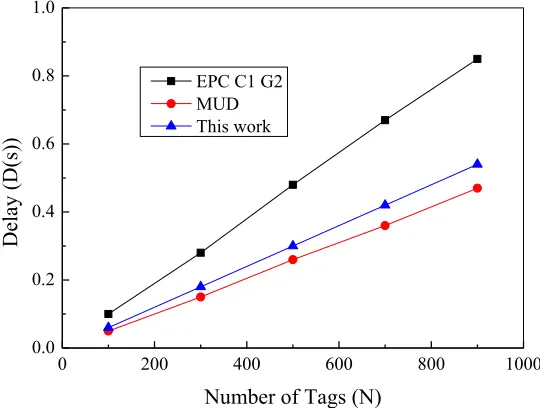
With different numbers of tags, the system uses 8 readers. The minimum value of the multi-user detection system delay expectation and the EPC Class-1 Generation-2 system and the proposed system are simulated. The latency of the three systems increases linearly with the number of tags. After using the Gold code, the RN 16 data is 7 times longer than the EPC Class-1 Generation-2 system. However, the recognition rates of the proposed system and the multi-user detection system are 1.6 and 1.8 times that of the EPC Class-1 Generation-2 system, respectively. With the Gold code, tag-to-tag conflicts are greatly reduced. The total number of time slots used by the proposed system and the multi-user detection system is fifth and one-ninth, respectively, of the EPC Class-1 Generation-2 system.
Compared with the proposed system, the multi-user detection system has better system performance under ideal conditions. However, the multi-user detection system
Server
Reader 1
Reader 2
Reader N
Tag 1 Tag 2 Tag N
will be seriously affected by the received signal power, phase shift, and channel noise in real applications. Moreover, multi-user detection systems often need to know the number of response tags in a time slot, but this number is unpredictable in advance. In this way, the multi-user detection system needs to recalculate the inverse matrix of the correlation matrix or eliminate the interference with multiple stages in each time slot. These methods increase the complexity of the reader and the time of processing the signal. On the contrary, in the case of a certain number of readers and tags, the proposed system is lower in cost than the multi-user detection system and is more suitable for RF1D systems. Comparison of system performance is shown in Figure 4.
Fig. 4. Comparison of system performance
4.3 Simulation example based on COSMO
Currently, in order to meet customer requirements and reduce costs, retailers manage inventory automatically. However, due to the wrong placement of items, the accuracy of the inventory of the world-renowned retailers is only 51%. RFID positioning technology can effectively reduce the possibility of misplaced items, and can also help operators quickly find the wrong items. Compared with active RFID positioning, passive RFID positioning has the advantages of low cost, no battery, and low maintenance cost, which makes passive RFID positioning more attractive for inventory management.
Simulation examples of passive RFID positioning based on COSMO are given. EPC Class-1 Generation-2 UHF passive RFID network is used to locate items in supermarkets. To demonstrate the power of COSMO, COSMO and other network simulation tools were compared in the same passive RFID network scenario.
0 200 400 600 800 1000
0.0 0.2 0.4 0.6 0.8 1.0
Delay (
D(s))
Number of Tags (N) EPC C1 G2
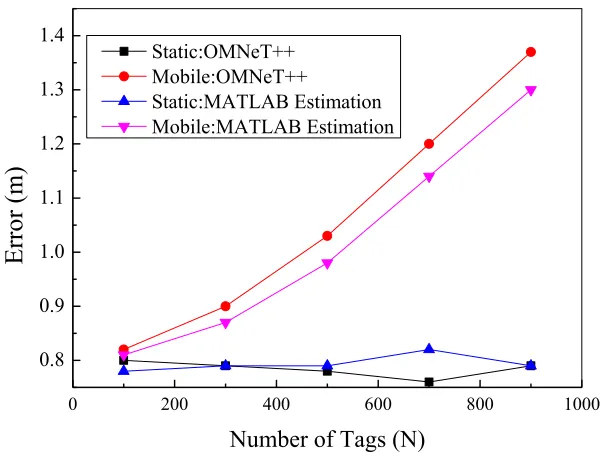
The positioning error for a stationary tag is 0.8m, which hardly varies with the number of tags. However, when the number of tags increases from 100 to 900, the positioning error for moving tags will gradually increase. The proposed multi-layer passive RFID network has a positioning error of 0.8 m for stationary tags. A mobile tag that tracks S00 speeds of no more than 3 m/s with a positioning error of no more than 1 m is implemented. When the speed of moving the label is faster, the positioning error will increase accordingly. When the speed of the moving label exceeds 3m/s, the positioning error will increase linearly with the label speed. Positioning error (maximum speed of label 3m/s) is shown in Figure 5.
Fig. 5. Positioning error (maximum speed of label 3m/s)
Simulation results in MATLAB can be used to verify the results of the co-simulation. MATLAB positioning errors and processing delays for a tag can be used to estimate the positioning error of multiple tags in a co-simulation. In a read cycle, the time at which the tag is identified is evenly distributed between the processing delay minimum and maximum values. Then, this tag is read 1000 times and the average of the positioning error is calculated. Since this tag may be identified in a different time slot in a read cycle, the average of its positioning error can be used as an approximate estimate in the case of multiple tags. As shown in Figure 5, for stationary and moving tags, the MATLAB estimates all agree with the results of the co-simulation.
0 200 400 600 800 1000
0.8 0.9 1.0 1.1 1.2 1.3 1.4
Erro
r (m)
Number of Tags (N)
Static:OMNeT++ Mobile:OMNeT++
Fig. 6. Positioning error for 500 mobile tags
5
Conclusion
The passive UHF RFID standard overview, the difference between the reflection modulation in the physical layer and the simulation platform was introduced. According to the evolution of the passive UHF RFID standard, the anti-collision algorithm of the tag evolved from the algorithm based on the tree structure to the ALOHA algorithm based on the dynamic frame slot. Miller's modulation method was proposed, and the frequency hopping and dense reader modes of operation were added. In addition, a protocol design and optimization method based on CDMA multiple access is proposed, and a multi-reader passive UHF RFID system for dense environments is designed. The cost of the proposed reader is slightly higher than that of the reader in the EPC Class-1 Generation-2 system, but it is much lower than the cost of the reader detected by the multiuser.
Using examples, the results show that a system of 8 readers and 9 7-bit long Gold codes can achieve the best compromise between recognition rate and cost. With this configuration, the proposed system can achieve a recognition rate of 1670 tags per second. The number of readers is doubled. When using 16 readers, only the recognition rate can be increased by 3.6. With the same configuration, the proposed system is 58% faster than the EPC Class-1 Generation-2 system. Compared with other network simulation tools, when COSMO is used to build the network, the workload is reduced by half, and the simulation results can be verified by COSMO itself.
0 2 4 6
0.8 1.0 1.2 1.4 1.6
Error (m)
6
References
[1]Liu, X., Wang, P., Lan, Z., & Shao, B. (2015). Biological characteristic online identification technique over 5G network. IEEE Wireless Communications, 22(6): 84-90
https://doi.org/10.1109/MWC.2015.7368828
[2]Tham, J. C. K. (2018). Interactivity in an age of immersive media: Seven dimensions for wearable technology, internet of things, and technical communication. Technical Communication, 65(1): 46-65
[3]Li, S., Chen, W., Hu, J., & Hu, J. (2018). ASPIE: A Framework for Active Sensing and Processing of Complex Events in the Internet of Manufacturing Things. Sustainability, 10(3): 692 https://doi.org/10.3390/su10030692
[4]Mrissa, M., Médini, L., Jamont, J. P., Le Sommer, N., & Laplace, J. (2015). An avatar architecture for the web of things. IEEE Internet Computing, 19(2): 30-38
https://doi.org/10.1109/MIC.2015.19
[5]Baloch, Z., Shaikh, F. K., & Unar, M. A. (2018). A context-aware data fusion approach for health-IoT. International Journal of Information Technology, 10(3): 241-245
https://doi.org/10.1007/s41870-018-0116-1
[6]Alsheikh, M. A., Niyato, D., Lin, S., Tan, H. P., & Han, Z. (2016). Mobile big data analytics using deep learning and apache spark. IEEE network, 30(3): 22-29
https://doi.org/10.1109/MNET.2016.7474340
[7]Geng, L., & Dong, T. (2017). An Agricultural Monitoring System Based on Wireless Sensor and Depth Learning Algorithm. International Journal of Online Engineering (iJOE), 13(12): 127-137 https://doi.org/10.3991/ijoe.v13i12.7885
[8]Wu, Q., Ding, G., Xu, Y., Feng, S., Du, Z., Wang, J., & Long, K. (2014). Cognitive internet of things: a new paradigm beyond connection. IEEE Internet of Things Journal, 1(2): 129-143 https://doi.org/10.1109/JIOT.2014.2311513
7
Authors
Er-hua Sun and Yu Chen are Researchers of Chongqing Real Estate Career Academy, Chongqing, China. Their research interests include Multi-layer Wireless Perception and Recognition Technology.