
July 2018
An Efficient Algorithm to Test
Forcibly-connectedness of Graphical Degree Sequences
Kai Wang
Georgia Southern University, [email protected]
Follow this and additional works at:https://digitalcommons.georgiasouthern.edu/tag Part of theDiscrete Mathematics and Combinatorics Commons
This article is brought to you for free and open access by the Journals at Digital Commons@Georgia Southern. It has been accepted for inclusion in Theory and Applications of Graphs by an authorized administrator of Digital Commons@Georgia Southern. For more information, please contact
[email protected]. Recommended Citation
Wang, Kai (2018) "An Efficient Algorithm to Test Forcibly-connectedness of Graphical Degree Sequences,"Theory and Applications of Graphs: Vol. 5 : Iss. 2 , Article 2.
DOI: 10.20429/tag.2018.050202
Cover Page Footnote
Abstract
We present an algorithm to test whether a given graphical degree sequence is forcibly connected or not and prove its correctness. We also outline the extensions of the algorithm to test whether a given graphical degree sequence is forciblyk-connected or not for every fixedk≥2. We show through experimental evaluations that the algo-rithm is efficient on average, though its worst case run time is probably exponential. We also adapt Ruskey et al’s classic algorithm to enumerate zero-free graphical degree sequences of lengthn and Barnes and Savage’s classic algorithm to enumerate graph-ical partitions of an even integern by incorporating our testing algorithm into theirs and then obtain some enumerative results about forcibly connected graphical degree sequences of given length n and forcibly connected graphical partitions of given even integern. Based on these enumerative results we make some conjectures such as: when
n is large, (1) almost all zero-free graphical degree sequences of length nare forcibly connected; (2) almost none of the graphical partitions of evennare forcibly connected.
Keywords— graphical degree sequence, graphical partition, forcibly connected, forcibly
k-connected, co-NP
1
Introduction
A graphical degree sequence of finite length n is a non-increasing sequence of non-negative integers d1 ≥ d2 ≥ · · · ≥dn such that it is the vertex degree sequence of some simple graph
(i.e. a finite undirected graph without loops or multiple edges). Given an arbitrary non-increasing sequence of non-negative integers a1 ≥ a2 ≥ · · · ≥ an, it is easy to test whether
it is a graphical degree sequence by using the Erd˝os-Gallai criterion [1] or the Havel-Hakimi algorithm [2, 3]. Seven equivalent criteria to characterize graphical degree sequences are summarized by Sierksma and Hoogeveen [4]. The notion of partitioning an integer is well known in number theory, and is defined to be a non-increasing sequence of positive integers whose sum is the given integer. An integer partition is called a graphical partition if it is the vertex degree sequence of some simple graph. Clearly a zero-free graphical degree sequence and a graphical partition are essentially the same.
It is often interesting to observe the properties of all graphs having the same vertex degree sequence. A graph G with degree sequence d = (d1 ≥ d2 ≥ · · · ≥ dn) is called a realization
of d. Let P be any property of graphs (e.g. being bipartite, connected, planar, triangle-free, Hamiltonian, etc). A degree sequence d is called potentially P-graphic if it has at least one realization having the property P and forcibly P-graphic if all its realizations have the property P [5]. In this paper, we only consider the property of k-connectedness (k ≥ 1 is fixed). Wang and Kleitman [6] give a simple characterization of potentially k-connected graphical degree sequences of length n, through which we can easily test whether a given graphical degree sequence is potentially connected. However, to the best of our knowledge no simple characterization of forciblyk-connected graphical degree sequences has been found so far and no algorithm has been published to test whether a given graphical degree sequence is forcibly connected or forciblyk-connected with given k. Some sufficient (but unnecessary) conditions are known for a graphical degree sequence to be forcibly connected or forcibly
In the rest of this paper, we will present a straight-forward algorithm to characterize forcibly connected graphical degree sequences and outline the extensions of the algorithm to test forcibly k-connectedness of graphical degree sequences for fixed k≥2. We will demon-strate the efficiency of the algorithm through some computational experiments and then present some enumerative results regarding forcibly connected graphical degree sequences of given length nand forcibly connected graphical partitions of given even integern. Based on these available enumerative results we make some conjectures about the relative asymptotic behavior of considered functions and the unimodality of certain associated integer sequences.
2
The testing algorithm
2.1
Preliminaries
Based on a result of Wang and Kleitman [6], a graphical degree sequenced1 ≥d2 ≥ · · · ≥dn
is potentially k-connected if and only if dn ≥ k and Pin=1di ≥ 2n−2 k2
−2 + 2Pk−1 i=1 di.
Taking k = 1, we get that a zero-free graphical degree sequence d1 ≥ d2 ≥ · · · ≥ dn is
potentially connected if and only if Pn
i=1di ≥2n−2.
Note that any graphical degree sequence with a 0 in it can be neither potentially nor forcibly connected. We will design an algorithm to test whether a zero-free graphical de-gree sequence d is forcibly connected based on the simple observation that d is forcibly connected if and only if it is not potentially disconnected, i.e., it does not have any discon-nected realization. Equivalently, we need to test whetherd can be decomposed into two sub graphical degree sequences. For example, 3,3,3,3,2,2,2 is a potentially connected graphical degree sequence of length 7. It is not forcibly connected since it can be decomposed into two sub graphical degree sequences 3,3,3,3 and 2,2,2. Note also that when a graphical degree sequence can be decomposed into two sub graphical degree sequences, the terms in each sub sequence need not be consecutive in the original sequence. For example, the graphical degree sequence 4,4,3,3,3,2,2,2,1 can be decomposed into two sub graphical degree sequences 4,4,3,3,3,1 and 2,2,2 or into 4,4,3,3,2 and 3,2,2,1. We say that the graphical degree sequence 3,3,3,3,2,2,2 has anatural decomposition because it has a decomposition in which the terms in each sub sequence are consecutive in the original sequence. The graphical degree sequence 4,4,3,3,3,2,2,2,1 is not forcibly connected but does not have a natural decomposition. On the other hand, the graphical degree sequence 6,6,6,5,5,5,5,4,4 is forcibly connected since there is no way to decompose it into two sub graphical degree sequences.
2.2
Pseudo-code and the proof of its correctness
In this section, we will present the pseudo-code to test forcibly-connectedness of a given zero-free graphical degree sequence in Algorithm 1. We then give a proof why it correctly identifies such graphical degree sequences.
otherwise. The output can also include a way to decompose the input in case it is not forcibly connected and such a decomposition is desired.
Algorithm 1: Pseudo-code to test forcibly-connectedness of a graphical degree se-quence
Input: A zero-free graphical degree sequence d= (d1 ≥d2 ≥ · · · ≥dn) Output: True orFalse, indicating whether d is forcibly connected or not 1 if d1 ≥n−2 or dn ≥ bn/2c then
2 return True
3 if d1 =dn then
4 return False
5 su ←max{s :s < n−ds+1};// 2≤su ≤n−dn−1
6 if there exists ans such that d1+ 1≤s ≤su and d1 = (d1 ≥d2 ≥ · · · ≥ds) and d2 = (ds+1 ≥ds+2 ≥ · · · ≥dn) are both graphical then
7 return False
8 for l←dn+ 1 to min{bn/2c, n−d1−1}do
9 if dn+1−l< l then
10 m ←min{i:di < l}; // 1≤m≤n−l+ 1 11 if l≤n−m then
12 Form all candidate decompositions of d intos1 and s2 such thats1 is taken from dL= (dm ≥dm+1 ≥ · · · ≥dn) of length l and s2 =d−s1 is of length
n−l and both with even sum. If boths1 and s2 are graphical, return False
13 return True
Now, we show why Algorithm 1 correctly identifies whether d is forcibly connected or not. The conditional test on line 1 works as follows.
• If d1 ≥n−2, then in any realization G of d the vertex v1 with degree d1 will be in a
connected component with at leastn−1 vertices, leaving at most 1 vertex to be in any other connected component should the inputd be non forcibly connected. However, a graph with a single vertex has the degree sequence 0, which contradicts the assumption that d is zero-free. Thus, in this cased must be forcibly connected.
• Ifdn ≥ bn/2c, then the vertexvnwith degreednwill be in a connected component with
at least 1 +bn/2c vertices. Should the input d be non forcibly connected, there will be another connected component not containing vn and also having at least 1 +bn/2c
vertices since each vertex in that connected component has degree at leastdn≥ bn/2c.
This will result in a realization with at least 2 + 2bn/2c> n vertices, a contradiction. Thus, in this case d must also be forcibly connected.
The conditional test on line 3 works as follows. Let d1 =dn=d. Note that dnmust be
even for this regular sequence to be graphical.
• If n is odd, then d must be even. When we reach line 3, we must have d < bn/2c. Now,d can be decomposed into two sub graphical degree sequences of length n−21 and
n+1
2 respectively since d <
n−1
• Ifn is even, we consider two cases.
Case (A): n/2 is even, i.e. n ≡ 0 mod 4. In this case, d can be decomposed into two graphical degree sequences of length n/2 since d < bn/2c =n/2. Thus, it is not forcibly connected.
Case (B): n/2 is odd, i.e. n ≡2 mod 4. Further, consider two sub cases. (B1): if d is odd, then d can be decomposed into two graphical degree sequences of lengthn/2−1 and n/2 + 1 respectively since d < n/2−1 as a result of d and n/2 being both odd and d < n/2. (B2): if d is even, then d can be decomposed into two graphical degree sequences of lengthn/2 sinced < n/2. Thus, in this case d is not forcibly connected.
Lines 5 to 7 try to find if d can be decomposed into two sub graphical degree sequences such that each sub sequence contains terms consecutive in the original sequence d, i.e. if the input d has a natural decomposition. For each given s, the two sub sequences d1 = (d1 ≥ d2 ≥ · · · ≥ ds) and d2 = (ds+1 ≥ ds+2 ≥ · · · ≥ dn) can be tested whether they
are graphical by utilizing a linear time algorithm [10] that is equivalent to the Erd˝os-Gallai criterion. The smallests that need to be tested is d1+ 1 sinced1 can only be in a graphical
degree sequence of length at leastd1+ 1 and d1 has lengths. The largest sthat needs to be tested is at most n−dn−1 sincedn can only be in a graphical degree sequence of length at
leastdn+ 1 andd2 has lengthn−s. Actually, the upper bound of the testedscan be chosen to be at most the largest s such that s < n−ds+1 since ds+1 can only be in a graphical
degree sequence of length at least ds+1+ 1. Let su be the largest integer that satisfies this
inequality. Note su ≥2 since s= 2 satisfies the inequality at the point of line 5. Also, note
that su ≤ n−dn−1 because if su ≥ n−dn then n−dn ≤ su < n−dsu+1, which leads to dsu+1 < dn, a contradiction. Therefore, the upper bound of tested s is chosen to be su. Additional data structures can be maintained to skip the tests of those s for which each of the two sub sequencesd1 and d2 has odd sum. Clearly, a necessary condition for the input d to have a natural decomposition is su ≥ d1 + 1. A weaker necessary condition which is
easier to check is n−dn−1≥d1+ 1, i.e. d1+dn ≤n−2.
The for loop starting from line 8 is to test whether the input d can be decomposed into two sub graphical degree sequences of length l and n − l respectively, whether the decomposition is natural or not. At first glance, we need to test the range oflin 2≤l ≤n−2 since the shortest zero-free graphical degree sequence has length 2. By symmetry we do not need to test those l beyond bn/2c. Actually, we only need to test the range ofl fromdn+ 1
to min{bn/2c, n−d1−1}. We can start the loop withl =dn+ 1 since, should the inputdbe
decomposable, dn must be in a sub graphical degree sequence of length at least dn+ 1 and
the other sub graphical degree sequence not containing dn must also be of length at least
dn+ 1 due to all its terms being at least dn. There is no need to test those l > n−d1−1
since, should the inputd be decomposable,d1 must be in a sub graphical sequence of length
at least d1+ 1 and the other sub graphical sequence not containing d1 must have length at
most n−d1−1.
The condition tested on line 9 (dn+1−l < l) is necessary for d to be decomposable into
two sub graphical degree sequences of length l and n−l respectively. A zero-free graphical degree sequence of length l must have all its terms less than l. If d is decomposable into two sub graphical degree sequences of length l and n−l respectively, d must have at least
(dn−l+1 ≥ dn−l+2 ≥ · · · ≥ dn) must be all less than l and the n −l smallest terms of d
(dl+1 ≥ dl+2 ≥ · · · ≥ dn) must be all less than n −l. These translate to the necessary
conditionsdn−l+1 < l anddl+1 < n−l for dto be decomposable. The conditiondl+1 < n−l
has already been satisfied since d1 < n−l based on the loop range of l on line 8.
Lines 10 to 12 first find out the sub sequence dL of d consisting exactly of those terms less than l and then exhaustively enumerate all sub sequences s1 of dL with length l and even sum, trying to find a valid decomposition ofdintos1ands2 =d−s1 with lengthn−l, consisting of the terms of d not in s1. Note that the l terms of s1 need not be consecutive in dL. The motivation for the construction of m and dL = (dm ≥dm+1 ≥ · · · ≥ dn) is that,
should the inputd be decomposable into two sub graphical degree sequences of lengthl and
n−l respectively, the sub graphical degree sequence with length l must have all its terms coming from dL. For each such sub sequence s1 of dL with length l (we can always choose such an s1 since dL has length n−m+ 1 ≥ l due to the definition of m on line 10), let the remaining terms of d form a sub sequence s2 =d−s1 of length n−l. If both s1 and s2 are graphical degree sequences, then the input d is not forcibly connected since we have found a valid decomposition of d into s1 and s2 and we may return False on line 12. The conditional test on line 11 (l≤n−m) is added because at this point we knowd cannot be naturally decomposed and we can therefore exclude the consideration of l=n−m+ 1 since under this condition there is only one possible choice of s1 from dL and consequently only one possible decomposition of d into two sub sequences of length l and n−l respectively, which is also a natural decomposition. If we remove the natural decomposition test from lines 5 to 7 and also remove the conditional test on line 11, the algorithm would obviously still be correct. If in the for loop from lines 8 to 13 we never return False on line 12, this means there is no way to decompose the input d into two sub graphical degree sequences whatsoever and we should returnTrue on line 14. If we returnFalse on line 4, 7, or 12, then a valid decomposition can also be returned if desired.
Later, we will show that there is a computable threshold M(n) given the lengthn of the input d such that if d1 is below this threshold the algorithm can immediately return False
without any exhaustive enumerations. However, our computational experiences suggest that if the input satisfies d1 < M(n) then Algorithm 1 already runs fast and it might not be
worthwhile to add the computation of the additional threshold M(n) into it.
2.3
Extensions of the algorithm
In this section, we show how to extend Algorithm 1 to perform additional tasks such as listing all possible decompositions of a graphical degree sequence and testing forcibly k -connectedness of a graphical degree sequence for fixed k≥2.
2.3.1 Enumeration of all possible decompositions
Algorithm 1 can be easily extended to give all possible decompositions of the input d into two sub graphical degree sequences in case it is not forcibly connected. We simply need to report a valid decomposition found on line 3, 6 and 12 and continue without returningFalse
immediately. Such an enumerative algorithm to find all valid decompositions of the input d
2.3.2 Testing forcibly k-connectedness of d when k ≥2
It is also possible to extend Algorithm 1 to decide whether a given graphical degree sequence
d is forcibly biconnected or not. We know that a connected graph is biconnected (non-separable) if and only if it does not have a cut vertex. This characterization leads us to observe that if in any forcibly connected graphical degree sequence d, the removal of any term di and the reduction of some collectiondS of di elements from the remaining sequence d− {di} by 1 each results in a non forcibly connected graphical degree sequence d0 then d is not forcibly biconnected. If no such term and a corresponding collection of elements from the remaining sequence can be found whose removal/reduction results in a non forcibly connected graphical degree sequence, then dis forcibly biconnected. We give a pseudo-code framework in Algorithm 2 to decide whether a given graphical degree sequence d is forcibly biconnected or not. To simplify our description, we call the above mentioned combination of removal/reduction operations a generalized Havel-Hakimi (GHH) operation, notationally
d0 = GHH(d, di,dS). We remark that if the d0 obtained on line 4 of Algorithm 2 is not a graphical degree sequence, then the condition on line 5 is not satisfied and the algorithm will not return False at the moment.
Algorithm 2: Pseudo-code to test whether a graphical degree sequence is forcibly biconnected (See text for the description of GHH operation)
Input: A zero-free graphical degree sequence d= (d1 ≥d2 ≥ · · · ≥dn) Output: True orFalse, indicating whether d is forcibly biconnected or not 1 if d is not potentially biconnected or forcibly connected then
2 return False
3 for each di and each collection dS of size di from d− {di} do
4 d0 ←GHH(d, di,dS);
5 if d0 is a non forcibly connected graphical degree sequence then
6 return False
7 return True
Similarly, we can test whether a given graphical degree sequencedis forciblyk-connected or not fork≥3 iteratively as long as we already have a procedure to test whether a graphical degree sequence is forcibly (k−1)-connected or not. Suppose we already know an input d
is potentially k-connected and forcibly (k−1)-connected. We can proceed to choose a term
di and a collection dS of sizedi from the remaining sequence d− {di} and perform a GHH
Algorithm 3: Pseudo-code to test whether a graphical degree sequence is forcibly
k-connected (See text for the description of GHH operation)
Input: A zero-free graphical degree sequence d= (d1 ≥d2 ≥ · · · ≥dn) and an integer
k ≥2
Output: True orFalse, indicating whether d is forcibly k-connected or not 1 if d is not potentially k-connected or forcibly (k−1)-connected then
2 return False
3 for each di and each collection dS of size di from d− {di} do
4 d0 ←GHH(d, di,dS);
5 if d0 is a non forcibly (k−1)-connected graphical degree sequence then
6 return False
7 return True
3
Complexity analysis
We conjecture that Algorithm 1 runs in time polynomial in n on average. The worst case run time complexity is probably still exponential in n. We are unable to provide a rigorous proof at this time, but we will later show through experimental evaluations that it runs fast on randomly generated long graphical degree sequences most of the time.
Now, we give a discussion of the run time behavior of Algorithm 1. Observe that lines 1 to 4 take constant time. Lines 5 to 7 take O(n2) time if we use the linear time algorithm
from [10] to test whether an integer sequence is graphical. Lines 9 to 11 combined takeO(n) time and they are executed O(n) times. So, the overall time complexity isO(n2) excluding the time on line 12.
Next, consider all candidate decompositions of d into s1 and s2 on line 12. The sub sequence s1 is taken from dL = (dm ≥ dm+1 ≥ · · · ≥ dn) whose length could be as large as
n and the length l of s1 could be as large as bn/2c. Therefore, in the worst case we may have up to n/n2 candidate decompositions, which could make the run time of Algorithm 1 exponential in n.
A careful implementation of Algorithm 1 will help reduce running time by noting that
dL is a multi-set and provides us an opportunity to avoid duplicate enumerations of s1 because different l combinations of the indices (m, m+ 1,· · · , n) could produce the same sub sequence s1. For this purpose, we can assume the input d is also provided in another format (e1, f1),(e2, f2),· · · ,(eq, fq) where d contains fi copies of ei for i = 1,· · · , q and
e1 > e2 >· · ·> eq >0. (Clearlyd1 =e1 and dn=eq.) Now, enumeratings1 of lengthlfrom dL can be equivalently translated to the following problem of enumerating all non-negative integer solutions of Equation (1) subject to constraints (2),
k X
i=1
xi =l, (1)
0≤xi ≤fq−k+i, for i= 1,· · · , k, (2)
where k is the number of distinct elements in dL = (dm ≥ dm+1 ≥ · · · ≥ dn) which can
k ≤ l −dn since all the elements of dL are < l and ≥ dn. In this context, m and k vary
withl as thefor loop from lines 8 to 12 progresses. Each solution of Equation (1) represents a candidate choice of s1 out of dL with length l by taking xi copies of eq−k+i. Further
improvement could be achieved by noting the odd terms among eq−k+1, eq−k+2,· · · , eq since
we must have an even number of odd terms ins1 for it to have even sum. We can categorize the xi variables of Equation (1) into two groups based on the parity of the corresponding ei
and enumerate only its solutions having an even sum of the xi’s belonging to the odd group.
The number of solutions of Equation (1) can be exponential in n. For example, let
l = n/2, k =n/4 and let fj = 4 for j =q−k+ 1,· · · , q. Then, the number of solutions of
Equation (1) will be at least n/n/48 by taking half of all x1,· · · , xk to be 4 and the remaining
half to be 0. However, in practice we rarely find such a large number of solutions are actually all enumerated before Algorithm 1 returns.
To the best of our knowledge, the computational complexity of the decision problem of whether a given graphical degree sequence is forcibly connected is unknown. The problem is clearly in co-NP since a short certificate to prove that a given input is not forcibly connected is a valid decomposition of the input sequence. But is it co-NP-hard? As far as we know, this is an open problem.
The time complexity of the extension Algorithms 2 and 3 to test whether a given graphical degree sequence d is forcibly k-connected or not for k ≥2 is apparently exponential due to the exhaustive enumeration of the candidate collection dS of size di from the remaining
sequence d− {di} and the ultimate calls to Algorithm 1 possibly an exponential number of
times.
The computational complexity of the decision problem of whether a given graphical degree sequence is forcibly k-connected (k ≥2) is also unknown to us. Clearly, the problem is still in co-NP when k is fixed; to prove that a graphical degree sequenced is not forcibly
k-connected is as easy as using a sequence of k −1 certificates each consisting of a pair (di,dS) and a kth certificate being a valid decomposition to show that the final resulting sequence is decomposable after a sequence of k −1 GHH operations on d, but we do not know if it is inherently any harder than the decision problem for k= 1.
4
Computational results
In this section, we will first present some results on the experimental evaluation for the performance of Algorithm 1 on randomly generated long graphical degree sequences. We will then provide some enumerative results about the number of forcibly connected graphical degree sequences of given length and the number of forcibly connected graphical partitions of a given even integer. Based on the available enumerative results, we will make some conjectures about the asymptotic behavior of related functions and the unimodality of certain associated integer sequences.
4.1
Performance evaluations of Algorithm 1
Our experimental methodology is as follows. Choose a constant ph in the range [0.1,0.95]
and a constant pl in the range of [0.001,min{ph −0.01,0.49}] and generate 100 random
graphical degree sequences of length n with largest term around phn and smallest term
around pln. Each such graphical degree sequence is generated by first uniformly random
sampling integer partitions with the specified number of parts n and the specified largest part and smallest part and then accept it as input for Algorithm 1 if it is a graphical degree sequence. We run Algorithm 1 on these random instances and record the average performance and note the proportion of them that are forcibly connected. Table 1 lists the tested ph and pl. The largest tested pl is 0.49 since any graphical degree sequence of length
n and smallest term at least 0.5n will cause Algorithm 1 to return True on line 2.
Table 1: Chosen ph and pl in the experimental performance evaluation of Algorithm 1.
ph pl
0.10 0.001,0.002,0.003,...,0.01,0.02,0.03,...,0.09 0.20 0.001,0.002,0.003,...,0.01,0.02,0.03,...,0.19 0.30 0.001,0.002,0.003,...,0.01,0.02,0.03,...,0.29 0.40 0.001,0.002,0.003,...,0.01,0.02,0.03,...,0.39 0.50 0.001,0.002,0.003,...,0.01,0.02,0.03,...,0.49 0.55 0.001,0.002,0.003,...,0.01,0.02,0.03,...,0.49 0.60 0.001,0.002,0.003,...,0.01,0.02,0.03,...,0.49 0.65 0.001,0.002,0.003,...,0.01,0.02,0.03,...,0.49 0.70 0.001,0.002,0.003,...,0.01,0.02,0.03,...,0.49 0.75 0.001,0.002,0.003,...,0.01,0.02,0.03,...,0.49 0.80 0.001,0.002,0.003,...,0.01,0.02,0.03,...,0.49 0.85 0.001,0.002,0.003,...,0.01,0.02,0.03,...,0.49 0.90 0.001,0.002,0.003,...,0.01,0.02,0.03,...,0.49 0.95 0.001,0.002,0.003,...,0.01,0.02,0.03,...,0.49
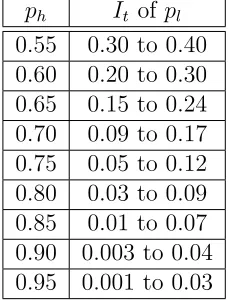
Table 2: Transition interval It of pl for each ph (for n= 1000).
ph It of pl
0.55 0.30 to 0.40 0.60 0.20 to 0.30 0.65 0.15 to 0.24 0.70 0.09 to 0.17 0.75 0.05 to 0.12 0.80 0.03 to 0.09 0.85 0.01 to 0.07 0.90 0.003 to 0.04 0.95 0.001 to 0.03
We summarize our experimental results for the length n= 1000 as follows.
1. For those instances with ph in the range from 0.1 to 0.5, Algorithm 1 always finishes
instantly (run time < 0.01s) and all the tested instances are non forcibly connected. This does not necessarily mean that there are no forcibly connected graphical degree sequences of length n= 1000 with largest term aroundphn withph in this range. It only suggests that
forcibly connected graphical degree sequences are relatively rare in this range.
2. For each ph in the range from 0.55 to 0.95, we observed a transition intervalItof pl for
each fixedph. See Table 2 for a list of observed transition intervals. All those instances with
pl below the range It are non forcibly connected and all those instances with pl above the
rangeIt are forcibly connected. Those instances with pl in the rangeIt exhibit the behavior
that the proportion of forcibly connected among all tested 100 instances gradually increases from 0 to 1 as pl increases in the range It. For example, based on the results of Table 2,
the proportions of forcibly connected graphical degree sequences of length 1000 with largest term around 850 (ph = 0.85) and smallest term below around 10 (pl = 0.01) are close to
0. If the smallest term is above around 70 (pl = 0.07) then the proportion is close to 1.
When the smallest term is between 10 and 70 (pl in the range from 0.01 to 0.07) then the
proportion transitions from 0 to 1. Again, these results should be interpreted as relative frequency instead of absolute law.
3. Algorithm 1 is efficient most of the time, but encounters bottlenecks every so often. For ph from 0.80 to 0.95 and pl near the lower end of the transition interval It, Algorithm
1 does perform poorly on some of the tested instances with run time from a few seconds to more than a few hours (time out). The exact range of pl near the lower end of It where
Algorithm 1 could perform poorly varies. We observed that this range of pl for which the
algorithm could perform poorly is quite narrow. For example, whenn = 1000,ph = 0.9, the
observed range ofpl is from 0.001 to 0.01. We also observed that the frequency at which the
algorithm performs poorly also varies. We believe that this is because among all possible instances with given length and given largest and smallest terms, there is still great variety in terms of difficulty of testing their property of forcibly connectedness using Algorithm 1. In particular, some instances will trigger the exhaustive behavior of Algorithm 1 on line 12, forcing it to enumerate a lot of candidate decompositions without returning.
We have also performed experimental evaluations of Algorithm 1 for the length n = 2000,3000, ...,10000 without being able to finish all the same ph, pl choices as for n = 1000
because of shortage of time. The behavior of Algorithm 1 on inputs of these longer lengths is similar to the case of n = 1000 but with different transition intervals It and varied range
of pl near the lower end of the transition interval It for which it could perform poorly.
In summation, we believe that the average case run time of Algorithm 1 is polynomial. We estimate that more than half of all zero-free graphical degree sequences of length n can be tested in constant time on line 1. However, its worst case run time should be exponential. As mentioned above, the computational complexity of the decision problem itself is unknown to us.
exhaustive enumerations. We plan to investigate the possible improvements to Algorithms 2 and 3 in the future.
4.2
Enumerative results
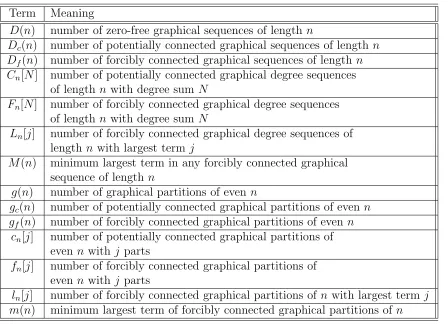
In this section, we will present some enumerative results related to forcibly connected graph-ical degree sequences of given length and forcibly connected graphgraph-ical partitions of given even integer. We also make some conjectures based on these enumerative results. For the reader’s convenience, we summarize the notations used in this section in Table 3.
Table 3: Terminology used in this section
Term Meaning
D(n) number of zero-free graphical sequences of length n
Dc(n) number of potentially connected graphical sequences of length n
Df(n) number of forcibly connected graphical sequences of length n
Cn[N] number of potentially connected graphical degree sequences
of length n with degree sum N
Fn[N] number of forcibly connected graphical degree sequences
of length n with degree sum N
Ln[j] number of forcibly connected graphical degree sequences of
length n with largest term j
M(n) minimum largest term in any forcibly connected graphical sequence of length n
g(n) number of graphical partitions of even n
gc(n) number of potentially connected graphical partitions of even n
gf(n) number of forcibly connected graphical partitions of even n
cn[j] number of potentially connected graphical partitions of
even n with j parts
fn[j] number of forcibly connected graphical partitions of
even n with j parts
ln[j] number of forcibly connected graphical partitions of n with largest term j
m(n) minimum largest term of forcibly connected graphical partitions of n
In a previous manuscript [11], we have presented efficient algorithms for counting the number of graphical degree sequences of length n and the number of graphical degree se-quences of k-connected graphs with n vertices (or graphical degree sequences of length n
that are potentially k-connected). It is proved there that the asymptotic orders of the number D(n) of zero-free graphical degree sequences of length n and the number Dc(n)
of potentially connected graphical degree sequences of length n are equivalent. That is, limn→∞ DDc((nn)) = 1. In order to investigate how the number Df(n) of forcibly connected
of that can generate all zero-free graphical degree sequences of length n is from Ruskey et al [12]. We adapted this algorithm to incorporate the test in Algorithm 1 to count those that are forcibly connected. Since D(n) grows as an exponential function ofn based on the bounds given by Burns [13] (4n/(c
1n) ≤ D(n) ≤ 4n/((logn)c2
√
n)) for all sufficiently large
n with c1, c2 positive constants), it is unlikely to get the value ofDf(n) for large n using an
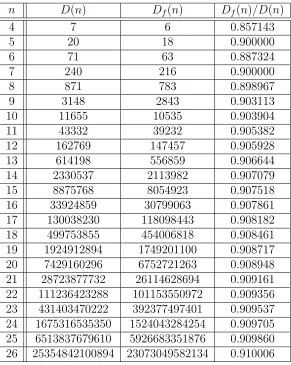
exhaustive generation algorithm. We only have counting results of Df(n) forn up to 26 due
to the long running time of our implementation. The results together with the proportion of them in all zero-free graphical degree sequences are listed in Table 4. From the table it seems reasonable to conclude that the proportionDf(n)/D(n) will increase whenn ≥8 and
it might tend to the limit 1.
Table 4: Number of forcibly connected graphical degree sequences of length n and their proportions in zero-free graphical degree sequences of length n.
n D(n) Df(n) Df(n)/D(n)
4 7 6 0.857143
5 20 18 0.900000
6 71 63 0.887324
7 240 216 0.900000
8 871 783 0.898967
9 3148 2843 0.903113
10 11655 10535 0.903904
11 43332 39232 0.905382
12 162769 147457 0.905928
13 614198 556859 0.906644
14 2330537 2113982 0.907079
15 8875768 8054923 0.907518
16 33924859 30799063 0.907861
17 130038230 118098443 0.908182
18 499753855 454006818 0.908461
19 1924912894 1749201100 0.908717
20 7429160296 6752721263 0.908948
21 28723877732 26114628694 0.909161
22 111236423288 101153550972 0.909356
23 431403470222 392377497401 0.909537
24 1675316535350 1524043284254 0.909705 25 6513837679610 5926683351876 0.909860 26 25354842100894 23073049582134 0.910006
Since our adapted algorithm from Ruskey et al [12] for computing Df(n) actually
Table 5: Number of potentially (row C7[N]) and forcibly (row F7[N]) connected graphical
degree sequences of length 7 with given degree sum N.
N 12 14 16 18 20 22 24 26 28 30 32 34 36 38 40 42
C7[N] 7 11 15 22 26 29 29 26 23 18 13 8 5 2 1 1
F7[N] 3 5 10 19 25 28 29 26 23 18 13 8 5 2 1 1
Table 6: Number L15[j] of forcibly connected graphical degree sequences of length 15 with
given largest termj.
j 14 13 12 11 10 9 8 7 6
L15[j] 3166852 2624083 1398781 600406 201128 52903 9718 1031 21
are not shown because those counts are all 0. The highest degree sum is 42 for any graphical degree sequence of length 7. From the table, we see that the individual counts based on the degree sum N that contribute to Dc(7) (row C7[N]) and Df(7) (row F7[N]) both form a
unimodal sequence. Counts for other degree sequence lengths from 5 to 26 exhibit similar behavior. Based on the available enumerative results, we find that for any given nthe range of even N for Cn[N] and Fn[N] to be nonzero are exactly the same (between 2n−2 and
n(n−1)). We prove this observation is true below.
Proposition 4.1. An even N has a potentially connected graphical partition withn parts if and only if it has a forcibly connected graphical partition with n parts.
Proof. Sufficiency is obvious by definition. In the following we show the necessity.
Suppose an even N has a potentially connected graphical partition with n parts. From the Wang and Kleitman characterization [6] we know that N must be between 2n−2 and
n(n−1) for it to have a potentially connected graphical partition ofn parts. Now construct a partition π of N with n parts as follows. Let the largest part be n −1 and let the remaining n−1 parts be distributed as evenly as possible. That is, let b = bN−n+1
n−1 c and
a=N −(n−1)(b+ 1). Then, the smallest n−1 parts ofπ consist ofa copies of b+ 1 and
n−1−acopies ofb. With 2n−2≤N ≤n(n−1), we have 0< b≤n−1 and 0≤a < n−1. Based on the Nash-Williams condition, it is easy to verify that π is a graphical partition of
N with n parts and it is forcibly connected since its largest part is n−1.
In Table 6, we show itemized numbers of forcibly connected graphical degree sequences of length 15 based on the largest degree. The counts for largest degrees less than 6 are not shown because those counts are all 0. From the table we can see that the counts decrease with the largest degree. For other degree sequence lengths from 5 to 26 we observed similar behavior. The table also indicates that there are no forcibly connected graphical degree sequences of length 15 with largest degree less than 6. In fact, if we define M(n) to be the minimum largest term in any forcibly connected graphical sequence of length n. This is,
Theorem 4.2. For M(n) defined above, we have M(n) = Ω(√n). That is, there is a constant c >0 such that M(n)> c√n for all sufficiently large n.
Proof. For the purpose of deriving a contradiction, assume there is a forcibly connected graphical degree sequence ß = (d1 ≥ d2 ≥ · · · ≥ dn) of length n with the largest term
d1 =M(n) =o(
√ n).
Let us first consider the case that n is even. Let ßH be the higher half (of length n/2) of ß and ßL be the lower half (of length n/2) of ß. If bothßH and ßL have even sums, then they can be shown to be graphical degree sequences based on the Nash-Williams condition [14, 15, 4] as follows. Suppose the Durfee square size of ß iss, where s≤d1 =M(n) by the
definition of Durfee square. Since ß is graphical, it satisfies the Nash-Williams condition, which can be represented as s inequalities:
j X
i=1
(d0i−di)≥j, j = 1,· · · , s,
whered01,· · · , d0sare the largestsparts of the conjugate partition of the partitionß(d01 =n). NowßandßH have the same Durfee square size by our assumption thats=o(
√
n) and they have the same s largest parts. Let the s largest parts of the conjugate of ßH be d001,· · · , d
00 s
withd001 =n/2 by our construction. To show thatßH is graphical, we only need to show that the followings inequalities hold:
j X
i=1
(d00i −di)≥j, j = 1,· · · , s. (3)
The first of these inequalities d001 −d1 = n/2−M(n) ≥ 1 is clearly satisfied since M(n) =
o(√n). We also have the following inequalities,
d00j ≥s and dj ≤M(n), j = 2,· · · , s,
so we have d00j −dj ≥ s−M(n), j = 2,· · · , s. Even if d00j −dj, j = 2,· · · , s are all negative,
their sum will be of ordero(n) sinces≤M(n) = o(√n). Clearly, thesinequalities in (3) are all satisfied since d001 −d1 =n/2−M(n) is of order Ω(n). This shows that ßH is graphical. By the same argument ßL is graphical and we have found that ß can be decomposed into two sub graphical degree sequences ßH and ßL. This contradicts our assumption that ß is forcibly connected.
If both ßH and ßL have odd sums (we cannot have one of them having even sum and the other having odd sum since the sum of all the terms of ß is even), then it must be the case that bothßH and ßL have an odd number of odd terms. Construct two new sequences ß0H and ß0L from ßH and ßL by removing the largest odd term from ßL and adding it to ßH. Now, clearlyß0H andß0L is a decomposition ofß into two sub sequences of lengthn/2 + 1 and
n/2−1 respectively and both having even sums. Again they are guaranteed to be graphical degree sequences by the Nash-Williams condition using a similar argument as above, which contradicts the assumption thatß is forcibly connected.
The case forn odd can be proved in a similar way. The conclusion that M(n) cannot be
We do not have any theory or algorithm to efficiently obtainM(n) for any givenn. Other than recording the minimum largest term while enumerating all forcibly connected graphical degree sequences of length n, a naive approach would be to let ∆ start from 3 upward and test if there is a forcibly connected graphical degree sequence of lengthnwith largest term∆
and stop incrementing∆when we have found one. Obviously, this works, but is not efficient. Any efficient algorithm for M(n) might be worthwhile to be added into Algorithm 1 so that it can immediately return False if d1 < M(n). However, while we conduct performance
evaluations of Algorithm 1 we do find that a random graphical degree sequence of length n
with d1 ≤ n/2 most likely can be decided instantly by Algorithm 1. Therefore we believe
that an efficient algorithm for M(n) will not help much on average. We show the values of
M(n) based on our enumerative results in Table 7. The fact that M(15) = 6 agrees with the results of Table 6 where the counts L15[j] = 0 for all j < 6. As a side note, the minimum
largest term in any potentially connected graphical sequence of lengthnis clearly 2 since the degree sequence 2,2,· · · ,2 (n copies) is potentially connected while 1,1,· · · ,1 (n copies) is not potentially connected.
Table 7: Minimum largest termM(n) of forcibly connected graphical sequences of lengthn.
n 3 4 5 6 7 8 9 10 11 12 13 14
M(n) 2 2 2 3 3 3 4 4 5 5 5 6
n 15 16 17 18 19 20 21 22 23 24 25 26
M(n) 6 6 7 7 7 7 8 8 8 8 8 9
We also investigated the number gf(n) of forcibly connected graphical partitions of a
given even integer n. There is a highly efficient Constant Amortized Time (CAT) algorithm of Barnes and Savage [16] to generate all graphical partitions of a given even n. And there are efficient counting algorithms of Barnes and Savage [17] and Kohnert [18] to count the number g(n) of graphical partitions of even n without generating them. It is known from Erd˝os and Richmond [19] that the numbergc(n) of potentially connected graphical partitions
of n and g(n) are of equivalent order, i.e. limn→∞ ggc(2(2nn)) = 1. It is also known from Pittel [20] that the proportion of graphical partitions among all partitions of an integer n tends to 0. Although the order of the number p(n) of unrestricted partitions ofn is long known since Hardy and Ramanujan [21], the exact asymptotic order of g(n) is still unknown. We know of no algorithm to count the number gf(n) of forcibly connected graphical partitions of n
without generating them. Using a strategy similar to that we employed in computingDf(n),
we adapted the algorithm of Barnes and Savage [16] and incorporated the test of forcibly connectedness from Algorithm 1 and counted those that are forcibly connected. The growth of g(n) is quick and we only have numerical results of gf(n) for n up to 170. The results
together with the proportion of them in all graphical partitions are listed in Table 8. For the purpose of saving space, we only show the results in increments of 10 for n. From the table it seems reasonable to conclude that the proportion gf(n)/g(n) will decrease when n
is beyond some small threshold and it might tend to the limit 0.
Like the situation for Df(n), the adapted algorithm from Barnes and Savage [16] to
compute gf(n) actually generates all forcibly connected graphical partitions of n, so it is
Table 8: Number of forcibly connected graphical partitions ofn and their proportions in all graphical partitions of n
n g(n) gf(n) gf(n)/g(n)
10 17 8 0.470588
20 244 81 0.331967
30 2136 586 0.274345
40 14048 3308 0.235478
50 76104 15748 0.206927
60 357635 66843 0.186903
70 1503172 256347 0.170537
80 5777292 909945 0.157504
90 20614755 3026907 0.146832
100 69065657 9512939 0.137738
110 219186741 28504221 0.130045
120 663394137 81823499 0.123341
130 1925513465 226224550 0.117488 140 5383833857 604601758 0.112299 150 14555902348 1567370784 0.107679 160 38173235010 3951974440 0.103527 170 97368672089 9714690421 0.099772
Table 9: Number of potentially (row c20[j]) and forcibly (row f20[j]) connected graphical
partitions of 20 with given number of parts j.
number of parts j 5 6 7 8 9 10 11
c20[j] 1 9 26 38 37 36 30
f20[j] 1 9 25 22 10 9 5
Table 10: Number l20[j] of forcibly connected graphical partitions of 20 with given largest
term j.
largest partj 3 4 5 6 7 8 9 10
l20[j] 1 14 26 20 12 5 2 1
Table 11: Minimum largest term m(n) of forcibly connected graphical partitions of n.
n 10 20 30 40 50 60 70 80 90 100
m(n) 2 3 4 5 5 6 6 6 7 7
In Table 9, we show the individual counts of potentially and forcibly connected graphical partitions of 20 based on the number of parts. Counts for the number of parts less than 5 or greater than 11 are not shown since those counts are all 0. The ranges of the number of parts
and the numberfn[j] of forcibly connected graphical partitions ofn withj parts are nonzero
are exactly the same based on Proposition 4.1. The smallest number of partsj for whichcn[j]
and fn[j] are both nonzero is the smallest positive integer t(n) such that t(n)(t(n)−1)≥n
and this is also the smallest number of parts for which a partition ofn with this many parts might be graphical. The largest number of partsj for whichcn[j] andfn[j] are both nonzero
is n/2 + 1 based on the Wang and Kleitman characterization [6]. In Table 10, we show the individual counts of forcibly connected graphical partitions of 20 based on the largest part. Counts for the largest part less than 3 or greater than 10 are not shown since those counts are all 0. Clearly,n/2 is the maximum largest part of any forcibly connected graphical partition of n since n/2,1,1,· · · ,1 (n/2 copies of 1) is a forcibly connected graphical partition of n
and no graphical partition ofnhas its largest part greater thann/2. However, similar to the case ofM(n), the minimum largest part,m(n), of any forcibly connected graphical partition of n does not seem to be easily obtainable. Clearly, m(n) grows at most like √n since for every large even n, it has a graphical partition with about √n parts and all parts about
√
n −1 and this graphical partition is forcibly connected. In Table 11, we show several values of m(n). They are obtained while we exhaustively generate all graphical partitions of n and keep a record of the minimum largest part. The fact that m(20) = 3 agrees with the results of Table 10 where l20[j] = 0 for all j < 3. As a side note, the minimum largest
part of any potentially connected graphical partition of n is clearly 2 since 2,2,· · · ,2 (n/2 copies) is a potentially connected graphical partition of n while 1,1,· · · ,1 (n copies) is not.
4.3
Questions and conjectures
Based on the available enumerative results, we ask the following questions and make certain conjectures:
1. What is the growth order of Df(n) relative to D(n)? Note that the exact asymptotic
order of D(n) is still unknown. (Some upper and lower bounds of D(n) are known. See Burns [13]). We conjecture limn→∞ DDf((nn)) = 1. That is, almost all zero-free graphical degree sequences of length n are forcibly connected. If this is true, then it is a stronger result than the known result (see [11]) limn→∞ DDc((nn)) = 1 since Df(n) ≤ Dc(n) ≤ D(n). Furthermore,
we conjecture that Df(n)/D(n) is monotonically increasing when n ≥ 8. Let Dc k(n) and
Df k(n) denote the number of potentially and forciblyk-connected graphical degree sequences
of length n, respectively. It is already known from [11] that limn→∞ DDc k(n()n) 6= 1 when k≥2. Clearly we also have limn→∞
Df k(n)
D(n) 6= 1 when k ≥ 2. What can be said about the relative
orders of Dc k(n), Df k(n) andD(n) whenk ≥2?
2. What is the growth order of gf(2n) relative to g(2n)? Note that the exact asymptotic
order of g(2n) is unknown yet. We conjecture limn→∞ gf(2n)
g(2n) = 0. That is, almost none
of the graphical partitions of 2n are forcibly connected. Furthermore, we conjecture that
gf(2n)/g(2n) is monotonically decreasing when n ≥ 5. Let gc k(n) and gf k(n) denote the
number of potentially and forciblyk-connected graphical partitions ofn, respectively. What can be said about the relative orders of gc k(n), gf k(n) and g(n) whenk ≥2?
3. We conjecture that the numbers of forcibly connected graphical partitions of N with exactlyn parts, when N runs through 2n−2,2n,· · · , n(n−1), give a unimodal sequence.
that the numbers of forcibly connected graphical partitions of n with j parts, when j runs through t(n), t(n) + 1,· · · , n/2 + 1, give a unimodal sequence.
5. What is the growth order ofM(n), the minimum largest term in any forcibly connected graphical sequence of length n? Is there a constant C > 0 such that limn→∞ Mn(n) =C? Is there an efficient algorithm to compute M(n)?
6. What is the growth order ofm(n), the minimum largest term in any forcibly connected graphical partition of n? Is there a constant C >0 such that limn→∞ m√(nn) =C? Is there an efficient algorithm to compute m(n)?
7. We conjecture that the numbers of forcibly connected graphical partitions of an evenn
with largest part exactly∆, when∆runs throughm(n), m(n) + 1,· · · , n/2, give a unimodal sequence.
8. We showed all these decision problems to test whether a given graphical degree sequence is forcibly k-connected to be in co-NP for fixed k ≥ 1. Are they co-NP-hard? Is the decision problem for k+ 1 inherently harder than fork?
5
Conclusions
In this paper, we presented an efficient algorithm to test whether a given graphical degree sequence is forcibly connected or not and its extensions to test forcibly k-connectedness of graphical degree sequences for fixedk ≥2. Through performance evaluations on a wide range of long random graphical degree sequences, we demonstrate its average case efficiency and we believe that it runs in polynomial time on average. We, then, incorporated this testing algorithm into existing algorithms that enumerate zero-free graphical degree sequences of length n and graphical partitions of an even integer n to obtain some enumerative results about the number of forcibly connected graphical degree sequences of length n and forcibly connected graphical partitions of n. We proved some simple observations related to the available numerical results and made several conjectures. We are excited that there are many avenues for further investigation in this line of research.
References
[1] P. Erd˝os and T. Gallai, “Graphs with given degree of vertices,” Mat. Lapok, vol. 11, pp. 264–274, 1960.
[2] V. Havel, “A remark on the existence of finite graphs,” Casopis pro pˇˇ estov´an´ı matem-atiky, vol. 80, no. 4, pp. 477–480, 1955.
[3] S. L. Hakimi, “On realizability of a set of integers as degrees of the vertices of a linear graph. I,”Journal of the Society for Industrial and Applied Mathematics, vol. 10, no. 3, pp. 496–506, 1962.
[4] G. Sierksma and H. Hoogeveen, “Seven Criteria for Integer Sequences Being Graphic,”
[5] S. B. Rao,A survey of the theory of potentially P-graphic and forcibly P-graphic degree sequences, pp. 417–440. Springer Berlin Heidelberg, 1981.
[6] D. L. Wang and D. J. Kleitman, “On the Existence of n-Connected Graphs with Pre-scribed Degrees (n≥2),” Networks, vol. 3, no. 3, pp. 225–239, 1973.
[7] G. Chartrand, S. F. Kapoor, and H. V. Kronk, “A sufficient condition for n-connectedness of graphs,” Mathematika, vol. 15, no. 1, pp. 51–52, 1968.
[8] F. T. Boesch, “The strongest monotone degree condition for n-connectedness of a graph,” Journal of Combinatorial Theory, Series B, vol. 16, no. 2, pp. 162–165, 1974.
[9] S. A. Choudum, “On forcibly connected graphic sequences,” Discrete Mathematics, vol. 96, no. 3, pp. 175–181, 1991.
[10] A. Iv´anyi, G. Gombos, L. Lucz, and T. Matuszka, “Parallel enumeration of degree sequences of simple graphs II,”Acta Universitatis Sapientiae, Informatica, vol. 5, no. 2, pp. 245–270, 2013.
[11] K. Wang, “Efficient counting of degree sequences,” https://arxiv.org/abs/1604.04148, Under Review.
[12] F. Ruskey, R. Cohen, P. Eades, and A. Scott, “Alley CATs in search of good homes,” in 25th S.E. Conference on Combinatorics, Graph Theory, and Computing, vol. 102, pp. 97–110, Congressus Numerantium, 1994.
[13] J. M. Burns, The Number of Degree Sequences of Graphs. PhD thesis, Massachusetts Institute of Technology. Dept. of Mathematics, 2007.
[14] E. Ruch and I. Gutman, “The Branching Extent of Graphs,”Journal of Combinatorics, Information and System Sciences, vol. 4, no. 4, pp. 285–295, 1979.
[15] C. C. Rousseau and F. Ali, “A Note on Graphical Partitions,”Journal of Combinatorial Theory, Series B, vol. 64, no. 2, pp. 314–318, 1995.
[16] T. M. Barnes and C. D. Savage, “Efficient generation of graphical partitions,” Discrete Applied Mathematics, vol. 78, no. 13, pp. 17–26, 1997.
[17] T. M. Barnes and C. D. Savage, “A Recurrence for Counting Graphical Partitions,”
Electronic Journal of Combinatorics, vol. 2, 1995.
[18] A. Kohnert, “Dominance Order and Graphical Partitions,”Electronic Journal of Com-binatorics, vol. 11, no. 1, 2004.
[19] P. Erd˝os and L. B. Richmond, “On graphical partitions,”Combinatorica, vol. 13, no. 1, pp. 57–63, 1993.
![Table 6: Number Lgiven largest term15[j] of forcibly connected graphical degree sequences of length 15 with j.](https://thumb-us.123doks.com/thumbv2/123dok_us/8837976.1793040/15.612.87.519.209.243/table-number-lgiven-largest-forcibly-connected-graphical-sequences.webp)

