Issues
ISSN: 2146-4138
available at http: www.econjournals.com
International Journal of Economics and Financial Issues, 2017, 7(1), 234-240.
Determinants of External Debt: A Panel Data Analysis for Oil
and Gas Exporting and Importing Countries
Abdul Waheed*
Department of Economics and Finance, College of Business Administration, University of Bahrain, Bahrain. *Email: [email protected]
ABSTRACT
This study investigates the macroeconomic determinants of external debt in oil and gas exporting and importing countries. The study uses panel data
of 12 oil and gas exporting and 12 oil and gas importing countries covering the period 2004-2013. The study identifies eight macroeconomic factors that significantly affect the external debt of oil and gas exporting and importing countries. The major lesson learnt from this study is the importance
of avoiding particular generalization for external debt accumulation factors for oil and gas exporting and importing countries. Furthermore, the effect of different macroeconomic factors can be different in these two groups of countries.
Keywords: External Debt, Panel Data, Oil and Gas, Exports and Imports
JEL Classifications: C13, C33, Q41, F14
1. INTRODUCTION
The recent decades witnessed a significant increase in external debt
of many developing countries due to persistent current account
and fis al imbalances. This rising burden of external debt and high
debt service payments is becoming a constant source of concern for these economies.
The determinants of external debt in developing countries have generated a lot of interest among scholars and policy makers in recent years. Most of the previous studies are either time series or cross sections and there are few studies that used panel data. This study uses panel data analysis for two reasons. First given the rapid changes in global macroeconomic environment in the past years, the application of panel data approach seems to be highly
preferred, as it allows to control time-specificevents that are linked
to overseas borrowing. Second most of the previous studies used aggregate set of data. Since it is believed that determinants of external debt could be different in various economies, this study tries to explore the determinants of external debt in the sample of oil and gas exporting and importing countries.
The study focuses on oil and gas exporting and importing countries
mostly high income and oil and gas importing are mostly low income indebted countries. Second, the oil and gas exporting countries have surplus in their current account while oil and gas
importing countries are facing a deficit in their current account. Third, both classifications of countries are badly suffering from high external debt, and many of them are classified as highly indebted poor countries (HIPC) by the World Bank. The findings
from this study will be a great help for designing their external debt reduction strategy.
After introduction section, the rest of the paper is organized as follows. Section-2 discusses the review of literature. Section-3 presents the modeling framework and the econometric models for both oil and gas exporting and importing countries. Section-4
first performs the preliminary data analysis and then discusses
the panel data models’ estimation results. Section-5 concludes the study, discusses the policy implications and set directions for further research.
2. REVIEW OF LITERATURE
study uses panel data, therefore, this review of literature mainly
focuses on the findings of panel studies
Barro (1979) argued, theoretically and empirically, that temporary increase in income plays a counter cyclical role on debt in the US,
and also that there is an expected positive effect of infl tion on debt.
Eichengreen and Portes (1986) using the data for 16-23 countries
for the period 1930-1938 performed both cross-section and panel data analysis. The studied indicated that there is insignificanteffect
of export instability and degree of openness on external debt. Only the log of gross domestic product (GDP) per capita was found to
have significant effect on external debt. On panel data regression,
all variables except export variability turned out to be statistically
significant. In their study, they identified the problem of potential
simultaneity, which requires the attention of the future studies.
Hajivassiliou (1987), used the data for 79 developing countries
for the period 1970-1982 to estimate the determinants of demand
for and supply of loans. The author addressed the problem of heterogeneity by introducing an error-components structure in the model. The effect of total debt service to export ratio, import to GDP ratio, interest and principal to export ratio was positive on demand for borrowing, while the effect of real GDP per capita was negative. The study identify that the existing foreign exchange reserves can serve as an alternative to external debt. It is also pointed out by the study that high debt obligations are accompanied by high demand for new funds.
Tiruneh (2004) conducted a panel data study for sixty heavily
indebted poor countries and non-heavily indebted less-developed countries to explore the demand for external borrowing in the
1980s and 1990s. The estimation results of random and fixe
effects model for pooled data of 1982-1998 showed that capital
flight, debt service payments, the imports to GDP ratio, income
per capita, and the growth rate of GDP are the key determinants of the demand for external borrowing. The cross-section pooled time-series analysis for heavily indebted poor countries indicated that sluggish economic growth, high past debt service payments,
income instability and demand for foreign exchange to finance
their import bills, are the main reasons for external borrowing. The author suggested for debt relief for poor nations and sound debt management strategy to avoid debt crisis.
Colombo and Longoni (2009) analyzed the determinants of long
term external debt for a large sample of developing countries. The study included 61 developing countries, some of them were
HIPC, and covered the period 1970-2000. In addition to the
standard economic variables, the study also included the socio-political factors in the model to explain the level of external debt of the developing countries. The study found that external debt is positively correlated to the level of economic development, the degree of openness and the level of education. The external debt
is also found higher in those countries that have more flexible exchange rate system. The financial depth and inflation have
positive effect on external debt. It is also found that a higher degree of institutional quality allows developing countries to take on more external debt. The open and competitive electoral system has the positive effect on external debt. This shows that higher
transparency of the electoral system and higher political stability
are rewarded by international financial markets
Forslund et al. (2011) identified the determinants of public debt
in a large sample of developing and emerging market-countries. The data set consists of an unbalanced panel of 1558 observations
covering 104 countries for the 1990-2007 period. The study found that financial deepening and GDP have significant positive effect
on public debt, while past debt and real exchange rate depreciation
have significant negative effect on public debt. The study did not findany signifi ant effect of infl tion, current account, bank crisis,
default, openness, debt contraction, and debt explosion on public debt in the full sample. However, there was a change in the results for the presence of capital controls.
In a recent study Bittencourt (2013) investigated the determinants of external debt in South America, covering the period 1970-2007.
The estimation results of principal component and dynamic panel
data analysis confirmed that economic growth has the ability to significantly reduce the debt in the region. The other important determinants as suggested by the literature, such as infl tion,
inequality or executive (better checks and balances) did not present the expected nor clear-cut estimates on external debt. However, the authors come up with the conclusion that these results cannot be generalized.
3. THE MODELING FRAMEWORK
For a sustainable solution to the debt problem, it is important to focus upon the elements in the economy that generate the need to borrow. There are several frameworks in which the debt can be analyzed; however, the econometric models of this study are based on the emerging literature on the two gap model (Chenery andStrout, 1966) and the three gap model (Bacha, 1990)1. These gap
models identifiedthree possible sources for accumulation of debt,
which includes the saving-investment gap, foreign exchange gap
and fiscal-constraint gap. The fiscal constraint gap is particularly
important to this study keeping in view the samples of oil and gas exporting and importing countries. For oil and gas exporting countries, the foreign-exchange gap is less important but for oil and gas importing countries, this is very important in addition to the saving-investment gap.
There are at least four ways to finance a deficit in budget. Printing
money, running down resources, domestic borrowing and/or external borrowing. The budget constraint can be represented as:
Tt+(Dt-Dt−1) = Gt+r Dt−1 (1)
Where Tt is the government revenue, Dt and Dt−1 is the current and past debt respectively, Gt is government expenditure, and r is
the interest on accumulated debt. Thus, from the fiscal side debt accumulation, after simplification can be represented as
Dt=Gt-Tt+(1+r) Dt−1 (2)
1 For a critical review of the gap models and other theoretical frameworks
Where Gt-Tt is the primary budget deficit. An increase in government expenditure or interest on debt will increase current debt, while government revenue reduces the need for borrowing and ultimately the debt. From the balance of payment perspective, debt can be accumulated as follows:
CAB=Xt-Mt-r Dt−1 (3)
KAB=(Dt-Dt−1)+(Rt-Rt−1) (4)
Where current account balance (CAB) is the CAB and KAB is the capital account balance. Xt is exports of goods and services, and Mt is the imports of goods and services. R is the international
reserve. Since the CAB+KAB = 0, thus debt accumulation from
balance of payment side can be represented as:
Dt=Mt-Xt+(1+r) Dt−1-∆R (5)
The debt accumulation from saving-investment gap can be represented as:
St+(Dt-Dt−1) = It+r Dt−1 (6)
Where St is the saving and It is the investment. The re-arrangement of (6) will result following debt identity:
Dt=It-St+(1+r) Dt−1 (7)
Thus, the main factors that affect the debt of a nation from (2), (5) and (7) can be listed as government expenditure, government revenue, interest on debt, export of goods and services, imports of goods and service, international reserve, investment and
savings. These are the factors that are identified by the economic
theory. In empirical analyses some additional variables are also
identified as potential determinants of external debt. Inflation is
an important variable that affect external debt and extensively
used in empirical studies (Barro, 1979; Forslund et al., 2011; Bittencourt, 2013). Several empirical studies found that economic
growth measured by GDP or GDP per capita is also an important
variable that significantlyaffect external debt (Hajivassiliou, 1987; Selami, 2004; Tiruneh, 2004). Instead of using imports and exports separately, the empirical studies used CAB (Forslund et al., 2011) or trade balance (Colombo and Longoni, 2009; Selami, 2004).
In the same way instead of using government expenditure and
government revenue separately the budget deficit variable is used
in empirical studies as potential determinants of external debt
(Bader and Magableh, 2009; Awan et al., 2011). Benedict et al. (2014) identified Foreign direct investment (FDI) as significan
determinant of external debt. Sachs and Berg (1998) believed that in many countries the main reason for accumulation of external debt is the more reliance on external borrowing rather than raising the taxes.
Keeping in view the economic theory and findings of the
previous empirical studies, and region specific conditions, two
different econometric models are used for oil and gas exporting and importing countries. Following model is used to explore the determinants of external debt in oil and gas exporting countries.
EDit=∝0+∝1GDPit+∝2CABit+∝3GGRit+∝4GGEit+∝5INFit+∝6POI Lit+∝7RESit+∝8INVit+μit (8)
The description of all above variables is available in Appendix Table 1. The parameters ∝2, ∝4, ∝5 are expected to be positive while ∝1, ∝3, ∝6, ∝7 are expected to be negative. The sign of ∝8
is an empirical issue. The μit is the error term.
The determinants of external debt of oil and gas importing countries is estimated using following model.
EDit=β0+β1GDPit+β2TBit+β3GGRit+β4POILit+β5REDit+β6FDIit+β7
GDSit+β8INVit+ωit (9)
The description of all above variables is available in Appendix
Table 1. The parameters β2, β4, and β5 are expected to be positive.
The parameters β1, β3 and β7 are expected to be negative. The
sign of the parameters β6 and β8 is an empirical issue. The ωit is
the error term.
4. ESTIMATION RESULTS
4.1. Data and Preliminary Analysis
The data set covers the period 2004-2013. The sample consists of
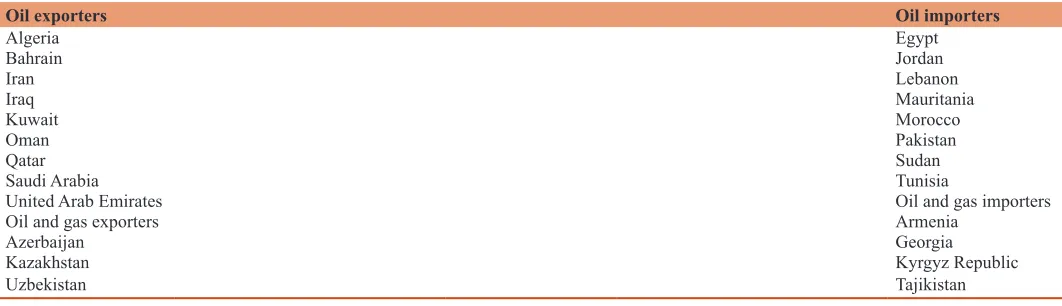
12 oil and gas exporting countries and 12 oil and gas importing countries. The list of countries included within the study is given in Appendix Table 2. The variables used to measure external debt is the gross external debt to GDP ratio, which is obtained from Regional Economic Outlook of International Monetary Fund (IMF). The other macroeconomic data are collected from the World Development Indicators of the World Bank and the International Financial Statistics of IMF. Table 1 in the appendix provides the description of each variable used in the model and the sources of data.
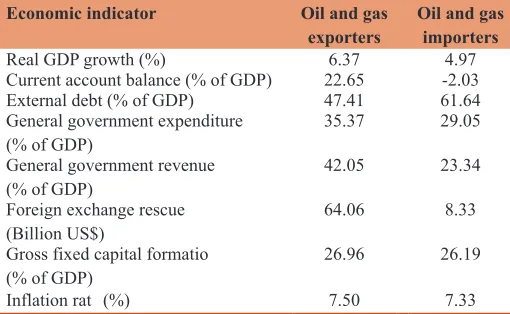
Table 1 indicates that the oil and gas importers are lagging behind the oil and gas exporters in economic growth, CAB, government expenditure and revenue, and foreign exchange reserve. The external debt accumulation is high in oil and gas importing
countries, while the average rate of investment and inflation are almost same in both groups of countries during 2004-2013. The
Table 1: Selected economic indicators (average 2004-2013)
Economic indicator Oil and gas
exporters Oil and gas importers
Real GDP growth (%) 6.37 4.97
Current account balance (% of GDP) 22.65 -2.03
External debt (% of GDP) 47.41 61.64 General government expenditure
(% of GDP) 35.37 29.05
General government revenue
(% of GDP) 42.05 23.34
Foreign exchange rescue
(Billion US$) 64.06 8.33
Gross fixed capital formatio
(% of GDP) 26.96 26.19
Inflation rat (%) 7.50 7.33
current decline in international oil prices may reverse the trend as the oil and gas exporters are experiencing a sharp decline in their revenue. This may results in a slowdown in economic growth,
increase in external debt and inflation rate
Figure 1 shows the trend of external debt to GDP ratio of oil and
gas exporting countries. The ratio has been very high as 60% in 2004, and then it decreases to 40% in 2006. After that it had a fluctuating trend between 30% and 50%, and finally it was at the level of little above then 30% in 2013. For oil and gas importing
countries, Figure 2 shows that the external debt to GDP ratio was
as high as 80% in 2004, but it had a declining trend after that, and it reached to the level of 50% in 2008. After that, the external debt to GDP ratio has a rising trend and in 2013, it was more than 60%. It seems that the external debt problem is more serious in
oil and gas importing countries than the oil and gas exporting countries. However, the current decline in international oil prices may reverse the trend as oil and gas export is a major source of foreign exchange earnings for oil and gas exporting countries. On
the other hand, the decline in international oil prices may benefit
oil and gas importing countries, as it is the major component in their import bill.
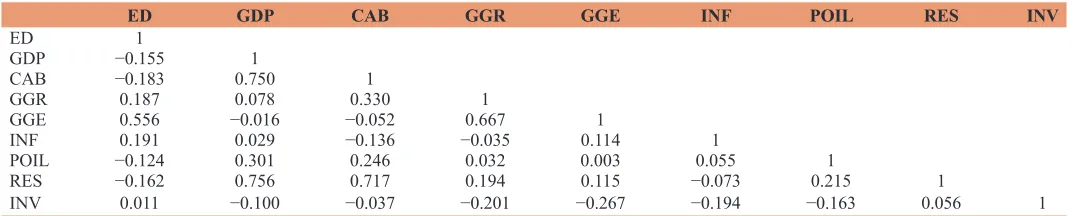
Tables 2 and 3 provide the cross correlation of different variables for oil and gas exporting and importing countries. It is clear from Table 4 that GDP, CAB, price of oil and foreign exchange reserves are negatively correlated with external debt in oil and gas exporting
countries, while government expenditure, revenue, inflation and
investment are positively correlated with external debt.
For oil and gas importing countries, Table 2 shows that GDP, trade balance, and domestic savings are negatively correlated with external debt, while government revenue, price of oil, interest on debt, FDI and investment are positively correlated with external
debt. Basically, these preliminary correlations suggest that the relationship between macroeconomic variables and external debt is weak in most of the cases. However, there is a negative relationship between external debt and economic growth in both regions, which is in accordance with economic theory. Furthermore, the external debt is positively correlated with price of oil in oil and
Table 2: Cross correlation matrix for oil and gas exporting countries, (2004-2013)
ED GDP CAB GGR GGE INF POIL RES INV
ED 1
GDP −0.155 1
CAB −0.183 0.750 1
GGR 0.187 0.078 0.330 1
GGE 0.556 −0.016 −0.052 0.667 1
INF 0.191 0.029 −0.136 −0.035 0.114 1
POIL −0.124 0.301 0.246 0.032 0.003 0.055 1
RES −0.162 0.756 0.717 0.194 0.115 −0.073 0.215 1
INV 0.011 −0.100 −0.037 −0.201 −0.267 −0.194 −0.163 0.056 1
Source: Author’s estimation, GDP: Gross domestic product, CAB: Current account balance, GGE: General government expenditure, FDI: Foreign direct investment
Table 3: Cross correlation matrix for oil and gas importing countries, (2004-2013)
ED GDP TB GGR POIL RED FDI GDS INV
ED 1
GDP −0.362 1
TB −0.181 0.501 1
GGR 0.131 −0.320 −0.237 1
POIL 0.079 0.208 −0.172 0.096 1
RED 0.685 −0.294 −0.202 0.215 −0.116 1
FDI 0.435 −0.396 −0.423 0.311 −0.153 0.328 1
GDS −0.126 0.271 0.837 −0.002 −0.118 −0.231 −0.112 1
INV 0.196 −0.402 −0.257 0.437 0.065 −0.012 0.573 0.290 1
Source: Author’s estimation, GDP: Gross domestic product, CAB: Current account balance, GGE: General government expenditure, FDI: Foreign direct investment
Figure 1: Trends in external debt of oil and gas exporting countries
Source: Author’s estimation
Figure 2: Trends in external debt of oil and gas importing countries
gas importing sample, while it is negatively correlated with oil and gas exporting sample of countries. This is another important
find ng, which will be further analyzed in the econometric models,
that takes care of causation.
4.2. Model Estimation Results
The models for both oil and gas exporters and importers are estimated employing the panel least square method. There are several advantages of panel data analysis over the cross-section
and time-series data analysis. According to Baltagi (2005), in
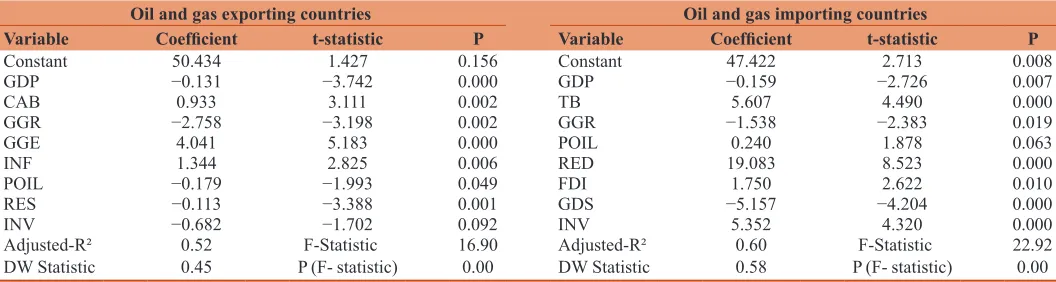
panel data analysis, there is a possibility of less co-linearity among variable and more degrees of freedom. The panel data analysis can better detect and measure effects, which simply cannot be observed in cross-section or time-series data analysis. The parameter heterogeneity is a typical short coming of regression analysis based upon a sample of the large set of countries. To control this full sample is divided into oil and gas exporting countries and oil and gas importing countries that takes care of the level of development. The estimation results for both groups of countries are given in Table 4.
Theoretically, if a country has more income, it may not require external funding and reduce the chances of borrowing. On the other hand, a higher income is an indicator of credit worthiness and may get more loan, resulting higher borrowing and debt. Essentially
in both models the coefficients of GDP variable are negative and highly significant, which highlight the effectiveness of economic
growth in reducing external debt in the region.
The coefficients of variable CAB and TB represent the predicted positive sign and these are statistically significant. This suggests that increase in current account or trade deficit will stimulate
external debt in the region.
There is an important role of general government revenue (GGR) and expenditure in external debt. Increase in government expenditure has a positive effect on external debt if local markets are shallow. On the other hand, an increase in government revenue, reduces the need for further borrowing. Bader and Magableh
(2009) confirmedthe significant positive effect of the budget defici
on external debt. Awan et al. (2015) also found that fiscal deficit is a significant determinant of external debt. The coefficient of general government expenditure (GGE) is statistically significant
and positive in the sample of oil and gas exporting countries, while
it was insignificant in oil and gas importing countries (that’s why
not included into the model). This indicates that reduction in GGE
can decrease external debt of these countries. The coefficient of GGR is negative and highly significant in both models, but its
magnitude is higher in oil and gas exporting countries compared to oil and gas importing countries.
The international price of oil is also playing an important role in external debt of oil and gas exporting and importing
countries. As expected the coefficient of POIL is negative for
oil-gas exporting countries but positive for oil-gas importing countries. This shows that an increase in international price of oil is expected to reduce the external debt of oil and gas exporting countries but worsen the debt burden in oil and gas importing countries.
The inflation is also contributing to external debt in the region,
particularly in oil and gas exporting countries. Because most
of these countries are following fixed exchange rate system, an increase in the inflationrate put the pressure on exchange rate and to maintain the fixed rate, these countries need foreign exchange,
which can be met through foreign borrowing that may result in accumulation of external debt.
The effect of investment on external debt is very high in the region. This effect is more in oil and gas importing countries compare to oil and gas exporting countries. The investment is affecting external debt positively in oil and gas importing countries, and negatively in oil and gas exporting countries. The domestic saving has expected negative effect on external debt of oil and gas importing countries. Since oil and gas importing countries have very low saving rate, this force them to borrow abroad extensively. The increase in domestic saving will decrease their external debt by a large amount.
Foreign exchange reserves are another source of external finance
just like external debt. High foreign exchange reserve may result in reduced willingness to borrow. On the other hand, an increase in reserve, may indicate an enhanced ability to manage the debt, which may result increase borrowing to build up reserves. The
coefficientof RES is negative and highly significantin oil and gas
exporting countries. The foreign exchange reserves of most of the Table 4: Model estimation results
Oil and gas exporting countries Oil and gas importing countries
Variable Coefficient t-statistic P Variable Coefficient t-statistic P
Constant 50.434 1.427 0.156 Constant 47.422 2.713 0.008
GDP −0.131 −3.742 0.000 GDP −0.159 −2.726 0.007
CAB 0.933 3.111 0.002 TB 5.607 4.490 0.000
GGR −2.758 −3.198 0.002 GGR −1.538 −2.383 0.019
GGE 4.041 5.183 0.000 POIL 0.240 1.878 0.063
INF 1.344 2.825 0.006 RED 19.083 8.523 0.000
POIL −0.179 −1.993 0.049 FDI 1.750 2.622 0.010
RES −0.113 −3.388 0.001 GDS −5.157 −4.204 0.000
INV −0.682 −1.702 0.092 INV 5.352 4.320 0.000
Adjusted-R² 0.52 F-Statistic 16.90 Adjusted-R² 0.60 F-Statistic 22.92
DW Statistic 0.45 P (F- statistic) 0.00 DW Statistic 0.58 P (F- statistic) 0.00
countries in this region are very low. An effort to increase foreign exchange reserve will lower the external debt burden.
The results presented in Table 4 have been subjected to several
robustness checks. The validity of these results are confirme
by comparing them with the results obtained in the previous studies, using different estimation methods and different sample sizes. The two models results are good based on the adjusted-R2
and F-statistic. The explanatory power of all models is between
50% and 60%, and these models are overall highly statistically significant. The bias proportion and variance proportions were
also reasonable in both models, showing their good forecast ability.
5. CONCLUSION AND POLICY
IMPLICATIONS
In this study, the determinants of external debt are explored in oil and gas exporting and importing countries. The results from
the study confirmed that the determinants of external debt, and
their effects are different in oil and gas exporting and importing countries.
The panel data estimation results for oil and gas exporting countries show that increased economic growth, foreign exchange reserves, GGR, price of oil, and domestic investment are the important factors in reducing external debt. The current account
deficit,GGE and inflationare accumulating external debt of these
countries. The policy makers in these countries should focus on
particularly current account defi it and infl tion for reduction
of external debt. Moreover, these countries need to increase the GGR and cut expenditures as this has the strong effect in reducing external debt.
The estimation results of oil and gas importing countries are slightly different than the oil and gas exporting countries. The increase in economic growth, GGR, and gross domestic savings (GDS) are important factors in reducing external debt in oil and
gas importing countries. The increase in trade defi it, international
price of oil, interest payment on external debt, FDI and domestic investment are resulting in higher external debt in oil and gas importing countries. The policy makers in these countries are
needed to pay special attention in reducing trade deficitand findin
the new sources of government revenue and providing incentive to domestic savers to boost the domestic saving.
The future research can be extended in many directions. First the sample can be extend to include other oil and gas exporting and importing countries in the rest of the Asia or even the rest of the world. Second, the study focused only economic factors, which can be further extended to include administrative and uncertainty related factors. Finally, the external debt variable can be disaggregated to short-term and long term and into different currency compositions.
The core lesson learnt from this study is the importance of avoiding particular generalization for external debt accumulation. It is
necessary for the policy makers to know the importance and effect of each factor that are responsible for external debt accumulation. This will help policy makers to handle the issue properly and to avoid any possible crisis.
6. ACKNOWLEDGMENT
This paper is the outcome of the research project entitled. “Sustainability and Determinants of External Debt: Empirical
Analysis for Bahrain” funded by the Deanship of Scientifi
Research, University of Bahrain, Kingdom of Bahrain.
REFERENCES
Awan, A., Asghar, N., Rehman, H. (2011), The impact of exchange rate, fiscal deficit and terms of trade on external debt of Pakistan:
A cointegration and causality analysis. Australian Journal of Business
and Management Research, 1(3), 10-24.
Awan, R., Anjum, A., Rahim, S. (2015), An econometric analysis
of determinants of external debt in Pakistan. British Journal of Economics, Management and Trade, 5(4), 382-391.
Bacha, E.L. (1990), A three gap model of foreign transfers and the
GDP growth rate in developing countries. Journal of Development Economics, 32(3), 279-296.
Bader, M., Magableh, I.K. (2009), An enquiry into the main determinants of
public debt in Jordan: An econometric study. Dirasat Administrative
Science, 36(1), 181-190.
Baltagi, B.H. (2005), Econometric Analysis of Panel Data. New York:
John Wiley and Sons Ltd.
Barro, R. (1979), On the determination of public debt. Journal of Political
Economy, 87, 240-270.
Benedict, I., Ehikioya, I.L., Asin, O.M. (2014), Determinants and
sustainability of external debt in a deregulated economy:
A cointegration analysis from Nigeria (1986-2010). American International Journal of Contemporary Research, 4(6), 201-214. Bittencourt, M. (2013), Determinants of Government and External
Debt: Evidence from the Young Democracies of South
America. ERSA Working Paper No. 341, Economic Research Southern Africa.
Chenery, H., Strout, A.M. (1966), Foreign assistance and economic development. American Economic Review, 56(4), 679-733.
Colombo, E., Longoni, E. (2009), The Politics of External Debt in
Developing Countries. Department of Economics, University of Milan Working Paper Series No. 176. p1-22.
Eichengreen, B.J., Portes, R. (1986), Debt and default in the 1930s: Causes and consequences. European Economic Review, 30(3), 599-640.
Forslund, K., Lima, L., Panizza, U. (2011), The determinants of the
composition of public debt in developing and emerging market
countries. Review of Development Finance, 1, 207-222.
Hajivassiliou, V.A. (1987), The external debt repayments problems of LDC’s: An econometric model based on panel data. Journal of
Econometrics, 36(1-2), 205-230.
IMF. (2015-2006), Regional Economic Outlook: Middle East and Central
Asia. Washington, DC: International Monetary Fund.
Sachs, J., Berg, A. (1988), The Debt Crisis. Structural Explanations of
Country Performance NBER Working Series No. 2607. Cambridge,
MA: National Bureau of Economic Research.
Selami, S. (2004), An empirical note on external debt and defence
expenditures in Turkey. Defence and Peace Economics, 15(2),
Tiruneh, M.W. (2004), An empirical investigation into the determinants
of external indebtedness. Prague Economic Papers, 3, 261-277.
Waheed, A. (2007), Foreign public capital and economic growth of
developing countries: A selected survey. In: Siddiqui, A., editor. India
and South Asia: Economic Development in the Age of Globalization. USA: M.E. Sharpe.
World Bank. (2015), World Development Indicators. Washington, DC:
The World Bank.
APPENDIX
Table 1: Definition of variables and sources of data
Variable Definition Data source
ED Gross external debt Regional economic outlook-IMF
GDP Gross domestic product World development indicators-WB
CAB Current account balance Regional economic outlook-IMF
GGR General government revenue Regional economic outlook-IMF
GGE General government expenditure Regional economic outlook-IMF
INF Inflation rat Regional economic outlook-IMF
POIL Price of oil Organization of petroleum exporting countries
RES Foreign exchange reserve Regional economic outlook-IMF
INV Gross capital formation World development indicators-WB
TB Trade balance World development indicators-WB
RED Interest on external debt World development indicators-WB
FDI Foreign direct investment World development indicators-WB
GDS Gross domestic savings World development indicators-WB
GDP: Gross domestic product, CAB: Current account balance, GGE: General government expenditure, FDI: Foreign direct investment, Data Sources: IMF(2015-2006) and world bank (2015).
Table 2: List of Countries
Oil exporters Oil importers
Algeria Egypt
Bahrain Jordan
Iran Lebanon
Iraq Mauritania
Kuwait Morocco
Oman Pakistan
Qatar Sudan
Saudi Arabia Tunisia
United Arab Emirates Oil and gas importers
Oil and gas exporters Armenia
Azerbaijan Georgia
Kazakhstan Kyrgyz Republic
Uzbekistan Tajikistan