CASE REPORT
Parent–Child Interaction Therapy (PCIT)
for young children with Attention-Deficit
Hyperactivity Disorder (ADHD) in Japan
Nana Hosogane
1*, Masaki Kodaira
1, Nozomi Kihara
2, Kazuhiko Saito
3and Toshiko Kamo
4Abstract
Early intervention for preschoolers with Attention-Deficit Hyperactivity Disorder (ADHD) is important considering the impact on their prognosis. Parent–Child Interaction Therapy (PCIT) is a psychotherapy treatment for the parent–child dyad and has been shown to be effective for children with disruptive behaviors. We present the treatment course of PCIT for two Japanese children with ADHD. Case 1 is a 2-year-old female child with hyperactivity and aggressiveness. Case 2 is a 4-year-old male child with restlessness and intolerability to daily events. For both cases, PCIT was effective in improving the problematic behaviors. PCIT may serve as a treatment option for Japanese children with ADHD. Keywords: Attention-Deficit Hyperactivity Disorder (ADHD), Treatment, Parent–Child Interaction Therapy (PCIT), Preschooler
© The Author(s) 2018. This article is distributed under the terms of the Creative Commons Attribution 4.0 International License (http://creativecommons.org/licenses/by/4.0/), which permits unrestricted use, distribution, and reproduction in any medium, provided you give appropriate credit to the original author(s) and the source, provide a link to the Creative Commons license, and indicate if changes were made. The Creative Commons Public Domain Dedication waiver (http://creativecommons.org/ publicdomain/zero/1.0/) applies to the data made available in this article, unless otherwise stated.
Background
Young children with Attention-Deficit Hyperactivity Disorder (ADHD) are often referred to services for their disruptive behaviors, such as difficulty in obeying com-mands in pre-school/day-care, tantrums or aggressive-ness; all which influence relationships with others. Early interventions for these preschoolers are important taking into account of their prognosis that may lead to impair-ments in academic, interpersonal, and occupational domains. Treatment guidelines for children with ADHD recommend environmental adjustments, psychosocial treatment, and psychopharmacotherapy according to the severity of impairment [1]. Psychostimulant medica-tions which are regarded as first-line treatment in psy-chopharmacotherapy are not recommended for children under age of 6 because of the paucity of investigation of the efficacy and safety in this age group [2]. Parent behav-ior training (PBT) interventions have greater evidence of effectiveness for preschoolers with ADHD [3]. PBT inter-ventions refer to interinter-ventions in which parents learn
certain skills to improve children’s problematic behavior, such as group-based parent-training [4, 5], Positive Par-enting Program (Triple P) [6], or Parent–Child Interac-tion Therapy (PCIT) [7].
PCIT is an individualized psychotherapy treatment for the child–parent dyad based on behavioral therapy. It has been developed to improve externalizing problem-atic behavior through the improvement of child–parent interaction. Meta-analysis has shown that PCIT is effec-tive for young children with disrupeffec-tive behavior [8] and efficacy has been shown to be maintained for 3–6 years after treatment [9].
PCIT is a manualized treatment with core defining fea-tures. It consists of two phases: Child-Directed Interac-tion (CDI) and Parent-Directed InteracInterac-tion (PDI). PCIT skills are taught didactically to parents in the first ses-sion of each phase (“teaching sesses-sion”) and also through direct coaching in the following sessions (“coaching session”) where the therapists watch the dyad play in the play-room behind the one-way mirror and coaches directly to the parent using a microphone and “bug-in-the-ear” device. In this way, the therapists are able to give immediate feedback to the parent and reinforce behavior management skills while interacting with the child. The parent can also validate how certain skills are effective for
Open Access
*Correspondence: [email protected]
1 Department of Child and Adolescent Mental Health, Aiiku Clinic,
Maternal and Child Health Center, Imperial Gift Foundation Boshi-Aiiku-Kai, 5-6-8 Minami-Azabu, Minato-ku, Tokyo 106-8580, Japan
their child. Treatment proceeds according to the parent’s skills and improvement of the child. PCIT often consists of 12–20 weekly sessions.
During the first phase (CDI), parents are taught posi-tive parenting skills while they are following the child’s lead during their interaction. These skills are called “PRIDE skills”: Praise, Reflect, Imitate, Describe, and Enjoy (Enthusiasm). They are also taught to avoid nega-tive interactions: criticism, questions, and commands, which take the lead away from the child, and also to ignore inappropriate behavior. Parents are assessed at the beginning of each coaching session for 5 min and when parents meet mastery criteria, which is pre-set in the manual, they then move on to the next phase.
During the second phase (PDI), parents learn to give effective commands and to follow the protocol for con-sequence according to the child’s behavior: compliance or non-compliance. When parents meet the mastery cri-teria for PDI skills and child’s behavior reach the normal range (according to a behavior checklist (Eyberg Child Behavior Inventory; ECBI)), PCIT reaches completion. Although the number of sessions differs according to the progress, the manual includes the essential components in each session and allows the family to acquire all neces-sary skills during treatment.
During both phases, daily homework is given to the parents to practice skills during interaction. Parents are gradually encouraged to use these skills not only during the 5-min interaction, but also during daily life.
PCIT has been developed in the USA by Sheila Eyberg and has been translated to several languages and dissemi-nated to countries world-wide such as Australia, Ger-many, Norway, and Asian countries. In Japan, PCIT was introduced in 2005 and has been shown to be efficacious for children and parents who experienced domestic vio-lence (DV) [10].
In this current paper, we describe the treatment course of PCIT for two young Japanese children diagnosed with ADHD. The first author served as the main therapist; she has completed training and was certified as a PCIT Ther-apist by PCIT International. This is the first article writ-ten in English to date describing the treatment of PCIT for Japanese ADHD children.
Case presentation
Case 1
“Anna Oka,” a Japanese female child, was 2 years and 10 months old with no siblings. She was brought by her parents for her hyperactivity and aggressiveness. Anna was aggressive toward her parents and other children: often hitting, biting, and scratching them. She had prob-lems with daily routines such as getting dressed and
brushing her teeth. Her parents needed to either threaten her or hold her down to make her obey.
Her developmental history revealed that she had no physical illnesses or injuries and had no delay in opmental milestones including her intellectual devel-opment. She had no history of child abuse or any other types of negative life events that may explain her symp-toms. Anna was diagnosed as Attention-Deficit Hyperac-tivity Disorder (ADHD)-Combined Type after psychiatric evaluation. Her psychiatrist performed an interview and observation about the ADHD symptoms according to the DSM-5 diagnostic criteria [11]. The presence of impair-ment was observable both at home and at her day-care center. She did not fulfill the diagnostic criteria for Autism Spectrum Disorder. Mr. Oka was a self-employed business owner and Ms. Oka worked part-time. Although parents showed some inconsistency in their parenting, that was not enough to explain her destructiveness.
Parenting skills were taught during regular outpatient clinic visits; however, Anna’s parents still had difficulty controlling her temper. Medication was not recom-mended for Anna because of the paucity of evidence in this age group and also because the varieties of types of stimulants are limited in Japan. Parent–Child Interaction Therapy (PCIT) was recommended and weekly sessions started with Anna and her mother when she was 3 years and 1 month old.
PCIT sessions were held every week for 60–90 min using the Japanese version of the PCIT 2011 protocol [12] by two PCIT therapists (NH and NK). Outpatient visits were continued in a regular basis by her psychiatrist (MK).
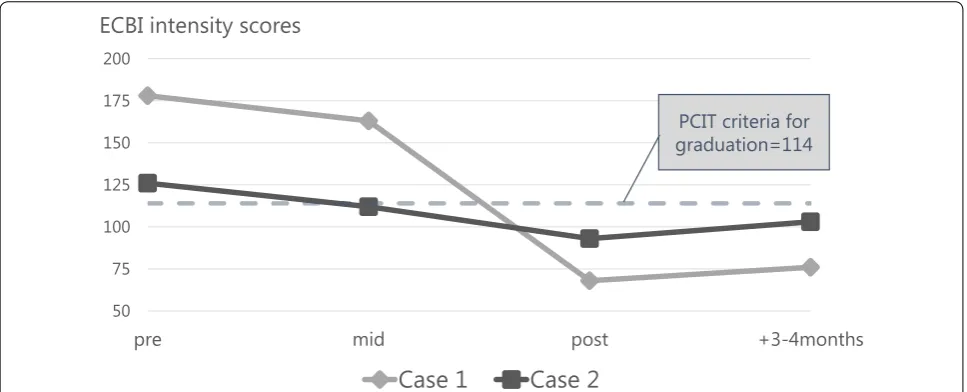
Problematic behaviors were assessed using the parent-scored Eyberg Child Behavior Inventory (ECBI; 13). The Japanese average intensity score is 100.1 (SD = 24.6) and the average problem score is 6.57 (SD = 6.46). At base-line, Anna scored 178 on her ECBI intensity scale and 28 on her ECBI problem scale which meant that she had high frequency and number of problems in disruptive behaviors.
The atmosphere of the mother and child seemed enjoy-able; however, Anna and Ms. Oka were slightly physically distanced.
During the first phase of PCIT, called CDI (child-directed interaction), Ms. Oka learned to follow Anna’s lead and to use PRIDE skills whenever Anna was play-ing appropriately and to ignore her problematic behav-ior until it had diminished. Ms. Oka and Anna had high attendance and completed homework every week. As Ms. Oka learned to use her skills, she was able to praise appropriate behaviors that were opposite of Anna’s prob-lematic behaviors (e.g., “Thank you for speaking with a soft voice.” “You’re such a good girl sitting while play-ing.”). This was effective in preventing Anna behaving disruptively. Ms. Oka tried to maintain her consistency so that Anna could understand what her mother was expecting from her. Anna’s father sometimes joined the session and watched the dyad from the back of the one-way mirror with the therapists.
During the second phase of PCIT, called PDI (parent-directed interaction), Ms. Oka gave simple commands and followed the protocol according to Anna’s response (i.e., obey or disobey). As the treatment progressed, Anna was able to listen to her mother’s commands during ses-sion and this change was also seen at home. Although Anna was still very hyperactive, her aggressiveness had decreased and parents felt confident in their parenting as she was able to follow most commands in every-day life.
PCIT sessions consisted of 21 CDI sessions and 9 PDI sessions, total of 30 sessions until Ms. Oka had met the “mastery criteria” and Anna’s disruptive behaviors were
within normal limits. Ms. Oka mentioned that Anna was not as hyperactive and desired to stay with her more frequently.
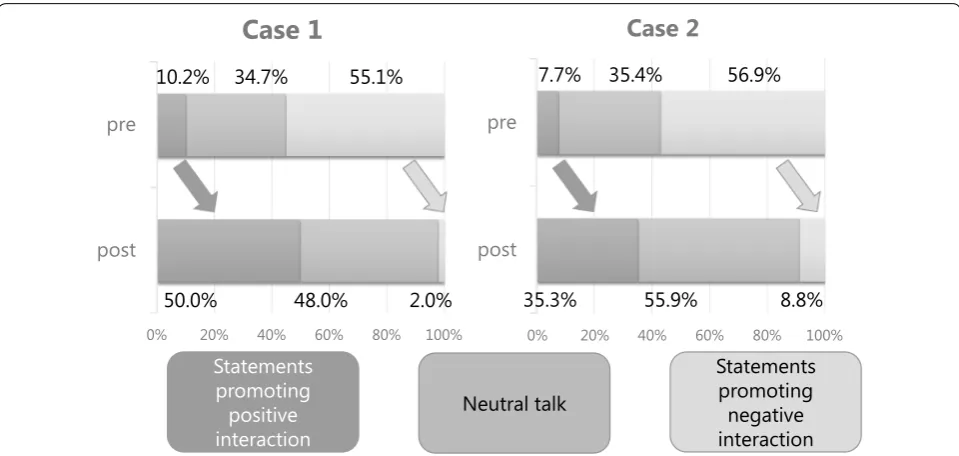
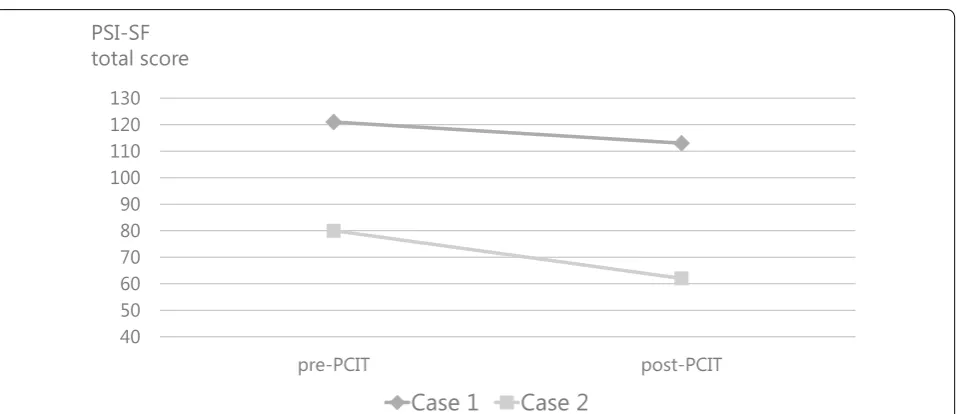
Post-treatment evaluation showed that the ECBI scores were 68 on her intensity scale and 11 on her problem scale; both well within normal limits (Fig. 1). At the post-treatment evaluation, Ms. Oka used statements promot-ing positive interaction (PRIDE skills) more often than pre-treatment (Fig. 2). Ms. Oka gave direct commands when necessary and Anna’s compliance had improved (4/5 = 80% in PLP, 10/12 = 83% in CU; Fig. 3). On the Parenting Stress Index-Short Form (PSI-SF; 15), her total stress score had decreased revealing that the therapy was also meaningful for Ms. Oka herself (Fig. 4).
Follow-up sessions were held and Anna’s ECBI scores were 76 on her intensity scale and 18 on her problem scale 3 months post-treatment (Fig. 1). Problem score had increased but her intensity score was well within normal limits.
All figures show raw scores and data were not statisti-cally analyzed.
Case 2
“Kou Kawa,” a Japanese male child, was 4 years and 2 months old when he was brought by his mother to the Clinic for his restlessness and intolerability to daily events. His parents both worked full-time and he had no siblings. He did not have any history of physical ill-nesses or injuries and has no delay in verbal or physical developments. He had problems at pre-school where he easily got excited and had difficulty staying seated. He
50 75 100 125 150 175 200
pre mid post +3-4months
ECBI intensity scores
Case 1
Case 2
PCIT criteria for graduation=114
50.0% 10.2%
48.0% 34.7%
2.0% 55.1%
post pre
0% 20% 40% 60% 80% 100%
Case 1
35.3% 7.7%
55.9% 35.4%
8.8% 56.9%
post pre
0% 20% 40% 60% 80% 100%
Case 2
Statements promoting positive interaction
Statements promoting negative interaction Neutral talk
Fig. 2 Changes in quality of verbalization of parent in Case 1 and Case 2. The parents’ verbalization was scored using the DPICS-IV during 5 min of CLP in pre- and post-treatment. The percentage of the quality of verbalization is shown. Statements were classified into three groups: statements promoting positive interaction (labeled and unlabeled praises, reflections, and descriptions), statements promoting negative interaction (questions, criticisms, commands), and neutral talk (other statements). Both mothers showed improvement in using statements that promoted positive interac-tions. DPICS-IV: Dyadic Parent–Child Interaction Coding System (4th edition), CLP: Child-Led Play
9
5 18
2 pre,
0%
post, 80%
0 5 10 15 20 25 30
pre post
Case 1
no. of ineffective commands
no. of effective commands
compliance (%)
7 7
18
2 pre,
43%
post, 100%
0% 25% 50% 75% 100%
pre post
Case 2
no. of ineffective commands
no. of effective commands
compliance (%)
was often scolded by his teachers because he was unable to follow instructions despite of his high comprehen-sion. After psychiatric evaluation, Kou was diagnosed as Attention-Deficit Hyperactivity Disorder (ADHD)-Com-bined Type. His psychiatrist performed an interview and observation about the ADHD symptoms according to the DSM-5 diagnostic criteria [11]. The presence of impair-ment was observable both at home and at pre-school. He did not fulfill the diagnostic criteria for Autism Spectrum Disorder. Medication was not recommended by his psy-chiatrist, and weekly PCIT was recommended for Kou and Ms. Kawa. PCIT sessions were held by two PCIT therapists using the PCIT 2011 protocol when he was 4 years and 3 months old.
At baseline, his ECBI scores were 126 on the intensity scale and 8 on the problem scale. Baseline interactions revealed that Kou was a very active and inquisitive boy and was very talkative during play. When he was stacking blocks high and was not able to manage the blocks as he desired to, he showed anger and got aggressive. Ms. Kawa was also talkative and asked many questions and made many suggestions during Child-Led Play. It seemed as though she was contributing to Kou’s excitability. During Clean-Up, he was able to obey instructions while being very angry. At the end of the session, he had difficulty exiting the play-room and Ms. Kawa tried to encourage him by changing the subject, threatening him and try-ing to bribe him with snacks; none of this was effective in changing his behaviors. His compliance was 43% (= 3/7) during PLP and 67% (= 2/3) during CU. His difficulty seemed to lay in controlling his emotions.
During CDI, we tried to strengthen Ms. Kawa’s skills by decreasing unnecessary stimuli (i.e., questions and both direct and indirect commands including suggestions) and increasing positive attention using PRIDE skills for appropriate behaviors. Ms. Kawa learned to give praises when he was playing gently and was focusing well, which was the opposite of his problematic behavior at home and at pre-school. Ms. Kawa noticed that Kou was con-centrating well when she was continuously giving posi-tive comments to him. She also noticed that when she was busy with her work and went on business trips leav-ing Kou with his father or grandparents, Kou was not able to sleep well and this had negative influence on his behaviors. She was unable to complete her PCIT home-work and sometimes canceled PCIT sessions, so she had difficulty meeting the “mastery criteria.” Kou’s main psychiatrist had discussed the issue with Ms. Kawa and she tried to schedule her work and gave priority to Kou’s schedules and PCIT. She was able to meet “mastery crite-ria” after 11 sessions of CDI. By this point, his excitabil-ity had improved and Ms. Kawa was able to remain calm even when he started to become angry.
During PDI, Ms. Kawa learned to give simple com-mands and Kou seemed to be willing to comply. He sometimes missed her commands especially when he was focusing on his play. We asked Ms. Kawa to give a short command to look at her first to seek his attention, praise him for his compliance and then to give the command. This seemed to work well for Kou. Commands were grad-ually integrated to those used in every-day life and he was able to comply. She also noticed that he was able to com-ply when she tried to control the frequency and quantity
40 50 60 70 80 90 100 110 120 130
pre-PCIT post-PCIT
Case 1
Case 2
PSI-SF total score
of the commands used. She asked the teachers to try to use similar techniques at school (i.e., praising appropri-ate behaviors and avoiding unnecessary stimuli), and his overall function had improved.
For this case, PCIT consisted of 13 CDI sessions and 10 PDI sessions. Ms. Kawa mentioned that Kou “loved mom” and he understood what would please her. Father and grandparents reported that Kou was able to under-stand and follow their instructions at once.
Post-treatment evaluation showed that the ECBI scores were 93 on the intensity scale and 1 on the problem scale; both within normal limits (Fig. 1). Ms. Kawa’s verbaliza-tion showed improvement; she used more statements that promoted positive interaction compared to pre-treatment (Fig. 2). Kou’s compliance was both 100% dur-ing PLP and CU (Fig. 3). On the PSI-SF, her total stress score decreased from 80 to 62; decrease in stress scores was observed in each domain (Fig. 4).
Follow-up session revealed that his ECBI scores were remained low (103 for intensity scale and 4 for problem scale) and his behavior at school was well maintained (Fig. 4).
Discussion
Two cases with ADHD were illustrated. PCIT was effec-tive in both cases with improvement in problematic behaviors. Although hyperactive symptoms remained in both cases, mothers in both cases showed reduction in stress scores and felt confident in taking charge of their children.
From the behavioral perspective, PCIT strengthens appropriate behaviors by giving positive reinforcement using PRIDE skills while withholding attention to inap-propriate behavior expecting for extinction. Also, prais-ing positive behaviors that are opposite of problematic behaviors were effective in increasing adaptive behaviors. For Case 1 (Anna), this corresponded to “speaking with a soft voice” opposed to whining and being noisy; for Case 2 (Kou), this was “playing gently” opposed to restlessness and being over-excited. Giving clear and precise com-mands and being able to be consistent according to the children’s behaviors enabled the children to have clearer images of their expectations. PCIT techniques were generalized to every-day life situations to prevent prob-lematic behaviors outside sessions. Unnecessary stimuli were lowered as possible. For Case 2, the realization of the mother of the link between her business trips and the child’s behaviors led her to regulate her work to maxi-mize his performance at pre-school.
From the developmental perspective, children with dis-ruptive behaviors tend to have difficulty building mater-nal secure attachment. Kissgen showed that matermater-nal insecure attachment was matched with higher ADHD
symptoms [16]. During PCIT, the quality of the parent– child interaction improves [17]. Using PRIDE skills for appropriate behaviors enables mothers to increase reflec-tive functioning, which may in turn strengthen the child’s self-esteem and promote emotional regulation. Although ADHD is a neuro-developmental disorder with impair-ments in behaviors and emotional regulation domains, enhancing parenting skills from the developmental per-spective seemed to be effective in reducing problematic behaviors.
Conclusion
According to the two cases reported here, PCIT seems to be effective for Japanese young children with disruptive problematic behaviors. Future studies using randomized controlled trials are recommendable for confirmation.
Abbreviations
PCIT: Parent–Child Interaction Therapy; ADHD: Attention-Deficit Hyperactivity Disorder; PBT: parent behavior training; Triple P: Positive Parenting Program; CDI: child-directed interaction; PDI: parent-directed interaction; ECBI: Eyberg Child Behavior Inventory; DPICS: Dyadic Parent–Child Interaction Coding Sys-tem; CLP: Child-Led Play; PLP: Parent-Led Play; CU: Clean-Up; PSI-SF: Parenting Stress Index-Short Form.
Authors’ contributions
NH was the main therapist for the presented cases and wrote this paper. MK was the main psychiatrist for both cases and recruited them for PCIT. NK col-lected and analyzed clinical data. KS and TK revised the manuscript critically for important intellectual content. All authors read and approved the final manuscript.
Author details
1 Department of Child and Adolescent Mental Health, Aiiku Clinic, Maternal
and Child Health Center, Imperial Gift Foundation Boshi-Aiiku-Kai, 5-6-8 Minami-Azabu, Minato-ku, Tokyo 106-8580, Japan. 2 Department of
Medi-cal Welfare, Aiiku Clinic, Maternal and Child Health Center, Imperial Gift Foundation Boshi-Aiiku-Kai, 5-6-8 Minami-Azabu, Minato-ku, Tokyo 106-8580, Japan. 3 Division of Child Welfare and Mental Health, Aiiku Research Institute,
Imperial Gift Foundation Boshi-Aiiku-Kai, 5-6-8 Minami-Azabu, Minato-ku, Tokyo 106-8580, Japan. 4 Wakamatsu-cho Mental and Skin Clinic, 9-4MH
Build-ing 1F/B1F, Wakamatsu-cho, Shinjku-ku, Tokyo 162-0056, Japan.
Acknowledgements
Not applicable.
Competing interests
The authors declare that they have no competing interests.
Availability of data and materials
The datasets used and analyzed during the current study are available from the author on reasonable request.
Consent for publication
Written informed consent was obtained from the parents of the two patients for publication of this case report. The names used are pseudonyms and all personal information are kept anonymous.
Ethics approval and consent to participate
All study procedures were in accordance with the World Medical Association Helsinki Declaration.
Funding
• We accept pre-submission inquiries
• Our selector tool helps you to find the most relevant journal • We provide round the clock customer support
• Convenient online submission • Thorough peer review
• Inclusion in PubMed and all major indexing services • Maximum visibility for your research
Submit your manuscript at www.biomedcentral.com/submit
Submit your next manuscript to BioMed Central
and we will help you at every step:
Publisher’s Note
Springer Nature remains neutral with regard to jurisdictional claims in pub-lished maps and institutional affiliations.
Received: 5 June 2017 Accepted: 14 February 2018
References
1. Wolraich M, Brown L, Brown RT, Du Paul G, Earls M, Feldman HM, Visser S. ADHD: Clinical Practice Guideline for the diagnosis, evaluation, and treatment of attention-deficit/hyperactivity disorder in children and adolescents. Pediatrics. 2011;128(5):1007–22.
2. Gleason MM, Egger HL, Emslie GJ, Greenhill LL, Kowatch RA, Lieber-man AF, Zeanah CH. Psychopharmacological treatment for very young children: contexts and guidelines. J Am Acad Child Adolesc Psychiatry. 2007;46(12):1532–72.
3. Charach A, Carson P, Fox S, Ali MU, Beckett J, Lim CG. Interventions for preschool children at high risk for ADHD: a comparative effectiveness review. Pediatrics. 2013;131(5):e1584–604.
4. Barkley RA. Attention deficit hyperactivity disorder. 4th Edition. A Hand-book for Diagnosis and Treatment. New York: Guilford Press; 2014. 5. Anastopoulos AD, Shelton TL, DuPaul GJ, Guevremont DC. Parent training
for attention-deficit hyperactivity disorder: its impact on parent function-ing. J Abnorm Child Psychol. 1993;21(5):581–96.
6. Bor W, Sanders MR, Markie-Dadds C. The effects of the Triple P-Positive Parenting Program on preschool children with co-occurring disruptive behavior and attentional/hyperactive difficulties. J Abnorm Child Psychol. 2002;30:571–87.
7. Eyberg SM. Parent-Child Interaction Therapy: integration of traditional and behavioral concerns. Child Fam Behav Ther. 1988;10:33–46. 8. Cooley ME, Veldorale-Griffin A, Petren RE, Mullis AK. Parent-Child
Interac-tion Therapy: a meta-analysis of child behavior outcomes and parent stress. J Fam Soc Work. 2014;17(3):191–208.
9. Hood K, Eyberg SM. Outcomes of parent-child interaction therapy: moth-ers’ reports on maintenance three to six years after treatment. J Clin Child Adolesc Psychol. 2003;32:419–29.
10. Kamo T. Rebuilding of the nurturing relationship and parent-child inter-action therapy of mothers and children affected by domestic violence [Article in Japanese]. Seishin Shinkeigaku Zasshi. 2010;112(9):885–9. 11. American Psychiatric Assocation. Diagnostic and statistical manual of
mental disorders, 5th edition: DSM-5. Washington DC: American Psychiat-ric Association; 2013.
12. Eyberg SM, Funderburg B. Kamo T. transl. Japanese Version of Parent-Child Interaction Therapy protocol 2011, PCIT International; 2011. 13. Eyberg SM, Pincus D. Eyberg child behavior inventory and Sutter-Eyberg
student behavior inventory: Professional manual. Odessa: Psychological Assessment Resources; 1999. (Kamo T. transl. Japanese Version of ECBI, Tokyo, Japan: Chiba Test Center, 2016.).
14. Eyberg SM, et al. Kamo T. transl. Japanese Version of Dyadic Parent-Child Interaction Coding System Clinical Manual (Fourth Edition). PCIT Interna-tional; 2014.
15. Abidin R. Parenting stress index manual. 3rd ed. Odessa: Psychological Assessment Resources; 1995.
16. Kissgen R, Krischer M, Kummetat V, Spiess R, Schleiffer R, Sevecke K. Attachment representation in mothers of children with attention deficit hyperactivity disorder. Psychopathology. 2009;42:201–20.