DEMOGRAPHIC RESEARCH
VOLUME 33, ARTICLE 40, PAGES 1137
−
1152
PUBLISHED 26 NOVEMBER 2015
http://www.demographic-research.org/Volumes/Vol33/40/ DOI: 10.4054/DemRes.2015.33.40
Descriptive Finding
Non-resident parent-child contact after marital
dissolution and parental repartnering:
Evidence from Italy
Silvia Meggiolaro
Fausta Ongaro
©2015 Silvia Meggiolaro & Fausta Ongaro.
This open-access work is published under the terms of the Creative Commons Attribution NonCommercial License 2.0 Germany, which permits use, reproduction & distribution in any medium for non-commercial purposes, provided the original author(s) and source are given credit.
1 Introduction 1138
2 Data and measures 1139
3 Results 1141
3.1 Preliminary results 1141
3.2 Modeling non-resident parent-child contact 1142
4 Concluding remarks 1145
5 Acknowledgements 1147
Non-resident parent-child contact after marital dissolution and
parental repartnering: Evidence from Italy
Silvia Meggiolaro1
Fausta Ongaro2
Abstract
BACKGROUND
With the diffusion of marital instability, the number of children who spend some of their childhood without one of their parents has become significant, even in Italy. Therefore, given the importance of parent-child interactions for children’s wellbeing, analyzing children’s contact with the non-resident parent has become relevant.
OBJECTIVE
In this paper we consider the frequency of contact between children and their resident parent after separation, with a double aim: a) to analyze if and how the non-resident parent’s contact with his/her children varies according to whether the (non-resident or non-resident) parent has repartnered, and b) to investigate whether the relationship between repartnering and contact differs according to the gender of the non-resident parent.
METHODS
The study focuses on children aged 0−17 living with only one biological parent, using data pooled together from two cross-sectional rounds of the Italian survey, Family and Social Subjects.
RESULTS
Results show that parents’ repartnering is positively associated with lower non-resident parent-child contact only in the case of resident fathers; in the case of a non-resident mother, her repartnering is actually correlated with higher contact.
1. Introduction
Over the past few decades the increase in the proportion of separations and divorce involving children has been accompanied by a rise in sole parenthood, and thus an increasing number of children spend some of their childhood without one of their parents (Chapple 2009; Panico et al. 2010). Since a good parent-child interaction contributes to children’s psychological well-being and positive development (Carlson 2006; Levin and Currie 2010) and to the non-custodial parent’s compliance in paying child support (see, for example, Juby et al. 2007), great attention has been paid in the literature to examining the frequency of contact between non-resident parents and their children, and the factors associated with it (Juby et al. 2007; King and Sobolewski 2006; Nepomnyaschy 2007; Amato, Meyers, and Emery 2009).
The diffusion of marital instability is, however, associated with an increase in repartnering (Ermisch 2002; Sweeney 2010). What about the contact between children and non-resident parents when one or both parents enter a new partnership? Previous empirical literature has usually considered children who live with their mothers after their parents’ separation, disregarding those living with their fathers (Sousa and Sorensen 2008). This literature has generally found a negative effect of the non-resident father’s repartnering on the contact with his children (Juby et al. 2007; Swiss and Le Bourdais 2009); the research evidence is more mixed regarding resident mother’s repartnering. Some studies have suggested that the mother’s new union decreases non-resident father involvement (Amato, Meyers, and Emery 2009; Berger, Cancian, and Meyer 2012), whereas others have found little or no effect (Day and Acock 2004; Sobolewski and King 2005; King 2009). Studies on non-resident mothers are limited: most are dated (Stewart 1999) or based on small or highly selected samples (King 2007). More recently, studies on non-resident motherhood have received some attention, but mainly from a qualitative viewpoint (Kielty 2008a, 2008b). In addition, studies on the topic have not considered the relationship between the repartnering of both parents and non-resident parent-child contact.
163,000 households (Istat 2011b). At the same time, repartnering is increasingly common: in 2009, 23% of women and 32% of men who had experienced marital instability were in a new union (Istat 2011c). From this perspective, the current paper could shed light on a topic – parental behavior after separation – which, given the lack of adequate data, is still little analyzed for countries moving from a traditional to a more complex family context.
2. Data and measures
The data come from pooling together two independent cross-sectional rounds of the nationally representative survey Family and Social Subjects (FSS), conducted in Italy by the Italian Statistical Institute (ISTAT) in 2003 and in 2009. We focused on 1,079 boys and girls aged 0−17, who at the time of interview were living with their mother after their parents’ marital dissolution and had a living father, and on their 135 counterparts who were living with their father and had a living mother.
Besides socio-demographic data on each household member and on the household (family structure, economic conditions, geographical area of residence), the survey provided information on the geographical distance and frequency of contact between non-resident parents and their children. In particular, two questions investigated face-to-face and phone contact. In both cases, response options consisted of 1 = every day, 2 = several (2–6) times per week, 3 = once per week, 4 = one to three times per month, 5 = several times a year, 6 = never. In addition, the FSS survey reported the non-resident parent’s union status. Unfortunately, further information about the non-resident parent (socio-demographic characteristics) or her/his possible new family (children born from any new union) were unavailable. In addition, no information was provided on whether children’s parents shared custody, introduced in Italy as an ordinary procedure by law 54/2006. The survey only asked whether in the last year the child had lived in a different home from that at the time of the interview for some days a week, to be with a parent: however, the corresponding percentage is negligible (6.3%) and thus this information is not considered in the analyses.
situations when children see their non-resident parents once per week or have phone contact several times per week; middle-low contact is defined as in-person visits one to three times per month, or phone contact once per week or one to three times per month; lastly, children who reported not having contact with their non-resident parents at all, either by phone or by in-person visits, and children who only had contact several times a year are classified as low contact. For non-resident parents living more than 50 kilometers from their children’s residence, phone contact is given more importance than in-person contact when defining high contact. The complete categorization is described in Figure 1b.
In fact, the geographical distance between children’s and non-resident parents’ households might be an important control covariate (Cheadle, Amato, and King 2010), but many questions about the causal direction remain and cannot be adequately addressed with the cross-sectional data used here (Le Bourdais, Juby, and Marcil-Gratton 2002; Swiss and Le Bourdais 2009). Consequently, non-resident parents’ proximity to children is not included in the analyses as a control covariate, but in the definition of the dependent variable.
Figure 1b: Definition of non-resident parent-child contact for non-resident parents living more than 50 kilometers away from the child
3. Analyzing non-resident parent-child contact
3.1 Preliminary results
happens with non-resident fathers, the proportion of children with high or middle-high contact with their mothers is higher when the mothers have repartnered.
Table 1: Non-resident parent-child contact according to the gender of resident parent and parents’ repartnering (%)
High Middle-high
Middle Middle-low
Low N = 100
Resident mother Both parents
repartnered 15.6 25.0 12.5 31.3 15.6 32
Only the mother
repartnered 12.9 29.0 16.1 11.3 30.7 62
Only the father
repartnered 18.9 32.3 14.4 20.0 14.4 180
Neither parents
repartnered 23.5 36.5 14.7 11.4 13.9 805
Total 21.9 35.1 14.6 13.4 15.0 1,079
Resident father Both parents
repartnered 76.9 7.7 7.7 0.0 7.7 13
Only the mother
repartnered 34.3 40.0 17.1 8.6 0.0 35
Only the father
repartnered 0.0 50.0 0.0 0.0 50.0 4
Neither parents
repartnered 25.3 38.5 15.7 13.3 7.2 83
Total 31.8 36.3 14.8 10.4 6.7 135
Total 23.0 35.2 14.6 13.1 14.1 1,214
3.2 Modeling non-resident parent-child contact
correlation matrix structure is specified to account for the non-independence of children within the same family (Agresti 2002). The key covariate distinguishes all possible parent repartnering statuses (as described in Table 1) for resident mothers but only whether mothers repartnered or not (independent of fathers’ repartnering) for resident fathers. This categorization allows us to avoid too small sample sizes in some categories of the key covariate; however, it merges cases which, in the descriptive results (Table 1), seem to have similar effects on non-resident mother-child contact (at least as regards high and middle-high contact).
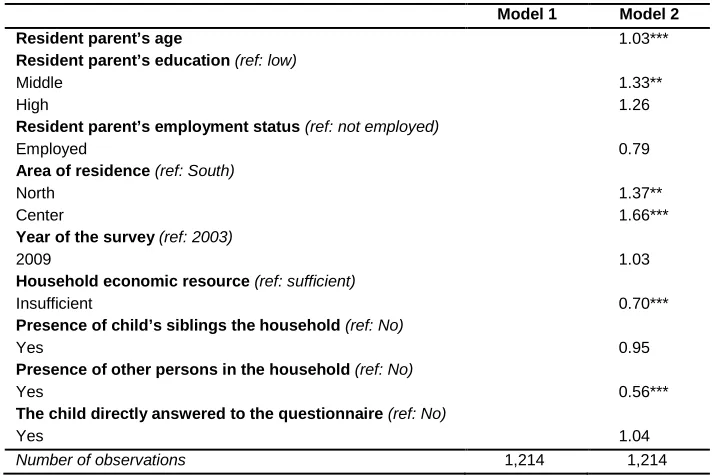
Besides the key covariate, the model takes into account the socio-demographic characteristics of both children and parents. As regards children’s characteristics, their gender and age at interview are considered, due to their importance for non-resident parent-child contact suggested by the literature (King, Harris, and Heard 2004; Amato, Meyers, and Emery 2009; Cheadle, Amato, and King 2010). As regard the parents, the available information is about the resident parent and not the non-resident parent (as in most previous studies, for example, Juby et al. 2007). However, several maternal and paternal traits are positively correlated, and thus, although we relied on one parent’s characteristics, we may expect that these variables also capture some information about the other parent. In particular, the resident parent’s age at time of interview and her/his educational level and employment status are controlled for, following suggestions made in previous studies (Cheadle, Amato, and King 2010; Lindsey, Caldera, and Colwell 2005). Also, the time passed since the de facto separation (chosen as marking the end of the marriage, following the approach used in other Italian studies; for example, Meggiolaro and Ongaro 2008) is taken into account, because children’s relationships with their non-resident parents are stronger when less time has elapsed since separation (Le Bourdais, Juby, and Marcil-Gratton 2002; Aquilino 2006). Some other potential disturbing factors are also considered. In particular, some household characteristics (a subjective measure of economic resources, the presence of siblings or other persons in the household) are controlled for. The area of residence (north, center, or south Italy) and the year of the survey are inserted in the models as a measure of contextual background (in particular, the year of the survey could be a proxy for the changes in the shared custody law). Lastly, whether the child answered directly to the questionnaire is also considered as control.
Model 1 shows that for non-resident fathers, parents’ repartnering is generally associated with lower father-child contact than when neither parents has repartnered (baseline group). For non-resident mothers the results show a different picture: if the mother has not repartnered, mother-child contact does not significantly differ from that of the baseline group; if the mother has repartnered the contact is significantly higher than in the baseline group. Other analyses, not reported here for space reasons, show that non-resident mother-child contact when neither parent has repartnered does not significantly differ from the baseline category, and thus contact does not significantly differ by gender of the resident parent when neither parent has repartnered. The same analyses also show that, when only the non-resident mother repartnered, significantly higher contact is observed with respect to the baseline group.
Model 2 tells us that the potential compositional factors and controls do not greatly interfere with that found by Model 1, except for in the case of non-resident fathers when both parents have repartnered (whose coefficient is no longer significant) and when only the mother has repartnered (it becomes borderline significant). This could, however, be due to the relatively limited sample size of these two categories and has to be considered with caution.
Table 2: Ordinal logit regressions (odds ratios for the probability of more frequent non-resident parent-child contact)
Model 1 Model 2 Gender of resident parent and parents’ repartnering (ref:
resident mother and neither parents repartnered)
Resident mother and only father repartnered 0.73* 0.62***
Resident mother and only mother repartnered 0.44*** 0.59*
Resident mother and both parents repartnered 0.52** 0.72
Resident father and mother did not repartner 1.14 1.13
Resident father and mother repartnered 2.69*** 3.25***
Child’s gender (ref: female)
Male 1.17
Child’s age (ref: under 6)
6−10 0.67**
11−13 0.55***
14−17 0.41***
Years from parents’ separation (ref: more than 5)
Missing 2.93***
2 or less years 1.38*
Table 2: (Continued)
Model 1 Model 2 Resident parent’s age 1.03*** Resident parent’s education (ref: low)
Middle 1.33**
High 1.26
Resident parent’s employment status (ref: not employed)
Employed 0.79
Area of residence (ref: South)
North 1.37**
Center 1.66***
Year of the survey (ref: 2003)
2009 1.03
Household economic resource (ref: sufficient)
Insufficient 0.70***
Presence of child’s siblings the household (ref: No)
Yes 0.95
Presence of other persons in the household (ref: No)
Yes 0.56***
The child directly answered to the questionnaire (ref: No)
Yes 1.04
Number of observations 1,214 1,214
Notes: ***= p<.001; **=p<0.05; *=p<0.10.
4. Concluding remarks
This paper is the one of the few attempts to use a quantitative approach to study the frequency of non-resident parent-child contact i) focusing on both non-resident fathers and mothers and ii) analyzing jointly their repartnering after separation. Another distinctive aspect of the study is that the results refer to a country where the diffusion of marital instability and repartnering is recent and thus the family context is still rather traditional and hard to explore with non-specific surveys.
significance) for mother’s repartnering, in line with that found in the US context (see, for example, Berger, Cancian, and Meyer 2012). On the other hand, the repartnering of both parents does not appear to be associated with variation in father-child contact with respect to the case when neither parents repartnered. The results tell a different story when the non-resident parent is the mother. Surprisingly, her repartnering is associated with higher contact with her non-resident child, compared to the situation of a single non-resident mother. The available data do not allow us to state that this is true whatever the father’s repartnering status; however, this is certainly true when the father has not repartnered.
5. Acknowledgements
References
Agresti, A. (2002). Categorical Data Analysis (Second Edition). Hoboken, New Jersey: John Wiley & Sons. doi:10.1002/0471249688.
Amato, P.R., Meyers, C.E., and Emery, R.E. (2009). Changes in nonresident father-child contact from 1976 to 2002. Family Relations 58: 41–53.
doi:10.1111/j.1741-3729.2008.00533.x.
Aquilino, W.S. (2006). The noncustodial father-child relationship from adolescence into young adulthood. Journal of Marriage and Family 68: 929–946.
doi:10.1111/j.1741-3737.2006.00305.x.
Berger, L.M., Cancian, M., and Meyer, D.R. (2012). Maternal re-partnering and new-partner fertility: Associations with nonresident father investments in children.
Children and Youth Services Review 34: 426–436. doi:10.1016/ j.childyouth.2011.11.012.
Carlson, M.J. (2006). Family structure, father involvement, and adolescent behavioural outcomes. Journal of Marriage and Family 68: 137–154. doi:10.1111/j.1741-3737.2006.00239.x.
Chapple, S. (2009). Child well-being and sole-parent family structure in the OECD: An analysis. Paris (OECD Publishing): OECD Social, Employment and Migration Working Papers, No. 82. doi:10.1787/225407362040.
Cheadle, J.E., Amato, P.R., and King, V. (2010). Patterns of nonresident father contact.
Demography 47: 205–225. doi:10.1353/dem.0.0084.
Day, R. and Acock, A.C. (2004). Youth ratings of family processes and father role performance of resident and nonresident fathers: A first look at the NLSY97. In: Day R.D. and Lamb M.E. (eds.) Conceptualizing and Measuring Father Involvement. Mahwah: Lawrence Erlbaum Associates: 273–293.
De Maris, A. (2004). Regression with social data: Modeling continuous and limited response variables. Hoboken, NJ: Wiley. doi:10.1002/0471677566.
Ermisch, J. (2002). Trying again: repartnering after dissolution of a union. ISER Working Paper Series, No. 2002–19.
Istat (2011a). Separazioni e divorzi in Italia. Anno 2009 (Statistiche Report). Roma: Istat.
Istat (2011b). Come cambiano le forme familiari (Statistiche Report). Roma: Istat. Istat (2011c). Condizioni di vita delle persone separate, divorziate e coniugate dopo un
divorzio(Statistiche Focus). Roma: Istat.
Istat (2012). Separazioni e divorzi in Italia. Anno 2010 (Statistiche Report). Roma: Istat.
Istat (2014). Separazioni e divorzi in Italia. Anno 2012 (Statistiche Report). Roma: Istat.
Ivanova, K., Kalmijin, M., and Uunk, W. (2013). The effect of children on men’s and women’s chances of re-partnering in a European context. European Journal of Population 29: 417–444. doi:10.1007/s10680-013-9294-5.
Juby, H., Billette, J., Laplante, B., and Le Bourdais, C.L. (2007). Nonresident fathers and children: Parents’ new unions and frequency of contact. Journal of Family Issues 28: 1220–1245. doi:10.1177/0192513X07302103.
Kielty, S. (2008a). Non-resident motherhood: managing a threatened identity. Child and Family Social Work 13: 32–40.
Kielty, S. (2008b). Working hard to resist a “bad mother” label. Narratives of non-resident motherhood. Qualitative Social Work 7: 363–379.
doi:10.1177/1473325008093707.
King, V. (2007). When children have two mothers: relationships with nonresident mothers, stepmothers, and fathers. Journal of Marriage and Family 69: 1178– 1193. doi:10.1111/j.1741-3737.2007.00440.x.
King, V. (2009). Stepfamily formation: Implications for adolescent ties to mothers, nonresident fathers, and stepfathers. Journal of Marriage and Family 71: 954– 968. doi:10.1111/j.1741-3737.2009.00646.x.
King, V., Harris, K.M., and Heard, H.E. (2004). Racial and ethnic diversity in nonresident father involvement. Journal of Marriage and Family 66: 1–21. King, V. and Sobolewski, J.M. (2006). Nonresident fathers’ contributions to adolescent
well-being. Journal of Marriage and the Family 68: 537–557.
King, V., Stamps, K.C., and Hawkins, D.N. (2010). Adolescents with two nonresident biological parents: Living arrangements, parental involvement, and well-being.
Journal of Family Issues 31: 3–30. doi:10.1177/0192513X09345833.
Lader, D. (2008). Non-resident parental contact, 2007/8. UK: Office for National Statistics.
Le Bourdais, C., Juby, H., and Marcil-Gratton, N. (2002). Keeping in touch with children after separation: The point of view of fathers. Canadian Journal of Community Mental Health (Special Supplement) 21(4): 109–130.
doi:10.7870/cjcmh-2002-0031.
Levin, K.A. and Currie, C. (2010). Family structure, mother-child communication, father-child communication, and adolescent life satisfaction. Health Education
110: 152–168. doi:10.1108/09654281011038831.
Lindsey, E.W., Caldera, Y., and Colwell, M. (2005). Correlates of coparenting during infancy. Family Relations 54: 346–359. doi:10.1111/j.1741-3729.2005.00322.x. Meggiolaro, S. and Ongaro, F. (2008). Repartnering after marital dissolution: does
context play a role? Demographic Research 19: 1913–1934.
doi:10.4054/DemRes.2008.19.57.
Nepomnyaschy, L. (2007). Child support and father-child contact: Testing reciprocal pathways. Demography 44: 93–112. doi:10.1353/dem.2007.0008.
Panico, L., Bartley, M., Kelly, Y., McMunn, A., and Sacker, A. (2010). Changes in family structure in early childhood in the Millennium Cohort Study. Population Trends 142: 78–92. doi:10.1057/pt.2010.32.
Sobolewski, J.M. and King, V. (2005). The importance of the coparental relationship for nonresident fathers’ ties to children. Journal of Marriage and Family 67: 1196–1212. doi:10.1111/j.1741-3737.2005.00210.x.
Sousa, L. and Sorensen, E. (2008). The economic reality of nonresident mothers and their children (Assessing the New Federalism (Series B, No. B-69)). Washington, DC: Urban Institute.
Stewart, S.D. (1999). Nonresident mothers’ and fathers’ social contact with children.
Journal of Marriage and Family 62: 894–907. doi:10.2307/354011.
Sweeney, M.M. (2010). Remarriage and stepfamilies: strategic sites for family scholarship in the 21st century. Journal of Marriage and Family 72: 667–684.
Swiss, L. and Le Bourdais, C. (2009). Father-Child contact after separation the influence of living arrangements. Journal of Family Issues 30: 623–652.