VOLUME 36, ARTICLE 55, PAGES 1703
,
1720
PUBLISHED 25 MAY 2017
http://www.demographic-research.org/Volumes/Vol36/55/ DOI: 10.4054/DemRes.2017.36.55
Descriptive Finding
From never partnered to serial cohabitors:
Union trajectories to childlessness
Marika Jalovaara
Anette Eva Fasang
© 2017 Marika Jalovaara & Anette Eva Fasang.
This open-access work is published under the terms of the Creative Commons Attribution NonCommercial License 2.0 Germany, which permits use, reproduction & distribution in any medium for non-commercial purposes, provided the original author(s) and source are given credit.
1 Introduction 1704
2 Data and methods 1705
2.1 Data 1705
2.2 Methods 1707
3 Results 1708
4 Conclusions 1715
5 Acknowledgments 1716
From never partnered to serial cohabitors:
Union trajectories to childlessness
Marika Jalovaara1
Anette Eva Fasang2
Abstract
BACKGROUND
Childlessness has increased in many European countries. Partnerships and parenthood are obviously closely related, but there is relatively little knowledge on how childlessness is linked to contemporary union dynamics that involve high rates of separation and unmarried cohabitation.
OBJECTIVE
To situate (biological) childlessness in longitudinal dynamics of union formation and stability, we take a life-course approach to union trajectories that consist of states entered via the formation and dissolution of cohabitations and marriages. Concretely, we identify groups of similar union trajectories of individuals between the ages of 18 and 39 who are childless at age 42.
METHODS
We analyse register data on Finnish men and women born in 1969 and 1970 (childless N=3,241) with sequence, cluster, and multinomial logistic regression methods.
RESULTS
Four clusters of typical union trajectories were identified among the childless and assigned these labels: 1) Never Partnered (45%), characterized by never having entered a coresidential partnership, or just having entered a cohabitation near age 40; 2) Briefly Cohabited (25%), characterized by mostly living single after a brief cohabitation spell; 3) Cohabitors, Often Serial (19%), marked by typically discontinuous cohabitation; and 4) Married (11%). The Never-Partnered cluster is male-dominated. Men with a rural background and less-educated men and women are overrepresented among the Never-Partnered childless.
1 Department of Social Research, University of Turku, Turku, Finland. E-Mail:[email protected]. 2 Department of Social Sciences, Humboldt University, and WZB Berlin Social Science Center, Berlin,
CONCLUSION
For the great majority of the childless in our study cohorts, union trajectories are marked by either the (almost) complete absence of coresidential unions or fragmentary cohabitation histories.
CONTRIBUTION
The study contributes to the literature by showing that union histories, including never partnering as well as cohabitation instability, are key for understanding contemporary childlessness.
1. Introduction
Childlessness, defined as reaching the end of one’s reproductive life without entering parenthood, has increased in most European societies, although the trends vary substantially (Beaujouan, Brzozowska, and Zeman 2016; Miettinen et al. 2015). These developments have fuelled interest in the reasons for childlessness (Kreyenfeld and Konietzka 2017). Most empirical research on antecedents of childbearing has concentrated on women and on the complex and changing influences of education and employment (e.g., Andersson et al. 2009; Beaujouan, Brzozowska, and Zeman 2016; Mynarska et al. 2015).
In addition to education and employment, partnership status and history are crucial for understanding childlessness. Some people have children outside of coresidential partnerships, but a stable partnership is usually viewed as a precursor for childbearing. Not being married, never having married, and having divorced are important predictors of childlessness (see Keizer, Dykstra, and Jansen 2008; Portanti and Withworth 2009; Tanturri et al. 2015). However, little is known about how childlessness is linked to contemporary union dynamics involving high rates of separation and unmarried cohabitation. Across affluent democracies, young adults increasingly postpone or forgo marriage. Some of this is compensated by an increase in unwed cohabitation but, although cohabitation is increasingly also an arena for childbearing, married couples enter parenthood at a much higher rate (Sobotka and Toulemon 2008; for Finland, see Jalovaara and Miettinen 2013). Similarly, while divorce rates are high, separation rates for cohabitations are higher (Liefbroer and Dourleijn 2006; for Finland, see Jalovaara 2013).
difficulty of distinguishing between voluntary and involuntary childlessness (ibid.). Several scholars stress that childlessness is ideally studied from a life-course perspective (see Berrington 2017; Mynarska et al. 2015). To date, life-course studies on union trajectories of the childless have relied on isolated summary measures, such as the number of unions. A Dutch study (Keizer et al. 2008) showed that both having had no partnership and having had more than one partnership strongly predict childlessness, especially among men.
This study aims to identify the typical longitudinal union trajectories of the childless beyond isolated summary indicators. We take a life-course perspective and specify union trajectories that combine states entered via the formation and dissolution of cohabitations and marriages. This enables us to situate childlessness in the dynamics of union formation and dissolution. In addition to the research on specific events that uses summary measures, our sequential approach can inform how the joint occurrence, timing, and duration of multiple states in a union trajectory are associated with childlessness.
In Finland childlessness has increased continuously and is now the highest among the Nordic countries (Miettinen et al. 2015; Jalovaara et al. 2017). We focus on Finnish men and women born in 1969 and 1970 who are childless at age 42 and their union trajectories from ages 18 to 39. We use sequence, cluster, and multinomial logistic regression methods to briefly compare the union trajectories of the childless to those of parents; then to identify clusters of typical union trajectories of the childless; and finally, to show how the clusters vary in terms of education and rural–urban residence among childless men and women.
2. Data and methods
2.1 Data
be inferred, because the data would not allow us to distinguish cohabiting couples from roommates, such as students who share a living facility in order to reduce expenses.
This study focuses on the birth cohorts 1969 and 1970 because they have the longest complete union histories: The 1969 cohort is the oldest to have histories of all coresidential unions from their 18th birthday. Currently, our data enables us to study
their full union trajectories up to the age of 39, and childbearing until age 42.
We focus on childless people but include parents in the first descriptive step. Childlessness indicates that a person has no registered (biological) child at age 42. Unlike the typical case in survey data, men’s childbearing is almost as completely covered as women’s: Only 1.3% of the children in our data have no father registered. While measuring childlessness at age 45 or 50 would be ideal, 42 is what this otherwise rich and detailed data allows. Note that the focus on biological parenthood ignores important family ties that childless individuals may have to children, for instance through step-parenting, social parenthood, or adoption.
We begin with a sequential representation of union trajectories of childless people and parents from ages 18 to 39 that comprise 259 months for both cohorts (N=12,951). Data for those who did not live in Finland on their 18th birthday is excluded. Moreover,
individuals who died or emigrated between ages 18 and 39 were excluded. Of the remaining population, 98% were born in Finland. The sequences of union histories distinguish between never partnered (NP), cohabiting (C), married (M), and previously partnered (PP). The two single states, never partnered and previously partnered, are distinguished because, for childlessness, it is theoretically meaningful whether individuals never had a partner or separated from a partner with whom parenthood might have been possible.
2.2 Methods
We first use sequence analysis (Abbott 1995) to graphically compare the union trajectories of the childless and parents. Subsequently, sequence and cluster analysis are used to identify clusters of union trajectories that represent collective patterns among the childless.
For the sequence analysis, Optimal Matching (OM) with constant substitution costs of 2 and indel costs of 1 (half the maximum substitution cost) is employed to assess the similarity of each possible pair of union sequences (MacIndoe and Abbott 2004; Aisenbrey and Fasang 2010). This cost setting is well suited for identifying sequence similarity in terms of both the order and the timing of relationship states (MacIndoe and Abbott 2004). The results were substantively robust to other cost specifications, including the Dynamic Hamming Distance (Lesnard 2010). OM yields a pairwise distance matrix that contains a distance value for each possible pair of union trajectories.
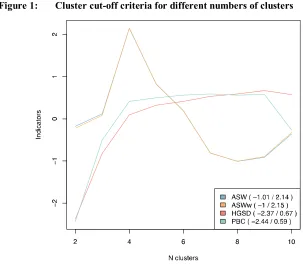
Ward cluster analysis considering several cluster cut-off criteria is applied to the sequence distance matrix to identify the most discriminant groups of typical union trajectories among the childless (see Studer 2013). Several cut-off criteria in Figure 1 support a grouping into four clusters. The weighted Average Silhouette Width for four clusters is 0.56 and indicates a clear structure in the trajectories (ibid.). Four clusters also proved substantively meaningful, thus meeting the criterion of construct validity (Aisenbrey and Fasang 2010). Separate cluster analyses for men and women resulted in the same four clusters for women. For men some criteria suggested an additional fifth cluster that was characterized by cohabitation beginning at a relatively high age (30+ years) but was otherwise heterogeneous (cohabitation length varying from a few months to a decade). Given the overall high similarity of gender-specific findings to the results based on the total sample, we decided to retain the same four clusters for men and women in the pooled analysis.
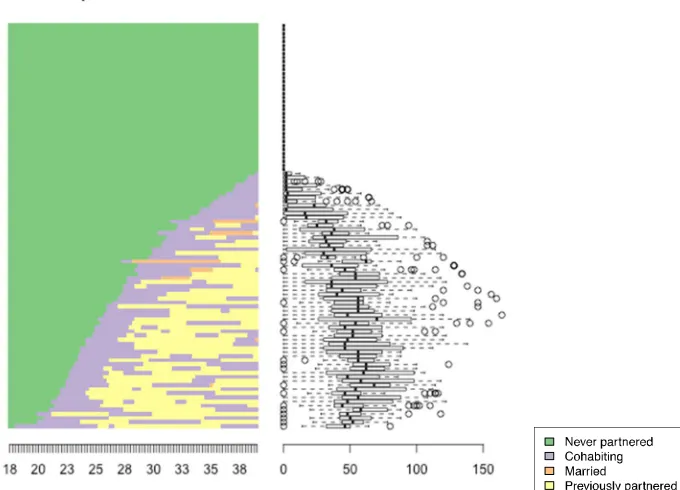
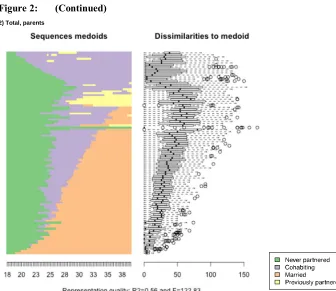
the lowest sum of distances to all other sequences in the frequency group) is selected as a representative. The corresponding distance-to-medoid box plots visualize the distances of all sequences in a frequency group to their medoid, and thereby indicate cluster homogeneity at different regions of the sorted sequences. High average distance to the medoid indicates high sequence heterogeneity.
Figure 1: Cluster cut-off criteria for different numbers of clusters
3. Results
Figure 2: Union trajectories at age 18–39 of the childless (A) and parents (B); relative frequency sequence plots, representative sequences; childlessness observed at age 42
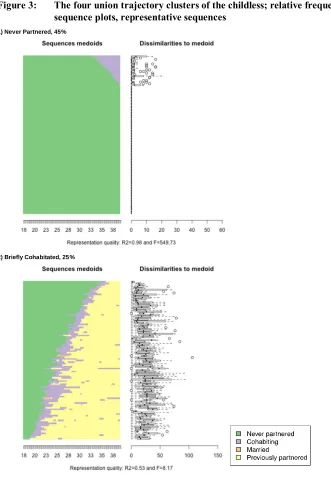
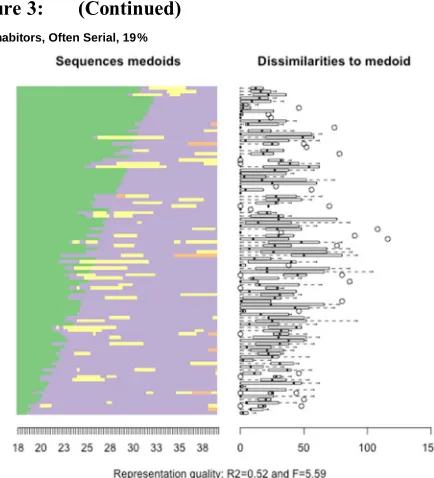
Figure 3: The four union trajectory clusters of the childless; relative frequency sequence plots, representative sequences
1) Never Partnered, 45%
Figure 3: (Continued) 3) Cohabitors, Often Serial, 19%
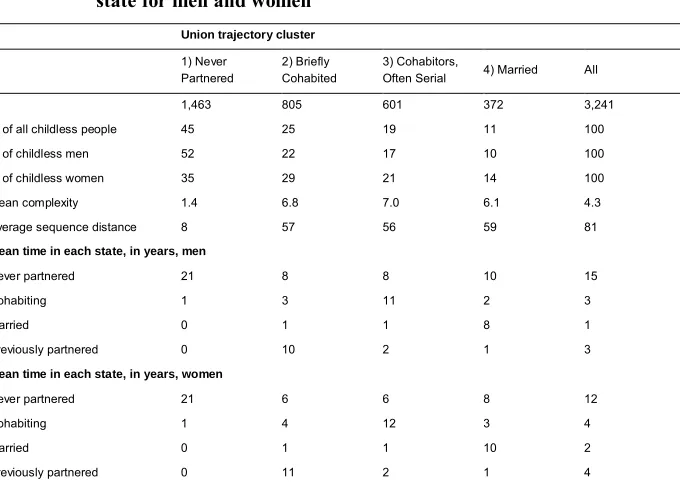
Figure 3 shows the RF sequence plots for each of the four clusters of union trajectories only among the childless. Table 1 summarizes information on the size of the clusters, average sequence complexity (Elzinga 2010), average sequence distance (as an indicator of cluster homogeneity), and average time spent in each state for each cluster for men and women.
The four clusters are labeled 1) Never Partnered, 2) Briefly Cohabited, 3) Cohabitors, Often Serial, and 4) Married. The Never-Partnered cluster is largest, covering 45% of the childless sample. It is characterized by never having lived in cohabitation or marriage or, for some, just entering cohabitation when nearing age 40. This cluster, with the lowest sequence complexity and largest homogeneity, represents the continual absence of union formation (Table 1). A larger proportion of childless men (52%) than of childless women (35%) are in the Never-Partnered cluster, while all other clusters are more prevalent among women (Table 1).
Table 1: The union trajectory clusters: distributions, mean complexities, average sequence distances, and mean time (in years) spent in each state for men and women
Union trajectory cluster
1) Never Partnered
2) Briefly Cohabited
3) Cohabitors,
Often Serial 4) Married All
N 1,463 805 601 372 3,241
% of all childless people 45 25 19 11 100
% of childless men 52 22 17 10 100
% of childless women 35 29 21 14 100
Mean complexity 1.4 6.8 7.0 6.1 4.3
Average sequence distance 8 57 56 59 81
Mean time in each state, in years, men
Never partnered 21 8 8 10 15
Cohabiting 1 3 11 2 3
Married 0 1 1 8 1
Previously partnered 0 10 2 1 3
Mean time in each state, in years, women
Never partnered 21 6 6 8 12
Cohabiting 1 4 12 3 4
Married 0 1 1 10 2
The second and third clusters cover 25% and 19% of the childless, respectively, and 44% of the childless in total. Cluster 2, Briefly Cohabited, is characterized by a short cohabitation spell followed by living without a partner. Very few have repartnered by age 39, and equally few were married for a short time at a rather young age. Cluster 3, Cohabitors, Often Serial, is marked by cohabitation throughout most of the trajectories. Most of the cohabitation histories are discontinuous, with unpartnered periods in between.
Cluster 4, Married, is the smallest cluster (11%), characterized by marriage mostly entered by age 35. A large proportion of these marriages are stable in that they have not ended by age 39, but the cluster also covers previously married individuals. The most complex trajectories in the Married cluster represent those who have repartnered after a first union. Of all four clusters, the Married cluster is the most heterogeneous one, as measured by the average sequence distance (Table 1).
In sum, the great majority of the union trajectories of the childless are marked by the (almost) complete absence of coresidential unions, or fragmentary cohabitation histories. The clearest exception to this is the relatively small Married cluster.
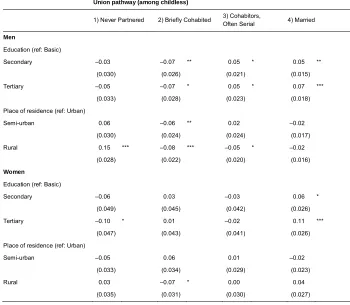
Table 2: Associations between education and place of residence, and union trajectory cluster among the childless. A multinomial regression model of childlessness cluster; average marginal effects at means, and their standard errors (in parentheses). Separate models for men and women
Union pathway (among childless)
1) Never Partnered 2) Briefly Cohabited 3) Cohabitors,
Often Serial 4) Married
Men
Education (ref: Basic)
Secondary –0.03 –0.07 ** 0.05 * 0.05 **
(0.030) (0.026) (0.021) (0.015)
Tertiary –0.05 –0.07 * 0.05 * 0.07 ***
(0.033) (0.028) (0.023) (0.018)
Place of residence (ref: Urban)
Semi-urban 0.06 –0.06 ** 0.02 –0.02
(0.030) (0.024) (0.024) (0.017)
Rural 0.15 *** –0.08 *** –0.05 * –0.02
(0.028) (0.022) (0.020) (0.016)
Women
Education (ref: Basic)
Secondary –0.06 0.03 –0.03 0.06 *
(0.049) (0.045) (0.042) (0.026)
Tertiary –0.10 * 0.01 –0.02 0.11 ***
(0.047) (0.043) (0.041) (0.026)
Place of residence (ref: Urban)
Semi-urban –0.05 0.06 0.01 –0.02
(0.033) (0.034) (0.029) (0.023)
Rural 0.03 –0.07 * 0.00 0.04
(0.035) (0.031) (0.030) (0.027)
Note: * P ≤ 0.05; **P ≤ 0.01; ***P ≤ 0.001
4. Conclusions
Our results strongly suggest that partnership histories are key for understanding contemporary childlessness. Specifically, we find a polarization into either never partnering or unstable cohabitation histories among the childless, with only a small group of married childless. The never partnered and previously partnered are possibly dating and involved in Living Apart Together relationships, but they do not decide to move in together or marry.
There are remarkable differences in the union trajectories of childless people compared with parents, as well as within the group of childless people. Our findings resonate with subjective accounts: In recent surveys, the lack of a suitable partner is frequently given as a reason for postponing or giving up childbearing plans (Miettinen 2010, 2015; Berrington 2017). These findings suggest that policy measures to decrease childlessness that are directed at couples who hesitate with childbearing may be inefficient. A substantial proportion of childlessness probably has deeper roots in individual biographies and local partner availability that lead to never partnering and union instability.
Much of the recent research attention has been directed at the link between education, employment, and childlessness, mostly among women. Our findings suggest that union dynamics are a part of the story. It is likely that education, employment, and partnership trajectories jointly create opportunities, obstacles, and motivations for entering into parenthood. A recent Finnish study showed that less-educated men and women are by far most likely to remain childless and never become partnered (Jalovaara and Fasang 2015). Another recent study (Trimarchi and Van Bavel 2017) concluded that the effect of education on entry into fatherhood operates chiefly through selection into a union. Future research should continue to consider such interplays.
5. Acknowledgments
References
Abbott, A. (1995). Sequence analysis: New methods for old ideas. Annual Review of
Sociology 21: 93–113.doi:10.1146/annurev.so.21.080195.000521.
Aisenbrey, S. and Fasang, A.E. (2010). New life for old ideas: The “second wave” of sequence analysis bringing the “course” back into the life course. Sociological Methods & Research 38(3): 420–462.
Andersson, G., Rønsen, M., Knudsen, L.B., Lappegård, T., Neyer, G., Skrede, K., Teschner, K., and Vikat, A. (2009). Cohort fertility patterns in the Nordic countries.Demographic Research20(14): 313–352. doi:10.4054/DemRes.2009. 20.14.
Beaujouan, E., Brzozowska, Z., and Zeman, K. (2016). The limited effect of increasing educational attainment on childlessness trends in twentieth-century Europe, women born 1916–65. Population Studies 70(3): 275–291. doi:10.1080/ 00324728.2016.1206210.
Berrington, A. (2004). Perpetual postponers? Women’s, men’s and couple’s fertility intentions and subsequent fertility behaviour. Population Trends 117(Autumn 2004): 9–19.
Berrington, A. (2017). Childlessness in the UK. In: Kreyenfeld, M. and Konietzka, D. (eds.).Childlessness in Europe: Contexts, causes, and consequences.Dordrecht: Springer: 57–76.doi:10.1007/978-3-319-44667-7_3.
Elzinga, C.H. (2010). Complexity of categorical time series. Sociological Methods &
Research38(3): 463–481.doi:10.1177/0049124109357535.
Fasang, A.E. and Liao, T.F. (2014). Visualizing sequences in the social sciences: Relative frequency sequence plots. Sociological Methods & Research 43(4): 643–676.doi:10.1177/0049124113506563.
Jalovaara, M. (2013). Socioeconomic resources and the dissolution of cohabitations and marriages. European Journal of Population 29(2): 167–193. doi:10.1007/ s10680-012-9280-3.
Jalovaara, M. and Fasang, A.E. (2015). Are there gender differences in family trajectories by education in Finland?Demographic Research 33(44): 1241– 1256.doi:10.4054/DemRes.2015.33.44.
Finland. Demographic Research 28(31): 881–916. doi:10.4054/DemRes.2013. 28.31.
Jalovaara, M., Neyer, G., Andersson, G., Dahlberg, J., Dommermuth, L., Fallesen, P., and Lappegård, T. (2017). Education, gender, and cohort fertility in the Nordic countries. Stockholm: Stockholm University, Department of Sociology (Stockholm Research Reports in Demography 2017: 6).
Keizer, R., Dykstra, P.A., and Jansen, M.D. (2008). Pathways into childlessness: Evidence of gendered life course dynamics. Journal of Biosocial Science 40(6): 863–878.doi:10.1017/S0021932007002660.
Kreyenfeld, M. and Konietzka, D. (2017). Childlessness in Europe: Contexts, causes,
and consequences. Dordrecht: Springer.doi:10.1007/978-3-319-44667-7.
Lesnard, L. (2010). Setting cost in optimal matching to uncover contemporaneous socio-temporal patterns. Sociological Methods & Research 38(3): 389–419. doi:10.1177/0049124110362526.
Liefbroer, A.C. and Dourleijn, E. (2006). Unmarried cohabitation and union stability: Testing the role of diffusion using data from 16 European countries.
Demography 43(2): 203–221.doi:10.1353/dem.2006.0018.
MacIndoe, H. and Abbott, A. (2004). Sequence analysis and optimal matching techniques for social science data. In: Hardy, M. and Bryman, A. (eds.).
Handbook of data analysis. London: Sage: 387–406. doi:10.4135/
9781848608184.n17.
Miettinen, A. (2010). Voluntary or involuntary childlessness? Socio-demographic factors and childlessness intentions among childless Finnish men and women aged 25–44.Finnish Yearbook of Population Research 45: 5–24.
Miettinen, A. (2015). Miksi syntyvyys laskee? Suomalaisten lastensaantiin liittyviä toiveita ja odotuksia. Helsinki: Väestöliitto (Katsauksia E49/2015).
Miettinen, A., Rotkirch, A., Szalma, I., Donno, A., and Tanturri, M.-L. (2015). Increasing childlessness in Europe: Time trends and country differences. Stockholm: Stockholm University (Families And Societies Working Paper 33). Mynarska, M., Matysiak, A., Rybińska, A., Tocchioni, V., and Vignoli, D. (2015).
Piccarreta, R. and Lior, O. (2010). Exploring sequences: A graphical tool based on multi-dimensional scaling.Journal of the Royal Statistical Society: Series A (Statistics in Society) 173(1): 165–184.doi:10.1111/j.1467-985X.2009.00606.x. Portanti, M. and Whitworth, S. (2009). A comparison of the characteristics of childless
women and mothers in the ONS Longitudinal Study.Population Trends 136(1): 10–20.doi:10.1057/pt.2009.15.
Raab, M., Fasang, A.E., Karhula, A., and Erola, J. (2014). Sibling similarity in family formation.Demography 51(6): 2127–2154.doi:10.1007/s13524-014-0341-6. Sobotka, T. and Toulemon, L. (2008). Overview chapter 4: Changing family and
partnership behaviour. Demographic Research 19(6): 85–138. doi:10.4054/ DemRes.2008.19.6.
Studer, M. (2013). WeightedCluster Library Manual: A practical guide to creating typologies of trajectories in the social sciences with R. Lausanne: University of Lausanne (LIVES Working Papers 2013/24).
Tanturri, M.L., Mills, M., Rotkirch, A., Sobotka, T., Takács, J., Miettinen, A., Faludi, C., Kantsa, V., and Nasiri, D. (2015). State-of-the-art report childlessness in
Europe. Stockholm: Stockholm University (Families And Societies Working
Paper 32).