The present study aims at development of method for simultaneous estimation of chloride and citrate in oral rehydration salt (ORS) by ion chromatography and its validation. The estimation was carried out with a step change gradient mode by altering concentrations of NaOH as an eluent, an anion exchange column IonPac AS11 analytical column, guard column AG11 and conductivity detector. The suppressor used was used as ASRS ULTRA. The developed method was validated as per ICH guidelines for various parameters. The method is useful for determining the contents of chloride and citrate in single run from ORS.
Keywords: Ion chromatography,Oral rehydration salt, simultaneous estimation, chloride, citrate
ABSTRACT
Submitted: 28/06/2012 Accepted: 28/03/2013INTRODUCTION
ORS is a simple, cost effective formulation which can prevent about 90 % of child deaths from diarrhoeal dehydration. Around 80 % child diarrhoea cases have been successfully treated in less than 45 countries with ORS. It is reported that 90 % of the mortality from diarrhoea is due to the fluid loss. Accurately and timely replacement of that loss is life saving and this is possible by ORS. ORS is not only used in the case of diarrhoea but also in the dehydration of patients with burns, fluid and electrolyte imbalance in surgical patients,
1
dehydration in elderly patients etc. ORS mainly contains ions such as sodium, chloride, potassium, citrate, bicarbonate, glucose and sometimes lactate and sulphate. The presence of potassium in ORS is particularly important for the treatment of losses in diarrhoea, citrate is need for the treatment of acidosis, glucose is principally helpful for absorption of sodium. Sodium and chloride play very important roles in transport system for the ion channels. Thus, ions present in
2,3
ORS are essential for the normal body functioning.
There are many methods to estimate the elements/ions like flame photometry, X-ray fluorescence, instrumental neutron activation analysis, atomic emission spectroscopy, etc. but these methods have their own draw backs. The titrimetry method for estimation of chloride also fails because it is not able to estimate the chloride at trace level. No method has been reported to estimate chloride and citrate simultaneously in trace amounts. Thus development of method for
Simultaneous Estimation of Anions Present in Oral Rehydration Salt by ION
Chromatography and its Method Validation
1 1 1 2 2 2
Preeti Kulkarni , Sonal Desai , Pratima Tatke *, T. P. Ghule , C.D. Chavan and V. R. Bhate
1
C. U. Shah College Of Pharmacy, S. N. D. T. Women's University, Santacruz (W), Mumbai-400 049, India.
2
Analytical Solutions, R-610, Rabale, M. I. D. C., Mumbai-400 701, India.
*Address for Correspondence:
Pratima A. Tatke, Professor, C.U. Shah College of Pharmacy, S.N.D.T Women's University, Mumbai-400049, India.
E-mail: [email protected]
simultaneous estimation of these anions is essential for
4
estimation of anions present in the ORS.
Ion chromatography is a modern and efficient method for separating and estimating ions using ion exchange resin. It was first introduced in 1975 by Small, Stevens and Baumann. In this technique, sensitive detection of ions is carried out via electric conductance. The eluent from separator column passes through a suppressor column. The suppressor column reduces background conductance of eluent, while at the same time increases the conductance of analyte ions. Ion chromatography (IC) as part of liquid chromatography is based on three different separation mechanisms and based on that it is divided into Ion chromatography, Ion-exclusion
5
chromatography and Ion-Pair chromatography.
The basic components of an IC are similar to the conventional HPLC systems. It consists of the pump, sample injection system, separation valve, guard column, analytical column,
5-8
suppressor column and detector.
The aim and objectives of the work was to develop the method for simultaneous estimation and quantitation of the anions (chloride and citrate) in the ORS by ion chromatography and validation of developed method for various parameters as per ICH guidelines.
MATERIALS AND METHOD
Reagents and instruments: ORS was purchased from local market of Mumbai. NaOH used was of AR grade and was purchased from S. D. fine chemicals, Mumbai.
Dionex DX500 Ion chromatography system module was used.
Column: Anion exchange column, IonPac AS11 (250X4 mm)
Guard column: AG11 (50X4 mm)
Mobile phase: A: 40 mM NaOH, B: Water
Gradient (Time/%A):- 0/5, 4/5, 4.1/50, 8/50, 8.1/5
Flow-1.0 ml/min
Loop size: 50 µl
Range: 100 µs
Current: 50 mA
Mode: Recycle mode
Method validation: The developed method was validated for various parameters such as linearity and range, limit of detection (LOD), limit of quantitation (LOQ), accuracy, precision, robustness and system suitability as per ICH guidelines. Method validation provides an assurance of reliability of method during normal use and it provides documented evidence that the method does what it is intended
9
to do.
Preparation of solutions:
Standard solution of chloride: Sodium chloride (0.1673 g) was accurately weighed in a 100 ml of volumetric flask and a small quantity of 2 mM NaOH (prepared using high purity deionised water) was added and shaken to dissolve contents and volume was made up to mark with the same diluents to obtain 1000 ppm concentration of chloride solution.
Standard solution of citrate: Trisodiumcitrate dihydrate
(0.1586 g) was accurately weighed in a 100 ml of volumetric flask and a small quantity of 2 mM NaOH (prepared using high purity deionised water) was added and shaken to dissolve contents and volume was made upto mark with the same diluents to obtain 1000 ppm concentration of citrate solution.
Preparation of sample: Around 1.7893 g of the sample was weighed and transferred to 50 ml of volumetric flask. Then a small quantity of 2 mM NaOH was added to it and sonicated for 5 min and volume was made up to mark with same diluent to get 1455.5 ppm and 1891 ppm of chloride and citrate respectively. Further the solution was dilute with diluent to get 2.912 ppm of chloride and 3.782 ppm of citrate.
Linearity and range: Linearity is the ability of the method to elicit test results that are directly proportional to the analyte concentration within a given range. Linearity was assessed by performing on five analyte concentrations. The data obtained was then processed using a linear least square regression. Each concentration was injected thrice and the average area was taken.
concentration of analyte in the sample that can be quantitated. LOD and LOQ were determined by signal to noise ratio. They were obtained by successively decreasing the concentration as long as a signal-to-noise ratio of 3:1 and 10:1 appeared for LOD and LOQ respectively.
Accuracy: The accuracy of an analytical procedure expresses the closeness of measured value to true value. Accuracy was measured as the percentage of analyte recovered by assay, by spiking samples with the standards of known concentration. The sample was spiked with the standard of 2 ppm, 3ppm and 4 ppm of chloride and citrate respectively.
Precision: It is a measure of the degree of repeatability of an analytical method under normal operation and is normally expressed as the percent relative standard deviation for statistically significant number of samples. The precision was determined by injecting six solutions of standard and samples and deviations in the results were observed.
Robustness and Ruggedness: Robustness is the capacity of the method to remain unaffected by small and deliberate variations in method parameters. Ruggedness is the degree of reproducibility of the results obtained under a variety of conditions, expressed as % relative standard deviation (% RSD). Robustness and ruggedness was determined by making small deliberate changes of the conditions (flow rate, different analyst etc.)
System suitability: The purpose of the system suitability test is to ensure that the complete testing system (including instrument, reagents, columns, analysts) is suitable for the intended application. It is used to verify that the resolution and reproducibility of the chromatographic system are adequate for the analysis to be done. Here parameters such as plate count, tailing factor, resolution and reproducibility are evaluated.
RESULTS AND DISCUSSIONS
The simultaneous estimation of chloride and citrate was done using ion chromatography. Initially, the column IonPac
-1/1 2.93 0.69 8.31 0.128 0.0052 0.8 0.006 0.4
2/2 2.94 1.401 8.20 0.254 0.0087 0.6 0.0015 0.6
4/4 2.97 2.732 8.30 0.518 0.0108 0.4 0.0035 0.7
8/8 3.04 5.447 8.26 1.016 0.0258 0.5 0.0065 0.6
10/10 3.04 7.079 8.23 1.30 0.0182 0.3 0.007 0.5
Concentration
-
3-of Cl / C H O 6 5 7
(ppm)
Average Rt
-Cl (min)
Average
-area of Cl
Average Rt
3-of C H O6 5 7
( min)
Average area
3-of C H O6 5 7
S. D. of
-Cl
% R. S. D.
-of Cl
S. D. of
3-C H O6 5 7
% R. S. D. of
3-C H O6 5 7
Table 1: Results of linearity studies for chloride and citrate
-
Amount of Cl and
3-C H O added in 6 5 7
the flask(ppm)
Total amount
-
Cl present (Calculated)
Total amount
-
Cl found (Experimentally)
% Recovery
Total amount of
3-C H O present6 5 7
(Calculated)
Total amount of
3-
C H O found6 5 7
(Experimentally)
% Recovery
2 5.034 4.955 98.4 7.095 7.182 99.7
3 6.034 6.060 100.4 8.095 8.182 99.3
4 7.024 7.085 100.7 9.095 9.182 100.4
Table 2: Recovery studies for chloride and citrate
Conc. of
3-Cl-/ C H O 6 5 7
(ppm)
-Area of Cl Area of
3-C H O6 5 7
Sample -
Conc. of Cl (mM/l)
3/5 2.065 0.648 Sample 1 2.074 0.649 42.49 13.1
3/5 2.062 0.65 Sample 1 1.999 0.668 40.60 13.5
3/5 2.075 0.648 Sample 1 2.000 0.669 40.60 13.5
3/5 2.061 0.636 Sample 1 2.077 0.664 42.29 13.5
3/5 2.061 0.647 Sample 1 2.082 0.665 42.14 13.5
3/5 2.080 0.653 Sample 1 2.074 0.666 42.49 13.1
Average 2.067 0.647 Sample 1 2.051 0.660
S.D. 0.0082 0.0058 0.04 0.0088
% R. S.D. 0.4 0.9 1.9 1.3
Table 3: Results of precision studies.
-Area of Cl Area of
3-C H O6 5 7
Conc. of
3-Cl-/ C H O 6 5 7
(mM/I)
Conc. of
3-Cl-/ C H O 6 5 7
(ppm)
-Area of Cl Area of
3-C H O6 5 7
Sample -
Conc. of Cl (mM/l)
3/5 2.667 0.302 Sample 1 2.766 0.305 42.82 13.31
3/5 2.675 0.305 Sample 1 2.780 0.295 42.70 12.70
3/5 2.761 0.304 Sample 1 2.765 0.303 42.80 13.10
Average 2.701 0.304 2.770 0.301
S.D. 0.0521 0.0015 0.0084 0.0053
% R.S.D. 1.9 0.5 0.4 0.6
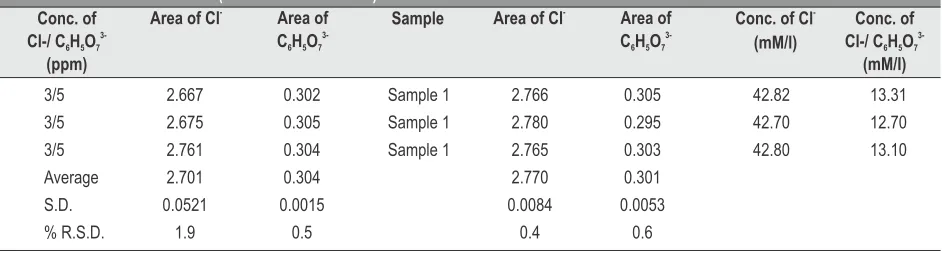
Table 4: Results of robustness (Flow rate =0.9 ml/min)
-Area of Cl Area of
3-C H O6 5 7
Conc. of
3-Cl-/ C H O 6 5 7
AS4A-SC, and the guard column AG4-SC was used for analysis, but the column was not found suitable for separating dip and the chloride peak, hence the column was changed to an anion exchange column IonPac AS11 (250X4 mm) and guard column AG11(25X4 mm) which gave optimum resolution for chloride and citrate peaks. The mobile phase tried for the column AS4A-S C was Na CO : NaOH (40 mM: 2 3
4 mM) in isocratic mode. The peaks of chloride and citrate were well separated but there was no baseline separation between the chloride peak and the dip. The composition of mobile phase was varied to
Na CO : NaOH (20 mM: 2 mM) which was found to be 2 3
unsuitable for baseline separation of chloride peak. Then the mobile phase comprising of Na CO : NaOH (5 mM: 2 mM) 2 3
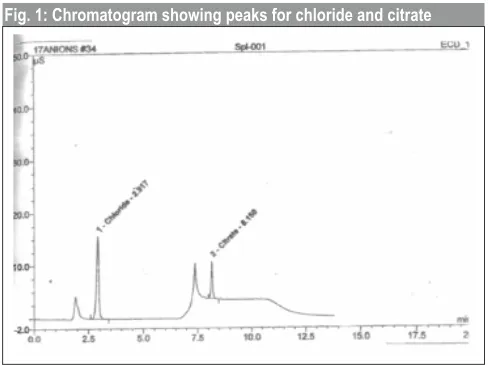
was tried but the citrate peak was broadened. Hence the mobile phase was changed to 40 mM NaOH which gave sharp peaks with optimum resolution. Initially isocratic mode was used but it could not resolve the peak of chloride and the dip so gradient program was selected. The retention time of chloride and citrate was found to be 2.9 min and 8.3 min respectively (Fig.1). The above method was validated as per ICH guidelines. In linearity studies, the method was found to be linear. The correlation coefficient was found to be 0.9995 and
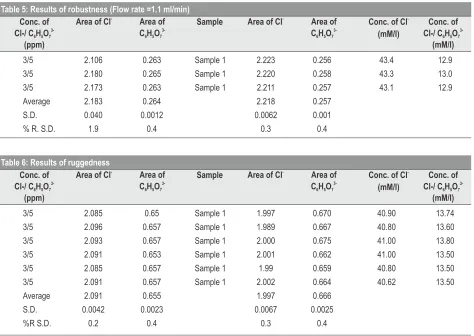
respectively for both chloride and citrate. In recovery studies, the sample was spiked with standard and % recovery of chloride and citrate was calculated. The method was found to be accurate. (Table 2). The method was found to be precise (Table 3). Table 4 and Table 5 show the result of robustness with respect to change in flow rate. The method was found to be robust. The ruggedness was tested by varying the analyst and the period of experimentation. The developed method was found to be rugged with the change in analyst and period of experiment (Table 6). The system suitability of the developed method was tested and was found to comply with the specifications.
CONCLUSION
An ion chromatography method was successfully developed for simultaneous estimation of chloride and citrate in ORS. The optimized ion chromatographic method was validated as per ICH guidelines and was found to comply with the specifications.
REFERENCES
1. Dollery C. Therapeutic Drugs. Vol. II, Churchill Livingstone, Edinburgh; 1991:24-8.
Conc. of
3-Cl-/ C H O 6 5 7
(ppm)
-Area of Cl Area of
3-C H O6 5 7
Sample -
Conc. of Cl (mM/l)
3/5 2.106 0.263 Sample 1 2.223 0.256 43.4 12.9
3/5 2.180 0.265 Sample 1 2.220 0.258 43.3 13.0
3/5 2.173 0.263 Sample 1 2.211 0.257 43.1 12.9
Average 2.183 0.264 2.218 0.257
S.D. 0.040 0.0012 0.0062 0.001
% R. S.D. 1.9 0.4 0.3 0.4
Table 5: Results of robustness (Flow rate =1.1 ml/min)
-Area of Cl Area of
3-C H O6 5 7
Conc. of
3-Cl-/ C H O 6 5 7
(mM/I)
Conc. of
3-Cl-/ C H O 6 5 7
(ppm)
-Area of Cl Area of
3-C H O6 5 7
Sample -
Conc. of Cl (mM/l)
3/5 2.085 0.65 Sample 1 1.997 0.670 40.90 13.74
3/5 2.096 0.657 Sample 1 1.989 0.667 40.80 13.60
3/5 2.093 0.657 Sample 1 2.000 0.675 41.00 13.80
3/5 2.091 0.653 Sample 1 2.001 0.662 41.00 13.50
3/5 2.085 0.657 Sample 1 1.99 0.659 40.80 13.50
3/5 2.091 0.657 Sample 1 2.002 0.664 40.62 13.50
Average 2.091 0.655 1.997 0.666
S.D. 0.0042 0.0023 0.0067 0.0025
%R S.D. 0.2 0.4 0.3 0.4
Table 6: Results of ruggedness
-Area of Cl Area of
3-C H O6 5 7
Conc. of
3-Cl-/ C H O 6 5 7
3. Satoskar RS, Bhandarkar SD, Ainapure SS. Pharmacology and Pharmacotherapeutics. 16th ed., Poular Prakashan, Mumbai; 1999:506
4. Remington in Remington's Pharmaceutical Sciences. 19th ed., Vol. I, Mack Publishing Company, Pennsylvania,; 1995:439-41
5. Weiss J. Ion Chromatography. 2nd ed., VCH Publishers, Inc., New York; 1995:1
6. Jeffery GH, Bassett J, Mendham J, Denny RC. Vogel's Textbook of Quantitative Chemical Analysis. 5th ed., Longman Scientific and Technical, England;1989:197-201.
7. Dionex, Product Selection Guide, IC/HPLC system, Sunnavale, CA; 1998:1-3.
8. Kealey D, Haines PJ. Instant Notes Analytcal Chemistry. Viva, New Delhi; 2002:169-70
9. ICH guidelines, Validation of Analytical Procedures: Text and Methodology, Q2(R1)Geneva;2005