Arrows Can Be Dangerous
John Monk
Communications and Systems, Open University, UK, [email protected]
Abstract: Arrow signs find use in professional fields and are a part of everyday practices. The application of arrow signs in scientific literature is briefly explored. A fragment of the arrow’s cultural history is outlined and identification of a family of arrow shapes confirms that arrow signs do not have a unique form. The broad arrow is introduced as a sign that has been used in disparate practices, illustrating that signs are embedded in social networks and showing a sign cannot be said to have a unique meaning and is informative or meaningful only when it has a role in a socio-technological system. Within a system a sign acts as a catalyst for a variety of relationships. To unravel some of those relationships an analytical frame-work proposed by Jakobson is applied to a variety of arrow signs. Jakobson’s functional categories show that practices incorporating signs are not under the control of the sign maker and occasionally a change in a sign’s use can transform an acceptable sign into one that provokes anger or brings ignominy. Such negative effects draw attention to the ethical dimen-sion of signs, or rather the ethics of the practices that encompass signs.
Keywords: Arrow signs, Semiotics, Poetics, Broad Arrow, English Law, Ethics
A familiar element of many signs is an image of an arrow. Signs incorporating arrow images are material artefacts that are intended to influence what people do, and a reaction to an arrow sign by a sign reader is both a product of a social convention that guides the reader’s specific response and a defining statement that sustains or alters a customary practice. Where sign readers respond we are inclined to say the sign is informative and conveys information, but a sign may fail to be informative if it does not gain the attention of a sign user, if the sign reader is unfamiliar with the conventions and practices assumed by the sign makers or if the sign reader has scant regard for the authority that the sign projects. Therefore, when sign makers want to create a new sign, they must attend to a sign’s saliency and the authority the sign displays but they must also establish a practice that incorporates the sign; a more practical option is to appropriate an artefact, such as the arrow, or image of an artefact that already has a customary use and recognisable qualities that, like a successful literary metaphor, catches on in a new context and has a desired effect on sign read-ers.
In the Philosophical Investigations Wittgenstein (1992, §454) sketched a picture of an arrow and asked “How does it come about that this arrow points?” He also posed the question so it could be applied to any sign, asking, “Doesn’t it seem to carry something in it besides itself?” and continued, “The arrow points only in the application that a living being makes of it”. Put another way, a picture of an arrow can be taken as a sign, but what it signifies, what information it provides, what actions it elicits are dependent on the individuals who encounter the arrow image and their customs and habits.
An effective sign, like language, requires established habitual use that aligns the sign makers’ expectations with the reaction the sign provokes. Consequently, the sign’s use is part of a prevail-ing tradition that helps to define a community of practice. To enter a coterie formed by, for example, chemists, engineers, painters or road users, individuals develop characteristic habitual uses of signs, often including arrow images, by informally mimicking others and experimenting or by under-taking a formalised apprenticeship.
Figure 1: Illustration from William Gilbert’s De Magnete of an instrument, an arrow-shaped versor-ium, and a diagram illustrating magnetic influences around a magnetised earthlike sphere (Gilbert
Arrow images crop up widely in scientific literature. In 1600 when bows and arrows were dying out as part of England’s armoury, a treatise on magnetism published by the Englishman William Gilbert included diagrams showing a number of arrow-shaped “versoriums”. The arrow sign on Gilbert’s magnetised versoriums indicated the direction of magnetic influences. One of his illustra-tions, reproduced on the left of figure 1, was accompanied by a description of how to make a ver-sorium implying the picture was an image of a constructed physical instrument that carried an ar-row sign. However, many of Gilbert’s illustrations like the one on right of figure 1 showed versori-ums schematically around magnetised bodies. These diagrams were not images of particular situa-tions or of collecsitua-tions of instruments, but summaries of several possible experiments and therefore a part of a theory. For example, the diagram on the right of figure 1 encourages speculation on how versoriums would be affected in as yet unexplored locations around the terrella. Thus arrow signs are found in different contexts some, like the physical versorium, to guide an immediate determina-tion of a state of affairs and others providing an element in the lexicons of theories that guide delib-erations on what could happen.
There have been studies of the use of arrows employed in diagrams in several scientific disci-plines. Schott, whose interests lay in cerebral functioning, saw the arrow in diagrams of the brain’s activity as “a remarkable symbolic device” (2000, 1789) and, he observed, “the use […] of this ele-gant symbol” is “often contentious” (Schott 2000, 1798) and, he acknowledged, arrows are de-ployed in diagrams without explanation or indication of their purpose (Schott 2000, 1796). Alvarez presented a host of uses of images of arrows in chemistry, from alchemy to the description of cata-lytic cycles and photochemical processes. He emphasised the radical differences in uses of the symbol, for example the differences in use of similar shaped arrows which are “horizontal, up-pointing, or down-pointing […] within a chemical equation” (Alvarez 2011, 599), and according to Heiser and Tversky (2006, 582), in diagrams of mechanical systems, arrows “express many rela-tions, among them pointing or connecting, sequence, change over time, path, or manner of move-ment or forces” as well as relationships between presumed causes and effects.
1.
The Honourable Arrow
Arrows have been a part of many cultures. Historical references might be taken from a number of sources from different parts of the world. In this paper my primary focus is on the literature of England and what were once its North American colonies.
The obsolescence of the arrow as an English weapon of war in the 1590s triggered a contro-versy. Supporters of firearms, such as Williams (1590, 41-43), set out to “proove Bow men the worst shot”; they reckoned weapons such as the arquebus were more effective than bows and arrows, though such claims have been challenged, for example, by Benjamin Franklin (1776, 170) who believed, “bows and arrows […] were good weapons, not wisely laid aside”.The advocates of archery adopted a moral stance; they argued archery was “wholesome for the health of the bodie” and exercised the mind “honorably” since in archery practice “a man always desireth to bee best” (R.S. 1596, B2). Archery, it was supposed, prevented “drunkennes and other evills” (Smythe 1590, A2) and was “a medicine to purge the whole land of all pestilent gaming” (R.S. 1596, at end of Part II). However by 1598 in London “the auncient dayly exercises in the long bow [… were] almost cleane left of and forsaken” (Stow 1598, 77) and it was these persistent lax attitudes towards ar-chery practice that made it impossible to assemble an effective body of bowmen (Esper 1965). By 1674 archery was “quite laid aside by English Men for fighting”, and although archery was “used by some for pastime” (Cotton 1674, 203), in his book of games Cotton gave only a brief treatment because, he explained, “it is so little used now adays” (Cotton 1674, 204).
Nostalgia for the Gothic and the medieval, towards the end of the eighteenth century, led to the resurgence of recreational archery by the English upper classes (Johnes 2004). Whittaker (1880, 60) reported on the “sudden and remarkable revival” of archery in England and attributed the de-velopment of the sport in the United States to Maurice Thompson (1877, 287) who eulogized bows and arrows by presenting them as “natural” weapons which were “to the mind and body what music and poetry are to the soul”; earlier Hastings (1831, 118), a North American, displayed similar sen-timents, describing archery as eminent amongst the “Fine or Polite Arts” and capable of increasing “social happiness”.
that through archery “our nacion in tymes past hath gotten […] great honour” (Elizabeth I 1591, 175), and late sixteenth century English supporters of archery reckoned that through archery their ancestors had made the nation famous with their “many miraculous victories” (Smythe 1590, A2).
Specific battles have often been singled out. Holinshed (1577, 1199) wrote an influential ac-count of the Battle of Agincourt and remarked on “the high valiancie of the English people, with the ayde of theyr Bowes”. The mythology persisted. Cecil Beaton (1942, 18), for instance, told of war-time pilots who practised recreational archery and described them as “champions of the most mod-ern of all long-range weapons [who] are adepts at the bow and arrow, through which the English archers won the battle of Agincourt”. More recently, A. A. Gill (2012, 51) wrote, “English archers have attained a mythic status down the ages” which he attributed in part to victory at Agincourt and another newspaper article opened with the assertion, “AGINCOURT. After nearly six centuries, it’s still a name that rings triumphantly in the English ear” (Hart 2009).
The arrow image thus records an obsolete weapon with a mythic, noble past kept in the English public consciousness by historical accounts, romanticized revivals and honourable legends such as the stories of Robin Hood already well known in the 14th century (Brockman 1983). The image of the arrow has therefore been transformed from that of a vicious debilitating weapon by an associa-tion with a gentrified sport and a glorified past to become an accepted and familiar component of public signs.
Figure 2: An urban scene in London in 2011.
Nowadays arrow images appear on signs in places such as airports (Fuller 2002) and everyday urban settings as figure 2 shows. And, it seems, they have a variety of uses and address a variety of audiences. What is immediately apparent about the arrows in figure 2 is that they lose their utility if they are moved. Location and orientation are constituents of such arrow signs.
2.
Shape
There is no single shape or outline that characterises an arrow. The collection of images from present-day signs shown in figure 3 illustrates a variety of shapes that would undoubtedly be called arrows. An element of the variety arises from the range of materials that make up these signs such as painted wood, chiselled stone, brass mounted on marble or enamelled or cast metal. Some of the variety is a result of the different tools available to the sign writers together with differences in their skills and available resources. Part of the diversity is also due to different sign writers’ inter-pretations of what an arrow should look like and therefore dependent on the exposure of the sign writers to other images of arrows either on signs or in historical illustrations, accounts or legends.
Figure 3: A collection of arrow images from signs photographed in publicly accessible places in England and Belgium.
There was, therefore, no single specific shape for an arrow consequently arrow images on signs belong to a family of shapes rather than being reproductions of a well-specified image. In spite of the variety, Moseley’s brief survey opened by stating, “[the] figure of the Arrow has undergone less variation than that of the Bow” and concluded, “Arrow-heads […] found in countries the most re-mote from each other, are all nearly alike in figure” (1792, 124). The similarity in shape of arrow-heads from many cultures and eras suggests that the images of arrows will be universally recog-nised.
Figure 4: St Ursula portrayed in stained glass in Antwerp Cathedral holding a palm leaf and an arrow as emblems of her martyrdom.
Images of arrows can be emblematic; for example figure 4 is an allegoric picture symbolizing the martyrdom of St Ursula who rejected the advances of a prince holding her captive, whereupon “he shote at her an arow and perced her thorugh the body” (de Voragine 1483, 337).
light staff” with “a thong fastened to the middest thereof”. He explained, “it pierceth speedily, and maketh a large wound, by reason of the wide-spreading barbs thereof.”
Figure 5: Images of arrows used as heraldic charges. The leftmost image is a barbed arrow second from the left is a broad arrowhead (Berry c1830) and the rightmost head is a pheon (Renton 1889).
The broad arrowhead shape found its way into the design of many present day arrow signs, commonly modelled on the form described in Guillim’s account of the pheon with a shaft and with-out fletchings. Figure 6 shows several such broad headed arrow signs which are clearly different from the shapes of arrows in figure 3.
Figure 6: Arrow signs modelled on the broad arrow head photographed in public places in the UK and Canada
Arrows intended for war such as the barbed arrow to the left of figure 5 required different char-acteristics to those used in sport. For instance, Ford (1856) recommended a straight sided arrow-head for recreational archery pictured in figure 7. This shape of arrowarrow-head has an outline that has influenced signs such as that shown in the image in figure 8.
Figure 7: A parallel sided arrowhead, or pile, for recreational archery attached to a shaft (derived from Ford 1856 Plate 5)
Figure 8: An arrow sign of similar shape to the parallel sided arrowhead with its shaft.
3.
The Broad Arrow
Arrow images on signs can have many different forms, and each form could have a variety of uses. English broad arrow signs, for instance, constitute a family of signs which exploit a particular arrow image. However on its own a broad arrow sign does not signal a particular use; there are a number of radically different practices that incorporate broad arrow images with each practice characterized by specific relationships amongst particular groups of actors.
3.1.
Uses of the Broad Arrow
The narrative in a popular novel, entitled The King’s Own, associated the broad arrow with the book’s title and explained: “The broad-headed arrow was a mark assumed at the time of the Ed-wards […] as distinguishing the property of the King ; and this mark has been continued down to the present day. Every article supplied to his Majesty’s service from the arsenals, and dockyards is thickly studded with this mark ; and to be found in possession of any property so marked is a capi-tal offence, as it designates that property to be the King’s own.” (Maryatt 1830, 22)
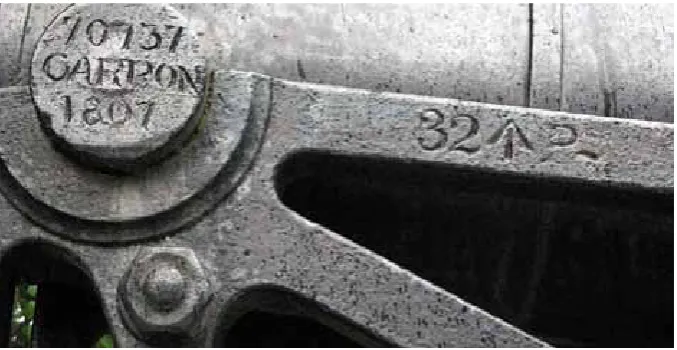
A great deal of recorded evidence supports this fictional account. For instance, figure 9 shows part of the carriage of a canon, one of several, overlooking the St Lawrence River in Quebec City. The broad arrow mark is readily apparent and the year of manufacture, 1807, is also inscribed. The canon barrel carries George III’s monogram.
Figure 9: A broad arrow mark to the right of the picture on a gun carriage stationed in Quebec City.
under the heading “BROAD ARROW” Stone (1934, 150) confirmed, the arrow was “still used to designate the property of the British navy”, and in a 1987 revision of a 1984 standard, the British Ministry of Defence issued guidance for marking military materials with marks described as the “‘BROAD ARROW’ OR ‘PHEON’” similar in shape to those in figure 10. (MoD 1984, 27).
Figure 10: Broad arrows drawn to meet the proportions defined by the British Ministry of Defence Standard 05–34/2 (MoD 1984 27).
For archaeologists the broad arrow is a potential symbol of past practices and relationships. One archaeological investigation of a sunken ship, for example, found “numerous loose copper artefacts [... and f]ragments of detached copper sheets […] marked with the English broad-arrow” (Tomalin, Simpson, and Bingeman 2000, 7-8). The archaeologists concluded that clearly the ship was an English Navy vessel and that it would have been more difficult to determine the ship’s na-tionality without the evidence of the arrow markings (Tomalin, Simpson, and Bingeman 2000, 9).
As well as the broad arrow marking goods bought for the King, Pepys (1926, 307) mentioned marks on goods that belonged to the King which had been recovered and goods “forfeited to him as at the Custom House”. Similarly, in the fifteenth century, according to Welch’s (1902, ix) history of the London Company of Pewterers, “All bad ware or metal was marked with the Broad Arrow-head” and, Welch added, “it was doubt-less the fate of all vessels marked with the broad arrow to be forfeited and melted down without delay” (Welch 1902, 47). Evidence comes from the Com-pany’s records which, in the inventory for 1489–1490, mentioned an iron punch with “abrode arowe hede grauyn therin” (Welch 1902, 69) and an entry made in the year 1564–65 refers to the “mend-ing the Brode Arowhede” (Welch 1902, 249). A delivery note issued dur“mend-ing 1474–1475 revealed the purpose of the punch by describing it as having a “brode arowe hede fore the forfet marke” (Welch 1902, 47).
Records also show that at one time English sailors detaining vessels on behalf of the monarch marked a ship’s mast to signal the arrest. For instance, on April 17 1633 a gunner and a Mr. Smith arrested two merchant ships. The crew “suffered Mr. Smith to mark the broad arrow upon the mainmast”. Alas the crew refused to surrender the apprehended ships’ sails and “[t]he next day the two East India ships slipped their cables and anchors and made sail” (Tourney 1633, 22), thereby thwarting the arrest. A similar event occurred in 1693 when ships were commandeered for military service; an official account referred to the broad arrow as the “Broad R” and noted that the Victual-ling Commissioners “finding a want of shipping to supply the Fleet with beer […] took up such ships in the river as were ready and fit for that service; but after having set the Broad R upon them they have gone away and declined the service” (Guy 1693, 219). In another case, in 1696, an officer of the Excise Commissioners “set the broad R upon the copper” of a brewing vat when the impecuni-ous brewer was unable to pay a demand for excise duty (Treasury 1696, 222).
The broad arrow also found use in reserving timber in forests. For instance, in 1667 an Act of Parliament demanded that two or more Justices should assess the maturity of trees in the Forest of Dean and if they reckoned a tree was fit for felling they should mark it “with a broad Arrow and Crown” (19 & 20 Cha. 2 c.81
In another context, Augustus Such (1841, 11) described the uniforms prisoners wore in Millbank prison that were conspicuously “stamped on the arms, back, and legs with B. O. and the broad arrow […] in white paint”. He was puzzled because he believed B. O. and the broad arrow were ), however in 1772 in Sherwood Forest where similar rules applied it was reported that three defiant verderers “would not regard” the broad arrow marking the trees “for his Majesty’s use” (Wither 1722, 143).
1
marks for Board of Ordnance property. Later, an unknown convict also wrote about Millbank pris-oners’ uniforms, which were then covered with “hideous black impressions of the Broad Arrow , the ‘crow’s foot’” (Anon. 1878, 68). After transferring to Dartmoor prison the same felon worked on new prison garments and “marked them with the broad arrow, stamping them all over in regular allotted places […] with black paint, and […] with red” (Anon. 1878, 307). Another internee, John Mitchel (1854, 57) described the occupants of a prison hulk he encountered during his enforced odyssey as “men in white linen blouses and straw hats — and on the back of every man’s blouse […] the queen’s broad arrow”. In 1846 an issue of the Illustrated London News depicted prisoners attending a chapel aboard a prison hulk with arrows printed on their shirts (Anon. 1846) and over fifty years later a photograph, in another edition of the same periodical, depicted prisoners from Portland Prison in church with large broad arrows marked on their clothes (Anon. 1910).
Cartoonists who wanted to portray convicts or wrong-doers adopted the broad arrow image stamped on prisoner’s clothing. For instance, the cartoon in figure 11 caricatured a convicted con-tractor who supplied shoddy goods and unpalatable rations to the army and who is complaining about prison food. Similarly in a written satire the writer alluding to the criminal practices of some builders wrote about them as “Certain gentlemen who have since been awarded the decoration of the Broad Arrow” (Anon. 1895).
Figure 11: An extract from a cartoon identifying a convict wearing a uniform covered in broad ar-rows (Sambourne 1910).
Figure 12: On the left a metal benchmark in the village of Beaulieu. On the right a benchmark cut into brick on the side of a house in Buckingham.
Technological change in map making has rendered bench marks redundant but they can still be found on buildings and boundary posts. Figure 12 gives two examples. Both benchmarks show clearly the Ordnance Survey’s signature of the broad arrow with a horizontal line above the arrow defining the height relative to a national reference. The broad arrow identified them as authorised bench marks with entries in the national index.
Clearly, the broad arrow mark has had a variety of uses and could identify royal goods, secern fine trees, mark an arrest, signal the commandeering of a ship, denote a forfeit, identify the author-ity behind a benchmark or differentiate a convict in person or as a caricature. The shape of an ar-row image alone, therefore, does not uniquely establish how a percipient is expected to respond to a sign.
3.2.
Origins
Over many years correspondents to Notes and Queries posed the question “What is the origin of the arrow head as a government mark?” (Anon 1851). One thesis, which the claimant admitted lacked supporting evidence, was that an “Arrow shot would formerly give the limit of dominion to kings’ rule. Hence possibly the mark of the broad arrow. Everything so marked would show that it lay within royal authority and protective rights.” (Ward 1884). As an alternative, the respondent P.C.S.S. (1851, 371-372) presumed the “broad arrow” on government stores represented the “Pheon” adopted from the arms of Henry Sydney who, around 1700, was Master-General of the Ordnance. Bradridge (1925, 283) repeated that claim and added that Henry Sidney on “finding that Government stores were being stolen […] caused the pheon to be stamped on the stores”.
Although it was commonly referred to as a broad arrow, the simple shape of the “king’s mark” has been speculatively traced to other named forms and artefacts. One writer suggested the mark might be “traced back to the mysteries of Mithras” but admitted that this was “merely thrown out as a conjecture” (J. M. 1852, 116). A different suggestion was that the broad arrow had a “Celtic ori-gin; and that the so-called arrow may be […] the broad [letter] a of the Druids” (A.C.M. 1851). This proposal got support from a later contributor who maintained the broad arrow was “derived from an ancient Cymric sign called the three rods or rays of divine light, which signified the radiating eye of divine intelligence shed upon the Druidic circle” (A.F. 1925, 153).
The English Admiralty employed the broad arrow and this puzzled Samuel Pepys (1926, 311) who wrote, “had our Princes valued […] their sea doings and sea power, they would have taken their public brand, especially that which was to serve them in sea matters […], from some thing really relating to that element rather than to an arrow-head”. He felt the symbol could be a roughly drawn anchor but accepted the wording of the English laws which identified it as a broad arrow.
Harris (1914) suspected the broad arrow mark was modelled on an image of a gallows in the form of a tripod. He cited Robert Ward as the source of this proposition. Ward offered advice to soldiers and wrote, for instance, about preventing the theft of tools such as “Iron-shovels, Mat-tockes, Pick-axes, Axes, Hatchets, Hookes, Plants, Boordes, Hurdles, Mandes, Baskets, Wheele-barrows” and so on which, he considered, “ought to be marked with the Gallowes” and, Ward added, “hee that steales them dyes without mercy” (Ward 1639, 108). Later in his book he advised, “Amunition, with Axes, Mattockes, Spades, and the like to build their Hutts withall; these instru-ments are to have the marke of the Gallowse set on them, in token of death to them that steale them” (Ward 1639, 200).
Whether or not the gallows or the anchor are alternative names for the English monarch’s broad arrow or whether or not it is modelled on an arrowhead is not entirely clear, but Ward made the crucial point that it is useful to have a distinguished mark to prove that someone has appropriated military goods. A symbol other than an image of an arrowhead could perform the same functions.
Speculations on the form, origins or name of the broad arrow symbol did not affect its various uses but those speculations do emphasise a degree of arbitrariness in the adoption of an arrow image as a symbol. Superficially the origins are unimportant. Functionally all that was required to support each use of the broad arrow was a distinctive sign and provided people were educated in the uses of whatever symbol was chosen the sign would fulfil its function. However it is clear in the protracted correspondence in Notes and Queries that people yearn for a story to tell and wish to use symbols that have a history, and for some uses, in for example archaeology or satire, a history is essential.
3.3.
Duration and Support
Since the image of the broad arrow does not bear an obvious connection with its various uses, on occasions authorities advised potential sign makers and readers of the practices surrounding the arrow’s application. For example, the British Ministry of Defence standard implied that marking goods with a broad arrow provided a “psychological deterrent to theft” and therefore was to be “used on items of an attractive nature if it seems likely that the marks would deter theft” (MoD 1984, 26). Similar sentiments were revealed in an early series of English decrees, bills and laws. In No-vember 1661 during Charles II reign, a proclamation about the discovery and punishment of the embezzlement of Navy stores required certain of the King’s goods to be marked with the broad arrow “by Stamp, Brand, or other Way” (Charles II 1661, 2). Faced with continuing pilfering, William and Mary (1693) issued a proclamation “For the Preventing of the Stealth and Imbezilment of Their Majesties Stores of War” and announced goods were to be marked with “the Broad Arrow, by Stamp, Brand or otherwise”. In 1697 an Act was passed which required “Warlike and Naval or ord-nance Stores” to be marked with the broad arrow (9 Will 3. c.41).
A further series of laws reiterated the obligation to mark Royal goods with a broad arrow. Under George I in 1722 an Act included clauses on “the Preservation of Naval Stores, and Stores of War” (9 Geo. 1 c.8) and in 1800, during George III’s reign, a similar Act was passed which referred to “Naval, Ordnance, and Victualling Stores” (39 & 40 Geo. 3 c.89). An Act of 1815 extended the marking “to all other public Stores” (55 Geo. 3 c.127) and Queen Victoria’s parliament introduced a Public Stores Act in 1875 that, with few exceptions, required the State’s stores to be marked with a crown, the royal arms or a broad arrow (38 & 39 Vict. c.25).
In the twentieth century, a proposed Government Marks Bill attached to a note from Winston Churchill, Secretary of State for War included a schedule reaffirming the broad arrow as a valid mark of state property (Churchill 1920). Thus the practice of marking goods with a broad arrow was established by English law by a succession of attempts to curb theft. The mark did not simply de-clare something to be the King’s property in the absence of a crime but ensured there was evi-dence indelibly linked to an object when a theft was alleged. The explicit connection with the Crown made it clear that there were likely to be agents seeking thieves and if a theft was discovered then punishment would ensue. Marking the goods with a well-known mark, it was hoped, would then discourage theft, though current views on deterrence and crime challenge the effectiveness of such measures (Paternoster 2010; Wikström, Tseloni, and Karlis 2011)
3.4.
A System
If the unauthorised trading of military and latterly public goods, was to be prevented, the broad arrow had to be placed on goods by manufacturers who required suitable tools or manufacturing equipment. For instance, in 1844 the King of Saxony during a visit to the naval works in Portsmouth witnessed the machinery that imprinted marks on copper sheathing. He “observed how the metal is melted, how it is then flattened out by means of rollers, and how the last roller impresses on it in every part the mark of all the property of the royal navy — the broad arrow: so that one can see upon every little bit of copper that it has been manufactured in a royal arsenal” (Carus 1846, 52).
marks and criminalising the possession of “dies or other appliances by which the marks in question could be produced” (Churchill 1920).
A mark such as the broad arrow on a canon was, therefore, an instrumental part of an extensive socio-technological system embracing a variety of practices such as law making, manufacturing, machine fabrication and the exercise of techniques for imposing authority such as the detection of fraud and theft and effective punishment regimes. Nefarious schemes for evading authority were also enmeshed in the same system by an interest in the appropriation, application or removal of the broad arrow. Accordingly broad arrows marking property bound together radically different ways of life and connected their practitioners including thieves, those tempted to steal, manufacturers, law makers and enforcers. However the broad arrows identifying Ordnance Survey benchmarks en-gaged different people, different skills, different equipment and established different relationships from those engaged in upholding a monarch’s property rights. Thus the broad arrow was a compo-nent in several loosely connected systems offering different social functions and embracing differ-ent sets of practices. The particular shape of an arrow symbol was therefore not associated with a particular institution, system, group of participants or set of objects, and radically different uses could arise in different geographical places or with different groups of people; for instance, Richardson in describing his travels in the Sahara wrote,“the camels have all public and private marks, the former for their country, and the latter for their owner, and, strange enough, the public mark of the Ghadames camels is the English broad R. So when a camel is stolen, a man claims his camel by his mark” (Richardson 1848, 420).
However the Ghadames people were not a part of the English system and their use of the famil-iar symbol for an apparently similar purpose to the King’s mark was coincidental and defined by their own practices and cultural developments.
Uses of the broad arrow demonstrated that it is the activities of the participants within a system that established particular functions of a sign and a particular form of sign can be part of several separate socio-technological systems.
3.5.
Emotional Impact
The deterrent effect of the broad arrow on state property relied on the fear of being caught with marked goods. Signs can, therefore, stir emotions. It has also been noted that “the prison uniform with its broad arrows [was] intentionally demeaning and unsightly” (Edwards and Hurley 1981). Convicts were humiliated by wearing the “grotesque garb, dotted all over with broad arrows” (Bal-four 1907) and in 1922 the Prison Commissioners hoped the new and simple clothing without a broad arrow would “give a better chance to self-respect" when they announced “Broad arrows [… were] being removed from the outside of prison clothing” (Prison Commission 1922).
The repercussions of using the broad arrow in the forests of the British North American colonies were far reaching for the colonialists for whom the broad arrow became a sign that aroused anger and resentment. In 1629 a Charter was issued to govern the affairs of the Massachusetts Bay col-ony; it licensed fishing and permitted the settlers to “cut down, and take … Trees and other Materi-als” (Charles II 1629, 25). William and Mary (1691) issued a second Charter which added a new provision for “the better provideing and furnishing of Masts for Our Royall Navy” that removed ear-lier rights and restricted the cutting of large trees. In pursuance of this new Charter, English gov-ernment officials marked large standing trees to indicate they were the Monarch’s property with “the “Broad Arrow” — the old sign of naval property, shaped like a crow’s track and made with three blows of a marking hatchet” (Albion 1926, 241).
The new Charter regulations proved ineffective and the Surveyor General complained, “every-one [was] going into the woods in defiance and cut[ting] what they please” (Bridger 1710, 19). An Act of 1710 put into law the delegation of authority to the Surveyor General or his officers to mark “with the broad arrow all such trees as now are, or hereafter shall be fit and proper to be taken for the use of her Majesty’s royal navy” (9 Ann. c.22). This Act also recognized some settlers had ap-propriated the broad arrow symbol and whatever authority it carried; for example, the Surveyor General alleged, “some ill men have this last winter gone into the woods and marked all trees be-fore them, those trees fitt and unfitt for masts, with the Broad Arrow […] and when theire neighbours come into the woods to get loggs for boards etc., they seeing all the trees marked im-mediatly returned, thinking that I had ordred the marking” (Bridger 1708, 169).
peo-ple would refer to the “privileges of the Charter” consequently “the Charter is allways peo-pleaded and the reservation for H.M. Navy is null’d” (1718a, 308). Bridger (1711, 524) earlier explained, “H.M. can never hope of any justice here, where judge and jury are offenders”. He observed therefore “’tis in dispute whether H.M. has any woods in this governmt or no” (Bridger 1718b, 311).
Also some cunning schemes exploited the letter of the law. For example, the regulations al-lowed the felling of trees within the townships but Armstrong (1720, 231) reported “the people […] have taken in thousands of acres wherein the best timber grows, and form the same into their townships, tho’’ the thousandth part thereof is not under any immediate improvement etc”. There was a straightforward disregard of the legal prohibitions (Armstrong 1722), some evidence the government agents were bribed and criticism of the drafting of the legislation (Armstrong 1721).
A new law in 1721 imposed more stringent penalties on those cutting trees and those transport-ing them without permission. It also allowed conviction in an Admiralty Court on receipt of “Informa-tion, upon the Oath of one or more credible Witness or Witnesses” with one half of any proceeds going to the informer (8 Geo. 1 c.12)I. It seems this added to the confusion between the “Charter which obliges us to try it at common law, and in the act […] wch. only prohibits cutting trees without townships wch. we are to try in the Court of Admiralty” (Dunbar 1729, 472).
Complaints from the officials continued, in some instances they were confronted by violence and the impossibility of imposing the law when the “owners of mills were [also] magistrates and officers” (Dunbar 1734, 92). The settlers too were aggrieved, partly because in the trials in the vice admiralty courts could be carried out without a jury (Surrency 1967). The Surveyor General felt the naval jurisdiction was ineffective and declared, “As to the woods, my deputys and I meet with so much discouragement from the Judge of Vice-Admty. as encourages the loggers, who treat us with scorn” (Dunbar 1732, 200).
In New England, the broad arrow came to signify oppressive policies and provoked wide-spread discontent, which was compounded by “the added oppressions of the last decade before the Revo-lution” (Carlton 1939, 11), and as a consequence of the impotence of the King’s agents in the colo-nies the “importance of […] the king’s “broad arrow” was probably more symbolic than real” (Tolles 1954, 6). That is the broad arrow failed as a deterrent and became a provocative emblem of an unappealing government.
In addition to limiting rights over timber, in 1765 at a time of economic hardship, the British gov-ernment passed the Stamp Act, which infamously imposed additional taxes on the American colo-nialists. An American newspaper recorded the feelings of the colonialists and announced, “it mani-festly appears to be the unanimous sentiment of all his Majesty’s free and loyal subjects throughout his extensive dominions in America, that the STAMP ACT is not legally binding on them” (Anon. 1765). The Act was repealed a year later and the politicians of the time were lampooned in a num-ber of cartoons. In two of these cartoons, The Great Financier (Hawkins 1883, BM 4128 1765) and Goody Bull (Hawkins 1883, BM 4142 1766), amongst the caricatures goods lay on a dockside marked with broad arrows, probably to represent the produce of Britain that the colonialists had boycotted. The broad arrow thus found a new use in the rhetoric of political satire as a symbol of Britain or more specifically the British government and was aimed at amusing and informing the public and discomforting politicians.
3.6.
Summary
The diverse applications of the broad arrow symbol illustrate that a symbol alone does not carry a specific meaning or imply a specific use. It is the customs and habits of users and abusers that set out specific practices that employ signs such as the broad arrow. Since customs and habits can be localised and fade with time so particular uses of, for instance, the broad arrow may only be prevalent for a limited period or within a particular cultural setting or geographical area.
Each application of the broad arrow engaged many people pursuing a variety of ways of life. A sign, such as the broad arrow, therefore is instrumental in the formation of a social network drawing together many individuals and practices. Sign making for example is an enterprise that requires a sign to be commissioned, designed, constructed, installed, maintained and authorised all of which may be taken on by an individual or, as with the broad arrow, furnished by an extensive network of individuals. A sign can therefore bring together many individuals and sustain a network of relations that, as with the North American use of the broad arrow sign on trees, are asymmetric.
4.
Analysis
other parts of the system. Commonly a sign provides connections between participants and con-nections between participants and objects and therefore an image of an arrow can play a part in forming relationships which may be many and varied. Relationships in sign systems have com-monly been partitioned and reduced to a set of functions attributed to signs. Jakobson (1981) iden-tified six types of functions of language, which can also be applied more generally to signs and the relationships they engender (Monk 2011). Notably, Jakobson introduced a poetic function which can accommodate the emotional responses of, for instance, the readers of broad arrow signs.
All six of Jakobson’s functions are active in every situation where a sign is experienced though in different situations, with different signs or different people, the relative dominance of the func-tions can differ. The funcfunc-tions and their effects are also a product of a situation as well as the par-ticular sign makers and sign readers. This implies that any general statements that are made by a commentator about the functions of particular signs (including statements made in what follows here) are speculative.
4.1.
Referential Function
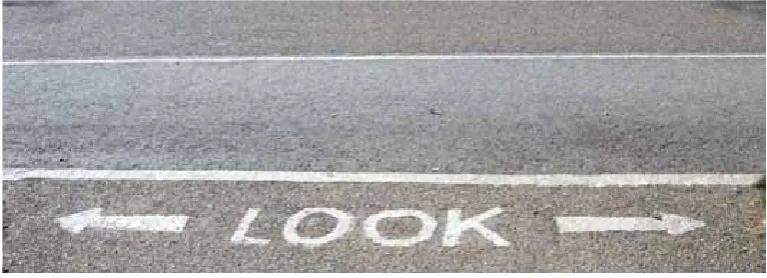
The referential function of a sign reveals what the sign is about. It centres on what a sign mak-ers expected sign readmak-ers to do, but, of course, sign readmak-ers’ responses do not necessarily match up to sign makers’ expectations. The referential function can therefore be asymmetric with the ob-verse of the referential function recording the place of the sign in sign readers’ ways of life. Figure 13 shows a sign where the expected action is made explicit. Sign readers should be in no doubt that they are expected to look both ways. Of course, the sign does not give any reasons for looking nor an indication of what to look for. These are assumed to be apparent to sign readers, who will relate the practices they are engaged in to the sign and its surroundings.
Figure 13: A sign with a clear statement of the sign writer’s expectations.
For the English monarchy, the referential function of a broad arrow rested on the presumption that an object marked with the broad arrow would be taken to be the monarch’s or the state’s prop-erty and that the marked object would only be used in practices authorised by the king or queen. However the referential function could be appropriated by others, for example, counterfeiters might have hoped and expected others to be fooled into recognising the forged mark as an authentic sign indicating marked objects were the property of the King or Queen. And Maine woodsmen, whose sign readers were neighbours, adopted the sign to exploit the complementary referential function that indicated the marked object was not available to their neighbours and should be left alone. The woodsman effectively exploited the system of deterrence provided by the king’s agents.
Agents of the Ordnance Survey put a broad arrow alongside each fiducial mark so surveyors would recognise the benchmarks as authorised indications of level. People who were not surveyors would know to leave the sign alone. By inscribing the broad arrow on manufactured goods, an authorised manufacturer signified a commitment to give up any claim to the goods and transfer ownership to the Crown and in prison the referential function of the broad arrow on clothing identi-fied people as convicts who were expected to behave as convicts and be treated as convicts by others.
4.2.
Expressive Function
The expressive function articulates something about the sign makers or some aspect of the sign making enterprise. Corporate logos are dominated by their expressive functions. For instance, the retailing company Amazon has a logo that incorporates an arrow with a curved shaft in the shape of a smile pointing from the first a in the company’s name to the z which the company claimed, emphasised “that Amazon.com offers anything, from A to Z” (Amazon.com 2000). A sign may also reveal something about the skill of the sign writer. Figure 14 shows a rudimentary sign hastily drawn. It probably indicates the sign writer was short of time and was limited by the materials to hand.
Figure 14: Hastily drawn arrows on a sign in London
A single broad arrow would reveal very little about an English monarch. A sovereign would delegate the minting of broad arrows so individual signs reflected something of the individual worker’s approach to sign making. The monarch’s attitude would be revealed in the collection of all arrows inscribed under regal authority together with the laws, proclamations, the existence of agents to police use of the arrow and punishments for particular actions. Rulers expressed them-selves in the whole sign system. The existence of the broad arrow system suggests the regal au-thorities mistrusted their subjects and the geographical extent of the objects marked with the broad arrow was an indication of the monarch’s reach. Since a king would project his wishes through a system of signs, punishments and detection, the brutality of punishment and zealousness of the policing would be signs of the monarch’s emotional orientation. For the monarchy the broad arrow system was a statement about Royal rights and the declarations and laws expressed intolerance to infractions.
While the sign might be taken to stand for ownership by the king, the relationship with the King or the King’s representative would depend on those encountering the sign and where they were situated. For the American colonialists, the authority that accompanied the King’s mark was ques-tionable but for an honest citizen in London the sign was an expression of a powerful regime. For the dishonest in London the broad arrow was probably recognised as a sign of an authority that could, with cunning, be evaded. Thus what the sign expresses about the authors of the sign de-pends on the individual sign readers, their practices, their locale and their personal history.
The Ordnance Survey had its agents who cut or cast benchmarks. The neat workmanship and uniform arrow symbols offered a public face of a well-regulated organisation. Obsolete benchmarks do not require maintenance but their state of disrepair might reflect on the agency that installed them and could tarnish its reputation; for instance, if a passer-by mistakenly believed the sign re-tained a functional role or had views on preserving a map-making heritage. That is, views on the organisation projected by the sign are partly a product of the sign readers’ beliefs about the sys-tem. For instance, for the owner of property sequestered and marked by royal agents, the arrow may have signified an authority that was efficient in fulfilling its obligations, an authority that set challenges or one that made mistakes; the conclusion would have determined, for example, in the case of a ship’s arrest, whether to abscond with the arrested ship or to surrender.
4.3.
Conative Function
The conative aspect of a sign grabs the attention of sign readers and in many cases selectively addresses specific groups. It ensures those who are to be addressed notice the sign and those who are not be addressed know the sign is not a trigger for action by them.
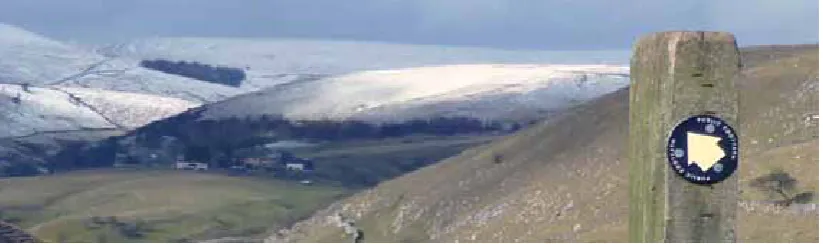
Figure 15: The colour of the arrow makes it stand out.
The picture in Figure 15 includes a yellow arrow sign which is prominent because of its colour and its position on a post. By convention in England, the colour indicates that the arrow is pointing to the route of a footpath (Ramblers 2012) and therefore the sign addresses walkers and not mo-torists, cyclists or horse riders. The prominent position and colour provide the conative function but only those who are familiar with the colour convention will grasp its full significance.
The conative function of a broad arrow relies on the distinctive shape, the symbol being in a prominent place and in a place where the arrow cannot be confused with other functional parts of the object it marks. The Defence Standard on marking goods, for instance warns that an arrow marking goods “should be so positioned that it does not point in a direction which could be con-strued as indicating the direction of rotation of instrument pointers, direction of flow of liquids or gases, or direction of movement of mechanical parts” (MoD 1984, 26) and so muddled with arrows used in other sign systems and their related practices.
Fellers in colonial North America, as part of their trade, would have learned to look out for the broad arrow sign and those policing the sign would certainly have been familiar with it.
In prisons the purpose of adding the arrow was to make it clear someone was a convict so the arrows on the clothing would have been bold and the clothing distinct from any other patterned garment.
4.4.
Phatic Function
The phatic aspect of a sign encourages the formation of connections between separated signs so they are taken as one sign. Figure 16 is a sign spotted in a hotel corridor. It has two major com-ponents. To the left the up and down arrows are united by their similar styles which are distinct from the style of the third arrow. The pair of arrows together with the box containing the two figures are commonly taken to be a sign for a lift/elevator with the up and down arrows indicating the up and down movement; this is the grammatical object of a graphical sentence. To the right and on the same substrate, is a second upward pointing arrow which, in this case, gives a clue to the loca-tion of the actual object, the lift/elevator that is beyond the sign and by convenloca-tion along (not above) the corridor. The rightmost arrow acts as an imperative verb. In this case the phatic function is provided firstly by the sign’s substrate which unites the sign’s components. Secondly, the loca-tion is implicitly part of the sign and the single upward pointing arrow would lose its utility if the sign were moved, so the sign is bound to its location by being screwed to the wall. Thirdly, the relative positions of the sign’s implicit subjects, the readers, matter; for instance they must face the sign for it to be of use; as a result the phatic function is dependent on potential sign readers’ relative posi-tions and their individual desire to find a lift/elevator. The arrows on the sign in the centre of figure 16 are all of a similar style and the phatic function binding the two arrows for the lift/elevator is achieved by their juxtaposition and enclosure.
sign and those who are not. Such recognised cross-references between numerals on the sign in the street and on buses also form phatic functions.
Figure 16: On the left is a sign composed of two distinctive parts bound by the common substrate. The sign in the centre uses arrows with a similar style to one another. On the right is a sign
provid-ing a link to specific bus numbers.
As a mark of royal property, the broad arrow was inseparable from its substrate; a tree, a plank or a canon barrel, for example. The broad arrow symbol was therefore bound physically to the pro-prietary object. The significance of a specific arrow was therefore related to a specific object. Strictly, removing the arrow does not change the status of the object nor does transferring it to an-other object however in practice skilful attempts at destroying the phatic function would remove any identification and more than likely cause a de facto transfer of ownership. A broad arrow provided the connection between an object and the royal authorities. The phatic function of the arrow there-fore included a binding between the broad arrow and the King’s authority relayed to sign readers probably by scant direct experience and accounts and rumours of incidents which could in some instance be fabricated and therefore be in the form of moral tales. Self-identification with the char-acters in the tales and the attitude towards the emblematic sign readers in those tales potentially influences an actual sign reader’s perception of the sign’s phatic function.
The Ordnance Survey’s broad arrow and its accompanying survey line are physically bound to-gether by their common substrate. The broad arrow also indicates that data about the survey point is held in an official index. That is the arrow announces or binds the survey point with a volume of data held elsewhere. Specific data for a particular benchmark is indexed according to the position of the benchmark thus the locations of the benchmarks are part of the sign system and the immo-bility of the benchmarks’ substrates is an important ingredient of the sign system.
The binding of the convicts to the broad arrow was simply provided by the prisoner wearing marked clothes. Prison rules, prison discipline and the lack of an alternative secured the garments in place on the prisoner’s bodies.
In all cases, physical arrangements and symbols give hints on bindings but an association ulti-mately is recognised by those who read the signs; that is bindings are themselves symbolised, for example, by juxtaposition. The broad arrow, it could be argued, was dominated by its phatic func-tion which for sign readers connected an object with an authority.
4.5.
Meta-lingual Function
Figure 17: A piece of a map of Venice with an arrow showing the orientation of the map (Anon. 1886)
However without such meta-lingual elements anyone unfamiliar with the mark, for instance on pewter work would be ignorant of what to do if they noticed it. In effect it was the laws, proclama-tions, accounts of events, observations rumours and gossip, or in the case of a pewter craftsman an apprenticeship, that provided the meta-lingual elements that familiarised people with the use of the broad arrow. Thus declarative practices surrounding the sign system create meta-lingual cues.
4.6.
Poetic Function
A poetic function accommodates the resonances that words, shapes, colours and arrangements on a sign have with similar words, shapes, colours and arrangements in other settings — reso-nances that provoke responses and create tensions with the responses invoked by other functions of the sign.
The sensual image of a situation can on occasions be seen as an invitation to action. Thus a sign gains its power by modifying a situation to arouse (or inhibit or regulate) action in particular ways. Objects, artefacts, shapes, symbols, words, colours and signs have affordances, that is they invite specific reactions. They have a history of literary, semiotic and physical use which can infect new uses. For example, arrow signs and the word arrow are infected by the shape, properties, history and tales and uses of physical arrows. An element of a sign that comes with a rich set of affordances, such as an arrow, can present what might otherwise require an arrangement of sev-eral graphical or verbal elements just as a literary metaphor can express what would otherwise be tedious, cumbersome or impossible to state. However, a rich set of affordances can generate am-biguity and confusion when it is unclear to the sign reader which affordances to adopt. Figure 18 shows two diagrams taken from a single plate in a paper by Faraday where various arrows with a similar appearance have different uses and belong to different systems of signification. The meta-lingual clues given in the accompanying text, in this case, disambiguate the arrows’ roles.
Figure 18: Two diagrams taken from a single plate in a paper by Faraday (1834).
edition of the King James biblical apocrypha emphasises that a plague will not return by creating a comparison with an arrow which when “shot of a mightie archer returneth not backward” (Esdras 1996). Arrows also evoke sensations of movement at speed as when Andrewe (1527) describes an eagle’s descent to pluck a fish from water as “swyft as an arowe out of a bowe”. Sureness is al-luded to in the Fletchers’ company motto — “true and sure” (Sanders-Hewett 2004, 11). Direction-ality is also exploited in the use of images of arrows. Figure 19, for example, is a part of a hydraulic system that is described in a paper by Charles Babbage. In the paper he did not mention the arrow; he takes it for granted that readers will be aware of the arrow’s affordances and interpret the arrow as indicating both movement and the direction of flow of water in the pipe.
Figure 19: A part of a hydraulic system with an arrow showing the direction of flow (Babbage 1826).
Figure 20: An arrowhead on a lightning strike warning of the danger of electrocution.
Other references use the wounds inflicted by arrows as similes, for example, likening the hbouring of an insult with “an arrowe that sticketh in a mans thigh” (Ecclesiasticus 1996). The ar-row’s capability to harm is also metaphorically exploited on the sign in figure 20 warning of the danger of electrocution.
The poetic function introduced by Jakobson operates in the space offered by the variety of ways of materialising referential and other functions. After fulfilling the other functions of a sign, for ex-ample, ensuring a sign commands the attention of the intended audience and withstands its ambi-ent conditions, sign makers can inject individual preferences bounded only by the available space, tools, skills and materials. As Pepys remarked, the admiralty could have chosen an anchor rather than an arrowhead or even kept the broad arrow symbol and called it an anchor.
Figure 21 illustrates the choices sign makers have. The figure shows three serviceable weather vanes with identical referential functions but with different shaped indicators; one is fish-shaped and therefore offers a poetic function provided by a metaphorical connection to imply a direction, which differs from the metaphor provided by the arrow shaped vanes that connect the wind with the forms of arrows in noiseless flight — some with more grace than others. For some purposes a manicule, a pointing fist, is an alternative to an arrow or arrowhead. Manicules are found in medie-val documents (Sherman 2005) to highlight parts of texts and as figure 22 shows there are continu-ing uses for manicules on signs indicatcontinu-ing directions.
Figure 22: Finger post directing walkers, cyclists and horse riders. (Buckinghamshire, UK)
Since there are options, sign makers can choose the forms that are appropriate to the practice that the sign belongs to. Thompson (1878, 10-11) demonstrated that literary choices can be good or bad — apt or inappropriate. He gave a list of similes and highlighted their durability as poetic elements writing, ““Sharp as an arrow,” “Swift as an arrow,” “Straight as an arrow,” “The shafts of envy, love, hatred, or revenge”, etc., are expressions as common to the verse-makers of our own time as to those of Pindar and Homer”. He then took exception to other examples which did not refer to arrows and therefore had different affordances which he considered rendered the similes and metaphors distasteful. He argued, “Straight as a ramrod,” “Swift as bird-shot,” “The buck-shot of envy,” or “The cartridges of malice” would be thought expressions or phrases of very question-able propriety”
Convention dictates the arrow in figure 23, for example, would be taken to point the way but other shapes, such as the manicule shape in figure 22, could have been chosen; nevertheless the association of the image with the imagined flight of a physical arrow makes the choice an apt one.
Figure 23: An arrow indicating the direction to travel to get to a named town.
were drawn on the frame of a portrait of a physicist: Henry Rowland accompanied by one of his inventions.
Charles Babbage aimed to describe the movements of parts of machines but admitted he found “ordinary language […] far too diffuse” (1826, 251) so, because of its ability to condense descriptions, he resorted to “the language of signs”. Babbage then explained, “The sign which I have chosen to indicate this transmission of motion (an arrow), is one very generally employed to denote the direction of motion in mechanical drawings; it will therefore readily suggest the direction in which the movement is transmitted” (1826, 253).
Thus he chose the arrow because of its history in describing motion but it was nevertheless a choice and he could have chosen a different symbol which would have different affordances.
The availability of choice lays open the sign maker to criticism of the choices they actually make. For instance, in Britain in 1929, there was considerable interest in the standardisation of traffic signs. Prototype designs of signs showing people where to cross the road were challenged by The Royal Fine Art Commission, which “criticized the old-fashioned design for […] ‘needlessly reinforced’ arrow shafts and ‘the barbs and quills of the arrow’ that had to be ‘simplified’”(Suga 2003, 176). This was clearly a matter of opinion, in this case tied up with a modernist ideology and thus potentially a topic for hostile irresolvable debates. In such cases a sign can clearly provoke a strong emotional response.
The eminent artist, Paul Klee, famously incorporated arrow shapes into his pictures. Klee’s use of arrows shows that arrow shapes and their colouring in association with other graphical compo-nents can excite responses in the sign reader beyond a cold visual sensation of shape. The section of his lecture notes entitled “Symbols of Form in Motion” is in part dedicated to showing how arrows might be used in visual art. Elsewhere in the notes arrows convey motion, force or conjure up a third dimension. Figure 24 is an example of Klee’s work with black arrows that seem to be captured in flight. In his lecture notes Klee was explicit about the affordances of a specifically black arrow and wrote, “the arrow always flies in the direction of action […] the contrasting peculiarity of sudden action (black) sharpens the vividness of vision toward the climax or the termination of this action” (Klee 1972, 57)
Leibowitz and Hoffmann (1991, 17) explained “Klee constructed his universe in terms of ten-sions or balances” with the arrow as a “symbol of this tension, whether it is physical or within the psyche” (1991, 18). For spectators, the arrows in Klee’s painting do not necessarily have an obvi-ous referential function but do support a particular practice, art, that deliberately provokes emo-tional responses; thus Klee’s arrows are dominated by their poetic function.
Figure 24: Wandbild aus dem Tempel der Sehnsucht dorthin (Mural from the Temple of Long-ing thither ). Painted by Paul Klee (1922).
found themselves handling marked goods because of stories of arrests they may have heard. A captain who had the broad arrow stamped on the mast of his ship would likely be angered and frustrated by sight of the mark.
Arrows can be portrayed, as Klee did, so that they hint at movement. Alternatively, lacking a shaft and a tail and commonly pointing directly upward on marked goods, or in English heraldry pointing downwards, the broad arrow head appears static. The pictures of Ordnance Survey benchmarks illustrate the opportunity for the use of different materials and different shapes in por-traying an arrow. The attachment to a robust and permanent structure adds to a feeling of stability appropriate to a reference point. Additionally, pointing upward and blocked by the surveyors fiducial marks, the Ordnance Survey arrowhead lacks a sense of movement that might come with an un-constrained horizontal fletched arrow.
Those convicted and imprisoned under the broad arrow regulations may have felt remorseful, dispirited and demeaned when they encountered the sign day after day inseparable from their indi-vidual selves. For the colonialist a broad arrow would have stirred up anger and frustration which became in some cases an incitement to violence; it would have been a provocative reminder of an unsatisfactory constitutional position, an attribute that led Tolles (1954, 6) to write of the broad ar-row as an “emotion-laden symbol”.
4.7.
Multifaceted
Jakobson’s six categories show that signs, or rather the responses of sign readers to signs, are multifaceted. The picture to the left of figure 25 shows the sign of figure 13 in a wider context. Aside from the referential function which makes people aware of the possibility of traffic from both direc-tions, the expressive function is evident since the sign demonstrates that the sign makers cared about the safety of the sign readers. The orientation of the word, the boldness of the sign and the sign’s position all perform conative functions drawing the attention of pedestrians on the path. The arrows are likely to be seen as part of the same sign by their similar style, size and colour charac-teristics that provide a phatic function. Because of its situation on a footpath next to a road the word “LOOK” is likely to be redundant for many pedestrians. “LOOK” (or possibly the arrows) therefore provides a meta-lingual function. The poetic function is revealed when the sign on the left of figure 25 is compared with the sign to the right which performs a similar referential function (except the warning is for traffic in one direction only) but has a radically different appearance and illustrates that in both instances the sign makers had choices available to them.
Figure 25: On the left the sign of figure 13 with some context. On the right a sign with a similar ref-erential function to the sign in figure 13.
Each arrow sign exhibits several functions and the number of functions can be multiplied by the situations and the stances of the sign makers and the potential multiplicity of sign readers. Edmund Clark’s (2010) photograph of an arrow on the floor in the Guantanamo detention facility entitled “Camp Four: arrow pointing to Mecca and ring for ankle shackles” hints at the complex of relations that can revolve around a single arrow sign and indicates how the geographic, temporal and cul-tural context might affect the perception of the sign’s functions for different observers, such as the captives, the captors, the photographer and the photograph’s viewers.
5.
Conclusion
Signs have incorporated arrow images from the time of their early monarchical use to today when signs commonly exploit a metaphoric connection with the characteristics of physical arrows; while some semiotic applications simply appropriate other uses of the image, as in cartoons, or adopt their use, like the sign for authorised survey points which was derived from of the Board of Ordnance’s broad arrow emblem.
What made arrow images on signs useful were extensive social arrangements. Applications of the broad arrow show artefactual signs are situated within socio-technological systems, and within such a system an individual sign is a point of convergence for a variety of practices — at the very least the distinctive practices of an individual sign reader and an individual sign maker.
To say a physical image of an arrow plays a part in a sign reader’s practices implies the sensual image prompts or restricts action; a sign is therefore a political device and the deployment of a sign is an attempt to influence the ways of life of the sign readers. Thus a sign, like a present-day arrow sign directing drivers of vehicles, modifies its specific environment to invite (or inhibit) action. Where a sign has become an accepted component of a way of life, the material properties of the sign, for instance its durability and its spatiality together with the acquiescence and habits of the sign readers, aid sign makers in projecting their authority across time and at a distance. Although a sign making enterprise governs where and when a sign is deployed, each sign reader determines how a sign is used. For example, the intention behind the introduction of the broad arrow in North America, did not match the well-established ways of life of the settlers and efforts to enforce a spe-cific use bred resentment; it did alter ways of life and the political climate but not as the sign mak-ers intended. The effectiveness of a sign therefore depends on the integration of the sign into the sign readers’ ways of life in the manner the sign makers anticipated. A sign maker can be an indi-vidual with a clear expectation of the effect of the sign. However sign making can be an enterprise potentially on a national scale with different groups responsible for constructing, deploying and designing the sign with others standing for the authority behind the sign possibly aided by associ-ates regulating a sign’s use and penalising its abuse. In such cases the potential variety of expec-tations is liable to generate an assortment of views on a sign’s efficacy. If ready acceptance seems unlikely sign makers could engage in the metaphorical use of images of commonly known arte-facts, images described in commonly told moral tales or appropriated forms of existing signs which have already found a place. They might also try instruction, propaganda or even coercion.
All readers will not respond in the same way to a sign. Some North American loggers, for ex-ample, had little regard for the broad arrow but were able to reserve timber for themselves by ap-propriating the symbol and exploiting the respect shown towards the sign by other settlers. Addi-tionally, signs with a similar appearance and deployed with similar intentions will be in different locations and potentially at different times when different physical or social circumstances could affect readers’ responses. In most cases an individual sign will be part of a close family of signs expected to be part of a widely adopted practice, however each sign will be a part of a different situation and each sign reader will have a different personal history. For example the archaeolo-gist’s response to the same broad arrow would have been different to a receiver of stolen goods several centuries earlier. Thus a fine grained analysis must accommodate such differences or at least the types of differences. There is therefore nothing inherent in a sign that leads to specific universal uses; the broad arrow signs, for example, were instrumental in a range of practices which had different political, geographical, temporal and cultural bounds.
A thorough analysis of the role a sign has to take account of the different interests and practices of the individuals involved in its creation and the individuals that encounter it. Jakobson’s identifica-tion of six funcidentifica-tions provides an initial partiidentifica-tioning of a sign’s effects which colour the relaidentifica-tionships between those connected with a sign. However Jakobson’s framework does not in itself encourage consideration of the plurality of the ways of life of sign readers or those employed in the enterprise of sign making. Jakobson’s referential function, for example, reveals how people encountering a sign are expected to behave. However, there is no guarantee of congruence between the reactions of different sign readers or between the reaction of a sign reader and the expectations of those creating and deploying the sign. There is therefore a potential multiplicity of referential functions associated with a single sign.