R E S E A R C H
Open Access
The Armeo Spring as training tool to improve
upper limb functionality in multiple sclerosis:
a pilot study
Domien Gijbels
1,2*, Ilse Lamers
1,2†, Lore Kerkhofs
3†, Geert Alders
1†, Els Knippenberg
1†, Peter Feys
1,2†Abstract
Background:Few research in multiple sclerosis (MS) has focused on physical rehabilitation of upper limb
dysfunction, though the latter strongly influences independent performance of activities of daily living. Upper limb rehabilitation technology could hold promise for complementing traditional MS therapy. Consequently, this pilot study aimed to examine the feasibility of an 8-week mechanical-assisted training program for improving upper limb muscle strength and functional capacity in MS patients with evident paresis.
Methods:A case series was applied, with provision of a training program (3×/week, 30 minutes/session), supplementary on the customary maintaining care, by employing a gravity-supporting exoskeleton apparatus (Armeo Spring). Ten high-level disability MS patients (Expanded Disability Status Scale 7.0-8.5) actively performed task-oriented movements in a virtual real-life-like learning environment with the affected upper limb. Tests were administered before and after training, and at 2-month follow-up. Muscle strength was determined through the Motricity Index and Jamar hand-held dynamometer. Functional capacity was assessed using the TEMPA, Action Research Arm Test (ARAT) and 9-Hole Peg Test (9HPT).
Results:Muscle strength did not change significantly. Significant gains were particularly found in functional capacity tests. After training completion, TEMPA scores improved (p= 0.02), while a trend towards significance was found for the 9HPT (p = 0.05). At follow-up, the TEMPA as well as ARAT showed greater improvement relative to baseline than after the 8-week intervention period (p= 0.01, p= 0.02 respectively).
Conclusions:The results of present pilot study suggest that upper limb functionality of high-level disability MS patients can be positively influenced by means of a technology-enhanced physical rehabilitation program.
Background
Multiple sclerosis (MS) is a chronic progressive disease of the central nervous system, mainly affecting young adults, leading to cumulative heterogeneous disability over time. Pharmacological therapies are currently able to slow down the inflammatory-related disability pro-gression, but cannot cure the disease nor restore func-tionality yet [1]. As such, rehabilitation remains necessary to maximize one’s functional status. A vast number of studies has now demonstrated beneficial
effects of physical exercise therapy in MS without stat-ing any important deleterious outcome [2].
The physical exercise interventions in these studies were mostly targeting lower limb function and/or ambu-latory mobility [2,3]. During the disease course, however, approximately 3 out of 4 MS patients are confronted with upper limb dysfunction, [4] which can manifest bilaterally. As a consequence, a substantial number among them experience a negative impact on important activities of daily living (ADL, e.g. eating or toileting), [5] resulting in dependence and reducing quality of life [6]. Surprisingly, given its relevance, physical rehabilita-tion studies that specifically target upper limb dysfunc-tion in MS are sparse. By our knowledge, only Mark et al. (2008) have reported, in hemiparetic patients (Expanded Disability Status Scale, EDSS 6.0-7.0; n = 5), * Correspondence: [email protected]
†Contributed equally
1
REVAL Rehabilitation Research Center, Hasselt University, Agoralaan Building A, BE-3590 Diepenbeek, Belgium
Full list of author information is available at the end of the article
significantly improved real-world upper limb use through constraint-induced movement therapy (CIMT) [7]. Obviously, more research is needed to identify the most optimal treatment methodology as well as the treatment potential for different levels of upper limb dysfunction in MS.
In the last decade, computerized robotic and (electro) mechanical devices have been introduced to provide autonomous, high-intensive training for the upper limb [8]. Such devices could hold promise for complementing traditional MS therapy, as therapy time dedicated to arm and hand function training is often limited, princi-pally being indicated in highly disabled MS patients who have a multiplicity of symptoms requiring treatment. On the other hand, training duration and training intensity are known to be key factors for a successful neurological rehabilitation [9]. In particular, this emerging technology enables independent and repetitive movement practice, and this in a motivating, enriched and interactive virtual learning environment in which complex motor tasks, involving central neural pathways related to propriocep-tive and visual feedback processing, need to be accom-plished. That way, massed exercise according to principles of motor learning, [10] something that is aimed for in rehabilitation, [11] can be established, also by more severely affected individuals who are unable to sufficiently lift their arm against gravity or lacking mini-mal fine motor capacity to manipulate objects in daily life setting (cf. CIMT).
In stroke, the use of these devices is already well-established. Systematic reviews demonstrated significant improvements in (proximal) upper limb motor strength (Motricity Index, MI) and motor function (Brunnstrom Fugl-Meyer, FM) after robotic/(electro)mechanical-assisted training; however, gains on the ADL level were debatable or modest at best [8,12]. Recently, a study in chronic stroke patients implemented repetitive perfor-mance of task-oriented movements in a virtual learning environment through means of the gravity-supporting Therapy Wilmington Robotic Exoskeleton (T-WREX) [13]. Significantly improved patient-rated Motor Activity Log (MAL) scores were stated, representing a better quality and higher amount of affected upper limb use for ADL in the home situation.
In MS literature, so far, robotic/(electro)mechanical technology for the upper limb has barely been engaged as a training tool, certainly not with focus to functional capacity outcome. Two studies have reported the useful-ness of end-effector robots as assessment tools for quan-tifying motor coordination in (a)symptomatic MS patients during the execution of robotic tasks (e.g. reaching tasks towards virtual targets on a screen) [14,15]. Two other studies have investigated the feasibil-ity of an end-effector robot-based rehabilitation protocol
for improving upper limb motor coordination, overall reporting, in moderately affected MS patients (EDSS 3.0-6.5; n = 7) who predominantly suffered from ataxia and/or tremor, significant gains in their velocity, linear-ity and smoothness of reaching movements after 8 train-ing sessions over 2 and 4 weeks respectively [16,17]. This was clinically accompanied with a decrease in ataxia and tremor scores and a significant positive result on time scores of the 9-Hole Peg Test (9HPT). The long-term application of technology for rehabilitating upper limb dysfunction due to paresis has not yet been documented.
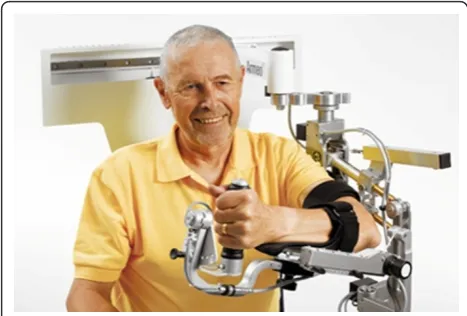
Therefore, this pilot study aimed to determine the fea-sibility of an 8-week mechanical-assisted training pro-gram for improving upper limb muscle strength and functional capacity in MS patients with paresis. The training program was given supplementary on custom-ary maintaining care by employing the Armeo Spring (Hocoma AG, Zurich, CH), a gravity-supporting exoske-leton apparatus.
Methods Participants
A convenience sample was recruited among MS patients scheduled at the Rehabilitation & MS Center Overpelt, Belgium. Local neurologists enrolled 10 eligible subjects in present pilot study, which was approved by the appropriate ethical committees. Subjects fulfilled the fol-lowing inclusion criteria: a definite diagnosis of MS according to the McDonald criteria, [18] and upper limb dysfunction due to evident paresis (characterized by an upper limb MI score ≥ 50 and ≤ 84) [19]. Exclusion criteria were: manifest spasticity (Modified Ashworth Scale > 1) [20] or tremor (Fahn’s Tremor Rating Scale > 1) [21] in the upper limb, severe cognitive (Mini-Mental State Examination < 24) [22] or visual (Snellen Test < 50%) [23] deficits interfering with the comprehension or execution of presented virtual reality tasks, or another diagnosis (e.g. orthopaedic) having a major effect on upper limb function. Admitted participants had a high level of general disability and were each wheelchair-bound, as described by an EDSS 7.0-8.5 [24]. They all gave written informed consent.
Apparatus
spring mechanism. This enables patients, using residual upper limb function, to achieve a larger active range of motion (ROM) within a 3-dimensional workspace than is possible without support [26]. The integration of a pressure-sensitive handgrip additionally allows the execution of graded grasp and release exercises. Through instrumentation of built-in position sensors and software, the Armeo Spring can be engaged as an input device for the accomplishment of meaningful functional tasks (e.g. cleaning a stove top) that are simu-lated in a virtual learning environment on a computer screen, with the provision of auditory and visual perfor-mance feedback during and after practice.
Experimental design, procedure and training program An explorative before-after single group research design was applied to examine the feasibility, that is to say the proof of principle, of the training intervention.
An experienced and independent occupational thera-pist performed the individual setup of the Armeo Spring before training (i.e. establishment of weight compensa-tion, maximal active workspace, and level of exercise difficulty), as well as intermittent supervision under training. The initial amount of gravity support provided by the Armeo Spring was defined based on the subject’s ability to maintain the affected arm in a standardized position of 45° shoulder flexion and 90° elbow flexion. Setup features were gradually adjusted at the first train-ing session of each week. If as a consequence increased compensatory movements were observed during task execution, former settings were resumed.
Training frequency was 3 times per week for 8 weeks, or 9 weeks in case the participant missed a training ses-sion. One session lasted 30 minutes and consisted of intense repetitive performance of 5 out of 15 virtual rea-lity tasks (5 minutes per task, ranging from gross motor
movement when cleaning a stove top, over more precise movement when watering flowers, to subtle strength-dosed movement when picking up an egg), added with 1 patient-preferred therapy game (e.g. car racing or card playing). The mechanical-assisted training was given supplementary on customary care comprising physical and/or occupational therapy aimed at the maintenance of general functional status (e.g. mobilisations to prevent muscle contractures, respiratory exercises, practise of transfers, etc.; 2 to 3×/week, 30 minutes/session).
Outcome measures
Tests were administered by a single independent researcher, a physiotherapist, before and after 24 training sessions as well as 2 months after training completion.
Upper limb and handgrip muscle strength were deter-mined by means of the MI (normal score = 100) and the Jamar hand-held dynamometer (Biometrics Ltd., Ladysmith, USA). Upper limb functional capacity was assessed with the TEMPA, [27] the Action Research Arm Test (ARAT; normal score = 57) [28] and the 9HPT [29]. For the TEMPA, the median execution time of the 4 unilateral activities (i.e. grasping and moving a jar, pouring water from a jug into a cup, inserting coins in a slot, pinching and moving small objects) was regis-tered. The maximal time limit for each of the 4 TEMPA tasks was 120 seconds, while that of the 9HPT was stan-dardized to 300 seconds. Thus, when a patient was not able to finish a TEMPA task or the 9HPT within the specified time frame, a truncated score of respectively 120 and 300 seconds was given.
Also, after completing the 8-week training program, participants rated their global impression of change in upper limb function compared to the perceived state before the intervention. The utilized 7-point ordinal scale (ranging from 1 = very much improved to 7 = very much worse) was based on the Clinical Global Impres-sion’s subscale questioning Change (CGIC) [30].
Statistical analyses
Normality of the variables was tested applying the Kolmogorov-Smirnov test. Because assumptions of nor-mality were not always fulfilled, and because of the modest sample size, the non-parametric Wilcoxon signed-rank test was implemented to appraise changes in outcome measures after 24 training sessions and at 2-month follow-up relative to baseline. All analyses were done using Statistica (Statsoft Inc., Tulsa, USA). The level of significance was set asp< 0.05.
Results
Patient compliance and characteristics
One patient dropped out during the study due to perso-nal reasons unrelated to the intervention. This subject Figure 1The Armeo Spring, an exoskeleton apparatus with
was excluded from all analyses. Detailed descriptive characteristics of the participants that completed the training program (n= 9) are presented in Table 1. Each of them concluded all 24 training sessions within maxi-mal 9 weeks.
Effects of the Armeo Spring training program on upper limb muscle strength and functional capacity
Baseline values of the outcome measures and changes over time are provided in Table 2. Armeo Spring train-ing yielded no significant alteration in upper limb mus-cle strength, although the mean MI score improved subsequent to the intervention, sustaining gain at fol-low-up. Hand grip force measured with the Jamar remained stable throughout the whole study.
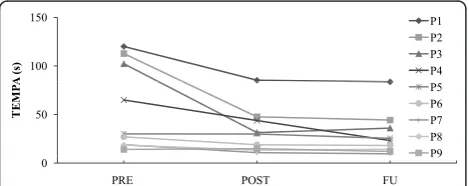
Significant improvements were particularly found in functional capacity parameters (see Figure 2). At comple-tion of the training program, the funccomple-tional activities of the TEMPA were performed significantly faster com-pared to baseline, while time scores on the 9HPT gave evidence of a positive trend. ARAT scores increased 4 points on average, not being significant however. Largest gains were observed in subjects most affected at baseline, more specifically in 4 individuals who initially required a TEMPA execution time of more than 60 seconds (see Figure 3 in illustration of this finding) and a 9HPT execu-tion time of more than 180 seconds, besides scoring less than 41 points on the ARAT. In fact, these 4 subjects
were not able to accomplish one or more TEMPA tasks (all 4 individuals) or the 9HPT (2 out of 4 individuals) within the specified maximal time frame before the vention, while most of them were capable after the inter-vention (3 out of 4, and 4 out 4 individuals respectively). At 2-month follow-up, results on the TEMPA and ARAT revealed even greater and for both measures significant gains relative to baseline than immediately after the inter-vention period, despite the fact that in the meantime no supplementary mechanical-assisted training had taken place. The 9HPT outcomes approximated the post-train-ing performance levels.
After finishing the training program, 3 participants rated themselves much improved, 2 participants rated themselves moderately improved, and 4 participants noted no change on the CGIC, without stating any side effects. Interestingly, the 4 subjects who showed greatest responsiveness on the functional capacity parameters were among those declaring much (3 individuals) and moderate (1 individual) self-perceived improvement.
Discussion
This pilot study reports on an 8-week technology-enhanced training program for improving upper limb muscle strength and functional capacity in MS patients with paresis. The gravity-supporting Armeo Spring was employed as a training tool assisting participants to additionally and independently practice task-oriented movements in a virtual real-life-like learning environ-ment. Importantly, significant gains in the functional capacity outcome measures were found after completion of the intervention period, which sustained or even pro-gressed at 2-month follow-up.
In MS, limited literature is available on rehabilitation of upper limb dysfunction, neither with regard to tradi-tional physical therapy in general, nor with regard to technology-enhanced physical therapy in particular. Pre-viously, a 2- and 4-week robot-based rehabilitation protocol, applied in moderately affected patients (EDSS 3.5-6.0) who predominantly suffered from cerebellar symptoms like ataxia and/or tremor, led to improved upper limb motor coordination as measured through
Table 1 Patient characteristics (n = 9)
Variable
Gender(m/f) 4/5
Age(years) 63 ± 10
Disease duration(years) 27 ± 10
Type of MS(RR/SP/PP) 0/6/3
EDSS 7.9 ± 0.5
Trained upper limb(D/ND)* 6/3
Values are mean ± standard deviation, or number.
RR, relapsing remitting; SP, secondary progressive; PP, primary progressive; EDSS, Expanded Disability Status Scale; D, dominant; ND, non-dominant. *2 out of 3 non-dominant limbs have become dominant limbs over time because of paralysis of the initial dominant limb.
Table 2 Changes in outcome measures with Armeo Spring training (n = 9)
Variable Baseline value
Δafter 24 training sessions
p ofΔafter 24 training sessions
Δat 2-month follow-up, relative to baseline
p ofΔat 2-month follow-up, relative to baseline
MI 72 ± 8 4 ± 7 0.07 6 ± 9 0.08
Jamar(kg) 14,3 ± 9,1 0,2 ± 4,5 0.51 0,0 ± 5,7 0.67
TEMPA(s) 56,4 ± 44,1 -23,6 ± 27,4 0.02* -26,8 ± 27,0 0.01*
ARAT 45 ± 13 4 ± 11 0.31 5 ± 7 0.02*
9HPT(s) 157,1 ± 114,6 -47,8 ± 59,4 0.05+ -47,0 ± 76,9 0.09
Values or mean ± standard deviation.
Δstands for change in outcome measures; *p< 0.05;+
robotic parameters, ataxia and tremor indices, and the 9HPT [16,17]. Current investigation implemented mechanical-assisted training over a longer period of 8 weeks as a treatment modality supplementary on cus-tomary maintaining care. Beneficial effects were noted, particularly on the functional capacity level, and this mainly in subjects whose upper limb function was most affected at baseline (i.e. initially having a TEMPA execu-tion time > 60 seconds, 9HPT execuexecu-tion time > 180 sec-onds, ARAT score < 41 points). It were also these individuals that, examined by the CGIC after finishing the training program, perceived at least moderate improvements in their upper limb function compared to the status before the intervention. Patient’s quotations were: ‘Combing my hair goes easier’, ‘I can scratch my nose again when it itches’, or‘I’m better able to hold a book and turn pages’. Given that precarious arm and hand dysfunction often occurs in a later stage of MS, it is noteworthy that the above findings were obtained in high-level disability patients with an EDDS≥7, a patient subgroup that as far as we know has not been studied before in the context of (technology-enhanced) physical rehabilitation [2]. Our study results suggest that the upper limb of such persons, who are already wheelchair-bound, is still trainable with profits being established in a functionally relevant way.
It is acknowledged that MS and stroke can present themselves with different clinical symptoms. Nonetheless,
it is supportive to notice that the reported effects of Armeo Spring training in MS are in concordance with the outcomes of a recent randomized clinical trial (RCT) in stroke patients with chronic hemiparesis (cf. two dis-tinct pathologies showing similar upper limb dysfunction caused by upper motor neuron lesions) [13]. This RCT also demonstrated, subsequent to 8 weeks of gravity-sup-ported T-WREX training, functionally relevant changes in the use of the affected upper limb in terms of signifi-cantly improved patient-rated MAL scores, besides sig-nificant gains in active reaching ROM and the FM. In both studies in MS and stroke, handgrip force measured with the Jamar showed no significant alteration. This might be because especially proximal muscles around the shoulder girdle, shoulder and elbow joint were exercised during the execution of virtual reality tasks. The pres-sure-sensitive handle integrated in the exoskeleton sys-tems effectively allows grasp and release exercises, but these only need to be performed submaximally in part of the tasks. In present research, the MI measuring overall upper limb muscle strength improved, albeit non-signifi-cant. A less pronounced gain in strength is not entirely surprising given that the Armeo Spring(/T-WREX) device provides anti-gravity support, notwithstanding the fact that this support had (slightly) decreased in all sub-jects at the end of the training period.
Movement practice in a virtual environment with the Armeo Spring may rather be considered as dexterity training, by which (partial) relief of the upper limb’s weight enables the more severely affected patient to actively produce a larger ROM within a 3-dimensional workspace [31]. Dexterity is hereby defined as the ability to address spatial and temporal accuracy necessary to make the movement meet environmental demands [32]. So mechanical-assisted therapy in a virtual workspace engages not just repeated use of the upper limb, but involves repetitive and active exertion of goal-directed movements, with enlarged ROM and superior multi-joint coordination, during the practice of complex motor tasks in an enrichedlearningenvironment. Focus on dexterity during (technology-enhanced) task-oriented
-45
-30
-15
0
ǻ
TEMP
A
(
s)
0
3
6
9
ǻ
ARA
T
-90
-60
-30
0
ǻ
9HPT
(s)
*
+*
*
-45
PRE POST FU
ǻ
0
PRE POST FU
-90
PRE POST FU
*
Figure 2Effects of Armeo Spring training on upper limb functional capacity parameters. Changes in outcome measures (Δ) were measured after 8 weeks of training (POST) and at 2-month follow-up (FU), relative to baseline (PRE). Vertical bars show 1 standard error; *p< 0.05;+trend towards significance. ARAT, Action Research Arm Test; 9HPT, 9-Hole Peg Test.
100 150
A
(s)
P1 P2 P3 P4
50
TEMP
A P5
P6 P7 P8 P9 0
PRE POST FU P9
training is deliberately wanted by therapists, [33] and could have been a main driver for the improved func-tional outcome of the upper limb in both MS and chronic stroke patients [11].
The improved functional capacity is of importance as systematic reviews assessing the effectiveness of robotic/ (electro)mechanical-assisted training in stroke mainly demonstrated significant gains in upper limb motor function, contrary to benefits on the ADL level which were less pronounced [8,12]. In the selected studies for review, emphasis was rather put on 2-dimensional goal-directed instead of 3-dimensional task-oriented training, which might have contributed to the lack of effective-ness for functional recovery. However, the limited con-trast between experimental and control interventions can be another issue in this regard. In the recent RCT of Housman et al. (2009), patients receiving control therapy in the form of conventional table top exercises, positively exhibited similar improvements on the out-come measures as patients receiving mechanical-assisted training with the T-WREX, except for a modest sus-tained gain on the FM at 6-month follow-up in favour of T-WREX, while participants expressed their prefer-ence for T-WREX training after a single-session cross-over treatment [13]. It seems unlikely that robotic/ (electro)mechanical-assisted training will arrive at better results than another training modality/therapist-mediated training under the premise that the content, frequency, amount and intensity of therapy are compar-able [34]. Yet, rehabilitation technology encompar-ables stimu-lating as well as cost-effective practice, since it can be performed on a relatively autonomous and additional basis, also by a more disabled patient population as the one in the present study that does not necessarily meet the selection criteria for a functional training modality such as CIMT [35].
Another important finding in current investigation is the fact that the noted effects on the functional capacity level sustained or even progressed at 2-month follow-up. Analogue statements were made in the above mentioned T-WREX study in stroke, where functionally relevant changes revealed by the MAL showed greater significant improvement at 6-month follow-up relative to baseline than after the 8-week intervention period. This patient-reported index supports our assumption that beneficial effects of technology-enhanced training plausibly culminated an increased spontaneous use of MS patients’ paretic upper limb in the habitual life situation, retaining or further enhancing outcome over time. It also suggests that 8 weeks of repetitive weight-supported practice in a virtual setting can work out transferred and durable benefits in non-weight-supported real-world upper limb functionality in either chronically affected MS and stroke patients. Within this
context, it is regretful that the two studies in diverse pathologies applied other outcome measures on the var-ious domains of the International Classification of Func-tioning, Disability and Health (ICF), [36] hindering direct comparison of the extent of improvement between neurological conditions and possible differential effects of different total training times in both investiga-tions. Future research in MS should therefore consider the inclusion of parameters that are frequently used in stroke, such as the MAL (although not yet fairly applic-able in MS as it compares the affected with the non-affected upper limb, whereas motor symptoms can man-ifest bilaterally in MS patients) and the FM index [37,38].
kinematical (e.g. accelerometry) and neurophysiological (e.g. transcranial magnetic stimulation) measurements to determine quality of movement and to comprehend the neural substrates underlying motor performance.
Conclusions
This pilot study is the first one to provide indications that technology-enhanced physical rehabilitation is effec-tive for improving upper limb functionality in high-level disability MS patients with paresis, and this in a durable manner. Beneficial effects were mainly noted in indivi-duals most affected at baseline. Further RCTs including a broader assessment are warranted to confirm and ela-borate these results.
Consent
Written informed consent was obtained for publication of the accompanying image. A copy of the written con-sent is available for review by the Editor-in-Chief of this journal.
Acknowledgements
Domien Gijbels is recipient of a PhD fellowship from the Research Foundation Flanders (FWO), while the other authors are involved in the European Interreg IV project‘Rehabilitation Robotics II’(IVA-VLANED-1.14). The authors thank Erik De Winter (Enraf-Nonius, local distributor for Hocoma AG in Belgium) for lending the Armeo Spring apparatus, Dr Bart
Vanwijmeersch for patient recruitment, and Herbert Thijs for his contribution in data processing. The Belgian Charcot Foundation is acknowledged for their Equipment Grant (2008), the FWO for their Research Grant (’Krediet aan Navorsers’) to Peter Feys.
Author details
1REVAL Rehabilitation Research Center, Hasselt University, Agoralaan Building
A, BE-3590 Diepenbeek, Belgium.2BIOMED Biomedical Research Institute, Hasselt University, Agoralaan Building A, BE-3590 Diepenbeek, Belgium.
3RMSC Rehabilitation & MS Center, Boemerangstraat 2, BE-3900 Overpelt,
Belgium.
Authors’contributions
DG and PF conceived of the study, participated in its design and coordination, and drafted the manuscript. IL, GA and EK co-operated in the study design and performed data collection. DG and PF carried out the statistical analysis. LK provided project management and consultation. All authors read and approved the final manuscript.
Competing interests
The authors declare that they have no competing interests.
Received: 19 August 2010 Accepted: 24 January 2011 Published: 24 January 2011
References
1. Pittock SJ, Lucchinetti CF:The pathology of MS: new insights and potential clinical applications.Neurologist2007,13:45-56.
2. Dalgas U, Stenager E, Ingemann-Hansen T:Multiple sclerosis and physical exercise: recommendations for the application of resistance-, endurance-and combined training.Mult Scler2008,14:35-53.
3. Snook EM, Motl RW:Effect of exercise training on walking mobility in multiple sclerosis: a meta-analysis.Neurorehabil Neural Repair2009,23:108-116. 4. Johansson S, Ytterberg C, Claesson IM, Lindberg J, Hillert J, Andersson M,
Widén Holmqvist L, von Koch L:High concurrent presence of disability in
multiple sclerosis. Associations with perceived health.J Neurol2007, 254:767-773.
5. Paltamaa J, Sarasoja T, Leskinen E, Wikstrom J, Malkia E:Measures of physical functioning predict self-reported performance in self-care, mobility, and domestic life in ambulatory persons with multiple sclerosis.Arch Phys Med Rehabil2007,88:1649-1657.
6. Yozbatiran N, Baskurt F, Baskurt Z, Ozakbas S, Idiman E:Motor assessment of upper extremity function and its relation with fatigue, cognitive function and quality of life in multiple sclerosis patients.J Neurol Sci 2006,246:117-122.
7. Mark VW, Taub E, Bashir K, Uswatte G, Delgado A, Bowman MH, Bryson CC, McKay S, Cutter GR:Constraint-Induced Movement therapy can improve hemiparetic progressive multiple sclerosis. Preliminary findings.Mult Scler2008,14:992-994.
8. Kwakkel G, Kollen BJ, Krebs HI:Effects of robot-assisted therapy on upper limb recovery after stroke: a systematic review.Neurorehabil Neural Repair 2008,22:111-121.
9. Kwakkel G, van Peppen R, Wagenaar RC, Wood DS, Richards C, Ashburn A, Miller K, Lincoln N, Partridge C, Wellwood I, Langhorne P:Effects of augmented exercise therapy time after stroke: a meta-analysis.Stroke 2004,35:2529-2539.
10. Magill R:Motor Learning and Control, Concepts and ApplicationsNew York, NY: The McGraw-Hill Companies; 2007.
11. Van Peppen RP, Kwakkel G, Wood-Dauphinee S, Hendriks HJ, Van der Wees PJ, Dekker J:The impact of physical therapy on functional outcomes after stroke: what’s the evidence.Clin Rehabil2004,18:833-862. 12. Mehrholz J, Platz T, Kugler J, Pohl M:Electromechanical and robot-assisted
arm training for improving arm function and activities of daily living after stroke.Cochrane Database Syst Rev2008, CD006876.
13. Housman SJ, Scott KM, Reinkensmeyer DJ:A randomized controlled trial of gravity-supported, computer-enhanced arm exercise for individuals with severe hemiparesis.Neurorehabil Neural Repair2009,23:505-514. 14. Casadio M, Sanguineti V, Morasso P, Solaro C:Abnormal sensorimotor
control, but intact force field adaptation, in multiple sclerosis subjects with no clinical disability.Mult Scler2008,14:330-342.
15. Feys P, Alders G, Gijbels D, De Boeck T, De Weyer T, Coninx K,
Raymaekers C, Truyens V, Groenen P, Meijer K, Savelberg H, Eijnde BO:Arm training in multiple sclerosis using Phantom: clinical relevance of robotic outcome measures.Proceedings of the 11th International Conference of the IEEE Rehabilitation Robotics, Kyoto2009, 576-581.
16. Carpinella I, Cattaneo D, Abuarqub S, Ferrarin M:Robot-based rehabilitation of the upper limbs in multiple sclerosis: feasibility and preliminary results.J Rehabil Med2009,41:966-970.
17. Vergaro E, Squeri V, Brichetto G, Casadio M, Morasso P, Solaro C, Sanguineti V:Adaptive robot training for the treatment of incoordination in Multiple Sclerosis.J Neuroeng Rehabil2010,7:37.
18. McDonald WI, Compston A, Edan G, Goodkin D, Hartung HP, Lublin FD, McFarland HF, Paty DW, Polman CH, Reingold SC, Sandberg-Wollheim M, Sibley W, Thompson A, van den Noort S, Weinshenker BY, Wolinsky JS: Recommended diagnostic criteria for multiple sclerosis: guidelines from the International Panel on the diagnosis of multiple sclerosis.Ann Neurol 2001,50:121-127.
19. Collin C, Wade D:Assessing motor impairment after stroke: a pilot reliability study.J Neurol Neurosurg Psychiatry1990,53:576-579. 20. Bohannon RW, Smith MB:Interrater reliability of a modified Ashworth
scale of muscle spasticity.Phys Ther1987,67:206-207.
21. Hooper J, Taylor R, Pentland B, Whittle IR:Rater reliability of Fahn’s tremor rating scale in patients with multiple sclerosis.Arch Phys Med Rehabil 1998,79:1076-1079.
22. Pfeiffer E:A short portable mental status questionnaire for the assessment of organic brain deficit in elderly patients.J Am Geriatr Soc1975,23:433-441. 23. Hetherington R:The Snellen chart as a test of visual acuity.Psychol Forsch
1954,24:349-357.
24. Kurtzke JF:Rating neurologic impairment in multiple sclerosis: an expanded disability status scale (EDSS).Neurology1983,33:1444-1452. 25. Sanchez RJ, Reinkensmeyer D, Shah P, Liu J, Rao S, Smith R, Cramer S,
26. Sanchez RJ, Liu J, Rao S, Shah P, Smith R, Rahman T, Cramer SC, Bobrow JE, Reinkensmeyer DJ:Automating arm movement training following severe stroke: functional exercises with quantitative feedback in a gravity-reduced environment.IEEE Trans Neural Syst Rehabil Eng2006,14:378-389. 27. Feys P, Duportail M, Kos D, Van AP, Ketelaer P:Validity of the TEMPA for
the measurement of upper limb function in multiple sclerosis.Clin Rehabil2002,16:166-173.
28. Lyle RC:A performance test for assessment of upper limb function in physical rehabilitation treatment and research.Int J Rehabil Res1981, 4:483-492.
29. Fischer JS, Rudick RA, Cutter GR, Reingold SC:The Multiple Sclerosis Functional Composite Measure (MSFC): an integrated approach to MS clinical outcome assessment. National MS Society Clinical Outcomes Assessment Task Force.Mult Scler1999,5:244-250.
30. Guy W:ECDEU Assessment Manual for PsychopharmacologyRockville, MD: US Department of Health, Education and Welfare Public Health Service Alcohol, Drug Abuse, and Mental Health Administration; 1976. 31. Beer RF, Ellis MD, Holubar BG, Dewald JP:Impact of gravity loading on
post-stroke reaching and its relationship to weakness.Muscle Nerve2007, 36:242-250.
32. Ada L, Canning C:Changing the way we view the contribution of motor impairments to physical disability after stroke.InScience-based Rehabilitation, Theories into Practice.Edited by: Refshauge K, Ada L, Ellis E. Sydney: Butterworth-Heinemann; 2005:87-106.
33. Timmermans AA, Seelen HA, Willmann RD, Kingma H:Technology-assisted training of arm-hand skills in stroke: concepts on reacquisition of motor control and therapist guidelines for rehabilitation technology design. J Neuroeng Rehabil2009,6:1.
34. Volpe BT, Lynch D, Rykman-Berland A, Ferraro M, Galgano M, Hogan N, Krebs HI:Intensive sensorimotor arm training mediated by therapist or robot improves hemiparesis in patients with chronic stroke.Neurorehabil Neural Repair2008,22:305-310.
35. Sirtori V, Corbetta D, Moja L, Gatti R:Constraint-induced movement therapy for upper extremities in stroke patients.Cochrane Database Syst Rev2009, CD004433.
36. WHO:International Classification of Functioning, Disability and Health: ICF Geneva: World Health Organization; 2001.
37. Timmermans AA, Seelen HA, Willmann RD, Bakx W, de RB, Lanfermann G, Kingma H:Arm and hand skills: training preferences after stroke.Disabil Rehabil2009,31:1344-1352.
38. Gladstone DJ, Danells CJ, Black SE:The fugl-meyer assessment of motor recovery after stroke: a critical review of its measurement properties. Neurorehabil Neural Repair2002,16:232-240.
39. Ytterberg C, Johansson S, Andersson M, Widén Holmqvist L, von Koch L: Variations in functioning and disability in multiple sclerosis. A two-year prospective study.J Neurol2008,255:967-973.
40. Kos D, Nagels G, D’Hooghe MB, Duquet W, Ilsbroukx S, Delbeke S, Kerckhofs E:Measuring activity patterns using actigraphy in multiple sclerosis.Chronobiol Int2007,24:345-356.
41. Rocca MA, Pagani E, Absinta M, Valsasina P, Falini A, Scotti G, Comi G, Filippi M:Altered functional and structural connectivities in patients with MS: a 3-T study.Neurology2007,69:2136-2145.
42. Adamovich SV, Fluet GG, Tunik E, Merians AS:Sensorimotor training in virtual reality: a review.NeuroRehabilitation2009,25:29-44.
doi:10.1186/1743-0003-8-5
Cite this article as:Gijbelset al.:The Armeo Spring as training tool to improve upper limb functionality in multiple sclerosis: a pilot study.
Journal of NeuroEngineering and Rehabilitation20118:5. Submit your next manuscript to BioMed Central
and take full advantage of:
• Convenient online submission
• Thorough peer review
• No space constraints or color figure charges
• Immediate publication on acceptance
• Inclusion in PubMed, CAS, Scopus and Google Scholar
• Research which is freely available for redistribution