S H O R T R E P O R T
Open Access
Exploring the unique function of imprinting
control centers in the PWS/AS-responsible
region: finding from array-based
methylation analysis in cases with variously
sized microdeletions
Keiko Matsubara
1*, Masatsune Itoh
2, Kenji Shimizu
3, Shinji Saito
4, Keisuke Enomoto
5,6, Kazuhiko Nakabayashi
7,
Kenichiro Hata
7, Kenji Kurosawa
8, Tsutomu Ogata
1,9, Maki Fukami
1and Masayo Kagami
1*Abstract
Background:Human 15q11–13 is responsible for Prader-Willi syndrome (PWS) and Angelman syndrome (AS) and
includes several imprinted genes together with bipartite elements named AS-IC (imprinting center) and PWS-IC. These concertedly confer allele specificity on 15q11–13. Here, we report DNA methylation status of 15q11–13 and other autosomal imprinted differentially methylated regions (iDMRs) in cases with various deletions within the PWS/ AS-responsible region.
Methods:We performed array-based methylation analysis and examined the methylation status of CpG sites in
15q11–13 and in 71 iDMRs in six cases with various microdeletions, eight cases with conventional deletions within 15q11–13, and healthy controls.
Results:We detected 89 CpGs in 15q11–13 showing significant methylation changes in our cases. Of them, 14 CpGs in theSNORD116s cluster presented slight hypomethylation in the PWS cases and hypermethylation in the AS cases. No iDMRs at regions other than 15q11–13 showed abnormal methylation.
Conclusions:We identified CpG sites and regions in which methylation status is regulated by AS-IC and PWS-IC. This result indicated that each IC had unique functions and coordinately regulated the DNA methylation of respective alleles. In addition, only aberrant methylation at iDMRs in 15q11–13 leads to the development of the phenotypes in our cases.
Keywords:15q11–13, Prader-Willi syndrome, Angelman syndrome, Genome-wide methylation study, Deletion
Introduction
The chromosomal region 15q11–13 includes several genes showing monoallelic expression in a parent-of-ori-gin-specific manner [1]. This region is responsible for Prader-Willi syndrome (PWS, OMIM #176270) and Angelman syndrome (AS, OMIM #105830). PWS is characterized by hypotonia during infancy, developmen-tal delay, hyperphagia followed by morbid obesity, and
cognitive impairment [2], and AS is associated with se-vere developmental delay, ataxia, and recurrent seizures [3]. Approximately 70% of PWS and AS patients have 5–7 Mb deletions affecting the 15q11–13 imprinted re-gion (Fig.1). Recently, it has been reported that deletion involving theSNORD116 gene, which is one of the C/D box small nucleolar RNAs (snoRNAs), causes the pheno-types of PWS [4–8]. AS phenotypes arise from the loss of expression or function of the UBE3A gene, which is expressed on the maternally derived allele in mature neurons [3].
* Correspondence:[email protected];[email protected]
1Department of Molecular Endocrinology, National Center for Child Health
and Development, 2-10-1 Ohkura, Setagaya-ku, Tokyo 157-8535, Japan Full list of author information is available at the end of the article
The imprinting control region (ICR) conferring par-ent-of-origin identity of the genes on 15q11–13 was de-fined according to the smallest region of overlap (SRO) found in PWS or AS individuals with rare atypical microdeletions [9]. The ICR on 15q11–13 consists of
bi-partite DNA elements named AS-IC (imprinting center) and PWS-IC [10]. The PWS-IC is a 4.1-kb region, which spans theSNURF/SNRPNpromoter and exon 1, and in-cludes an imprinted differentially methylated region (iDMR), which is maternally methylated and paternally unmethylated. The AS-IC is an 880-bp sequence located ~ 35 kb centromeric of the PWS-IC and does not in-clude iDMR. It is known that PWS-IC and AS-IC
cooperate in regulating epigenetic status and allele-spe-cific gene expression at this locus [1].
Recent advancement in methylation analysis allows genome-wide methylation studies, and it detected novel iDMRs located in regions near the SNURF/SNRPNgene and several CpG sites in the SNORD116s cluster showing a slight tendency for preferential paternal methylation [11]. The regulatory mechanism in DNA methylation of those imprinted regions by ICR has not yet been elucidated precisely.
In this study, we performed an array-based DNA methylation analysis in the cases with various deletions involving the PWS/AS region and examined the Fig. 1Schematic diagram of the PWS/AS region. Horizontal gray line and dotted line indicate the range of conventional large deletion bounded by breakpoint (BP) 1 or 2 and BP 3. snoRNA genes are shown in ovals. Not all genes of the locus are shown, and the map is not to scale
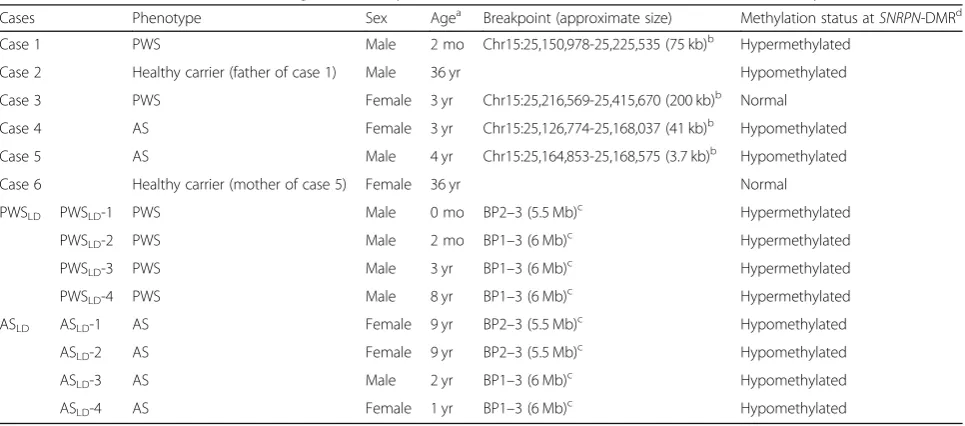
Table 1Clinical information, deletion range, and methylation status atSNRPN-DMR in cases enrolled in this study
Cases Phenotype Sex Agea Breakpoint (approximate size) Methylation status atSNRPN-DMRd
Case 1 PWS Male 2 mo Chr15:25,150,978-25,225,535 (75 kb)b Hypermethylated Case 2 Healthy carrier (father of case 1) Male 36 yr Hypomethylated Case 3 PWS Female 3 yr Chr15:25,216,569-25,415,670 (200 kb)b Normal Case 4 AS Female 3 yr Chr15:25,126,774-25,168,037 (41 kb)b Hypomethylated Case 5 AS Male 4 yr Chr15:25,164,853-25,168,575 (3.7 kb)b Hypomethylated Case 6 Healthy carrier (mother of case 5) Female 36 yr Normal PWSLD PWSLD-1 PWS Male 0 mo BP2–3 (5.5 Mb)c Hypermethylated
PWSLD-2 PWS Male 2 mo BP1–3 (6 Mb)c Hypermethylated
PWSLD-3 PWS Male 3 yr BP1–3 (6 Mb)c Hypermethylated
PWSLD-4 PWS Male 8 yr BP1–3 (6 Mb)c Hypermethylated
ASLD ASLD-1 AS Female 9 yr BP2–3 (5.5 Mb)c Hypomethylated
ASLD-2 AS Female 9 yr BP2–3 (5.5 Mb)c Hypomethylated
ASLD-3 AS Male 2 yr BP1–3 (6 Mb)c Hypomethylated
ASLD-4 AS Female 1 yr BP1–3 (6 Mb)c Hypomethylated PWSPrader-Willi syndrome,ASAngelman syndrome,DMRdifferentially methylated region,LDlarge deletion,BPbreakpoint
a
Age at sample collection (momonths,yryears) b
The breakpoints were estimated according to the results of aCGH c
The breakpoints were estimated according to the results of methylation-specific multiplex ligation-dependent probe amplification (MS-MLPA). The locations of BPs are shown in Additional file2: Figure S1
d
methylation status of CpG sites in 15q11–13 and in 71 iDMRs at regions other than the PWS/AS region to clar-ify the regulatory mechanism for DNA methylation in the 15q11–13 imprinted region.
Results and discussion
Six cases with atypical microdeletions in the 15q11–13 region (cases 1–6) and four with PWS and four with AS due to conventional large deletions (LD) in 15q11–13 (PWSLD and ASLD, respectively) were enrolled in this
study (Table 1 and Additional file 1: Supplementary document).
Deletion size and breakpoint
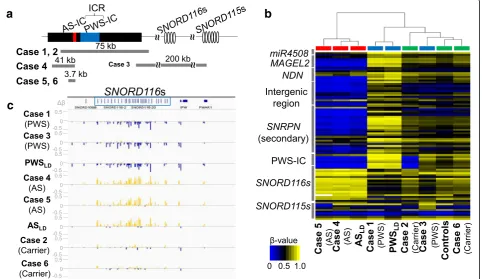
Custom-built array CGH revealed a copy number loss in each case (Fig. 2a and Additional file2: Figure S1). This array contained approximately 38,000 probes for 15q11– q13 encompassing the imprinted region and ~ 10,000 reference probes for other chromosomal regions (4×180K format, Design ID 032112) (Agilent Technolo-gies, Palo Alto, CA, USA). The detailed information of
probes contained in this custom-built array is shown in Additional file3: Table S1. Cases 1 and 2 had a deletion involving both AS-IC and PWS-IC, case 3 had a deletion involving only the SNORD116s cluster, and cases 4–6 had a deletion involving only AS-IC.
Difference in the DNA methylation status between each case with various microdeletions and controls
We focused on the DNA methylation status at CpG sites on autosomal chromosomes in two groups (groups 1 and 2) and extracted methylation data at 1335 probes lo-cated in CpG sites at the 15q11–13 PWS/AS region (group 1, Additional file 4: Table S2) and at 863 probes in the iDMRs at regions other than the PWS/AS region (group 2, Additional file5: Table S3).
CpG sites in 15q11–13 (probes in group 1)
We identified 89 probes in group 1 showing significant differences in DNA methylation in at least 1 case against normal controls (Fig.2b and Additional file6: Table S4). Most probes located in the miR4508-PWS-IC region
c
b
a
showed hypermethylation in case 1 and PWSLD and
hy-pomethylation in cases 4 and 5 and ASLD, respectively.
Case 3 showed normal methylation status in these sites. Hierarchical clustering of the methylation status of these 89 CpGs showed that all cases other than case 3 with the SNORD116s deletion were classified into subgroups according to their phenotypes (Fig.2b). Case 3 was clus-tered closer to the normal controls.
In case 2, who was the father of case 1, probes in his deleted region in PWS-IC showed hypomethylation; however, the remaining probes showed normal methyla-tion status. In case 6, who was the mother of case 5, no CpG with aberrant methylation was found.
In addition, 14 probes in theSNORD116s cluster pre-sented slight hypomethylation in the cases with PWS phenotype (cases 1and 3 and PWSLD) and
hypermethyla-tion in the cases with AS phenotype (cases 4 and 5 and ASLD) (Fig.2c).
iDMRs at regions other than the PWS/AS region (probes in group 2)
Additional file 7: Table S5 shows the results of the methylation analyses for 71 iDMRs including 828 probes in group 2 between each of cases 1–6 and normal con-trols. We detected no iDMR with an abnormal methyla-tion pattern.
In this study, we examined the methylation status of CpG sites in 15q11–13 and in 71 iDMRs at regions other than the PWS/AS region using methylation array for the cases with various deletions involving the PWS/ AS region. This study provides several notable findings. First, we clarified CpG sites and regions in which the methylation status was regulated by AS-IC and PWS-IC in 15q11–13. Most abnormally methylated CpG sites in cases with deletions were located within or very close to the regions reported in previous studies [11–13]. Based on the results from our patients and a previously re-ported PWS patient with a microdeletion involving only PWS-IC, we present a hypothetical model for the regula-tion of DNA methylaregula-tion at the 15q11–13 imprinted re-gion in Fig.3. We suggest regulatory mechanisms of this region as follows: (1) maternal pattern (methylated) at CpGs in the upstream region of the ICR was the default state (see normal state and case 2), (2) AS-IC was re-quired for the methylation of PWS-IC on the maternally derived allele (compare case 6 with cases 4 and 5), (3) the unmethylated PWS-IC led to the unmethylated sta-tus of CpGs in the upstream of the ICR even on the ma-ternally derived allele (see cases 4 and 5), and (4) the methylation patterns of several CpGs in theSNORD116s clusters were also regulated by both AS-IC and PWS-IC. Several CpGs in the SNORD116s cluster were preferen-tially methylated on the paternally inherited allele (Fig. 2c) [11]. The methylation pattern in the
SNORD116s cluster was different between case 1 and
the PWS case lacking only PWS-IC [14]. These results indicate that both AS-IC and unmethylated PWS-IC on the paternally derived allele function independently as regulators of the methylation status of CpGs in the
SNORD116s cluster. Furthermore, several CpGs in the
SNORD116s cluster were methylated in cases 4 and 5 on the maternally derived allele. This result indicates that unmethylated PWS-IC was needed for the methylation of the CpGs in the SNORD116s cluster independently on the parental origin. In the cases with large deletions involving the entire region of 15q11–13 (Fig. 3c), abnor-mal methylation patterns were simply due to the loss of the paternally or maternally derived allele in PWS or AS patients, respectively.
Second, this study demonstrated that PWS/AS case with various deletions had normal methylation status in known iDMRs at regions other than 15q11–13. This re-sult indicates that the development of phenotypes in our cases was not caused by aberrant methylation changes at iDMRs at regions other than 15q11–13. In addition, our study and previous studies using other methylation ana-lyses showed a normal methylation pattern at PWS-IC in patients with deletions only including theSNORD116s cluster [4–7]. It remains to be clarified how the deletion
of SNORD116s contributes to the development of PWS
phenotypes. Previous studies reported several findings re-garding long non-coding RNAs (sno-lncRNAs) including SNORD116s: (1) some functional units, 116 host genes (116HG) and snoRNA-related sno-lncRNAs, were proc-essed from the SNORD116s cluster in human tissues or cells [15,16], (2) Fox-family splicing regulators are bound to sno-lncRNAs and altered splicing patterns of genes are related to neuronal development in human ES cells [17], and (3) there was aSnord116-dependent diurnal rhythmic DNA methylation in the mouse cortex [18]. Thus, the loss of the expression of SNORD116s may lead to PWS-relevant phenotypes, such as abnormalities of en-ergy metabolism and diurnal rhythm [17,18].
In summary, we performed an array-based methyla-tion study in cases with various-sized microdelemethyla-tions in the PWS/AS region on maternally or paternally de-rived chromosome 15. We identified CpG sites and regions in which the DNA methylation status is regu-lated by ICR. Our results enabled us to speculate on the regulatory mechanism for the establishment of
the methylation status of local CpG sites or regions in 15q11–13. Moreover, we demonstrated that the de-velopment of phenotypes in the PWS/AS patients with deletions encompassing ICR and/or the
SNORD116s cluster was not mediated by aberrant
methylation changes at iDMRs at regions other than the PWS/AS regions. Further investigation will be
P
Default Default
M CpGs in the 5’ upstream of ICR
AS-IC PWS -IC
CpGs in the SNORD116s
cluster
a
Normal State
P
M
PWS with large deletion
P
M
AS with large deletion
c
Case in ref 14 (PWS)
P
M
X
X
Case 1 (PWS)
P
M
X
X
X
Case 2 (Carrier)
P
M
Case 3 (PWS)
P
M
X
Case 4 and 5 (AS)
P
M
Case 6 (Carrier)
P
M
X
b
necessary to fully elucidate how paternal deletion of
SNORD116s causes PWS phenotypes.
Materials and methods
Subjects
Six cases with atypical microdeletions in the 15q11–13 region (cases 1–6) and four with PWSLD and four with
ASLDdue to conventional large deletions were enrolled in
this study (Figs. 1 and 2a, Table 1, Additional file 1: Supplementary document, and Additional file8: Figure S2). Genomic DNAs from leukocytes in these cases and healthy controls were utilized for this study. Methyl ation-specific multiplex ligation-dependent probe amplification (MS-MLPA; ME030, MRC-Holland, Amsterdam, Netherlands) was performed in all cases to examine the deleted region and DNA methylation sta-tus in 15q11–13 (data not shown). All cases showed normal karyotype. Clinical manifestations of cases are shown in the supplementary document. Healthy chil-dren (n= 11) and adults (n= 24) were involved as nor-mal controls.
Copy number analysis
We designed a custom-built array-based comparative gen-omic hybridization (aCGH) and utilized this aCGH to nar-row down the deleted regions in cases 1–6 (4×180K format, Design ID 032112, Agilent Technologies, Palo Alto, CA, USA). The detailed information of probes con-tained in this array is shown in Additional file3: Table S1. The procedure was as described in the manufacturer’s instructions.
Comprehensive methylation analysis using the HumanMethylation450 BeadChip
We performed methylation assays on cases with various deletions together with healthy controls using the Infi-nium HumanMethylation450 BeadChip (HM450k, Illu-mina, Inc., San Diego, CA, USA). Detailed procedures are shown in Additional file1: Supplementary document.
HM450k data processing
The HM450k data were processed using the “ChAMP” R package version 1.10.0 [20]. Detailed algorithms of data pre-processing are available in the supplementary document and Additional file9: Figure S3. We extracted the methylation data at 1335 probes located in the CpG sites at the 15q11–13 PWS/AS region (group 1, Additional file 4: Table S2) and at 863 probes in the iDMRs at regions other than the PWS/AS region (group 2, Additional file 5: Table S3) [11, 12]. Of note, 161 probes in group 1 presented with allele-specific methyla-tion status according to the parental origin [11–13].
Before making comparisons of the methylation status between each single case with microdeletion (cases 1–6),
patients with PWSLDor with ASLD, and controls, we
ex-cluded five probes in group 1 (cg26889953, cg1789680, cg09873524, cg26955196, and cg11826104) showing dif-ferential methylation status between child and adult con-trols from the group 1 list for further analysis (Additional file 1: Supplementary document and Additional file9: Figure S3). There was no probe show-ing a different methylation status between child and adult controls in group 2.
Subsequently, we compared the methylation status be-tween each single case (cases 1–6), patients with PWS or with AS due to large deletions, and normal controls. The methylation level at each probe was represented by βvalues ranging from 0 (completely unmethylated) to 1 (completely methylated). The differences in DNA methy-lation (Δβ) were calculated by the subtraction of the β value in each case from the average β value in controls at each probe site. We considered a probe as differen-tially methylated when the absolute value of the differ-ence in β value (|Δβ|) between two groups was above 0.2 and the false discovery rate (FDR) was below 1%. Detailed methods are available in Additional file 1: Supplementary document.
Additional files
Additional file 1:Supplementary document. (DOCX 23 kb)
Additional file 2:Figure S1.Combination of the results of aCGH and schematic diagram of PWS/AS region. (PPTX 112 kb)
Additional file 3:Table S1.Probes on a custom-built oligo-microarray. (XLSX 1717 kb)
Additional file 4:Table S2.Probe list of group 1. (XLSX 102 kb)
Additional file 5:Table S3.Probe list of group 2. (XLSX 83 kb)
Additional file 6:Table S4.Methylation values of group 1 probes. (XLSX 674 kb)
Additional file 7:Table S5.Methylation values of group 2 probes. (XLSX 459 kb)
Additional file 8:Figure S2.Family trees of cases with microdeletions enrolled in this study. (PPTX 40 kb)
Additional file 9:Figure S3.Algorithm for HM450k data processing. (PPTX 46 kb)
Abbreviations
116HG:116 host genes; aCGH: Array-based comparative genomic hybridization; AS: Angelman syndrome; HM450k: Infinium
HumanMethylation450 BeadChip; IC: Imprinting center; ICR: Imprinting control region; iDMRs: Imprinted differentially methylated regions; LD: Large deletions; MS-MLPA: Methylation-specific multiplex ligation-dependent probe amplification; PWS: Prader-Willi syndrome; sno-lncRNAs: Long non-coding RNAs; SRO: Smallest region of overlap
Acknowledgements
Funding
This work was supported by a grant from the Japan Agency for Medical Research and Development (AMED) (18ek0109204h0002).
Availability of data and materials
The datasets used and/or analysed during the current study are available from the corresponding author on reasonable request.
Authors’contributions
KM designed the project, performed the molecular and data analyses, and wrote the paper. MI, KS, SS, KE, KK, and TO recruited and managed the cases enrolled in this study and interpreted the cases’data from the point of view of clinical genetics. KN and KH supervised the bioinformatics analysis. MF and MK provided the facilities and resources for the study. MK gave the final approval of the version to be published. All authors read the manuscript, revised it critically for important intellectual content, and approved the final manuscript.
Ethics approval and consent to participate
This study was approved by the Institute Review Board Committees at the National Center for Child Health and Development (number 518) and performed after obtaining written informed consent from the parents.
Consent for publication
Consent for publication were obtained from all patients or their parents.
Competing interests
The authors declare that they have no competing interests.
Publisher’s Note
Springer Nature remains neutral with regard to jurisdictional claims in published maps and institutional affiliations.
Author details
1Department of Molecular Endocrinology, National Center for Child Health
and Development, 2-10-1 Ohkura, Setagaya-ku, Tokyo 157-8535, Japan.
2
Department of Pediatrics, Kanazawa Medical University, Kanazawa 920-1192, Japan.3Division of Medical Genetics, Saitama Children’s Medical Center,
Saitama 330-8777, Japan.4Department of Pediatrics and Neonatology,
Nagoya City University Graduate School of Medical Sciences, Nagoya 467-8601, Japan.5Enomoto Children’s Clinic, Moriya 302-0127, Japan.
6Department of Pediatrics and Developmental Biology, Tokyo Medical and
Dental University Graduate School, Tokyo 113-8510, Japan.7Department of
Maternal-Fetal Biology, National Center for Child Health and Development, Tokyo 157-8535, Japan.8Division of Medical Genetics, Kanagawa Children’s Medical Center, Yokohama 232-8555, Japan.9Department of Pediatrics,
Hamamatsu University School of Medicine, Hamamatsu 431-3192, Japan.
Received: 28 December 2018 Accepted: 14 February 2019
References
1. Horsthemke B, Wagstaff J. Mechanisms of imprinting of the Prader-Willi/ Angelman region. Am J Med Genet A. 2008;146A:2041–52.https://doi.org/ 10.1002/ajmg.a.32364.
2. Cassidy SB, Schwartz S, Miller JL, Driscoll DJ. Prader-Willi syndrome. Genet Med. 2012;14:10–26.https://doi.org/10.1038/gim.0b013e31822bead0. 3. Buiting K, Williams C, Horsthemke B. Angelman syndrome–insights into a
rare neurogenetic disorder. Nat Rev Neurol. 2016;12:584–93.https://doi.org/ 10.1038/nrneurol.2016.133.
4. Sahoo T, del Gaudio D, German JR, Shinawi M, Peters SU, Person RE, et al. Prader-Willi phenotype caused by paternal deficiency for the HBII-85 C/D box small nucleolar RNA cluster. Nat Genet. 2008;40:719–21.https://doi.org/ 10.1038/ng.158.
5. de Smith AJ, Purmann C, Walters RG, Ellis RJ, Holder SE, Van Haelst MM, et al. A deletion of the HBII-85 class of small nucleolar RNAs (snoRNAs) is associated with hyperphagia, obesity and hypogonadism. Hum Mol Genet. 2009;18:3257–65.https://doi.org/10.1093/hmg/ddp263.
6. Duker AL, Ballif BC, Bawle EV, Person RE, Mahadevan S, Alliman S, et al. Paternally inherited microdeletion at 15q11.2 confirms a significant role of the SNORD116 C/D box snoRNA cluster in Prader-Willi syndrome. Eur J Hum Genet. 2010;18:1196–201.https://doi.org/10.1038/ejhg.2010.102.
7. Bieth E, Eddiry S, Gaston V, Lorenzini F, Buffet A, Conte Auriol F, et al. Highly restricted deletion of the SNORD116 region is implicated in Prader–Willi syndrome. Eur J Hum Genet. 2015;23:252–5.https://doi.org/10.1038/ejhg. 2014.103.
8. Fontana P, Grasso M, Acquaviva F, Gennaro E, Galli ML, Falco M, et al. SNORD116 deletions cause Prader–Willi syndrome with a mild phenotype and macrocephaly. Clin Genet. 2017;92:440–3.https://doi.org/10.1111/cge.13005. 9. Buiting K. Prader-Willi syndrome and Angelman syndrome. Am J Med Genet C
Semin Med Genet. 2010;154C:365–76.https://doi.org/10.1002/ajmg.c.30273. 10. Buiting K, Gross S, Lich C, Gillessen-Kaesbach G, el-Maarri O, Horsthemke B.
Epimutations in Prader-Willi and Angelman syndromes: a molecular study of 136 patients with an imprinting defect. Am J Hum Genet. 2003;72:571–7. https://doi.org/10.1086/367926.
11. Joshi RS, Garg P, Zaitlen N, Lappalainen T, Watson CT, Azam N, et al. DNA methylation profiling of uniparental disomy subjects provides a map of parental epigenetic bias in the human genome. Am J Hum Genet. 2016;99: 555–66.https://doi.org/10.1016/j.ajhg.2016.06.032.
12. Court F, Tayama C, Romanelli V, Martin-Trujillo A, Iglesias-Platas I, Okamura K, et al. Genome-wide parent-of-origin DNA methylation analysis reveals the intricacies of human imprinting and suggests a germline methylation-independent mechanism of establishment. Genome Res. 2014;24:554–69. https://doi.org/10.1101/gr.164913.113.
13. Sharp AJ, Migliavacca E, Dupre Y, Stathaki E, Sailani MR, Baumer A, et al. Methylation profiling in individuals with uniparental disomy identifies novel differentially methylated regions on chromosome 15. Genome Res. 2010;20: 1271–8.https://doi.org/10.1101/gr.108597.110.
14. Rabinovitz S, Kaufman Y, Ludwig G, Razin A, Shemer R. Mechanisms of activation of the paternally expressed genes by the Prader-Willi imprinting center in the Prader-Willi/Angelman syndromes domains. Proc Natl Acad Sci U S A. 2012;109:7403–8.https://doi.org/10.1073/pnas.1116661109. 15. Castle JC, Armour CD, Löwer M, Haynor D, Biery M, Bouzek H, et al. Digital
genome-wide ncRNA expression,including SnoRNAs, across 11 human tissues using poly A-neutral amplification. PLoS One. 2010;5:e11779.https:// doi.org/10.1371/journal.pone.0011779.
16. Yin QF, Yang L, Zhang Y, Xiang JF, Wu YW, Carmichael GG, et al. Long noncoding RNAs with snoRNA ends. Mol Cell. 2012;48:219–30.https://doi. org/10.1016/j.molcel.2012.07.033.
17. Powell WT, Coulson RL, Crary FK, Wong SS, Ach RA, Tsang P, et al. A Prader-Willi locus lncRNA cloud modulates diurnal genes and energy expenditure. Hum Mol Genet. 2013;22:4318–28.https://doi.org/10.1093/hmg/ddt281. 18. Coulson RL, Yasui DH, Dunaway KW, Laufer BI, Vogel Ciernia A, Zhu Y, et al.
Snord116-dependent diurnal rhythm of DNA methylation in mouse cortex. Nat Commun. 2018;9:1616.https://doi.org/10.1038/s41467-018-03676-0. 19. Lewis MW, Brant JO, Kramer JM, Moss JI, Yang TP, Hansen PJ, et al. Angelman
syndrome imprinting center encodes a transcriptional promoter. Proc Natl Acad Sci U S A. 2015;112:6871–5.https://doi.org/10.1073/pnas.141126111. 20. Morris TJ, Butcher LM, Feber A, Teschendorff AE, Chakravarthy AR, Wojdacz