https://doi.org/10.5194/gmd-11-2033-2018 © Author(s) 2018. This work is distributed under the Creative Commons Attribution 4.0 License.
Cluster-based analysis of multi-model climate ensembles
Richard Hyde1, Ryan Hossaini1, and Amber A. Leeson2,1
1Lancaster Environment Centre, Lancaster University, Lancaster, LA1 4WA, UK 2Data Science Institute, Lancaster University, Lancaster, LA1 4WA, UK
Correspondence:Richard Hyde ([email protected]) and Ryan Hossaini ([email protected]) Received: 19 December 2017 – Discussion started: 15 January 2018
Revised: 4 May 2018 – Accepted: 10 May 2018 – Published: 4 June 2018
Abstract. Clustering – the automated grouping of similar data – can provide powerful and unique insight into large and complex data sets, in a fast and computationally effi-cient manner. While clustering has been used in a variety of fields (from medical image processing to economics), its application within atmospheric science has been fairly lim-ited to date, and the potential benefits of the application of advanced clustering techniques to climate data (both model output and observations) has yet to be fully realised. In this paper, we explore the specific application of clustering to a multi-model climate ensemble. We hypothesise that cluster-ing techniques can provide (a) a flexible, data-driven method of testing model–observation agreement and (b) a mecha-nism with which to identify model development priorities. We focus our analysis on chemistry–climate model (CCM) output of tropospheric ozone – an important greenhouse gas – from the recent Atmospheric Chemistry and Climate Model Intercomparison Project (ACCMIP). Tropospheric column ozone from the ACCMIP ensemble was clustered using the Data Density based Clustering (DDC) algorithm. We find that a multi-model mean (MMM) calculated using mem-bers of the most-populous cluster identified at each loca-tion offers a reducloca-tion of up to ∼20 % in the global abso-lute mean bias between the MMM and an observed satellite-based tropospheric ozone climatology, with respect to a sim-ple, all-model MMM. On a spatial basis, the bias is reduced at∼62 % of all locations, with the largest bias reductions oc-curring in the Northern Hemisphere – where ozone concen-trations are relatively large. However, the bias is unchanged at 9 % of all locations and increases at 29 %, particularly in the Southern Hemisphere. The latter demonstrates that although cluster-based subsampling acts to remove outlier model data, such data may in fact be closer to observed val-ues in some locations. We further demonstrate that
cluster-ing can provide a viable and useful framework in which to assess and visualise model spread, offering insight into geo-graphical areas of agreement among models and a measure of diversity across an ensemble. Finally, we discuss caveats of the clustering techniques and note that while we have fo-cused on tropospheric ozone, the principles underlying the cluster-based MMMs are applicable to other prognostic vari-ables from climate models.
1 Introduction
model with perturbed physics or variations in forcing data. One example of a model ensemble is that generated dur-ing multi-model inter-comparison projects, involvdur-ing chemi-cal transport models (CTMs), climate models, or chemistry– climate models (CCMs). Such initiatives are now common and form an integral part of scientific assessment of at-mospheric composition, particularly in international-policy-facing research concerning climate change. For example, re-cent model inter-comparison studies have considered strato-spheric ozone layer recovery (Eyring et al., 2010), the cli-mate impacts of long-term tropospheric ozone trends (Young et al., 2013; Stevenson et al., 2013), and palaeoclimatology (Braconnot et al., 2012), among others.
Multi-model ensembles are used to identify the most likely value for a given variable at a particular place and time, and a range of possible values for that variable, under the as-sumption that all model predictions are equally valid. In most instances, a multi-model mean (MMM) is computed from a simple arithmetic mean of all models (i.e. a one model, one vote approach), such as during the recent Atmospheric Chemistry and Climate Model Intercomparison Project (AC-CMIP) studies of tropospheric ozone and the hydroxyl radi-cal, OH (Young et al., 2013; Voulgarakis et al., 2013). For chemical species such as these, that exhibit large space– time inhomogeneity in their tropospheric abundance, a sin-gle model will rarely be universally best performing (i.e. at all locations and times). In this regard, a MMM is a use-ful quantity and is often considered a best estimate that in-cludes robust features (that are still apparent after averaging) from the ensemble of models. In these circumstances how-ever, it is also of interest to consider how estimates differ among models (model spread), which is often characterised by the standard deviation of values from all models, for ex-ample in the studies referenced above. Model spread may be used to identify areas where the best-estimate values may be more, or less, uncertain. For example, if all models agree at a given place and time then we can have confidence in the all-model MMM at that location. If all models do not agree, then more involved MMM approaches may be taken. For ex-ample, this might somehow weight individual model con-tributions (e.g. DelSole et al., 2013; Haughton et al., 2015; Wanders and Wood, 2016), such as based on their perfor-mance against a set of observations, thus potentially diluting spurious features from individual models. However, such ap-proaches have been somewhat rarely implemented in recent CCM inter-comparisons and can only really be used for as-sessing past states, for which observations are available. Fur-thermore, it is not uncommon for individual models to be ex-cluded entirely from a MMM if deemed particularly poor on the basis of an evaluation against a set of observations (e.g. Hossaini et al., 2016), or if deemed a clear or substantial out-lier with respect to the majority of other models (e.g. Eyring et al., 2010).
In this study, we hypothesise that clustering techniques can provide (a) a flexible, data-driven method of testing model–
observation agreement and (b) a mechanism with which to identify model development priorities. In terms of the for-mer, clustering provides a data-driven method of grouping the model output at each place and time by how well each modelled value agrees with the ensemble as a whole. This potentially enables refinement of the ensemble by objectively identifying outlier data at a given place and time on a case-by-case basis, thus potentially removing the need to per-form blanket model exclusions. In terms of the latter, cluster-ing provides potential insight into model development needs through exploring the membership of the clusters, for exam-ple why a specific model may always be excluded from the most populous cluster at a particular location. We focus our analysis on tropospheric column ozone data from 14 atmo-spheric models (mostly CCMs) that took part in the ACCMIP inter-comparison (Young et al., 2013). Our specific objec-tives are to (i) use clustering to subsample tropospheric col-umn ozone estimates produced by the ensemble, (ii) generate a cluster-based MMM using this subsample and evaluate this against more rudimentary approaches by comparison to ob-servations, and (iii) explore the use of clustering as a tool to identify and visualise diversity across a model ensemble and assess the potential of this method to inform model devel-opment. We demonstrate that, as a consequence of ensemble refinement through clustering, the overall bias between mod-elled (i.e. MMM) and observed tropospheric column ozone is reduced, while retention of data from individual models is maximised. We also show that by using clustering to char-acterise model spread, we can highlight regions of time or space where our process-level understanding is presumably robust (i.e. the models are in close agreement) and where more work is needed to (a) understand why models disagree and (b) improve our understanding of underlying physical processes driving these differences. Advantages of the clus-tering approach over more traditional weighting methods are discussed, as are limitations of the techniques and areas of future development.
The paper is structured as follows. Section 2 provides a brief overview of cluster-based classification. Section 3 de-scribes the principles of the proposed clustering technique, exemplified using an idealised synthetic data set. Section 4 describes the specific application of the clustering techniques to multi-model output from the ACCMIP inter-comparison. Results from the ACCMIP clustering and discussion are pre-sented in Sect. 5. Recommendations for future research are given in Sect. 6 and we make concluding remarks in Sect. 7.
and may adapt to underlying changes in the data relation-ships. Many offline clustering algorithms are available, and no single algorithm can be considered the best for all situa-tions. Several in-depth reviews of clustering techniques have recently been published (Aggarwal and Reddy, 2014; Nisha and Kaur, 2015; Xu and Tian, 2015); therefore here we out-line only briefly the features of some common techniques, in the context of this work.
Perhaps the most popular method employed within atmo-spheric science is the k-means clustering algorithm (Mac-Queen, 1967).K means generate hyper-elliptical (i.e. ellip-tical over more than two dimensions), unconstrained clus-ters offering the benefit of fast processing and a constrained number of clusters. However, the method requires the num-ber of clusters to be specified beforehand, limiting its use-fulness in data mining and often meaning that the technique results in clusters that fit the “required answer”. Other algo-rithms that do not require prior knowledge of the data clusters and are therefore considered to be more data driven include subtractive clustering. This generates the required number of clusters, though it is limited by a maximum cluster radius, thereby potentially dividing natural groups of data. This tech-nique can also be prohibitively slow where large data sets are involved, as calculations are repeated for all remaining data samples after each cluster is formed. Recently, purely data-driven techniques have been developed, including grid-based algorithms and density-based algorithms. Many of these re-cent developments can match, or exceed, the older tech-niques for speed and consistency and have the added ability to be data driven with minimal user intervention. As such, these techniques have the potential to provide powerful semi-automated insight into large data sets, such as output gener-ated from individual atmospheric models, or a large ensem-ble of multiple models. In this study, we use the Data Den-sity based Clustering (DDC) algorithm (Hyde and Angelov, 2014). The underlying principle is that data classified into a DDC-generated cluster are more similar to other data within said cluster than they are to data within other clusters. The DDC algorithm has the advantage in that the scope of each cluster is well defined. For example, maximum distances can be set, in the physical world as well as in the data space, which define the spatial regions covered by clusters and the range of data values to be considered similar. DDC matches simple techniques such askmeans for speed but requires no prior information on the number of clusters. It is also robust to using larger cluster radii, as the algorithm adjusts the radii to match the data contained within the cluster. A simple ap-plication of the algorithm is described in Sect. 3 below.
3 The principles of cluster-based ensemble subsampling
In this section we explain the principles behind the pro-posed technique for subsampling a model ensemble through
clustering, using a simple synthetic data set as an exam-ple. Chemistry–climate models attempt to simulate the at-mospheric distribution of numerous chemical compounds in-cluding, for example, tropospheric ozone. Model skill and performance are typically assessed by comparison to atmo-spheric observations made at discrete times and locations. For a given comparison, a model may exhibit a phase off-set in time or space, resulting in a large model–measurement bias, suggesting an inaccurate model – perhaps due to a process-level deficiency. However, in some cases phase off-sets in space, for example, could be related to a sampling or mismatch error, particularly when comparing output from coarse-resolution models to point source observational data. Such errors are commonly encountered in inverse modelling studies, for example, that aim to derive top-down emissions of a given compound based on atmospheric observations (e.g. Chen and Prinn, 2006). To account for such, a flexible tech-nique that looks beyond a specific space and time and that can identify similar data in the surrounding data space is re-quired. To illustrate this, we use a simple 2-D synthetic data set as shown in Fig. 1.
The data shown in Fig. 1 include synthetic observations (panel a) generated using a sin function. The values on thex andy axes are arbitrary and the data are intended to mimic a generic observation that is spatially non-uniform. We also consider four different sets of synthetic model data (panel b), which, with respect to the observations, exhibit (1) a small consistent positive bias (red), (2) a small consistent nega-tive bias (dark blue), (3) a large bias (green), and (4) a slight phase offset (cyan); clearly model 3 would be considered a poor or outlier model. Taking the four models to be an en-semble, a simple MMM is generated by taking the arithmetic mean of the four model data sets at each location (i.e. no clustering involved). We also apply the DDC algorithm to the data, as shown in panel (c), to generate a cluster-based MMM. The ellipses represent the different clusters that are formed, which, as noted, can extend to nearby surrounding data space.
Figure 1.Principles of the ensemble clustering method illustrated using a synthetic data set.(a)A synthetic spatially varying observation (X).
(b)Predictions of X from four idealised models (see main text).(c)Cluster analysis of the model data sets using the DDC clustering algorithm. Ellipses represent the different clusters that are formed, and the black crosses are outliers not included in the clusters.(d)Comparison of a multi-model mean (MMM) of X derived from either a simple arithmetic mean of all model data (red) or one based on clusters (green). Observation data from panel(a)are again shown in black.
4 Specific application of clustering to ACCMIP model data
4.1 Overview of ACCMIP datasets
The Atmospheric Chemistry and Climate Model Intercom-parison Project (ACCMIP) was a multi-model initiative con-ducted to investigate the atmospheric abundance of key cli-mate forcing agents, including tropospheric ozone, and their change over time (e.g. Young et al., 2013; Stevenson et al., 2013; Lamarque et al., 2013). For our purposes, we use the ACCMIP climate model data as an example of a typical multi-model ensemble on which to perform the clustering. A benefit of using ACCMIP output is that the data have been extensively handled and analysed by various groups, allow-ing direct comparison of our findallow-ings with published work, and the data are publicly available. We focus our analysis on modelled tropospheric column ozone data (Dobson units, DU) generated by 14 of the ACCMIP models (see Table A1). A detailed description of the models and their underlying processes can be found in the above ACCMIP publications. For each model, we analyse output from the historical sim-ulation corresponding to the year 2000 (Young et al., 2013).
Within ACCMIP, evaluation of models and the MMM was performed by comparison to a tropospheric ozone column climatology based on Ozone Monitoring Instrument (OMI) and Microwave Limb Sounder (MLS) satellite measurements (Ziemke et al., 2011). The monthly climatology extends from 60◦N to 60◦S; thus our cluster analysis of the ACCMIP models is applied within this latitude range (following Young et al., 2013).
Initialisation of the clustering algorithm involves selecting suitable initial cluster radii for each of the data dimensions, in this case longitude, latitude, and column ozone. In this work, we operate the clustering on a spatial basis only, to account for spatial mismatches as discussed in Sect. 3. When selecting these radii, it should be noted that the clustering algorithms perform best with data on a similar scale in each axis. To this end we scale the data to approximately 0–1 in each dimension.
4.1.1 Ozone radius selection
in each month as given by Eq. (1):
O3S(m,i,t )=
12O3(m,i,t )− 12 P
t=1
min(O3(∗,∗,t )) 12
P
t=1
max(O3(∗,∗,t ))− 12 P
t=1
min(O3(∗,∗,t ))
, (1)
where O3and O3Sare the modelled and scaled ozone values, respectively, at locationias estimated by modelmat timet. The initial ozone cluster radius is taken to be the average of twice the standard deviation on the model spread, Eq. (2):
rO3= 2 n P i=1 12 P t=1
SD(O3(∗,i,t ))
12n , (2)
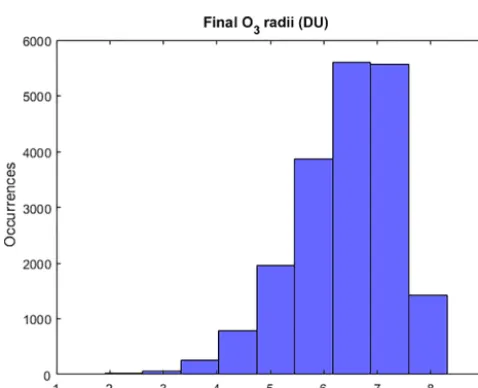
where SD(O3(∗,i,t )) is the standard deviation of the ozone values of the ensemble at time t at locationi, andnis the number of grid spaces. This corresponds to an initial radius of 8.3 DU (0.1523 when scaled as in Eq. 1). Note, the cluster radii evolve in a data-driven manner, excluding outliers and extreme values from the clusters. In consequence, final clus-ter radii using DDC range from 0.1 to 8.3 DU, with 70 % of the primary clusters with a radius<7 DU (Fig. A1). This ra-dius is indicative of the range of O3data at each grid location, after outliers have been identified by the clustering process. 4.1.2 Spatial radii selection
In later sections we show that a cluster-based MMM col-umn ozone field exhibits a lower global mean absolute bias with respect to observations, compared to a simple arith-metic MMM. This reduction in bias, due to the cluster-based subsampling, exhibits some sensitivity to the choice of ini-tial radii in the spaini-tial dimensions. In the latitude dimen-sion, reduction in bias exhibits a negative correlation with radius (r= −0.88); i.e. bias is reduced to a lesser degree with larger radii. Results are presented from here on for ini-tial cluster radii of 1.5 grid cells (0.0683 when normalised to 0–1) and 2.5 grid cells (0.0352) in the latitude and longi-tude directions, respectively, as this combination was found to give the greatest reduction in model–observation bias over-all. As in Sect. 4.1.1., the cluster radii evolve in a data-driven manner and final cluster radii range from 1 to 1.6 grid cells (0.0455–0.0728) in the latitude direction, and 1–2.6 grid cells (0.0141–0.0367) in the longitude direction. Note, 92 and 99 % ofprimaryclusters identified in this study have a radius of less than or equal to 1.1 grid cells in the latitude and longi-tude directions, respectively. A radius of 1.1 grid cells means that at each location, the primary cluster potentially contains data from that cell and from cells with which it shares a bor-der. While data from nearby grid cells may affect the loca-tion of a cluster, these data are not included in cluster-based MMM calculations; the cluster-based MMM at each location is the mean of the data in the primary cluster at that location only.
4.2 Scenarios and metrics
Using the principles described above, the DDC algorithm was applied to the ACCMIP model ensemble of tropospheric column ozone on a monthly basis, and a MMM value was calculated as an average of model values in the primary clus-ter at each location. We also calculated MMMs of the same data using a simple arithmetic mean (all models included, equally weighted) and a sigma mean, without clustering in-volved in either. The sigma mean is essentially the average of all model data within 1σ of the simple arithmetic mean – i.e. a very simple outlier-removal technique. In Sect. 5.1 and 5.2, we compare each of these MMMs and evaluate their per-formance by comparison to the satellite-based tropospheric ozone climatology described in Sect. 4.1. In particular, we note whether or not the cluster-based MMM reduces model– observation bias with respect to the most rudimentary ap-proach, the simple arithmetic mean, which omits no model data. In summary, three MMMs are considered: (1) simple MMM, (2) sigma MMM, and (3) cluster-based MMM. Sev-eral metrics are used in the ensuing discussion, including the model–observation mean bias (Eq. 3), and the absolute mean bias (Eq. 4), whereM andO are the MMM and observed ozone field, respectively, at locationi.
Mean bias=1 n
n X
i=1
(Mi−Oi) (3)
Mean absolute bias=1 n
n X
i=1
|Mi−Oi| (4)
5 Results and discussion
5.1 Assessment of cluster-based MMM on a global basis
Table 1.Observed and multi-model mean (MMM) global tropospheric ozone column (DU) between 60◦N and 60◦S latitude. Observations are a satellite-based climatology (Ziemke et al., 2011). Model data are from the historical (year 2000) ACCMIP simulation. The simple MMM is the arithmetic mean of all models, the sigma MMM excludes data outside of 1 standard deviation from the simple MMM, and the DDC MMM was generated through cluster-based subsampling.
Jan Feb Mar Apr May Jun Jul Aug Sep Oct Nov Dec Annual mean
Observation 28.7 28.8 29.7 30.7 31.5 32.6 33.1 32.8 32.8 32.1 31.1 29.8 31.1
Simple MMM 29.4 29.5 31.0 30.4 30.7 31.4 31.9 32.2 32.3 31.4 30.1 29.5 30.7
Sigma MMM 29.0 29.2 29.9 30.2 30.4 31.1 31.7 32.0 32.0 31.3 30.1 29.4 30.5
DDC MMM 29.0 29.2 29.8 30.2 30.5 31.1 31.5 31.9 32.0 31.2 29.8 29.2 30.5
Table 2.Global monthly mean bias (DU) in tropospheric ozone column (see Eq. (1)) among the various MMMs and observations presented in Table 1.
Jan Feb Mar Apr May Jun Jul Aug Sep Oct Nov Dec Annual mean
Simple MMM 0.6 0.7 0.4 −0.3 −0.8 −1.3 −1.2 −0.6 −0.6 −0.7 −1 −0.4 −0.4 Sigma MMM 0.3 0.5 0.2 −0.5 −1.1 −1.5 −1.4 −0.8 −0.8 −0.8 −1 −0.5 −0.6
DDC MMM 0.2 0.5 0.1 −0.4 −1.0 −1.56 −1.6 −0.9 −0.9 −1.0 −1.3 −0.6 −0.7
Figure 2. Temporal variability in global mean (tropospheric col-umn ozone) absolute bias reduction (%, MMM ozone−observed ozone) with respect to simple arithmetic MMM. Blue points denote bias reduction using DDC clustering to determine model inclusion into the MMM. Orange points denote bias reduction using just the model spread (1σ) to determine model inclusion into the MMM (i.e. without clustering).
mean sense. For example, the annual mean bias for each of the various MMMs is<1 DU. The cluster-based MMM ex-hibits a bias (−0.7 DU) that is marginally greater than that obtained from the simple arithmetic MMM (−0.4 DU). How-ever, note that the global mean biases reflect an amalgama-tion of positive and negative biases, masking important re-gional and hemispheric differences as outlined below.
Table 3 is similar to Table 2 but presents the absolute bi-ases, again on a global mean basis. The cluster-based MMM
exhibits lower global mean absolute biases in all months rel-ative to those obtained from the simple arithmetic mean ap-proach (Fig. 2), reducing the MMM global bias by 5–19 %, depending on the month. While we do not over-interpret our findings from a model process standpoint, a distinct monthly variability is apparent in the bias reduction, with the lowest overall bias reduction in the months June–August. This is also the case for the sigma MMM, also shown in Fig. 2, which exhibits a bias increase with respect to the simple MMM during these months, despite offering a slight bias reduction overall. From Tables 1 and 2, both the ob-served annual mean ozone column and the absolute (model– observation) biases are highest in these months. It is perhaps unsurprising that the impact of subsampling through cluster-ing in some months is relatively modest; if all models agree well, few (or no) model data may be excluded. In this case, the cluster-based MMM will not vary substantially from the simple arithmetic MMM and relatively little (or no) bias re-duction will be observed through cluster-based subsampling. A similar situation also arises if the models have a wide spread of values at a given location; data excluded from the dominant cluster and thus not included in the cluster-based MMM may be equally divided above and below the simple MMM. In such a case, removing these data will have little effect and the cluster-based MMM will vary little from the simple MMM.
5.2 Assessment of cluster-based MMM: spatial variability
Table 3.As Table 2 but the absolute bias (DU) according to Eq. (2).
Jan Feb Mar Apr May Jun Jul Aug Sep Oct Nov Dec Annual mean
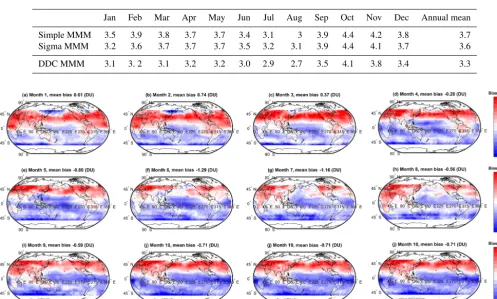
Simple MMM 3.5 3.9 3.8 3.7 3.7 3.4 3.1 3 3.9 4.4 4.2 3.8 3.7
Sigma MMM 3.2 3.6 3.7 3.7 3.7 3.5 3.2 3.1 3.9 4.4 4.1 3.7 3.6
DDC MMM 3.1 3. 2 3.1 3.2 3.2 3.0 2.9 2.7 3.5 4.1 3.8 3.4 3.3
Figure 3.Monthly bias (DU) between the simple arithmetic multi-model mean (MMM) tropospheric ozone column and the observed clima-tology. Global mean values are annotated.
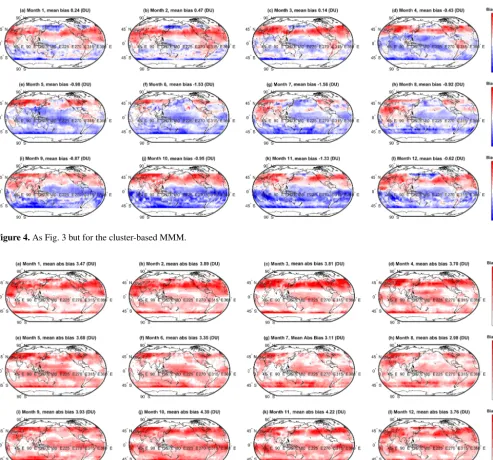
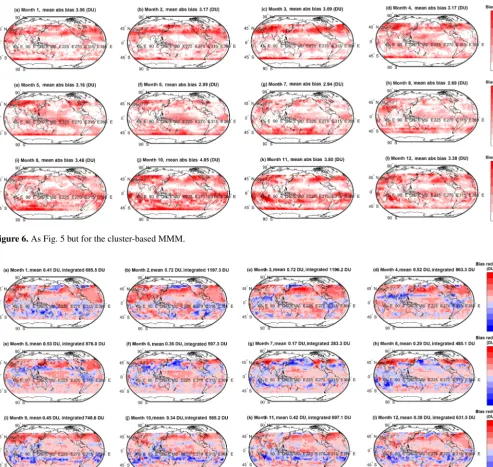
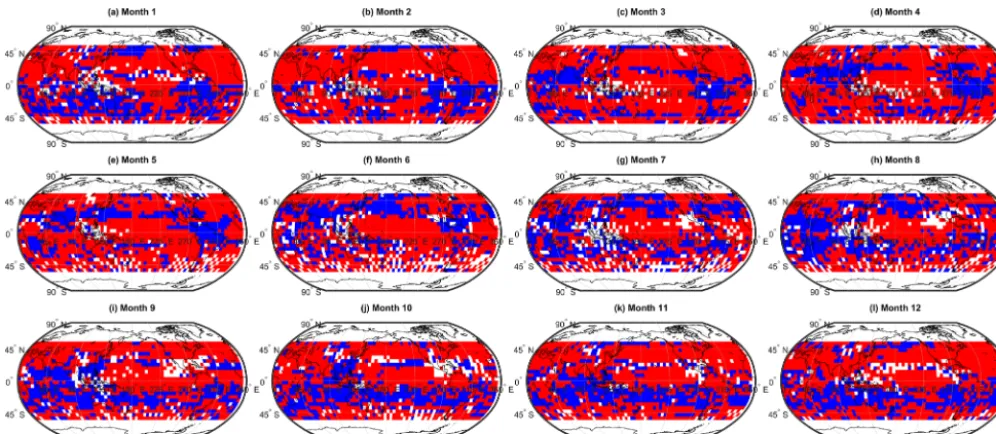
(model−observations, DU) for the simple MMM case is shown in Fig. 3. A similar figure but for the cluster-based MMM is shown in Fig. 4. We note that our analysis agrees with Young et al. (2013); i.e. the ACCMIP ensemble tends to exhibit a high bias with respect to the observations in the Northern Hemisphere (NH) and a low bias in the South-ern Hemisphere (SH, Fig. 3). The positive and negative bi-ases largely cancel, yielding an overall small negative bias when expressed as a global mean (see Table 2). Based on Figs. 3 and 4, differences between the simple rudimentary MMM and the cluster-based MMM are difficult to fully dis-cern by eye. The differences are more apparent when viewed as absolute biases, as given in Figs. 5 and 6. However, most striking is Fig. 7, which compares the reduction in model– observation absolute bias for the cluster-based MMM, rela-tive to the simple arithmetic MMM. Geographically, cluster-based ensemble subsampling reduces the model–observation bias at all latitudes, though particularly in the NH and in-cluding over central Asia, Europe, and the USA – where ozone precursor emissions are generally elevated due to an-thropogenic processes. Note, the ACCMIP ensemble overes-timates the ozone column climatology in the NH (e.g. see Figs. 3 and 5 and previously Young et al., 2013). As such, the NH bias reduction seen in the cluster-based MMM
effec-tively reflects some removal of data at the upper end of the model range (i.e. those models with relatively high ozone). Typical bias reduction is of the order of 1–5 DU, though larger reductions of>5 DU are found in both hemispheres in some grid boxes.
Ad-Figure 4.As Fig. 3 but for the cluster-based MMM.
Figure 5.Monthly absolute bias (DU) between the simple arithmetic multi-model mean (MMM) tropospheric ozone column and the observed climatology. Global mean values are annotated.
ditionally, 29 % of grid cells exhibit a negative bias reduction (i.e. biases between the cluster-based MMM and the obser-vations are larger than those between the simple MMM and the observations). Importantly, the magnitude of the positive bias reductions greatly exceeds that of the negative changes as can be seen from the histogram given in Fig. A2. This sug-gests that the outliers removed from the ensemble tend to be those in relatively strong disagreement with the observations.
Figure 6.As Fig. 5 but for the cluster-based MMM.
Figure 7.Monthly bias reduction (DU) defined as the difference in the absolute bias between the cluster-based MMM ozone column and observations, and the simple arithmetic MMM and observations. Where the bias reduction is positive (i.e. red) the cluster-based MMM values are closer to the observations than the simple arithmetic MMM. In the title of each panel, the global mean absolute bias reduction, and the absolute bias reduction summed over all grid cells are shown.
this suggests that model spread is larger at these locations and times. As such, both cluster 1 and cluster 2 can proba-bly be considered equivocal in terms of representing the en-semble. As can be seen from Fig. 9, in the majority of cases we consider, cluster 1 has significantly more members than cluster 2. This confirms that, in the majority of cases, sub-sampling the ensemble based on the membership of cluster 1 can be considered to be robust. It is important to note
how-ever that there is tail of data points with ratio values>0.5 for which subsampling based on cluster 1 is less reasonable.
dur-Figure 8.As Fig. 7 but showing a binary of grid cells in which the model–observation bias has reduced (red), increased (blue), or not changed (white) as a result of the cluster-based ensemble subsampling.
Figure 9.Histogram of the ratio of the number of members in the second most populous cluster (cluster 2) to those in the most popu-lous cluster (cluster 1).
ing the summer months. It is interesting to note that regions where the ratio>0.5 seem, by eye, to coincide with regions where the model–observation bias is increased when the en-semble is subsampled to the membership of cluster 1. This suggests that by excluding data here we are in fact removing data points which are in closer agreement with the observa-tions. However, in general we calculate no statistically sig-nificant correlation between the ratio values and the change (if any) in bias.
5.4 Insights from cluster membership into model agreement and spread
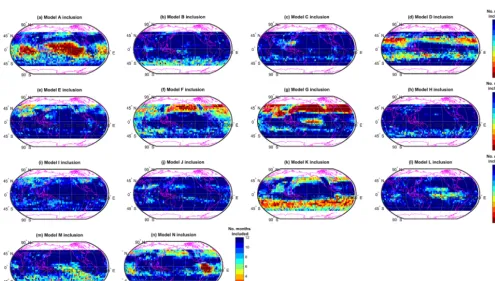
We investigate the degree to which individual models are typically included or excluded from the primary cluster by counting the number of months when that model is included at each location, as shown in Fig. 11. This offers a simple mechanism to visualise model spread more generally; outlier models are more often excluded, and models which fall in the pack are more often included. This information can be used together with Fig. 6 as a means to identify which models are potentially driving ensemble mean model–observation biases, and so identify priorities for model development. We outline some examples here but do not intend this to be ex-haustive, but rather more indicative of how this reasoning and approach potentially provides a useful framework to guide further investigation.
cluster-Figure 10.Spatial and temporal variability in the ratio of the number of members in the second most populous cluster (cluster 2) to those in the most populous cluster (cluster 1).
Figure 11.Number of months each model (names removed, labelled A–N) is included in the primary cluster. For a given region, models that are seldom included (i.e. a low numbers of months) differ more from the ensemble pack.
ing process – could be closer to reality (observations) in this region, relative to the other models. We note that all models are included at some locations, i.e. there is no blanket exclu-sion of certain models from the primary cluster. In fact, some models, e.g. models C, I, and J, are almost always included in
6 Future work
While the principles presented here are robust and proven to be beneficial, some areas of methodological development or refinement have been identified. Firstly, we intend to explore the application of clustering in time, in addition to the mainly spatial methods presented here. Further, at present clusters are allowed to form in three dimensions: latitude, longitude, and the predicted column ozone. In this way we allow for a degree of uncertainty in the model output. Future work will build on this by developing methods to incorporate estimates of standard deviation and range associated with the modelled mean values in our techniques, thus enabling a more sophisti-cated treatment of uncertainty. We have also identified areas of methodological development in terms of our method for calculating a cluster-based MMM. For example, we currently assign all model data from the ensemble to a cluster and then we use this information to include or exclude model data in an MMM. We have yet to consider the impact of weight-ing data within a cluster by (a) distance from cluster centre and (b) distance from the location of the simple MMM (as opposed to a simple include or exclude rule). Similarly, in future work we will look at the possibility of weighting en-semble members according to their cluster membership, i.e. members of the most populous cluster contributing more to the MMM than the less populous clusters and clear outliers. Finally, forthcoming model inter-comparison initiatives, e.g. CMIP6, will provide an excellent opportunity to apply our methods to consider parameters other than ozone that are of atmospheric interest (e.g. other short-lived climate forcing agents).
7 Concluding remarks
In this paper, we have investigated the applicability of an ad-vanced data clustering method as an analytical–diagnostic tool with which to examine multi-model climate output. Relative to more rudimentary approaches, clustering offers a flexible method to evaluate inter-model differences. The technique operates by grouping data at a given location based on the density of data points. The flexibility arises as the clus-tering method examines surrounding data space (e.g. spa-tially) to account for small spatial and mismatch errors (e.g. arising due to differing coarse model grids), thus offering an advantage over more traditional inter-comparison methods. The clustering technique was applied to simulated fields of tropospheric column ozone from the 14 CCMs that took part in the ACCMIP model inter-comparison. We demonstrate that a cluster-based MMM tropospheric column ozone field, calculated using those data which are members of the most populous cluster at each location, exhibits a lower absolute bias with respect to observations, compared to a simple arith-metic MMM approach. On a global mean basis this reduction is observed in all months and, in some months, is as high as ∼20 %. However, we also note that at 28 % of places and times, the cluster-based MMM exhibits a higher absolute bias with respect to observations than a simple arithmetic MMM. We attribute this to apparent outlier model data, which are in closer agreement with observations, being excluded from the cluster-based MMM through cluster-based subsampling. Additionally, we show that clustering offers a useful frame-work in which to readily identify and visualise model spread and outliers. We suggest that such techniques could prove valuable in the identification of model development areas and provide insight surrounding regional strengths and deficien-cies of specific models (or an ensemble as a whole), and to help characterise uncertainty. Finally, while we have focused on tropospheric ozone, we note that there is broad scope to develop the application of these techniques within the atmo-spheric sciences to examine other compounds relevant to cli-mate.
Appendix A
Table A1.Summary and citations for the ACCMIP models and data sets used in this work.
No. Model name Reference
1 CMAM Canadian Centre for Climate Modelling and Analysis (2011)
2 CICERO Centre for International Climate and Environment Research – Oslo (2011) 3 EMAC DLR German Institute for Atmospheric Physics (2011)
4 GFDL-AM3 Geophysical Fluid Dynamics Laboratory (2011) 5 GISS-E2-R NASA Goddard Institute for Space Studies (2011) 6 GEOSCCM NASA Goddard Space Flight Center (2011) 7 CESM-CAM-superfast Lawrence Livermore National Laboratory (2011)
8 LMDzORINCA Laboratoire des Sciences du Climat et de l’Environnement (2011)
9 MOCAGE Météo-France (2011)
10 NCAR-CAM-3.5 NCAR (National Centre for Atmospheric Research, 2011) 11 MIROC-CHEM NCAS British Atmospheric Data Centre (2011)
12 UM-CAM NIWA (2011)
13 STOC-HadAM3 University of Edinburgh (2011)
14 HadGEM2 Hadley Centre for Climate Prediction and Research (2011)
Figure A1.Final radii in the ozone dimension (DU) for primary clusters.
Competing interests. The authors declare that they have no conflict of interest.
Acknowledgements. This work was supported by the EPSRC through a pilot study (Advanced Data Clustering for Climate Science Applications, RFFLP027) as part of the Research on Changes of Variability and Environmental Risk (ReCoVER) program. R. Hossaini is also supported by an NERC Independent Research Fellowship (NE/N014375/1). We thank Paul Young for data access and helpful discussions.
Edited by: Jeremy Fyke
Reviewed by: Martin Schultz and one anonymous referee
References
Aggarwal, C. C. and Reddy, C. K. (Eds.): DATA Clus-tering Algorithms and Applications, CRC Press, Boca Raton, available at: https://www.crcpress. com/Data-Clustering-Algorithms-and-Applications/
Aggarwal-Reddy/p/book/9781466558212 (last access: 28 May 2018), 2014.
Arroyo, A., Tricio, V., Herrero, A., and Corchado, E.: Time Analy-sis of Air Pollution in a Spanish Region Through k-means, in: In-ternational Joint Conference SOCO’16- CISIS’16-ICEUTE’16, edited by: Grana, M., Lopez Guede, J. M., Etxaniz, O., Herrero, A., Quintian, H., and Corchado, E., Advances in Intelligent Sys-tems and Computing, 527 63–72, https://doi.org/10.1007/978-3-319-47364-2, 2017.
Austin, E., Coull, B. A., Zanobetti, A., and Koutrakis, P.: A frame-work to spatially cluster air pollution monitoring sites in US based on the PM2.5 composition, Environ. Int., 59, 244–254, https://doi.org/10.1016/j.envint.2013.06.003, 2013.
Bador, M., Naveau, P., Gilleland, E., Castellà, M., and Arivelo, T.: Spatial clustering of summer temperature maxima from the CNRM-CM5 climate model ensembles and E-OBS over Europe, Weather Clim. Extrem., 9, 17–24, 2015.
Braconnot, P., Harrison, S. P., Kageyama, M., Bartlein, P. J., Masson-Delmotte, V., Abe-Ouchi, A., Otto-Bliesner, B., and Zhao, Y.: Evaluation of climate models us-ing palaeoclimatic data, Nat. Clim. Change, 2, 417–424, https://doi.org/10.1038/NCLIMATE1456, 2012.
Canadian Centre for Climate Modelling and Analysis: ACCMIP: CCCma (Canadian Centre for Climate Modelling and Analysis) climate model output, available at: http://catalogue.ceda.ac.uk/ uuid/933f1028b637a847a6f2e1729cc3237c (last access: 28 May 2018), 2011.
Centre for International Climate and Environment Research – Oslo: ACCMIP: CICERO (Centre for International Cli-mate and Environment Research, Oslo) climate model output, available at: http://catalogue.ceda.ac.uk/uuid/ 798b90d6eec65e6436c34c329df8b9c4 (last access: 28 May 2018), 2011.
Chen, Y.-H. and Prinn, R. G.: Estimation of atmospheric methane emissions between 1996 and 2001 using a three-dimensional global chemical transport model, J. Geophys. Res.-Atmos., 111, D10307, https://doi.org/10.1029/2005JD006058, 2006.
DelSole, T., Yang, X., and Tippett, M. K.: Is unequal weight-ing significantly better than equal weightweight-ing for multi-model forecasting?, Q. J. Roy. Meteor. Soc., 139, 176–183, https://doi.org/10.1002/qj.1961, 2013.
DLR German Institute for Atmospheric Physics: AC-CMIP: DLR (German Aerospace Centre) climate model output, available at: http://catalogue.ceda.ac.uk/uuid/ 4cbf297603e8fec86cbd81abe0591377 (last access: 28 May 2018), 2011.
Eyring, V., Cionni, I., Bodeker, G. E., Charlton-Perez, A. J., Kinni-son, D. E., Scinocca, J. F., Waugh, D. W., Akiyoshi, H., Bekki, S., Chipperfield, M. P., Dameris, M., Dhomse, S., Frith, S. M., Garny, H., Gettelman, A., Kubin, A., Langematz, U., Mancini, E., Marchand, M., Nakamura, T., Oman, L. D., Pawson, S., Pitari, G., Plummer, D. A., Rozanov, E., Shepherd, T. G., Shibata, K., Tian, W., Braesicke, P., Hardiman, S. C., Lamarque, J. F., Mor-genstern, O., Pyle, J. A., Smale, D., and Yamashita, Y.: Multi-model assessment of stratospheric ozone return dates and ozone recovery in CCMVal-2 models, Atmos. Chem. Phys., 10, 9451– 9472, https://doi.org/10.5194/acp-10-9451-2010, 2010. Geophysical Fluid Dynamics Laboratory: ACCMIP: GFDL
(Geophysical Fluid Dynamics Laboratory) climate model output, available at: http://catalogue.ceda.ac.uk/uuid/ 4f766fc704885bd8abc2e8cf8da18074 (last access: 28 May 2018), 2011.
Hadley Centre for Climate Prediction and Research: AC-CMIP: UKMO (UK Meteorological Office) climate model output, available at: http://catalogue.ceda.ac.uk/uuid/ d425df86b1c93132f91fcb1712eb4231 (last access: 28 May 2018), 2011.
Haughton, N., Abramowitz, G., Pitman, A., and Phipps, S. J.: Weighting climate model ensembles for mean and variance estimates, Clim. Dynam., 45, 3169–3181, https://doi.org/10.1007/s00382-015-2531-3, 2015.
Hossaini, R., Patra, P. K., Leeson, A. A., Krysztofiak, G., Abra-ham, N. L., Andrews, S. J., Archibald, A. T., Aschmann, J., Atlas, E. L., Belikov, D. A., Bönisch, H., Carpenter, L. J., Dhomse, S., Dorf, M., Engel, A., Feng, W., Fuhlbrügge, S., Grif-fiths, P. T., Harris, N. R. P., Hommel, R., Keber, T., Krüger, K., Lennartz, S. T., Maksyutov, S., Mantle, H., Mills, G. P., Miller, B., Montzka, S. A., Moore, F., Navarro, M. A., Oram, D. E., Pfeilsticker, K., Pyle, J. A., Quack, B., Robinson, A. D., Saikawa, E., Saiz-Lopez, A., Sala, S., Sinnhuber, B.-M., Taguchi, S., Tegtmeier, S., Lidster, R. T., Wilson, C., and Ziska, F.: A multi-model intercomparison of halogenated very short-lived substances (TransCom-VSLS): linking oceanic emissions and tropospheric transport for a reconciled estimate of the strato-spheric source gas injection of bromine, Atmos. Chem. Phys., 16, 9163–9187, https://doi.org/10.5194/acp-16-9163-2016, 2016. Hyde, R.:
RHyde67/CATaCoMB-Climate-Model-Ensemble: Initial Release (Version v0.1.1), Zenodo, https://doi.org/10.5281/ZENODO.1119039, 2017.
Hyde, R. and Angelov, P.: Data density based clustering, in: 2014 14th UK Workshop on Computational Intelligence (UKCI), 2014 14th UK Workshop on Computational In-telligence (UKCI), Bradford, UK, 8–10 September 2014, https://doi.org/10.1109/UKCI.2014.6930157, 2014.
Labora-tory) climate model output, available at: http://catalogue.ceda.ac. uk/uuid/76176d487a5757234d3075175675246a (last access: 28 May 2018), 2011.
Lamarque, J.-F., Shindell, D. T., Josse, B., Young, P. J., Cionni, I., Eyring, V., Bergmann, D., Cameron-Smith, P., Collins, W. J., Do-herty, R., Dalsoren, S., Faluvegi, G., Folberth, G., Ghan, S. J., Horowitz, L. W., Lee, Y. H., MacKenzie, I. A., Nagashima, T., Naik, V., Plummer, D., Righi, M., Rumbold, S. T., Schulz, M., Skeie, R. B., Stevenson, D. S., Strode, S., Sudo, K., Szopa, S., Voulgarakis, A., and Zeng, G.: The Atmospheric Chemistry and Climate Model Intercomparison Project (ACCMIP): overview and description of models, simulations and climate diagnostics, Geosci. Model Dev., 6, 179–206, https://doi.org/10.5194/gmd-6-179-2013, 2013.
Lawrence Livermore National Laboratory: ACCMIP: LLNL (Lawrence Livermore National Laboratory) climate model output, available at: http://catalogue.ceda.ac.uk/uuid/ 81942748c9f4e15632d0082d9d84a37d (last access: 28 May 2018), 2011.
Lyapina, O., Schultz, M. G., and Hense, A.: Cluster analy-sis of European surface ozone observations for evaluation of MACC reanalysis data, Atmos. Chem. Phys., 16, 6863–6881, https://doi.org/10.5194/acp-16-6863-2016, 2016.
Mace, A., Sommariva, R., Fleming, Z., and Wang, W.: Adaptive K-Means for Clustering Air Mass Trajectories, in: IIntelligent Data Engineering and Automated Learning – IDEAL 2011., edited by: Yin, H., Wang, W., and Rayward Smith, V., Lecture Notes in Computer Science, vol. 6936, Springer, Berlin, Heidelberg, 2011.
MacQueen, J. B.: Some Methods for classification and analysis of multivariate observations, Procedings of the Fifth Berkeley Sym-posium on Math, Statistics, and Probability, 1, 281–297, 1967. Météo-France: ACCMIP: MeteoFrance (French
Na-tional Meteorological Service) climate model out-put, available at: http://catalogue.ceda.ac.uk/uuid/ 5fd4b24429ed256e0572ebf38f860343 (last access: 28 May 2018), 2011.
Muñoz-Díaz, D. and Rodrigo, F. S.: Spatio-temporal patterns of seasonal rainfall in Spain (1912–2000) using cluster and princi-pal component analysis: comparison, Ann. Geophys., 22, 1435– 1448, https://doi.org/10.5194/angeo-22-1435-2004, 2004. NASA Goddard Institute for Space Studies: ACCMIP: GISS
(Goddard Institute for Space Studies) climate model output, available at: http://catalogue.ceda.ac.uk/uuid/ e6a0f9fa6e8a5cce53a2ce56c4eb0426 (last access: 28 May 2018), 2011.
NCAR (National Centre for Atmospheric Research), Lamar-que, J., Shindell, D., Eyring, V., Collins, W., Nagashima, T., Szopa, S., and Zeng, G.: ACCMIP: NCAR (Na-tional Centre for Atmospheric Research) climate model output, available at: http://catalogue.ceda.ac.uk/uuid/ 6a1c68641c65075d2cd24eb899ec6c45 (last access: 28 May 2018), 2011.
NCAS British Atmospheric Data Centre: ACCMIP: NIES (National Institute for Environmental Studies) climate model output, available at: http://catalogue.ceda.ac.uk/uuid/ d8fd67c8235a9935545da54534376ff8 (last access: 28 May 2018), 2011.
Nisha and Kaur, P. J.: A Survey of Clustering Techniques and Algorithms, 2nd International Conference on Computing for Sustainable Global Development (INDIACom), 304–307, https://doi.org/10.5120/1326-1808, 2015.
NIWA: ACCMIP: NIWA (National Institute of Water and Atmospheric Research, New Zealand) climate model output, available at: http://catalogue.ceda.ac.uk/uuid/ 3c5beadb79d969bcf4796b0a1db0bea6 (last access: 28 May 2018), 2011.
University of Edinburgh: ACCMIP: UEDI (University of Ed-inburgh) climate model output. NCAS British Atmospheric Data Centre, available at: http://catalogue.ceda.ac.uk/uuid/ 750818091eb772add8e9e0f7df735a7b (last access: 28 May 2018), 2011.
Qin, N., Kong, X.-Z., Zhu, Y., He, W., He, Q.-S., Yang, B., Ou-Yang, H.-L., Liu, W.-X., Wang, Q.-M., and Xu, F.-L.: Distributions, Sources, and Backward Trajectories of Atmo-spheric Polycyclic Aromatic Hydrocarbons at Lake Small Baiyangdian, Northern China, Sci. World J., 2012, 4163211, https://doi.org/10.1100/2012/416321, 2012.
Stevenson, D. S., Young, P. J., Naik, V., Lamarque, J.-F., Shindell, D. T., Voulgarakis, A., Skeie, R. B., Dalsoren, S. B., Myhre, G., Berntsen, T. K., Folberth, G. A., Rumbold, S. T., Collins, W. J., MacKenzie, I. A., Doherty, R. M., Zeng, G., van Noije, T. P. C., Strunk, A., Bergmann, D., Cameron-Smith, P., Plummer, D. A., Strode, S. A., Horowitz, L., Lee, Y. H., Szopa, S., Sudo, K., Na-gashima, T., Josse, B., Cionni, I., Righi, M., Eyring, V., Conley, A., Bowman, K. W., Wild, O., and Archibald, A.: Tropospheric ozone changes, radiative forcing and attribution to emissions in the Atmospheric Chemistry and Climate Model Intercompari-son Project (ACCMIP), Atmos. Chem. Phys., 13, 3063–3085, https://doi.org/10.5194/acp-13-3063-2013, 2013.
Viovy, N.: Automatic Classification of Time Series (ACTS): A new clustering method for remote sens-ing time series, Int. J. Remote Sens., 21, 1537–1560, https://doi.org/10.1080/014311600210308, 2000.
Voulgarakis, A., Naik, V., Lamarque, J.-F., Shindell, D. T., Young, P. J., Prather, M. J., Wild, O., Field, R. D., Bergmann, D., Cameron-Smith, P., Cionni, I., Collins, W. J., Dalsøren, S. B., Doherty, R. M., Eyring, V., Faluvegi, G., Folberth, G. A., Horowitz, L. W., Josse, B., MacKenzie, I. A., Nagashima, T., Plummer, D. A., Righi, M., Rumbold, S. T., Stevenson, D. S., Strode, S. A., Sudo, K., Szopa, S., and Zeng, G.: Analysis of present day and future OH and methane lifetime in the ACCMIP simulations, At-mos. Chem. Phys., 13, 2563–2587, https://doi.org/10.5194/acp-13-2563-2013, 2013.
Wanders, N. and Wood, E. F.: Improved sub-seasonal me-teorological forecast skill using weighted multi-model ensemble simulations, Environ. Res. Lett., 11, 94007, https://doi.org/10.1088/1748-9326/11/9/094007, 2016.
Xu, D. and Tian, Y.: A Comprehensive Survey of Clus-tering Algorithms, Annals of Data Science, 2, 165–193, https://doi.org/10.1007/s40745015-0040-1, 2015.
Shin-dell, D. T., Strode, S. A., Sudo, K., Szopa, S., and Zeng, G.: Pre-industrial to end 21st century projections of tropospheric ozone from the Atmospheric Chemistry and Climate Model Intercom-parison Project (ACCMIP), Atmos. Chem. Phys., 13, 2063– 2090, https://doi.org/10.5194/acp-13-2063-2013, 2013. Yuan, X. and Wood, E. F.: On the clustering of climate models in
ensemble seasonal forecasting, Geophys. Res. Lett., 39, L18701, https://doi.org/10.1029/2012GL052735, 2012.
Ziemke, J. R., Chandra, S., Labow, G. J., Bhartia, P. K., Froide-vaux, L., and Witte, J. C.: A global climatology of tropo-spheric and stratotropo-spheric ozone derived from Aura OMI and MLS measurements, Atmos. Chem. Phys., 11, 9237–9251, https://doi.org/10.5194/acp-11-9237-2011, 2011.