LTE Based SUI Modeling For FLIP-OFDM To Analyse The Performance
Of Optical Wireless Communication
Kosalendra Eethamakula
Department of ECM (Assistant Professor)J. B. Institute of Engineering and Technology, Moinabad Mandal, Hyderabad, Telangana, (500075), INDIA
Abstract
EM spectrum is considered as scariest assets in the world as the request is increasing and resources are keep on reducing. Along with time, traffic is increasing and OWC is thinking about as promising method for utilizing RF resources in effective way particularly in short and medium range of communications. In this paper, To extract nonnegative signals in optical wireless communication (OWC) systems, flipped orthogonal frequency division multiplexing (Flip-OFDM) transmits the positive and negative parts of the signal more than two back to back OFDM subframes (positive sub frame and negative subframe, individually).As the conventional receiver are used to transmit the data by subtracting the negative frame from the positive subframe. Due to the subtraction of negative frame there will be data loss. Because the signal analysis shows that the information will be transmitted by both the subframes. An efficient flip OFDM mechanism is utilized along with iterative receiver to improve the transmission and finally results show proposed method yield good performance.
Index terms: Keywords: Optical Wireless Communication (OWC), Orthogonal Frequency Division Multiplexing (OFDM), Flip OFDM, Iterative Receiver and Stanford university interim (SUI).
I.
I
NTRODUCTION
Recently, optical wireless communications (OWC) need risen as an elective on utilizing radio frequencies (RF) to wireless. OWC need Traditionally utilized infrared (IR) transmitters. This is because infrared systems present certain advantages over RF systems for short-range indoor communications, including no electromagnetic interference concerns, simplicity about sign restriction to security purposes, also license-free operations. However, the utilization for white light emitting diodes (LEDs) will
be progressively turning into a engaging elective on IR since white LEDs can be used to illuminate and communicate at the same time. OWC system utilizing white LEDs would allude to Likewise visible light communications (VLC). As LED is used widely due to their more advantages, so optical wireless communication is mostly used in industry and other application nowadays. Advantages of LED such as rich spectrum resource and higher security application which are replaces RF (Radio Frequency) systems.
Mainly the green communication technology is working on this technology. The green communication is going to consider direct application on the signals or it may changes the network used to transmit the signal.
In order to get high data rate and other so many advantages, like ISI (inter symbol interference), ICI (Inter carrier interference), the technology used is OFDM (Orthogonal Frequency Division Multiplexing) in Optical Wireless Communication (OWC). As we are using the IM/DD (Intensity Modulation and Direct Detection) the transmitted signal must be real and nonnegative signal. There are two techniques we are going to use one is for obtaining real time domain signal by applying Hermitian Symmetry on the OFDM subcarriers and for issue of bipolarity in OFDM signal several schemes are proposed as , Direct current (DC) biased optical OFDM(DCO-OFDM), Asymmetrically clipped optical OFDM (ACO-OFDM) and pulse amplitude modulated discrete multitone(PAM-DMT).
In this paper we are going to transmit the signal through a novel OFDM technique named as Flip-OFDM, in this technique we are going to transmit the positive and negative signals on two consecutive subframes. We can see how we are going to replace the DCO-OFDM with nearly equal or more spectral efficiency using Flip-OFDM in OWC.
In this paper we are going to use iterative receiver. As in conventional receiver for flip-OFDM data is regained by subtracting the negative signal block from the positive signal block. This method is simple and straightforward, but it increases the noise variance of the received symbol making the performance more worst. Again to improve the performance we are going to use Time domain noise filtering techniques was proposed but algorithm doesn’t use full structure.
So, in this paper Iterative receiver is proposed for Flip-OFDM which uses the full structure of received signal. By MATLAB simulation we can see that the proposed receiver is performing better than the other receivers.
II.
R
ELATEDW
ORKPrevious related works have mainly focused on the maximization of GEE, but for different system settings. To the best of our knowledge, the work which considers the scenario most similar to ours is; however, while assumes that users are associated to all BSs in the cluster, a configuration usually referred to as virtual (or network) MIMO, we consider a scenario wherein each user is associated to only one BS. As to Sum-EE and Prod-EE, they have been considered in non-cooperative games, but not in the context of coordinated cellular networks.
We derive novel procedures aimed at maximizing the above figures of merit with a constraint on the maximum transmit power (either per subcarrier or per base station): this is the major contribution of this work. GEE is optimized by solving a series of concave-convex fractional relaxations, while for Prod-EE a series of concave relaxations is considered. In both cases, the proposed
method to solve the Karush–Kuhn– Tucker (KKT) conditions of the corresponding nonconvex problem. For all figures of merit, we derive algorithms to compute a globally-optimal solution in the asymptotic noise-limited regime.
Numerical results indicate that the optimization of the considered figures of merit gives similar performance for low values of the maximum transmit power; in this case, maximizing the network energy efficiency is also approximatively equivalent to maximizing the network spectral efficiency. For large values of the maximum transmit power, a moderate reduction of the network spectral efficiency may allow a significant energy saving; in this regime, Sum-EE and Prod-EE allow to better control the individual energy efficiency achieved by each BS than GEE, which is an attractive feature in heterogeneous networks. Also, Prod-EE ensures a more balanced use of the available subcarriers at the price of a more severe loss. Our approach applies to both frequency- and time-division duplexing in terms of network spectral efficiency.
III.
S
YSTEMM
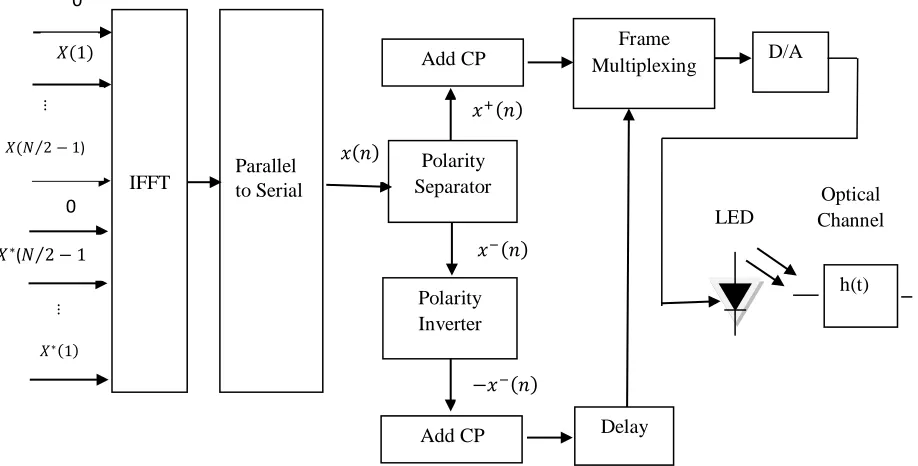
ODELThe block diagram of iterative Flip-OFDM transmitter with N subcarriers is shown in Fig. 1. To be certain that the time-domain signal is actual in IM/DD systems, the input data vector 𝑋 = [𝑋(0), 𝑋(1), … 𝑋(𝑁 − 1)]𝑇
must be satisfy the Hermitian symmetry property, i.e.,
𝑋(𝑘) = 𝑋∗(𝑁 − 𝑘), 𝑘 = 1,2, … , 𝑁 2 − 1⁄ (1)
Fig. 1. Block diagram of a Flip-OFDM transmitter.
𝑥(𝑛) = 1
√𝑁∑ 𝑋(𝑘)𝑒𝑥𝑝(𝑗2𝜋𝑘𝑛 𝑁⁄ )
𝑁−1
𝑘=0
= 2
√𝑁 ∑ 𝑅𝑒[𝑋(𝑘)𝑒𝑥𝑝(𝑗2𝜋𝑘𝑛 𝑁⁄ )]
𝑁 2−1⁄
𝑘=1
(2)
𝑛 = 0,1, … , 𝑁 − 1
The signal𝑥(𝑛) ,is real and bipolar values, can be decomposed as
𝑥(𝑛) = 𝑥+(𝑛) + 𝑥−(𝑛) (3)
Here, the positive part and the negative part are defined as
𝑥+(𝑛) = {𝑥(𝑛), 𝑥(𝑛) ≥ 0
0, 𝑥(𝑛) < 0 (4)
𝑥−(𝑛) = {𝑥(𝑛), 𝑥(𝑛) < 0
0, 𝑥(𝑛) ≥ 0(5)
To guarantee a nonnegative time-domain signal, the two components 𝑥+= [𝑥+(0), 𝑥+(1), … 𝑥+(𝑁 − 1)]𝑇 and
𝑥−= [𝑥−(0), 𝑥−(1), … 𝑥−(𝑁 − 1)]𝑇 are Individually
transmitted over two successive OFDM subframes. The confident component x+ is transmitted within the first subframe (confident subframe), while the flipped negative element −x− is transmitted within the 2d subframe (negative subframe). An instance of the time domain alerts in Flip-OFDM is illustrated in Fig. 2. After propagating through the optical channel, the unipolar time domain sign is got via a photo detector. Assuming the channel impulse response vector h = [h(0), h(1), … h(𝑁 − 1)]𝑇 is
constant over two consecutive OFDM subframes, the received signal vectors in the frequency domain are given by
𝑌+= 𝐻𝑋++ 𝑍+ (6)
𝑌−= −𝐻𝑋−+ 𝑍− (7)
Where 𝐻 = 𝑑𝑖𝑎𝑔(𝑊𝑁ℎ), 𝑥+= 𝑊𝑁𝑥+, 𝑥−= 𝑊𝑁𝑥−, 𝑊𝑁
is the 𝑁 × 𝑁 Discrete Fourier transform (DFT) matrix, 𝑍+
and 𝑍−~𝑁(0, 𝜎2𝐼) represent the noise vectors of the two
subframes, respectively IFFT
0
𝑋(1)
⋮
𝑋(𝑁 2 − 1⁄ )
Parallel to Serial
Polarity Separator
Polarity Inverter
Add CP
Frame
Multiplexing D/A
Delay
h(t)
0
𝑋∗(𝑁 2 − 1⁄
)
⋮
𝑋∗(1)
Add CP
𝑥−(𝑛)
𝑥(𝑛)
𝑥+(𝑛)
−𝑥−(𝑛)
LED
Fig. 2. An example of the time domain signals in Flip-OFDM (N =8). (a) 𝑥(𝑛). (b) 𝑥+(𝑛)
and 𝑥−(𝑛)
.
IV.
P
ROPOSEDR
ECEIVERThe conventional receiver is simple and straightforward, but it does not fully exploit the structures of the received signals. In the following, a new receiver is proposed by establishing the relationship between the received signals
𝑦+and 𝑦− the input data X.
Where |𝑥| can be expressed as
|𝑥| = 𝑆(𝑋)𝑥 =𝑆(𝑋)𝑊𝑁𝐻𝑋 , (1)
Where S(X) is defined as
S(X) =𝑑𝑖𝑎𝑔{𝑠𝑖𝑔𝑛(𝑥)}𝑑𝑖𝑎𝑔{𝑠𝑖𝑔𝑛(𝑊𝑁𝐻𝑋)}, (2)
Then the positive and negative parts can be writes as follows,
𝑥+=𝑥+|𝑥| 2 =
𝑥+𝑆(𝑋)𝑊𝑁𝐻𝑋 2 .
The relationship between the 𝑦+ and X can be derived as
𝑦+=𝐻𝑊𝑁𝐻𝑆(𝑋)𝑊𝑁𝐻𝑋−𝐻
2 𝑋 + 𝑍
− (3)
Particularly, in line-of-sight (LOS) channels, the channel response can be expressed as
ℎ(𝑛) = 𝑐𝛿(𝑛) (4)
and finally the iterative receiver becomes
+ [𝐼 + 𝑊𝑁𝑆(𝑥̂𝐿𝑂𝑆 )𝑊𝑁 − 𝐼]𝑦 }
V.
E
XTENSIONW
ORKIn the future, Stanford University Interim (SUI) channel is replaced in place of AWGN channel. SUI channel works for both indoor and outdoor applications; here the complexity is more but the spectral efficiency is much more near to AWGN channel. The set of SUI channel models specify statistical parameters of microscopic effects (tapped delay line, fading, and antenna directivity). To complete the channel model, these statistics have to be combined with macroscopic channel effects such as path loss and shadowing.
The performance of BER in SUI model is better compared to iterative method. The simulation results are as follows to shows the performances of multiple methods.
VI.
S
IMULATIONR
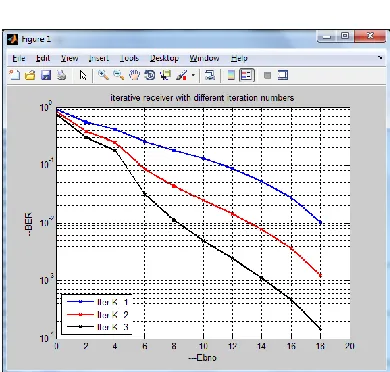
ESULTSFig 3: BER performance of iterative receiver with multiple iterations
Fig 4: The performance of BER using NLOS
Analysis: The performance of BER is evaluated using flip-OFDM. The signal is transmitted through non-line of sight path. In the above the performance of conventional and proposed method is compared. The performance of iterative is better than conventional method.
Fig 5: The performance of BER using LOS
Analysis: The performance of BER is evaluated using flip-OFDM. The signal is transmitted through line of sight path. In the above the performance of conventional and proposed method is compared. The performance of iterative is better than conventional method.
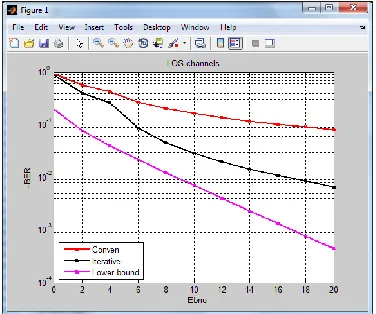
Fig 6: SUI channel in terms of BER
Analysis: In the extension work, Stanford university interim (SUI) is used as a channel model to improve the performance of BER compared to iterative method.
VII.
C
ONCLUSIONIn optical wireless communication there is almost all data is stored in positive peak so negative peak should be bring back to zero amplitude. In flip-OFDM we flipped negative amplitude to zero and data rate is almost increased to certain level. By analysis through BER graph we get the performance of the proposed work. Also, we proved that the execution results obtained by applying the SUI modeling improved to certain extent.
R
EFERENCES[1] H. L. Minh, D. O’Brien, G. Faulkner, L. Zeng, K. Lee, D. Jung, Y. Oh, and E. T. Won, “100-mb/s NRZ visible light communications using a postequalized white led,” IEEE Photonics Technology Letters, vol. 21, no. 15, pp. 1063–1065, Aug. 2009.
[2] J.-B. Wang, Q.-S. Hu, J. Wang, M. Chen, and J.-Y. Wang, “Tight bounds on channel capacity for dimmable visible light communications,” Journal of Lightwave Technology, vol. 31, no. 23, pp. 3771–3779, Dec. 2013.
optical wireless links,” IEEE Transactions on Communications, vol. 60, no. 1, pp. 153–163, Jan. 2012.
[5] N. Huang, J.-B. Wang, J. Wang, C. Pan, H. Wang, and M. Chen, “Receiver design for PAM-DMT in indoor optical wireless links,” IEEE Photonics Technology Letters, vol. 27, no. 2, pp. 161–164, Jan. 2015.
[6] J. Armstrong and B. Schmidt, “Comparison of asymmetrically clipped optical OFDM and DC-biased optical OFDM in AWGN,” IEEE Communications Letters, vol. 12, no. 5, pp. 343–345, May 2008.
[7] J. Armstrong and A. Lowery, “Power efficient optical OFDM,” Electronics Letters, vol. 42, no. 6, pp. 370–372, Mar. 2006.
[8] S. C. J. Lee, S. Randel, F. Breyer, and A. M. Koonen, “PAM-DMT for intensity-modulated and direct-detection optical communication systems,” IEEE Photonics Technology Letters, vol. 21, no. 23, pp. 1749–1751, Dec. 2009.
[9] N. Fernando, Y. Hong, and E. Viterbo, “Flip-OFDM for optical wireless communications,” in Proc. 2011 IEEE Information Theory Workshop (ITW), 2011, pp. 5–9
[10] D. Tsonev and H. Haas, “Avoiding spectral efficiency loss in unipolar OFDM for optical wireless communication,” in Proc. 2014 IEEE International Conference on Communications (ICC), pp. 3336–3341.
[11] N. Fernando, Y. Hong, and E. Viterbo, “Flip-OFDM for unipolar communication systems,” IEEE Transactions on Communications, vol. 60, no. 12, pp. 3726–3733, Dec. 2012.
[12] D. Tsonev, S. Sinanovic, and H. Haas, “Novel unipolar orthogonal frequency division multiplexing (U-OFDM) for optical wireless,” in Proc. 2012 IEEE 75th Vehicular Technology Conference (VTC Spring), pp. 1–5.
[13] E. G. Larsson, “MIMO detection methods: How they work,” IEEE Signal Processing Magazine, vol. 26, no. 3, pp. 91–95, May 2009.
Information Theory, vol. 58, no. 7, pp. 4645– 4659, July 2012.