www.geosci-model-dev.net/4/611/2011/ doi:10.5194/gmd-4-611-2011
© Author(s) 2011. CC Attribution 3.0 License.
Geoscientific
Model Development
Influence of the compiler on multi-CPU performance of WRFv3
T. Langkamp and J. B¨ohner
Institute of Geography, University of Hamburg, Germany
Received: 14 February 2011 – Published in Geosci. Model Dev. Discuss.: 21 March 2011 Revised: 27 June 2011 – Accepted: 4 July 2011 – Published: 13 July 2011
Abstract. The Weather Research and Forecasting system version 3 (WRFv3) is an open source and state of the art numerical Regional Climate Model used in climate related sciences. These years the model has been successfully op-timized on a wide variety of clustered compute nodes con-nected with high speed interconnects. This is currently the most used hardware architecture for high-performance com-puting (Shainer et al., 2009). As such, understanding the influence of hardware like the CPU, its interconnects, or the software on WRFs performance is crucial for saving com-puting time. This is important because comcom-puting time in general is rare, resource intensive, and hence very expensive. This paper evaluates the influence of different compilers on WRFs performance, which was found to differ up to 26 %. The paper also evaluates the performance of different Mes-sage Passing Interface library versions, a software which is needed for multi CPU runs, and of different WRF versions. Both showed no significant influence on the performance for this test case on the used High Performance Cluster (HPC) hardware.
Emphasis is also laid on the applied non-standard method of performance measuring, which was required because of performance fluctuations between identical runs on the used HPC. Those are caused by contention for network resources, a phenomenon examined for many HPCs (Wright et al., 2009).
1 Introduction: the benchmark goal
In numerical weather modelling limited computing capac-ity is a crucial problem.Especially for climate relevant time spans of 30 yr simulation time (or even more), for high model
Correspondence to: T. Langkamp ([email protected])
resolutions, and/or big domains (global) every percent of gained model performance counts. Thus, the performance of the Regional Climate Model (RCM) Weather Research and Forecast (WRF) system is evaluated in this paper. More pre-cisely the benchmark was done for one of the two available numerical solvers of the WRF: the Advanced Research WRF (ARW) version 3.
Since access was restricted to Tornado, a High Performance Cluster (HPC) of the Deutsche Klima-Rechenzentrum (DKRZ), an inter-comparison study between different HPC hardware was not possible. Either way such a study would not be as interesting at all, because many hardware-related studies are already available for WRF. Most of them are collected by WRF developer John Michalakes of the National Center for Atmospheric Research (NCAR), and made publicly available on the central web page www. mmm.ucar.edu/wrf/WG2/benchv3. The page is updated at least yearly with new benchmark measurements since 2008.
Instead of such a hardware-related study different software influencing WRFs performance was evaluated. This includes different versions of WRF, the Message Passing Interface (MPI) library, and the compiler. This kind of benchmark yet has been published in conference papers, but not in peer re-viewed journals. For example, the search results on the ISI Web of Science http://apps.isiknowledge.com on 24 May in-cluding the following words in the title were:
– 0 results for “compiler* benchmark* WRF*”, – 16 results for “compiler* benchmark*”
But as mentioned, at least some conference papers dealt with a compiler comparison benchmark on WRF. For exam-ple Shainer et al. (2009), Roe and Stevens (2010), or Newby and Morton (2008), made benchmarks with a focus on MPI and network issues. Similar work was published lately in two presentations with an additional focus on Intel versus the GNU Compiler Collection (GCC) and Intel versus PGI compilers by the HPC Advisory Council (December 2010) and Sankaran (October 2010) respectively. Both benchmarks were done on HPCs with Intel CPUs, the latter additionally on AMD CPUs.
For this paper a benchmark suite was implemented on the Tornado HPC which operates AMD CPUs of another series, thus the results allow a relative comparison with the results of Sankaran and the HPC Advisory Council only. As an ex-tension to their presentations this paper compares three ma-jor compilers instead of two on a single machine running WRFv3, and documents the whole implementation process in such a detailed way that other users should be able to con-duct comparable benchmarks on their systems.
1.1 Introduction: important software influencing WRFs performance
The compiler is the most important performance-related soft-ware for any program which the user can compile. The compilation process translates the source code written in a programming language like C or Fortran into a machine-readable binary format. This process enables the perfor-mance optimization of the software for different hardware.
In case of software that can take advantage of HPCs due to the time-parallel use of many CPUs (like WRF) the MPI library is a second important software influencing WRFs per-formance. MPI is responsible for the efficient communica-tion between the CPUs, which often is a bottleneck due to a limited transfer bandwidth of their connection. Hence, four different MPI versions available on Tornado were compared in this performance evaluation.
The third important software is WRF itself. It is not always necessary to use the most recent version in regard of new fea-tures or model accuracy because they may not be needed in specific research questions. In this case one should always just use the fastest version. One can expect older, less com-plex versions to perform better, however, one may also ex-pect newer versions to perform better because of source code optimizations. Therefore the two ARW versions 3.1.1 and 3.2.1 were evaluated.
The fourth parameter influencing the performance is set in the configuration file configure.wrf, which will be generated right before the compilation. One can set in the configure.wrf the option to compile WRF for single or multi-CPU hard-ware. Since practical application cases of WRF running on a single-CPU are rare – especially if an HPC is available – only a multi-CPU option was of interest. WRF offers three of them: The first multi-CPU option is named smpar, working
with an OpenMP shared memory thread paradigm, not to be confused with MPI. Second option is dmpar and works with an MPI task distributed memory paradigm. The third approach is a hybrid one, that combines MPI and OpenMP, where each MPI task spawns a number of threads to utilize shared memory in a node. But as already shown by Morton et al. (2009), by the HPC Advisory Council (December 2010) and others for WRF the dmpar case often outperforms the hybrid and the smpar cases clearly. However, referring to Morton et al. (2009) there were groups that found opposing results on other architectures and with other compilers, but only with “slightly” and not clearly better performance of the hybrid approach. So no emphasis is laid on hybrid versus dmpar comparison within this paper.
In a nutshell, this software benchmark suite will consist of an inter-comparison of compiler, MPI library, and WRF version influencing WRFs performance. However, the focus is on the compiler as the most important tool in performance optimization of software.
1.2 Introduction: about the WRF model
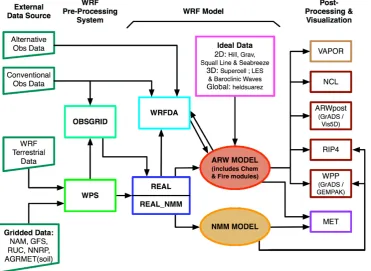
WRF is a mesoscale numerical weather prediction system and also a regional to global (experimental stage) climate model allowing simulations reflecting either real data or ide-alized configurations. It features a 3-dimensional variational data assimilation system, and an open source software archi-tecture allowing for computational parallelism and system extensibility due to the modularity of its components (see Fig. 1).
WRF can be run with two dynamical cores, the Nonhy-drostatic Mesoscale Model (NMM) and ARW. ARW-only features are regional climate and seasonal time-scale re-search, coupled-chemistry applications, global and idealized simulations – while both NMM and ARW are suitable to do research on atmospheric physics/parameterizations, case-studies, real-time NWPs and forecast systems, and data as-similation (Dudhia, 2011).
Both are freely available via the same source code pack-ages at www.mmm.ucar.edu/wrf/src for versions 2.0 up to 3.3. Precompiled binaries are only available for version 3.1 and x86 CPUs via Robert Rozumalski of the US National Weather Service at http://strc.comet.ucar.edu/wrfems/index. htm.
Fig. 1. A schematic of the used model environment. Mainly the WRF Modelling System consists of the WRF Preprocessing System (WPS) and the physical numerical core Advanced Research WRF (ARW). The NMM core is an alternative used in operational weather forecast (from Wang et al., 2011).
user guide by Wang et al. (2011) and in the technical physi-cal documentation by Skamarock et al. (2008).
2 The benchmark setup
After describing the benchmark goal, the environmental soft-ware components, and the model to benchmark in the pre-vious section, this section will document the detailed setup of the benchmark suite, consisting of specifications of hard-ware, environmental softhard-ware, model softhard-ware, and model domain.
2.1 Hardware: specifications of Tornado
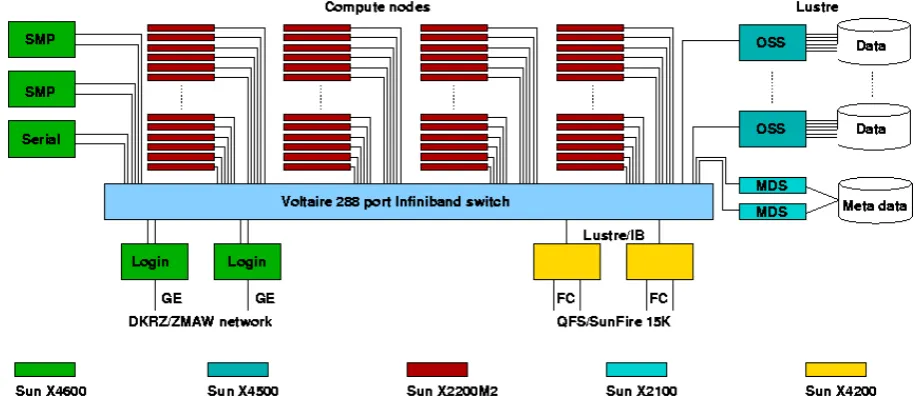
The Tornado HPC of the DKRZ is a 2048 core Linux cluster. Core describes a subunit of today’s multi-core CPUs, which is capable of processing one task at a time each. The 256 compute servers of Tornado consist of two quad-core CPUs each (model AMD Opteron 2384, 2.7 GHz), including 4 gi-gabyte RAM per core. Furthermore a single of the 256 com-pute servers is referred to as a node (model Sun X2200 M2). This multiplies up to 4 cores times 2 CPUs times 256 nodes equals 2048 cores; and 4 gigabyte RAM times 8 cores times 256 nodes equals 8 terabyte RAM.
The nodes are interconnected via Gigabit Ethernet and a low latency Infiniband DDR network. More details like
on storage and login nodes – which are in this case non-crucial components concerning performance – see Fig. 2 and https://tornado-wiki.dkrz.de/farm/HardwareOverview. (Note: In other scenarios with e.g. heavy write loads the storage nodes might even be more important than the compute nodes.)
2.2 Environmental software: operating system, grid engine, MPI, and compiler
Fig. 2. A schematic of the used cluster hardware also known as “Tornado” of the Deutsche Klima Rechenzentrum (from the Tornado Wiki Hardware Overview).
probably negative influence on WRF. The installed Sun Grid Engine (SGE) software version 12.1 is responsible for sub-mission and scheduling of jobs from Tornado’s login nodes to its compute node queue. After a job submission to the queue MPI starts distributing the job to the requested amount of cores.
MPI libraries are available from different proprietary soft-ware vendors like Intel. The preinstalled MPI on Tornado is an open source implementation of MPI, named Open MPI. The installation and benchmarking of another MPI, even of only another version of Open MPI was successful for Open MPI 1.5.1, but worked only for 8 cores. Altogether the Open MPI versions 1.3.3, 1.4.0, 1.4.3, and 1.5.1 were eval-uated. (Note: Open MPI should not in any way be confused with OpenMP needed for smpar shared memory runs, see Sect. 1.1)
The most straightforward compiler for WRF is the GCC. It consists of the C compiler gcc, the Fortran compiler Gfor-tran, and several more. Gfortran and gcc are both needed, because WRFs framework connecting all parts of WRF is written in C while all physical modules are written in For-tran. However, only the latter significantly influences the ap-plication’s performance (see Sect. 2.3).
Besides the open source GCC, proprietary Fortran and C compilers of the manufacturers Intel and PGI were used. The Sun compiler came without a proper Open MPI installation. (Note: Open MPI should be compiled with the same compiler as WRF to avoid complications; Until version 11 the Intel compilers were free of charge for non-commercial use, since the actual version 12 they are chargeable as those from PGI.) There are more compilers supported by WRF (see Wang et al., 2011), but they are not compatible with Tornado’s hard-ware, with exception of the PathScale compiler, which was
not preinstalled. It would be worth testing it in future re-search.
2.3 Model software: compiling of netCDF, WRF and WPS
An important prerequisite to compile WRF is an installa-tion of the Network Common Data Format (netCDF) used as input and output format by WRF. Further prerequisites for netCDF and WRF are numerous and usually shipped with the Linux Distribution. Only the most important packages shall be noted here: zlib, perl, a shell like bash or csh, make, M4.
wise to compile netCDF with “large file support” to access bigger than 2 GB files. A detailed online tutorial on those prerequisites and finally the compiling of WRF can be found at www.mmm.ucar.edu/wrf/OnLineTutorial/index.htm.)
The two WRF ARW versions 3.1.1 and 3.2.1 had to be compiled with special MPI- and compiler-options. Those are specific to this case and therefore not documented within the WRF user’s guide (Wang et al., 2011) or in the online tutorial just mentioned. The general compile-options, also known as flags, can be altered in theconfigure.wrf, just like the option that tells WRF to compile for single- or multi-CPU usage (see Sect. 1.1). In most cases all flags are auto-matically chosen correctly by the configure script. But be-cause Open MPI did not recognize the flags-f90=$(SFC) and-cc=$(SCC), those had to be erased from the lines DM FC and DM CC, on the one hand. On the other hand, the flag -DMPI2 SUPPORT had to be added to the line DM CC. Additionally the flag -ip had to be erased from the line CFLAGS LOCALfor versions using an Intel com-piler. For PGI and GCC compilers the auto-generated configure.wrfwas sufficient (see Appendix A).
There are also compiler-flags that influence the perfor-mance of WRF-runs, but only for WRFs Fortran coded part. This was verified by turning off all optimizations for the C code compilation in theconfigure.wrf line CFLAGS LOCALby setting-O3to-O0. As expected this did not change the benchmark results. The Fortran code in-stead is considerably faster with full optimizations (e.g.-O3) or flags like -qhot, but this might crash the model while run-ning or compiling (WRF Users Page 2008). In most cases sticking to-O2 is sufficient, only one user reported in the WRF User’s Forum (2009) that he had to fall back to -O0to compile WRF.
Further performance-flags were altered within this paper to compare GCC with the unoptimized PGI. Thus the five PGI optimization flags fastsse, Mvect=noaltcode, Msmartalloc, Mprefetch=distance:8, and Mfprelaxed were deleted consecutively from configure.wrf, line FCOPTIM, before the com-pilation. This left six differently optimized WRF/PGI configurations (full to no optimization).
There are also non value-safe optimizations that lead to differing model outputs. Those are e.g. adding the flag -IPF fp relaxed (Cisneros et al., 2008; Semenov et al., 2005), or removing the -fp-model precise flag from the lineFCBASEOPTSwhen using Intel compilers (for reference and explanatory notes see the Intel-note in your configure.wrf). Both optimizations were not consid-ered worth testing. They should be used careful, only after comparing the differences between a representative model-output of the safe compiled model and the non value-safe compiled one. If the errors are not relevant for ones research target, one can use them.
2.4 Model domain: size, resolution, decomposition, and duration
WRF developer John Michalakes (2010) offers two standard benchmark domains for WRF version 3.0 at www.mmm. ucar.edu/wrf/WG2/benchv3, named CONUS, with resolu-tions of 2.5 and 12 km. It is crucial to run those benchmark cases exactly according to the instructions on that page if one wants to compare different HPC hardware. Since CONUS lays no emphasis on benchmarking software like compilers, it was decided to evaluate the more up to date WRF ver-sions 3.1.1 and 3.2.1 with an easily available domain of a size somewhat between CONUS 2.5 and 12 km. Therefore the already available Default January 2000 case1of the WRF online tutorial case studies2 was used. Only little modifi-cations were made solely to resolution and duration via the namelist configuration files (see Appendix B). This has two advantages. The first one is that other users can implement the same benchmark easily by following the detailed instruc-tions and download locainstruc-tions of the online tutorial case stud-ies. The second advantage is that in consequence there is no new documentation needed.
The Default January 2000 case is a winter storm of 24 to 25 January over the east coast of North America with a hori-zontal resolution of 30 km and 28 vertical levels. At this reso-lution the domain comprises 74·61·28=126 392 grid points. On Tornado this relatively small grid turned out to slow down the computation when using more than 8 cores. This can be explained due to Tornado’s limitations in network resources or the so called computations to communications ratio, which was to small for more than 8 cores. To elaborate, the compu-tations to communications ratio describes the phenomenon, that the more cores share the computation of a domain, the more they have to communicate about the physical fluxes be-tween the sub-domains: “Computation is related to the local domain’s volume, and communication is related to the local domain’s boundary area” (Salapura et al., 2006).
Even though Tornado’s nodes have low latency Infini-band interconnects, the time to communicate those processes is longer than the time needed to process the sub-domain. (Note: the intra-node communication between the 8 cores of a node is much faster than the inter-node communication us-ing Infiniband and thus represents no bottleneck.)
The problem with the computations to communications ra-tio can be circumvented by raising the horizontal resolura-tion of the Default January 2000 case from 30.0 km to 3.333 km or 10 237 752 grid points, and lowering the time step accord-ingly to 20 s. Consequently, computation of the resulting do-main scaled up to 32 cores, but 64 cores were sometimes as slow as 8 cores. This performance hit may be unique to Tornado. According to the administrators the cause may be
1www.mmm.ucar.edu/wrf tmp/WRF OnLineTutorial/ SOURCE DATA/JAN00.tar.gz
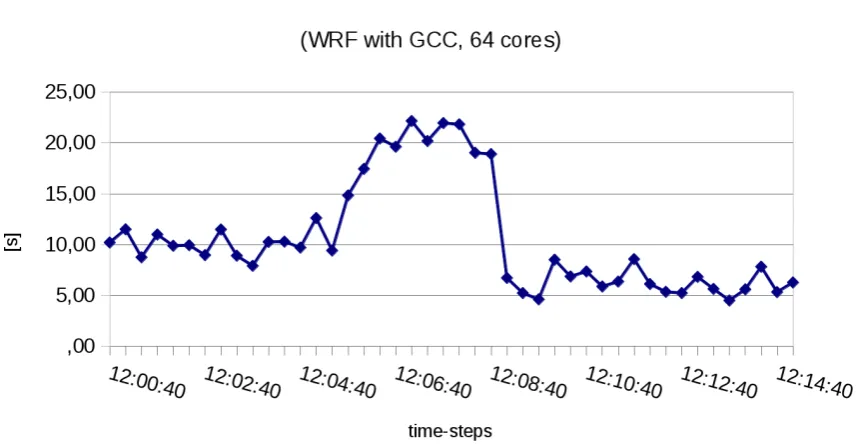
Fig. 3. Short term fluctuations of a WRF run at 64 cores with GCC. One clearly can see the short term fluctuations due to overall high network load on Tornado where the time needed for the computation of one time step is 22.162 s maximum compared to 4.508 s minimum what equals a span of 492 % where no span should exist at all.
that at high network loads Tornado falsely switches the use of the lower latency Infiniband to the higher latency Giga-bit Ethernet. A new MPI version did not fix the problem. Thus, the problem was circumvented by evaluating results from 32 cores at most.
An optional tuning parameter within the namelist.input – not dependent on environmental software – isnumtile. Like elaborated in Sect. 2.3, WRF decomposes the domain into tasks or patches each assigned to a core via a MPI process. Each patch can be further decomposed into tiles that are processed separately, but by default there is only one tile (numtile not set or=1). If the single tile is too large to fit into the cache of the CPU and/or core it slows down computation due to WRF’s memory bandwidth sensitivity (Roman, 2009). In order to reduce the size of the tiles, it is possible to increase their number vianumtile=x (see Appendix B). However the optimal valuex heavily depends on the cache sizes of core and CPU, the number of assigned cores, and the size of the domain. Thus there is no other way than experimentation to find what value gives the best performance. For reference purposes, the best values found here were 64/32/16 for 8/16/32 cores, respectively. This lead to a speed up of 22 % for 8 cores rising to 26 % for 32 cores. Altogether, a benchmark setup should not be expensive, speaking of workload for the user and computing time for the CPU. By minimizing the duration of a run instead of the default 12 h only 15 min of model time were computed equal to 45 time steps, 20 s each. Further, an intelligent matrix of
compiler/WRF/MPI-combinations instead of testing every possible combination (see Table 1 and Sect. 4) leads to a small test sample with a maximum of explanatory power.
3 Method of performance measurement
In most model benchmarks the performance metric is the av-erage time per model time step over a representative period of model integration, ignoring the additional time needed for the model initialization. Alternatively the metric is just the total runtime including initialization averaged over three or more runs (Note: initialization of WRF needs longer the more cores used).
Here instead, the performance metric used is the minimum computing time needed for one of the 45 model time steps. This was done because of large performance fluctuations on Tornado between time steps within and across identical runs like others have encountered before (Wright et al., 2009). They sum up to large differences in computation time for whole runs, as for averaged model time step performance.
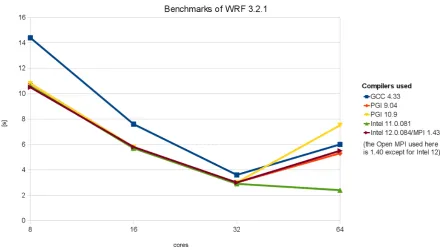
Fig. 4. Data of Table 1, but for Open MPI 1.40/1.43 only. All results are minimal seconds needed for one of 45 model time steps of the Default January 2000 case at 3.33 km horizontal resolution. The runs with 64 cores are strongly varying and were sometimes not reproducible (>5 runs).
degradation. But in practice the processor within the Infini-band network switch, handling the communication requests, often is the bottleneck. Thus the network load due to users leads to random performance fluctuations of up to 500 % for 64 cores (see Fig. 3), decreasing with less cores, due to in-creasing computations to communications.
The only non-random picture of the fluctuations was that especially before lunch-break and at Friday afternoons a rush-hour of job-computations appeared, where the fluctu-ation reached its peak.
Hence, on the one hand, with the random fluctuations in mind, measuring the average time over many time steps or whole runs would mask the optimal performance gain. This optimal gain is possible with the optimal compiler on HPCs, where the network is not the limiting factor, as shown by Shainer et al. (2009) for 192 cores Or Newby et al. (2008) for 16 384 cores, with WRFs’ performance scaling up almost linear. Salapura et al. (2006) used 2048 cores with an effi-ciency “a little higher than 50 %”.
On the other hand, regarding the rush-hour fluctuations, one must run the model several times spread over a day, first to detect if and when rush-hours appear on the system, and second, to sort out rush-hour influenced measurements. As conclusion model runs with an identical setup (of core count, compiler, MPI, and WRF) had to be repeated at least twice on different days with some distance to the rush-hours. They had to be repeated more often, if the minimum time needed for one time step was not reproducible.
Section 4 consequently shows only the reproducible min-imum time needed for a time step. This method overcomes the influence of the hardware (Infiniband switch) and shows only the possible performance gain through the software (compiler, WRF, MPI) as it was intended by this work in the first place.
4 Results and conclusions
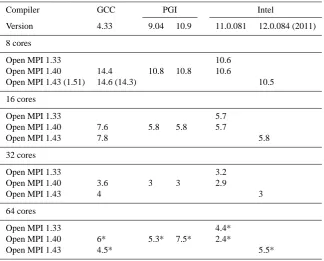
Table 1. Results for WRF 3.2.1. All results are minimal seconds needed for one of 45 model time steps of the Default January 2000 case at 3.33 km horizontal resolution. The strongly varying and sometimes not reproducible (>5 runs) results of runs with 64 cores are marked *. (To compare the results with other benchmarks like CONUS one may calculate the “simulation speed” (Michalakes, 2010). As example for the Intel 12 compiler at 8 cores it is 20 s/10.5 s=1.9, where 20 is the always identical simulation time step.)
Compiler GCC PGI Intel
Version 4.33 9.04 10.9 11.0.081 12.0.084 (2011) 8 cores
Open MPI 1.33 10.6
Open MPI 1.40 14.4 10.8 10.8 10.6
Open MPI 1.43 (1.51) 14.6 (14.3) 10.5 16 cores
Open MPI 1.33 5.7
Open MPI 1.40 7.6 5.8 5.8 5.7
Open MPI 1.43 7.8 5.8
32 cores
Open MPI 1.33 3.2
Open MPI 1.40 3.6 3 3 2.9
Open MPI 1.43 4 3
64 cores
Open MPI 1.33 4.4*
Open MPI 1.40 6* 5.3* 7.5* 2.4*
Open MPI 1.43 4.5* 5.5*
the trend shown by the results in Table 1 may change with the advancements of hard- and software. Therefore it should be considered testing available software combinations influ-encing WRFs performance before submitting the main job, if no comparable benchmark result not older than one or two years is available.
Another major result is that there is almost no performance difference between the costly Intel and PGI compilers on this platform, or between different compiler release versions of the same manufacturer. There is also almost no difference between the different MPI release versions. (Note: while the benchmarking with Open MPI 1.3.3, 1.4.0, 1.4.3 worked seamlessly, the beta version 1.5.1 was able to compile and run WRF only with GCC and worked only on a single node.) Furthermore the gap between GCC and Intel/PGI de-creases with increasing node numbers down to 20 % for four nodes or 32 cores on this system. The cause might again be the decreasing computation to communication ratio as ex-plained in Sect. 2.4. (With more cores there is more commu-nication needed at the same amount of computation, thus the network limitations drain the potential performance gain.) Table 2 shows the results for WRF 3.1.1. A maximum per-formance gain over WRF 3.2.1 of 2.7 % was found with PGI 9.04 on two nodes, what almost lies within the range of
measuring accuracy3. It is unlikely that the performance gap would increase with other compiler/MPI-combinations, thus no further tests in case of different compilers for WRF 3.1.1 were done. But Table 2 additionally shows results between WRF 3.1.1 versions compiled with different PGI compiler flags, set within theconfigure.wrf. This shows which flags are responsible for which percentage of performance gain. Asked to the cause of the performance discrepancy between GCC and PGI compilers Mathew Colgrove of PGI wrote (e-mail of 12 January 2011) “It’s possible that it’s our auto-vectorizer (SSE) but more likely a combination of many optimizations”.
PGI and Intel are able to better optimize their compilers because they are reduced to function on the x86 hardware platform. GCC instead aims to support a broad range of hard-ware and operating systems and thus has to focus more on compatibility as on performance optimizations (GCC plat-forms, 2011).
Table 2. Results for WRF 3.1.1. All results are minimal seconds needed for one of 45 model time steps of the Default January 2000 case at 3.33 km horizontal resolution. The strongly varying and sometimes not reproducible (>5 runs) results of runs with 64 cores are marked *.
Compiler GCC PGI (Fortran optimazation flags turned off) Version 4.33 9.04 9.04 (fastsse) 9.04 (fastsse+Mvect) 8 cores Open MPI 1.40 14.2 10.6 12.7 17.5 16 cores Open MPI 1.40 7.4 5.7 6.6 9 32 cores Open MPI 1.40 3.6 3 3.4 4.7 64 cores Open MPI 1.40 3.3* 3.8* 2.7* 5.4*
Mfprelaxed were deleted consecutively from configure.wrf, line FCOPTIM, before the com-pilation. This left six differently optimized WRF/PGI configurations (full to no optimization), but of which only three left different results (see Table 2). The flagsfastsse and Mvect were responsible for the biggest performance gain, and without them PGI is slower than GCC. The other flags had no effect. For information on them see reference PGI flags (2011). The flag fastsse enables the use of special instruction sets common in today’s x86-CPUs of AMD and Intel and adds 17 % speed up at 8 cores. The flag Mvect instructs the vectorizer to generate alternate code for vectorized loops when appropriate (PGI flags, 2011). This feature does not work with WRF since by default it is set tonoaltcode, what adds performance. To verify this Mvect was set to altcode, what resulted in a performance degradation of 27 %. Since it is not the focus of this paper to deal with the numerous other non default and non value-safe optimizations of GCC, Intel and PGI, those benchmarks were left out here.
Another further noteworthy result of the whole work was the detection of three different performance fluctuations, dis-cussed in Sects. 2.4 and 3. The first fluctuation appeared with a too small computations to communications ratio, suspected to be caused by the switching from Infiniband to the slower Gigabit Ethernet under high network loads. It was temporar-ily circumvented by rising the domains’ resolution and lim-iting the study to 32 cores. The second fluctuation appeared randomly due to the user-induced random load of the net-work. The third and largest fluctuation appeared periodically
at specific rush hours before lunch and on Friday afternoons. All three phenomena appeared in a different type of time-fluctuation and were not easy to identify, but are important to know about for accurate measurements. These findings may help others occupied with benchmarking tasks in the future.
Summarizing, first testing and then choosing a compiler is worth the work for WRF on a HPC, thinking of the many WRF users which just stick to GCC compilers as the easiest “out of the box” solution. In addition a careful monitoring for exceptional performance fluctuations is also needed for accurate benchmarking. Those are tasks which can’t be ac-complished by every WRF user. Hence, more and continuous publications of the professionals on this matter are important to provide at least a rough overview on the performance of the countless possible combinations of hardware and soft-ware like the compiler.
Aspects particularly missing in this paper are performance measurements with a sophisticated tool like The Vampir Per-formance Analysis Tool-Set (Kn¨upfer et al., 2008), measure-ments with larger core-counts, with a broader range of com-pilers (PathScale, Sun/Oracle) and more MPI implementa-tions (MPICH/MVAPICH/IntelMPI), and with the just re-leased WRF version 3.3, April 2011.
Appendix A
configure.wrf architecture specific settings
Open MPI-specific lines
DMPARALLEL = 1 # 1 for dmpar and hybrid mode, 0 for smpar and serial (single-CPU)
OMPCPP = # -D OPENMP # like the next two only for smpar mode
OMP = # -mp -Minfo=mp -Mrecursive
OMPCC = # -mp
[...]
DM FC = mpif90 -f90=$(SFC)
DM CC = mpicc -cc=$(SCC) -DMPI2-SUPPORT
[...]
Compiler-specific lines
# Settings for Linux x86 64, PGI compiler with gcc (dmpar)
[...]
SFC = pgf90
SCC = gcc
CCOMP = pgcc
[...]
PROMOTION = -r$(RWORDSIZE) -i4
ARCH LOCAL = -DNONSTANDARD SYSTEM SUBR
CFLAGS LOCAL = -w -O3
[...]
FCOPTIM = -fastsse -Mvect=noaltcode -Msmartalloc -Mprefetch=distance:8 -Mfprelaxed
# -Minfo=all=Mneginfo=all
FCREDUCEDOPT = $(FCOPTIM)
FCNOOPT = -O0
FCDEBUG = # -g $(FCNOOPT)
FORMAT FIXED = -Mfixed
FORMAT FREE = -Mfree
FCSUFFIX =
BYTESWAPIO = -byteswapio
FCBASEOPTS NO G = -w $(FORMAT FREE) $(BYTESWAPIO) $(OMP)
FCBASEOPTS = $(FCBASEOPTS NO G) $(FCDEBUG)
MODULE SRCH FLAG = -module $(WRF SRC ROOT DIR)/main
[...]
# Settings for Linux x86 64 ifort compiler with icc (dmpar)
[...]
SFC = ifort
SCC = icc
CCOMP = icc
[...]
PROMOTION = -i4
ARCH LOCAL = -DNONSTANDARD SYSTEM FUNC
CFLAGS LOCAL = -w -O3
FCOPTIM = -O3
FCREDUCEDOPT = $(FCOPTIM)
FCNOOPT = -O0 -fno-inline
-fno-ip
FCDEBUG = # -g $(FCNOOPT)
-traceback
FORMAT FIXED = -FI
FORMAT FREE = -FR
FCSUFFIX =
BYTESWAPIO = -convert big endian
FCBASEOPTS NO G = -w -ftz -align
all -fno-alias -fp-model precise $(FORMAT FREE) $(BYTESWAPIO)
FCBASEOPTS = $(FCBASEOPTS NO G)
$(FCDEBUG)
MODULE SRCH FLAG =
[. . . ]
# Settings for x86 64 Linux,gFortran compiler with gcc (dmpar)
[...]
SFC = gFortran
SCC = gcc
CCOMP = gcc
[...]
PROMOTION = # -fdefault-real-8 #
uncomment manually
ARCH LOCAL = -DNONSTANDARD SYSTEM SUBR
CFLAGS LOCAL = -w -O3 -c
-DLANDREAD STUB
[...]
FCOPTIM = -O3 -ftree-vectorize
-ftree-loop-linear -funroll-loops
FCREDUCEDOPT = $(FCOPTIM)
FCNOOPT = -O0
FCDEBUG = # -g $(FCNOOPT)
FORMAT FIXED = -ffixed-form
FORMAT FREE = -ffree-form
-ffree-line-length-none
FCSUFFIX =
BYTESWAPIO = -fconvert=big-endian
-frecord-marker=4
FCBASEOPTS NO G = -w $(FORMAT FREE)
$(BYTESWAPIO)
FCBASEOPTS = $(FCBASEOPTS NO G)
$(FCDEBUG)
MODULE SRCH FLAG =
Appendix B
Changes in the namelist configuration files (bold)
Within the namelist.wps: &share
start date = ’2000-01-24 12:00:00’, end date = ’2000-01-25 12:00:00’,
interval seconds = 21600,
prefix = ’FILE’,
wrf core = ’ARW’,
max dom = 1,
io form geogrid = 2, /
&geogrid
parent id = 1, 1,
parent grid ratio = 1, 3, i parent start = 1, 31, j parent start = 1, 17,
e we = 666,
e sn = 549,
geog data res = ’30s’,
dx = 3333,
dy = 3333,
map proj = ’lambert’,
ref lat = 34.83,
ref lon = -81.03,
truelat1 = 30.0,
truelat2 = 60.0,
stand lon = -98.0,
geog data path = ’Your WPS GEOG data loca-tion’
/
[...]
Within the namelist.input:
&time control
run days = 0,
run hours = 0, run minutes = 15,
[...]
&domains
numtile = X # set a value for X, see Sect. 2.4
time step = 20,
max dom = 1,
s we = 1, 1, 1,
e we = 666,
s sn = 1, 1, 1,
e sn = 549,
s vert = 1, 1, 1,
e vert = 28, 28, 28,
num metgrid levels = 27
dx = 3333,
dy = 3333,
[...]
Supplementary material related to this article is available online at:
http://www.geosci-model-dev.net/4/611/2011/ gmd-4-611-2011-supplement.zip.
Acknowledgements. The author thanks his colleagues for continu-ing support and discussion around the coffee breaks. I especially and greatly thank the whole DKRZ team pointing out Birgit Sch¨uen for the outstanding and sustained support during the compilation process of WRF!
Edited by: P. J¨ockel
References
Cisneros, G., Dembek, S. R., Dudhia, J., and Kain, J.: Ef-fect of non-IEEE-compliant optimizations on WRF numeri-cal results, 9th WRF Users’ Workshop, Boulder, CO, avail-able at: www.mmm.ucar.edu/wrf/users/workshops/WS2008/ abstracts/P11-06.pdf (last access: 25 May 2011), 2008. Dudhia, J.: WRF Modeling System Overview, available
at: www.mmm.ucar.edu/wrf/users/tutorial/201104 Korea/ 01 WRF Overview Dudhia.pdf, last access: 25 May 2011. GCC platforms: available at: http://gcc.gnu.org/install/specific.
html, last access: 1 February 2011.
HPC Advisory Council: Weather Research and Forecasting (WRF) Performance Benchmark and Profiling, Best Practices of the HPC Advisory Council, available at: www.hpcadvisorycouncil. com/best practices.php, www.hpcadvisorycouncil.com/pdf/ WRF Analysis and Profiling Intel.pdf (last access: 25 May 2011), 2010.
Kn¨upfer, A., Brunst, H., Doleschal, J., Jurenz, M., Lieber, M., Mickler, H., M¨uller, M. S., and Nagel, W. E.: The Vampir Perfor-mance Analysis Tool-Set, in Tools for High PerforPerfor-mance Com-puting Part 4, 139-155 – Proceedings of the 2nd International Workshop on Parallel Tools for High Performance Computing, July 2008, HLRS, Stuttgart, available at: doi:10.1007/978-3-540-68564-79, 2008.
Michalakes, J.: WRF V3 Parallel Benchmark Page, available at: www.mmm.ucar.edu/wrf/WG2/benchv3 (last access: 21 January 2011), 2010.
Morton, D., Nudson, O., and Stephenson, C.: Benchmarking and Evaluation of the Weather Research and Forecasting (WRF) Model on the Cray XT5, Cray User Group Proceedings, Atlanta, GA, 04–07, 2009.
Morton, D., Nudson, O., Bahls, D., and Newby, G.: Use of the Cray XT5 Architecture to Push the Limits of WRF Beyond One Billion Grid Points, PDF send by Morton via email dating 4 Jan-uary 2011, in Cray User Group Proceedings, Edinburgh, Scot-land, 24–27 May 2010.
PGI flags: available at: www.pgroup.com/benchmark/speccpu/ woodcrest/pgi701pre-cint2006.flags.html (last access 3 February 2011), 2006.
Phoronix.com: Five Years Of Linux Kernel Benchmarks: 2.6.12 Through 2.6.37, available at: www.phoronix.com/scan.php? page=article&item=linux 2612 2637&num=3 (last access: 25 May 2011), 2010.
Roe, P. K. and Stevens, D.: Maximizing Multi-Core Performance of the Weather Research and Forecast Model Over the Hawaiian Is-lands, 2010 AMOS Conference Technical Papers, Maui, Hawaii, available at: www.amostech.com/TechnicalPapers/2010/Posters/ Roe.pdf (last access: 5 July 2011), 2010.
Roman, D.: Performance hints for WRF on Intel® archi-tecture, available at: http://software.intel.com/en-us/articles/ performance-hints-for-wrf-on-intel-architecture (last access: 9 February 2011), 2009.
Rozumalski, R.: NOAA/NWS SOO STRC WRF Environmen-tal Modeling System, available at: http://strc.comet.ucar.edu/ wrfems/index.htm (last access: 21 January 2011), 2010. Salapura, V., Walkup, R., Gara, A.: Exploiting Workload
Par-allelism for Performance and Power Optimization in Blue Gene, in Micro, IEEE Sept.-Oct. 2006, 26(5), 67–81, doi:10.1109/MM.2006.89, 2006.
Sankaran, L.: System Tuning and Application Op-timization for HPC, Hewlett-Packard Company, available at: www.cbtechinc.com/?LinkServID= 68BA8DCC-FD89-E9E2-D3AEFD4E23C4A410&showMeta= 0 (last access: 17 March 2011), 2010.
Semenov, A., Kashevarova, T., Mankevich, P., Shkurko, D., Arturov, K., and Panov, N.: WRF performance tuning for platforms based upon the Intel Itanium Processor, Joint WRF/MM5 Users’ Workshop, Boulder, CO, June 2005, available at: http://www.mmm.ucar.edu/wrf/users/workshops/ WS2005/abstracts/Session3/46-Mankevich.pdf (last access: 25 May 2011), 2005.
Shainer, G., Liu, T., Michalakes, J., Liberman, J., Layton, J., Celebioglu, O., Schultz, S. A., Mora, J., and Cownie, D.: Weather Research and Forecast (WRF) Model Performance and Profiling Analysis on Advanced Multi-core HPC Clusters, The 10th LCI International Conference on High-Performance Clus-tered Computing, Boulder, CO, available at: http://141.142.2. 101/conferences/archive/2009/PDF/Shainer 64557.pdf (last ac-cess: 11 November 2010), 2009.
Skamarock, W. C., Klemp, J. B, Dudhia, J., Gill, D. O., Barker, D. M., Duda, M. G., Huang, X.-Y., Wang, W., and Powers, J. G.: A description of the advanced research WRF version 3, NCAR Technical Note, NCAR/TN-475+STR, 113 pp., 2008.
Tornado Wiki Hardware Overview: available at: https:// tornado-wiki.dkrz.de/farm/HardwareOverview (last access: 24 May 2011), 2010.
Wang, W., Bruy`ere, C., Duda, M., Dudhia, J., Gill, D., Lin, H.-C., Michalakes, J., Rizvi, S., Zhang, X., Beezley, J. D., Coen, J. L., and Mandel, J.: ARW Version 3 Modeling System User’s Guide 2011, available at: www.mmm.ucar.edu/wrf/users/docs/ user guide V3/contents.html, January 2011.
WRF Homepage: available at: www.wrf-model.org, last access: 19 January 2011.
WRF Users Page: WRF Model Version 3.0.1: UPDATES, available at: www.mmm.ucar.edu/wrf/users/wrfv3/updates-3.0. 1.html (last access 25 May 2011), 2008.
WRF User’s Forum: Compilation failed for file da wrfvar top.f on IBM, available at: http://forum.wrfforum.com/viewtopic.php?f= 5&t=1627 (last access 26 May 2011), 2009.