RESEARCH
Efficient production of extracellular
pullulanase in
Bacillus subtilis
ATCC6051 using
the host strain construction and promoter
optimization expression system
Xin Liu
†, Hai Wang
†, Bin Wang and Li Pan
*Abstract
Background: Bacillus subtilis has been widely used as a host for heterologous protein expression in food industry. B. subtilis ATCC6051 is an alternative expression host for the production of industrial enzymes, and exhibits favorable growth properties compared to B. subtilis 168. Extracellular expression of pullulanase from recombinant B. subtilis is still limited due to the issues on promoters of B. subtilis expression system. This study was undertaken to develop a new, high-level expression system in B. subtilis ATCC6051.
Results: To further optimize B. subtilis ATCC6051 as a expression host, eight extracellular proteases (aprE, nprE, nprB, epr, mpr, bpr, vpr and wprA), the sigma factor F (spoIIAC) and a surfactin (srfAC) were deleted, yielding the mutant B.
subtilis ATCC6051∆10. ATCC6051∆10 showed rapid growth and produced much more extracellular protein compared
to the widetype strain ATCC6051, due to the inactivation of multiple proteases. Using this mutant as the host, eleven plasmids equipped with single promoters were constructed for recombinant expression of pullulanase (PUL) from Bacillus naganoensis. The plasmid containing the PspovG promoter produced the highest extracellular PUL activity, which achieved 412.9 U/mL. Subsequently, sixteen dual-promoter plasmids were constructed and evaluated using this same method. The plasmid containing the dual promoter PamyL–PspovG produced the maximum extracellular PUL activity (625.5 U/mL) and showed the highest expression level (the dry cell weight of 18.7 g/L).
Conclusions: Taken together, we constructed an effective B. subtilis expression system by deleting multiple proteases and screening strong promoters. The dual-promoter PamyL–PspovG system was found to support superior expression of extracellular proteins in B. subtilis ATCC6051.
Keywords: Bacillus subtilis, Pullulanase, Protease deficient, Host construction, Promoter optimization
© The Author(s) 2018. This article is distributed under the terms of the Creative Commons Attribution 4.0 International License (http://creat iveco mmons .org/licen ses/by/4.0/), which permits unrestricted use, distribution, and reproduction in any medium, provided you give appropriate credit to the original author(s) and the source, provide a link to the Creative Commons license, and indicate if changes were made. The Creative Commons Public Domain Dedication waiver (http://creat iveco mmons .org/ publi cdoma in/zero/1.0/) applies to the data made available in this article, unless otherwise stated.
Background
Bacillus species have been widely used for the production of industrial enzymes [1]. Bacillus species are regarded as promising host strains with numerous advantages includ-ing: non-toxicity, convenience for gene modification and high yields of target proteins, fast growth rate and low
nutrient need [2]. Among Bacillus species, Bacillus sub-tilis is an attractive expression host due to its desirable features, such as having GRAS (generally recognized as safe) status, naturally efficient secretory system, the back-ground knowledge is available concerning its genetics, physiology and large-scale fermentation processes [3, 4].
Recombinant expression is an important method to facilitate the production of target proteins. Many genetic strategies have been developed to improve the produc-tion of recombinant proteins, such as the use of protease-deficient host strains to prevent degradation [5], the deletion of extracellular protein genes to reduce secretion
Open Access
*Correspondence: [email protected] †Xin Liu and Hai Wang are co-first authors
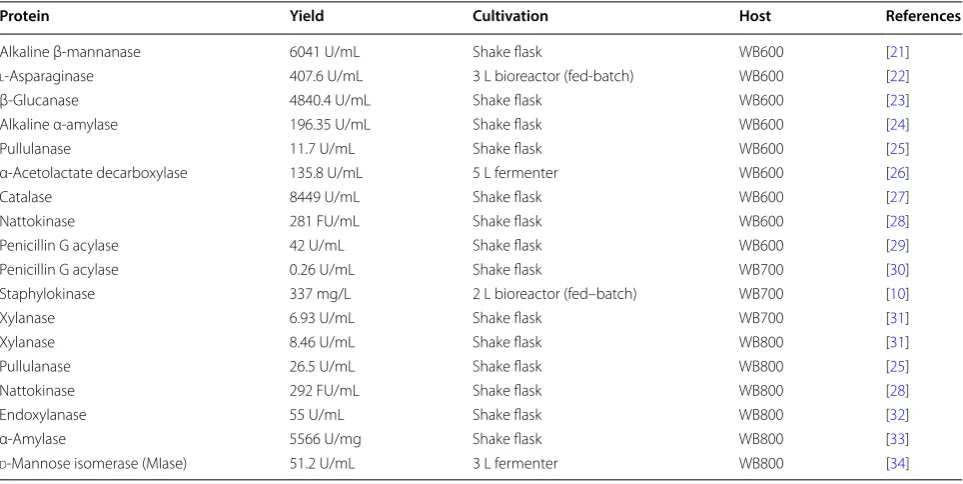
stress [6], and the optimization of promoters and signal peptides [7, 8]. Specifically, B. subtilis strains were engi-neered to serve as extracellular-protease-deficient strains for the overproduction of heterologous proteins such as B. subtilis WB600 [9], B. subtilis WB700 [10], and B. subtilis WB800 [11] (Table 1). These proteases-deficient strains were all constructed from the commonly used model and laboratory strain B. subtilis 168 [12]. B. sub-tilis 168 originates from the Marburg strain, which was deposited as B. subtilis ATCC 6051 (1930) and B. sub-tilis NCIB 3610 (1951), respectively [13]. Recently, B. subtilis ATCC6051 is an alternative expression host for production of industrial enzymes, which exhibits favora-ble growth properties as compared to the lab strain 168 [14]. Furthermore, gene expression systems of the genus Bacillus have been deeply investigated at the genome and transcriptome levels [15, 16]. In addition, the highly-active and controllable promoter is an important regula-tory elements in expression systems. Recent research has focused on a novel and effective strategy for the identifi-cation of active promoters via screening of chromosomal DNA fragments and using a combinatory approach to construct two or more tandem promoters. Efficient expression vectors have been developed with different promoters like the Pr2 promoter of the sigW gene [17] and the pBL9 promoter of the glvA gene [18], the dual-promoter PgsiB–PHpaII system [19] and the PHpaII–PamyQ′
system [20], etc.
Pullulanase (PUL, EC 3.2.1.41) is a debranching enzyme in the α-amylase family GH13, capable of specifically
hydrolyzing a-1,6-glycosidic linkages in pullulan, amylo-pectin, glycogen, and other related polysaccharides [35]. In food industries, there is a great commercial interest of using pullulanase, especially in the saccharification cess together with saccharifying amylases for the pro-duction of high-glucose syrup and maltose [36]. Over the years, a large number of pullulanases have been dis-covered and identified from different microorganisms, and have been successfully heterologously expressed in Escherichia coli [37, 38] and various Bacillus species [35, 39]. However, only pullulanase derived from few strains such as Bacillus acidopullulyticus [40] and Bacillus naga-noensis has great commercial value; and the production of pullulanase faces many difficulties, such as the expres-sion levels of recombinant pullulanase were yet limit, low yields and low enzyme activity [36]. As shown in Table 1, the protease-deficient B. subtilis host strains (WB600, WB800) have been explored for overexpressing B. naga-noensis pullulanase, but the expression levels are poorer, and cannot satisfy industrial needs. Therefore, the devel-opment of an efficient and easy-to-use expression system for the production of PUL is highly desirable.
It has been reported that B. subtilis ATCC 6051 could produce large amounts of foam, highly resistant spores, and multiple types of extracellular protease during fer-mentation [41–44]. In this study, to optimize B. subtilis ATCC6051 as an expression host, eight extracellular pro-teases (aprE, nprE, nprB, epr, mpr, bpr, vpr and wprA), the sigma factor F (spoIIAC) and a surfactin (srfAC) were deleted. We found that using this defective strain to
Table 1 Protein products from B. subtilis
Protein Yield Cultivation Host References
Alkaline β-mannanase 6041 U/mL Shake flask WB600 [21]
l-Asparaginase 407.6 U/mL 3 L bioreactor (fed-batch) WB600 [22]
β-Glucanase 4840.4 U/mL Shake flask WB600 [23]
Alkaline α-amylase 196.35 U/mL Shake flask WB600 [24]
Pullulanase 11.7 U/mL Shake flask WB600 [25]
α-Acetolactate decarboxylase 135.8 U/mL 5 L fermenter WB600 [26]
Catalase 8449 U/mL Shake flask WB600 [27]
Nattokinase 281 FU/mL Shake flask WB600 [28]
Penicillin G acylase 42 U/mL Shake flask WB600 [29]
Penicillin G acylase 0.26 U/mL Shake flask WB700 [30]
Staphylokinase 337 mg/L 2 L bioreactor (fed–batch) WB700 [10]
Xylanase 6.93 U/mL Shake flask WB700 [31]
Xylanase 8.46 U/mL Shake flask WB800 [31]
Pullulanase 26.5 U/mL Shake flask WB800 [25]
Nattokinase 292 FU/mL Shake flask WB800 [28]
Endoxylanase 55 U/mL Shake flask WB800 [32]
α-Amylase 5566 U/mg Shake flask WB800 [33]
express heterologous protein production is superior to the common model laboratory strain. Furthermore, we constructed eleven single-promoter plasmids and sixteen dual-promoter plasmids for PUL expression in B. subti-lis ATCC 6051∆10. Taken together, we constructed an effective B. subtilis expression system by deleting multi-ple proteases and screening strong promoters, which has high potential for use in industrial applications.
Results
Construction of B. subtilis ATCC6051 as the heterologous expression host
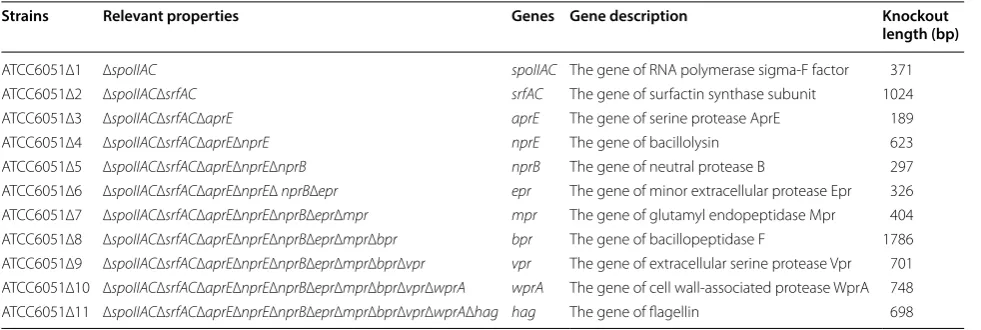
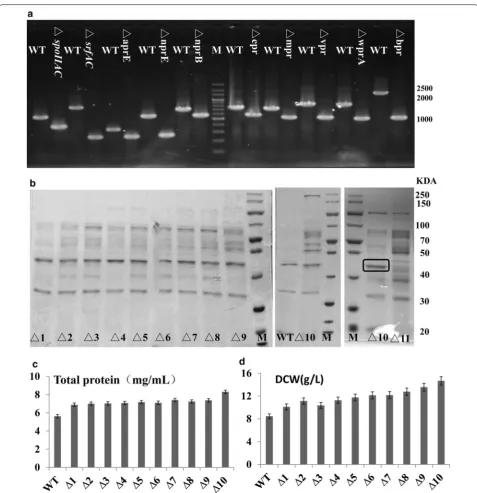
In order to develop the wild type strain B. subti-lis ATCC6051 as the alternative expression host with food-grade safety, we used the temperature-sensitive plasmid to inactivate eight protease genes, one spore-related gene and one surfactin gene, yielding the mutant ATCC6051∆10 (Table 2 and Fig. 1a). Eight extracellular proteases (aprE, nprE, nprB, epr, mpr, bpr, vpr, wprA) were selected as the targets for deletion, because previ-ous studies have demonstrated that the use of protease-deficient host strains could prevent protein degradation and reduce the secretory stress. As shown in Fig. 1b, the extracellular secreted proteins increased as more genes were deleted. A sigma factor F (spoIIAC) and a surfactin (srfAC) were also deleted, which affected the production of spores and foam during fermentation, respectively. During the shake flask fermentation pro-cess (48 h), B. subtilis ATCC6051 produced much foam and required to add 100 µl antifoam (25%, v/v) every 6 h; the mutant ATCC6051∆10 produced much less foam at a controllable level that needed once antifoam at 24 h. After being cultured for 48 h in LB culture medium, the sporulation efficiency of ATCC6051 was 35.33% (122 colonies/300 colonies), while the sporulation efficiency of ATCC6051∆10 was 0% (0 colonies/300 colonies),
which shows that ATCC6051∆10 has great resistant to spore formation. Moreover, the mutant ATCC6051∆10 achieved more extracellular protein production com-pared to that of ATCC6051 (Fig. 1c). And B. subtilis ATCC6051∆10 (the dry cell weight of 14.7 g/L) grew faster than the wild-type stain ATCC6051 (Fig. 1d).
Additionally, the extracellular proteins increased as more genes were deleted, while some ever-pre-sent bands showed that there were still intense in ATCC6051∆10. According to the molecular weights of these bands (Fig. 1b), corresponding proteases were pre-dicted as: superoxide dismutase sodA (22.4 kDa), flagel-lin hag (32.6 kDa), RNA degradation presenting factor YpfD (42.3 kDa), dihydrolipoyl dehydrogenase PdhD (49.8 kDa) and wall-associated proteinWapA (54.2 kDa). Without affecting the normal growth of the strain, we tried to inactivate a gene corresponding to the most obvi-ous protein bands (hag, block mark, Fig. 1b), yielding the mutant ATCC6051∆11: ∆10Δ hag. The extracellular protein became much more obvious, but protein back-grounds of this host strain became much more compli-cated (Fig. 1b). Therefore, the mutant ATCC6051∆10 may be beneficial for the expression of target proteins, instead of ATCC6051∆11: ∆10Δhag.
Optimization of promoters for PUL expression in B. subtilis
ATCC6051∆10
Obtaining highly active promoters is an effective method for increasing the expression of heterologous proteins. The plasmids, which contained the PUL gene from B. naganoensis ATCC 53909, eleven promoters (Table 3, Eight promoters were from B. subtilis: P43, PspovG, PaprE, PamyE, Phag, Pveg, PnprE and PnprB; PamyL and PglvA were from Bacillus licheniformis; PsigW was from Bacil-lus amyloliquefaciens) and the signal peptide of amyQ gene from B. amyloliquefaciens (SPamyQ), were used to
Table 2 The deficient strains
Strains Relevant properties Genes Gene description Knockout
length (bp)
ATCC6051∆1 ∆spoIIAC spoIIAC The gene of RNA polymerase sigma-F factor 371
ATCC6051∆2 ∆spoIIAC∆srfAC srfAC The gene of surfactin synthase subunit 1024
ATCC6051∆3 ∆spoIIAC∆srfAC∆aprE aprE The gene of serine protease AprE 189
ATCC6051∆4 ∆spoIIAC∆srfAC∆aprE∆nprE nprE The gene of bacillolysin 623
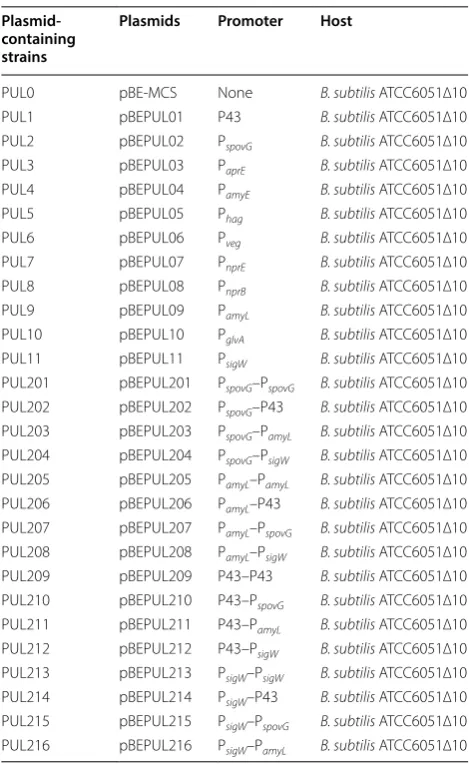
construct the secretory expression with the plasmid MCS in the following: pBEPUL01, pBEPUL02, pBE-PUL03, pBEPUL04, pBEPUL05, pBEPUL06, pBEPUL07, pBEPUL08, pBEPUL09, pBEPUL10 and pBEPUL11 (Table 4).
The eleven plasmids described above were used to transform B. subtilis ATCC6051∆10 in which ten genes
were disrupted. The relative strengths of these promot-ers were determined by measuring the extracellular PUL activities of the eleven plasmid containing strains using orifice plate cultivation. As shown in Fig. 2a, the extra-cellular PUL activity of strains PUL01 through PUL11 were 72.5, 87.5, 5.2, 4.2, 5.1,3.2, 1.8, 1.6, 25.7, 8.6 and 26.7 U/mL, respectively. Four (PUL01, PUL02, PUL09
and PUL11) of the 11 plasmid containing strains showed higher activity than others, and the PUL02 contain-ing promoter PspovG showed the highest PUL activity. Furthermore, the above four strains with high enzyme activity were expanded in shake-flask cultivation, the cell growth and PUL activities of these strains were compared. According to the results (Fig. 2b), the extra-cellular pullulanase activities were detected in differ-ent phases during the expression process, these four strains reached the stationary phase after 48 h. In the late phase of expression process, the maximum PUL activities were reached 412.9, 340.4, 301 and 159.5 U/ mL under the control of promoter PspovG, PamyL, P43 and PsigW, respectively. Meanwhile, the activity of PUL expressed by these four plasmid-containing strains indi-cated that the vitality effect among these four promot-ers were: PspovG> PamyL> P43 > PsigW. In addition, the dry cell weight of plasmid-containing strain PUL11 (PsigW) showed the lowest expression level (9.32 g/L) and the plasmid-containing strain PUL02 (PspovG) showed the highest expression level (14.76 g/L) at 48 h. As shown in Fig. 2c, SDS-PAGE analysis of supernatant proteins was carried out to verify these results, and the thicknesses of the appropriate bands (around 100 kDa) were in agree-ment with the PUL activity values.
PUL expression of dual promoters replacement in B. subtilis
ATCC6051∆10
Having compared eleven single promoters and identified promoters PspovG, PamyL, P43 and PsigW as superior among them, with PspovG being the strongest, dual-promoter plasmids were constructed to further increase PUL Table 3 Properties of promoters used for PUL expression optimization
Promoter Origin Properties
P43 B. subtilis Strong constitutive promoter [35]
PspovG B. subtilis Promoter of septation protein spovG
PaprE B. subtilis Promoter of alkaline protease [19]
PamyE B. subtilis Promoter of α-amylase
Phag B. subtilis Promoter of flagellin
Pveg B. subtilis Promoter of protein Veg
PnprE B. subtilis Promoter of neutral protease E [19]
PnprB B. subtilis Promoter of neutral protease B
PamyL B. licheniformis Promoter of α-amylase, strong constitutive promoter [62]
PglvA B. licheniformis Promoter ofα-amylase [18]
PsigW B. amyloliquefaciens Promoter of RNA polymerase sigma factor SigW [17]
Table 4 Strains and plasmids
Plasmid-containing strains
Plasmids Promoter Host
PUL0 pBE-MCS None B. subtilis ATCC6051∆10
PUL1 pBEPUL01 P43 B. subtilis ATCC6051∆10
PUL2 pBEPUL02 PspovG B. subtilis ATCC6051∆10 PUL3 pBEPUL03 PaprE B. subtilis ATCC6051∆10 PUL4 pBEPUL04 PamyE B. subtilis ATCC6051∆10
PUL5 pBEPUL05 Phag B. subtilis ATCC6051∆10
PUL6 pBEPUL06 Pveg B. subtilis ATCC6051∆10
expression. To create the dual promoter constructs, pro-moters PspovG, PamyL, P43 and PsigW were combined with each other, yielding plasmids pBEPUL201, pBEPUL202, pBEPUL203, pBEPUL204, pBEPUL205, pBEPUL206, pBEPUL207, pBEPUL208, pBEPUL209, pBEPUL210, pBEPUL211, pBEPUL212, pBEPUL213, pBEPUL214, pBEPUL215 and pBEPUL216, respectively (Table 4). The sixteen dual-promoter plasmids were used to transform B. subtilis ATCC6051∆10, yielding the sixteen corre-sponding plasmid-containing strains PUL201 through PUL216.
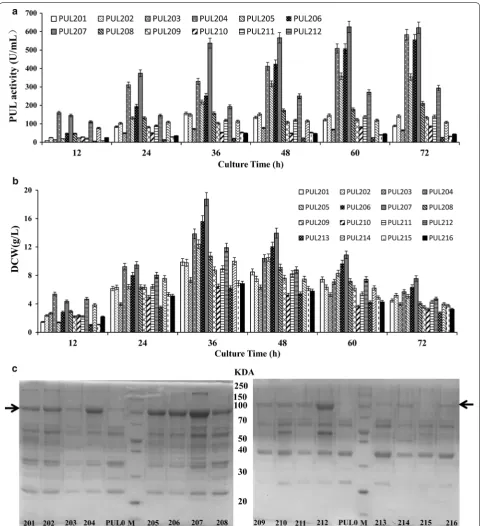
The expression strengths of the sixteen dual promot-ers were measured using shake-flask experiments similar to those used to assess the single promoters. As shown in Fig. 3a, the extracellular maximum PUL activities of plasmid-containing strains PUL201 through PUL216 during the expression process were 156.2 (PspovG–PspovG), 151.7 (PspovG–P43), 77.1 (PspovG–PamyL), 582.9 (PspovG– PsigW), 358.1 (PamyL–PamyL), 556.2 (PamyL–P43), 625.5 (PamyL–PspovG), 210.8 (PamyL–PsigW), 133.6 (P43–P43), 84.5 (P43–PspovG), 141 (P43–PamyL), 293.5 (P43–PsigW), 25.44 (PsigW–PsigW), 119.7 (PsigW–P43), 53 (PsigW–PspovG) and 48.3 (PsigW–PamyL) U/mL, respectively. Obviously, the plasmid-containing strain PUL207, which harbored the plas-mid pBEPUL207 with the dual promoter PamyL–PspovG, showed the highest PUL activity. This activity was almost 1.49-fold and 1.84 the activity produced by plasmid-containing strain PUL02 and PUL09, which expressed PUL using the PamyL and PspovG promoter, respectively. Two more plasmid-containing strains PUL204 (PspovG– PsigW) and PUL206 (PamyL–P43) also have higher enzyme activity than the single promoter. Moreover, The dry cell weights of the sixteen plasmid-containing strains peaked at 36 h, and decreased substantially from 48 to 72 h. In particular, the plasmid-containing strain PUL207 (18.73 g/L) was much higher than that of the other fifteen plasmid-containing strains (Fig. 3b). SDS-PAGE analysis of the supernatant of the culture broth also indicated a distinctive protein band at around 100 kDa for the posi-tive recombinant but not the negaposi-tive control (Fig. 3c), consistent with the results of activity assay.
Discussion
Bacillus subtilis species are usually used as the host strains for heterologous protein expression. However, the host strains can produce many different types of extra-cellular protease which might degrade the target protein
[1], and many protease-deficient strains display favorable heterologous protein production [43–45]. The multiple proteases-deficient host strains have been constructed, such as B. subtilis WB600, WB700 and WB800 [5, 46]. And the deficiency of proteases genes (nprE, nprB, mpr, vpr, epr, bpr, wprA, aprE) in B. subtilis improved the expression of target proteins obviously. Furthermore, Sigma F, encoded by SpoIIAC gene, controls the forma-tion of forespore [47]. Gutierrez et al. showed that inac-tivation of sigma F could largely block the sporulation of B. subtilis [48]. Moreover, B. subtilis produces surfactin, an amphiphilic molecule which could accumulate at gas– liquid interfaces and induce foam during fermentation [49, 50]. B. subtilis ATCC 6051 produces a large amount of foam during fermentation, which has an extreme effect on fermentation process control and may lead to con-tamination [51]. This shows that surfactin may be a major mediator for foam formation, which may affect the pro-tein secretion. In this study, eight extracellular proteases genes (nprE, nprB, mpr, vpr, epr, bpr, wprA and aprE), the sigma factor F gene (SpoIIAC) and the surfactin gene (srfAC) were knocked out to obtain the mutant ATCC 6051∆10.
Due to the great demand of industrial applications, the overexpression of pullulanase has received extensive attention in recent years [52]. Among the effective solu-tions and prerequisites are the selection of new bacte-rial strains or the improvement of bactebacte-rial strains [53] and B. subtilis strains are well known for their ability to secrete a large number of useful extracellular enzymes [54]. In previous reports, several protease-deficient B. subtilis host strains have been explored for overexpress-ing B. naganoensis pullulanase, including WB600 [28], WB800 [22], and B. subtilis CCTCC M 2016536 (srfC, spoIIAC, nprE, aprE and amyE genes deletion) [20]. But these hosts showed poor expression of pullulanase and the extracellular activities reached 90.7 U/mL, which was the highest ever reported [20]. Secretory expression of PUL was achieved in ten-genes deficient B. subtilis ATCC 6051∆10, and deletion of these ten genes indeed enhanced the production of PUL. This study provided a novel B. subtilis host, which has the potential for the het-erologous expression of different proteins.
Obviously, promoter as an important regulatory ele-ment directly influences the expression efficiency of heterologous protein and strong promoters are usually used to achieve gene high-level expression [20]. In recent
(See figure on next page.)
years, some previous reports have shown that many pro-moters in B. subtilis have been used for the expression of B. naganoensis pullulanase. As known, Wang et al. [55] used three widely promoters (P43, Papr and Pamy) to
select the best promoter for PUL expression in B. subti-lis, and the result indicated that Papr (2.82 U/mL) is the most suitable for the production of PUL. Song et al. [35] constructed plasmids under the promoter PHpaII and P43,
resulting in the extracellular PUL activity of 24.5 U/mL (P43). Other studies have shown that two or more tan-dem promoters can significantly increase the level of het-erologous protein expression. Zhang et al. [20] showed that the tandem promoter PHpaII–PamyQ′ (90.7 U/mL)
were found to elevate PUL productivity by 1.49 fold com-pared to the single PamyQ′ (60.9 U/mL) system. Although
the above promoters are used as strong promoters in B. subtilis, these promoters resulted in various levels of expression of the PUL reporter protein. In our work, a set of B. subtilis recombinants involving different combina-tion of various promoters were constructed for heterolo-gous expression of PUL from B. naganoensis. Compared with the previous reports, the promoters PspovG (412.9 U/ mL), PamyL (340.4 U/mL), and P43 (301 U/mL) can sig-nificantly increase the activity of PUL. Moreover, the dual promoters PamyL–PspovG (625.5 U/mL), PspovG–PsigW (582.9 U/mL) and PamyL–P43 (556.2 U/mL) showed the higher extracellular PUL activity than the single promot-ers. Thus, the above promoter expression systems may have the potential for the production of useful proteins in B. subtilis.
Conclusion
In this study, the ten-genes-deficient strain B. subtilis ATCC6051∆10 was obtained by overlap gene knock-out. Compared with B. subtilis ATCC 6051, the mutant ATCC6051∆10 had less foam during fermentation under the same conditions, displayed greater resistant to spore formation, achieved 1.48 times more extracellular pro-tein production and 1.73 times more dry cell weight. Then, eleven single-promoter plasmids and sixteen dual-promoter plasmids were constructed and evaluated using shake-flask cultivation. By host strain construction and promoters optimization, the maximum PUL activ-ity of 625.5 U/mL was achieved under the control of the dual promoter PamyL–PspovG. This study provides a valu-able expression system with the potential application for industrial production of PUL, as well as expression of other proteins.
Materials and methods Strains, plasmids and primers
The detailed information for genes, strains and plasmids were shown in Additional file 1: Table S1, and primers sequences were listed in Additional file 1: Table S2. The following concentrations of antibiotics were used for selection: 100 μg/mL ampicillin (Amp), 5 μg/mL erythro-mycin (Erm) and 20 μg/mL kanaerythro-mycin (Kan). Luria–Ber-tani (LB) medium consisted of 1% tryptone, 0.5% yeast extract, and 1% NaCl, with the pH 7. The flask fermenta-tion medium contained LB medium with 1% corn starch.
Gene prediction
All the annotated gene sequences of the proteases from B. subtilis were selected from the NCBI database (https ://www.ncbi.nlm.nih.gov/), and were used to find the cor-responding genes in B. subtilis ATCC6051 by Blast tool (http://blast .ncbi.nlm.nih.gov).
Construction of the knockout vectors
The knockout vectors were constructed by a previously reported method [56], using the mpr gene as an example (pKS2-mpr, Additional file 1: Figure S1). The upstream and downstream homologous arms (about 500 bp) of mpr gene, named mpr (L) and mpr (R), were amplified using the primers of F-mpr-1/R-mpr-1 and F-mpr-2/R-mpr-2 (Additional file 1: Table S2) respectively, and the amplified fragments were further purified and recov-ered. By splicing overlap extension PCR method using the primers of F-mpr-1/R-mpr-2, the mpr (L) and mpr (R) were fused to form the fragment mpr (L + R), which was then cloned into the pKS2 (5094 bp) at the EcoR V restriction site. Other knockout vectors were constructed following the same method.
Gene knockout
The competent cells of B. subtillis were prepared by the method reported [57]. The competent cells were elec-tro-transformed at 2.5 kV with 10 μL knockout plasmid solution (100 ng/μL), maintained in 900 μL recovery medium (LB medium added with 1% sorbitol) at 30 °C and 100 rpm for 4–6 h. The cells were spread onto LB plate with 5 μg/mL erythromycin, incubated at 30 °C for 16–24 h, and the transformants were selected by PCR and plasmid extraction verification. The positive trans-formants were inoculated into LB liquid medium con-taining 5 μg/mL erythromycin, cultured at 37 °C for 12 h and plated onto erythromycin LB solid medium, which was further incubated at 37 °C to screen the single-cross-over colonies. After PCR verification, the positive clones were subcultured in LB liquid medium without eryth-romycin at 30 °C for 12–16 h. At last, the cultures were incubated in LB plates at 37 °C for 20 h, and each single colony was inoculated onto a LB plate with erythromy-cin, as well as one without erythromycin. If a colony grew on the LB plate without erythromycin and was inhibited on LB plate with erythromycin, this strain could be the double crossover one, which would be further verified by PCR.
Construction of the PUL expression vector
P43 promoter and the terminator of amyE gene (TamyE) from B. subtillis 168. First, the fragments of P43, SPamyQ, pul and TamyE were amplified by the primers (Additional file 1: Table S2) and purified, respectively. Second, the purified fragments of P43, SPamyQ, pul gene and were fused by PCR to obtain the P43SPT fragment. Finally, the P43SPT fragment was inserted into the pBE-MCS plas-mid at EcoRI and XbaI sites, which was then transformed into Escherichia coli HST08 to obtain the expression plas-mid pBEPPUL01 (Additional file 1: Figure S2). Using the In-Fusion HD Cloning Plus kit [58], plasmid fragment one was joined with promoter fragments PspovG, PaprE, PamyE, Phag, Pveg, PnprE, PnprB, PamyL, PglvA, PsigW and sixteen dual-promoter fragments to yield plasmids pBEPUL2 to pBE-PUL11 and pBEPUL201 to pBEPUL216, respectively.
Analysis methods
According to a previously described method [59], the activity of PUL was assayed by the concentration of reducing sugars liberated into the reaction mixture and one unit of pullulanase was defined as the amount of enzyme required to produce the reducing sugar equiva-lent to 1 L/mol glucose per min. Data represent the aver-age of three independent experiments, and error bars indicate the standard error of the mean value.
The cell growth was evaluated by measuring the dry cell weight (DCW) [60]. DNA and the proteins were determined by agarose gel electrophoresis and sodium dodecyl sulfate–polyacrylamide gel electrophoresis (SDS-PAGE) [61], respectively.
Additional file
Additional file 1: Figure S1. Construction procedure of the knockout vector (pKS2-mpr). All knockout vectors were constructed as shown. Figure S2. Construction procedure of the promoter plasmid (pBEPUL01). All expression plasmids were constructed as shown. Table S1. Genes, bacterial strains and plasmids used in this study. Table S2. primers used in this study.
Abbreviations
LB: Luria–Bertani; Amp: ampicillin; Kan: kanamycin; Erm: erythromycin; PCR: polymerase chain reaction; PUL: pullulanase; spollAC: the gene of RNA poly-merase sigma-F factor; srfAC: the gene of surfactin synthase subunit; aprE: the gene of subtilisin E; nprE: the gene of bacillolysin; nprB: the gene of neutral protease B; epr: the gene of minor extracellular protease Epr; mpr: the gene of glutamyl endopeptidase Mpr; vpr: the gene of extracellular serine protease Vpr; bpr: the gene of bacillopeptidase F; wprA: the gene of cell wall-associated protease WprA; hag: the gene of flagellin; amyE: the gene of α-amylase; amyQ: the gene of α-amylase from B. amyloliquefaciens; SDS-PAGE: sodium dodecyl sulfate-polyacrylamide gel electrophoresis.
Authors’ contributions
XL led the design and performance of the experiments, analysis of the data and writing of the paper. HW and LP participated in experimental design and
analysis. BW participated in editing the paper. All authors read and approved the final manuscript.
Acknowledgements Not applicable.
Competing interests
The authors declare that they have no competing interests.
Availability of data and materials
The datasets supporting the conclusions of this article are included in the manuscript and additional file.
Consent for publication Not applicable.
Ethics approval and consent to participate Not applicable.
Funding
This work was supported by the Science and Technology Planning Project of Guangdong Province (2016A050503016 and 2016A010105004), the Fundamental Research Funds for the Central Universities (Grant Number 2015ZP032), and the Natural Science Foundation of Guangdong Province (2017A030313097).
Publisher’s Note
Springer Nature remains neutral with regard to jurisdictional claims in pub-lished maps and institutional affiliations.
Received: 16 April 2018 Accepted: 15 October 2018
References
1. Westers L, Westers H, Quax WJ. Bacillus subtilis as cell factory for phar-maceutical proteins: a biotechnological approach to optimize the host organism. BBA-Mol Cell Res. 2004;1694(1–3):299–310.
2. van Dijl JM, Hecker M. Bacillus subtilis: from soil bacterium to super-secreting cell factory. Microb Cell Fact. 2013. https ://doi. org/10.1186/1475-2859-12-3.
3. Schallmey M, Singh A, Ward OP. Developments in the use of Bacillus spe-cies for industrial production. Can J Microbiol. 2004;50(1):1–17. 4. Zhang X, Zhang YP. One-step production of biocommodities from
ligno-cellulosic biomass by recombinant cellulolytic Bacillus subtilis: opportuni-ties and challenges. Eng Life Sci. 2010;10(5):398–406.
5. Durban MA, Silbersack J, Schweder T, Schauer F, Bornscheuer UT. High level expression of a recombinant phospholipase C from Bacillus cereus in
Bacillus subtilis. Appl Microbiol Biotechnol. 2007;74(3):634–9.
6. Waldeck J, Meyer-Rammes H, Wieland S, Feesche J, Maurer K, Meinhardt F. Targeted deletion of genes encoding extracellular enzymes in Bacillus
licheniformis and the impact on the secretion capability. J Biotechnol.
2007;130(2):124–32.
7. Degering C, Eggert T, Puls M, Bongaerts J, Evers S, Maurer K, Jaeger K. Optimization of protease secretion in Bacillus subtilis and Bacillus
licheni-formis by screening of homologous and heterologous signal peptides.
Appl Environ Microb. 2010;76(19):6370–6.
8. Samant S, Gupta G, Karthikeyan S, Haq SF, Nair A, Sambasivam G, Suku-maran S. Effect of codon-optimized E. coli signal peptides on recombi-nant Bacillus stearothermophilus maltogenic amylase periplasmic localiza-tion, yield and activity. J Ind Microbiol Biotechnol. 2014;41(9):1435–42. 9. Xiao L, Zhang RH, Peng Y, Zhang YZ. Highly efficient gene expression of
a fibrinolytic enzyme (subtilisin DFE) in Bacillus subtilis mediated by the promoter of alpha-amylase gene from Bacillus amyloliquefaciens. Biotech-nol Lett. 2004;26(17):1365–9.
10. Ye RQ, Kim JH, Kim BG, Szarka S, Sihota E, Wong SL. High-level secretory production of intact, biologically active staphylokinase from Bacillus
11. Nielsen H, Engelbrecht J, Brunak S, VonHeijne G. Identification of prokary-otic and eukaryprokary-otic signal peptides and prediction of their cleavage sites. Protein Eng. 1997;10(1):1–6.
12. Wu SC, Yeung JC, Duan YJ, Ye RQ, Szarka SJ, Habibi HR, Wong SL. Func-tional production and characterization of a fibrin-specific single-chain antibody fragment from Bacillus subtilis: effects of molecular chaperones and a wall-bound protease on antibody fragment production. Appl Environ Microb. 2002;68(7):3261–9.
13. Zeigler DR, Pragai Z, Rodriguez S, Chevreux B, Muffler A, Albert T, Bai R, Wyss M, Perkins JB. The origins of 168, W23, and other Bacillus subtilis legacy strains. J Bacteriol. 2008;190(21):6983–95.
14. Kabisch J, Thuermer A, Huebel T, Popper L, Daniel R, Schweder T. Charac-terization and optimization of Bacillus subtilis ATCC 6051 as an expression host. J Biotechnol. 2013;163(2):97–104.
15. Kunst F, Ogasawara N, Moszer I, Albertini AM, Alloni G, Azevedo V, Bertero MG, Bessieres P, Bolotin A, Borchert S, et al. The complete genome sequence of the Gram-positive bacterium Bacillus subtilis. Nature. 1997;390(6657):249–56.
16. Nicolas P, Maeder U, Dervyn E, Rochat T, Leduc A, Pigeonneau N, Bid-nenko E, Marchadier E, Hoebeke M, Aymerich S, et al. Condition-depend-ent transcriptome reveals high-level regulatory architecture in Bacillus
subtilis. Science. 2012;335(6072):1103–6.
17. Liao Y, Huang L, Wang B, Zhou F, Pan L. The global transcriptional land-scape of Bacillus amyloliquefaciens XH7 and high-throughput screening of strong promoters based on RNA-seq data. Gene. 2015;571(2):252–62. 18. Liu X, Yang H, Zheng J, Ye Y, Pan L. Identification of strong promoters
based on the transcriptome of Bacillus licheniformis. Biotechnol Lett. 2017;39(6):873–81.
19. Guan C, Cui W, Cheng J, Liu R, Liu Z, Zhou L, Zhou Z. Construction of a highly active secretory expression system via an engineered dual promoter and a highly efficient signal peptide in Bacillus subtilis. New Biotechnol. 2016;33(3):372–9.
20. Zhang K, Su L, Duan X, Liu L, Wu J. High-level extracellular protein pro-duction in Bacillus subtilis using an optimized dual-promoter expression system. Microb Cell Fact. 2017;16:32.
21. Zhou C, Xue Y, Ma Y. Characterization and high-efficiency secreted expression in Bacillus subtilis of a thermo-alkaline beta-mannanase from an alkaliphilic Bacillus clausii strain S10. Microb Cell Fact. 2018;17(1):124. 22. Feng Y, Liu S, Jiao Y, Gao H, Wang M, Du G, Chen J. Enhanced extracellular
production of l-asparaginase from Bacillus subtilis 168 by B. subtilis WB600
through a combined strategy. Appl Microbiol Biot. 2017;101(4):1509–20. 23. Niu C, Liu C, Li Y, Zheng F, Wang J, Li Q. Production of a
thermosta-ble 1,3-1,4-beta-glucanase mutant in Bacillus subtilis WB600 at a high fer-mentation capacity and its potential application in the brewing industry. Int J Biol Macromol. 2018;107(Pt A):28–34.
24. Ma Y, Yang H, Chen X, Sun B, Du G, Zhou Z, Song J, Fan Y, Shen W. Signifi-cantly improving the yield of recombinant proteins in Bacillus subtilis by a novel powerful mutagenesis tool (ARTP): alkaline alpha-amylase as a case study. Protein Expr Purif. 2015;114:82–8.
25. Deng Y, Nie Y, Zhang Y, Wang Y, Xu Y. Improved inducible expression of
Bacillus naganoensis pullulanase from recombinant Bacillus subtilis by
enhancer regulation. Protein Expr Purif. 2018;148:9–15.
26. Zhang X, Rao Z, Li J, Zhou J, Yang T, Xu M, Bao T, Zhao X. Improving the acidic stability of Staphylococcus aureus alpha-acetolactate decarboxylase
in Bacillus subtilis by changing basic residues to acidic residues. Amino
Acids. 2015;47(4):707–17.
27. Xu S, Guo Y, Du G, Zhou J, Chen J. Self-cloning significantly enhances the production of catalase in Bacillus subtilis WSHDZ-01. Appl Biochem Biotechnol. 2014;173(8):2152–62.
28. Cui W, Suo F, Cheng J, Han L, Hao W, Guo J, Zhou Z. Stepwise modifica-tions of genetic parts reinforce the secretory production of nattokinase in
Bacillus subtilis. Microb Biotechnol. 2018;11(5):930–42.
29. Zhang M, Shi M, Zhou Z, Yang S, Yuan Z, Ye Q. Production of Alcaligenes faecalis penicillin G acylase in Bacillus subtilis WB600 (pMA5) fed with partially hydrolyzed starch. Enzyme Microb Technol. 2006;39(4):555–60. 30. Zhu FM, Ji SY, Zhang WW, Li W, Cao BY, Yang MM. Development and
application of a novel signal peptide probe vector with PGA as reporter
in Bacillus subtilis WB700: twenty-four tat pathway signal peptides from
Bacillus subtilis were monitored. Mol Biotechnol. 2008;39(3):225–30.
31. Phuong ND, Jeong YS, Selvaraj T, Kim SK, Kim YH, Jung KH, Kim J, Yun HD, Wong SL, Lee JK, et al. Production of XynX, a large multimodular protein
of thermo Anaerobacterium sp., by protease-deficient Bacillus subtilis strains. Appl Biochem Biotechnol. 2012;168(2):375–82 (corrected). 32. Guo Y, Gao Z, Xu J, Chang S, Wu B, He B. A family 30 glucurono-xylanase
from Bacillus subtilis LC9: expression, characterization and its application in Chinese bread making. Int J Biol Macromol. 2018;117:377–84. 33. Chen J, Chen X, Dai J, Xie G, Yan L, Lu L, Chen J. Cloning, enhanced
expression and characterization of an alpha-amylase gene from a wild strain in B. subtilis WB800. Int J Biol Macromol. 2015;80:200–7.
34. Hu X, Zhang P, Miao M, Zhang T, Jiang B. Development of a recombinant
d-mannose isomerase and its characterizations for d-mannose synthesis.
Int J Biol Macromol. 2016;89:328–35.
35. Song W, Nie Y, Mu XQ, Xu Y. Enhancement of extracellular expression of
Bacillus naganoensis pullulanase from recombinant Bacillus subtilis: effects
of promoter and host. Protein Expr Purif. 2016;124:23–31.
36. Wang X, Nie Y, Mu X, Xu Y, Xiao R. Disorder prediction-based construct optimization improves activity and catalytic efficiency of Bacillus
naga-noensis pullulanase. Sci Rep. 2016;6:24574.
37. Zhang Y, Liu Y, Li Y, Liu X, Lu F. Extracellular expression of pullulanase from
Bacillus naganoensis in Escherichia coli. Ann Microbiol. 2013;63(1):289–94.
38. Messaoud EB, Ben Ammar Y, Mellouli L, Bejar S. Thermostable pullula-nase type I from new isolated Bacillus thermoleovorans US105: cloning, sequencing and expression of the gene in E. coli. Enzyme Microb Technol. 2002;31(6):827–32.
39. Li Y, Zhang L, Niu D, Wang Z, Shi G. Cloning, expression, characteriza-tion, and biocatalytic investigation of a novel Bacilli thermostable type I pullulanase from Bacillus sp. CICIM 263. J Agr Food Chem. 2012;60(44):11164–72.
40. Chen A, Li Y, Liu X, Long Q, Yang Y, Bai Z. Soluble expression of pullulanase from Bacillus acidopullulyticus in Escherichia coli by tightly controlling basal expression. J Ind Microbiol Biotechnol. 2014;41(12):1803–10. 41. Clarke S, Mandelstam J. Regulation of stage II of sporulation in Bacillus
subtilis. J Gen Microbiol. 1987;133(9):2371–80.
42. Coutte F, Leclere V, Bechet M, Guez J, Lecouturier D, Chollet-Imbert M, Dhulster P, Jacques P. Effect of pps disruption and constitutive expression of srfA on surfactin productivity, spreading and antagonistic properties of
Bacillus subtilis 168 derivatives. J Appl Microbiol. 2010;109(2):480–91.
43. Kawabata Y, Kimura K, Funane K. Extracellular production of cycloi-somaltooligosaccharide glucanotransferase and cyclodextran by a protease-deficient Bacillus subtilis host-vector system. Appl Microbiol Biotechnol. 2012;93(5):1877–84.
44. Wu XC, Lee W, Tran L, Wong SL. Engineering a Bacillus subtilis expression-secretion system with a strain deficient in six extracellular proteases. J Bacteriol. 1991;173(16):4952–8.
45. Feng J, Gu Y, Quan Y, Zhang W, Cao M, Gao W, Song C, Yang C, Wang S. Recruiting a new strategy to improve levan production in Bacillus
amyloliquefaciens. Sci Rep. 2015;5:13814.
46. Thao TN, Thi DQ, Hoang TL. Cloning and enhancing production of a detergent- and organic-solvent-resistant nattokinase from Bacillus subtilis VTCC-DVN-12-01 by using an eight-protease-gene-deficient Bacillus
subtilis WB800. Microb Cell Fact. 2013;12:79.
47. Pereira FC, Saujet L, Tome AR, Serrano M, Monot M, Couture-Tosi E, Martin-Verstraete I, Dupuy B, Henriques AO. The spore differentiation pathway in the enteric pathogen clostridium difficile. PLoS Genet. 2013;9:e100378210.
48. Gutierrez J, Smith R, Pogliano K. SpoIID-mediated peptidoglycan degra-dation is required throughout engulfment during Bacillus subtilis sporula-tion. J Bacteriol. 2010;192(12):3174–86.
49. Willenbacher J, Rau J, Rogalla J, Syldatk C, Hausmann R. Foam-free production of surfactin via anaerobic fermentation of Bacillus subtilis DSM 10(T). AMB Express. 2015;5:21.
50. Vater J, Wilde C, Kell H. In situ detection of the intermediates in the biosynthesis of surfactin, a lipoheptapeptide from Bacillus subtilis OKB 105, by whole-cell cell matrix-assisted laser desorption/ionization time-of-flight mass spectrometry in combination with mutant analysis. Rapid Commun Mass Spectrom. 2009;23(10):1493–8.
51. Zhang K, Duan X, Wu J. Multigene disruption in undomesticated Bacillus
subtilis ATCC 6051a using the CRISPR/Cas9 system. Sci Rep. 2016;6:27943.
•fast, convenient online submission •
thorough peer review by experienced researchers in your field • rapid publication on acceptance
• support for research data, including large and complex data types •
gold Open Access which fosters wider collaboration and increased citations maximum visibility for your research: over 100M website views per year •
At BMC, research is always in progress.
Learn more biomedcentral.com/submissions
Ready to submit your research? Choose BMC and benefit from:
53. Klosowski G, Mikulski D, Czuprynski B, Kotarska K. Characterisation of fermentation of high-gravity maize mashes with the application of pullulanase, proteolytic enzymes and enzymes degrading non-starch polysaccharides. J Biosci Bioeng. 2010;109(5):466–71.
54. Wei W, Ma J, Chen S, Cai X, Wei D. A novel cold-adapted type I pullula-nase of Paenibacillus polymyxa Nws-pp2: in vivo functional expression and biochemical characterization of glucans hydrolyzates analysis. BMC Biotechnol. 2015;15:96.
55. Wang Y, Liu Y, Wang Z, Lu F. Influence of promoter and signal peptide on the expression of pullulanase in Bacillus subtilis. Biotechnol Lett. 2014;36(9):1783–9.
56. Shatalin KY, Neyfakh AA. Efficient gene inactivation in Bacillus anthracis. FEMS Microbiol Lett. 2005;245(2):315–9.
57. Zakataeva NP, Nikitina OV, Gronskiy SV, Romanenkov DV, Livshits VA. A simple method to introduce marker-free genetic modifications into the
chromosome of naturally nontransformable Bacillus amyloliquefaciens strains. Appl Microbiol Biotechnol. 2010;85(4):1201–9.
58. Sleight SC, Sauro HM. BioBrick assembly using the in-fusion PCR cloning kit. Methods Mol Biol (Clifton, NJ). 2013;1073:19–30.
59. Kang J, Park K, Choi K, Park C, Kim G, Kim D, Cha J. Molecular cloning and biochemical characterization of a heat-stable type I pullulanase from
Thermotoga neapolitana. Enzyme Microb Technol. 2011;48(3):260–6.
60. Wei X, Zhou Y, Chen J, Cai D, Wang D, Qi G, Chen S. Efficient expression of nattokinase in Bacillus licheniformis: host strain construction and signal peptide optimization. J Ind Microbiol Biotechnol. 2015;42(2):287–95. 61. Laemmli UK. Cleavage of structural proteins during the assembly of the
head of bacteriophage T4. Nature. 1970;227(5259):680–5.