Open Access
R E S E A R C H
Bio
Med
Central
© 2010 Tkach et al; licensee BioMed Central Ltd. This is an Open Access article distributed under the terms of the Creative CommonsAttribution License (http://creativecommons.org/licenses/by/2.0), which permits unrestricted use, distribution, and reproduction in any medium, provided the original work is properly cited.Research
Study of stability of time-domain features for
electromyographic pattern recognition
Dennis Tkach
1,2, He Huang*
1,3and Todd A Kuiken
1,4Abstract
Background: Significant progress has been made towards the clinical application of human-machine interfaces (HMIs) based on electromyographic (EMG) pattern recognition for various rehabilitation purposes. Making this technology practical and available to patients with motor deficits requires overcoming real-world challenges, such as physical and physiological changes, that result in variations in EMG signals and systems that are unreliable for long-term use. In this study, we aimed to address these challenges by (1) investigating the stability of time-domain EMG features during changes in the EMG signals and (2) identifying the feature sets that would provide the most robust EMG pattern recognition.
Methods: Variations in EMG signals were introduced during physical experiments. We identified three disturbances that commonly affect EMG signals: EMG electrode location shift, variation in muscle contraction effort, and muscle fatigue. The impact of these disturbances on individual features and combined feature sets was quantified by changes in classification performance. The robustness of feature sets was evaluated by a stability index developed in this study. Results: Muscle fatigue had the smallest effect on the studied EMG features, while electrode location shift and varying effort level significantly reduced the classification accuracy for most of the features. Under these disturbances, the most stable EMG feature set with combination of four features produced at least 16.0% higher classification accuracy than the least stable set. EMG autoregression coefficients and cepstrum coefficients showed the most robust classification performance of all studied time-domain features.
Conclusions: Selecting appropriate EMG feature combinations can overcome the impact of the studied disturbances on EMG pattern classification to a certain extent; however, this simple solution is still inadequate. Stabilizing electrode contact locations and developing effective classifier training strategies are suggested to further improve the
robustness of HMIs based on EMG pattern recognition.
Introduction
Electromyographic (EMG) signals represent neuromus-cular activity and are effective biological signals for expressing movement intent for external device control. EMG-based human-machine interfaces (HMIs) have been widely applied in biomedicine, industry, and aero-space. In the field of rehabilitation engineering, EMG sig-nals are one of the major neural control sources for powered upper-limb prostheses [1,2], powered orthoses/ exoskeletons [3,4], rehabilitation robots [5,6], robotic wheelchairs [7], and assistive computers [8].
Various EMG signal processing algorithms have been used to decipher movement intent. Simple HMI systems employ methods such as computing root mean square (RMS) to estimate the EMG magnitude. When the EMG magnitude is above a set value, the user's movement intent is identified, which triggers the HMI system to drive an external device. Such algorithms have been used in robotic devices [5-7] and upper-limb prostheses [9], but with limited function. For example, EMG signals from a residual pair of agonist/antagonist muscles were used to proportionally drive a prosthetic joint [9]. Each EMG signal controlled motor rotation in one direction. Although such prostheses have been widely used in clin-ics, they do not provide sufficient information to reliably control more than one degree of freedom. In addition,
* Correspondence: [email protected]
1 Neural Engineering Center for Artificial Limbs, Rehabilitation Institute of
Chicago, 345 E. Superior Street, Suite 1309, Chicago, IL, 60611, USA
users must be trained to avoid co-contracting the two muscles in order to drive the artificial joints smoothly.
EMG pattern recognition is an advanced, intelligent signal processing technology and has been proposed as a potential method for reliable user intent classification [8,10]. Beyond signal magnitude, a typical pattern recog-nition algorithm extracts a set of features that character-ize the acquired EMG signals and then classifies the user's intended movement for external device control. The benefit of pattern recognition algorithms are that they can increase the neural information extracted from EMG signals using a small number of monitored muscles and allow intuitive control of external devices. Previous studies have evaluated the ability of various EMG features and classifiers to recognize user intent [6,8,11-14]. These studies were mainly done on able-bodied subjects or on subjects with transradial amputations. The results dem-onstrated over 90% classification accuracy for either offline or online testing. The comparison of classification accuracies resulting from utilization of different types of classifiers and EMG features demonstrated that the type of classifier used does not significantly affect the classifi-cation performance, while the choice of features has a sig-nificant impact on classification performance [11-13].
Although these previous studies reported high classifi-cation accuracies in single-session experiments con-ducted in research laboratories, the robustness over time of HMIs based on EMG pattern recognition has rarely been evaluated [15]. Our research group attempted to implement HMIs based on EMG pattern recognition in clinics. In our experience, the performance of these sys-tems can degrade within hours after initial classifier training [16]. This significantly challenges the clinical application of such systems. This performance degrada-tion could be the result of EMG signal variadegrada-tions caused by undesired disturbances. One simple solution is to identify EMG features that are not only insensitive to the changes in EMG signals caused by these disturbances, but also maintain a high level of class separability. Zard-oshti-Kermani et al. [12] defined high-quality features as those that produce maximum class separability, robust-ness, and less computational complexity. In their study, robustness of features was tested by a repeat measure-ment of the classifier's performance with artificially added white noise. However, the factors affecting EMG pattern recognition the most may be more complex than additional noise and might be due to physical and physio-logical changes that directly interfere with the EMG sig-nal sources.
In this study, we investigated the general impact of EMG signal variations on 11 commonly used EMG fea-tures and identified the most robust EMG feature sets for reliable EMG pattern recognition. To keep the computa-tional complexity low, our investigation focused only on
time-domain (TD) features that do not require additional signal transformation. Additionally, instead of using com-puter simulation, we collected EMG data from human subjects with three changing physical or physiological conditions: EMG electrode location change (physical change of electrodes), muscle contraction effort (cogni-tive variations in users), and muscle fatigue (electrophysi-ological changes in users). These three factors are common disturbances of EMG signal sources in EMG pattern recognition.
Changing electrode location: Unlike the self-adhesive EMG electrodes used in a laboratory, the EMG elec-trodes used in prostheses or exoskeletons are usually metal contacts mounted on the inside wall of a socket or robotic limb. Sliding motion between the rigid structure and the user's limb causes shifts in the elec-trode contact location and therefore affects the recorded EMG signals [17].
Variability of muscle contraction effort: Pattern recog-nition is composed of two procedures: training and testing. During the training procedure, the classifier must "learn" the patterns of EMG signals generated when the user performs different tasks. The EMG classifier can then be used to identify user intent. However, maintaining the same effort of muscle con-traction while controlling an external device as that used when training the classifier could be difficult. It is well known that the muscle contraction force deter-mines the number and type of recruited muscle fibers, thus directly affecting the magnitude and fre-quency of surface EMG signals [18].
Muscle fatigue: Muscle fatigue is another factor that influences the EMG signal [19,20]. Muscle fatigue is common for users with neuromotor deficits, even with the assistance of robots or exoskeletons. Ampu-tee users also experienced fatigue after several hours of myoelectric prosthesis use, mostly due to the sus-tained muscle contraction.
The outcomes of this study could inform the design of more robust and clinically viable EMG pattern recogni-tion systems for specific rehabilitarecogni-tion applicarecogni-tions and eventually benefit individuals with motor deficits.
Methods
Participants and Experimental Protocol
This study was approved by the Institutional Review Board at Northwestern University. Eight able-bodied sub-jects (four male and four female, 35 ± 15 years in age) par-ticipated in the study and provided written and informed consent.
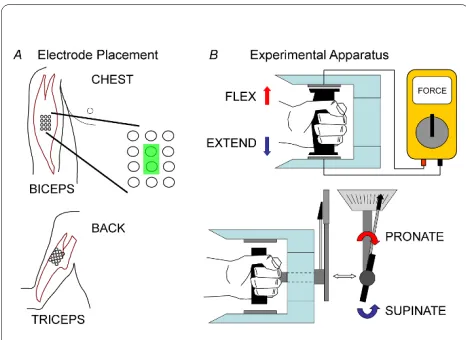
the Netherlands) was circular with a diameter of 10 mm. The center-to-center distance between two poles was 15 mm. Before electrode placement, the skin was shaved, lightly abraded, and cleaned with alcohol. Conductive gel was applied to each monopole. The center of the elec-trode grids were positioned over the anatomical locations described by Delagi and Perotto [21]. A reference elec-trode was placed on the abdomen of each subject. The subjects were asked to perform four types of isometric contractions with their preferred arm: elbow flexion, elbow extension, forearm pronation, and forearm supina-tion. They were also asked to complete resting trials. An experimental apparatus (Figure 1B) was constructed to maintain a consistent arm posture and normalize the level of effort exerted by all subjects. Subjects sat com-fortably in front of a desk with their elbow resting on an armrest, such that their elbow joint was at a right angle and their hand was level with the top of the desk. Their hand gripped the handle of the experimental apparatus. Elbow flexion and extension were performed by pressing the handle upward or downward against force sensors within the upper or lower enclosure of the apparatus, respectively. Pronation and supination were achieved by gripping a handle connected to a torque wrench and rotating the forearm against the resistance of the device while maintaining proper arm posture. No effort was required for the subjects to maintain their nominal pos-ture in the experimental apparatus.
To study the effect of different levels of muscle contrac-tion effort on classifier performance, we defined two dif-ferent effort levels--high and low. At the beginning of each experiment, subjects were asked to perform each of the four actions at their own pace and maintain maximal voluntary contractile force (MVC) for five seconds. Low and high effort levels were defined as 25% and 65% of MVC, respectively, in congruence with effort protocols seen in literature [20,22]. Although 25% to 65% effort lev-els are high compared to the effort required by able-bod-ied subjects to naturally move a joint without load, powered prostheses, wheelchairs, or exoskeletons are usually driven by EMG signal amplitudes (or muscle con-traction effort), and therefore patients with motor deficits use these effort levels to drive these machines. Once MVC was established, subjects were asked to perform flexion, extension, supination, or pronation at their own pace and to hold the contraction at the defined effort level for 5 s. Subjects were given feedback on their effort level via either the force sensors or the torque wrench (Figure 1B).
In order to study the effect of muscle fatigue on EMG features, we instructed the subjects to perform isometric contractions that induced short-term muscle fatigue. Subjects were asked to maintain an isometric contraction of the respective muscle at low effort (25% MVC) for 90 seconds [23,24]. All subjects verbally reported muscle soreness and presented some difficulties in maintaining the required amount of constant force at the end of this session. The EMG signals measured after this 90 seconds contraction were from fatigued muscles.
The experiment was divided into ten trials--a baseline/ rest trial and nine action trials. During the first trial, the subjects remained relaxed for 2 min. while baseline EMG activity was recorded. Each of the remaining trials con-sisted of 10 isometric contractions, either 5 flexions and 5 extensions, or 5 pronations and 5 supinations. The type of action and desired effort level were specified randomly within each trial. For each action, subjects were instructed to maintain a target level of contraction--either low or high effort, depending on the trial--for 5 s, with 5 s breaks between low effort contractions and 1.5 min. breaks between high effort contractions to avoid muscle fatigue [19,23]. During the first seven of the nine action trials the subjects were instructed to perform iso-metric contractions at either low or high levels of effort while the muscles remained unfatigued. The last two of the nine action trials required the subjects to perform only low effort actions while the muscles were in a fatigued state. A rest was allowed between trials.
EMG Data Collection and Pre-Processing
The Refa System (TMS International B.V., the Nether-lands) was used to acquire the EMG signals. The monop-Figure 1 Experimental apparatus and the placement of
olar analog signals were low-pass filtered with a 625 Hz cut-off frequency and pre-amplified with the gain of 60 dB. The common mode was removed by subtracting the average of the connected monopole signals. The EMG signals were digitally sampled at 2500 Hz and band-pass filtered from 15 to 450 Hz using a digital, eighth-order Butterworth filter. The data coinciding with muscle con-tractions were manually segmented and concatenated based on the type of intended movement [25]. Manual data segmentation allowed us to select transient EMG signals in the initial movement state, compared to auto-matic method. Note that the data segmentation was not required in real-time EMG pattern recognition. Single differential EMG signal (bipolar) recordings from longi-tudinally neighboring electrodes were subtracted from each other (see, e.g., Figure 1A). Single differential EMG signals are referred to below as EMG signal channels.
Investigation of Time-Domain Features
Eleven frequently suggested time-domain features with high computational efficiency [10,12,15,26-28] for real-time EMG pattern recognition were assessed. These fea-tures were extracted within an N-sample analysis time window.
Mean Absolute Value (mAV)
This feature is the mean absolute value of signal x in an analysis time window with N samples. xk is the kth sample in this analysis window.
Zero Crossings (ZC)
ZC is the number of times signal x crosses zero within an analysis window; it is a simple measure associated with the frequency of the signal. To avoid signal crossing counts due to low-level noise, a threshold ε was included (ε = 0.015 V) [27]. The ZC count increased by one if
Slope Sign Changes (slopeSign)
Slope sign change is related to signal frequency and is defined as the number of times that the slope of the EMG waveform changes sign within an analysis window. A count threshold ε was used to reduce noise-induced counts (ε = 0.015 V) [27]. The slopeSign count increased by one if
Waveform Length (waveLen)
This feature provides a measure of the complexity of the signal. It is defined as the cumulative length of the EMG signal within the analysis window:
Willison Amplitude (wAmp)
This feature is defined as the amount of times that the change in EMG signal amplitude exceeds a threshold; it is an indicator of the firing of motor unit action potentials and is thus a surrogate metric for the level of muscle con-traction [12]. A threshold between 50 and 100 mV has been reported in the literature [12]. In this study, the threshold ε was defined for each subject as the EMG sig-nal value that had a 50% probability of occurrence as defined by a computed cumulative distribution function for each type of intended movement:
where f(x) = {1 if x > ε; 0 otherwise}.
Variance (var)
This feature is the measure of the EMG signal's power.
v-Order (vOrder)
This metric yields an estimation of the exerted muscle
force [12]. The optimal EMG signal processor consists of
a pre-whitening filter, a nonlinear detector, a smoothing
filter, and a re-linearizer [12]. The nonlinear detector
here is characterized by the absolute value of EMG signal
to the vth power. The applied smoothing filter is the mov-ing average window. Therefore, this feature is defined as
, where E is the expectation operator
applied on the samples in one analysis window. One study
[12] indicates that the best value for v is 2, which leads to
the definition of the EMG v-Order feature as the same as
the square root of the var feature. mAV
N xk
k N = =
∑
1 1 (1)x and x or x and x
and x x
k k k k
k k
> <
{
}
{
< >}
− ≥
+ +
+
0 1 0 0 1 0
1
) e
(2)
x x and x x or x x and x x
and x x or x x
k k k k k k k k
k k k
> >
{
}
{
< <}
− ≥ −
− + − +
+
1 1 1 1
1 e kk−1 ≥e
waveLen xk where x x x
k N
k k k
= = − = −
∑
Δ Δ 1 1 ; (4)wamp f xk xk
k N
= − +
=
∑
( 1)1 (5) var= −
∑
= 1 1 2 1N xk
k N
(6)
vOrder E xk v v
log-Detector (logDetect)
Like the vOrder feature, this feature also provides an esti-mate of the exerted muscle force [12]. The nonlinear detector is characterized as log(|xk|) and the logDetect feature is defined as
Aside from the single-value features described above, we also studied three features with multiple dimensions. Each of them captured one or more characteristics of the EMG process. To be consistent, the dimensionality of these features was constrained to nine.
EMG Histogram (emgHist)
This feature provides information about the frequency with which the EMG signal reaches various amplitudes [12]. For each subject, a minimum and a maximum volt-age value of the EMG signal were determined and used as the data range for a histogram with nine data bins. We refer to this feature as emgHist. Although the data range for computing emgHist was different among subjects, this did not bias the classification result because the classifier was adaptive to the EMG patterns for individual subjects.
Autoregression Coefficient (AR)
This feature models individual EMG signals as a linear autoregressive time series and provides information about the muscle's contraction state. It is defined as
where ai represents autoregressive coefficients, p is the AR model order, and ek is the residual white noise [26].
Cepstrum coefficients (Ceps)
A cepstrum of a signal is the result of taking the Fourier transform of the decibel spectrum as if it were a signal. This measure provides information about the rate of change in different frequency spectrum bands of a signal. Cepstrum coefficients were derived from the autoregres-sive model [15] and were computed as
where ai is the ith AR coefficient as (8), c
i is the ith
Ceps-trum coefficient, i is the dimensionality of the model. Note that computing this feature does not require a Fou-rier transform, and this feature is still considered a time-domain feature.
Analysis of Disturbance Impact on EMG Features
The impact of the studied disturbances on individual fea-tures and combined feafea-tures was quantified by the change in classification performance. A simple linear dis-criminant analysis (LDA) classifier was used because it is a computationally efficient real-time operation and has classification performance similar to more complex algo-rithms [10,29,30]. One EMG channel from the biceps and one channel from the triceps were input to the LDA clas-sifier to identify five intended movements. For each movement class, the concatenated signals were separated into 150 ms analysis windows with 75 ms (50% of dura-tion) of overlap [25]. EMG features were calculated for each analysis window for each EMG channel. Features for two EMG signals were concatenated into a vector and passed to the LDA classifier. EMG features were further separated into a training data set (to train the classifier) and a testing data set (to evaluate the classifier). The sification performance was quantified by the overall clas-sification accuracy (CA):
To investigate feature stability with respect to the three studied disturbances, the training and testing data were organized as follows:
Location Stability
The electrode shift was assumed to occur in the same manner as a hypothetical orthotic or prosthetic socket that could rotate clockwise/counterclockwise or slide up/ down along a user's arm. To study the effect of electrode shift, the classifier was trained using the channel pairs located in the center of the electrode grids on the biceps and triceps. The classifier was then tested on data from each of four pairs of channels with locations that would coincide with socket shift (up/down) and socket rotation (clockwise/counterclockwise). The extent of the shift was constrained to the neighboring electrode pair: 15 mm shift in each of the four directions.
Effort Stability
Based on our clinical experience, users may exert one level of muscle contraction effort while training an EMG classifier but use a different level of effort during real-time testing. The effort stability was studied by training the EMG classifier on data gathered from high-effort actions and testing the classifier on data gathered from low-effort actions, and vice versa. In addition, to explore different training strategies, a classifier was also trained and tested on data of mixed high- and low-effort actions. EMG signals used in this analysis were taken from trials without muscle fatigue. The central pair of electrodes log
log( ) Dectect e N
xk k
N
=
∑
=1
1 (7)
xk a xi k i ek
i p
= − +
=
∑
1
, (8)
c a
c a l
ia c
i i l i
n i
1 1
1 1
1 1
= −
= − − −
= −
−
∑
( ) (9)CA= Number of Correct Classifications
with respect to the electrode grid was used for this analy-sis.
Fatigue Stability
In this analysis, the classifier was trained on trials without muscle fatigue and then tested on data corresponding to trials with muscle fatigue. During clinical testing, muscle fatigue emerges following prolonged usage of EMG pat-tern recognition systems but does not typically emerge during the training phase. The effort level was set to low, and the central pairs of electrodes on the electrode grids were used.
Identification of Robust Feature Sets
A robust EMG feature set should exhibit minimal impact from undesired disturbances, yet remain sensitive to the user's intended movements. To quantify the robustness of feature sets under the influence of the studied distur-bances, we defined a stability index as follows:
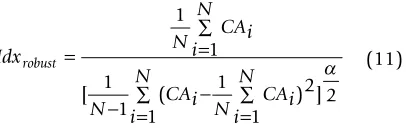
The numerator is the average classification accuracy over N samples; the denominator is the scaled standard deviation. α is a scaling factor that limits the influence of the standard deviation on the index value. A robust fea-ture set should produce high average classification accu-racy under the disturbance as well as low variance across subjects; therefore, the optimal feature set must provide the highest index value. In this study, α was set to 0.2. This value was determined by trial and error. It is note-worthy that the optimal feature set was not sensitive to α when α was within the range from 0.1 to 0.3. The most robust EMG feature sets were determined for each of the three studied disturbances as well as for the combination of the three studied disturbances.
Results
Impact of Disturbances on EMG signals
The impact of electrode location shift, changing effort level, and muscle fatigue on EMG signals recorded from the biceps are shown in Figure 2A. Shifting the electrode location by 15 mm caused a slight change in magnitude in EMG signals. Significantly larger EMG amplitudes were observed with high muscle contraction effort than with low effort. In addition, the EMG signals recorded during muscle fatigue demonstrated an attenuation of the higher frequency components as compared with the EMG sig-nals recorded without muscle fatigue. Figure 2B high-lights this observation by comparing the power spectrum density of the EMG signals recorded with and without
fatigue; the median frequency was reduced by 9.6 Hz when the muscles were fatigued.
Impact of Disturbances on Individual Features
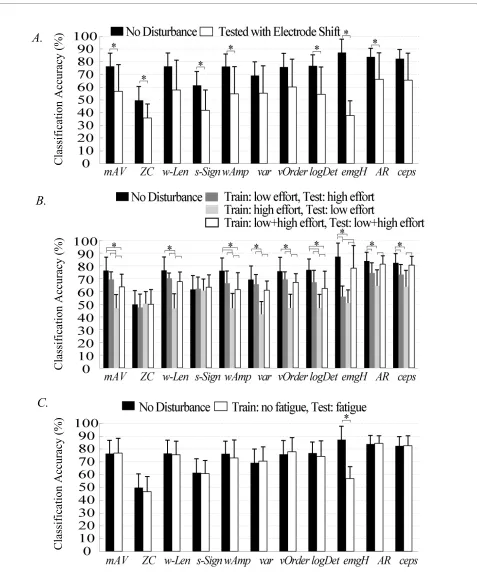
The effects of the three studied perturbations on individ-ual features are demonstrated in Figure 3. When the elec-trodes were not shifted, the use of emgHist resulted in the highest mean classification accuracy (87.3%) and the use of ZC yielded the lowest mean accuracy (49.7%). Intro-ducing a 15 mm electrode location shift in the testing data led to lower classification accuracy for all of the fea-tures (Figure 3A).
Stability of individual features with respect to the level of muscle contraction effort is demonstrated in Figure 3B. Compared with the performance without any distur-bances, variation in muscle contraction effort reduced the classification accuracy of all individual features except for ZC and slopSign. Training the classifier on high-effort data yielded the lowest classification performance for all features except for ZC. Training the classifier on low- and mixed-effort data resulted in similar accuracies. Overall, AR and Ceps were influenced the least and provided rela-tively high classification accuracies.
Stability of individual features with respect to muscle fatigue is demonstrated in Figure 3C. Muscle fatigue only affected the classification accuracy of the emgHist feature.
The Impact of Disturbances on Feature Combinations
Figure 4 demonstrates the average classification accuracy as a function of the number of combined features during each perturbation. All three disturbances reduced the classification performance of feature combinations. Although muscle fatigue did not significantly affect the classification performance of each individual feature, its impact became visible when combinations of features were used.
Using a feature set with two or more combined features improved EMG pattern classification performance in all studied conditions. In addition, using a combination of four features began to saturate the classification perfor-mance when tested with disturbances, which implies that at least four features should be used to reduce the impact of the three disturbances on the EMG pattern recognition performance. Using features sets with five or more com-bined features increased the computational complexity of pattern recognition and did not result in further improve-ment of classification accuracy when tested with muscle fatigue and changing effort level. Therefore, the most sta-ble feature set was identified from the combinations of four features.
Selection of Most Stable Feature Sets
When the number of combined features was limited to four, the feature set with the highest stability index (as in equation 11) with respect to location shift was composed
Idx N
CAi i
N
N CAi Ni CAi
N
i N
robust = =
∑
− =∑ − ∑=
1
1 1
1
1
1 2 1
2
[ ( ) ]
Figure 3 The effects of (A) location shift, (B) varied muscle contraction effort, and (C) muscle fatigue on the classification performance of individual features. Each bar indicates the mean value of classification accuracy over 8 subjects. The error bars denote one standard deviation. Stars (*) denote statistically significant differences by one-way ANOVA (P <0.05).
B.
A.
C.
Classifi
cation Accuracy (
%
)
Classifi
cation Accuracy (
%
)
Classifi
cation Accuracy (
%
of var, v-Order, logDetect, and emgHist features. The use of this optimal feature set produced a 72.6% mean accu-racy across the 8 subjects, with a standard deviation of 21.9%. The difference between the accuracy derived from the feature set with the highest stability index and the accuracy derived from the feature set with the lowest index (56.6% ± 22.5%) was not statistically significant (one-way ANOVA, p = 0.17). The classification accura-cies derived from both feature sets demonstrated a large variation across subjects.
The muscle contraction effort stability was studied using training data from low-effort muscle contractions and testing data from high-effort muscle contractions. The most stable feature set with respect to a changing level of effort consisted of waveLen, slopeSign, logDetect and AR features. Using this feature set produced 76.3% ± 8.03% accuracy when averaged across 8 subjects, which was significantly higher than the accuracy (57.9% ± 17.3%) derived from the worst performing feature set (one-way ANOVA, p < 0.05).
The most stable feature set with respect to muscle fatigue consisted of waveLen, slopeSign, AR and Ceps fea-tures, which resulted in 85.6% ± 4.8% accuracy across subjects. The feature set with the lowest index value resulted in 65.1% ± 11.4% accuracy, which was signifi-cantly lower than the most stable feature set (one-way ANOVA, p < 0.05).
Lastly, the stability of a feature set with respect to all studied disturbances was of primary interest in our analy-sis. The stability index of each feature set was calculated across the three studied disturbances and all tested sub-jects. Note that we only considered the effort level change from low (training) to high (testing). Figure 5 shows the performance of the three EMG feature sets with the high-est stability index across the three studied disturbances.
All three feature sets produced similar classification per-formance; the average classification accuracy over 8 sub-jects was approximatley 70% under electrode location shift, 78% under effort level change, and 87% with muscle fatigue. All three sets shared the features of waveLen, AR, and Ceps.
Discussion
Practical usage of EMG pattern recognition demands that performance remains invariant across prolonged periods of time. This requirement translates into the need for an understanding of the consequences of inevitable distur-bances, such as a shift in the location of EMG electrodes, variations in muscle contraction effort, and muscle fatigue. It is therefore necessary to identify parameters of the control signal that are robust with respect to these disturbances. Our study achieved two goals in addressing this practical problem: (1) we quantified the performance of EMG features under three physical and physiological disturbances and then (2) attempted to improve the robustness of EMG pattern classification by identifying robust sets of EMG features. The experiments of this study were designed with the aim of examining the stabil-ity of EMG features under general variations in EMG sig-nals; the results could inform other HMI design for different specific applications. Note that other HMI sys-tem may include different number of EMG electrodes, other type of tested movements, and different classifier, which may have effects on the absolute system accuracy, but little on the relative difference in classification accu-racy between the before and the after signal disturbance phase. Since the stability of TD features was measured by the relative change of accuracy after EMG disturbances, the outcome of this study can benefit general EMG-based HMI system design by selecting stable EMG features.
A shift in electrode location greatly diminished the classification accuracies of each individual feature as well as feature combinations. Choosing the most stable com-bination of four features with respect to electrode loca-tion resulted in only 72.6% classificaloca-tion accuracy, which was significantly lower than the average accuracy (~90% in Figure 4) when no disturbance was presented. This result implies that simply selecting proper time-domain EMG feature sets can offer some improvement in classifi-cation accuracy, but is inadequate to compensate for the large shifts (15 mm) on the biceps and triceps tested in this study. Physically maintaining electrode location is vital to achieving robustness of EMG pattern classifica-tion. Further investigation is required to assess the sensi-tivity of EMG features to electrode shifts in other muscle areas and shifts smaller than the ones we considered in our study.
Similar results were observed for the level of effort of muscle contractions. Using the feature set with the high-Figure 4 The change in average classification performance with
est stability index offers improvement in classification accuracy, but cannot effectively negate the impact from the effort level change. Interestingly, the magnitude of the impact due to variability in effort level was considerably influenced by the training strategy used for our classifier. Training the classifier on data from low-effort actions or on data from mixed high- and low-effort actions yielded much better classification accuracy than training the clas-sifier on data from high-effort actions only. This finding suggests that the initial training of a classifier should use EMG data composed of varied muscle contraction levels or low effort level in order to enhance the stability of the EMG classifier with respect to variability in the level of effort of muscle contractions. The effort level change from high (training) to low (testing) greatly decreased the classification performance, compared to the effect of the
effort change from low (training) to high (testing). This could be because high-effort muscle contraction not only shifts the mean of the distribution of the studied time-domain EMG features but also increases the features' variance within the classifier space.
Our results indicated that muscle fatigue fortunately had a minor effect on all features except for the EMG his-togram feature. However, when sets of combined features were used, selection of an appropriate feature combina-tion was critical to compensate for the influence of mus-cle fatigue on classification performance. This is because the use of the optimal feature set with respect to muscle fatigue provided a significantly more robust classification (higher accuracy and less variation) across subjects than the use of the least stable feature set.
Figure 5 Performance of the three optimal feature sets under three studied disturbances. The three feature sets are (A) mAV, waveLen, AR, and Ceps; (B)waveLen, logDetect, AR, and Ceps; (C)waveLen, wAmp, AR, and Ceps. Each graph is divided into three columns. The first column shows classifica-tion accuracies for each subject with respect to locaclassifica-tion stability. The second column shows classificaclassifica-tion accuracies for each subject with respect to effort stability. Only the classifier trained on low effort data and tested on high effort data was considered. The third column shows classification ac-curacies with respect to fatigue stability. Horizontal black lines in each column of all the graphs show the mean classifier performance across all sub-jects for the stability condition.
Classificatio
n Accuracy (%)
Location
Effort
Fatigue
(A)
(B)
One of our results contradicts the conclusion of previ-ous work with respect to the utility of the EMG histo-gram feature for pattern recognition. This previous study [12] showed that the EMG histogram feature was an effective feature that maintained the most separability between classes among all studied EMG features and was recommended by the authors for myoelectric artificial arm control. In our analysis, a consistent result was dem-onstrated only when no disturbance was present in the testing data. Without any perturbations, the EMG histo-gram feature produced the highest classification accuracy and was one of the four best-performing features. How-ever, when the three studied perturbations were intro-duced, the EMG histogram feature was the least stable feature. Including the three disturbances in the testing data drastically reduced the classification performance of the EMG histogram feature. Although the EMG histo-gram feature appeared in the most stable feature set with respect to electrode location stability, this combination did not elicit a significant difference in classification accuracy when compared with the performance of the least stable feature set. In addition, the EMG histogram feature was not included in the most stable set with respect to effort, muscle fatigue, and combined stability analysis. Therefore, our study indicates that the EMG his-togram feature is not robust, which challenges its value for the clinical implementation of EMG pattern recogni-tion.
One noticeable trend in our results is the robust perfor-mance of AR and Ceps features. When there was no dis-turbance in the testing data, both features extracted sufficient neural information. In the effort, fatigue, and combined stability analyses, the most stable feature sets shared AR and/or Ceps features. Nevertheless, AR and Ceps features are multi-dimensional; inclusion of these features in a feature set increases the dimensionality of the feature vectors, which increases the complexity of the classifier and the computational burden for real-time prosthesis control. Hence, there is a trade-off between feature stability and the computational efficiency of clas-sification. The three feature sets that we identified as optimal overall (Figure 5) included waveLen, AR, and Ceps, resulting in a 20-dimension feature per EMG chan-nel. When the number of EMG channels increases, dimensionality reduction of the feature vector following feature extraction might be necessary to improve compu-tational efficiency. Additionally, the dimensionality we included for the multi-dimensional features (nine) was based on reports in the literature [12]. Determining the optimal dimensionality of features such as Ceps and AR is the logical next step in this investigation.
There are several limitations in this study. First, we lim-ited our study to time-domain features. The
implementa-tion of frequency and time-frequency domain features with other types of classifiers is worth investigating in the future. Another limitation is that muscle fatigue during use of EMG-based HMIs is mainly due to repetitive, long-term muscle use; the muscle fatigue in this study was intensity-induced (short-term) because of the time con-straints for conducting the experiments. Additionally, because the level of muscle fatigue was not controlled across subjects, some subjects demonstrated very low level of muscle fatigue and slight changes in EMG signals. Based on the results of this study, relying only on "opti-mal" EMG features is not sufficient to overcome the vari-ations in EMG signals caused by the considered disturbances. Additional solutions, such as effective training strategies and adaptive pattern recognition [16], are promising, although the challenges in making these potential solutions clinically viable still exist. Continued engineering effort is demanded towards development of a practical and robust HMI based on EMG pattern recog-nition.
Conclusion
In this study we examined the influence of EMG signal changes elicited by electrode shift, changing amounts of user effort during muscle contraction, and muscle fatigue, on various time-domain EMG features and their resulting classification accuracies. Our results showed that the use of at least four combined EMG features enhanced the classifier performance, and multi-dimen-sional features, such as autoregression coefficients and cepstrum coefficients, were of greatest value. Although this study suggests three EMG feature sets that could off-set the impact of the three studied disturbances, simple selection of these feature sets for EMG pattern recogni-tion cannot fully solve the problem. Continuous efforts, such as developing effective classifier training strategies or physically fixing the electrode contact locations, are required to circumvent these undesired disturbances and minimize their effects on EMG pattern classification.
Appendix: Linear Discriminant Analysis (LDA) The idea of discriminant analysis is to classify the
observed features to the movement class in which the
posteriori probability P(Cg | ) can be maximized. Cg
(g [1, G]) denotes the movement classes; is the feature
vector in one analysis window. The posteriori probability
is the probability of class Cg given the observed feature
vector and can be expressed as f
f
where P(Cg) is the priori possibility, P( |Cg) is the
like-lihood, and P( ) is the possibility of observed feature
vector . Therefore, the discriminant analysis-based
classifiers can be mathematically described as
Given movement class Cg, the observed feature vectors
have a multivariate normal (MVN) distribution, i.e.
P( |Cg) ~ MVN(μg, Σg), where μg is the mean vector and
Σg is the covariance matrix of the class Cg. Additionally,
assume that the priori possibility P(Cg) is equivalent for
each movement class, and every class shared a common
covariance, i.e. Σg = Σ. Hence, the maximization of
poste-riori possibility in (13) becomes
is defined as the linear discriminant function.
In the offline training μg and Σ were estimated by fea-ture vectors calculated from a large amount of training data and were stored in the flash memory.
where Kg is the number of observations in class Cg;
is the k observed feature vector in class Cg; Fg is
the feature matrix
; Mg is the mean
matrix that has the same number
of columns as in Fg. Therefore, the parameters in the
lin-ear discriminant function (15) were known, i.e.
In the testing phase, the observed feature derived
from each analysis window was fed to the classifier to
cal-culate in (16) for each movement class and was
clas-sified into a specific class that satisfied
Competing interests
The authors declare that they have no competing interests.
Authors' contributions
DK designed experiments, conducted data collection and analysis, and drafted the manuscript. HH and TK supervised the study and revised the manuscript. All authors read and approved the final manuscript.
Acknowledgements
The authors sincerely thank Dr. Kevin Englehart of the University of New Bruns-wick, and Dr. Ping Zhou and Dr. Guanglin Li at the Rehabilitation Institute of Chicago for their assistance with this project. This work was supported by the NIH National Institute of Child and Human Development (Grants # R01 HD043137-01, #R01 HD044798 and # NO1-HD-5-3402), the Defense Advanced Research Projects Agency, and the National Institute on Disability and Rehabili-tation Research, U.S. Department of Education (Grant #H133F080006).
Author Details
1Neural Engineering Center for Artificial Limbs, Rehabilitation Institute of
Chicago, 345 E. Superior Street, Suite 1309, Chicago, IL, 60611, USA,
2Committee on Computational Neuroscience, University of Chicago, 1027 E
57th Street, Room 202, Chicago IL, 60637, USA, 3Department of Electrical,
Computer, and Biomedical Engineering, University of Rhode Island, 4 E. Alumni Ave Kelly A-116, Kingston, RI, 02881, USA and 4Department of Physical
Medicine and Rehabilitation, Northwestern University, Chicago, IL, 60611, USA
References
1. Basmajian JV, De Luca CJ: Muscles alive: their functions revealed by electromyography 5th edition. Baltimore: Williams & Wilkins; 1985. 2. Kuiken TA, Li G, Lock BA, Lipschutz RD, Miller LA, Stubblefield KA,
Englehart KB: Targeted muscle reinnervation for real-time myoelectric control of multifunction artificial arms. Jama 2009, 301:619-628. 3. Stein J, Narendran K, McBean J, Krebs K, Hughes R:
Electromyography-controlled exoskeletal upper-limb-powered orthosis for exercise training after stroke. Am J Phys Med Rehabil 2007, 86:255-261. 4. Rosen J, Brand M, Fuchs MB, Arcan M: A myosignal-based powered
exoskeleton system. IEEE Transation on System, Man, and Cybernetics
2001, 31:210-222.
5. Dipietro L, Ferraro M, Palazzolo JJ, Krebs HI, Volpe BT, Hogan N: Customized interactive robotic treatment for stroke: EMG-triggered therapy. IEEE Trans Neural Syst Rehabil Eng 2005, 13:325-334. 6. Kiguchi K, Imada Y, Liyanage M: EMG-based neuro-fuzzy control of a
4DOF upper-limb power-assist exoskeleton. Conf Proc IEEE Eng Med Biol Soc 2007, 2007:3040-3043.
7. Ferreira A, Celeste WC, Cheein FA, Bastos-Filho TF, Sarcinelli-Filho M, Carelli R: Human-machine interfaces based on EMG and EEG applied to robotic systems. J Neuroeng Rehabil 2008, 5:10.
8. Choi C, Micera S, Carpaneto J, Kim J: Development and quantitative performance evaluation of a noninvasive EMG computer interface.
IEEE Trans Biomed Eng 2009, 56:188-191. P C f P f C g P C g
P f g ( | ) ( | ) ( ) ( ) = (12) f f f
C P C f P C f
P
g C g C g
C
g g
g
= =
=
arg max { ( | )} arg max { ( | )}
arg max { (
ln
ln ff C| g)+ln lnP C( g)− P f( )} . (13)
f
Cg C P f Cg C f
T
g gT g
g g
=arg max {ln ( | )}=arg max { ∑−1 −1 ∑−1 }
2
m m m
(14)
dCg =fT∑−1 g−1 Tg ∑−1 g 2
m m m (15)
mg C k
k K
g g g g
T
g G
K g f g G K g F M F M
g
= ∑ = − −
= =
∑
∑
−1 1 1
1
1 1
, and ( )( )
fC k
g,
Fg =[fCg,1,fCg,2,…fC kg, ,…,fCg,Kg]
Mg =[m … g,mg, mg]
Received: 4 December 2009 Accepted: 21 May 2010 Published: 21 May 2010
This article is available from: http://www.jneuroengrehab.com/content/7/1/21 © 2010 Tkach et al; licensee BioMed Central Ltd.
This is an Open Access article distributed under the terms of the Creative Commons Attribution License (http://creativecommons.org/licenses/by/2.0), which permits unrestricted use, distribution, and reproduction in any medium, provided the original work is properly cited. Journal of NeuroEngineering and Rehabilitation 2010, 7:21
dC f
T
g g
T g
g
= ∑−1 −1 ∑−1 2
m m m (16)
f
dCg
Cg
9. Williams TW: Practical methods for controlling powered upper-extremity prostheses. Assist Technol 1990, 2:3-18.
10. Englehart K, Hudgins B: A robust, real-time control scheme for multifunction myoelectric control. IEEE Trans Biomed Eng 2003, 50:848-854.
11. Englehart K, Hudgins B, Parker PA, Stevenson M: Classification of the myoelectric signal using time-frequency based representations. Med Eng Phys 1999, 21:431-438.
12. Zardoshti-Kermani M, Wheeler B, Badie K, Hashemi R: EMG feature evaulation for movement control of upper extrmity prostheses. IEEE Trans Rehabil Eng 1995, 3:324-333.
13. Hargrove L, Englehart K, Hudgins B: A Comparison of Surface and Intramuscular Myoelectric Signal Classification. IEEE Transactions on Biomedical Engineering 2007, 54:847-853.
14. Micera S, Sabatini AM, Dario P: On automatic identification of upper-limb movements using small-sized training sets of EMG signals. Med Eng Phys 2000, 22:527-533.
15. Zecca M, Micera S, Carrozza MC, Dario P: Control of multifunctional prosthetic hands by processing the electromyographic signal. Crit Rev Biomed Eng 2002, 30:459-485.
16. Sensinger JW, Lock BA, Kuiken TA: Adaptive pattern recognition of myoelectric signals: exploration of conceptual framework and practical algorithms. IEEE Trans Neural Syst Rehabil Eng 2009, 17:270-278. 17. Vigreux B, Cnockaert JC, Pertuzon E: Factors influencing quantified
surface EMGs. Eur J Appl Physiol Occup Physiol 1979, 41:119-129. 18. Broman H, Bilotto G, De Luca CJ: Myoelectric signal conduction velocity
and spectral parameters: influence of force and time. J Appl Physiol
1985, 58:1428-1437.
19. Sahlin K, Tonkonogi M, Soderlund K: Energy supply and muscle fatigue in humans. Acta Physiol Scand 1998, 162:261-266.
20. West W, Hicks A, Clements L, Dowling J: The relationship between voluntary electromyogram, endurance time and intensity of effort in isometric handgrip exercise. Eur J Appl Physiol Occup Physiol 1995, 71:301-305.
21. Delagi EF, Perotto A: Anatomic guide for the electromyographer--the limbs
2nd edition. Springfield, Ill.: Thomas; 1980.
22. Yoon T, Schlinder Delap B, Griffith EE, Hunter SK: Mechanisms of fatigue differ after low- and high-force fatiguing contractions in men and women. Muscle Nerve 2007, 36:515-524.
23. Sahlin K, Ren JM: Relationship of contraction capacity to metabolic changes during recovery from a fatiguing contraction. J Appl Physiol
1989, 67:648-654.
24. Smith IC, Newham DJ: Fatigue and functional performance of human biceps muscle following concentric or eccentric contractions. J Appl Physiol 2007, 102:207-213.
25. Zhou P, Lowery MM, Englehart KB, Huang H, Li G, Hargrove L, Dewald JP, Kuiken TA: Decoding a New Neural-Machine Interface for Control of Artificial Limbs. J Neurophysiol 2007.
26. Graupe D, Salahi J, Kohn KH: Multifunctional prosthesis and orthosis control via microcomputer identification of temporal pattern differences in single-site myoelectric signals. J Biomed Eng 1982, 4:17-22.
27. Hudgins B, Parker P, Scott RN: A new strategy for multifunction myoelectric control. IEEE Trans Biomed Eng 1993, 40:82-94.
28. Khezri M, Jahed M: Real-time intelligent pattern recognition algorithm for surface EMG signals. Biomed Eng Online 2007, 6:45.
29. Hargrove L, Englehart K, Hudgins B: The effect of electrode
displacements on pattern recognition based myoelectric contro. the 28th IEEE EMG Annual International Conference; New York City 2006. 30. Huang H, Kuiken TA, Lipschutz RD: A strategy for identifying locomotion
modes using surface electromyography. IEEE Trans Biomed Eng 2009, 56:65-73.
doi: 10.1186/1743-0003-7-21