Identification of clinically antibiotic resistant genes
Aac(3)-IIa
and
Aac(6’)-Ib
in wastewater samples by multiplex PCR
Naser Samadi1, Rahim Aali2*, Esrafil Asgari3, Hamed Mirhosaeini4, Ali Shahriari5, Farhad Mahmoodi6, Fardin Nouri7, Asad Hamdi7, Farzad Fanaie7, Shahla Yosefi7, Saied Dadashi7
1MSc of Cellular and Mulecular Research Center, Faculty of medicine, Urmia University of Medical Sciences, Urmia, Iran
2Assistant Professor of Department of Environmental Health Engineering, Faculty of Nursing and Health, Urmia University of Medical Sciences, Urmia, Iran
3Instructor of Department of Environmental Health Engineering, Faculty of Nursing and Health, Urmia University of Medical Sciences, Urmia, Iran
4Instructor of Medical Microobiology, Department of Environmental Health Engineering, Faculty of Health, Arak University of Medical Sciences, Arak, Iran
5Assistant Professor of Department of Environmental Health Engineering, Environmental Health Research Center, Golestan University of Medical Sciences, Gorgan, Iran.
6PhD student of Department of Environmental Engineering, Ahvaz Branch, Islamic Azad University, Ahvaz, Iran 7BSc of Environmental Health, Student Research Committee, Urmia University of Medical Sciences, Urmia, Iran
Abstract
Background: Aminoglycoside antibiotics are widely used in medical centers, particularly to treat infections. The resistance developed against these agents is a huge concern in health care. A number of researchers have reported that hospital and municipal wastewaters are among the most important dissemination sources of these agent into the environment. Some, however, do not agree with this opinion. In the present study, the prevalence of aminoglycoside resistance genes was investigated in raw and effluent wastewater from hospital and municipal wastewater treatment plants.
Methods: To conduct this descriptive-analytical study, 30 samples were taken according to sampling principles and cold cycle and transferred to the molecular laboratory. DNA was extracted by the freeze-thaw method using a kit (Promega). The genes aac(3)-IIa and aac(6’)-Ib which code aminoglycoside resistance were examined in this study.
Results: The results indicated that the studied genes are present in 35% of urban and hospital wastewaters, and their frequency percentage is higher in hospital wastewater (52%) than urban wastewater (48%). The studied genes were identified in 61% of raw hospital wastewater samples; however, they were not detected in the output wastewater from the studied treatment plants.
Conclusion: Although, the studied genes were not detected in the final effluent, there is a high potential for their release into the environment. The current study demonstrated that the coding genes of aminoglycoside antibiotic resistance are present in raw urban and hospital wastewaters. In the case of improper exploitation of wastewater treatment plants, the output water can contaminate other environmental sections, such as soil and water resources, and result in the emission of these contaminants.
Keywords: Antibiotic resistance, Aminoglycosides, Urban and hospital wastewaters
Citation:Samadi N, Aali R, Asgari E, Mirhosaeini H, Shahriari A, Mahmoodi F, et al. Identification of clinically antibiotic resistant genes Aac(3)-IIa and Aac(6’)-Ib in wastewater samples by multiplex PCR. Environmental Health Engineering and Management Journal2015; 2(2): 47–52.
*Correspondence to: Rahim Aali
Email: [email protected] Article History: Received: 14 January 2015 Accepted: 19 April 2015 ePublished: 20 June 2015 Environmental Health
Engineering and Management Journal HE
M J
© 2015 The Author(s). Published by Kerman University of Medical Sciences. This is an open-access article distributed under the terms of the Creative Commons Attribution License (http://creativecommons.org/licenses/by/4.0), which permits unrestricted use,
Original Article
Introduction
Excessive use of antibiotics in the treatment of humans and animals leads to antibiotic resistance (1-3). Antibi-otic resistant bacteria (ARB) and antibiAntibi-otic resistant genes (ARGs) cause serious problems in the treatment of infec-tious diseases. They enter the environment in different ways. Urban and hospital wastewaters have a high
poten-tial for the release of resistant bacteria and genes into the environment (4,5). Such release increases concerns about public health (4). Antibiotic resistance in the environment can be transferred to nonpathogenic bacteria from patho-genic bacteria and increase pressure on the aquatic ecolo-gy through physiological changes and population mobility (4-6). Research has shown that a large number of ARB and
ARGs, in particular hospital strains, have been found in regions where hospital wastewaters have been discharged (7). Importantly, some of these contaminated water re-sources are used for public water supplies. Some inves-tigations have revealed that discharge of hospital waste-water is associated with the widespread dissemination of resistant bacteria in the environment (1). Other studies have demonstrated that urban wastewaters are important means through which resistant bacteria and genes are dis-charged into the environment (8). Some researchers have shown that resistant bacteria and genes are rarely removed from wastewater in treatment plant facilities (3,4). Some studies have even indicated that the number of resistant bacteria increases in such facilities (9).
Aminoglycosides are a group of medications that have similar chemical, antimicrobial, pharmacological, and toxic properties. Currently, this group includes strepto-mycin, gentamicin, tobrastrepto-mycin, kanastrepto-mycin, amikacin, netilmicin, neomycin, sizomycin, and others (10). Ami-noglycoside antibiotics are widely used in medical centers to treat life-threatening infections caused by gram-neg-ative bacteria (10,11). Resistance to aminoglycosides is often caused by drug enzymatic changes by phosphoryla-tion, adenylaphosphoryla-tion, and acetylation of amine and hydroxyl groups, the most common mechanism of antibiotic resis-tance in bacteria (12). Among enzymes that change ami-noglycosides, the aac(6’)-Ib is predominant and causes re-sistance to many antibiotics. This gene was first identified in 1986 in Klebsiella pneumoniae isolates (13). Although the production of aminoglycoside-changing enzymes is the most common mechanism for producing resistance to aminoglycosides, the gram-negative bacteria that produce 16S rRNA methylase have become increasingly preva-lent in recent years (14), and such widespread resistance to aminoglycosides has become a huge challenge to the medical profession (15). Filipova et al (16) and Chan-drakanth et al (17) reported aminoglycoside resistant bac-teria isolated from clinical environments. The aac gene is distributed in different microorganisms isolated from polluted waters (18-20). Szczepanowski et al (21) reported that aminoglycoside resistance genes prevailed in clini-cal compartments and can be spread to the environment through hospital wastewater. Considering the risk of these pollutant genes entering the environment, this study ex-amined the prevalence of the aac(3)-IIa and aac(6’)-Ib
resistant genes in raw and wastewater effluent and deter-mined the role of urban wastewater treatment plants in
removing/reducing aac genes.
Methods
Preparation of samples
A certain volume of the main samples (50 ml) was taken and centrifuged for 10 minutes at 6000 rpm. The sediment was extracted, 300 μl of distilled water was added, and the solution was subjected to freeze and thaw using liquid ni-trogen and boiling water, each for 1 minute periodically at 4-5 stages (22).
DNA extraction
DNA was extracted using a Promega Wizard Genomic DNA purification kit, (Madison, WI) in 3 stages. In the lysing stage of the cell, pipetting was performed well af-ter the addition of cell lyse solution (600 μl). The solution was then incubated at 80°C for 5 minutes. Finally, RNase was added, and the solution was incubated again for 15-60 minutes at 37°C. At the protein precipitation stage, 200 μl of precipitation solution was added and incubated for 5 minutes on ice, followed by centrifugation at 13000-16000 rpm for 3 minutes. At the DNA precipitation stage, the top liquid was transferred to a tube containing 600 μl of isopropanol at room temperature and mixed. Afterwards, 600 μl of 70% ethanol was added at room temperature and the mixture was centrifuged for 2 minuts at 13 000-16 000 rpm. The ethanol was then removed and the tubes dried under ambient conditions. DNA was suspended in 100 μl of distilled water and kept for 1 night at 4°C; it was ulti-mately maintained at -20°C until molecular experiments were performed. The concentration of the extracted DNA was read by spectrophotometry (Nanodrop ND 1000).
PCR method
The pair of primers used to amplify the aac(3)-IIa and
aac(6’)-Ib genes are listed in Table 1. PCR amplification was conducted at a volume of 25 λ containing 2.5 μl buffer 10X PCR, 1 μl of each primer, 0.75 μl of MgCl2, 0.5 μl of dNTP, 0.35 μl of tag polymerase, 2 μl of the DNA template, and 14.9 μl of deionized water. All PCR experiments had positive and negative controls. The process was performed using the initial denaturation stage for 5 minutes at 94°C, 35 cycles at 94°C for 45 seconds (denaturation), at 53°C for 30 seconds (annealing), and at 72°C for 1 minute (ex-tension). The final extension was performed at 72°C for 10 minute. PCR products were investigated using electro-phoresis (1.5%) and DNA safe stain. They were then
de-Table 1. Characteristics of primers
Primers Target gene Sequence (5'-3') Amplified size (bp) Annealing temperature (˚C) References
F
R Aac(3)-IIa F: 5-CGGAAGGCAATAACGGAG- 3R: 5 -TCGAACAGGTAGCACTGAG -3 749 bp 53°C (23) F
tected on Transluminar UV.
Data analysis
To compare the presence and absence of genes among var-ious sites, the chi-square test was employed. McNemar test was utilized before and after each treatment plant.
Results
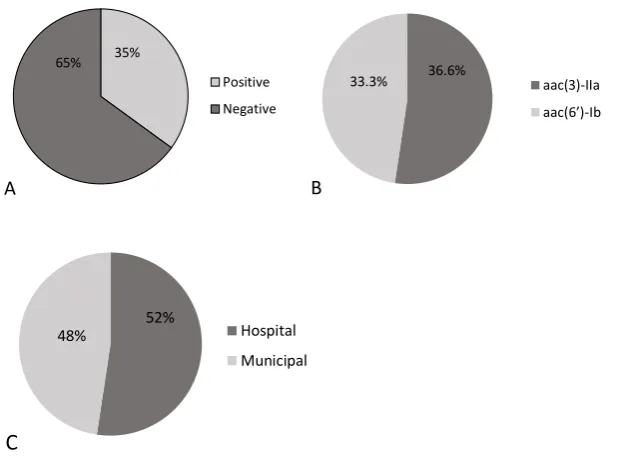
Amplified multiplex genes are illustrated in Figure 1. The results indicated that aac(3)-IIa and aac(6’)-Ibgenes were found in 35% of the samples (Figure 2A). The aac(3)-IIa
(37%) was found in a larger number of samples than the
aac(6’)-Ib gene (33%) (Figure 2B). Distinctive analysis of urban and hospital wastewaters indicated that the detec-tion percentage of the studied genes was higher in hos-pital wastewaters (52%) than in urban wastewaters (48%) (Figure 2C).
The results revealed that the aac(3)-IIa gene was present in 50% of the hospital wastewater samples, while aac(6’)-Ib was observed in 42% of the samples. The studied genes were found in 28% of the urban wastewater samples.
In-vestigations of the input and output of urban wastewaters indicated that, generally, 56% of the studied genes were found in the input. aac(3)-IIa and aac(6’)-Ib were pre-sented in the raw samples 56% and 44%, respectively. The studied genes were found in none of the effluent of urban wastewater treatment plants, but in 61% of the wastewater samples from hospitals. One of the studied hospitals had its own wastewater treatment plant; the results demon-strated that 83% of samples from this plant’s raw waste-water contained the studied genes, but none of the genes were found in the effluent.
Discussion
Aminoglycoside antibiotics are widely used in medical clinics, especially to treat life-threating infections caused by gram-negative bacteria (24-26). Because of the wide-spread incidence of aminoglycoside resistance and the resulting complications for the medical field (24), the present study investigated two aminoglycoside-resistance genes. Clinical genes resistant to aminoglycosides were found to be present in municipal wastewaters. In their studies, Guardabassi et al (27), Heuer et al (18), and Aali et al (8) also indicated that the genes resistant to aminoglyco-sides exist in environmental resources. The results of this study revealed the lowest percentage of clinically genes. The results of other studies also confirm these findings. Jakobsen et al (28) found aac genes in wastewater isolates and showed a possible dissemination of aac from hospital to wastewater. Aali et al (8) reported an association be-tween the lowest number of bacteria and aminoglycoside-resistance genes. The reason can be attributed to less use of aminoglycoside antibiotics. Recently, the consumption of some members of the aminoglycoside family (such as Figure 1. Aminoglycoside resistance genes, aac(3)-IIa (749) bp
and aac(6’)-Ib(524 bp).
Figure 2. (A) Overall detection of ARGs, (B) total detection of aac(3)-Iia and aac(6’)-Ib, and (C) differences between municipal and hospital wastewaters.
35% 65%
A
Positive Negative
36.6% 33.3%
B
aac(3)-IIa aac(6’)-Ib
52% 48%
C
gentamycin) has been limited because of side effects; how-ever, studies have indicated that resistance can develop even in low antibiotic concentrations (29). Heuer et al (18) attributed the diversity of the genes that code resistance to gentamycin (including Aac3-I) in different environments to the increased frequency of genetic transfer elements. The primary mechanism involved in resistance to genta-mycin has been reported as enzyme deactivation, and over 50 types of enzyme have been identified. These enzymes, based on their biochemical action, include acetyltransfer-ases, phosphotransferacetyltransfer-ases, and nucleotidyl transferases (adenylyl tranferases) (16,17,30). These enzymes are cod-ed by various genes, including Aac, Aph, and Ant (Aad). The mentioned enzymes and the coder genes have been identified in a wide range of isolated bacteria (Aeromonas, Escherichia, Vibrio, Salmonella, and Listeria) from hospital environments and contaminated waters (18-20). The Aac3
gene has been identified as the coder of aminoglycoside-N-acetyl transferases in the microbial populations isolated from wastewater treatment facilities, river water, and ag-ricultural regions (31,32). This can also be applicable to this study, yet complementary research is necessary to in-vestigate the role of key factors in genetic transfer in the studied wastewaters.
The findings of the current study revealed that the per-centages of aac(3)-IIa and aac(6’)-Ib genes are higher in hospital wastewaters than in urban wastewaters. These results are consistent with those of other researchers. The high rate of aminoglycoside-resistance genes in hospitals can be caused by common unnecessary prescriptions for patients. This also demonstrates the aminoglycoside resis-tant mobile genetic agents’ movements between clinical and environmental bacteria (18). Plasmid and integrons have main roles in the dissemination of these agents (30). In their study of the Aac3-1 gene, Aali et al (8) reported that the genes and bacteria resistant to aminoglycosides are more prevalent in hospital than urban wastewaters. Their low percentage in urban wastewaters can be related to process design and operation. The aac(3)-IIagene was identified in hospital wastewaters more than the aac(6’)-Ib
gene. This can be due to bacteria carrying or better ex-pression of the aac(3)-IIa gene.
In the current study, contrary to other studies, neither
aac(3)-IIa nor aac(6’)-Ib genes were detected in effluent wastewater samples from different wastewater treatment plants. Szczepanowski et al (21) identified many ami-noglycoside resistance genes (eg, aacA, aacA1, aacA4,
aacA7, aacA29b, aacC1, aacC2, aacC3, aacC4, aac(3)-Id, and aac[69]-Im) in the final effluent of wastewater treat-ment plants. The absence of the studied resistance genes in the effluent wastewater can be due to the effect of the plant’s disinfection unit, the shock caused by a huge or-ganic load, or the specific conditions of the wastewater treatment plants.
Conclusion
Human contact with resistant bacteria and genes has been a health concern associated with the management of dis-eases. This contact can occur through various means such as environmental resources. Hospital and urban wastewa-ter plays a great role in the spread of resistant genes and bacteria. Wastewater treatment plants are very important as a controlling barrier against these contaminants enter-ing environmental resources. Therefore, the design, op-eration, and continual monitoring of the effluent from treatment plants together with the monitoring of design parameters can be essential in the success of wastewater treatment plants in controlling these pollutants. Various parameters of treatment together with gene expression and the way genes are affected in the wastewater treatment process require further broad and extensive research. The presence of aac(3)-IIa and aac(6’)-Ib genes in the waste-water samples of treatment plants indicates that conven-tional treatment approaches cannot guarantee the absence of these genes; thus it is suggested that more advanced methods be applied to control antibiotic-resistant genes.
Acknowledgments
The authors would like to thank the staff of the Cellular and Molecular Laboratory (Urmia Medicine Faculty) and Dr. Nikaeen, Head of the Advanced Environmental Mo-lecular Laboratory (Department of Environmental Health Engineering), Isfahan University of Medical Sciences.
Ethical issues
The authors certify that all data collected during the study is presented in this manuscript, and no data from the study has been or will be published separately.
Competing interests
The authors declare that they have no competing interests.
Authors’ contributions
RA designed the study. NS (PCR setup), RA (DNA extrac-tion and PCR setup), FF (testing), FN (testing), AH (test-ing), SD (testing) and SHY (testing) did the lab work, and ASH, HM, and FM performed the literature search and wrote the manuscript. All authors critically reviewed, re-fined, and approved the manuscript.
References
1. Kümmerer K. The presence of pharmaceuticals in the environment due to human use--present knowledge and future challenges. J Environ Manageme 2009; 90(8): 2354-66.
158(6): 2101-9.
3. Kim S, Aga DS. Potential ecological and human health impacts of antibiotics and antibiotic-resistant bacteria from wastewater treatment plants. J Toxicol Environ Health B Crit Rev 2007; 10(8): 559-73. 4. Munir M, Wong K, Xagoraraki I. Release of antibiotic
resistant bacteria and genes in the effluent and biosolids of five wastewater utilities in Michigan. Water Res 2011; 45(2): 681-93.
5. Gao P, Munir M, Xagoraraki I. Correlation of tetracycline and sulfonamide antibiotics with corresponding resistance genes and resistant bacteria in a conventional municipal wastewater treatment plant. Sci Total Environ 2012; 421-422: 173-83. 6. Pruden A, Larsson DG, Amézquita A, Collignon P,
Brandt KK, Graham DW, et al. Management Options for Reducing the Release of Antibiotics and Antibiotic Resistance Genes to the Environment. Environ Health Perspect 2013; 121(8): 875.
7. Rahube TO, Yost CK. Antibiotic resistance plasmids in wastewater treatment plants and their possible dissemination into the environment. Afr J Biotechnol 2010; 9(54): 9183-90.
8. Aali R, Nikaeen M, Khanahmad H, Hassanzadeh A. Monitoring and comparison of antibiotic resistant bacteria and their resistance genes in municipal and hospital wastewaters. Int J Prev Med 2014; 5(7): 887-94.
9. Aali R, Nikaeen M, Khanahmad H, Hejazi Z, Kazemi M, Hassanzadeh A. Occurrence of tetracycline resistant bacteria and resistance gene(tetW) in hospital and municipal wastewaters. Fresenius Environmental Bulletin 2014; 23(10a): 2560-6. 10. Klare I, Konstabel C, Badstübner D, Werner G, Witte
W. Occurrence and spread of antibiotic resistances in Enterococcus faecium. Int J Food Microbiol 2003; 88(2-3): 269-90.
11. Bradfor PA. Extended-spectrum beta–lactamases in the 21st century: characterization, epidemiology, and detection of this important resistance threat. Clin Microbiol Rev 2001; 14(4): 933-51.
12. Wright GD. Antibiotic resistance in the environment: a link to the clinic? Curr Opin Microbiol 2010; 13(5): 589-94.
13. Savic M, Lovric J, Ilic Tomic T, Vasiljevic B, Conn LG. Determination of the target nucleosides for members of two families of 16S rRNA methyltransferases that confer resistance to partially overlapping groups of aminoglycoside antibiotics. Nucleic Acids Res 2009; 37(16): 5420-31.
14. Yamane K, Wachino JI, Suzuki S, Shibata N, Kato H, Shibayama K, et al. 16S rRNA Methylase producing, Gram-negative Pathogens. Emerg Infect Dis 2007; 13(4): 642-6.
15. Jawetz E, Melnick JL, Adelberg EA. Review of Medical Microbiology. 22nd ed. Los Altos: Appleton & Lange; 2007.
16. Filipova M, Bujdakova H, Drahovska H, Lišková A, Hanzen J. Occurrence of aminoglycoside-modifying-enzyme genesaac (6′)-aph (2″), aph (3′), ant (4′) andant (6) in clinical isolates ofEnterococcus faecalis resistant to high-level of gentamicin and amikacin. Folia Microbiol (Praha) 2006; 51(1): 57-61.
17. Chandrakanth RK, Raju S, Patil S. Aminoglycoside-resistance mechanisms in multidrug-resistant Staphylococcus aureus clinical isolates. Curr Microbiol 2008; 56(6): 558-62.
18. Heuer H, Krögerrecklenfort E, Wellington EM, Egan S, van Elsas JD, van Overbeek L, et al. Gentamicin resistance genes in environmental bacteria: prevalence and transfer. FEMS Microbiol Ecol 2002; 42(2): 289-302.
19. Tennstedt T, Szczepanowski R, Braun S, Pühler A, Schlüter A. Occurrence of integron-associated resistance gene cassettes located on antibiotic resistance plasmids isolated from a wastewater treatment plant. FEMS Microbiol Ecol 2003; 45(3): 239-52.
20. Tennstedt T, Szczepanowski R, Krahn I, Pühler A, Schlüter A. Sequence of the 68,869 bp IncP-1[alpha] plasmid pTB11 from a waste-water treatment plant reveals a highly conserved backbone, a Tn402-like integron and other transposable elements. Plasmid 2005; 53(3): 218-38.
21. Szczepanowski R, Linke B, Krahn I, Gartemann KH, Gützkow T, Eichler W, et al. Detection of 140 clinically relevant antibioticresistance genes in the plasmid metagenome of wastewater treatment plant bacteria showing reduced susceptibility to selected antibiotics. Microbiology 2009; 155: 2306-19. 22. Asghari FB, Nikaeen M, Mirhendi H. Rapid
monitoring of Pseudomonas aeruginosa in hospital water systems: a key priority in prevention of nosocomial infection. FEMS Microbiol Lett 2013; 343(1): 77-81.
23. Samadi N, Hosainzadegan H, Akbari Qomi M. Assessment of aac(3’)-IIa and aac(6’)-Ib genes incidence involved in aminoglycoside resistance in Klebsiella.pneumoniae isolated from Clinical samples in urmia hospitals. Jundishapur Journal of Microbiology 2014: in press.
24. Yu FY, Yao D, Pan JY, Chen C, Qin ZQ, Parsons C, et al. High prevalence of plasmid-mediated 16S rRNA methylase gene rmtB among Escherichia coli clinical isolates from a Chinese teaching hospital. BMC Infect Dis 2010; 10: 184.
of ArmA and RmtB aminoglycoside resistance 16S rRNA methylases in Belgium. J Antimicrob Chemother 2007; 59(3): 459-64.
26. Zhang Y, Zhou H, Shen XQ, Shen P, Yu YS, Li LJ. Plasmid-borne armA methylase gene, together with blaCTX-M-15 and blaTEM-1 in a Klebsiella oxytoca isolate from China. J Med Microbiol 2008; 57(Pt 10): 1273-6.
27. Guardabassi L, Lo Fo Wong DM, Dalsgaard A. The effects of tertiary wastewater treatment on the prevalence of antimicrobial resistant bacteria. Water Res 2002; 36(8): 1955-64.
28. Jakobsen L, Sandvang D, Hansen LH, Bagger-Skjøt L, Westh H, Jørgensen C, et al. Characterisation, dissemination and persistence of gentamicin resistant Escherichia coli from a Danish university hospital to the waste water environment. Environ Int 2008; 34(1): 108-15.
29. Bouki C, Venieri D, Diamadopoulos E. Detection
and fate of antibiotic resistant bacteria in wastewater treatment plants: a review. Ecotoxicol Environ Saf 2013; 91: 1-9.
30. Zhang XX, Zhang T, Fang H. Antibiotic resistance genes in water environment. Appl Microbiol Biotechnol 2009; 82(3): 397-414.
31. Park J, Lee J, Oh J, Jeong Y, Cho J, Joo H, et al. Antibiotic selective pressure for the maintenance of antibiotic resistant genes in coliform bacteria isolated from the aquatic environment. Water Sci Technol 2003; 47(3): 249-53.