Developing an analytical model for the formation of a design scenario
in research-based design processes in architecture
Shahab Abbaszadeh*, Zohreh Seyed Moradi, Behrooz Khosrowjerdi
Faculty of Architecture, Hakim Sabzevari University, Sabzevar, Iran
*Corresponding Author Email: [email protected] RESEARCH PAPER
ARTICLE INFO
Article History:
Received July 26th 2018 Revised August 7th 2018 Accepted August 28st 2018 Released September 1st 2018
Keywords: Design Concepts Analytical Models Design Scenario Research-Based Design
ABSTRACT
Although many attempts have been made in presenting systematic models for design processes, most projects have been implemented by non-systematic methods, which seems that too much emphasis on the description of the final project (product) and the lack of attention to the design process are to be blamed for this. In this paper, a specific pattern of design scenario formation in the framework of a research-oriented design process will be discussed. Therefore, the aim of this study is to develop a model that can be used in research-based design processes. In the present study, conceptual structures are extracted in the theoretical frameworks for each stage of the design scenario formation process by reviewing the literature of the subject, and then these conceptual structures are placed next to each other and presented in the form of a systematic process called research-oriented design process. The process presented in this paper is the result of the experience gained during 5 years of teaching an architectural design (2), which includes three milestones: 1) Design protocol 2) Sub-concepts and 3) Design scenario. This scenario is precisely coordinated and aligned with the design protocol; it also reveals behaviors that require a design response, explains clearly the scenario of the details of the activities and the elements that make up the spaces. This makes the subject more transparent in the minds of designers and details of the design for each stage should be determined.
How to cite this article
Abbaszadeh S, Seyed Moradi Z, Khosrowjerdi B. To Development an Analytical Model for the Formation of a “Design Scenario” in the Research-based Design Process in Architecture. Stud. Archit. Urban. Environ. Sci. J., 2018; 1(2): 108-122.
DOI: 10.22034/saues.2018.02.05
INTRODUCTION
Design is a multifaceted and complex process. The domains and concepts in which architecture and design are located are very wide and diverse. Hence, there are many uncertainties in the definition of architectural design, and each theorist has defined it from a particular angle with limited knowledge (landscape design, industrial design, interior design, etc.). Most people who have discussed the design process, at least for that, have taken steps and they agree that the design of architectural structure consists of different
stages that the designer goes through consciously or unconsciously to solve a problem. Generally, since the architect decides to create a work, as long as the project is ready for implementation, many things happen at the bottom of his move. These events are known as design process or procedure. This process involves several stages, from problem framework to precise design (1).
109
Stud. Archit. Urban. Environ. Sci. J., 1(2): 108-122, Summer and Autumn 2018
the design of the final product, and little attention has been paid to the design process (2). But efforts to advance a scientific understanding of the design process have made many important perspectives over the past decades (3). Since the 1960s, the first international conference of design approaches was held in England. Books on design methodology were also written, and experts express their views on the subject. For example, Herbert Simon established the foundations for design science that was rational, analytical, normative, experimental, and teachable in the form of design process (4). In this time, influenced by the developments in urban and industrial life, many architects and scholars such as Broadbent, Jones, Archer, Lawson, Alexander, and ... introduced a variety of methods for architectural design. These methods began linearly with the easiest trends in three stages of analysis, composition and evaluation, and then drawn more complex with a feedback path. However, the nature of the design process is still not fully understood, and to date, the increasing efforts of the researchers to reveal the design process through conferences and the emergence of scientific journals and books in this field have taken place.
In this paper, a specific pattern of “design scenario” formation in the framework of a research-oriented design process will be discussed. Therefore, the aim of this study is to develop a model that can be used in the research-based design process. So the readers of this research are architecture and architecture students, also designers can benefit from it in the next steps. So that all the readers of this research using this model, in a logical process, can recognize the right information for design and ultimately achieve an optimal architectural design. In this research, our preferred context is architecture, and the focus is on research-oriented design; therefore, any given example would be in the field of architecture.
THE PROCESS OF DESIGN PROTOCOL FORMATION
In architectural design process, design subject is considered as the first step. The designer should achieve sufficient knowledge of design subject; for this purpose, it is necessary to initially deal with the design problem. From perspective of Herbert Simon, the design is also a social process that different people begin with a different understanding of the problem situation (43). He also believes that the design
110
design program entitled spatial-physical program is prepared, designer must lead it to be operational; that is as a kind of conclusion of implemented phases which can be achieved. So, an overall pattern/idea is required that encompasses all these factors. Here in introduced “design protocol”. Design protocol as an “overall concept of the project” is a comprehensive and obstacle writing that declares designer’s ideas on the project including the project overview as well as details of various phases of the project. When designing the design protocol is proposed in terms of a “text”, the designer can propone a “sketch” reflecting all the ideas expressed in the previous step.
DESIGN PROTOCOL
In this section, design protocol is presented as a final step of design process. Numerous comments by scholars have been presented In connection with design protocol in architecture; Cross, (2001) believes that among all empirical research methods to analyze design interaction, “protocol study,” is one of the widely used approaches which has received the most attention. As well, it has been considered as the most likely method (perhaps the only one) to reveal mysterious cognitive abilities of designers (6). Newell, (1966) demonstrates that the term protocol generally refers to record chronological events (7). Akin & Lin, (1995) has concluded the supplementary relationship between two forms of oral-conceptual data and visual-graphical data is one of the remarkable features within design protocol studies (8). Despite the direct definitions of the protocol in the field of architecture, Duerk, )1993) in his book entitled “Architectural programming” has defined and explained some features of the word “concept” which is very close to the authors’ purpose of the term design protocol; such that it considers concept as an expression of ideal relationships which is created among the controllable elements (forms, materials, textures, colors, etc.) under the architect. As well, the concept is mentioned
as patterns, design ideas or “design diagrams”. Hence, concept is considered as an idea that defines ideal and proper relationships among different phases of a project. Based on Duerk, (1993), a concept may encompass the whole problem; so, concepts have been known as ideas that seamlessly assemble a variety of elements in an entirety like a special organizing idea, major concept, theme and sketch. The concept may also provide an ideal solution for a minor part of the project; such as circulation patterns. Here, it is suggested that initially a general and organizing concept is initially proposed for design; then, “sub-concepts” are to be presented consistent with the overall concept. In order to illustrate an overall concept of the project, some methods have been noted such as “expressing a concept diagram”, using deductive methods, and presenting a concept scenario (literal image with text writing). To make the designer’ purpose more clearly and transparently transferred to other people involved in the project, as well better understanding of pre-construction project, it is better to integrate concept scenario or concept diagrams (5). As mentioned above, in summary, the authors’ intend of design protocol is writing a concise manuscript that creates a “literal image” adopted with designer’ ideas on the project. So design protocol should be extensive enough to encompass many points about the project; as well, to provide ideal solutions for any level of details within different parts of the design project.
Here, example of design protocol to be shown:
KEYWORDS
This section is dedicated to the selection of the main keywords. As mentioned above, at this stage, what the designer is in possession of is a design protocol; in fact, it is a comprehensive and obstructive text that includes the intended ideas of the designer about the project. This comprehensive and obstructive text outlines the characteristics of the project that the designer intends
Table 1. Example of design protocol
Design protocol
We decide to design a faculty of architecture so that research is to be considered as a main priority and education and research are defined together. So, a field of scientific search within architecture data and other areas of science (humanities, social, cultural, environmental, education, etc.) should be provided to be feasible for the students to be incorporated in architectural design. Also, the students should test their ideas to generate knowledge; consequently, they will be able to transform theoretical knowledge into practical work. It is better to use attractive forms in the building design to be kept in mind. At last, the faculty should be firmly designed as the same as laboratory and research buildings, but, not be spiritless, as well as inspiring inviting and welcoming feelings for the society and citizens.
111
Analytical models for design scenarios in research-based design processes
to create. So the designer can extract important text points in the form of keywords. In order to properly choose the keywords, we first need to get to know the definitions:
According to the SEO Company (www.techopedia. com), a keyword is a word or phrase that describes the contents of a web page. Keywords are selected to summarize the whole page as shortcuts. They also help the search engine match the query page.
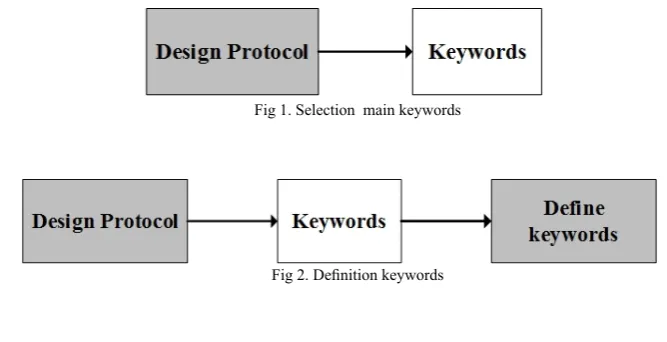
According to the proposed definitions, keywords are words or phrases derived from the text, which are the index of the text, highlight important points as well as the points of the text. Considering these points, the designer should select the keywords in the design protocol (Fig 1). Since the ideas of the designer are expressed in the form of a lexical image, they need to be fully identified in order to be in the body of the architecture.
DEFINITION OF KEYWORDS
This section identifies and defines the selected keywords. For this purpose, at first, the literal meaning, and then the definitions and opinions of different researchers concerning each keyword, is considered.
In fact, the designer at this stage, by collecting and reviewing the existing set of definitions of the keyword, encounters a large amount of information that can be used in later stages (Fig 2).
MANIFESTABLE IMPRESSIONS IN DESIGN
At this stage of the research - based design process, the designer must provide “manifestable impressions on the design” for each keyword. In this way, the designer provides a concept for each selected keyword in the previous step, which can be manifested in the architectural design. In fact, this impression brings the keyword one step closer to the architecture. Despite the fact that the keywords are close to theoretical knowledge, the impressions are closer to practical and applied knowledge in architecture, and are in fact the concepts that the designer provides them at later stages in his design. At this stage, manifestable impressions in design act as mediators. Since the keywords are extracted from the text and have a theoretical nature, it is not possible for the keywords to flow directly into the body of the architecture and become graphic manifestations; thus, after the definition of the keywords, concepts are presented
1
Fig 1. Selection main keywords
2
Fig 2. Definition keywords
Table 2. Selection of the main keywords from design protocol
Design protocol Main keywords
We decide to design a faculty of architecture so that research is to be considered as a main priority and education and research are defined together. So, a field of scientific search within architecture data and other areas of science (humanities, social, cultural, environmental, education, etc.) should be provided to be feasible for the students to be incorporated in architectural design. Also, the students should test their ideas to generate knowledge; consequently, they will be able to transform theoretical knowledge into practical work. It is better to use attractive forms in the building design to be kept in mind. At last, the faculty should be firmly designed as the same as laboratory and research buildings, but, not be spiritless, as well as inspiring inviting and welcoming feelings for the society and citizens.
Research Education Scientific search
Testing Generation
Attraction Keep in mind
inviting
Fig 1. Selection main keywords
Fig 2. Definition keywords
112
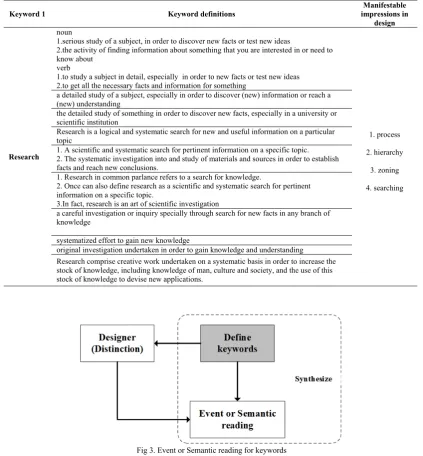
that are first taken from the definitions of the previous stage and, secondly, are capable of manifesting in the architectural design. The manifestable impressions in design at this stage can be derived from two sources (Fig 3); the designer can provide impressions for each keyword directly, according to the definitions and comments collected for each keyword in the previous stage. Also, definitions collected from the keyword may not lead to appropriate impressions. In this case, the role of the designer will be effective at this stage; thus, considering the definitions collected for the keyword, he writes the impressions of that keyword in accordance with his point of view.
Therefore, we can return to the stages of the formation of design statement and review the concepts that are also effective at this stage. It was stated in the process of forming a design statement that topical studies are the reason for the distinction of each design with another design. In fact, it refers to the role of the designer at this stage and argues that design problems can have multiple answers because of their qualitative nature, so each designer, according to his creativity, design knowledge and experience, responds to the design problem in a different way than the rest, and selects a particular approach. Here, too, considering that the role of the designer will be effective in the formation of impressions from the keywords, it can be argued that the designer provides a manifestable impressions in design of the keywords, with the help of creativity, design knowledge and experience. Thus, the designer can present manifestable impressions in design at this stage using his creativity, along with the definitions collected for each keyword. In this study,
designer knowledge is one of the factors affecting the presentation of manifestable impressions in design from the selected keywords. In fact, the designer uses his knowledge to provide creative impressions. Thus, the manifestable impressions in design for each keyword can be obtained from two sources (Fig. 3). In this way, the manifestable impressions in design for a given keyword, on the one hand, can be obtained directly from the definitions and opinions of scholars about that keyword; on the other hand, creativity, designer knowledge and experience of designer can be effective in creating these impressions. It should be noted that the manifestable impressions in design for a keyword based on creativity, design knowledge and experience occur intuitively, and have no special formula. After that the manifestable impressions in design for each of the keywords were presented, sub-concepts are created at this stage of the process. Thus, the keywords first become manifestable impressions in design and then sub concepts. Despite the fact that the keywords are close to theoretical knowledge, these impressions are closer to practical and applied knowledge in architecture, and sub-concepts are also one step closer to the architecture compared to the manifestable impressions in design. In fact, subconcepts are methods for displaying impressions in an architectural design. Therefore, the following briefly describes each of the factors of creativity, design knowledge and experience:
Creativity
Takala (1993) believes that creativity is perceived as the ability of a person to produce new and unexpected
3
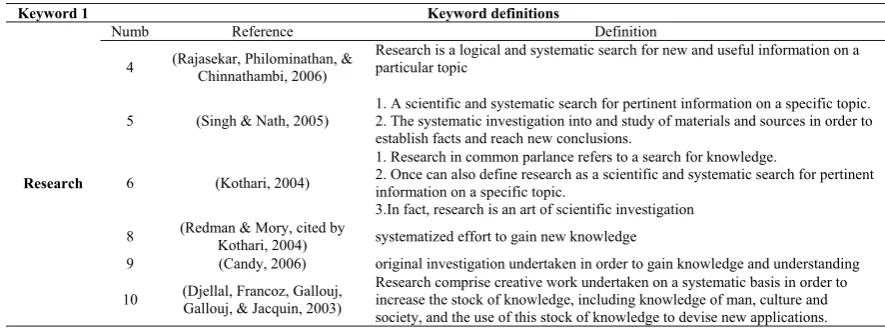
Table 3. Definitions of one keyword
Keyword 1 Keyword definitions
Research
Numb Reference Definition
4 (Rajasekar, Philominathan, & Chinnathambi, 2006) Research is a logical and systematic search for new and useful information on a particular topic
5 (Singh & Nath, 2005) 1. A scientific and systematic search for pertinent information on a specific topic. 2. The systematic investigation into and study of materials and sources in order to establish facts and reach new conclusions.
6 (Kothari, 2004)
1. Research in common parlance refers to a search for knowledge.
2. Once can also define research as a scientific and systematic search for pertinent information on a specific topic.
3.In fact, research is an art of scientific investigation 8 (Redman & Mory, cited by Kothari, 2004) systematized effort to gain new knowledge
9 (Candy, 2006) original investigation undertaken in order to gain knowledge and understanding
10 (Djellal, Francoz, Gallouj, Gallouj, & Jacquin, 2003) Research comprise creative work undertaken on a systematic basis in order to increase the stock of knowledge, including knowledge of man, culture and society, and the use of this stock of knowledge to devise new applications.
113
Stud. Archit. Urban. Environ. Sci. J., 1(2): 108-122, Summer and Autumn 2018
things (9). Csikszentmihalyi (1996) considers creativity as something resulting from the interaction of a system consisting of three elements, one of which is the person who brings something new (10). In his definition of creativity, Ogot & Okudan (2007) uses the phrase “the ability to find new methods using existing knowledge for the production of new products” (11). Therefore, creativity can be defined as the ability to
find new methods using existing knowledge in order to produce new things or solutions. In this way, the designer at this stage can, using his creativity, provide an event reading for each keyword along with the definitions collected for each keyword.
Design Knowledge
According to Goel (1995), design knowledge
3
Fig 3. Fig 3. Event or Semantic reading for keywordsEvent or Semantic reading for keywords
4
Table 4. Manifestable impressions in design for keyword of “research”
Keyword 1 Keyword definitions impressions in Manifestable
design
Research noun
1.serious study of a subject, in order to discover new facts or test new ideas
2.the activity of finding information about something that you are interested in or need to know about
verb
1.to study a subject in detail, especially in order to new facts or test new ideas 2.to get all the necessary facts and information for something
1. process
2. hierarchy 3. zoning
4. searching a detailed study of a subject, especially in order to discover (new) information or reach a
(new) understanding
the detailed study of something in order to discover new facts, especially in a university or scientific institution
Research is a logical and systematic search for new and useful information on a particular topic
1. A scientific and systematic search for pertinent information on a specific topic. 2. The systematic investigation into and study of materials and sources in order to establish facts and reach new conclusions.
1. Research in common parlance refers to a search for knowledge.
2. Once can also define research as a scientific and systematic search for pertinent information on a specific topic.
3.In fact, research is an art of scientific investigation
a careful investigation or inquiry specially through search for new facts in any branch of knowledge
systematized effort to gain new knowledge
original investigation undertaken in order to gain knowledge and understanding Research comprise creative work undertaken on a systematic basis in order to increase the stock of knowledge, including knowledge of man, culture and society, and the use of this stock of knowledge to devise new applications.
114
configuration is considered as a cyclic process comprising processing, recovery, research, classification, thinking and mental evolution of design information from long-term external memory to be utilized to frame design problem ( Goel 1995, cited by Alhusban, 2012). In fact, creative people rely on their specific content knowledge to ratiocinate on the situations of essential issues and, thus generate innovative solutions. In general, design knowledge, further defines the information (14) which is used to communicate main ideas in each part of design process.
In architectural design training, knowledge is also an important factor to develop innovative thinking skills learned as a significant component (15). Architectural design is a creative knowledge-based activity (16) and designer utilizes that to modulate design goals, define design subjects, and develop design solutions. Design knowledge plays an important role in reducing the probability of design error and enhancing the quality of design (17). In other words, the design knowledge can be defined in two ways: a set of information designer acquires through different methods such as university studies and stores them in his/her long-term memory to be utilized when necessary. Second, a set of information designer gains on a particular subject through different ways such as interviewing with people.
Experience
The importance of designer’s experience in architectural process design has been ever confirmed by many scholars. They consider generation of ideas and concepts of architecture related to design knowledge, inspiration, intuition, imagination, analytical skills of analysis/combination, cognitive skills, training, creative thinking abilities as well as experience (13). They also believe that design is based on acquiring skills, exercise and experience (18) and designer’s thinking about the design process is based on personal experiences (19). Designer’s experience in architecture can affect his/her design’s inherent approaches and characteristics. Furthermore, cultural background and life experience of designer can also play an important role to structure his/her ideas during the design process. It should be noted that the architectural knowledge is required to be broadly and interdisciplinary expanded for a unique design solution in order to cover all subjects proposed by design problem; hence, designers are expected to have
various architectural experiences and backgrounds considering different educational methods and design projects they are exposed (16). Thus, it is clear that the main issue in the knowledge of design is the direct training of the designer in an academic process; but in the discussion of experience, the designer should refer to his or her personal findings indirectly from the professional workplace (whether at the university or outside the university). Therefore, it can be argued that creativity, design knowledge and designer experience are effective in providing event readings from keywords.
In fact, the designer performs “combination” at this stage. In general, combination or mixing means bringing together the components and seeing them together (20). Thus, event reading for each keyword can be obtained from two sources (Fig 3). So that event reading for a given keyword can, on the one hand, directly derive from the definitions and opinions of thinkers about that keyword; on the other hand, creativity, design knowledge and designer experience can be effective in creating this event reading.
SUB-CONCEPTS
At this stage of the process - after the event readings are provided for each of the keywords, sub-concepts are created (Fig 4). Thus, the keywords first become event reading and then “sub-concepts”; with the difference that the keywords are close to theoretical knowledge, while event readings are closer to practical and applied knowledge in architecture, and sub-concepts are also one step closer to the architecture of the event readings. In fact, sub-concepts are methods for displaying event readings in architectural designs.
115
Analytical models for design scenarios in research-based design processes
general, the formation of design concepts is dependent on knowledge, thinking skills (Oxman, 2004 & Chiu, 2010), the information background, past experiences, and implicit and explicit knowledge (Wang, 2007 & Tseng, Moss, Cagan, & Kotovsky, 2008).
As mentioned according to Duerk )1993), a concept may encompass the whole problem; so, concepts have been known as ideas that seamlessly assemble a variety of elements in an entirety like a special organizing idea, major concept, theme and sketch. The concept
4
Fig 4. Fig 4. Develop sub conceptDevelop sub concept
5
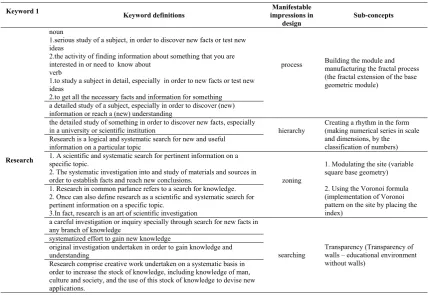
Table 5. Production of sub concepts for Manifestable impressions in design of “research”
Keyword 1 Keyword definitions impressions in Manifestable
design Sub-concepts
Research noun
1.serious study of a subject, in order to discover new facts or test new ideas
2.the activity of finding information about something that you are interested in or need to know about
verb
1.to study a subject in detail, especially in order to new facts or test new ideas
2.to get all the necessary facts and information for something
process Building the module and manufacturing the fractal process (the fractal extension of the base geometric module)
a detailed study of a subject, especially in order to discover (new) information or reach a (new) understanding
the detailed study of something in order to discover new facts, especially
in a university or scientific institution hierarchy Creating a rhythm in the form (making numerical series in scale and dimensions, by the classification of numbers) Research is a logical and systematic search for new and useful
information on a particular topic
1. A scientific and systematic search for pertinent information on a specific topic.
2. The systematic investigation into and study of materials and sources in
order to establish facts and reach new conclusions. zoning
1. Modulating the site (variable square base geometry)
2. Using the Voronoi formula (implementation of Voronoi pattern on the site by placing the index)
1. Research in common parlance refers to a search for knowledge. 2. Once can also define research as a scientific and systematic search for pertinent information on a specific topic.
3.In fact, research is an art of scientific investigation
a careful investigation or inquiry specially through search for new facts in any branch of knowledge
searching Transparency (Transparency of walls – educational environment without walls)
systematized effort to gain new knowledge
original investigation undertaken in order to gain knowledge and understanding
Research comprise creative work undertaken on a systematic basis in order to increase the stock of knowledge, including knowledge of man, culture and society, and the use of this stock of knowledge to devise new applications.
116
may also provide an ideal solution for a minor part of the project; such as circulation patterns (5). So, the authors introduced the design protocol as the overall project concept. Thus, at first, a general and organizer concept is proposed for the design - which is here the design protocol - and then, after a series of steps, from the general concept (design protocol), sub-concepts are presented for more detailed parts of the project. The sub-concepts created at this stage should have the features, including that they should be aligned with the project’s overall concept, i.e., design protocol. They should also be able to be featured in the architectural design, which means they can express these concepts with the architecture language.
PRODUCTION OF SEQUENCES
At this point, how to create sequences of the project will be discussed. After the sub-concepts were created, at this stage, the project is left out of a pure study mode, and sub-conceptions must be graphically manifested and circulated in the architectural structure. Therefore, the designer requires a tool to help him design his own architectural project in accordance with sub-concepts in his hand. In fact, the designer must operate the ideas that are in mind with regard to the sub-concepts. Therefore, we can mention the effective factors at this stage of the process: the principles of visual literacy, the design site (location of design ideas), and the physical-space design of the project. The principles of visual literacy help the designer to display the idea that he has in mind. Since the project should be placed on the site selected by the employer, then the site design should also be considered at this stage. In fact, at this stage, the designer must recognize that the idea that is in mind in which part of the site is applicable. The physical-space program of the project should always be considered by the designer from the beginning of this stage because it is not possible to design precisely and in accordance with the needs and requirements of the human groups associated with the project without regard to the physical-space design of the project. Here to learn how to influence the above three factors, each one is initially explained.
Principles of visual literacy
At this stage, we will discuss the “principles of visual literacy” used by the designer. The term “visual literacy” was first introduced in 1969 by John Debes (26). Wileman (1993) defines visual literacy as the
ability to read, interpret, and understand information presented in image or graphical forms (27). Robinson also considers visual literacy as an organizing force to improve the understanding, maintenance, and recall of many of the scientific concepts that students have to deal with ( Robinson (as quoted in Sinatra, 1986). In these definitions, visual literacy is referred to as the ability to understand and interpret concepts and forms. Suzanne Stokes defines the concept of visual literacy as the ability to interpret images as well as create images in order to associate ideas and concepts (29). Wileman (1993), also dependent on visual literacy, defines visual thinking as the ability to transform kinds of information into images, graphics, or forms that help to convey information (27). In these definitions of visual literacy, in addition to the ability to understand and interpret images, the ability to create images and convert information to images and graphics is also referred to. The use and interpretation of images is a specific language; that is, images are used to convey messages that their meaning should be decoded (Emery & Flood, 1998 & Branton, 1999 cited by Stokes, 2002). Therefore, visual literacy can be defined on the one hand as the ability to understand and interpret images, graphical shapes as well as forms, and on the other hand, it is considered as the ability to create images, graphical shapes and forms, the purpose of which is to convey concept, meaning and message to the audience, which also applies to architectural design. In fact, the designer can create shapes and forms using his visual literacy that contains the desired messages and meanings. Therefore, in this study, the aim of the writers from principles of visual literacy is, in fact, the ways in which the designer can show his desired concept using them.
Therefore, the purpose of the principles of visual literacy in this study is the methods used by the designer to create images, graphic shapes and forms in order to convey their concept to the audience. As there are different methods for creating images, graphic shapes and forms, the designer can provide graphic manifestation of the sub-concepts using the appropriate visual literacy principles.
Locating Design Ideas
117
Stud. Archit. Urban. Environ. Sci. J., 1(2): 108-122, Summer and Autumn 2018
sites, such as corner sites, street sites, etc (32).
As everyone knows, the role and impact of “geometry” in architectural design are undeniable. As Frith (2010) quotes Guarino Garurini writes: Geometry is the foundation and basis of architecture. Thus, the type of geometry used has a great influence on architecture and the nature of the forms produced will have spatial qualities and certain social situations (33).
On the other hand, the designer must at this stage locate sub-concepts in the design site, according to the geometry of the site. Sub-concepts are located here in three categories of open, semi-open and closed space. The table is prepared as shown in the table below; in the first column, factors are placed on the right side of the table, and in the left-hand column, the display (sample-view) of each factor is displayed in closed, semi-closed, semi-open and open spaces.
Space-physical design of project
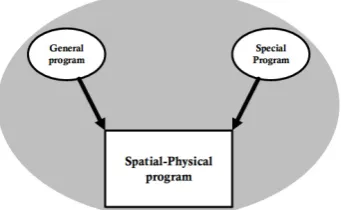
According to the content listed in the process of design protocol formation, the designer, at the stage of thematic studies, prepares a general physical design for the project considering the criteria and standards, as well as the per capita of each space. In the local studies section, according to the “approach” chosen for the project, a checklist of spaces is obtained that can be different for each individual, called “special physical program”. At the end, the design of the two “general” and “specific” programs, “the physical-space program” of the project is formed (Fig. 5), which should be considered at this stage. This means that the designer should use the space-physical program to implement the ideas that are in his mind, and always consider it.
As mentioned above, these three factors, i.e. the principles of visual literacy, the site and the space-physical program simultaneously affect the design
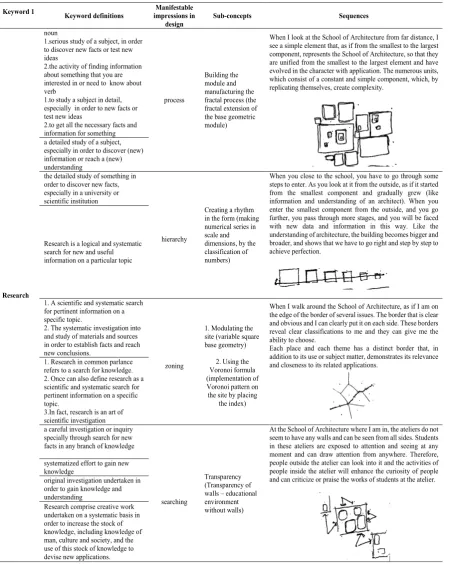
process. At this stage, when the sub-concepts find a 3D-dimensional and objective graphical manifestation on the design site with respect to the space-physical program and using the appropriate visual literacy principles, the designer, in fact, designs his project parts as “spatial sequences”. Thus, the designer produces a sequence according to the existing sub-concepts for different parts of the project (Fig. 6).
The term “sequence” here is the same sequence in cinema art. In cinema, a plan is one take of one scene and a sequence is the result of several connected plans. In architecture, the sequence is the mental image that is perceived by the audience at a single moment in the environment.
Architecture and cinema are structurally similar arts. The history of this connection can be traced back to the beginning of the twentieth century and modern architectural theories (34). One of the most important subjects in this regard is Le Corbusier, a leading modern architect. After getting familiar with Eisenstein, the great theorist of the Soviet cinema and his theories, he spoke of his interest in the creation of a cinematic architecture, stating that he was attempting to make the architecture of Eisenstein’s filmmaking (cited by Bruno, 2002).
Auguste Choisy also analyzes Acropolis in his
Architectural History book. He emphasizes the importance of moving on the site, especially the paths that lead to the Acropolis volumes. For Choisy, the “path” in architecture is like a motion sequence that provides landscapes for a moving observer. He believes that the design of the Acropolis includes a sequence of spaces between the spaces that create an architectural path and, in front of the observer’s moving eye, depicts a diverse set of eye-catching scenes and scenes as a movie. In this process, not only the observer’s eyes, but also his body is involved in the process of perceiving the architectural space.
Studies of Choisy on Acropolis can be considered as the link circle in Le Corbusier’s architectural theories and Eisenstein Cinema Theories. Le Corbusier repeatedly refers to the Choisy in “towards a new architecture” statement and talks about the importance of moving bodies in understanding architectural space (35). He proposes the idea of moving architectural experience in its most complete form, called “promenade architecture” (36). Promenade architecture is an instrument for the production of architectural space, taking into account the space perception experience of
5
118
a moving audience on the building during the design process (37). Finding the similarity of the audience’s spatial perception of an architectural complex with the viewer of a movie, Le Corbusier attempted to utilize its cinematic framing capabilities in its promenade architecture design process (38). In this design method, the spatial sequences are planed with regard to shifts and changes in moving viewer perspectives. Hence, the audience is allowed to perceive communications and spatial links from the filmic angle of view and based on cinematic rules (36).
Therefore, it can be argued that architecture and cinema are arts that are based on sequence and spatial proximity, which is the basis of their structure. As the cinematic viewer creates a path in his mind from filmic sites that sequence in front of him, in architecture, the observer moves among a series of phenomena that see them as consecutive sequences. In fact, moving in space makes sense of consecutive sequences that each of which creates an experience for the individual. Therefore, a person at a single moment is able to understand a sequence of space. As already mentioned, the designer at this stage of the design process produces different sequences of his project. Therefore, the available sub-concepts, according to the physical-space design of the project, and in terms of site geometry, find the graphic expression sequence using the appropriate visual literacy principles in the form of open, closed, and semi-open spaces.
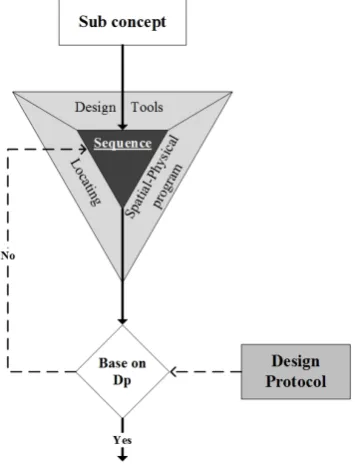
After the sequences are produced, it is necessary to check with the design protocol to determine whether each of the sequences has a trace in the protocol or not. Therefore, they must pass a filter that is based on the design protocol (Fig. 7). When the sequences were
measured according to the design protocol, if they were in line with the design protocol, they would go to the next step. But if they are not based on the design protocol, they will be returned again, modified and reproduced using the three factors of visual literacy principles, physical design, and site design.
After the final sequences are produced, it is necessary for the designer to somehow combine and integrate these separate parts (sequences). In general, it can be argued that the three factors of visual literacy principles, the physical design, and the positioning of ideas as tools that help the designer, can best capture the design protocol. Thus, how to put together the produced sequences together and communicate with each other, it goes back to the design protocol. In fact, the sequences produced at this stage are linked to each other according to the design protocol. In this way, the designer puts the sequences together and forms the “design scenario” according to the design protocol (Fig. 7). Here, for the sake of clarification, it is better to begin by explaining the scenario first.
DESIGN SCENARIO
At this stage, the research-based design process (as the final step in this part of the research-based design process) will be discussed in conjunction with the formation of design scenario. Yu (2001) believes that, in the early stages of architectural design, the designer will
6
Fig 6. Develop sequences
7
Fig 7. Evaluate sequence base on design protocol
119
Analytical models for design scenarios in research-based design processes
6
Table 6. Example of formation of sequences for “research”
Keyword 1 Keyword definitions impressions in Manifestable
design Sub-concepts Sequences
Research
noun
1.serious study of a subject, in order to discover new facts or test new ideas
2.the activity of finding information about something that you are interested in or need to know about verb
1.to study a subject in detail, especially in order to new facts or test new ideas
2.to get all the necessary facts and information for something
process
Building the module and manufacturing the fractal process (the fractal extension of the base geometric module)
When I look at the School of Architecture from far distance, I see a simple element that, as if from the smallest to the largest component, represents the School of Architecture, so that they are unified from the smallest to the largest element and have evolved in the character with application. The numerous units, which consist of a constant and simple component, which, by replicating themselves, create complexity.
a detailed study of a subject, especially in order to discover (new) information or reach a (new) understanding
the detailed study of something in order to discover new facts, especially in a university or scientific institution
hierarchy
Creating a rhythm in the form (making numerical series in scale and dimensions, by the classification of numbers)
When you close to the school, you have to go through some steps to enter. As you look at it from the outside, as if it started from the smallest component and gradually grew (like information and understanding of an architect). When you enter the smallest component from the outside, and you go further, you pass through more stages, and you will be faced with new data and information in this way. Like the understanding of architecture, the building becomes bigger and broader, and shows that we have to go right and step by step to achieve perfection.
Research is a logical and systematic search for new and useful information on a particular topic
1. A scientific and systematic search for pertinent information on a specific topic.
2. The systematic investigation into and study of materials and sources in order to establish facts and reach new conclusions.
zoning
1. Modulating the site (variable square base geometry)
2. Using the Voronoi formula (implementation of Voronoi pattern on the site by placing
the index)
When I walk around the School of Architecture, as if I am on the edge of the border of several issues. The border that is clear and obvious and I can clearly put it on each side. These borders reveal clear classifications to me and they can give me the ability to choose.
Each place and each theme has a distinct border that, in addition to its use or subject matter, demonstrates its relevance and closeness to its related applications.
1. Research in common parlance refers to a search for knowledge. 2. Once can also define research as a scientific and systematic search for pertinent information on a specific topic.
3.In fact, research is an art of scientific investigation a careful investigation or inquiry specially through search for new facts in any branch of knowledge
searching
Transparency (Transparency of walls – educational environment without walls)
At the School of Architecture where I am in, the ateliers do not seem to have any walls and can be seen from all sides. Students in these ateliers are exposed to attention and seeing at any moment and can draw attention from anywhere. Therefore, people outside the atelier can look into it and the activities of people inside the atelier will enhance the curiosity of people and can criticize or praise the works of students at the atelier. systematized effort to gain new
knowledge
original investigation undertaken in order to gain knowledge and understanding
Research comprise creative work undertaken on a systematic basis in order to increase the stock of knowledge, including knowledge of man, culture and society, and the use of this stock of knowledge to devise new applications.
120 Fig 8. Scenario concept development process
8
Fig 8. Scenario concept development process
use markings to make the design requirements clearer in each step for strengthening the relationship between requirements and design. One of these markings is design scenarios used to explain and describe the requirements for architectural design (39). A scenario is a brief description of the pure interaction of a user (beneficiary) with a system. Usually, scenarios are used to extract and validate design requirements, help them understand the needs of beneficiaries, and create a
variety of architectural views (40). Che & Perry (2011) provide a scenario-based approach for documenting and evolving architectural design decisions that enable the designer to effectively manage architectural knowledge (41). Duerk (1993) also believes that, if for any reason, interviews with the employer or project users are not feasible, the preparation of different scenarios about the life of employers or potential users of the project is an appropriate practice. This is a way in which a person considers himself to be in the position of another person and presents valuable design assumptions that constitute raw information. A scenario speaks in the form of a story about a part of the life of users or employers. The best practical solution for transferring the designer’s purpose to the employer and other people who must understand before building it is to combine the “concept scenario” with “concept diagrams” to express parts and different aspects of the design. Many people find it useful to maintain this connection even after the construction because it allows users to understand the designer’s purpose from the instructions provided to them (5).
According to the definitions proposed in relation to the scenario, it can be argued that the application of the scenario in the research-based design process is that the designer should put together the sequences produced in the previous step in a scenario. As mentioned in the previous section, the factor of the relationship between produced sequences is a design protocol. In fact, the designer at this stage - considering the design protocol - places himself in the place of the project user, and from the beginning of the user’s entry to the building, he sets the sequence together like a story, and thus the design ideas are shaped in the form of a scenario. The features of the scenario formed at this stage include the following cases: the scenario should be exactly written in line with the design protocol. Also, the scenario should reveal behaviors that require a design response, explicitly explain the details of activities and elements that make up the space.
Considering that the designer should always consider the design protocol when writing the design scenario, it can be argued that the design protocol works here like a tuner. This will transpose the sequences and set a supervisory perspective on the scenario. The relationship between the design protocol and the produced sequences will result in “the final scenario of the design”.
121
Stud. Archit. Urban. Environ. Sci. J., 1(2): 108-122, Summer and Autumn 2018
several sequences from a sub-concept. So the first step is to prioritize these sequences in order of necessity to implement the plan. During this prioritization of the sequences, the design protocol must always be considered by the designer. This means that the essence of the designer’s ideas is a design protocol, all of which has been produced and developed.
CONCLUSION
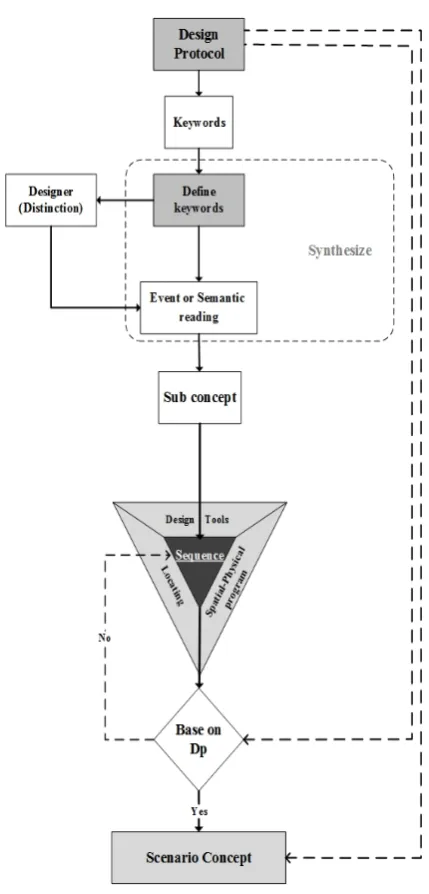
One of the most important aspects in design methodology and related areas of design research is a great deal of effort made in order to represent systematic models derived from design process. However, it seems that, in practice, lots of plans move forward in an ad hoc and unsystematic approach (42) . Thus, this research intended to provide a systematic pattern of design process emphasizing on process rather than the final product. As shown in the final diagram of the process (Fig 8), the design process begins with the design protocol. The design protocol, which is in the role of the overall concept of the project, is a comprehensive text and a document that expresses the designer’s intended ideas about the project. This comprehensive and documented text outlines the features of the project that the designer intends to create it. Therefore, the designer can extract the important points of the design protocol in the form of keywords. In the next step, the definition and identification of the keywords will be discussed. For this purpose, at first, the lexical meaning, and then the definitions and comments of different researchers in relation to each keyword, is examined. After that, the designer must provide an event reading for any keyword. An event reading is that the designer offers a concept for each keyword that has the ability to display in the architectural design. (The event reading at this stage can come from two sources; the designer can directly provide the readings of each keyword, according to the definitions and comments collected for each keyword, or the designer writes event reading from that keyword in accordance with his own point of view). So, each designer will provide event reading of the keywords according to their creativity, design knowledge and experience. After presenting the event readings for each of the keywords, micro-concepts will be created. In fact, sub-concepts are methods for displaying event readings in architectural designs. After producing sub-concepts, the project is out of mere study and the sub-concepts should be graphically represented and run into the body of the current architecture. So
the designer, with the help of a tool that includes the principles of visual literacy, site design (design ideas location) and the physical-space program of the project, operates ideas that are in mind with regard to sub-concepts. At this stage, where sub-concepts objectively find graphical manifestation, in fact, the designer designs his project components as a spatial sequences. After the sequences are produced, they pass through the filter to determine whether each of the sequences has tracking in the design protocol or not. After the final sequences are produced, it is necessary for the designer to somehow combine and integrate these separate parts (sequences) together. Thus, how to put together the produced sequences and communicate with each other, it goes back to the design protocol. The designer should put together the sequences generated in the previous step in a scenario. In this way, design ideas are shaped in the form of a scenario. The design protocol here acts like a tuner, so that it transposes the sequences, and has a regulatory approach there is a supervisory view to the project scenario. The relationship between the design protocol and the produced sequences will cause the formation of final design scenario.
Considering that designers are often unable to express what they know and are in their minds and they are mistaken when they try to make their tacit knowledge orally to explicit knowledge (Simon, 1995), it seems that using this process, they can get out their mental thoughts and ideas in the minds from mental state and carry out them following the procedures and implement them in the project.
So that they can first identify the appropriate information for the design, classify this information, and finally apply it to the design, because this process leads to more clarity of the issue to the mindset of the designers and how to get from theoretical foundations to the design will be processed in their minds. Therefore, it seems that the proposed process is a desirable method in design and can help to the formation of design scenario in the minds of students and architectural designers, so that they recognize the main dimensions forming the design scenario and the factors affecting it, as well as can easily navigate and draw the horizon of the design and make the design come to an end.
REFERENCE
1. Lambe N, Dongre A. Contextualism: An Approach To Achieve Architectural Identity And Continuity. 2016;
122 3. Wiltschnig S, Christensen BT, Ball LJ. Collaborative
problem--solution co-evolution in creative design. Des Stud. Elsevier; 2013;34(5):515–42.
4. Simon HA. The sciences of the artificial. MIT press; 1996. 5. Duerk DP. Architectural programming: Information management
for design. Wiley; 1993.
6. Cross N. Design cognition: Results from protocol and other empirical studies of design activity. Elsevier; 2001;
7. Newell A. On the analysis of human problem solving protocols. 1966;
8. Akin Ö, Lin C. Design protocol data and novel design decisions. Des Stud. Elsevier; 1995;16(2):211–36.
9. Takala T. A neuropsychologically based approach to creativity. Model Creat Knowledge-Based Creat Des. 1993;91–108. 10. Csikszentmihalyi M. Flow and the psychology of discovery and
invention. New Yprk Harper Collins. 1996;
11. Ogot M, Okudan GE. Systematic creativity methods in
engineering education: a learning styles perspective. Int J Eng Educ. TEMPUS PUBLICATIONS; 2007;22(3):566.
12. Goel V. Sketches of thought. 1995. Cambridge, Massachusetts: The MIT Press; 1995.
13. Alhusban AA. What Does the Architectural Creative Leap Look Like Through a Conceptual Design Phase in the Undergraduate Architectural Design Studio? 2012;
14. Blosiu JO. Use of synectics as an idea seeding technique to enhance design creativity. In: Systems, Man, and Cybernetics, 1999 IEEE SMC’99 Conference Proceedings 1999 IEEE International Conference on. 1999. p. 1001–6.
15. Oxman R. Think-maps: teaching design thinking in design education. Des Stud. Elsevier; 2004;25(1):63–91.
16. Al-Sayed K, Dalton RC, Hölscher C. Discursive design thinking: The role of explicit knowledge in creative architectural design reasoning. Artif Intell Eng Des Anal Manuf. Cambridge Univ Press; 2010;24(2):211–30.
17. Chiu S-H. Students knowledge sources and knowledge sharing in the design studio an exploratory study. Int J Technol Des Educ. Springer; 2010;20(1):27–42.
18. Goldschmidt G, Weil M. Contents and structure in design reasoning. Des issues. JSTOR; 1998;14(3):85–100.
19. Kokotovich V, Purcell T. Mental synthesis and creativity in design: an experimental examination. Des Stud. Elsevier; 2000;21(5):437–49.
20. Cherry E. Programming for design: From theory to practice. John Wiley & Sons; 1999.
21. Oxman R. Design by re-representation: a model of visual reasoning in design. Des Stud. Elsevier; 1997;18(4):329–47.
22. Kryssanov V V, Tamaki H, Kitamura S. Understanding
design fundamentals: how synthesis and analysis drive creativity, resulting in emergence. Artif Intell Eng. Elsevier; 2001;15(4):329–42.
23. Stempfle J, Badke-Schaub P. Thinking in design teams-an analysis of team communication. Des Stud. Elsevier; 2002;23(5):473–96. 24. Wang C. On the inspiration of creative thinking for engineering students. In: Information Technologies and Applications in Education, 2007 ISITAE’07 First IEEE International Symposium
on. 2007. p. 443–8.
25. Tseng I, Moss J, Cagan J, Kotovsky K. The role of timing and analogical similarity in the stimulation of idea generation in design. Des Stud. Elsevier; 2008;29(3):203–21.
26. Avgerinou M, Ericson J. A review of the concept of visual literacy. Br J Educ Technol. Wiley Online Library; 1997;28(4):280–91. 27. Wileman RE. Visual communicating. Educational Technology;
1993.
28. Sinatra R. Visual Literacy Connections to Thinking, Reading and Writing. ERIC; 1986.
29. Stokes S. Visual literacy in teaching and learning: A literature perspective. Electron J Integr Technol Educ. 2002;1(1):10–9. 30. Emery L, Flood A. Visual literacy. Retrieved Sept. 1998;22:1999. 31. Branton B. Visual literacy literature review. Retrieved December.
1999;26:2001.
32. MUNASINOHE N. Contextual design: an examination of the different aspects of the physical context and their manifestation in architectural expression. University of Moratuwa; 1999.
33. Frith S. Geometry and Architecture. Taylor & Francis; 2010. 34. Bruno G. Atlas of emotion: Journeys in art, architecture, and
film. Verso; 2002.
35. Corbusier L. Le Corbusier Talks with Students. Princeton Architectural Press; 1999.
36. Thomas M, Penz F. Architectures of illusion: from motion pictures to navigable interactive environments. Intellect Books; 2003.
37. Corbusier L. Towards a new architecture. Courier Corporation; 1931.
38. Colomina B, Bloomer J. Sexuality & space. Princeton
Architectural Press; 1992.
39. Yu LLE. From requirements to architectural design--using goals and scenarios. In: First International Workshop From Software Requirements to Architectures-STRAW. 2001. p. 22.
40. Kazman R, Carrière SJ, Woods SG. Toward a discipline of scenario-based architectural engineering. Ann Softw Eng. Springer; 2000;9(1):5–33.
41. Che M, Perry DE. Scenario-based architectural design decisions documentation and evolution. In: Engineering of Computer Based Systems (ECBS), 2011 18th IEEE International Conference and Workshops on. 2011. p. 216–25.
42. Cross N. Designerly ways of knowing. Springer; 2006. 43. Simon HA. Problem forming, problem finding and problem
solving in design. Des Syst. 1995;245–57.
44. Simon HA. Models of thought (Vol. 1). Yale Univ Prees, New Haven CT. 1979;
45. Hatchuel A. Towards Design Theory and expandable rationality: The unfinished program of Herbert Simon. J Manag Gov. Springer; 2001;5(3–4):260–73.
46. Cross N, Cross AC. Observations of teamwork and social processes in design. Des Stud. Elsevier; 1995;16(2):143–70. 47. Palmer MA. The architect’s guide to facility programming.
Institute; 1981.
48. Lawson B. How designers think: The design process demystified. Routledge; 2006.
COPYRIGHTS
Copyrights for this article are retained by the author(s) with publishing rights granted to the SAUES Journal.
The content of this article is distributed under SAUES open access policy and the terms and conditions of the Creative Commons