MULTI CARRIER CODE DIVISION MULTIPLE ACCESS (MC-CDMA) IS
TECHNOLOGY FOR FAR-FLUNG INTERNET
Vemulapalli Venkataramana*, VaddeArunaRai
*Department of Computer Engineering, Eritrea Institute of Technology, Mai nefhi, Asmara, Eritrea.
Department of Electronics and Communication Engineering, Eritrea Institute of Technology, Mai nefhi, Asmara, Eritrea.
KEYWORDS
:
BER, MC-CDMA, STBC, OFDM and PAPR.ABSTRACT
The Space Time Block Code Multi Carrier Code Division Multiple Access (STBC MC-CDMA) is a promising innovation for 4G remote correspondence frameworks. STBC is a unique type of Multiple Input Multiple Output (MIMO) initially utilized for 2 transmit recieving wires (Nt) and 1 get reception apparatus (Nr) by Alamouti under level blurring conditions. So utilization of STBC to recurrence particular channel is testing and has pulled in consideration of numerous specialists. Consequently, STBC is incorporated with multicarrier methods, for example, Orthogonal Frequency Division Multiplexing (OFDM) and Multi Carrier Code Division Multiple Access (MC-CDMA), which change over recurrence particular channel to a few level blurring channels in this manner dispensing with ISI and thus need of evening out. Like all other multicarrier methods STBC MC-CDMA likewise experiences high Peak-to-Average Power (PAPR) issue. To battle the issue of high PAPR, numerous methods have been proposed, among which Partial Transmit Sequence (PTS) is thought to be the best PAPR diminishment conspire yet at an expense of high computational unpredictability. This exposition principally focusses on usage of PTS procedure to STBC MC-CDMA plan for downlink situation. Additionally, a low many-sided quality beneficiary is intended for the above plan where the adjustment is done in time space premise. Likewise the proposed STBC MC-CDMA with PTS plan is contrasted and Single Input Single Output (SISO) MC-CDMA with PTS plan as far as Complementary Cumulative Distribution Function (CCDF) and Bit Error Rate (BER) execution. The reproduction results confirm that STBC MC-CDMA beats SISO MC-CDMA under blurring conditions. Likewise as the no of clients build, CCDF execution enhances and BER execution corrupts.
INTRODUCTION
In every single multicarrier method Inverse Fast Fourier Transform (IFFT) is the principle building hinder for era of orthogonal subcarriers[1]. Once in a while, all the subcarriers might get added to give a high transmitted force. This high transmitted force might be huge in deviation from the mean force offering ascend to high Peak-to-Average Power Ratio (PAPR) which is given as the proportion of most extreme energy to normal force[2]. This high PAPR might influence the orthogonality of the subcarriers. Once the orthogonality is lost numerous issues emerge. High PAPR has been a bottleneck for multicarrier methods[3].
Like all multi-transporter strategies, STBC MC-CDMA experiences high PAPR. The high PAPR of the transmitted sign which thusly brings about high information back-off (IBO) for the force speaker[4], drives the force intensifier to work in non-straight locale creating entomb adjustment (IM) items. IM causes out-of-band discharges and in-band contortions. Out-of-band discharges, or phantom re development, come about an expanded transmission transfer speed and causes Adjacent Channel Interference (ACI) and in-band contortion causes self-obstruction and debases bit blunder rates execution at the beneficiary[5,6]. So it is very crucial to mitigate this issue. To battle the issue of high PAPR, numerous systems [5] have been proposed.
PAPR REDUCTION TECHNIQUES
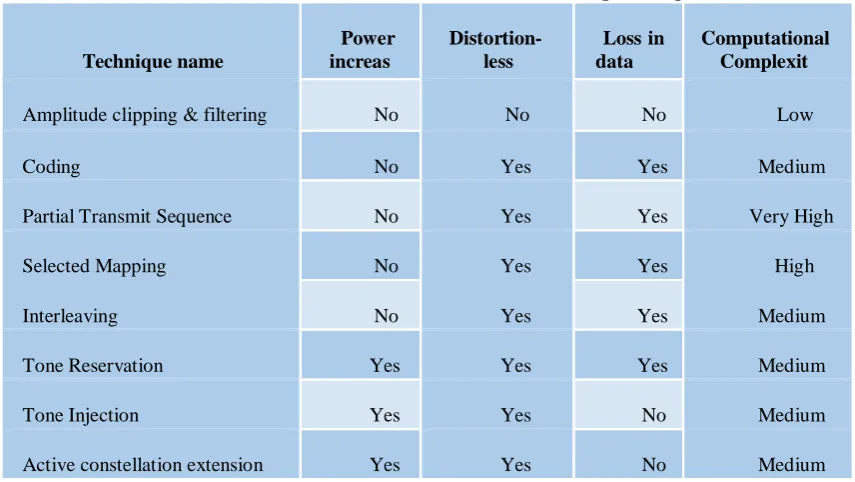
There are so many PAPR reduction techniques exist. Some of the important PAPR reduction techniques Include.
Clipping and filtering Coding
Interleaving Tone injection Tone reservation
Technique name increas e
less data rate
Complexit y
Amplitude clipping & filtering No No No Low
Coding No Yes Yes Medium
Partial Transmit Sequence No Yes Yes Very High
Selected Mapping No Yes Yes High
Interleaving No Yes Yes Medium
Tone Reservation Yes Yes Yes Medium
Tone Injection Yes Yes No Medium
Active constellation extension Yes Yes No Medium
Since MC-CDMA is a combination of CDMA and OFDM it takes advantage of both the schemes and inevitably has the same drawbacks [2]. OFDM converts frequency selective channel to several flat fading channels thus eliminating ISI and CDMA spreads the data by using orthogonal codes and reduces self-interference. MC-CDMA spreads the data with a particular spreading code in frequency direction thus increasing frequency diversity whereas MC-DS-CDMA spreads the data in time direction and MT-CDMA uses very high spreading factor [3]. This dissertation mainly focusses on signal processing aspects of downlink multiuser MC-CDMA. Since the downlink (from Base Transceiver Station (BTS) to Mobile Station (MS)) is considered to be synchronous, orthogonal codes can be used for spreading since they reduce multiple access interference. Walsh-Hadamard (W-H) code [2] is used for spreading since they are easy to generate and they have very good orthogonality property.
MC-CDMA Transceiver
It has already been mentioned that MC-CDMA is a combination of OFDM and CDMA. So the transmitter and receiver block diagram of MC-CDMA will contain the transmitter and receiver of OFDM and CDMA individually. MC-CDMA transmitter and receiver block diagrams are given below.
Fig. 1 MC-CDMA downlink transmitter
All the user data are spreaded by W-H code and are summed up to produce CDMA signal. Hence, in above figure is essentially CDMA signal. After this OFDM modulation operation is carried out and transmitted through channel.
MC-CDMA Receiver
In the receiver section, first inverse OFDM operation is carried out on the received signal followed by simple equalization. Then the user data are despreaded by using the same spreading code that was used for spreading at the transmitter side to get back the user information bits.
Fig.2 MC-CDMA downlink receiver
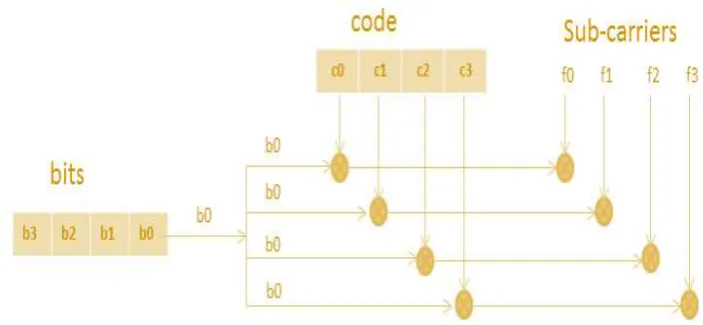
Insight to MC-CDMA
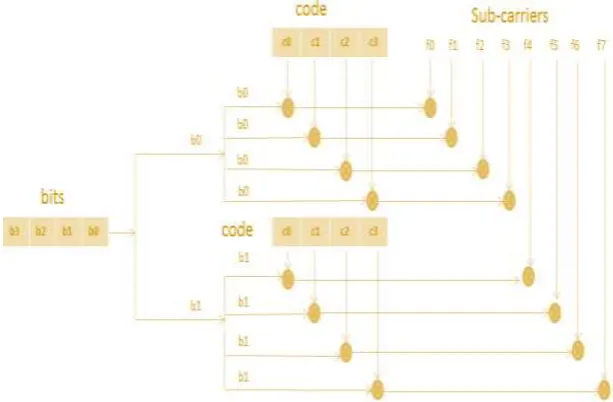
Fig. 4 MC-CDMA for a single user for two bit transmission at a time
The disadvantage of previous scheme is that we have to take no of sub-carriers equal to the spreading factor which is not practically feasible for large no of sub-carriers. In this scheme, two bits are transmitted at a time keeping SF same and no of sub-carriers has been doubled. So this system provides a flexible system design such that number of sub-carriers need not be taken equal to the SF [2, 3].
RESULTS AND DISCUSSION
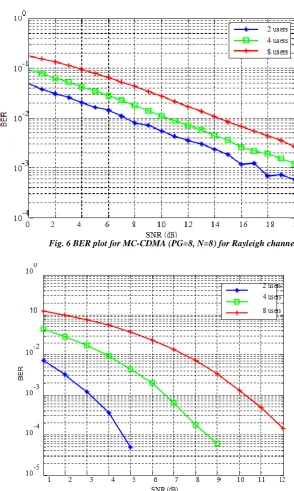
Fig. 5 represents the BER plot for 2, 4 and 8 users for AWGN channel. Here, the processing gain (PG) is taken equal to the no of subcarriers (N) i.e. 8. From the graph it is clear that as the no of users increase the BER performance degrades because the no users contribute more interference and maintaining orthogonality between them becomes a difficult task. All simulations are carried out for BPSK modulation and BER graphs are plotted using Monte-Carlo simulation.
Fig. 6 BER plot for MC-CDMA (PG=8, N=8) for Rayleigh channel
Fig. 7 BER plot for MC-CDMA using zero forcing equalization
Fig. 6 shows the BER plot for multiple users for Rayleigh channel. Here, the channel is considered to be flat fading channel. From both the figures we can conclude that as the no of users increase the BER performance degrades. In Fig. 7 presents the BER plot for MC-CDMA using zero forcing equalization.
ADVANTAGES OF MC-CDMA
High spectral efficiency: Since MC-CDMA is a superposition of large no of overlapping sub-carriers, it provides high spectral efficiency.
Robustness to channel fading: MC-CDMA converts frequency selective channel to flat fading channels thus eliminating Inter Symbol Interference (ISI).
APPLICATIONS OF MC-CDMA
MC-CDMA has a wide variety of applications in wireless communications. MC-CDMA is used in multimedia services of 4G wireless communication system in air interface for downlink scenario. It is a suitable modulation technique for indoor environments with small delay spread and small Doppler spread. MC-CDMA transmission with a low complexity iterative receiver is proposed for the PLC (power line communication) channel.
CONCLUSION
MC-CDMA has been the promising innovation for remote World Wide Web correspondence framework. Since it is a mix of both OFDM and CDMA, it investigates the upsides of both the plans. MIMO incorporated with multicarrier procedures can help the information rate and the unwavering quality of the connection. Additionally by utilizing multi reception apparatus components MIMO can accomplish differences which thus will enhance BER execution in this way enhancing the unwavering quality at the collector. So STBC MC-CDMA is a suitable applicant in such manner which can accomplish speed, reach and unwavering quality at the same time. To lessen PAPR numerous strategies have been proposed. The vast majority of the strategies proposed are application particular, for example, they are just appropriate to parallel flagging or specific no of subcarriers. Be that as it may, PTS is an adaptable method which is material for any balance plan or any no of subcarriers. In this thesis, PTS is connected to STBC MC-CDMA for PAPR lessening. Since STBC utilizes 2 transmitting recieving wires, PTS must be connected to both the radio wires in both interims.
REFERANCE
1. D. Gesbert, M. Shafi, D.-s. Shiu, P. J. Smith and A. Naguib, “From theory to practice: an overview of MIMO space-time coded wireless systems,” Selected Areas in Communications, IEEE Journal on, vol. 21, no. 3, pp. 281-302, 2003.
2. M. D. Hassib, M. Singh, M. Ismail and R. Nordin, “Efficient and low complexity STBC-OFDM scheme over fading channel,” in Communications (APCC), 2012 18th Asia-Pacific Conference on, 2012.
3. L. D'Orazio, C. Sacchi, R. Fedrizzi and F. G. De Natale, “An adaptive minimum-BER approach for multi-user detection in STBC-MIMO MC-CDMA systems,” in Global Telecommunications Conference, 2007. GLOBECOM'07. IEEE, 2007.
4. S. H. Han and J. H. Lee, “An overview of peak-to-average power ratio reduction techniques for multicarrier transmission,” Wireless Communications, IEEE, vol. 12, no. 2, pp. 56-65, 2005. 5. S. H. Muller and J. B. Huber, “A novel peak power reduction scheme for OFDM,” in Personal, Indoor
and Mobile Radio Communications, 1997. Waves of the Year 2000. PIMRC'97., The 8th IEEE International Symposium on, 1997
6. L.-L. Yang, Multicarrier communications, John Wiley \& Sons, 2009.
7. K. Fazel and S. Kaiser, Multi-carrier and Spread Spectrum Systems: From OFDM and MC-CDMA to LTE and WiMAX, John Wiley \& Sons, 2008.
8. S. Hara and R. Prasad, “Overview of multicarrier CDMA,” IEEE communications Magazine, vol. 35, no. 12, pp. 126-133, 1997.
9. A. J. Paulraj, D. A. Gore, R. U. Nabar and H. Bolcskei, “An overview of MIMO communications-a key to gigcommunications-abit wireless,” Proceedings of the IEEE, vol. 92, no. 2, pp. 198-218, 2004.