[Chougule* 4(9): September, 2017] ISSN 2349-4506
Impact Factor: 2.785
G
lobal
J
ournal of
E
ngineering
S
cience and
R
esearch
M
anagement
PRODUCTIVITY IMPROVEMENT ON BORE GRINDING MACHINE BY USING
SIX SIGMA
Mr. Suraj Subhash Chougule*, Dr. V. A. Kulkarni
*Department of Production Engineering, Dr. D. Y. Patil College of Engineering, Pune, India Head of the Production Department, Dr. D. Y. Patil College of Engineering, Pune, India
DOI: 10.5281/zenodo.1001070
KEYWORDS
:
Productivity, Scrap, Six Sigma, DMAIC.ABSTRACT
The main reason for such performance is the philosophy of six sigma, which are very much incorporated in the roots and culture of bearing manufacturing. From the customer’s view point, Six Sigma translates to higher quality products and services, delivered on time, at the lowest possible cost. In this sense, Six Sigma represents a tremendous value proposition. Through Six Sigma, a customer is better able to access the products and services they need, when they are needed, enjoy a significantly higher level of product and service utility, and pay less to receive such benefits. A Project named as “Productivity improvement on bore grinding machine by using six sigma” at TRB (Taper Roller Bearing) manufacturing company. Purpose of this work was to reduce the scrap percentage at Bore Grinding Machine by using DMAIC methodology and optimizing the parameters of the bore grinding machine to reduce the scrap generation, cycle time and standard deviation which will automatically results in improved productivity of machine.
INTRODUCTION
Six Sigma is a business management strategy originally developed by Motorola, USA in 1986. As of 2011, it is widely used in many sectors of industry. Six Sigma seeks to improve the quality of process outputs by identifying and removing the causes of defects (errors) and minimizing variability in manufacturing and business processes. It uses a set of quality management methods, including statistical methods, and creates a special infrastructure of people within the organization ("Black Belts", "Green Belts", etc.) who are experts in these methods. Each Six Sigma project carried out within an organization follows a defined sequence of steps and has quantified financial targets (cost reduction and/or profit increase).
The term Six Sigma originated from terminology associated with manufacturing, specifically terms associated with statistical modeling of manufacturing processes. The maturity of a manufacturing process can be described by a sigma rating indicating its yield, or the percentage of defect-free products it creates. A six sigma process is one in which 99.99966% of the products manufactured are statistically expected to be free of defects (3.4 defects per million). Motorola set a goal of "six sigma" for all of its manufacturing operations, and this goal became a byword for the management and engineering practices used to achieve it.
Bearings are designed to overcome friction to provide ease of rotation. Bearings are designed to support shafts and allow free rotation on applied loads. There are three basic types of load
Radial loads are applied perpendicular to the shaft-the bearing’s axis of rotation Axial (thrust) loads are applied parallel to the axis of rotation.
Combination load is encountered when the bearing simultaneously experiences a radial and axial load.
[Chougule* 4(9): September, 2017] ISSN 2349-4506
Impact Factor: 2.785
G
lobal
J
ournal of
E
ngineering
S
cience and
R
esearch
M
anagement
DMADC Approach DMADV Approach Figure 1. DMADC and DMADV approach
LITERATURE SURVEY
Md. Enamul Kabir, S. M. Mahbubul Islam Boby, Mostafa Lutfi: The implementation of six-sigma will save money which will result higher profit of the organization. As the businesses are influenced by globalization, the competition is arising more and more and so, to sustain in the global business every organization needs to maintain appropriate quality level. This study will contribute to a new management approach on improving business process for both efficiency and consistent quality customer service. A clear trend is that Six Sigma is diversifying into large service oriented organizations. By applying 5s and supermarket, it is possible to reduce repetitive task by saving time which have shown on data analysis. To ensure this quality and also the sustainability, six-sigma will no doubt play a vital role in the long run.
R. M. Belokara, Harish Kumar Bangab, Jagbir Singhc, Pratik Belokar: The aim of Six Sigma methodologies is to improve the quality by reducing the number of defects as much as possible. In this paper the application of Statistical methods in quality improvement after application of Six Sigma.
M. Soković, D. Pavletić, E. Krulči: A Six Sigma project, undertaken within company for production automotive parts, which deals with identification and reduction of production cost in the deburring process for gravity die-castings and improvement of quality level of produced parts. Design/methodology/approach: The objectives are achieved by application of Six Sigma approach to quality improvement project in automotive industry. The applied Six Sigma approach includes team works through several phases: Define Measure, Analyze, Improve, and Control (DMAIC). Systematic application of Six Sigma DMAIC tools and methodology within an automotive parts production results with several achievements such are reduction of tools expenses, cost of poor quality andlabours expenses. It was shown that Six sigma is an effective way to find out where are the greatest process needs and which are the softest points of the process. Also, six sigma provide measurable indicators and adequate data for analytical analysis.
[Chougule* 4(9): September, 2017] ISSN 2349-4506
Impact Factor: 2.785
G
lobal
J
ournal of
E
ngineering
S
cience and
R
esearch
M
anagement
Tariq Aldowaisana, Mustapha Nourelfathb, Jawad Hassan: In this paper, we show that when a process is exponential, attaining such performances may require larger reduction in variation (i.e., greater quality improvement effort). Additionally, identifying whether the process data are of non-normal distribution is important to more accurately estimate the effort required to improve the process. A key finding of this study is that, for a low level, the amount of variation reduction required to improve an exponentially distributed process is less than that of a normally distributed process. On the other hand, for a higher level, the reverse scenario is the case. A challenge to applying Six Sigma methodology in service processes is the fact that, in most cases, the underlying processes are non-normal. However, the majority of the existing studies are based on the normality assumption. Unlike the prior literature, this paper has developed an approach for Six Sigma performance evaluation without assuming normal probability distributions.Dayanand Yadav: In this paper reviews of productivity improvement project using Lean Six Sigma tools focused to improve the activity in project department of industry. Bill of material generation activity is one of critical activity at the start of the project which gives requirement of various parts to the planning department. But that bill of material generation activity takes very much time which affects the productivity of department. In paper history of Lean Six Sigma and six sigma project execution methodology which helped to achieve reduction in time &increase of accuracy of that activity. The PDCA (Plan-Do-Check-Act) cycle is a well-known fundamental concept of continuous improvement processes, DMAIC (Define-Measure-Analyze-Improve-Control) is a systematic, and fact based approach providing framework of results-oriented project management, DFSS (Design for Six Sigma) is a systematic approach to new products or processes design focusing on development activities. The organization continued to apply the Six Sigma Management Process to its organization in its drive for continuous improvement. Lean Six Sigma focuses on delivering both Lean speed and Six Sigma defect-free quality.
Luis Fonseca, David Leite, Vanda Lima: Six Sigma is a disciplined approach for dramatically reducing defects and producing measurable financial results It should not be a simple statistical tool, but rather a strategic management approach by supporting key projects aligned with the business goals and customer requirements. Although associated with considerable Return on Investments, there is not enough evidence of Six Sigma application. We hope that by sharing this results we can put focus more attention on Six Sigma Training and Education leading to a much more intense implementation of this proven effective and competitive improvement methodology.
Ralph Waldo Emerson: Introduction to DOE-Within the theory of optimization, an experiment is a series of tests in which the input variables are changed according to a given rule in order to identify the reasons for the changes in the output response. “Experiments are performed in almost any field of enquiry and are used to study the performance of processes and systems. The process is a combination of machines, methods, people and other resources that transforms some input into an output that has one or more observable responses. Some of the process variables are controllable, whereas other variables are uncontrollable, although they may be controllable for purpose. The objectives of the experiment include: determining which variables are most influential on the response, determining where to set the influential controllable variables so that the responses almost always near the desired optimal value, so that the variability in the response is small, so that the effect of uncontrollable variables are minimized.”
METHODOLOGY & MEASUREMENT STAGE
The main objective is to reduce the scrap generation quantity of Bore Grinding Process. However, to accomplish the target we had to achieve other objectives which are as follows.
1 To identify the causes of generation of scrap on Bore Grinding process. 2 Improve productivity
3. To eliminate or reduce the effects of the causes identified. 4. To reduce the output variation.
5. To improve the capability of the process.
[Chougule* 4(9): September, 2017] ISSN 2349-4506
Impact Factor: 2.785
G
lobal
J
ournal of
E
ngineering
S
cience and
R
esearch
M
anagement
To conduct any experimental work, we need a proper combination of parameters which have significant effects on the output parameters. For this reason, we must have a well-defined Design of Experiments (DOE). Design of experiments (DOE) is a systematic method to determine the relationship between the factors affecting a process and the output of the process. Basically it is a complete outline according to which we have to conduct our experiment. A strategically planned and executed DOE provides a great deal of information about the effect on a response variable due to one or more factors. It is performed after eliminating the special causes and when the process is predictable to improve it.Steps in performing DOE:
1. First of all, an initial capability study is conducted in which the process is observed under normal conditions. 2. Then after analyzing the results of baseline study, the critical factors are selected.
3. After finding the critical parameters, N numbers of trials are formed by using various combinations of values of critical parameters.
4. These trials are performed on the desired machine and the sample of outputs is noted down.
5. After this, the inputs and outputs of each trial are fed to response optimizer. (The grand average of output is taken.)
6. The response optimizer, after analyzing the inputs and outputs, provides an optimum set of inputs that will give the best result.
7. The inputs taken from response optimizer are fed to the machine and then a confirmation trial is performed.
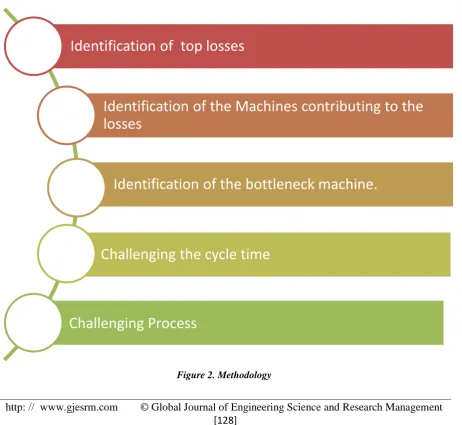
Figure 2. Methodology
Identification of top losses
Identification of the Machines contributing to the
losses
Identification of the bottleneck machine.
Challenging the cycle time
[Chougule* 4(9): September, 2017] ISSN 2349-4506
Impact Factor: 2.785
G
lobal
J
ournal of
E
ngineering
S
cience and
R
esearch
M
anagement
Design of ExperimentInitial Capability Analysis
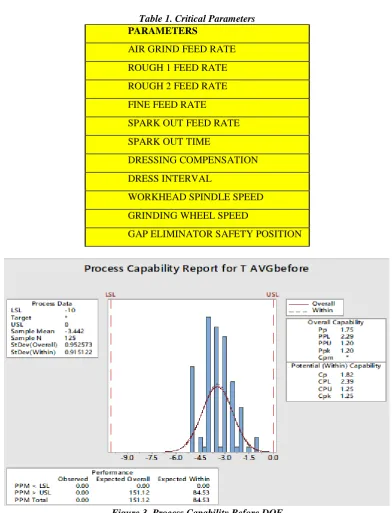
Rings were collected from the flex link conveyor immediately after grinding on Bore grinding machine continuously. These rings were measured on the gauges kept at the machine. Capability analysis were then conducted on each of these parameters in order to obtain the process capability and process performance according to the respective parameters. The parameters are as below. To find out whether process is stable or not. Process capabilities were also calculated using MINITAB software to get current Cp and Cpk and The graphs are shown below.
Table 1. Critical Parameters PARAMETERS
AIR GRIND FEED RATE
ROUGH 1 FEED RATE
ROUGH 2 FEED RATE
FINE FEED RATE
SPARK OUT FEED RATE
SPARK OUT TIME
DRESSING COMPENSATION
DRESS INTERVAL
WORKHEAD SPINDLE SPEED
GRINDING WHEEL SPEED
GAP ELIMINATOR SAFETY POSITION
[Chougule* 4(9): September, 2017] ISSN 2349-4506
Impact Factor: 2.785
G
lobal
J
ournal of
E
ngineering
S
cience and
R
esearch
M
anagement
As shown in above graph the Cp and Cpk for the bore grinding machine was 1.82 and 1.25 respectively.By considering both parameters the DOE were constructed using MINITAB by. It gave some number of run which had to be conducted on machine. The following table show the no. of run for selected parameters.
Table 2. DOE Plan for Bore Grinding Machine
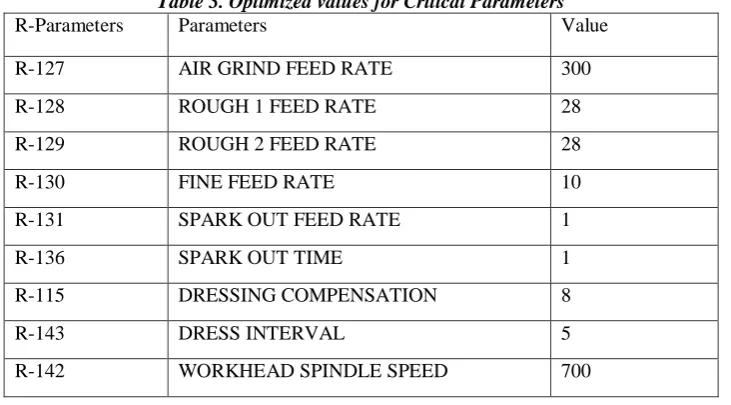
And from response optimizer final parameters were decided are below:
Table 3. Optimized values for Critical Parameters
R-Parameters Parameters Value
R-127 AIR GRIND FEED RATE 300
R-128 ROUGH 1 FEED RATE 28
R-129 ROUGH 2 FEED RATE 28
R-130 FINE FEED RATE 10
R-131 SPARK OUT FEED RATE 1
R-136 SPARK OUT TIME 1
R-115 DRESSING COMPENSATION 8
R-143 DRESS INTERVAL 5
[Chougule* 4(9): September, 2017] ISSN 2349-4506
Impact Factor: 2.785
G
lobal
J
ournal of
E
ngineering
S
cience and
R
esearch
M
anagement
R-153 GRINDING WHEEL SPEED 35000
R-102 GAP ELIMINATOR SAFETY POSITION 200
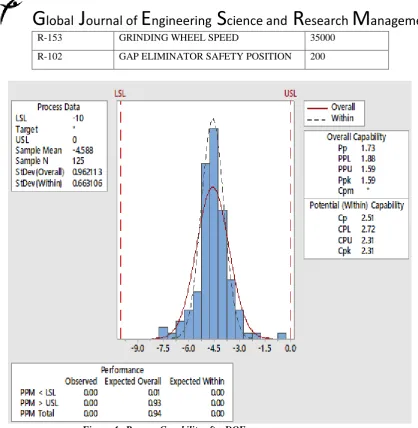
Figure 4. Process Capability after DOE
As shown in the above graphs, by applying optimized parameters the process is still stable and the capability also improved Cp=2.51 and Cpk=2.31.
[Chougule* 4(9): September, 2017] ISSN 2349-4506
Impact Factor: 2.785
G
lobal
J
ournal of
E
ngineering
S
cience and
R
esearch
M
anagement
RESULT AND DISCUSSION
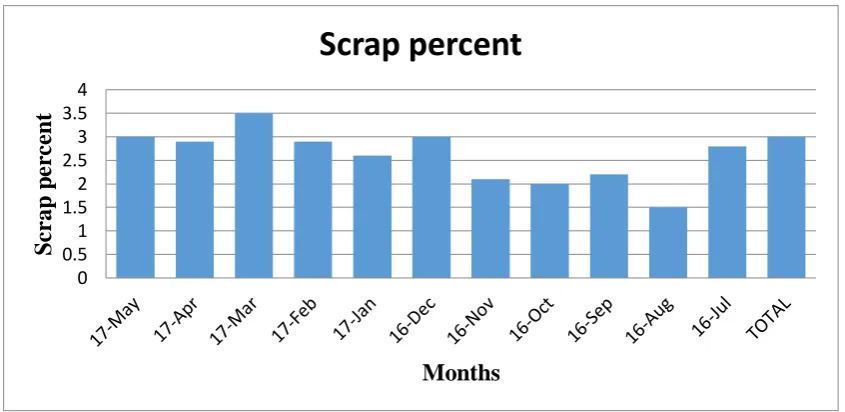
Figure 5 Scrap per Month
From above figure it is clearly indicating that scrap percentage is reduced up to average 3 %.
CONCLUSION
After the validation of result, we can conclude, the project for reduction in Scrap generation quantity from 4.3 % to 3 % by reducing Bore scrap generation is successful. It had many objectives, which has been completed and discussed below.
1. The causes for Scrap generation in bore grinding process were identified and accordingly, corrective actions were taken.
2. Productivity improved.
3. The Variation of process output was reduced.
4. The Capability of process was significantly improved. Before: Cp=1.82; Cpk= 1.25
After: Cp=2.51; Cpk= 2.31
5. Effective and desirable parameters are standardized for machine.
6. A Control Plan is made to combat the same problems if they arise in future.
REFERENCES
1. Md. Enamul Kabir, S. M. Mahbubul Islam Boby, Mostafa Lutfi, “Productivity Improvement by using Six-Sigma”, International Journal of Engineering and Technology Volume 3 No. 12, December, 2013 2. Behnam Nakhi, “The Challenges of Six Sigma in Improving Service Quality” International Journal of
quality and reliability management Vol.26 No7, 2009
3. Dayanand Yadav “Study of Productivity Improvement Using Lean Six Sigma Methodology” journal of International review of applied engineering Research, 2014
4. Tapan Bagchi “Justifying six sigma project in manufacturing management” NMIMS Management Review,2012
5. Adrian Pugnaa*, Romeo Negreaa, Serban Micleaa, “Using Six Sigma Methodology to Improve the Assembly Process in an Automotive Company” Elsevier 13 international symposium in management, 2016
6. Jeroen de Mast n, Joran Lokkerbol, “An analysis of the Six Sigma DMAIC method from the perspective of problem solving”, Int. J. Production Economics 139 ,2012